PRIMITIVE TYPES IN
JAVA
Primitive Types
Operations on Primitive Types
Review of Binary Numbers
• Numbering systems
• Counting in Decimal
• Counting in Binary
• Counting in Hexadecimal
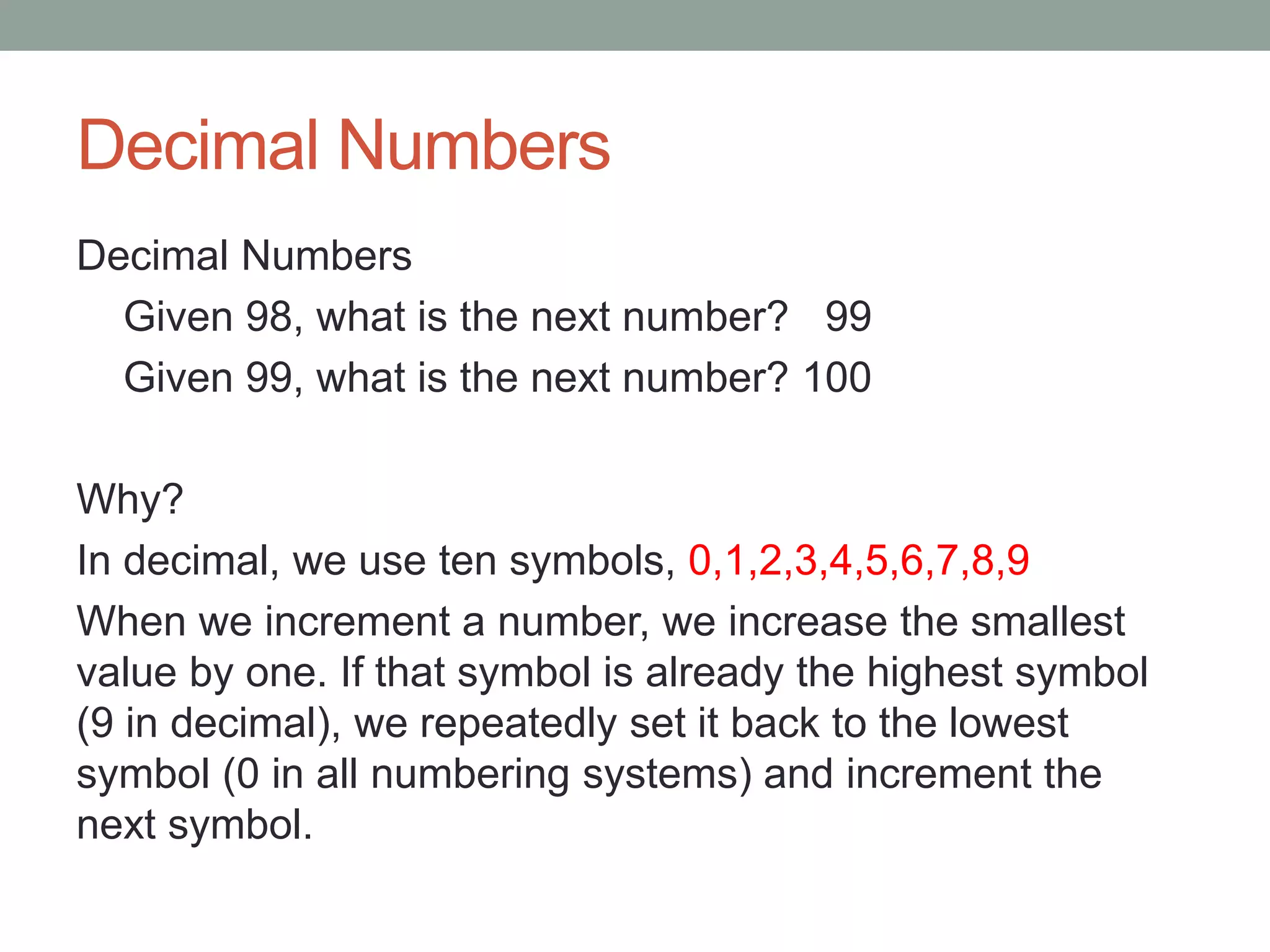
Decimal Numbers
Decimal Numbers
Given 98, what is the next number? 99
Given 99, what is the next number? 100
Why?
In decimal, we use ten symbols, 0,1,2,3,4,5,6,7,8,9
When we increment a number, we increase the smallest
value by one. If that symbol is already the highest symbol
(9 in decimal), we repeatedly set it back to the lowest
symbol (0 in all numbering systems) and increment the
next symbol.
Binary Numbers
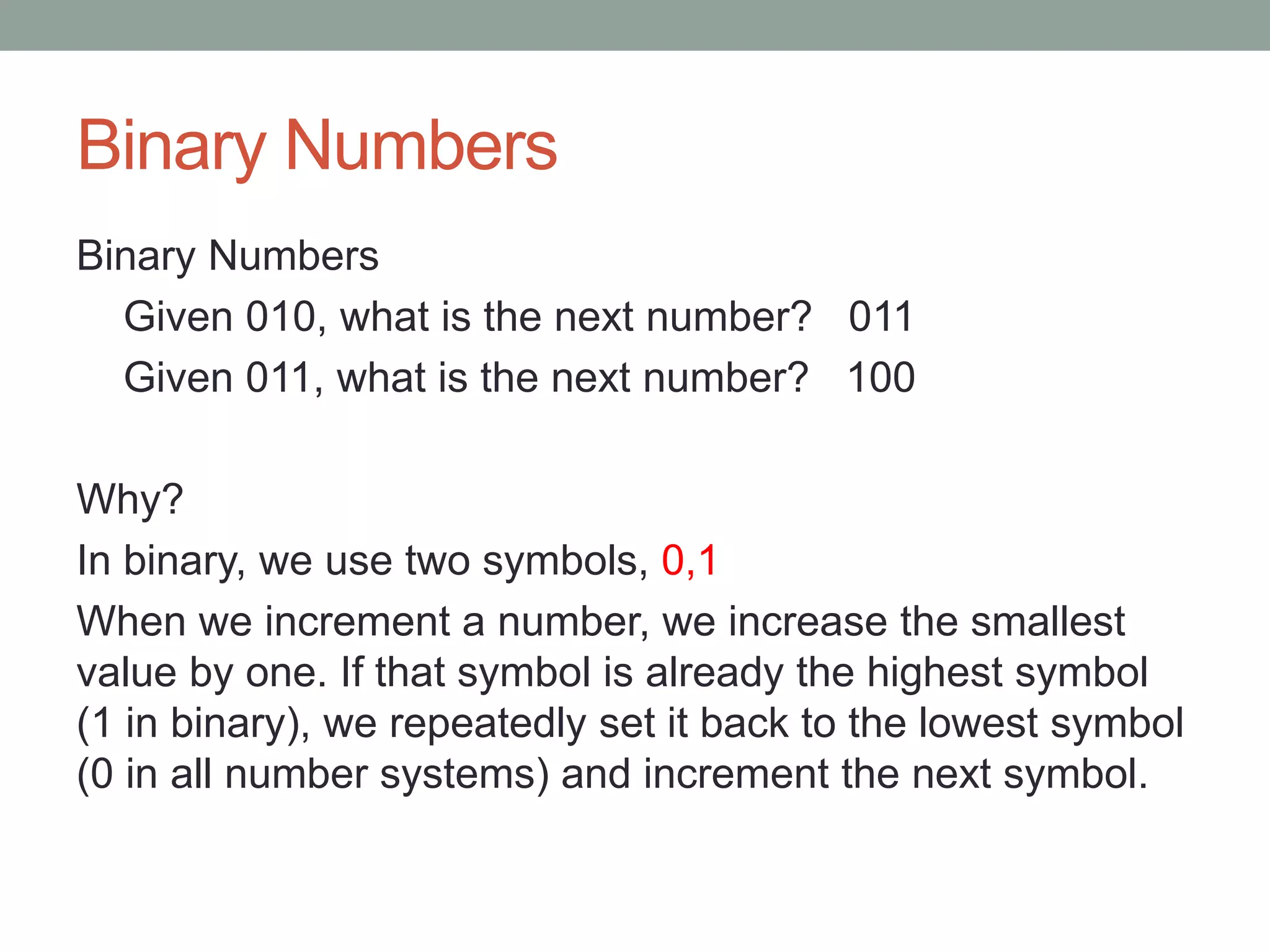
Binary Numbers
Given 010, what is the next number? 011
Given 011, what is the next number? 100
Why?
In binary, we use two symbols, 0,1
When we increment a number, we increase the smallest
value by one. If that symbol is already the highest symbol
(1 in binary), we repeatedly set it back to the lowest symbol
(0 in all number systems) and increment the next symbol.
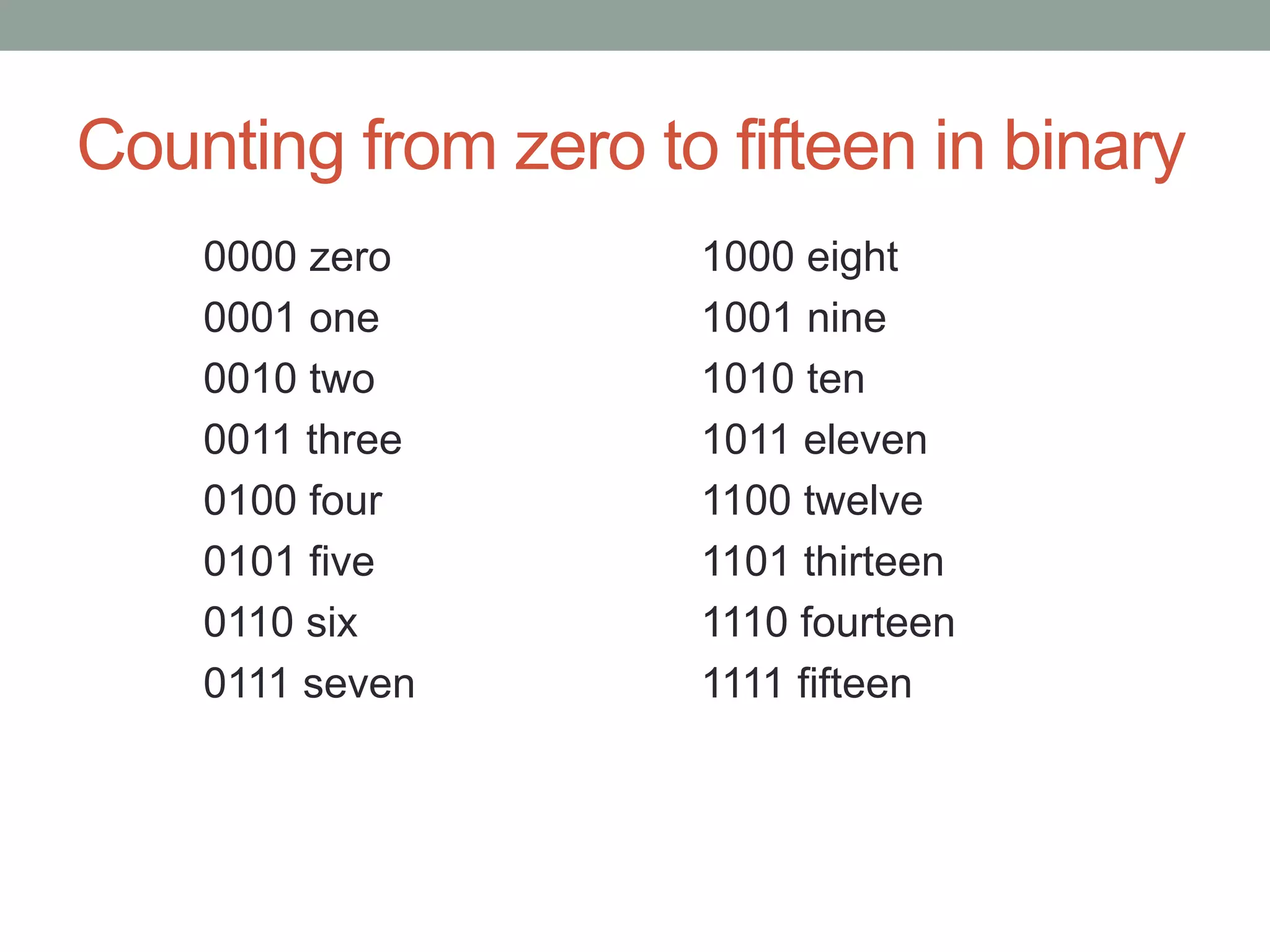
Counting from zero to fifteen in binary
0000 zero
0001 one
0010 two
0011 three
0100 four
0101 five
0110 six
0111 seven
1000 eight
1001 nine
1010 ten
1011 eleven
1100 twelve
1101 thirteen
1110 fourteen
1111 fifteen
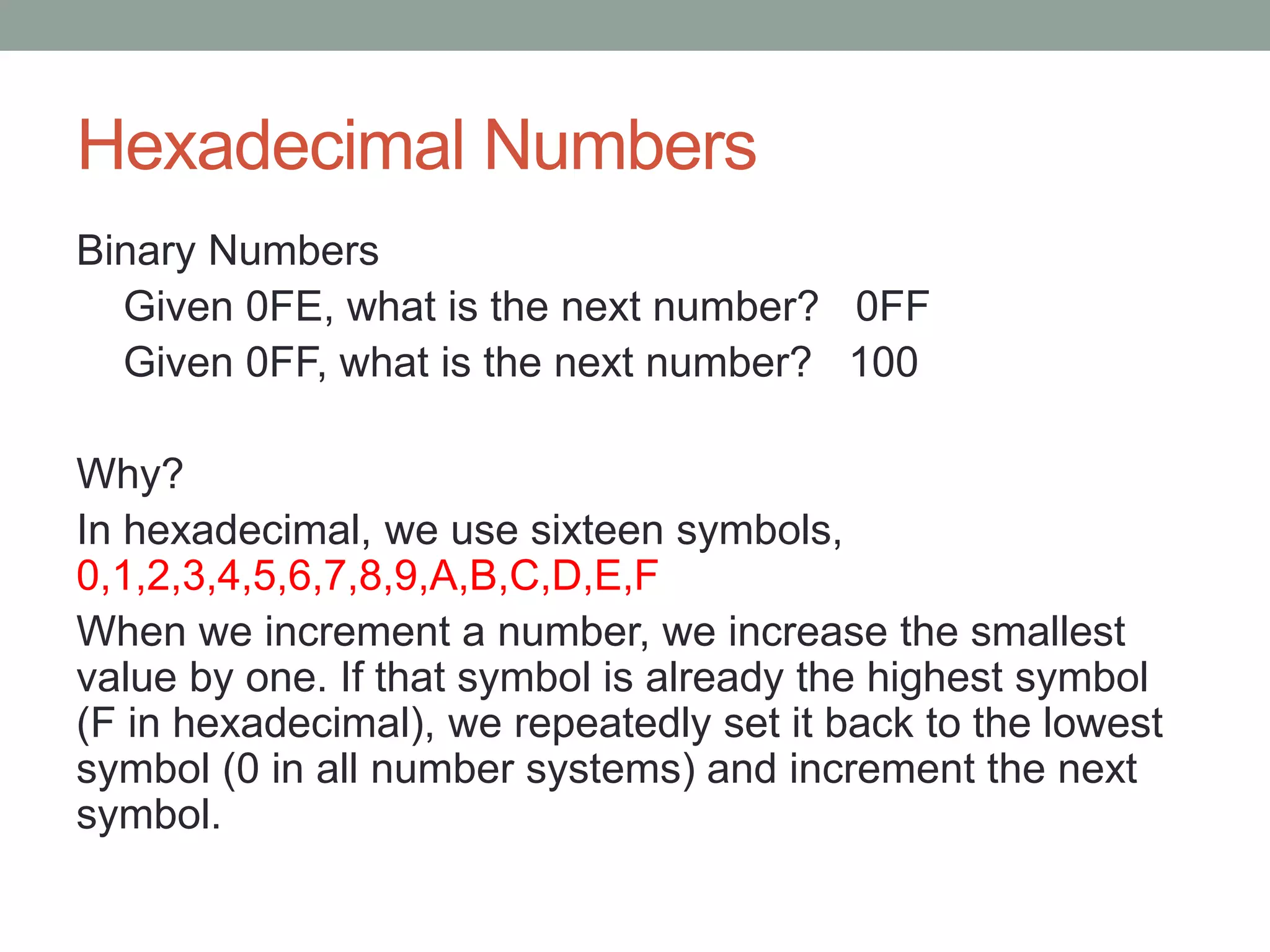
Hexadecimal Numbers
Binary Numbers
Given 0FE, what is the next number? 0FF
Given 0FF, what is the next number? 100
Why?
In hexadecimal, we use sixteen symbols,
0,1,2,3,4,5,6,7,8,9,A,B,C,D,E,F
When we increment a number, we increase the smallest
value by one. If that symbol is already the highest symbol
(F in hexadecimal), we repeatedly set it back to the lowest
symbol (0 in all number systems) and increment the next
symbol.
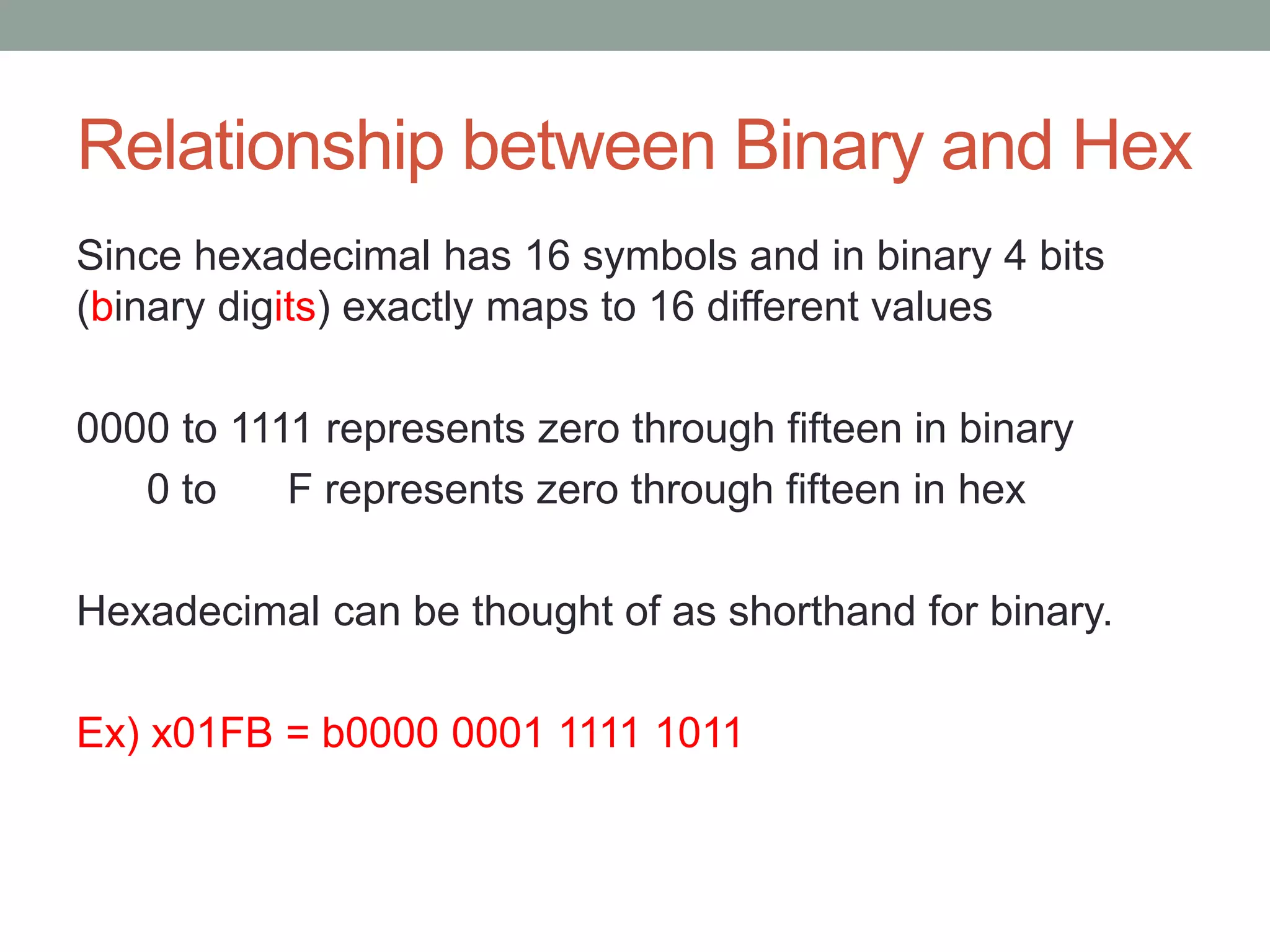
Relationship between Binary and Hex
Since hexadecimal has 16 symbols and in binary 4 bits
(binary digits) exactly maps to 16 different values
0000 to 1111 represents zero through fifteen in binary
0 to F represents zero through fifteen in hex
Hexadecimal can be thought of as shorthand for binary.
Ex) x01FB = b0000 0001 1111 1011
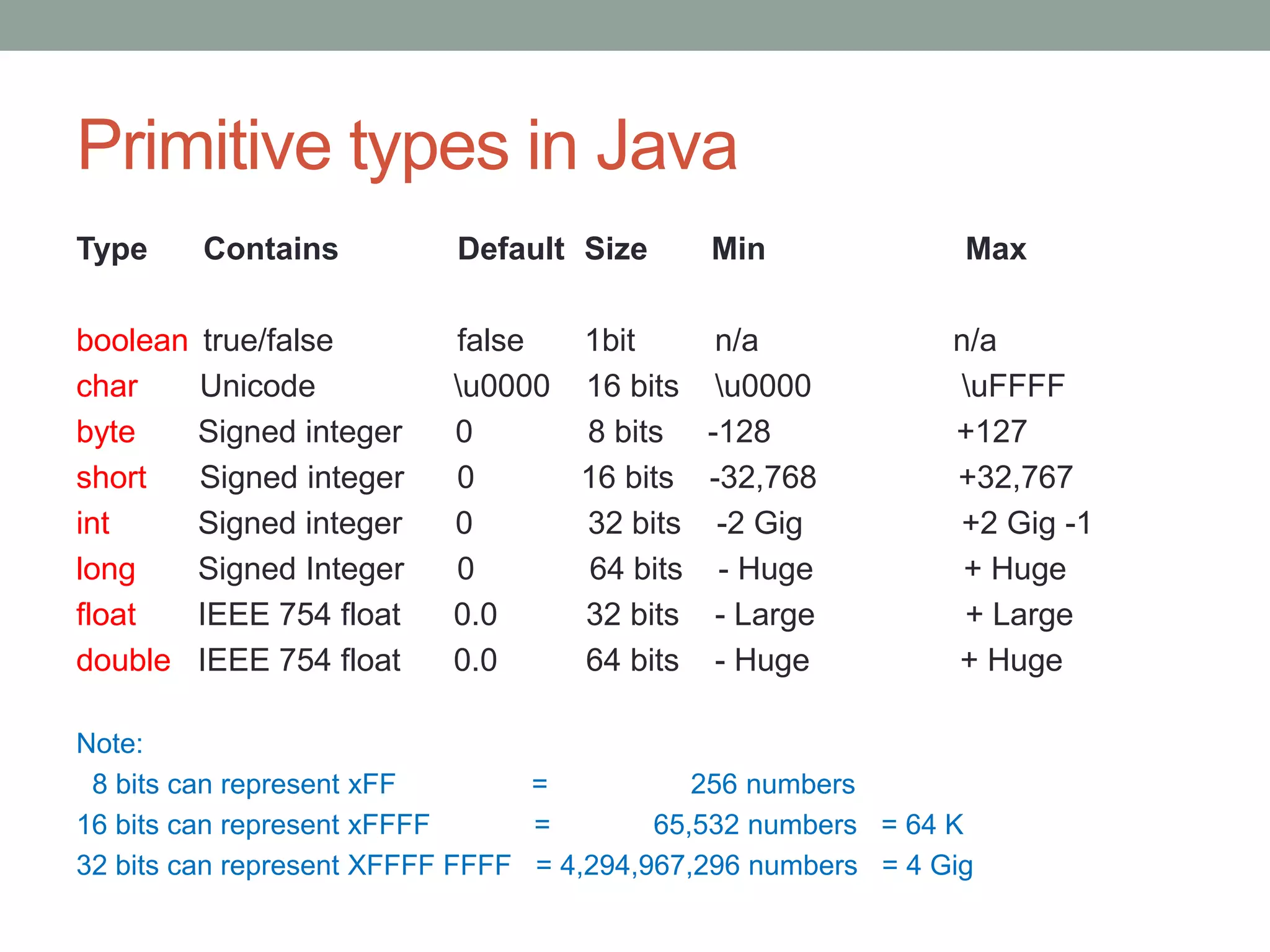
Primitive types in Java
Type Contains Default Size Min Max
boolean true/false false 1bit n/a n/a
char Unicode u0000 16 bits u0000 uFFFF
byte Signed integer 0 8 bits -128 +127
short Signed integer 0 16 bits -32,768 +32,767
int Signed integer 0 32 bits -2 Gig +2 Gig -1
long Signed Integer 0 64 bits - Huge + Huge
float IEEE 754 float 0.0 32 bits - Large + Large
double IEEE 754 float 0.0 64 bits - Huge + Huge
Note:
8 bits can represent xFF = 256 numbers
16 bits can represent xFFFF = 65,532 numbers = 64 K
32 bits can represent XFFFF FFFF = 4,294,967,296 numbers = 4 Gig
JAVA character codes
• Dec Char Dec Char Dec Char Dec Char
• --------- --------- --------- ----------
• 0 NUL (null) 32 SPACE 64 @ 96 `
• 1 SOH (start of heading) 33 ! 65 A 97 a
• 2 STX (start of text) 34 " 66 B 98 b
• 3 ETX (end of text) 35 # 67 C 99 c
• 4 EOT (end of transmission) 36 $ 68 D 100 d
• 5 ENQ (enquiry) 37 % 69 E 101 e
• 6 ACK (acknowledge) 38 & 70 F 102 f
• 7 BEL (bell) 39 ' 71 G 103 g
• 8 BS (backspace) 40 ( 72 H 104 h
• 9 TAB (horizontal tab) 41 ) 73 I 105 i
• 10 LF (NL line feed, new line) 42 * 74 J 106 j
• 11 VT (vertical tab) 43 + 75 K 107 k
• 12 FF (NP form feed, new page) 44 , 76 L 108 l
• 13 CR (carriage return) 45 - 77 M 109 m
• 14 SO (shift out) 46 . 78 N 110 n
• 15 SI (shift in) 47 / 79 O 111 o
• 16 DLE (data link escape) 48 0 80 P 112 p
• 17 DC1 (device control 1) 49 1 81 Q 113 q
• 18 DC2 (device control 2) 50 2 82 R 114 r
• 19 DC3 (device control 3) 51 3 83 S 115 s
• 20 DC4 (device control 4) 52 4 84 T 116 t
• 21 NAK (negative acknowledge) 53 5 85 U 117 u
• 22 SYN (synchronous idle) 54 6 86 V 118 v
• 23 ETB (end of trans. block) 55 7 87 W 119 w
• 24 CAN (cancel) 56 8 88 X 120 x
• 25 EM (end of medium) 57 9 89 Y 121 y
• 26 SUB (substitute) 58 : 90 Z 122 z
• 27 ESC (escape) 59 ; 91 [ 123 {
• 28 FS (file separator) 60 < 92  124 |
• 29 GS (group separator) 61 = 93 ] 125 }
• 30 RS (record separator) 62 > 94 ^ 126 ~
• 31 US (unit separator) 63 ? 95 _ 127 DEL
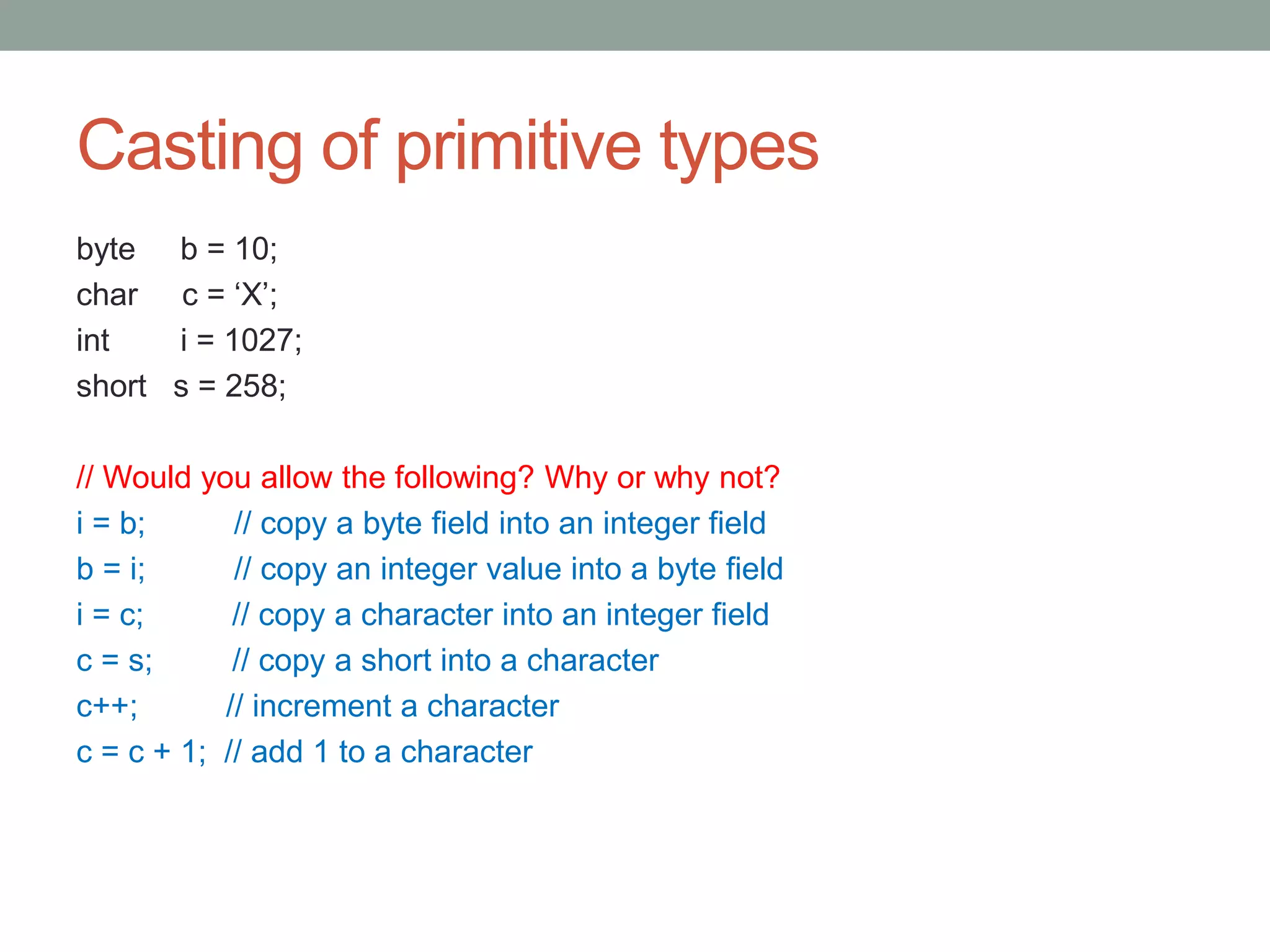
Casting of primitive types
byte b = 10;
char c = ‘X’;
int i = 1027;
short s = 258;
// Would you allow the following? Why or why not?
i = b; // copy a byte field into an integer field
b = i; // copy an integer value into a byte field
i = c; // copy a character into an integer field
c = s; // copy a short into a character
c++; // increment a character
c = c + 1; // add 1 to a character

javaPrimitiveTypes.pptx

  • 1.
    PRIMITIVE TYPES IN JAVA PrimitiveTypes Operations on Primitive Types
  • 2.
    Review of BinaryNumbers • Numbering systems • Counting in Decimal • Counting in Binary • Counting in Hexadecimal
  • 3.
    Decimal Numbers Decimal Numbers Given98, what is the next number? 99 Given 99, what is the next number? 100 Why? In decimal, we use ten symbols, 0,1,2,3,4,5,6,7,8,9 When we increment a number, we increase the smallest value by one. If that symbol is already the highest symbol (9 in decimal), we repeatedly set it back to the lowest symbol (0 in all numbering systems) and increment the next symbol.
  • 4.
    Binary Numbers Binary Numbers Given010, what is the next number? 011 Given 011, what is the next number? 100 Why? In binary, we use two symbols, 0,1 When we increment a number, we increase the smallest value by one. If that symbol is already the highest symbol (1 in binary), we repeatedly set it back to the lowest symbol (0 in all number systems) and increment the next symbol.
  • 5.
    Counting from zeroto fifteen in binary 0000 zero 0001 one 0010 two 0011 three 0100 four 0101 five 0110 six 0111 seven 1000 eight 1001 nine 1010 ten 1011 eleven 1100 twelve 1101 thirteen 1110 fourteen 1111 fifteen
  • 6.
    Hexadecimal Numbers Binary Numbers Given0FE, what is the next number? 0FF Given 0FF, what is the next number? 100 Why? In hexadecimal, we use sixteen symbols, 0,1,2,3,4,5,6,7,8,9,A,B,C,D,E,F When we increment a number, we increase the smallest value by one. If that symbol is already the highest symbol (F in hexadecimal), we repeatedly set it back to the lowest symbol (0 in all number systems) and increment the next symbol.
  • 7.
    Relationship between Binaryand Hex Since hexadecimal has 16 symbols and in binary 4 bits (binary digits) exactly maps to 16 different values 0000 to 1111 represents zero through fifteen in binary 0 to F represents zero through fifteen in hex Hexadecimal can be thought of as shorthand for binary. Ex) x01FB = b0000 0001 1111 1011
  • 8.
    Primitive types inJava Type Contains Default Size Min Max boolean true/false false 1bit n/a n/a char Unicode u0000 16 bits u0000 uFFFF byte Signed integer 0 8 bits -128 +127 short Signed integer 0 16 bits -32,768 +32,767 int Signed integer 0 32 bits -2 Gig +2 Gig -1 long Signed Integer 0 64 bits - Huge + Huge float IEEE 754 float 0.0 32 bits - Large + Large double IEEE 754 float 0.0 64 bits - Huge + Huge Note: 8 bits can represent xFF = 256 numbers 16 bits can represent xFFFF = 65,532 numbers = 64 K 32 bits can represent XFFFF FFFF = 4,294,967,296 numbers = 4 Gig
  • 9.
    JAVA character codes •Dec Char Dec Char Dec Char Dec Char • --------- --------- --------- ---------- • 0 NUL (null) 32 SPACE 64 @ 96 ` • 1 SOH (start of heading) 33 ! 65 A 97 a • 2 STX (start of text) 34 " 66 B 98 b • 3 ETX (end of text) 35 # 67 C 99 c • 4 EOT (end of transmission) 36 $ 68 D 100 d • 5 ENQ (enquiry) 37 % 69 E 101 e • 6 ACK (acknowledge) 38 & 70 F 102 f • 7 BEL (bell) 39 ' 71 G 103 g • 8 BS (backspace) 40 ( 72 H 104 h • 9 TAB (horizontal tab) 41 ) 73 I 105 i • 10 LF (NL line feed, new line) 42 * 74 J 106 j • 11 VT (vertical tab) 43 + 75 K 107 k • 12 FF (NP form feed, new page) 44 , 76 L 108 l • 13 CR (carriage return) 45 - 77 M 109 m • 14 SO (shift out) 46 . 78 N 110 n • 15 SI (shift in) 47 / 79 O 111 o • 16 DLE (data link escape) 48 0 80 P 112 p • 17 DC1 (device control 1) 49 1 81 Q 113 q • 18 DC2 (device control 2) 50 2 82 R 114 r • 19 DC3 (device control 3) 51 3 83 S 115 s • 20 DC4 (device control 4) 52 4 84 T 116 t • 21 NAK (negative acknowledge) 53 5 85 U 117 u • 22 SYN (synchronous idle) 54 6 86 V 118 v • 23 ETB (end of trans. block) 55 7 87 W 119 w • 24 CAN (cancel) 56 8 88 X 120 x • 25 EM (end of medium) 57 9 89 Y 121 y • 26 SUB (substitute) 58 : 90 Z 122 z • 27 ESC (escape) 59 ; 91 [ 123 { • 28 FS (file separator) 60 < 92 124 | • 29 GS (group separator) 61 = 93 ] 125 } • 30 RS (record separator) 62 > 94 ^ 126 ~ • 31 US (unit separator) 63 ? 95 _ 127 DEL
  • 10.
    Casting of primitivetypes byte b = 10; char c = ‘X’; int i = 1027; short s = 258; // Would you allow the following? Why or why not? i = b; // copy a byte field into an integer field b = i; // copy an integer value into a byte field i = c; // copy a character into an integer field c = s; // copy a short into a character c++; // increment a character c = c + 1; // add 1 to a character