CORDAID- COMMUNITY MANAGED DISASTER RISK
   REDUCTION CMDRR APPROACH/CLIMATE CHANGE
                 ADAPTATION

            PRESENTATION MADE AT

STRENGTHENING CLIMATE RESILIENCE (SCR PROJECT)-
               KENYA WORKSHOP

                 30th MARCH 2010

                 BY: SAFIA ABDI
ABOUT CORDAID
 Catholic Organization for Relief and Development Aid
    [Cordaid]
   Formed in 1999- merger of 3 organization- Caritas
    Netherlands, Memisa, and Dutch Bishop Lenten
    Campaign
   International relief and development NGO
   Hq- The Hague- Netherlands
   Works in 36 countries with over 1000 partners- in
    Africa, Asia, Latin America
   Partners/donors: Dutch Ministry of Development
    Cooperation, EU, Dutch public…
PROGRAMME AREAS

Four sectors and 10 programmes
 Participation- identity and diversity, slum
  dwellers and women and violence (Kenya)
 Emergency aid and reconstruction (Kenya)
 Health and well-being
 entrepreneurship
Emergency aid and reconstruction
sector- in Kenya
 Implemented in the pastoralist areas- active
  in Moyale, Mandera, Isiolo, Samburu, Isiolo
  and Marsabit
 DRR/CCA and emergency activities
  supported
 Focus on drought as a hazard but others-
  conflict management, floods, livestock
  disease...shaped by PDRA and analysis
 Combine drought cycle management and
  DRR/CCA approaches and strategies
Definition of key terms
 Disaster Risk reduction: The concept and practice
  of reducing disaster risks through systematic efforts
  to analyze and manage the causal factors of
  disasters, including through reduced exposure to
  hazards, lessened vulnerability of people and
  property, wise management of land and the
  environment, and improved preparedness for
  adverse events.
 Adaptation: Adjustment in natural and human
  systems in response to actual or expected climatic
  stimuli or their effects, which moderates harm or
  exploits beneficial opportunities –various types –
  anticipatory, autonomous and planned
CCA and DRR
 With climate change- frequency and intensity of Hazard
    increases
   Record shows increase in disaster events- affect sustainable
    development and growth of nations and communities.
   With CC there are opportunities and risks- Adaptation-
    addressing risk, turn opportunities into assets
   Adaptation and DRR both aim at reducing impacts of hazards-
    anticipating risks, reducing vulnerabilities and increasing
    capacities.
   CC is science based while DRR is based on past experiences.
    CCA intervention planning need to take into consideration the
    various future scenarios based on the science
CMDRR Approach

Hazard ≠ Disaster
Hazard can be natural and man made but
  disasters are caused by hazard when it
  interact with human condition ( exposure and
  lack of capacity to cope).
Disaster Risk = Hazard x Vulnerability
                            Capacity
CMDRR continued
Core Principles of CMDRR
 Communities manage DRR process
 Development organizations’ role is facilitation ( not
  solution providers) and employees are learning
  agents and not change agents
 DRR is multi-stakeholder process and facilitation
  done through multi-agency approach ( broad based
  partnership )
 DRR best done through multi-hazard approach
 Effective community organization is the foundation of
  CMDRR
 MEL & ADVOCACY an integral part of CMDRR.
CMDRR PROCESS
                                        Inputs :

  Tools, facilitators, community members
          knowledge & skills, time


                 PDRA
  Hazard, vulnerability and capacity assessment
               Risk analysis
         Conclusion on risk levels                  Processing
         Accept risk level or relocate elements                    Monitoring
         At risk if risk level is not acceptable                   Evaluation &
         Identify and prioritize what Needs to
                                                                   Learning
          be done
          Set DRR goals and objectives


                  Community Development plan
Contingency                                             Outputs
                     Hazard mitigation/prevention
plan
                     Strengthening systems/organ.
                      Livelihood enhancement          Community organization
                     Capacity building                responsible for
     Community Risk Reduction Plan                    implementation of DRR plan
Examples of DRR/CCA projects
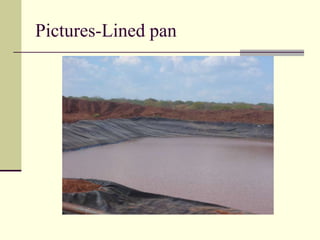
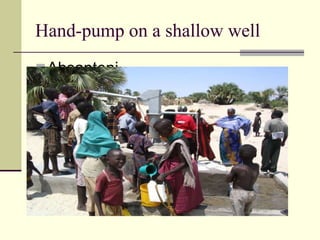
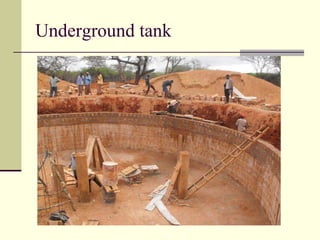
 Rain water harvesting- underground tanks, pans roof
    catchments – to reduce evaporation due increased temperature
    pans lined, tanks are masonry. Some communities in Marsabit
    (e.g Forolle and Balesa now have water throughout the year).
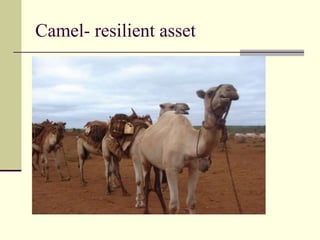
   Herd diversification- introduction of camels- more resilient.
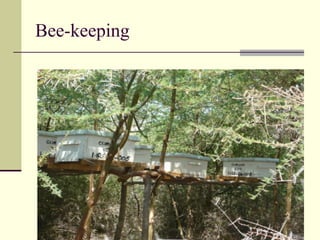
   Livelihood diversification- fish farming, commercial insect-
    partnership with ICIPE.
   Peace-building efforts to counter resource based conflict.
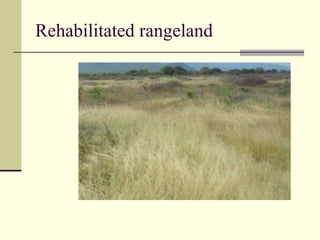
   Rangeland rehabilitation- revival of good indigenous practices of
    rangeland mgt eg kalo system, rid off invasive species
   Communities have autonomously adapted to some extent
   Capacity building of communities, local level stakeholders eg
    government, CBOs, NGOs, various committees
Pictures-Lined pan
Hand-pump on a shallow well
 Ahsanteni
Underground tank
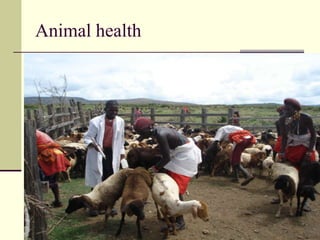
Animal health
Bee-keeping
Camel- resilient asset
Rehabilitated rangeland
Others activities
 Policy influencing/Lobby and advocacy –
  local, national and International level.
 International level advocacy through CIDSE
 Linking and learning- through workshops,
  publications, working with coalitions,
  universities
 Capacity building of partner organizations,
  government departments and communities
  on CMDRR and climate change.
Future plans- (2010 onwards.
 Using scientific information, develop climate
  scenarios and plan intervention based on
  that.
 Of course continue to develop interventions
  using experiences.
 Use traditional knowledge.
 Mainstream CC in all our programme-
 Thank you.