Including NRM and environmental
impacts within ACIAR impact
assessments
Methodological issues

September 2012

David Pearce
WorldFish NRM Workshop, Penang


                                 www.TheCIE.com.au
Themes
     Concerned with incorporating NRM/environment
     within extended BCA framework, as used for
     ACIAR IAS
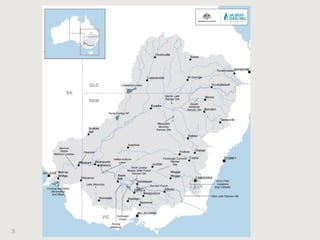
     MDB Plan major influence on thinking
     Maintain consistency with surplus measures
     ■   But not precluding other measures


2
3
4
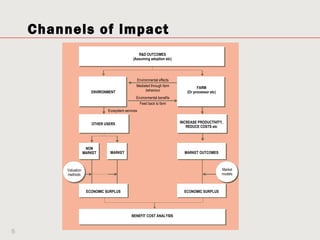
Channels of impact
                                                  R&D OUTCOMES
                                               (Assuming adoption etc)


                                                 Environmental effects
                                                 Mediated through farm             FARM
                        ENVIRONMENT                    behaviour             (Or processor etc)
                                                 Environmental benefits
                                                   Feed back to farm
                                Ecosystem services


                        OTHER USERS                                       INCREASE PRODUCTIVITY,
                                                                             REDUCE COSTS etc


                      NON
                     MARKET      MARKET                                     MARKET OUTCOMES


         Valuation                                                                                Market
         methods                                                                                  models


                      ECONOMIC SURPLUS                                      ECONOMIC SURPLUS


                                              BENEFIT COST ANALYSIS


5
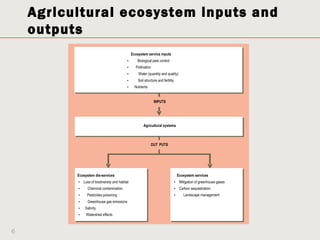
Agricultural ecosystem inputs and                                                                       1


    outputs
                                               Ecosystem service inputs
                                           •       Biological pest control
                                           •     Pollination
                                           •       Water (quantity and quality)
                                           •       Soil structure and fertility
                                           •     Nutrients


                                                               INPUTS


                                                       Agricultural systems


                                                             OUT PUTS


          Ecosystem dis-services                                                      Ecosystem services
          • Loss of biodiversity and habitat                                      • Mitigation of greenhouse gases
          •     Chemical contamination                                            • Carbon sequestration
          •    Pesticides poisoning                                               •      Landscape management
          •     Greenhouse gas emissions
          •   Salinity
          •    Watershed effects


6
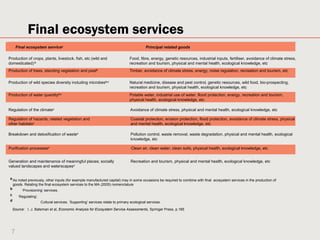
Final ecosystem services
      Final ecosystem servicea                                                               Principal related goods

Production of crops, plants, livestock, fish, etc (wild and                       Food, fibre, energy, genetic resources, industrial inputs, fertiliser, avoidance of climate stress,
domesticated) b                                                                   recreation and tourism, physical and mental health, ecological knowledge, etc
Production of trees, standing vegetation and peatb                                Timber, avoidance of climate stress, energy, noise regulation, recreation and tourism, etc

Production of wild species diversity including microbes b,c                       Natural medicine, disease and pest control, genetic resources, wild food, bio-prospecting,
                                                                                  recreation and tourism, physical health, ecological knowledge, etc
Production of water quantityb,c                                                   Potable water, industrial use of water, flood protection, energy, recreation and tourism,
                                                                                  physical health, ecological knowledge, etc

Regulation of the climatec                                                        Avoidance of climate stress, physical and mental health, ecological knowledge, etc

Regulation of hazards; related vegetation and                                      Coastal protection, erosion protection, flood protection, avoidance of climate stress, physical
other habitatsc                                                                    and mental health, ecological knowledge, etc

Breakdown and detoxification of wastec                                             Pollution control, waste removal, waste degradation, physical and mental health, ecological
                                                                                   knowledge, etc

Purification processesc                                                            Clean air, clean water, clean soils, physical health, ecological knowledge, etc


Generation and maintenance of meaningful places; socially                          Recreation and tourism, physical and mental health, ecological knowledge, etc
valued landscapes and waterscapesd


 a As noted previously, other inputs (for example manufactured capital) may in some occasions be required to combine with final ecosystem services in the production of
   goods. Relating the final ecosystem services to the MA (2005) nomenclature
 b      ‘Provisioning’ services.
 c      ‘Regulating’.
 d                      Cultural services. ‘Supporting’ services relate to primary ecological services.

     Source: I. J. Bateman et al, Economic Analysis for Ecosystem Service Assessments, Springer Press, p.185


 7
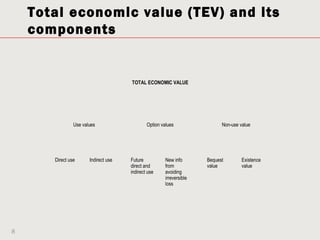
Total economic value (TEV) and its
    components


                                      TOTAL ECONOMIC VALUE


                Use values                    Option values                Non-use value


       Direct use      Indirect use   Future          New info       Bequest        Existence
                                      direct and      from           value          value
                                      indirect use    avoiding
                                                      irreversible
                                                      loss


8
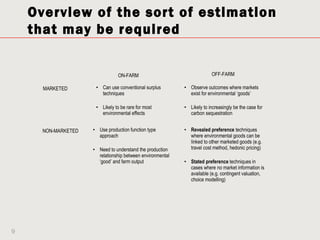
Overview of the sort of estimation
    that may be required


                                 ON-FARM                                  OFF-FARM

      MARKETED        • Can use conventional surplus        • Observe outcomes where markets
                        techniques                            exist for environmental ‘goods’

                      • Likely to be rare for most          • Likely to increasingly be the case for
                        environmental effects                 carbon sequestration


      NON-MARKETED   • Use production function type         • Revealed preference techniques
                       approach                               where environmental goods can be
                                                              linked to other marketed goods (e.g.
                     • Need to understand the production      travel cost method, hedonic pricing)
                       relationship between environmental
                       ‘good’ and farm output               • Stated preference techniques in
                                                              cases where no market information is
                                                              available (e.g. contingent valuation,
                                                              choice modelling)


9
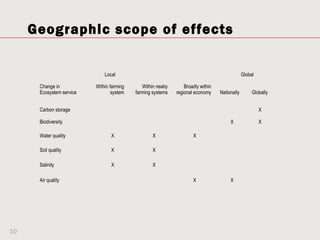
Geographic scope of effects

                              Local                                                            Global

      Change in           Within farming      Within neaby       Broadly within
      Ecosystem service           system   farming systems   regional economy     Nationally        Globally


      Carbon storage                                                                                    X

      Biodiversity                                                                     X                X

      Water quality              X                X                  X

      Soil quality               X                X

      Salinity                   X                X

      Air quality                                                    X                 X


10
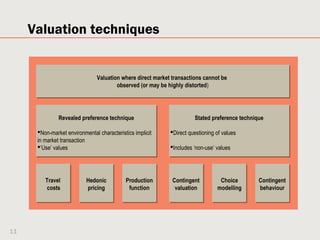
Valuation techniques


                                Valuation where direct market transactions cannot be
                                Valuation where direct market transactions cannot be
                                        observed (or may be highly distorted)
                                        observed (or may be highly distorted)


               Revealed preference technique                           Stated preference technique

      Non-market environmental characteristics implicit     Direct questioning of values
      in market transaction
      ‘Use’ values                                          Includes ‘non-use’ values


         Travel            Hedonic          Production        Contingent          Choice        Contingent
         costs             pricing           function          valuation         modelling      behaviour


11
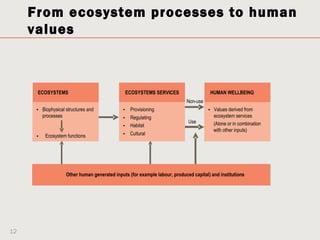
From ecosystem processes to human
     values


      ECOSYSTEMS                                  ECOSYSTEMS SERVICES                  HUMAN WELLBEING
                                                                            Non-use
      • Biophysical structures and            •    Provisioning                       • Values derived from
        processes                             •    Regulating                           ecosystem services
                                                                             Use        (Alone or in combination
                                              •    Habitat
                                                                                        with other inputs)
      •   Ecosystem functions                 • Cultural


                    Other human generated inputs (for example labour, produced capital) and institutions


12
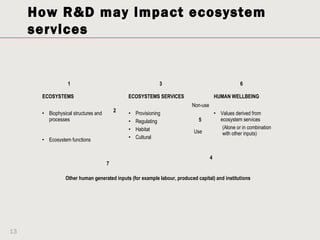
How R&D may impact ecosystem
     services


                  1                                         3                                      6

      ECOSYSTEMS                             ECOSYSTEMS SERVICES                       HUMAN WELLBEING
                                                                         Non-use
      • Biophysical structures and       2   •   Provisioning                          • Values derived from
        processes                            •   Regulating                 5            ecosystem services
                                             •   Habitat                                  (Alone or in combination
                                                                          Use             with other inputs)
      • Ecosystem functions                  •   Cultural


                                                                                   4
                                     7

                Other human generated inputs (for example labour, produced capital) and institutions


13
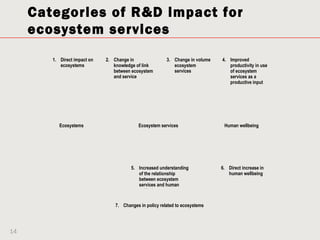
Categories of R&D impact for
     ecosystem services
        1. Direct impact on   2. Change in                3. Change in volume   4. Improved
           ecosystems            knowledge of link           ecosystem             productivity in use
                                 between ecosystem           services              of ecosystem
                                 and service                                       services as a
                                                                                   productive input


           Ecosystems                       Ecosystem services                   Human wellbeing


                                         5. Increased understanding             6. Direct increase in
                                            of the relationship                    human wellbeing
                                            between ecosystem
                                            services and human
                                            wellbeing

                                  7. Changes in policy related to ecosystems


14
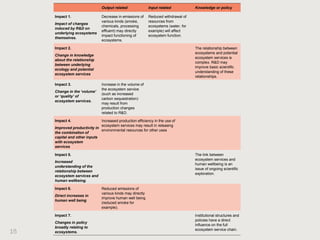
Output related               Input related            Knowledge or policy

     Impact 1.                  Decrease in emissions of     Reduced withdrawal of
                                various kinds (smoke,        resources from
     Impact of changes
                                chemicals, processing        ecosystems (water, for
     induced by R&D on
                                effluent) may directly       example) will affect
     underlying ecosystems
                                impact functioning of        ecosystem function.
     themselves.
                                ecosystems.

     Impact 2.                                                                        The relationship between
                                                                                      ecosystems and potential
     Change in knowledge
                                                                                      ecosystem services is
     about the relationship
                                                                                      complex. R&D may
     between underlying
                                                                                      improve basic scientific
     ecology and potential
                                                                                      understanding of these
     ecosystem services
                                                                                      relationships.

     Impact 3.                  Increase in the volume of
                                the ecosystem service
     Change in the ‘volume’
                                (such as increased
     or ‘quality’ of
                                carbon sequestration)
     ecosystem services.
                                may result from
                                production changes
                                related to R&D.

     Impact 4.                Increased production efficiency in the use of
                              ecosystem services may result in releasing
     Improved productivity in
                              environmental resources for other uses
     the combination of
     capital and other inputs
     with ecosystem
     services

     Impact 5.                                                                        The link between
                                                                                      ecosystem services and
     Increased
                                                                                      human wellbeing is an
     understanding of the
                                                                                      issue of ongoing scientific
     relationship between
                                                                                      exploration.
     ecosystem services and
     human wellbeing.

     Impact 6.                  Reduced emissions of
                                various kinds may directly
     Direct increases in
                                improve human well being
     human well being
                                (reduced smoke for
                                example).

     Impact 7.                                                                        Institutional structures and
                                                                                      policies have a direct
     Changes in policy
                                                                                      influence on the full
     broadly relating to
                                                                                      ecosystem service chain.
15   ecosystems.
Frequency of impact categories for ACIAR
      projects
                                                        41%


                                        24%
                                                                                                          20%


         11%


                         3%                                                                2%
                                                                           0%

     1. Impact on    2. Change in    3. Change in    4. Improved       5. Increased      6. Direct    7. Changes in
      underlying      knowledge:       volume of    productivity in   understanding: increase in well     policy
      ecosystem       ecology to      ecosystem         use of          ecosystem          being
                      ecosystem         service      ecosystem           service to
                        service                        services          wellbeing
     Based on desktop analysis of 356 ACIAR projects considered to have some NRM impact
     Shares apply to 260 of these projects where extended BCA was considered necessary
16
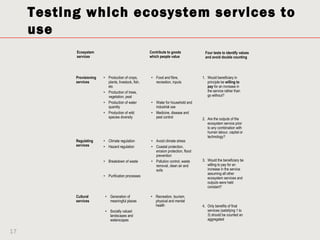
Testing which ecosystem services to
     use
           Ecosystem                                   Contribute to goods            Four tests to identify values
           services                                    which people value             and avoid double counting


           Provisioning   • Production of crops,       • Food and fibre,             1. Would beneficiary in
           services         plants, livestock, fish,     recreation, inputs             principle be willing to
                            etc                                                         pay for an increase in
                          • Production of trees,                                        the service rather than
                            vegetation, peat                                            go without?
                          • Production of water        • Water for household and
                            quantity                     industrial use
                          • Production of wild         • Medicine, disease and
                            species diversity            pest control                2. Are the outputs of the
                                                                                        ecosystem service prior
                                                                                        to any combination with
                                                                                        human labour, capital or
                                                                                        technology?
           Regulating     • Climate regulation         • Avoid climate stress
           services       • Hazard regulation          • Coastal protection,
                                                         erosion protection, flood
                                                         prevention
                          • Breakdown of waste         • Pollution control, waste    3. Would the beneficiary be
                                                         removal, clean air and         willing to pay for an
                                                         soils                          increase in the service
                                                                                        assuming all other
                          • Purification processes
                                                                                        ecosystem services and
                                                                                        outputs were held
                                                                                        constant?

           Cultural        • Generation of             • Recreation, tourism,
           services          meaningful places           physical and mental
                                                         health                      4. Only benefits of final
                           • Socially valued                                            services (satisfying 1 to
                             landscapes and                                             3) should be counted an
                             waterscapes                                                aggregated


17
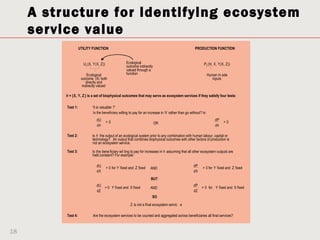
A structure for identifying ecosystem
     service value
                    UTILITY FUNCTION                                                                    PRODUCTION FUNCTION


                      Ui (X, Y(X, Z))                Ecological                                                P i (H, X, Y(X, Z))
                                                     outcome indirectly
                                                     valued through a
                         Ecological                  function                                                       Human m ade
                     outcome (X) both                                                                                  inputs
                        directly and
                     indirectly valued

          h = {X, Y, Z } is a set of biophysical outcomes that may serve as ecosystem services if they satisfy four tests:

          Test 1:           ‘It is valuable ?’
                             Is the beneficiary willing to pay for an increase in ‘h’ rather than go without? Is:
                               dU                                                                                       dP
                                        >0                                OR                                                 >0
                               dh                                                                                       dh

          Test 2:           Is h the output of an ecological system prior to any combination with human labour, capital or
                            technology? An output that combines biophysical outcomes with other factors of production is
                            not an ecosystem service.

          Test 3:           Is the bene ficiary wil ling to pay for increases in h assuming that all other ecosystem outputs are
                            held constant? For example:

                               dU                                                                      dP
                                        > 0 for Y fixed and Z fixed    AND                                    > 0 for Y fixed and Z fixed
                               dX                                                                      dX
                                                                       BUT
                               dU                                                                      dP
                                  = 0 Y fixed and X fixed              AND                                = 0 for Y fixed and X fixed
                               dZ                                                                      dZ
                                                                        SO
                                                        Z is not a final ecosystem servic e

          Test 4:           Are the ecosystem services to be counted and aggregated across beneficiaries all final services?


18
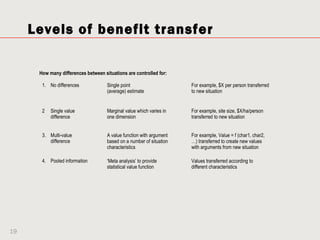
Levels of benefit transfer

      How many differences between situations are controlled for:

       1. No differences             Single point                     For example, $X per person transferred
                                     (average) estimate               to new situation


       2   Single value              Marginal value which varies in   For example, site size, $X/ha/person
           difference                one dimension                    transferred to new situation


       3. Multi-value                A value function with argument   For example, Value = f (char1, char2,
          difference                 based on a number of situation   …) transferred to create new values
                                     characteristics                  with arguments from new situation

       4. Pooled information         ‘Meta analysis’ to provide       Values transferred according to
                                     statistical value function       different characteristics


19
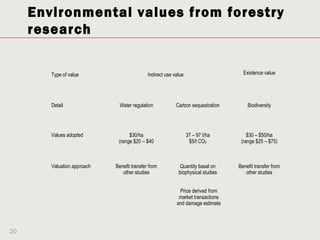
Environmental values from forestry
     research


        Type of value                        Indirect use value                     Existence value


        Detail                 Water regulation            Carbon sequestration       Biodiversity


        Values adopted             $30/ha                         37 – 97 t/ha        $30 – $50/ha
                              (range $20 – $40                     $5/t CO2        (range $25 – $75)


        Valuation approach   Benefit transfer from           Quantity basal on    Benefit transfer from
                                other studies               biophysical studies      other studies


                                                            Price derived from
                                                            market transactions
                                                           and damage estimate


20
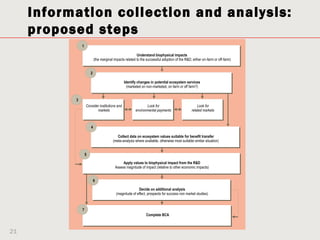
Information collection and analysis:
     proposed steps
               1

                                                         Understand biophysical impacts
                           (the marginal impacts related to the successful adoption of the R&D, either on-farm or off-farm)


                       2

                                                Identify changes in potential ecosystem services
                                                  (marketed on non-marketed, on farm or off farm?)


           3
                   Consider institutions and                   Look for                            Look for
                          markets                       environmental payments                 related markets


                       4

                                           Collect data on ecosystem values suitable for benefit transfer
                                        (meta-analysis where available, otherwise most suitable similar situation)


                   5

                                               Apply values to biophysical impact from the R&D
                                          Assess magnitude of impact (relative to other economic impacts)


                           6

                                                         Decide on additional analysis
                                          (magnitude of effect, prospects for success non market studies)


               7
                                                               Complete BCA


21
David Pearce
Executive Director

+61 2 6245 7800
dpearce@TheCIE.com.au


                        www.TheCIE.com.au

Including NRM and environmental impacts within ACIAR impact assessments - Methodological Issues

  • 1.
    Including NRM andenvironmental impacts within ACIAR impact assessments Methodological issues September 2012 David Pearce WorldFish NRM Workshop, Penang www.TheCIE.com.au
  • 2.
    Themes Concerned with incorporating NRM/environment within extended BCA framework, as used for ACIAR IAS MDB Plan major influence on thinking Maintain consistency with surplus measures ■ But not precluding other measures 2
  • 3.
  • 4.
  • 5.
    Channels of impact R&D OUTCOMES (Assuming adoption etc) Environmental effects Mediated through farm FARM ENVIRONMENT behaviour (Or processor etc) Environmental benefits Feed back to farm Ecosystem services OTHER USERS INCREASE PRODUCTIVITY, REDUCE COSTS etc NON MARKET MARKET MARKET OUTCOMES Valuation Market methods models ECONOMIC SURPLUS ECONOMIC SURPLUS BENEFIT COST ANALYSIS 5
  • 6.
    Agricultural ecosystem inputsand 1 outputs Ecosystem service inputs • Biological pest control • Pollination • Water (quantity and quality) • Soil structure and fertility • Nutrients INPUTS Agricultural systems OUT PUTS Ecosystem dis-services Ecosystem services • Loss of biodiversity and habitat • Mitigation of greenhouse gases • Chemical contamination • Carbon sequestration • Pesticides poisoning • Landscape management • Greenhouse gas emissions • Salinity • Watershed effects 6
  • 7.
    Final ecosystem services Final ecosystem servicea Principal related goods Production of crops, plants, livestock, fish, etc (wild and Food, fibre, energy, genetic resources, industrial inputs, fertiliser, avoidance of climate stress, domesticated) b recreation and tourism, physical and mental health, ecological knowledge, etc Production of trees, standing vegetation and peatb Timber, avoidance of climate stress, energy, noise regulation, recreation and tourism, etc Production of wild species diversity including microbes b,c Natural medicine, disease and pest control, genetic resources, wild food, bio-prospecting, recreation and tourism, physical health, ecological knowledge, etc Production of water quantityb,c Potable water, industrial use of water, flood protection, energy, recreation and tourism, physical health, ecological knowledge, etc Regulation of the climatec Avoidance of climate stress, physical and mental health, ecological knowledge, etc Regulation of hazards; related vegetation and Coastal protection, erosion protection, flood protection, avoidance of climate stress, physical other habitatsc and mental health, ecological knowledge, etc Breakdown and detoxification of wastec Pollution control, waste removal, waste degradation, physical and mental health, ecological knowledge, etc Purification processesc Clean air, clean water, clean soils, physical health, ecological knowledge, etc Generation and maintenance of meaningful places; socially Recreation and tourism, physical and mental health, ecological knowledge, etc valued landscapes and waterscapesd a As noted previously, other inputs (for example manufactured capital) may in some occasions be required to combine with final ecosystem services in the production of goods. Relating the final ecosystem services to the MA (2005) nomenclature b ‘Provisioning’ services. c ‘Regulating’. d Cultural services. ‘Supporting’ services relate to primary ecological services. Source: I. J. Bateman et al, Economic Analysis for Ecosystem Service Assessments, Springer Press, p.185 7
  • 8.
    Total economic value(TEV) and its components TOTAL ECONOMIC VALUE Use values Option values Non-use value Direct use Indirect use Future New info Bequest Existence direct and from value value indirect use avoiding irreversible loss 8
  • 9.
    Overview of thesort of estimation that may be required ON-FARM OFF-FARM MARKETED • Can use conventional surplus • Observe outcomes where markets techniques exist for environmental ‘goods’ • Likely to be rare for most • Likely to increasingly be the case for environmental effects carbon sequestration NON-MARKETED • Use production function type • Revealed preference techniques approach where environmental goods can be linked to other marketed goods (e.g. • Need to understand the production travel cost method, hedonic pricing) relationship between environmental ‘good’ and farm output • Stated preference techniques in cases where no market information is available (e.g. contingent valuation, choice modelling) 9
  • 10.
    Geographic scope ofeffects Local Global Change in Within farming Within neaby Broadly within Ecosystem service system farming systems regional economy Nationally Globally Carbon storage X Biodiversity X X Water quality X X X Soil quality X X Salinity X X Air quality X X 10
  • 11.
    Valuation techniques Valuation where direct market transactions cannot be Valuation where direct market transactions cannot be observed (or may be highly distorted) observed (or may be highly distorted) Revealed preference technique Stated preference technique Non-market environmental characteristics implicit Direct questioning of values in market transaction ‘Use’ values Includes ‘non-use’ values Travel Hedonic Production Contingent Choice Contingent costs pricing function valuation modelling behaviour 11
  • 12.
    From ecosystem processesto human values ECOSYSTEMS ECOSYSTEMS SERVICES HUMAN WELLBEING Non-use • Biophysical structures and • Provisioning • Values derived from processes • Regulating ecosystem services Use (Alone or in combination • Habitat with other inputs) • Ecosystem functions • Cultural Other human generated inputs (for example labour, produced capital) and institutions 12
  • 13.
    How R&D mayimpact ecosystem services 1 3 6 ECOSYSTEMS ECOSYSTEMS SERVICES HUMAN WELLBEING Non-use • Biophysical structures and 2 • Provisioning • Values derived from processes • Regulating 5 ecosystem services • Habitat (Alone or in combination Use with other inputs) • Ecosystem functions • Cultural 4 7 Other human generated inputs (for example labour, produced capital) and institutions 13
  • 14.
    Categories of R&Dimpact for ecosystem services 1. Direct impact on 2. Change in 3. Change in volume 4. Improved ecosystems knowledge of link ecosystem productivity in use between ecosystem services of ecosystem and service services as a productive input Ecosystems Ecosystem services Human wellbeing 5. Increased understanding 6. Direct increase in of the relationship human wellbeing between ecosystem services and human wellbeing 7. Changes in policy related to ecosystems 14
  • 15.
    Output related Input related Knowledge or policy Impact 1. Decrease in emissions of Reduced withdrawal of various kinds (smoke, resources from Impact of changes chemicals, processing ecosystems (water, for induced by R&D on effluent) may directly example) will affect underlying ecosystems impact functioning of ecosystem function. themselves. ecosystems. Impact 2. The relationship between ecosystems and potential Change in knowledge ecosystem services is about the relationship complex. R&D may between underlying improve basic scientific ecology and potential understanding of these ecosystem services relationships. Impact 3. Increase in the volume of the ecosystem service Change in the ‘volume’ (such as increased or ‘quality’ of carbon sequestration) ecosystem services. may result from production changes related to R&D. Impact 4. Increased production efficiency in the use of ecosystem services may result in releasing Improved productivity in environmental resources for other uses the combination of capital and other inputs with ecosystem services Impact 5. The link between ecosystem services and Increased human wellbeing is an understanding of the issue of ongoing scientific relationship between exploration. ecosystem services and human wellbeing. Impact 6. Reduced emissions of various kinds may directly Direct increases in improve human well being human well being (reduced smoke for example). Impact 7. Institutional structures and policies have a direct Changes in policy influence on the full broadly relating to ecosystem service chain. 15 ecosystems.
  • 16.
    Frequency of impactcategories for ACIAR projects 41% 24% 20% 11% 3% 2% 0% 1. Impact on 2. Change in 3. Change in 4. Improved 5. Increased 6. Direct 7. Changes in underlying knowledge: volume of productivity in understanding: increase in well policy ecosystem ecology to ecosystem use of ecosystem being ecosystem service ecosystem service to service services wellbeing Based on desktop analysis of 356 ACIAR projects considered to have some NRM impact Shares apply to 260 of these projects where extended BCA was considered necessary 16
  • 17.
    Testing which ecosystemservices to use Ecosystem Contribute to goods Four tests to identify values services which people value and avoid double counting Provisioning • Production of crops, • Food and fibre, 1. Would beneficiary in services plants, livestock, fish, recreation, inputs principle be willing to etc pay for an increase in • Production of trees, the service rather than vegetation, peat go without? • Production of water • Water for household and quantity industrial use • Production of wild • Medicine, disease and species diversity pest control 2. Are the outputs of the ecosystem service prior to any combination with human labour, capital or technology? Regulating • Climate regulation • Avoid climate stress services • Hazard regulation • Coastal protection, erosion protection, flood prevention • Breakdown of waste • Pollution control, waste 3. Would the beneficiary be removal, clean air and willing to pay for an soils increase in the service assuming all other • Purification processes ecosystem services and outputs were held constant? Cultural • Generation of • Recreation, tourism, services meaningful places physical and mental health 4. Only benefits of final • Socially valued services (satisfying 1 to landscapes and 3) should be counted an waterscapes aggregated 17
  • 18.
    A structure foridentifying ecosystem service value UTILITY FUNCTION PRODUCTION FUNCTION Ui (X, Y(X, Z)) Ecological P i (H, X, Y(X, Z)) outcome indirectly valued through a Ecological function Human m ade outcome (X) both inputs directly and indirectly valued h = {X, Y, Z } is a set of biophysical outcomes that may serve as ecosystem services if they satisfy four tests: Test 1: ‘It is valuable ?’ Is the beneficiary willing to pay for an increase in ‘h’ rather than go without? Is: dU dP >0 OR >0 dh dh Test 2: Is h the output of an ecological system prior to any combination with human labour, capital or technology? An output that combines biophysical outcomes with other factors of production is not an ecosystem service. Test 3: Is the bene ficiary wil ling to pay for increases in h assuming that all other ecosystem outputs are held constant? For example: dU dP > 0 for Y fixed and Z fixed AND > 0 for Y fixed and Z fixed dX dX BUT dU dP = 0 Y fixed and X fixed AND = 0 for Y fixed and X fixed dZ dZ SO Z is not a final ecosystem servic e Test 4: Are the ecosystem services to be counted and aggregated across beneficiaries all final services? 18
  • 19.
    Levels of benefittransfer How many differences between situations are controlled for: 1. No differences Single point For example, $X per person transferred (average) estimate to new situation 2 Single value Marginal value which varies in For example, site size, $X/ha/person difference one dimension transferred to new situation 3. Multi-value A value function with argument For example, Value = f (char1, char2, difference based on a number of situation …) transferred to create new values characteristics with arguments from new situation 4. Pooled information ‘Meta analysis’ to provide Values transferred according to statistical value function different characteristics 19
  • 20.
    Environmental values fromforestry research Type of value Indirect use value Existence value Detail Water regulation Carbon sequestration Biodiversity Values adopted $30/ha 37 – 97 t/ha $30 – $50/ha (range $20 – $40 $5/t CO2 (range $25 – $75) Valuation approach Benefit transfer from Quantity basal on Benefit transfer from other studies biophysical studies other studies Price derived from market transactions and damage estimate 20
  • 21.
    Information collection andanalysis: proposed steps 1 Understand biophysical impacts (the marginal impacts related to the successful adoption of the R&D, either on-farm or off-farm) 2 Identify changes in potential ecosystem services (marketed on non-marketed, on farm or off farm?) 3 Consider institutions and Look for Look for markets environmental payments related markets 4 Collect data on ecosystem values suitable for benefit transfer (meta-analysis where available, otherwise most suitable similar situation) 5 Apply values to biophysical impact from the R&D Assess magnitude of impact (relative to other economic impacts) 6 Decide on additional analysis (magnitude of effect, prospects for success non market studies) 7 Complete BCA 21
  • 22.
    David Pearce Executive Director +612 6245 7800 dpearce@TheCIE.com.au www.TheCIE.com.au