General introduction
Phytopathology  is the study field of plant diseases caused by pathogens  and physiological factors. Plant pathology  involves the study of pathogen identification, disease etiology, disease cycles, economic impact, epidemiology, plant disease resistance, effects on humans and animals and disease management. Phytopathology
keywords  Plant Pathology  : The study of plant diseases Plant Disease  : Any physiological or morphological change    in a plant that results in abnormal appearance    or development Pathogen  : An organism that causes disease Host: The infected plant Symptom  : Abnormal appearance of a plant
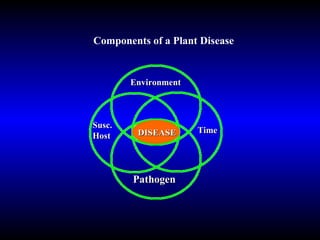
Components of a Plant Disease - Conducive Environment - Susceptible Host - Virulent Pathogen - Adequate Time
WSU Extension San Juan County DISEASE Pathogen Susc. Host Environment Time Components of a Plant Disease Time DISEASE Environment Pathogen Susc.  Host Components of a Plant Disease
Disease Classes - Abiotic   (not transmissible) - Biotic   (transmissible)
Causes of Abiotic Diseases - Environmental  (freezing, flooding, drought, light, wind, hail) Cultural  (mechanical damage, planting problems) C hemical  (fertilizers, herbicides, pets) - Physiological Disorders  (abnormal growth due to genetic and/or environmental interactions)
Causes of Biotic Diseases  (Plant Pathogens)
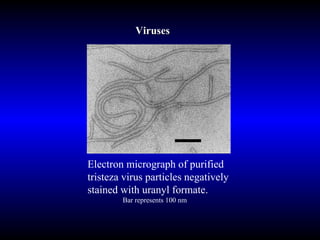
Viruses Electron micrograph of purified tristeza virus particles negatively stained with uranyl formate.  Bar represents 100 nm
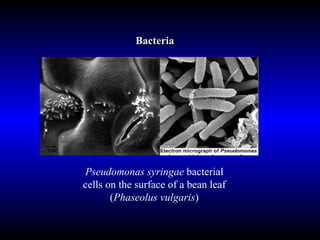
Bacteria Pseudomonas syringae  bacterial cells on the surface of a bean leaf ( Phaseolus vulgaris )
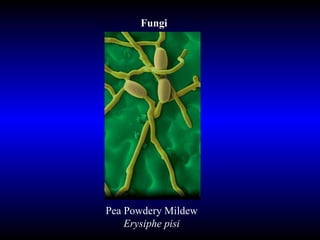
Fungi Pea Powdery Mildew Erysiphe pisi
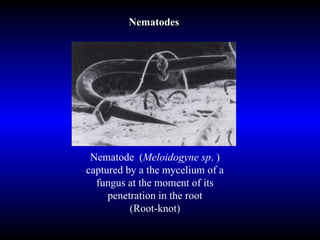
Nematode  ( Meloidogyne   sp . ) captured by a the mycelium of a fungus at the moment of its penetration in the root (Root-knot) Nematodes
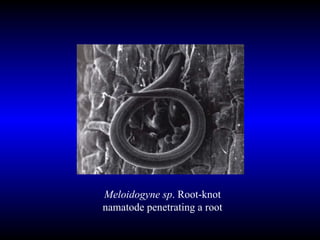
Meloidogyne   sp . Root-knot namatode penetrating a root
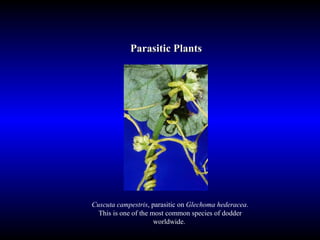
Parasitic Plants Cuscuta campestris , parasitic on  Glechoma hederacea . This is one of the most common species of dodder worldwide.
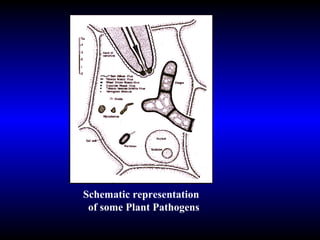
Schematic representation of some Plant Pathogens
Plant Disease Groups (By Symptoms) - Leaf Spots - Leaf and Shoot Blights - Mildews - Rusts - Cankers - Root Rots - Wilts - Galls - Mosaics and Ringspots
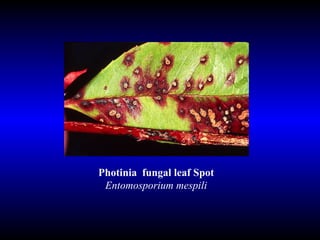
Leaf Spots Cause:  Fungi, bacteria, insects, mites, or abiotic factors Symptoms: Circular or “somewhat circular” spots showing chlorosis (yellowing) or necrosis (brown and dead) areas on leaf
Photinia  fungal leaf Spot  Entomosporium mespili
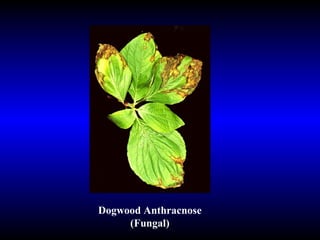
Leaf  and Shoot Blights Cause:  Fungi and bacteria Symptoms: Larger areas of leaves (not circular) and shoots showing localized discoloration and/or flagging
Dogwood Anthracnose (Fungal)
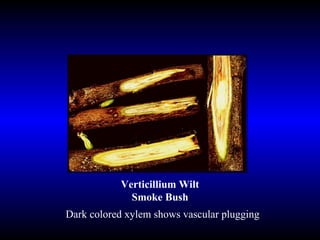
Wilts Cause: Fungi   ( Verticillium, Fusarium )   and  Bacteria   Symptoms: Vascular Plugging Wilted leaves and shoots
Verticillium Wilt Smoke Bush Dark colored xylem shows vascular plugging
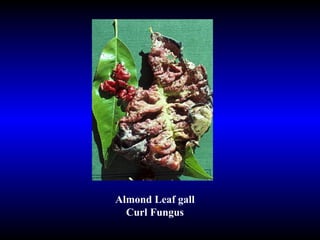
Galls Cause:  Fungi, bacteria, insects, mites, nematodes, and abiotic factors Symptoms: Abnormal proliferation of plant tissue Specific to a certain plant organ (leaf, stem, crown or root)
Almond Leaf gall Curl Fungus
Rusts Cause: Fungi Symptoms: Fungal spore masses in yellow, orange, white, brown, and black on leaves and stems
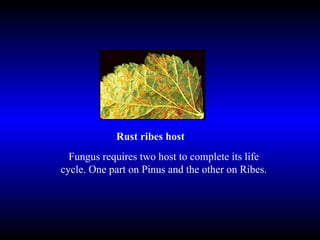
Rust ribes host Fungus requires two host to complete its life cycle. One part on Pinus and the other on Ribes.
Cankers Cause: Fungi or bacterial infection resulting in dead, non-growing areas on stems and branches Symptoms: Dark, sunken areas with distinct margins on stems sometimes have small red or purple fruiting bodies Same fungi also cause fruit rots (e.g. bulls-eye rot)
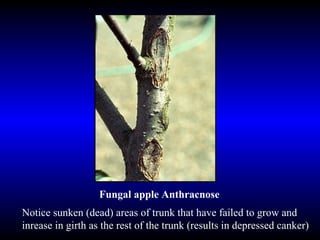
Fungal apple Anthracnose Notice sunken (dead) areas of trunk that have failed to grow and inrease in girth as the rest of the trunk (results in depressed canker)
Root Rots Cause: Fungi ( Armillaria, Phytophthora, Sclerotinia ) and bacteria ( Erwinia ) Symptoms: Shoot wilting, chlorosis/necrosis Stem and root discoloration Dead roots often with fungal hyphae growth under bark
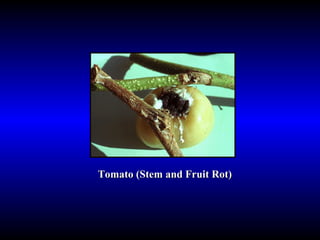
Tomato (Stem and Fruit Rot)
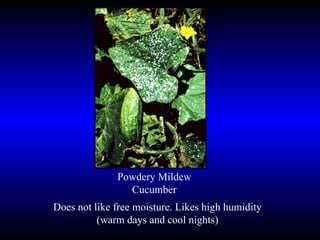
Mildews Cause: Fungi  Types: - Powdery (common)  “Dry” -  Downy  “Wet” Symptoms: Chlorosis, yellowing or purple blotches on leaves. White hyphae and fruiting bodies (fuzzy looking) on plant (leaf) surface
Powdery Mildew Cucumber Does not like free moisture. Likes high humidity (warm days and cool nights)
Abiotic Plant Disease (Not Transmissable)
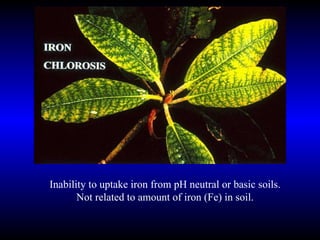
Inability to uptake iron from pH neutral or basic soils. Not related to amount of iron (Fe) in soil.
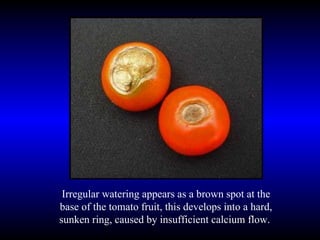
Irregular watering appears as a brown spot at the base of the tomato fruit, this develops into a hard, sunken ring, caused by insufficient calcium flow.
Disease control Chemical treatments  Biocontrol methods Development of resistant plant - Cultural practices: crop rotation, good soil drainage, proper handling of the crop, adequate storage and efficient post-harvest operations
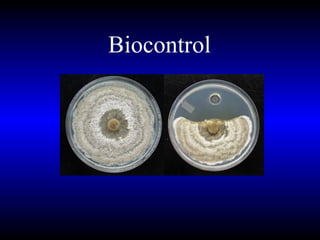
Biocontrol
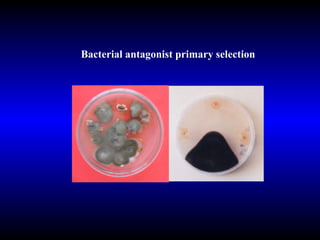
Bacterial antagonist primary selection
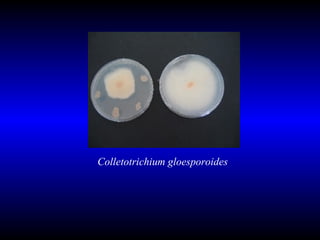
Colletotrichium gloesporoides
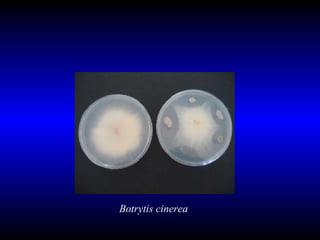
Botrytis cinerea
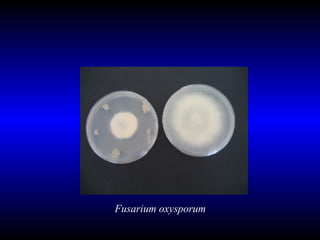
Fusarium oxysporum
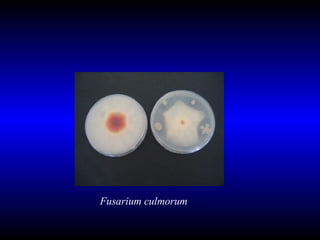
Fusarium culmorum
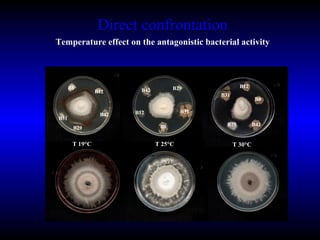
Direct confrontation Temperature effect on the antagonistic bacterial activity B31 B8 B29 B12 B42 B31 B12 B29 B42 B8 B8 B29 B42 B12 B31 T 19°C T 30°C T 25°C
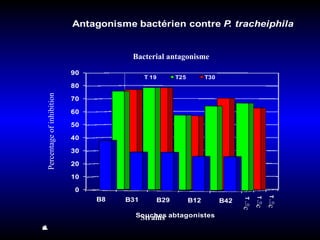
Percentage of inhibition Strains Bacterial antagonisme °c °c °c
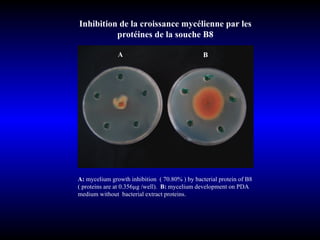
Inhibition de la croissance mycĂŠlienne par les protĂŠines de la souche B8 A:  mycelium   growth inhibition  ( 70.80% ) by bacterial protein of B8 ( proteins are at 0.356Âľg /well).  B:  mycelium development on PDA  medium without  bacterial extract proteins. A B
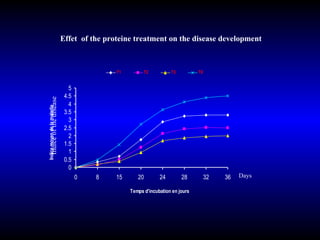
Effet  of the proteine treatment on the disease development Indice of the disease Days
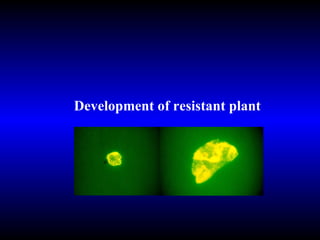
Development of resistant plant
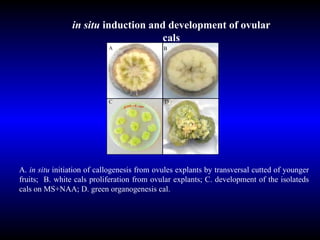
A.  in situ  initiation of callogenesis from ovules explants by transversal cutted of younger fruits;  B. white cals proliferation from ovular explants; C. development of the isolateds cals on MS+NAA; D. green organogenesis cal.  in situ  induction and development of ovular cals A B D C
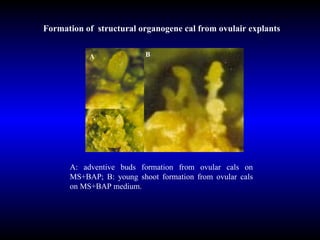
A :  adventive buds formation from ovular cals on MS+BAP; B :  young shoot formation from ovular cals on  MS+BAP medium .  Formation of  structural organogene cal from ovulair explants A B
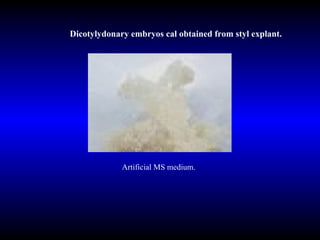
Artificial MS medium. Dicotylydonary embryos cal obtained from styl explant.
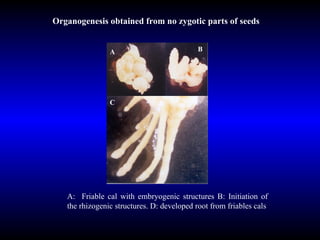
A :  Friable cal with embryogenic structures B :  Initiation of the rhizogenic structures. D :  developed root from friables cals Organogenesis obtained from no zygotic parts of seeds A B C
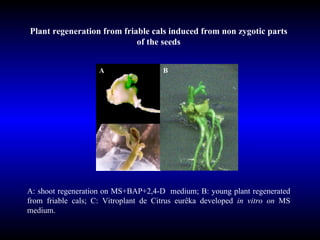
Plant regeneration from friable cals induced from non zygotic parts of the seeds A: shoot regeneration on MS+BAP+2,4-D  medium; B: young plant regenerated from friable cals; C: Vitroplant de Citrus eurĂŞka developed  in vitro on  MS medium. B A C
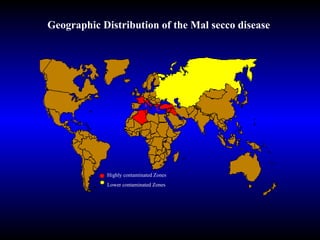
Mal secco  :  Vasculare  disease,      Tracheomycosis -  Causal Agent:  Phoma tracheiphila    (Ciccarone, 1971) - Hot:  Citrus limon - Geographic distribution: Mediterranean  sea region Black sea costs Citrus Mal Secoo
Highly  contaminated  Zones  Lower contaminated Zones Geographic Distribution of the Mal secco disease
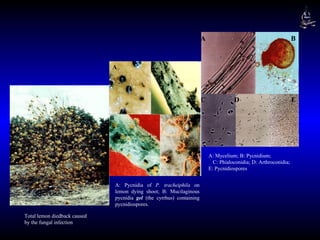
A: Pycnidia of  P. tracheiphila  on lemon dying shoot; B: M ucilaginous pycnidia  gel  (the cyrrhus) containing   pycnidiospores. A: Mycelium; B: Pycnidium;  C: Phialoconidia; D: Arthroconidia; E: Pycnidiospores Total lemon diedback caused by the fungal infection A D B C E A B
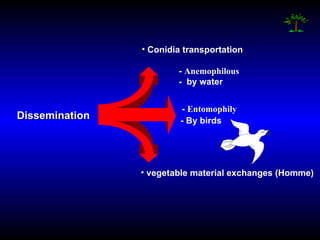
Dissemination Conidia transportation   -  Anemophilous   -  by water  -  Entomophily   vegetable material exchanges (Homme) - By birds
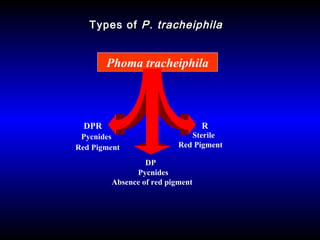
Phoma tracheiphila DPR DP R Pycnides Red Pigment Pycnides Absence of red pigment  Sterile Red Pigment  Types of  P. tracheiphila
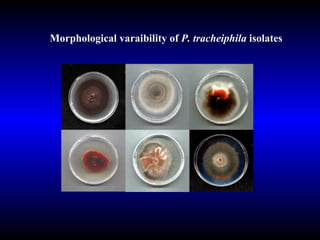
Morphological varaibility of  P. tracheiphila  isolates
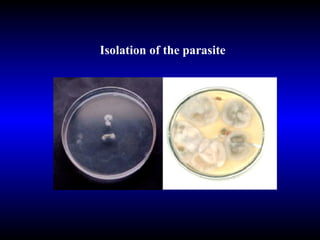
Isolation of the parasite
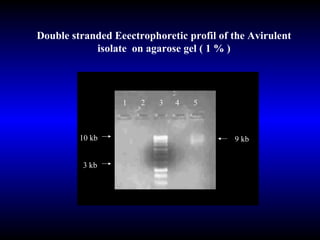
Double stranded Eeectrophoretic profil of the Avirulent isolate  on agarose gel ( 1 % ) 9 kb 10 kb 3 kb 1  2  3  4  5
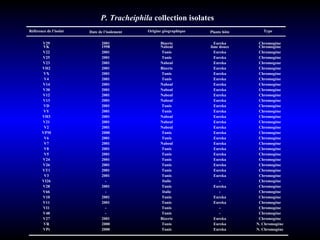
P. Tracheiphila  collection isolates Référence de l’isolat Date de l’isolement Origine géographique Plante hôte   Type   V29   2001   Bizerte   Eureka Chromogène VK 1998 Nabeul lime douce Chromogène V22 2001 Tunis Eureka Chromogène V25 2001 Tunis Eureka Chromogène V23 2001 Nabeul Eureka Chromogene VH2 2001 Bizerte Eureka Chromogène VX 2001 Tunis Eureka Chromogène V4 2001 Tunis Eureka Chromogène V14 2001 Nabeul Eureka Chromogène V30 2001 Nabeul Eureka Chromogène V12 2001 Nabeul Eureka Chromogène V13 2001 Nabeul Eureka Chromogène VD 2001 Tunis Eureka Chromogène VY 2001 Tunis Eureka Chromogène VH3 2001 Nabeul Eureka Chromogène V21 2001 Nabeul Eureka Chromogène V2 2001 Nabeul Eureka Chromogène VPM 2000 Tunis Eureka Chromogène V6 2001 Tunis Eureka Chromogène V7 2001 Nabeul Eureka Chromogène V8 2001 Tunis Eureka Chromogène V5 2001 Tunis Eureka Chromogène V24 2001 Tunis Eureka Chromogène V26 2001 Tunis Eureka Chromogène VT1 2001 Tunis Eureka Chromogène V3 2001 Tunis Eureka Chromogène VI26 - Italie - Chromogène V28 2001 Tunis Eureka Chromogène V66 - Italie - Chromogène V10 2001 Tunis Eureka Chromogène V11 2001 Tunis Eureka Chromogène VI1 - Tunis - Chromogène V48 - Tunis - Chromogène V27 2001 Bizerte Eureka Chromogène VR 2000 Tunis Eureka N. Chromogène VPt 2000 Tunis Eureka N. Chromogène          
Phytosanitary   evaluation Field infection Greenhouse artificial infection In vitro  artificial infection disease system
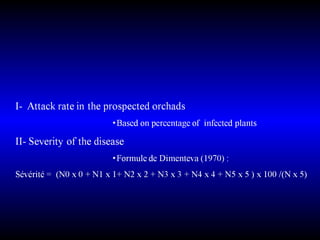
Field infection
 
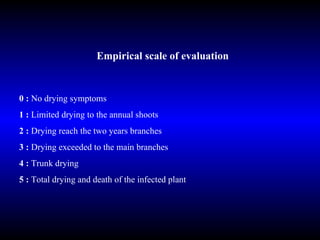
Empirical scale of evaluation 0 :  No drying symptoms  1 :  Limited drying to the annual shoots 2 :  Drying reach the two years branches 3 :  Drying exceeded to the main branches  4 :  Trunk drying 5 :  Total drying and death of the infected plant
Greenhouse artificial infection
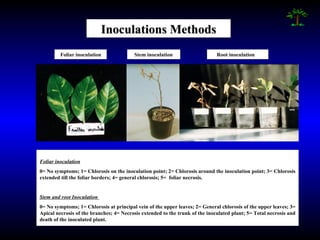
Inoculations Methods Foliar  inoculation Stem inoculation Root  inoculation Foliar inoculation 0= No symptoms; 1= Chlorosis on the inoculation point; 2= Chlorosis around the inoculation point; 3= Chlorosis extended till the foliar borders; 4= general chlorosis; 5=  foliar necrosis. Stem and root Inoculation  0= No symptoms; 1= Chlorosis at principal vein of the upper leaves; 2= General chlorosis of the upper leaves; 3= Apical necrosis of the branches; 4= Necrosis extended to the trunk of the inoculated plant; 5= Total necrosis and death of the inoculated plant.
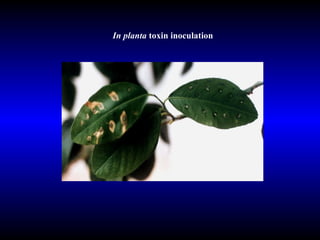
In planta  toxin inoculation
In vitro  artificial infection disease system
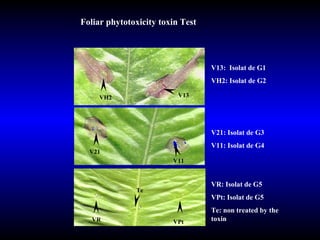
VR Te VPt V11 V21 VH2 V13 Foliar phytotoxicity toxin Test  V13:  Isolat de G1 VH2: Isolat de G2 V21: Isolat de G3 V11: Isolat de G4 VR: Isolat de G5 VPt: Isolat de G5 Te: non treated by the toxin
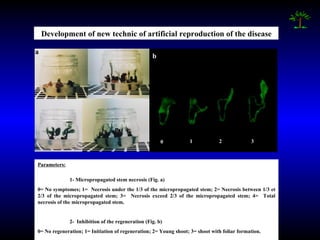
Development of new technic of artificial reproduction of the disease Parameters: 1- Micropropagated stem necrosis (Fig. a) 0= No symptomes; 1=  Necrosis under the 1/3 of the micropropagated stem; 2= Necrosis between 1/3 et 2/3 of the micropropagated stem; 3=  Necrosis exceed 2/3 of the micropropagated stem; 4=  Total necrosis of the micropropagated stem. 2-  Inhibition of the regeneration (Fig. b) 0= No regeneration; 1= Initiation of regeneration;  2= Young shoot; 3= shoot  with   foliar  formation .  2 0 1 3 b a
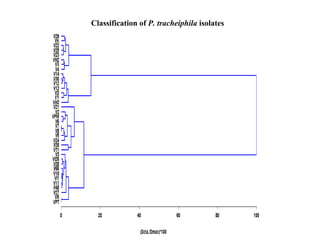
Classification of  P. tracheiphila  isolates

Phytopathology Modelling. Introduction

  • 1.
  • 2.
    Phytopathology isthe study field of plant diseases caused by pathogens and physiological factors. Plant pathology involves the study of pathogen identification, disease etiology, disease cycles, economic impact, epidemiology, plant disease resistance, effects on humans and animals and disease management. Phytopathology
  • 3.
    keywords PlantPathology : The study of plant diseases Plant Disease : Any physiological or morphological change in a plant that results in abnormal appearance or development Pathogen : An organism that causes disease Host: The infected plant Symptom : Abnormal appearance of a plant
  • 4.
    Components of aPlant Disease - Conducive Environment - Susceptible Host - Virulent Pathogen - Adequate Time
  • 5.
    WSU Extension SanJuan County DISEASE Pathogen Susc. Host Environment Time Components of a Plant Disease Time DISEASE Environment Pathogen Susc. Host Components of a Plant Disease
  • 6.
    Disease Classes -Abiotic (not transmissible) - Biotic (transmissible)
  • 7.
    Causes of AbioticDiseases - Environmental (freezing, flooding, drought, light, wind, hail) Cultural (mechanical damage, planting problems) C hemical (fertilizers, herbicides, pets) - Physiological Disorders (abnormal growth due to genetic and/or environmental interactions)
  • 8.
    Causes of BioticDiseases (Plant Pathogens)
  • 9.
    Viruses Electron micrographof purified tristeza virus particles negatively stained with uranyl formate. Bar represents 100 nm
  • 10.
    Bacteria Pseudomonas syringae bacterial cells on the surface of a bean leaf ( Phaseolus vulgaris )
  • 11.
    Fungi Pea PowderyMildew Erysiphe pisi
  • 12.
    Nematode (Meloidogyne sp . ) captured by a the mycelium of a fungus at the moment of its penetration in the root (Root-knot) Nematodes
  • 13.
    Meloidogyne sp . Root-knot namatode penetrating a root
  • 14.
    Parasitic Plants Cuscutacampestris , parasitic on Glechoma hederacea . This is one of the most common species of dodder worldwide.
  • 15.
    Schematic representation ofsome Plant Pathogens
  • 16.
    Plant Disease Groups(By Symptoms) - Leaf Spots - Leaf and Shoot Blights - Mildews - Rusts - Cankers - Root Rots - Wilts - Galls - Mosaics and Ringspots
  • 17.
    Leaf Spots Cause: Fungi, bacteria, insects, mites, or abiotic factors Symptoms: Circular or “somewhat circular” spots showing chlorosis (yellowing) or necrosis (brown and dead) areas on leaf
  • 18.
    Photinia fungalleaf Spot Entomosporium mespili
  • 19.
    Leaf andShoot Blights Cause: Fungi and bacteria Symptoms: Larger areas of leaves (not circular) and shoots showing localized discoloration and/or flagging
  • 20.
  • 21.
    Wilts Cause: Fungi ( Verticillium, Fusarium ) and Bacteria Symptoms: Vascular Plugging Wilted leaves and shoots
  • 22.
    Verticillium Wilt SmokeBush Dark colored xylem shows vascular plugging
  • 23.
    Galls Cause: Fungi, bacteria, insects, mites, nematodes, and abiotic factors Symptoms: Abnormal proliferation of plant tissue Specific to a certain plant organ (leaf, stem, crown or root)
  • 24.
    Almond Leaf gallCurl Fungus
  • 25.
    Rusts Cause: FungiSymptoms: Fungal spore masses in yellow, orange, white, brown, and black on leaves and stems
  • 26.
    Rust ribes hostFungus requires two host to complete its life cycle. One part on Pinus and the other on Ribes.
  • 27.
    Cankers Cause: Fungior bacterial infection resulting in dead, non-growing areas on stems and branches Symptoms: Dark, sunken areas with distinct margins on stems sometimes have small red or purple fruiting bodies Same fungi also cause fruit rots (e.g. bulls-eye rot)
  • 28.
    Fungal apple AnthracnoseNotice sunken (dead) areas of trunk that have failed to grow and inrease in girth as the rest of the trunk (results in depressed canker)
  • 29.
    Root Rots Cause:Fungi ( Armillaria, Phytophthora, Sclerotinia ) and bacteria ( Erwinia ) Symptoms: Shoot wilting, chlorosis/necrosis Stem and root discoloration Dead roots often with fungal hyphae growth under bark
  • 30.
    Tomato (Stem andFruit Rot)
  • 31.
    Mildews Cause: Fungi Types: - Powdery (common) “Dry” - Downy “Wet” Symptoms: Chlorosis, yellowing or purple blotches on leaves. White hyphae and fruiting bodies (fuzzy looking) on plant (leaf) surface
  • 32.
    Powdery Mildew CucumberDoes not like free moisture. Likes high humidity (warm days and cool nights)
  • 33.
    Abiotic Plant Disease(Not Transmissable)
  • 34.
    Inability to uptakeiron from pH neutral or basic soils. Not related to amount of iron (Fe) in soil.
  • 35.
    Irregular watering appearsas a brown spot at the base of the tomato fruit, this develops into a hard, sunken ring, caused by insufficient calcium flow.
  • 36.
    Disease control Chemicaltreatments Biocontrol methods Development of resistant plant - Cultural practices: crop rotation, good soil drainage, proper handling of the crop, adequate storage and efficient post-harvest operations
  • 37.
  • 38.
  • 39.
  • 40.
  • 41.
  • 42.
  • 43.
    Direct confrontation Temperatureeffect on the antagonistic bacterial activity B31 B8 B29 B12 B42 B31 B12 B29 B42 B8 B8 B29 B42 B12 B31 T 19°C T 30°C T 25°C
  • 44.
    Percentage of inhibitionStrains Bacterial antagonisme °c °c °c
  • 45.
    Inhibition de lacroissance mycĂŠlienne par les protĂŠines de la souche B8 A: mycelium growth inhibition ( 70.80% ) by bacterial protein of B8 ( proteins are at 0.356Âľg /well). B: mycelium development on PDA medium without bacterial extract proteins. A B
  • 46.
    Effet ofthe proteine treatment on the disease development Indice of the disease Days
  • 47.
  • 48.
    A. insitu initiation of callogenesis from ovules explants by transversal cutted of younger fruits; B. white cals proliferation from ovular explants; C. development of the isolateds cals on MS+NAA; D. green organogenesis cal. in situ induction and development of ovular cals A B D C
  • 49.
    A : adventive buds formation from ovular cals on MS+BAP; B : young shoot formation from ovular cals on MS+BAP medium . Formation of structural organogene cal from ovulair explants A B
  • 50.
    Artificial MS medium.Dicotylydonary embryos cal obtained from styl explant.
  • 51.
    A : Friable cal with embryogenic structures B : Initiation of the rhizogenic structures. D : developed root from friables cals Organogenesis obtained from no zygotic parts of seeds A B C
  • 52.
    Plant regeneration fromfriable cals induced from non zygotic parts of the seeds A: shoot regeneration on MS+BAP+2,4-D medium; B: young plant regenerated from friable cals; C: Vitroplant de Citrus eurĂŞka developed in vitro on MS medium. B A C
  • 53.
    Mal secco : Vasculare disease, Tracheomycosis - Causal Agent: Phoma tracheiphila (Ciccarone, 1971) - Hot: Citrus limon - Geographic distribution: Mediterranean sea region Black sea costs Citrus Mal Secoo
  • 54.
    Highly contaminated Zones Lower contaminated Zones Geographic Distribution of the Mal secco disease
  • 55.
    A: Pycnidia of P. tracheiphila on lemon dying shoot; B: M ucilaginous pycnidia gel (the cyrrhus) containing pycnidiospores. A: Mycelium; B: Pycnidium; C: Phialoconidia; D: Arthroconidia; E: Pycnidiospores Total lemon diedback caused by the fungal infection A D B C E A B
  • 56.
    Dissemination Conidia transportation - Anemophilous - by water - Entomophily vegetable material exchanges (Homme) - By birds
  • 57.
    Phoma tracheiphila DPRDP R Pycnides Red Pigment Pycnides Absence of red pigment Sterile Red Pigment Types of P. tracheiphila
  • 58.
    Morphological varaibility of P. tracheiphila isolates
  • 59.
  • 60.
    Double stranded Eeectrophoreticprofil of the Avirulent isolate on agarose gel ( 1 % ) 9 kb 10 kb 3 kb 1 2 3 4 5
  • 61.
    P. Tracheiphila collection isolates Référence de l’isolat Date de l’isolement Origine géographique Plante hôte   Type   V29   2001   Bizerte   Eureka Chromogène VK 1998 Nabeul lime douce Chromogène V22 2001 Tunis Eureka Chromogène V25 2001 Tunis Eureka Chromogène V23 2001 Nabeul Eureka Chromogene VH2 2001 Bizerte Eureka Chromogène VX 2001 Tunis Eureka Chromogène V4 2001 Tunis Eureka Chromogène V14 2001 Nabeul Eureka Chromogène V30 2001 Nabeul Eureka Chromogène V12 2001 Nabeul Eureka Chromogène V13 2001 Nabeul Eureka Chromogène VD 2001 Tunis Eureka Chromogène VY 2001 Tunis Eureka Chromogène VH3 2001 Nabeul Eureka Chromogène V21 2001 Nabeul Eureka Chromogène V2 2001 Nabeul Eureka Chromogène VPM 2000 Tunis Eureka Chromogène V6 2001 Tunis Eureka Chromogène V7 2001 Nabeul Eureka Chromogène V8 2001 Tunis Eureka Chromogène V5 2001 Tunis Eureka Chromogène V24 2001 Tunis Eureka Chromogène V26 2001 Tunis Eureka Chromogène VT1 2001 Tunis Eureka Chromogène V3 2001 Tunis Eureka Chromogène VI26 - Italie - Chromogène V28 2001 Tunis Eureka Chromogène V66 - Italie - Chromogène V10 2001 Tunis Eureka Chromogène V11 2001 Tunis Eureka Chromogène VI1 - Tunis - Chromogène V48 - Tunis - Chromogène V27 2001 Bizerte Eureka Chromogène VR 2000 Tunis Eureka N. Chromogène VPt 2000 Tunis Eureka N. Chromogène          
  • 62.
    Phytosanitary evaluation Field infection Greenhouse artificial infection In vitro artificial infection disease system
  • 63.
  • 64.
  • 65.
    Empirical scale ofevaluation 0 : No drying symptoms 1 : Limited drying to the annual shoots 2 : Drying reach the two years branches 3 : Drying exceeded to the main branches 4 : Trunk drying 5 : Total drying and death of the infected plant
  • 66.
  • 67.
    Inoculations Methods Foliar inoculation Stem inoculation Root inoculation Foliar inoculation 0= No symptoms; 1= Chlorosis on the inoculation point; 2= Chlorosis around the inoculation point; 3= Chlorosis extended till the foliar borders; 4= general chlorosis; 5= foliar necrosis. Stem and root Inoculation 0= No symptoms; 1= Chlorosis at principal vein of the upper leaves; 2= General chlorosis of the upper leaves; 3= Apical necrosis of the branches; 4= Necrosis extended to the trunk of the inoculated plant; 5= Total necrosis and death of the inoculated plant.
  • 68.
    In planta toxin inoculation
  • 69.
    In vitro artificial infection disease system
  • 70.
    VR Te VPtV11 V21 VH2 V13 Foliar phytotoxicity toxin Test V13: Isolat de G1 VH2: Isolat de G2 V21: Isolat de G3 V11: Isolat de G4 VR: Isolat de G5 VPt: Isolat de G5 Te: non treated by the toxin
  • 71.
    Development of newtechnic of artificial reproduction of the disease Parameters: 1- Micropropagated stem necrosis (Fig. a) 0= No symptomes; 1= Necrosis under the 1/3 of the micropropagated stem; 2= Necrosis between 1/3 et 2/3 of the micropropagated stem; 3= Necrosis exceed 2/3 of the micropropagated stem; 4= Total necrosis of the micropropagated stem. 2- Inhibition of the regeneration (Fig. b) 0= No regeneration; 1= Initiation of regeneration; 2= Young shoot; 3= shoot with foliar formation . 2 0 1 3 b a
  • 72.
    Classification of P. tracheiphila isolates