SOCIOLECT This is the way we speak that is individual to a social group.  It may have features that cross the linguistic methods e.g. lexical choice, grammar, phonology  (pronunciation).  Most people use several different sociolects e.g. occupational groups, friendship groups, family groups, cultural groups etc.
Who are you? Write all of your social labels on the post-it and wear it for the rest of the lesson. Here are some examples of social labels: ‘ a daughter’, ‘a woman’, ‘a doctor’, ‘a drop-out’, ‘an apprentice’, ‘a lay reader’, ‘a political activist’, ‘a Times reader’, ‘a community leader’ …
Key Question: What groups does society actually divide up into? Answer: there are many different groups, but seven key impact factors that determine those groups… In three groups you have seven words split in half and each half is jumbled.  Which group can find the seven impact factors first?
Speech bubbles Can you write a ‘speech bubble’ that shows language influenced by each impact factor? Gender Age Class Media Occupation Education Aspiration Eg: for age, write something that only a young/old person would say.
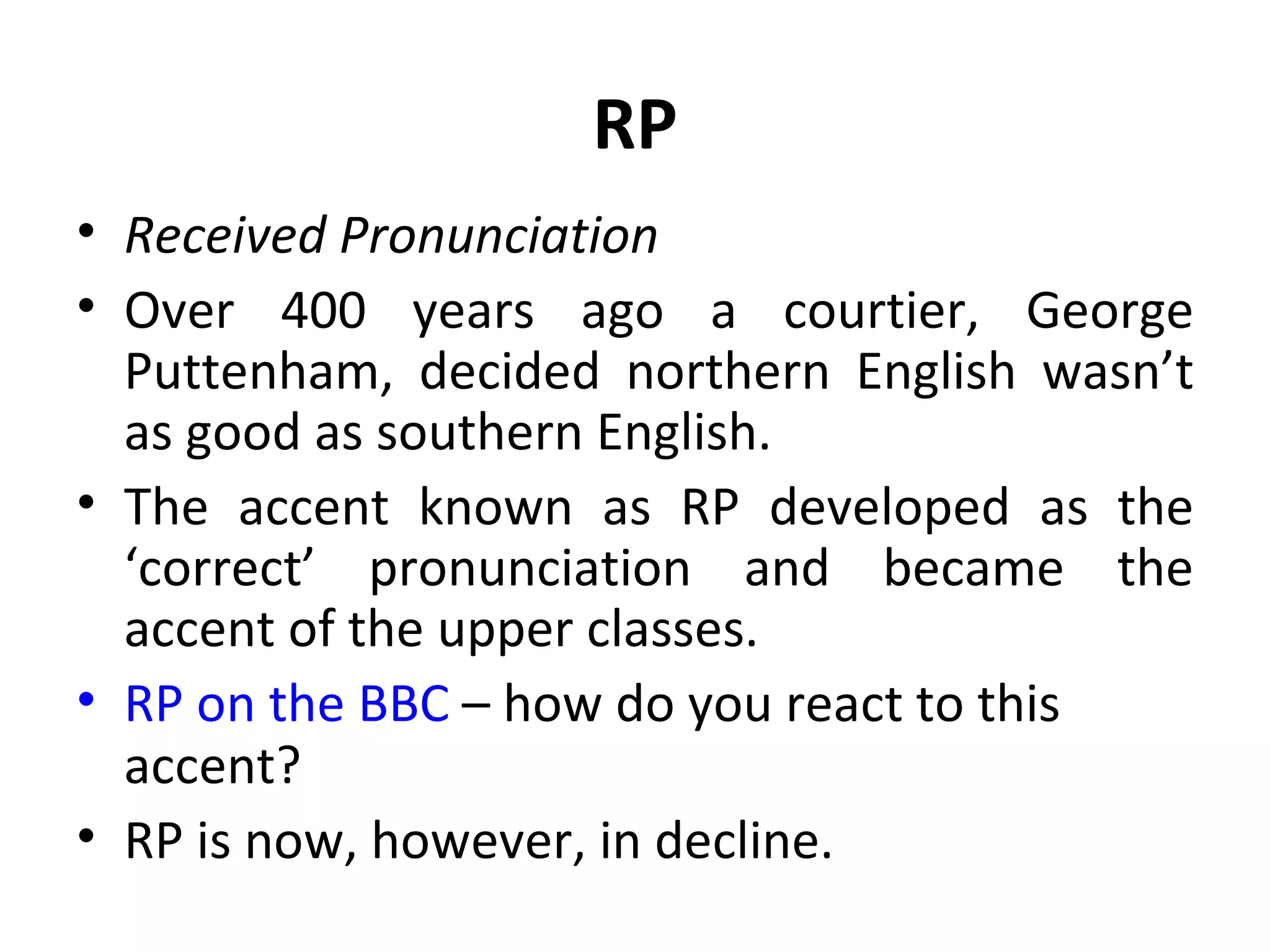
RP Received Pronunciation Over 400 years ago a courtier, George Puttenham, decided northern English wasn’t as good as southern English. The accent known as RP developed as the ‘correct’ pronunciation and became the accent of the upper classes. RP on the BBC  – how do you react to this accent? RP is now, however, in decline.
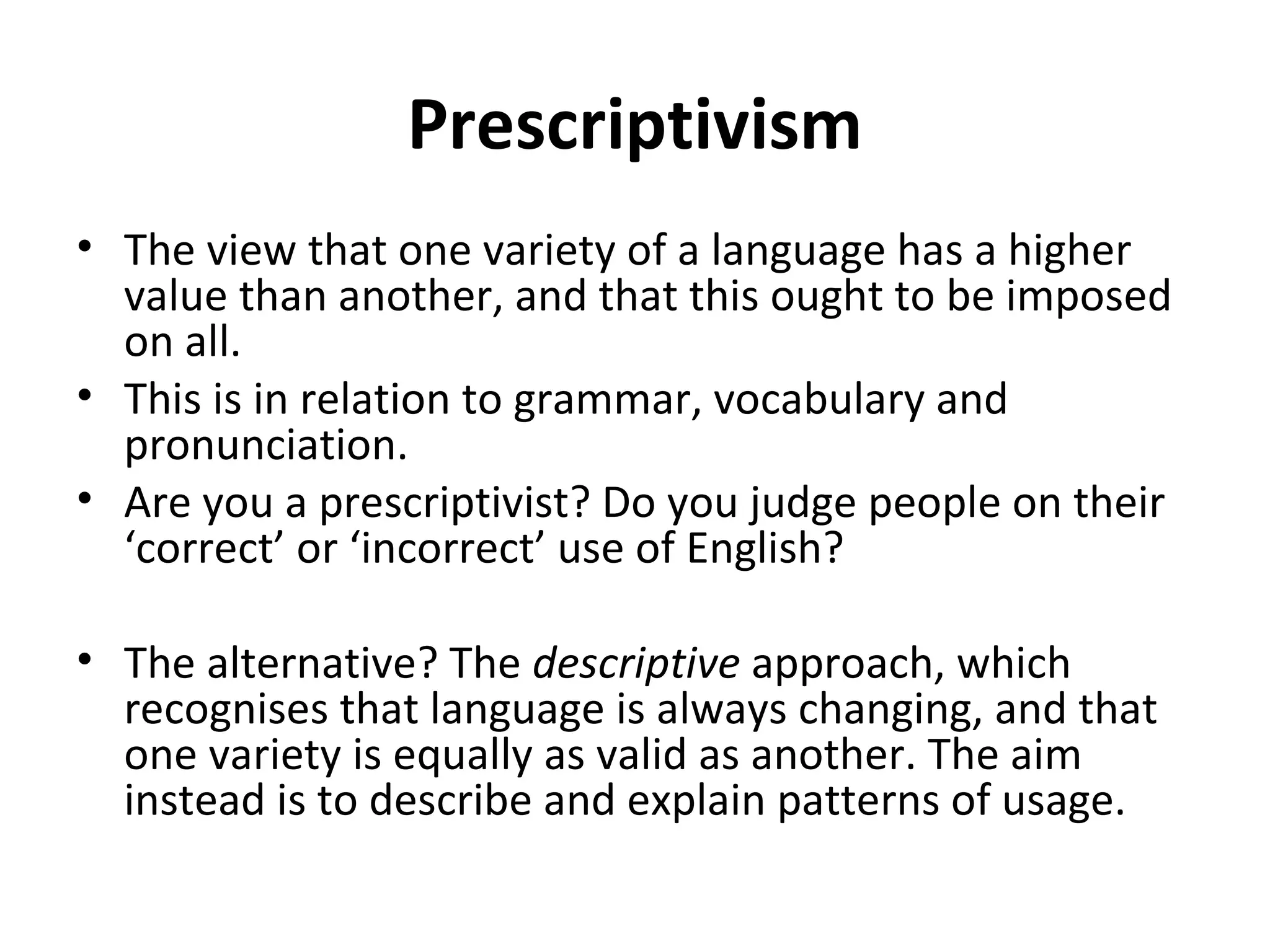
Prescriptivism The view that one variety of a language has a higher value than another, and that this ought to be imposed on all. This is in relation to grammar, vocabulary and pronunciation. Are you a prescriptivist? Do you judge people on their ‘correct’ or ‘incorrect’ use of English? The alternative? The  descriptive  approach, which recognises that language is always changing, and that one variety is equally as valid as another. The aim instead is to describe and explain patterns of usage.

Intro to sociolect

  • 1.
    SOCIOLECT This isthe way we speak that is individual to a social group. It may have features that cross the linguistic methods e.g. lexical choice, grammar, phonology (pronunciation). Most people use several different sociolects e.g. occupational groups, friendship groups, family groups, cultural groups etc.
  • 2.
    Who are you?Write all of your social labels on the post-it and wear it for the rest of the lesson. Here are some examples of social labels: ‘ a daughter’, ‘a woman’, ‘a doctor’, ‘a drop-out’, ‘an apprentice’, ‘a lay reader’, ‘a political activist’, ‘a Times reader’, ‘a community leader’ …
  • 3.
    Key Question: Whatgroups does society actually divide up into? Answer: there are many different groups, but seven key impact factors that determine those groups… In three groups you have seven words split in half and each half is jumbled. Which group can find the seven impact factors first?
  • 4.
    Speech bubbles Canyou write a ‘speech bubble’ that shows language influenced by each impact factor? Gender Age Class Media Occupation Education Aspiration Eg: for age, write something that only a young/old person would say.
  • 5.
    RP Received PronunciationOver 400 years ago a courtier, George Puttenham, decided northern English wasn’t as good as southern English. The accent known as RP developed as the ‘correct’ pronunciation and became the accent of the upper classes. RP on the BBC – how do you react to this accent? RP is now, however, in decline.
  • 6.
    Prescriptivism The viewthat one variety of a language has a higher value than another, and that this ought to be imposed on all. This is in relation to grammar, vocabulary and pronunciation. Are you a prescriptivist? Do you judge people on their ‘correct’ or ‘incorrect’ use of English? The alternative? The descriptive approach, which recognises that language is always changing, and that one variety is equally as valid as another. The aim instead is to describe and explain patterns of usage.