Modified from -Paula 
Pilarska
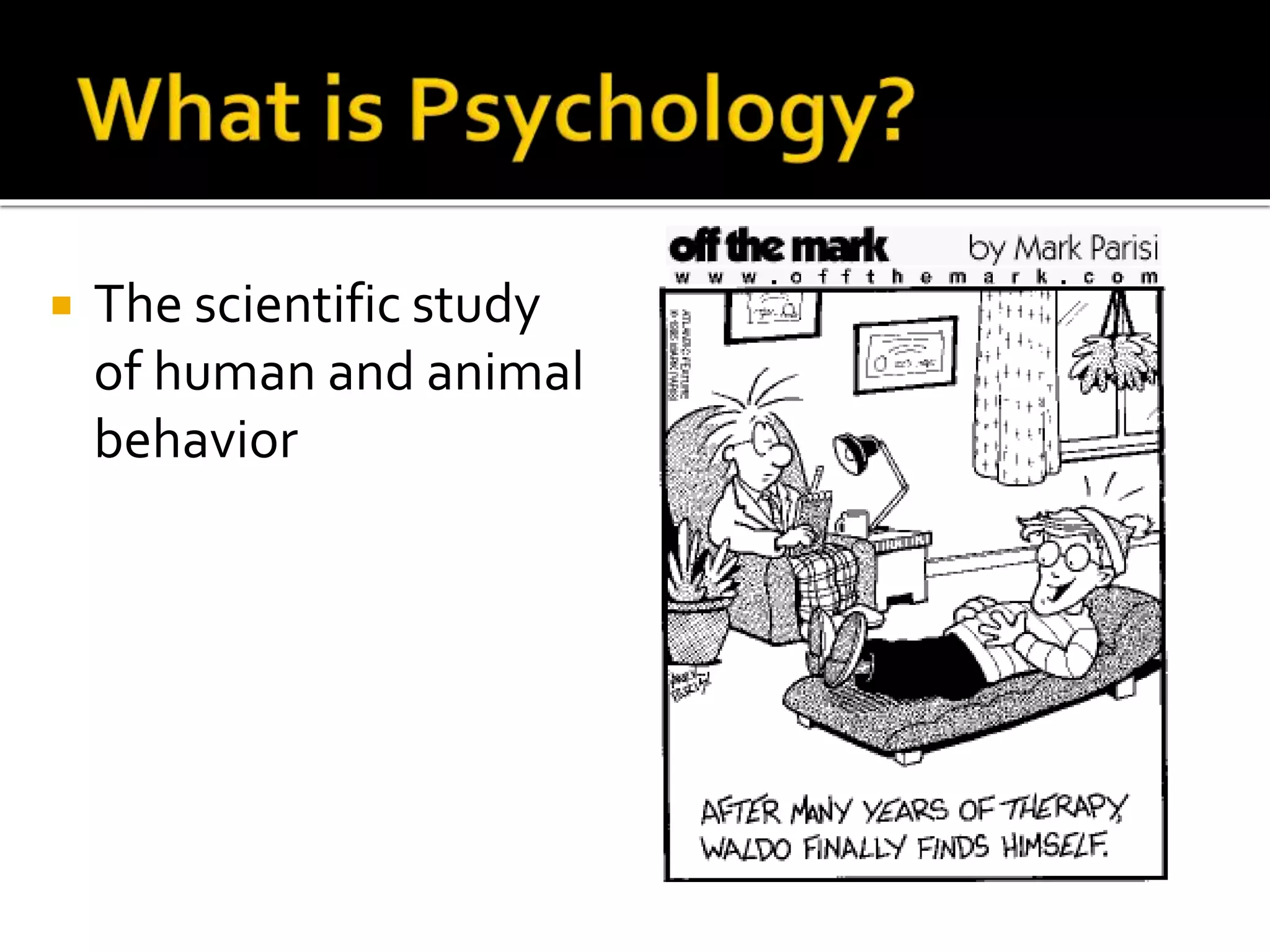
 The scientific study 
of human and animal 
behavior
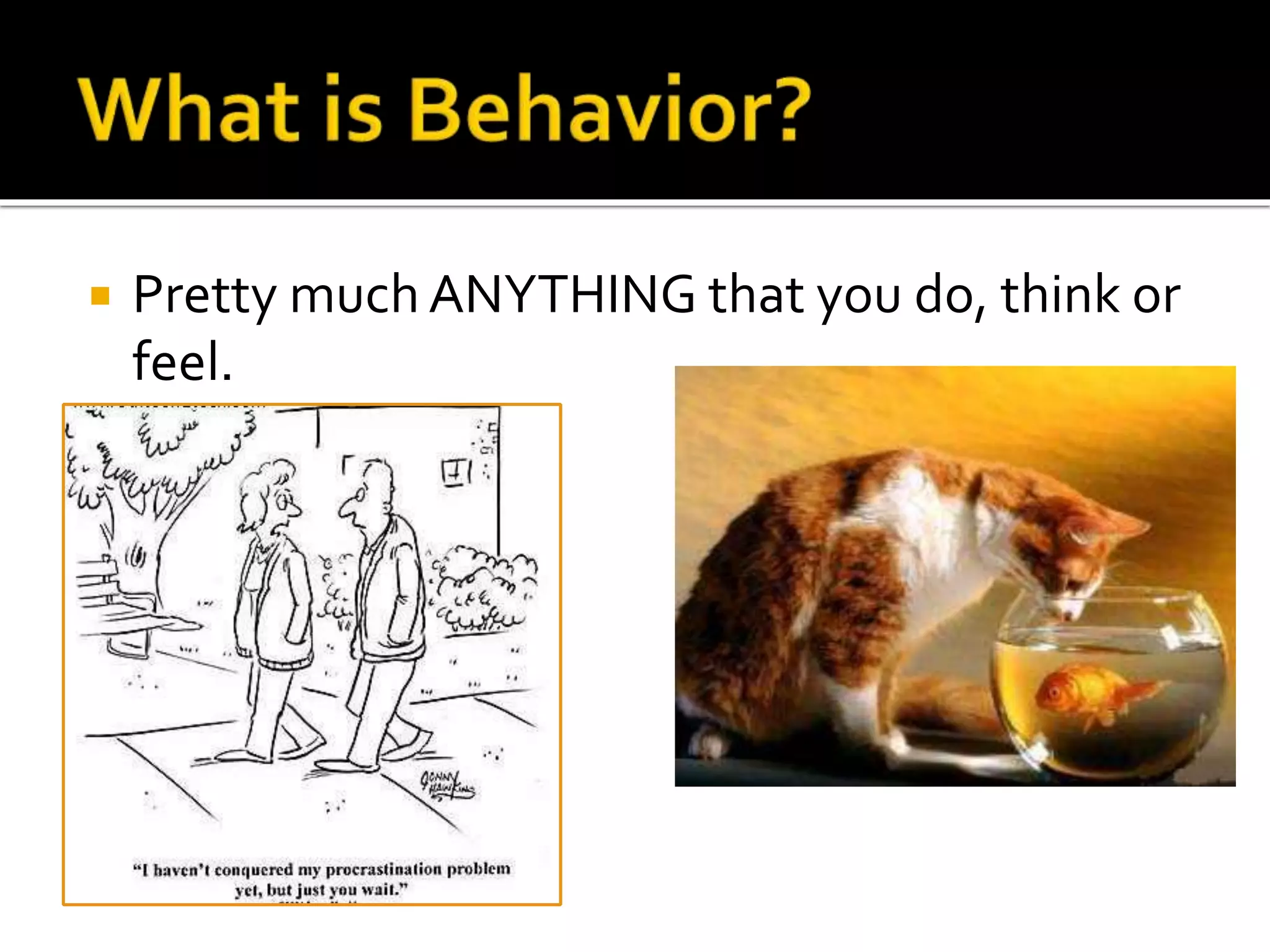
 Pretty much ANYTHING that you do, think or 
feel.
 Research: 
 Studies why things happen. 
 Deals with theories and lab experiments 
▪ “Lab tests show people’s anxiety level increases when 
surrounded by the color red.” 
 Applied: 
 Figures out how to USE information found by 
researchers 
 “NASA scientists study which colors to paint the 
inside of the International Space Station”
 Separated from philosophy in the middle of 19th century 
with roots in biology 
 Psychology" comes from the Greek words: 
 "psyche" meaning mind or soul, 
 and "logos", meaning reason. 
Reasoning about soul – philosophy of the mind
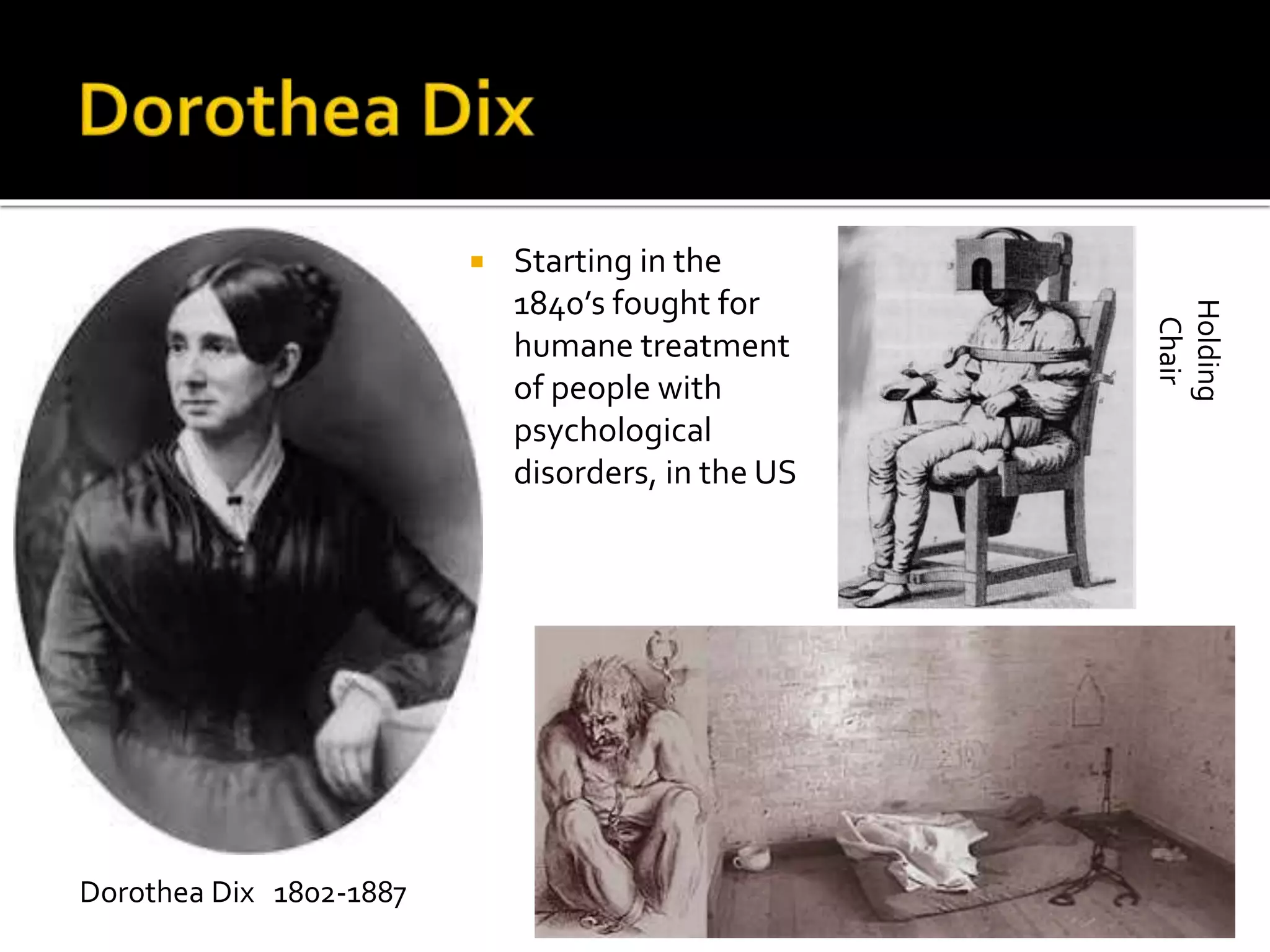
 Starting in the 
1840’s fought for 
humane treatment 
of people with 
psychological 
disorders, in the US 
Dorothea Dix 1802-1887 
Holding 
Chair
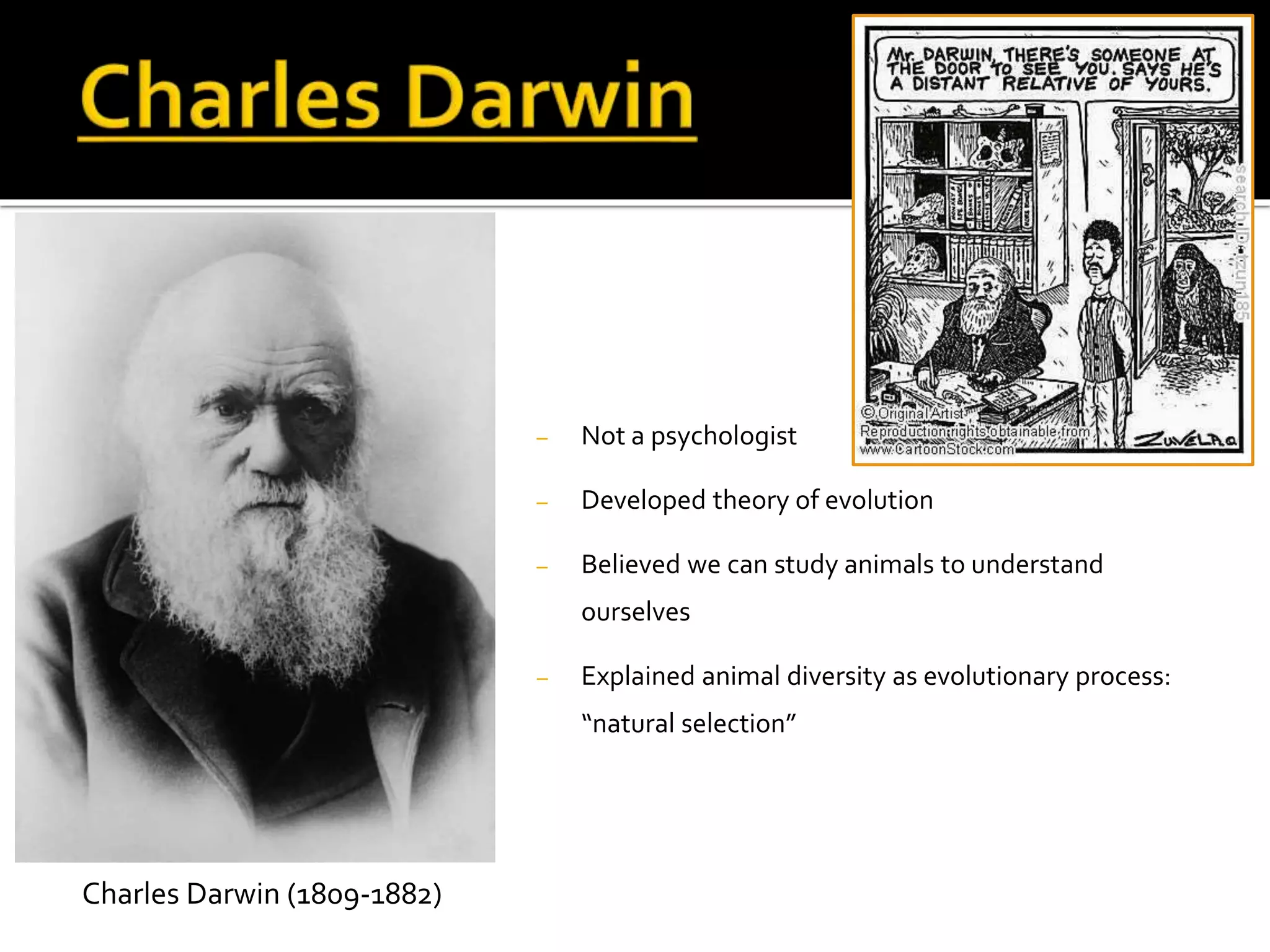
– Not a psychologist 
– Developed theory of evolution 
– Believed we can study animals to understand 
ourselves 
– Explained animal diversity as evolutionary process: 
“natural selection” 
Charles Darwin (1809-1882)
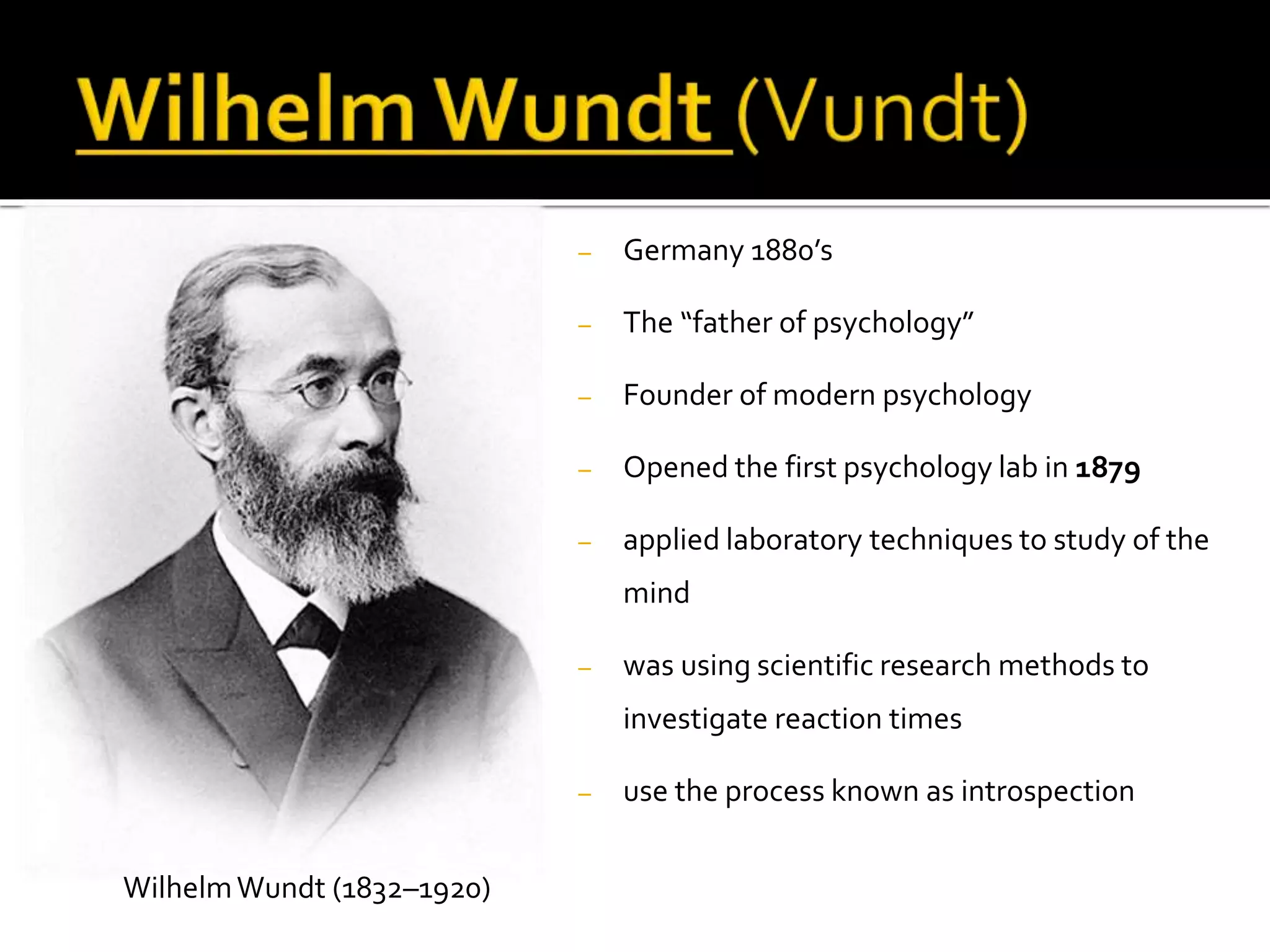
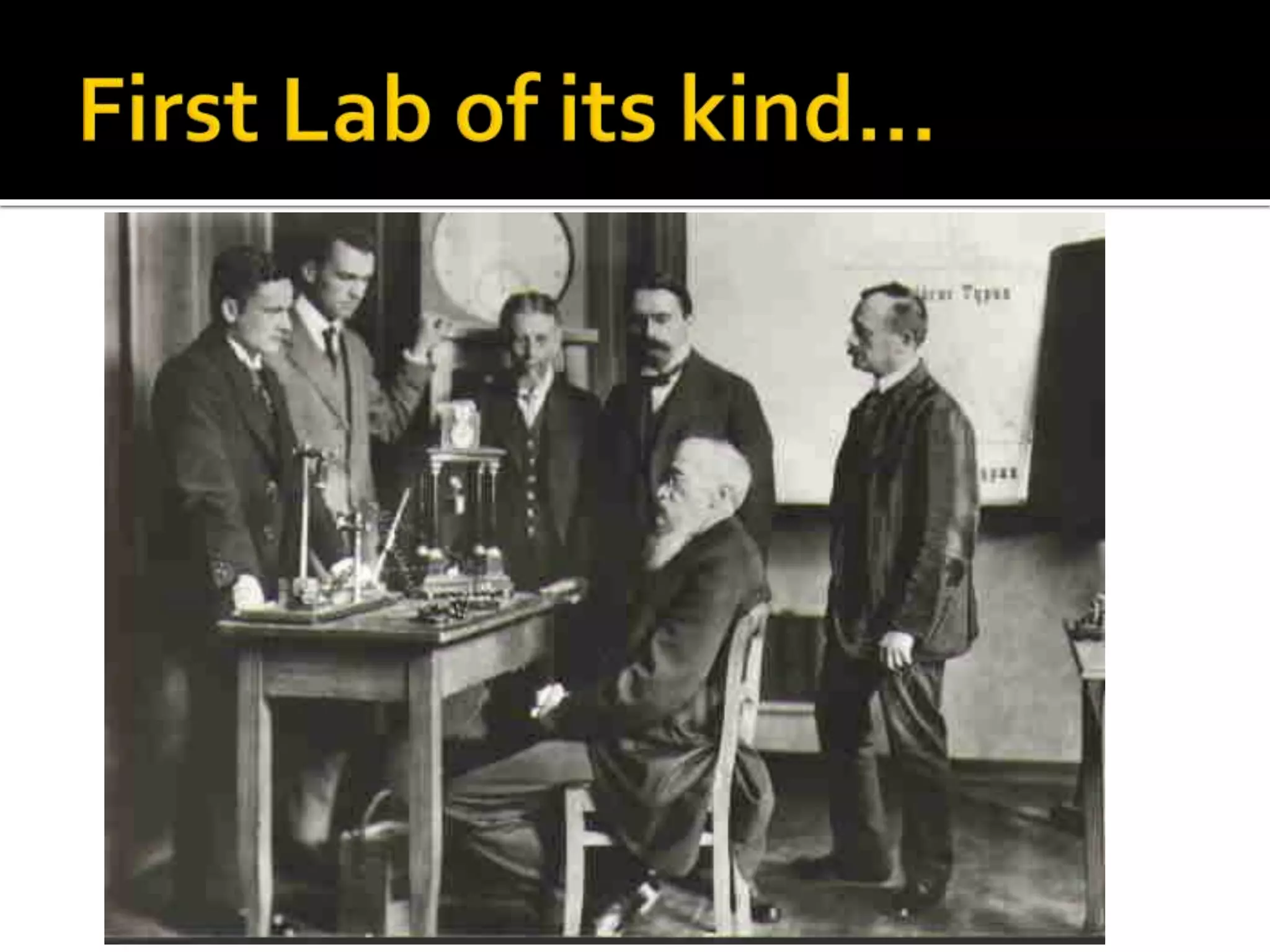
– Germany 1880’s 
– The “father of psychology” 
– Founder of modern psychology 
– Opened the first psychology lab in 1879 
– applied laboratory techniques to study of the 
mind 
– was using scientific research methods to 
investigate reaction times 
– use the process known as introspection 
Wilhelm Wundt (1832–1920)
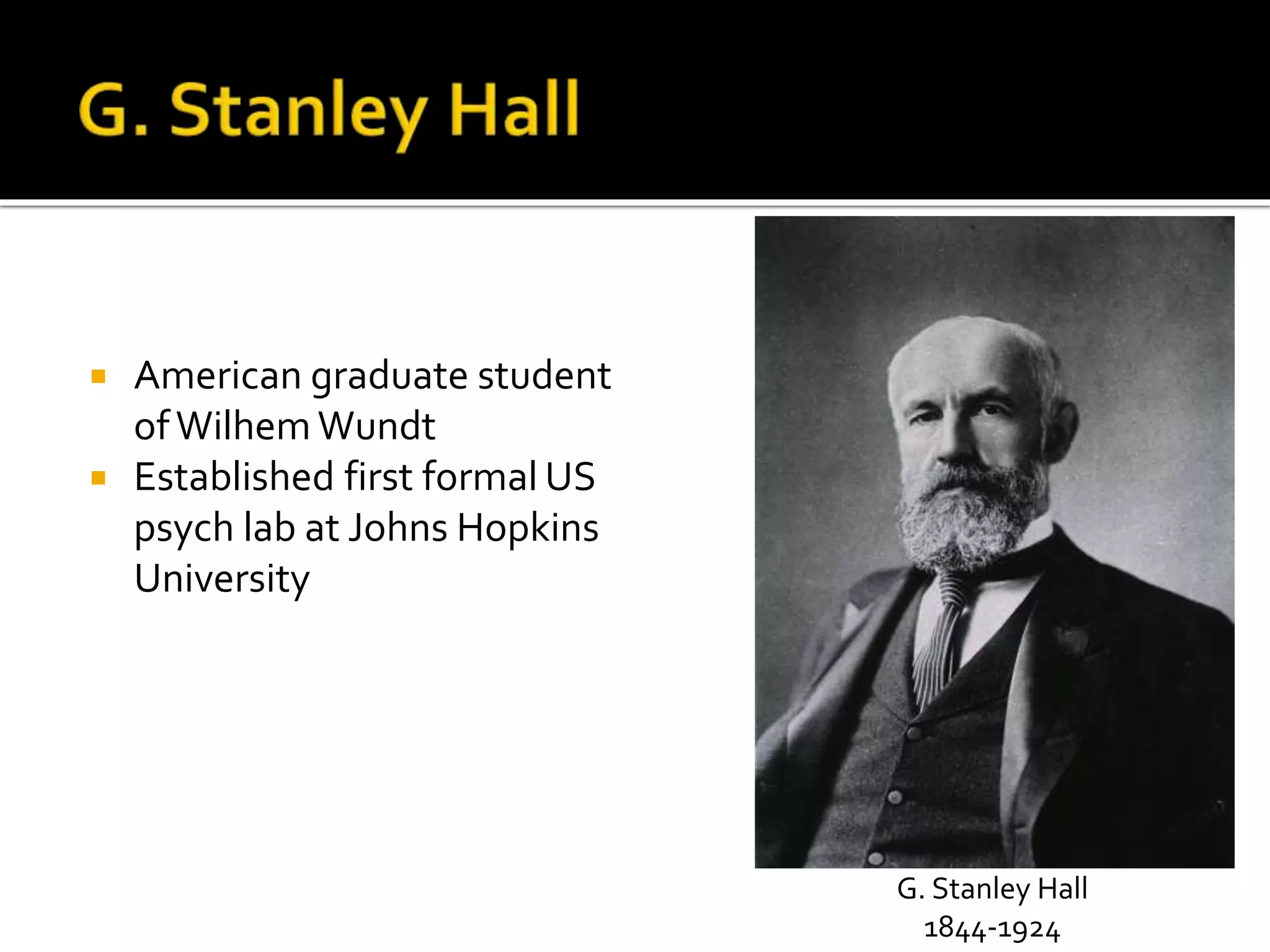
 American graduate student 
of WilhemWundt 
 Established first formal US 
psych lab at Johns Hopkins 
University 
G. Stanley Hall 
1844-1924
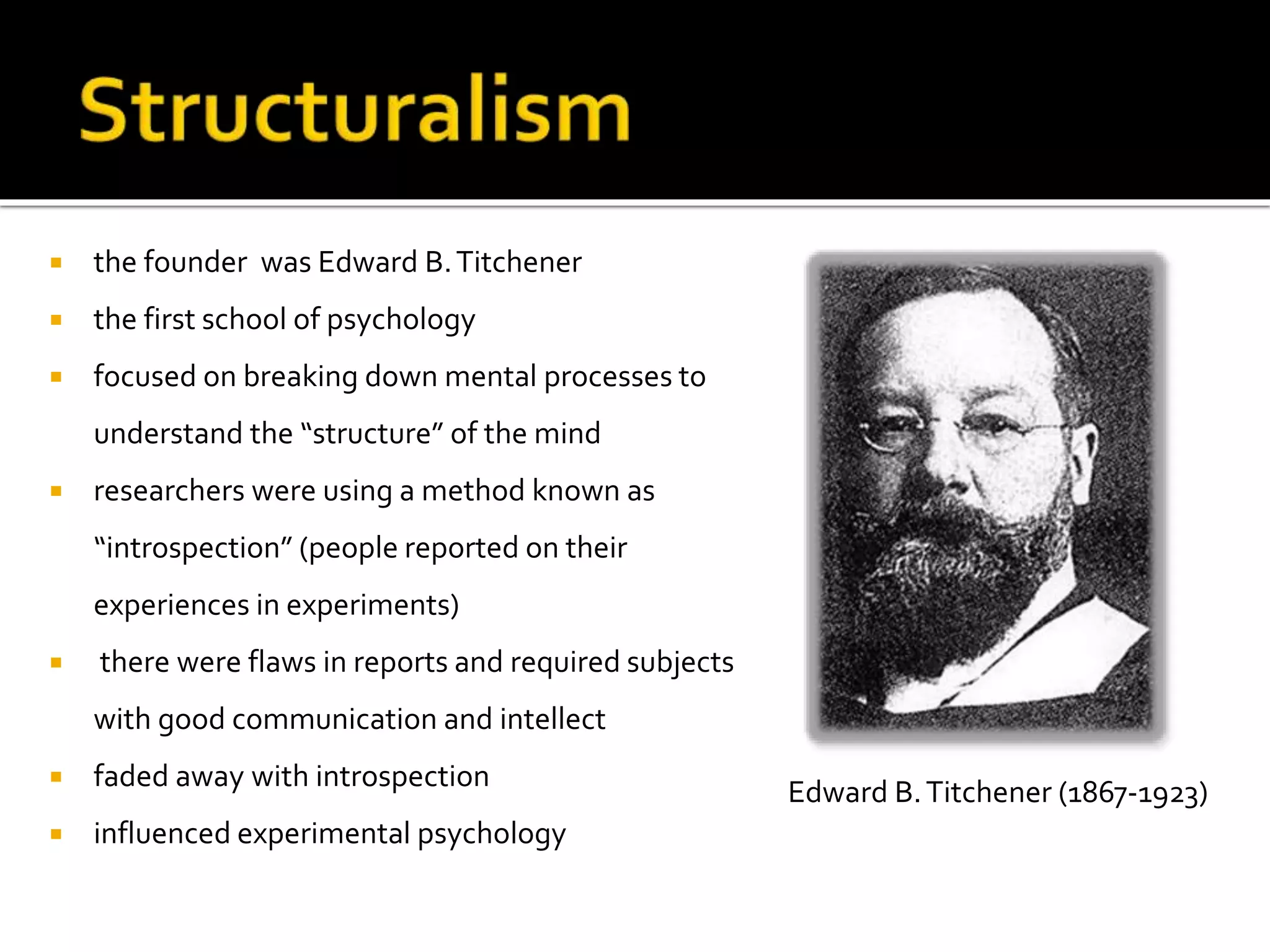
 the founder was Edward B. Titchener 
 the first school of psychology 
 focused on breaking down mental processes to 
understand the “structure” of the mind 
 researchers were using a method known as 
“introspection” (people reported on their 
experiences in experiments) 
 there were flaws in reports and required subjects 
with good communication and intellect 
 faded away with introspection 
 influenced experimental psychology 
Edward B. Titchener (1867-1923)
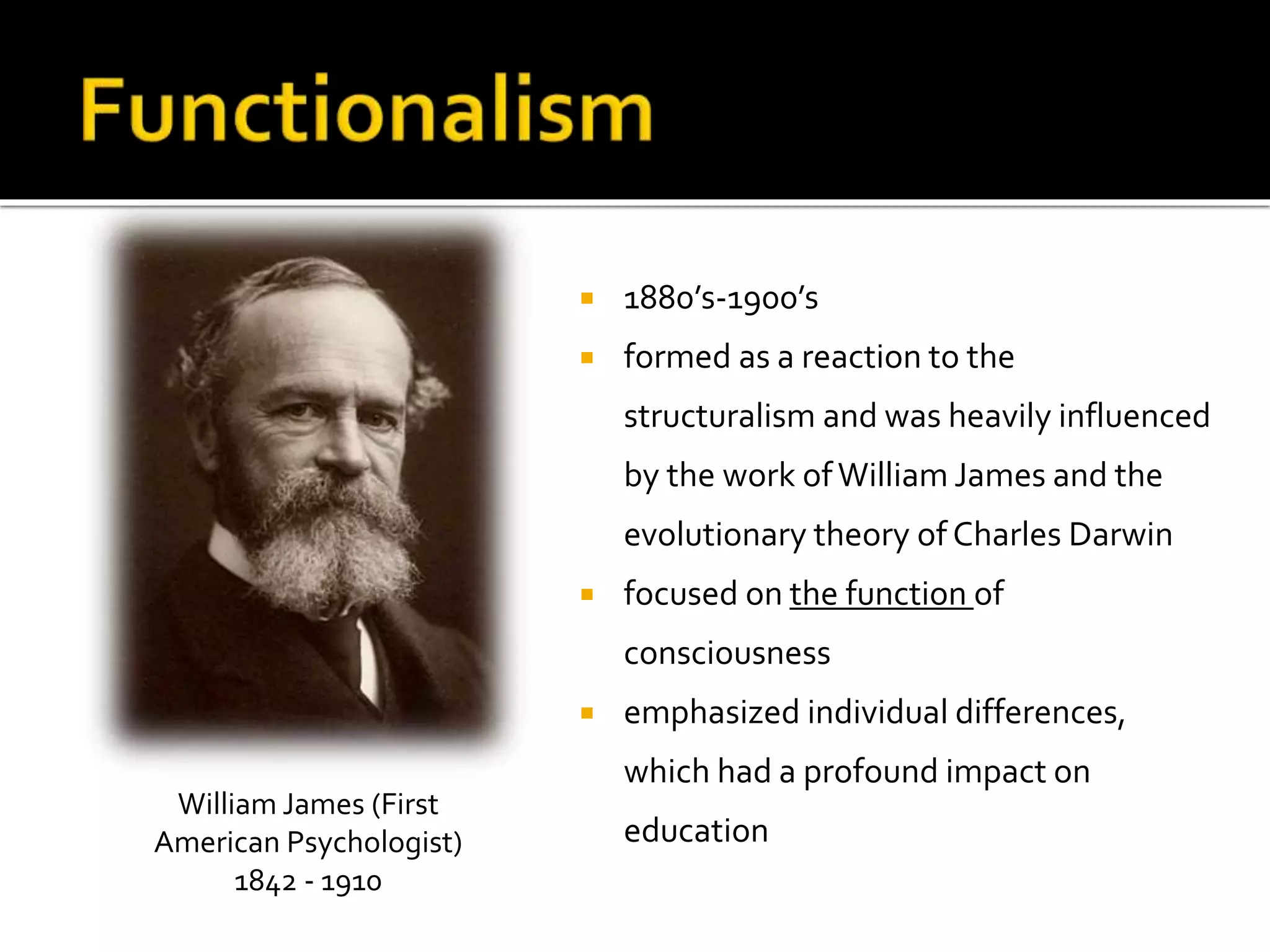
 1880’s-1900’s 
 formed as a reaction to the 
structuralism and was heavily influenced 
by the work of William James and the 
evolutionary theory of Charles Darwin 
 focused on the function of 
consciousness 
 emphasized individual differences, 
which had a profound impact on 
education 
William James (First 
American Psychologist) 
1842 - 1910
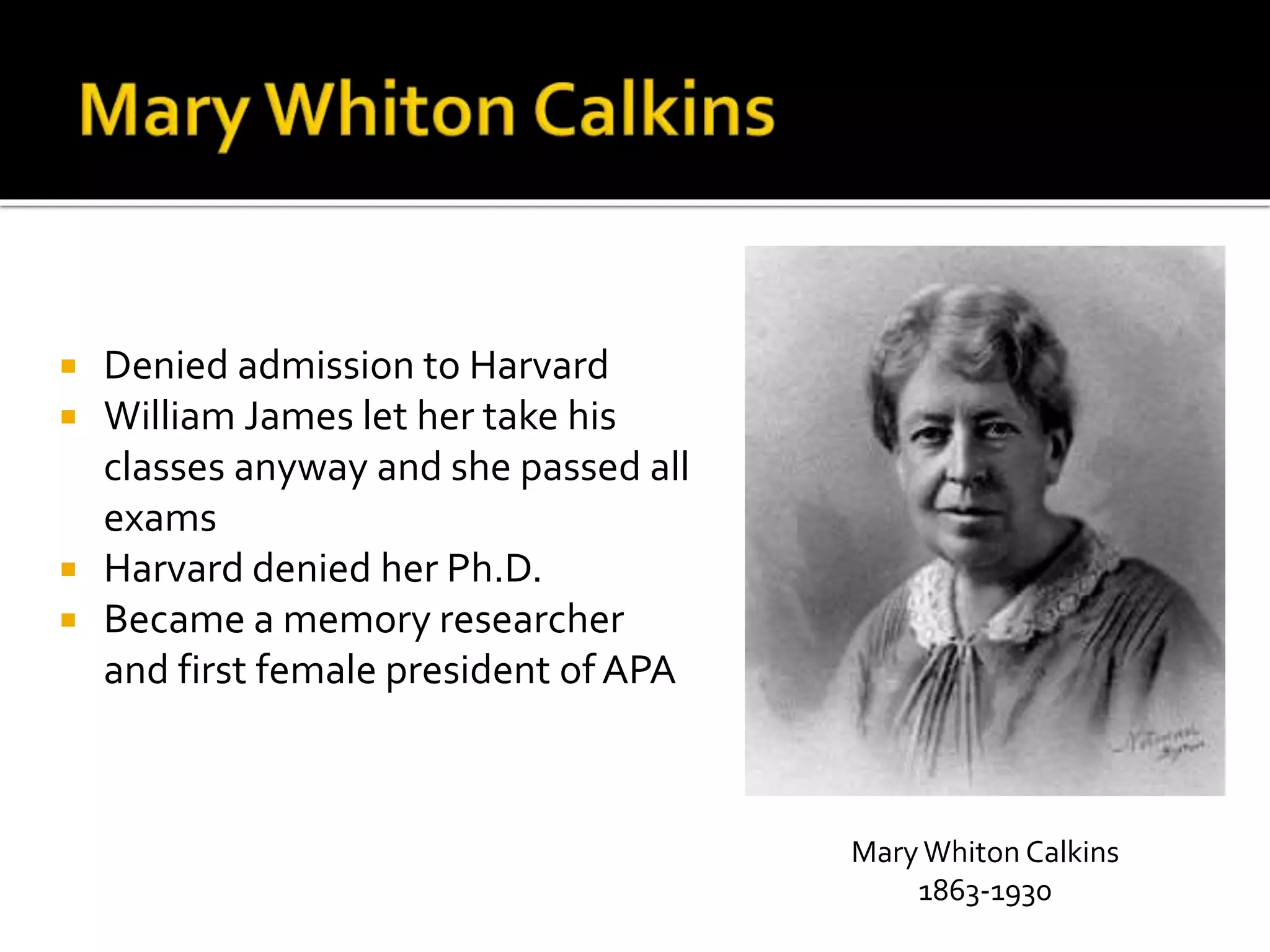
 Denied admission to Harvard 
 William James let her take his 
classes anyway and she passed all 
exams 
 Harvard denied her Ph.D. 
 Became a memory researcher 
and first female president of APA 
Mary Whiton Calkins 
1863-1930
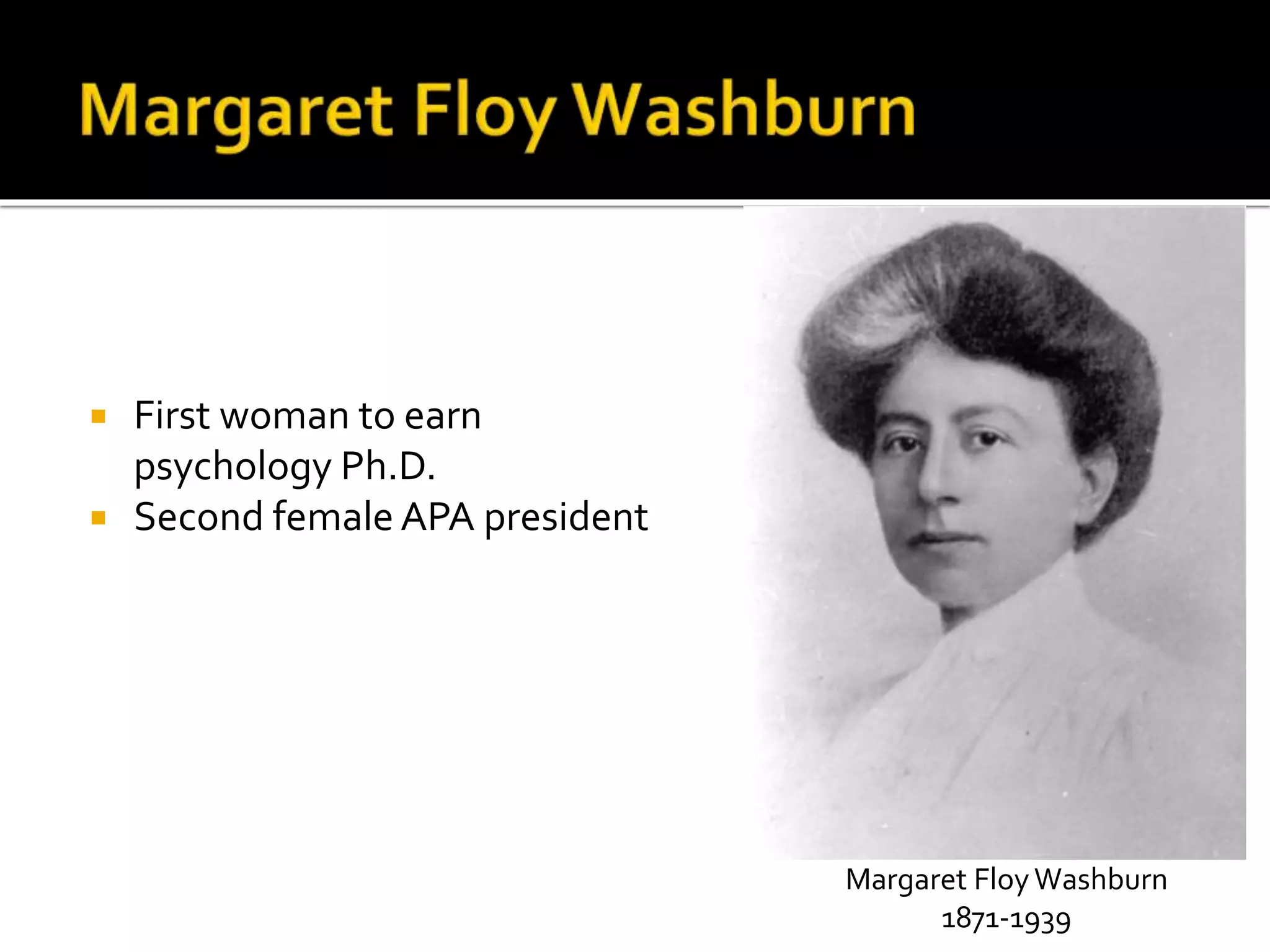
 First woman to earn 
psychology Ph.D. 
 Second female APA president 
Margaret Floy Washburn 
1871-1939
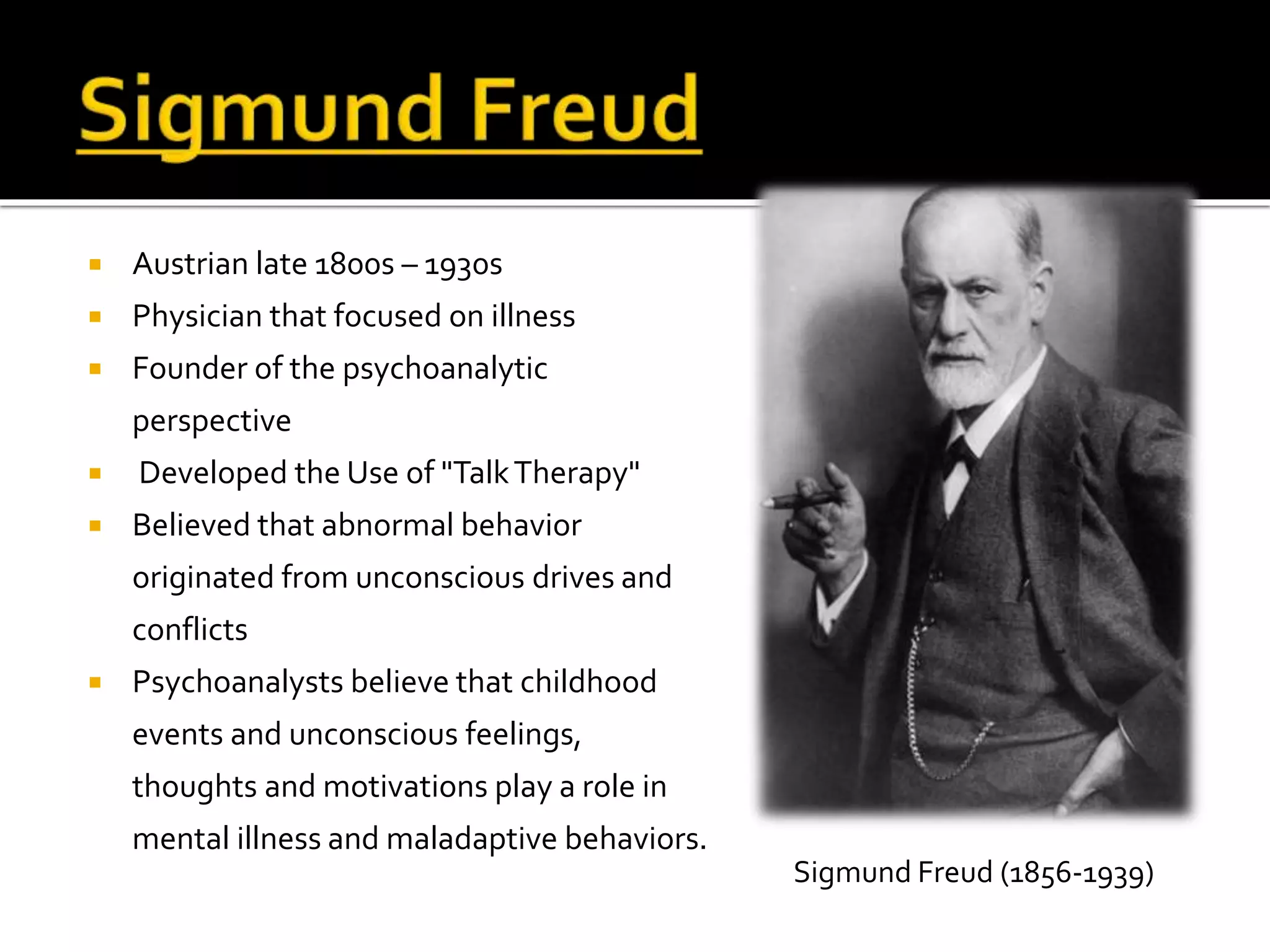
 Austrian late 1800s – 1930s 
 Physician that focused on illness 
 Founder of the psychoanalytic 
perspective 
 Developed the Use of "Talk Therapy" 
 Believed that abnormal behavior 
originated from unconscious drives and 
conflicts 
 Psychoanalysts believe that childhood 
events and unconscious feelings, 
thoughts and motivations play a role in 
mental illness and maladaptive behaviors. 
Sigmund Freud (1856-1939)
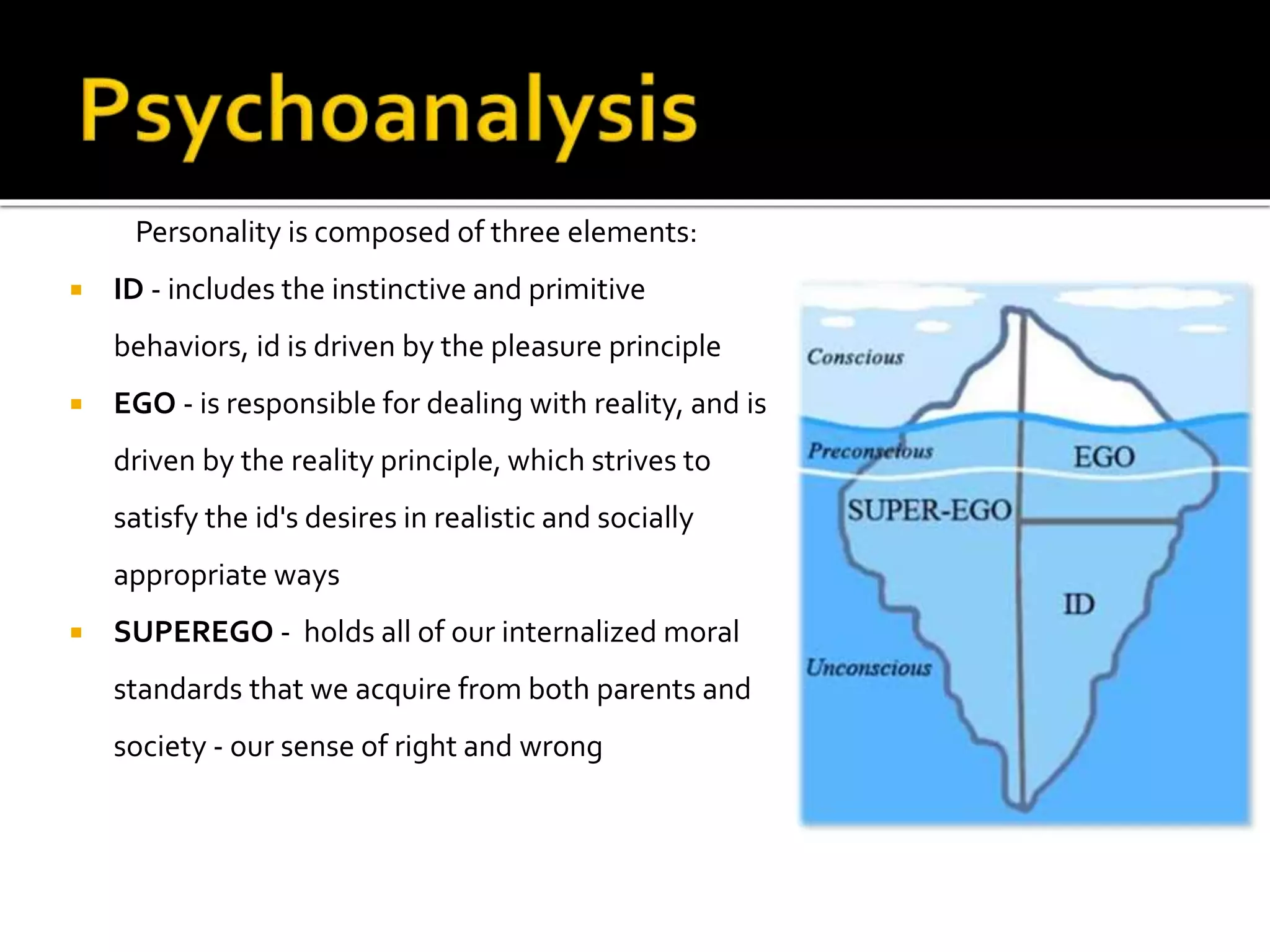
Personality is composed of three elements: 
 ID - includes the instinctive and primitive 
behaviors, id is driven by the pleasure principle 
 EGO - is responsible for dealing with reality, and is 
driven by the reality principle, which strives to 
satisfy the id's desires in realistic and socially 
appropriate ways 
 SUPEREGO - holds all of our internalized moral 
standards that we acquire from both parents and 
society - our sense of right and wrong
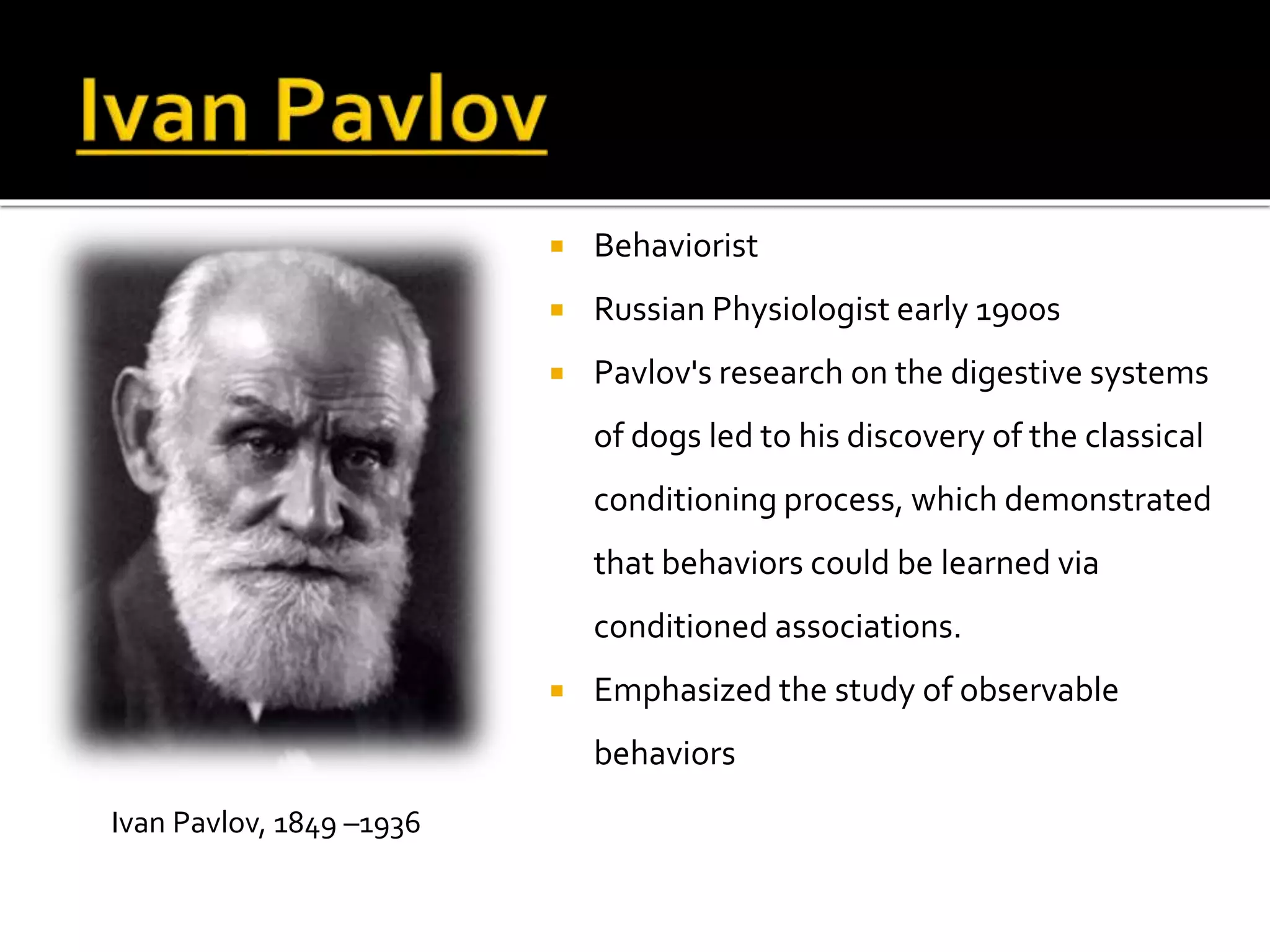
 Behaviorist 
 Russian Physiologist early 1900s 
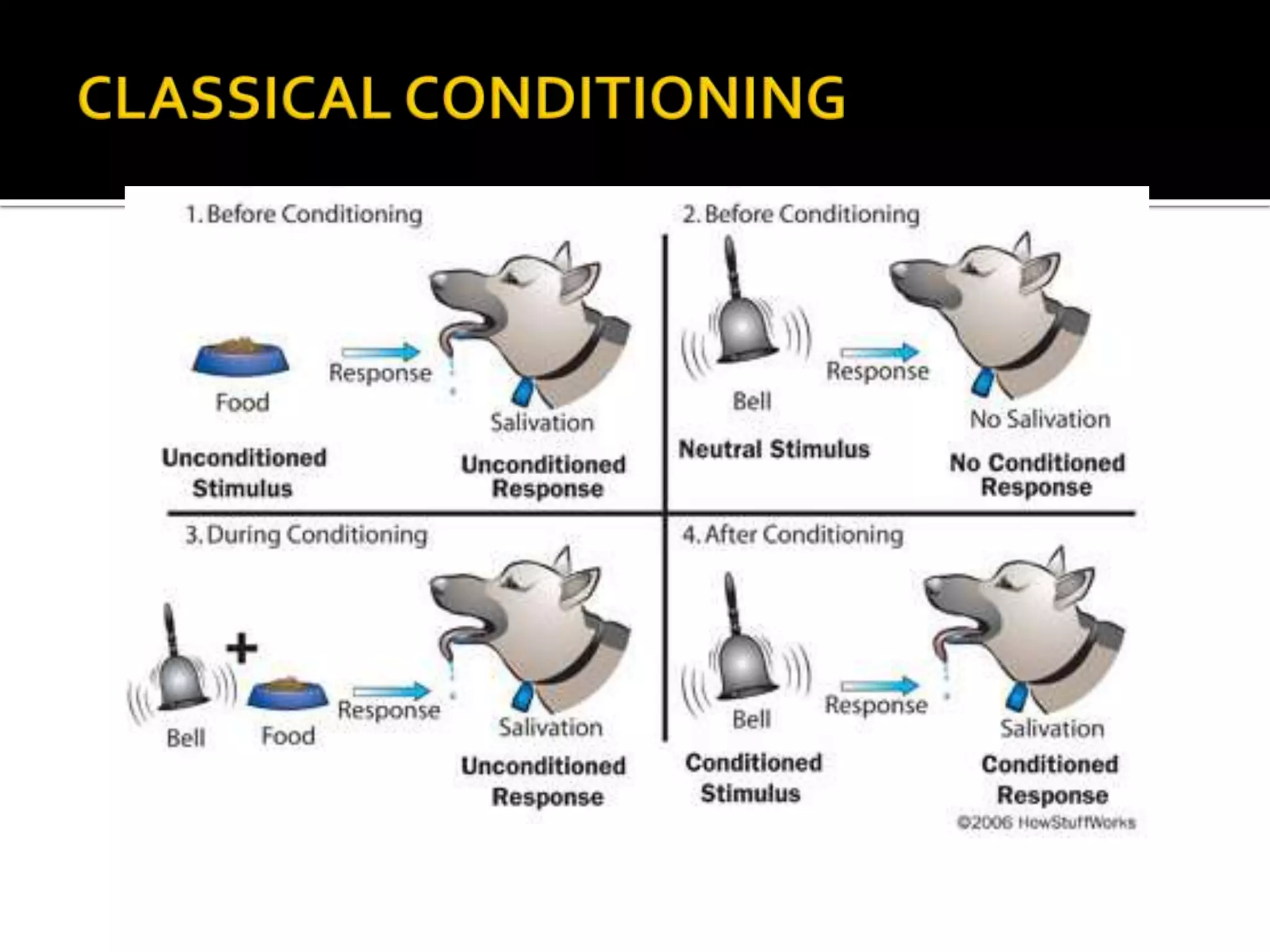
 Pavlov's research on the digestive systems 
of dogs led to his discovery of the classical 
conditioning process, which demonstrated 
that behaviors could be learned via 
conditioned associations. 
 Emphasized the study of observable 
behaviors 
Ivan Pavlov, 1849 –1936
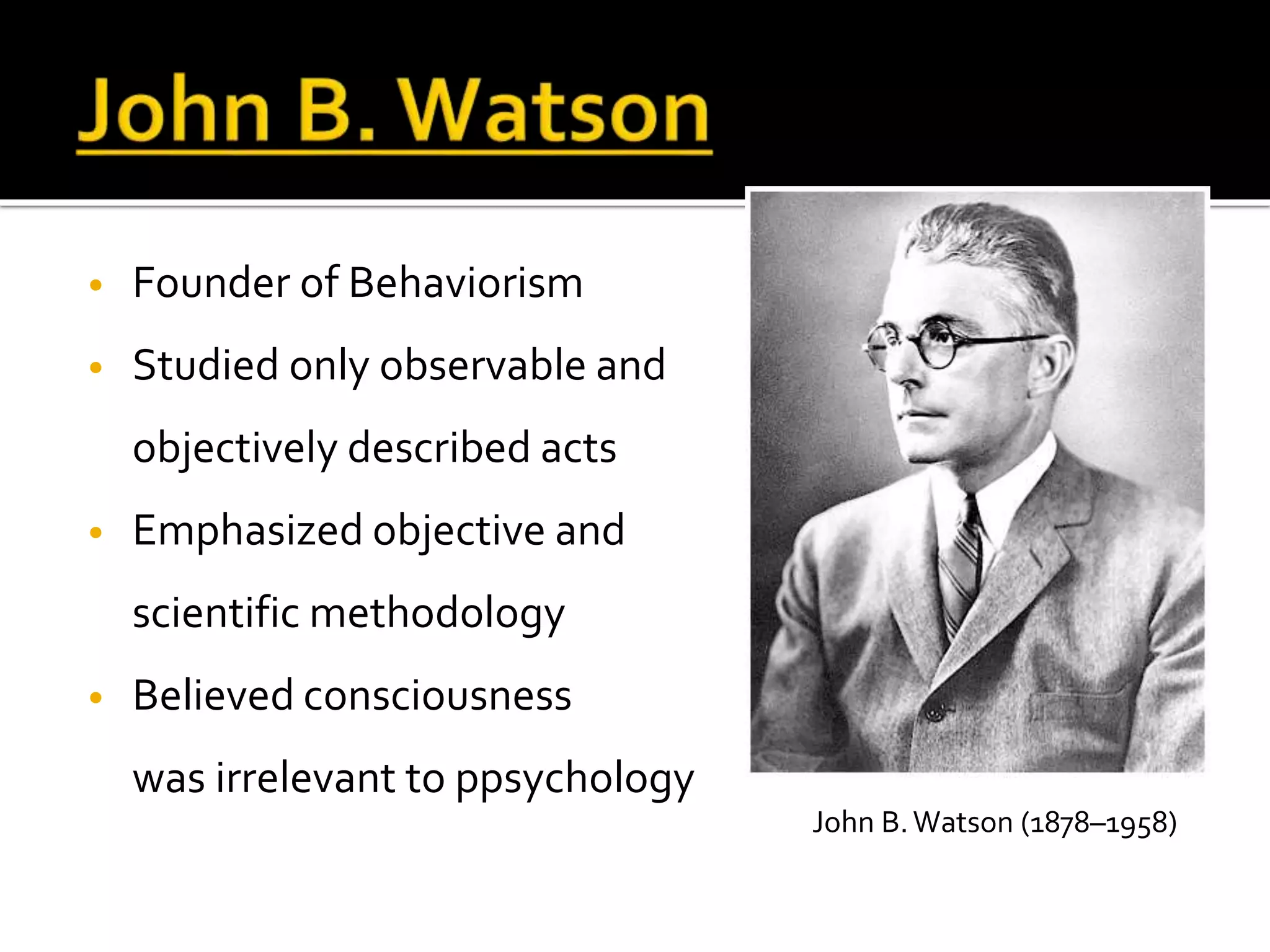
• Founder of Behaviorism 
• Studied only observable and 
objectively described acts 
• Emphasized objective and 
scientific methodology 
• Believed consciousness 
was irrelevant to ppsychology 
John B. Watson (1878–1958)
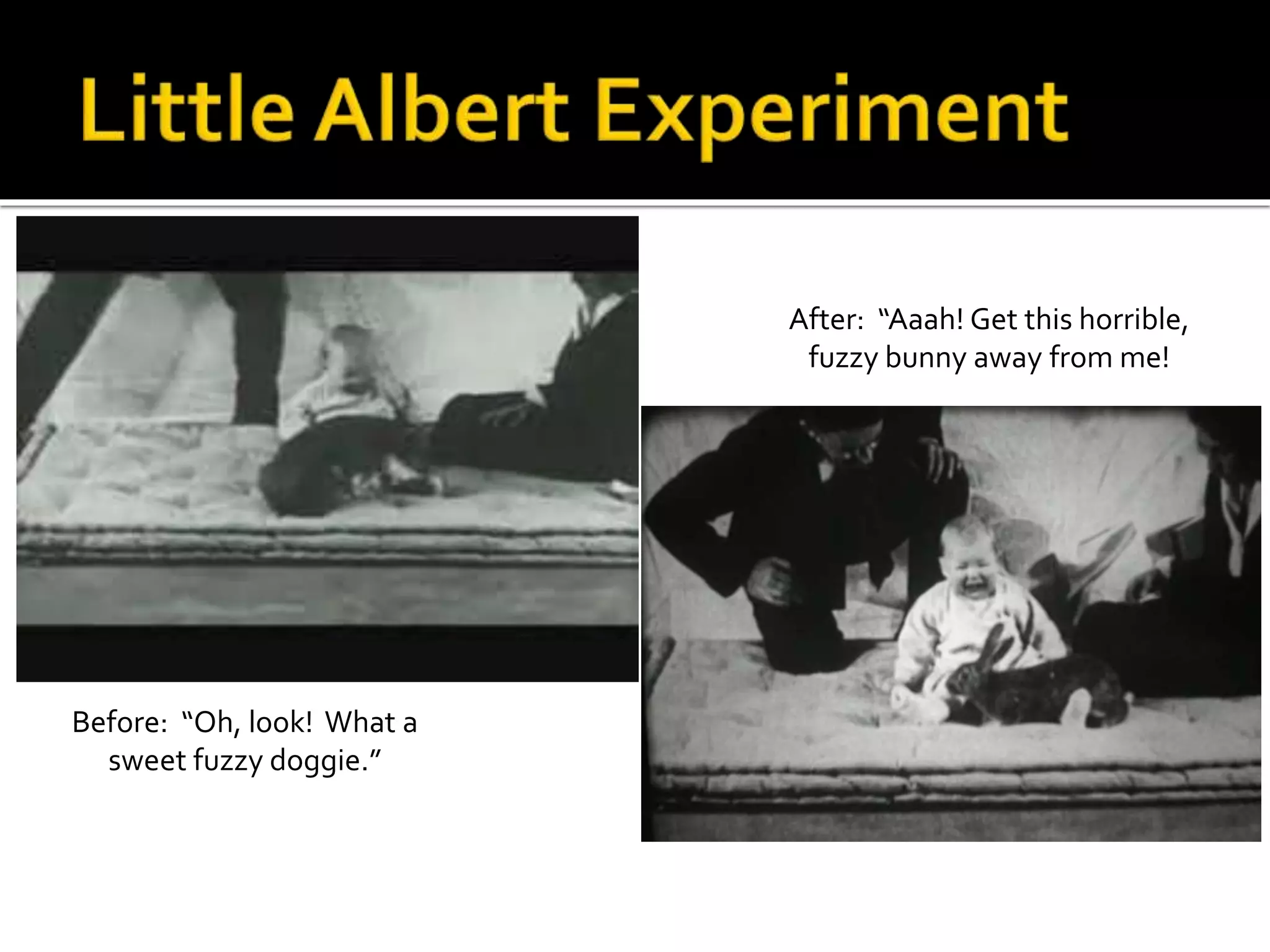
Before: “Oh, look! What a 
sweet fuzzy doggie.” 
After: “Aaah! Get this horrible, 
fuzzy bunny away from me!
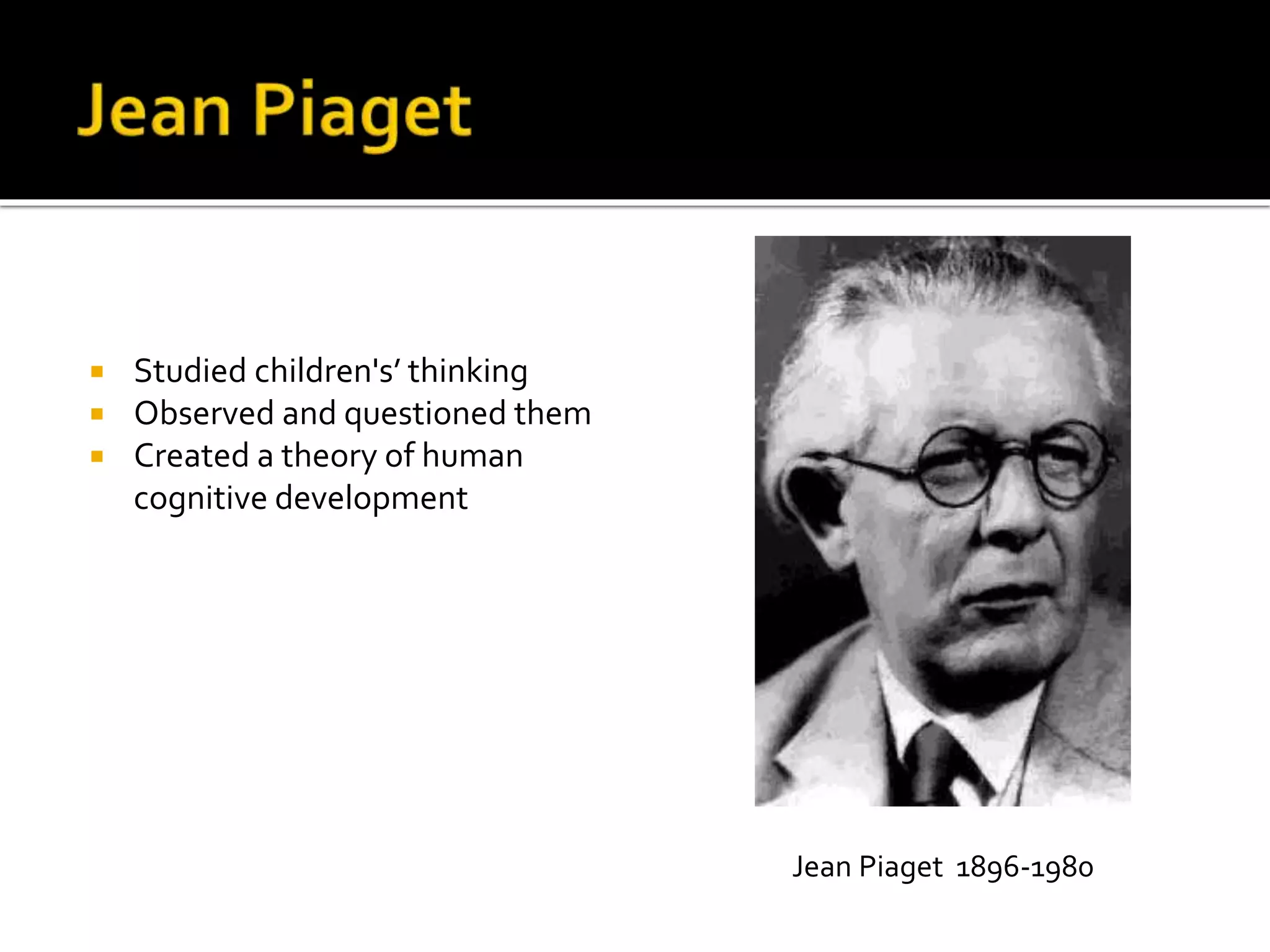
 Studied children's’ thinking 
 Observed and questioned them 
 Created a theory of human 
cognitive development 
Jean Piaget 1896-1980
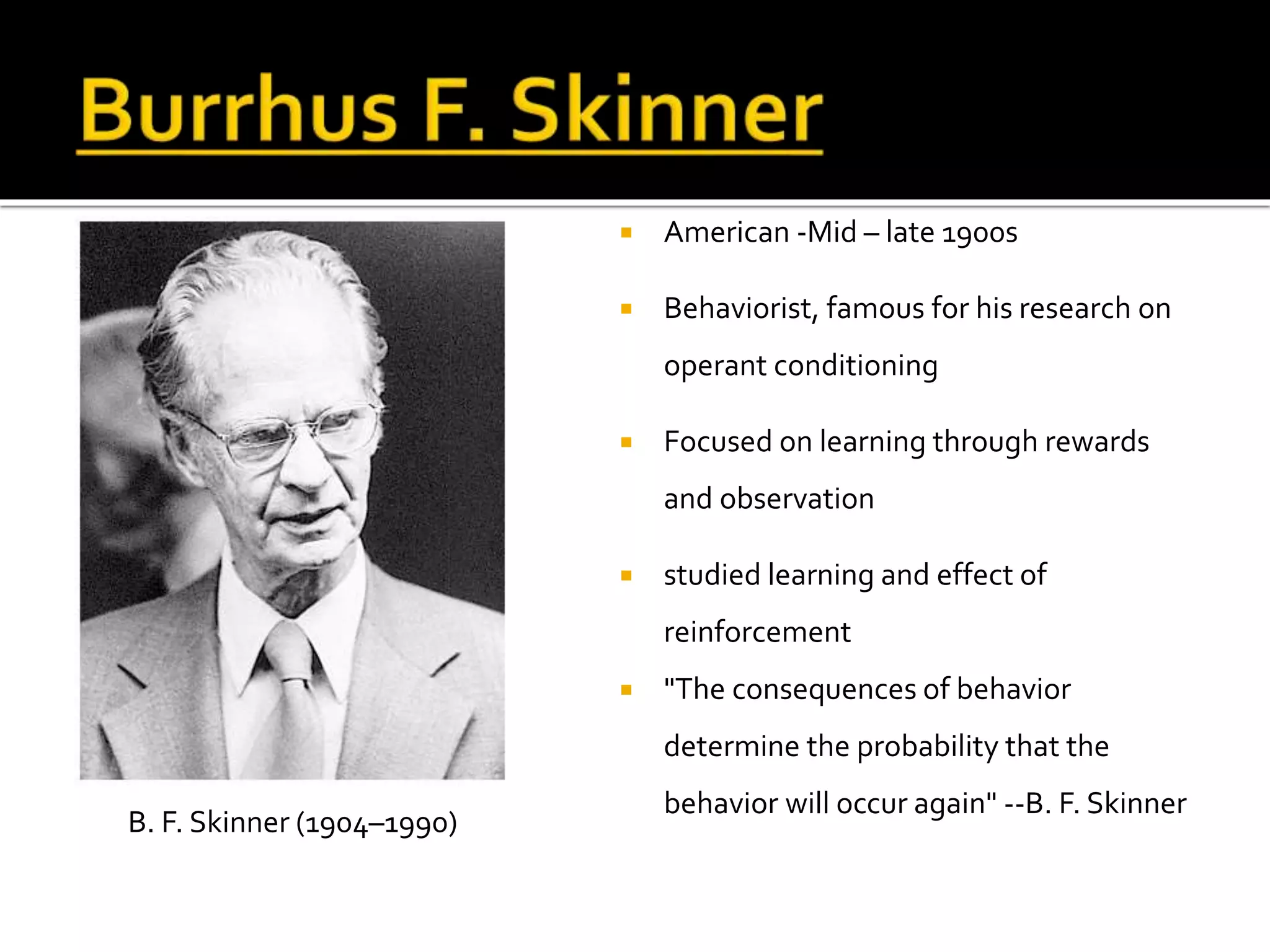
 American -Mid – late 1900s 
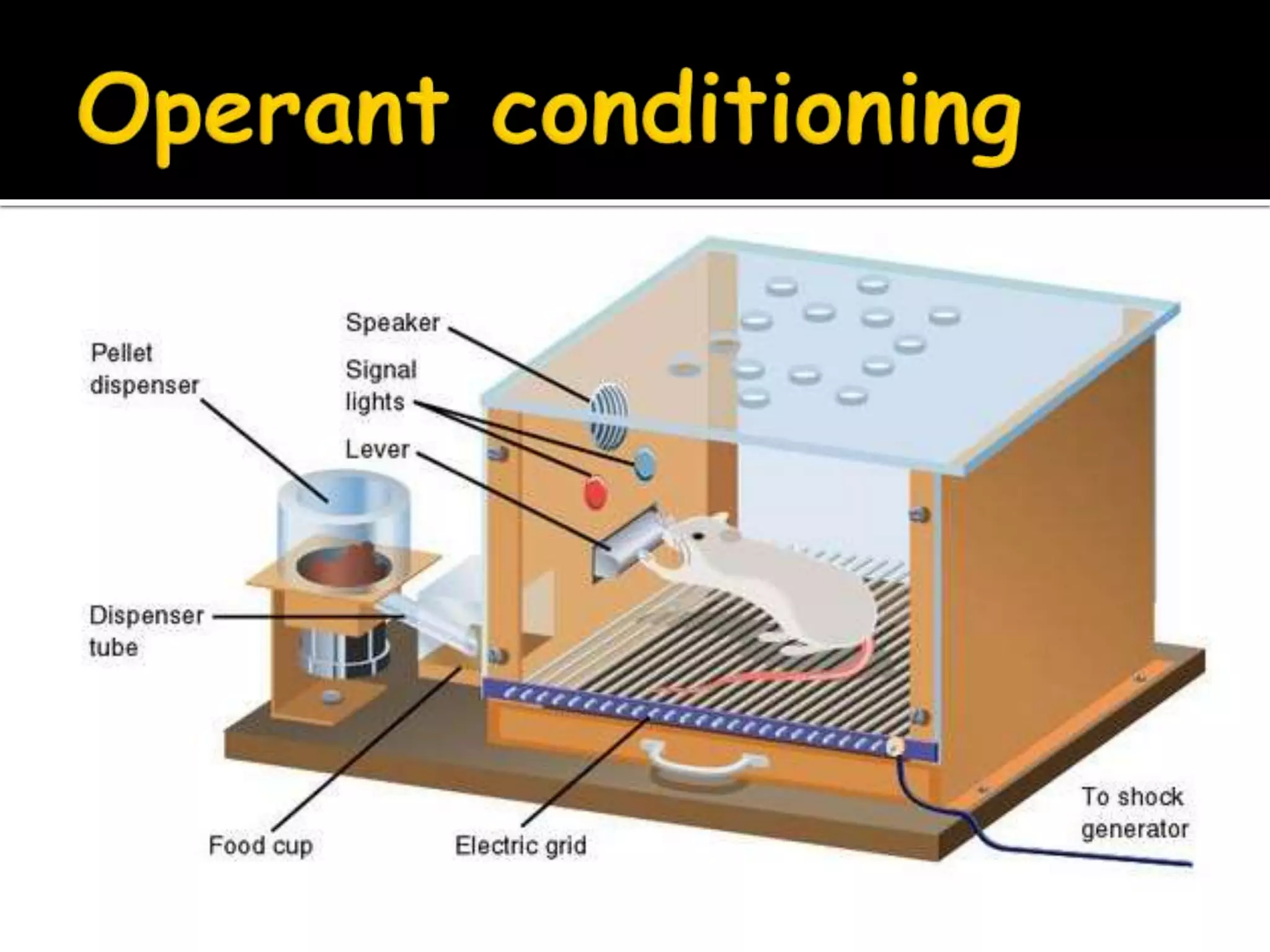
 Behaviorist, famous for his research on 
operant conditioning 
 Focused on learning through rewards 
and observation 
 studied learning and effect of 
reinforcement 
 "The consequences of behavior 
determine the probability that the 
behavior will occur again" --B. F. Skinner 
B. F. Skinner (1904–1990)
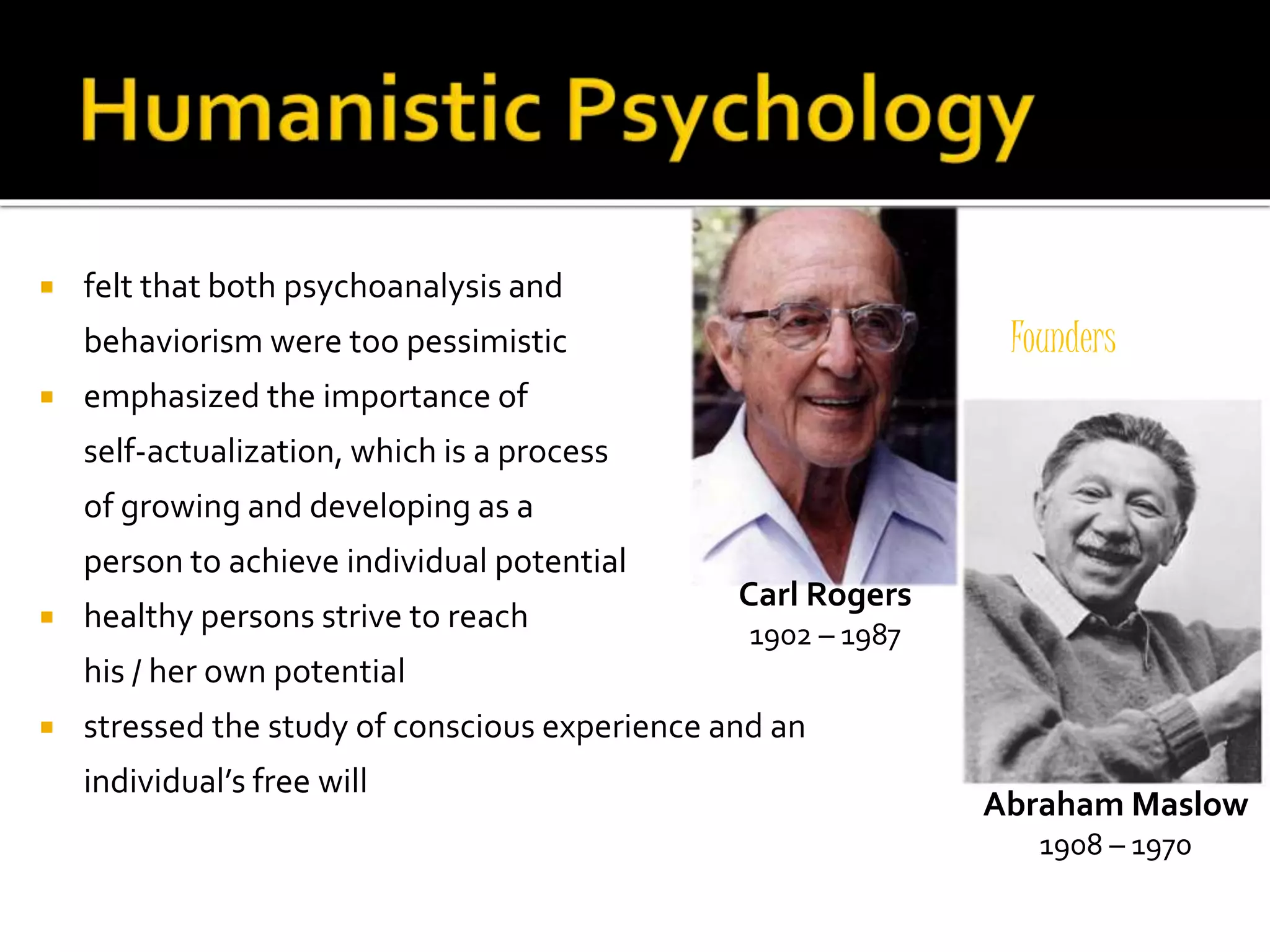
 felt that both psychoanalysis and 
behaviorism were too pessimistic 
 emphasized the importance of 
self-actualization, which is a process 
of growing and developing as a 
person to achieve individual potential 
 healthy persons strive to reach 
his / her own potential 
 stressed the study of conscious experience and an 
individual’s free will 
Founders 
Carl Rogers 
1902 – 1987 
Abraham Maslow 
1908 – 1970
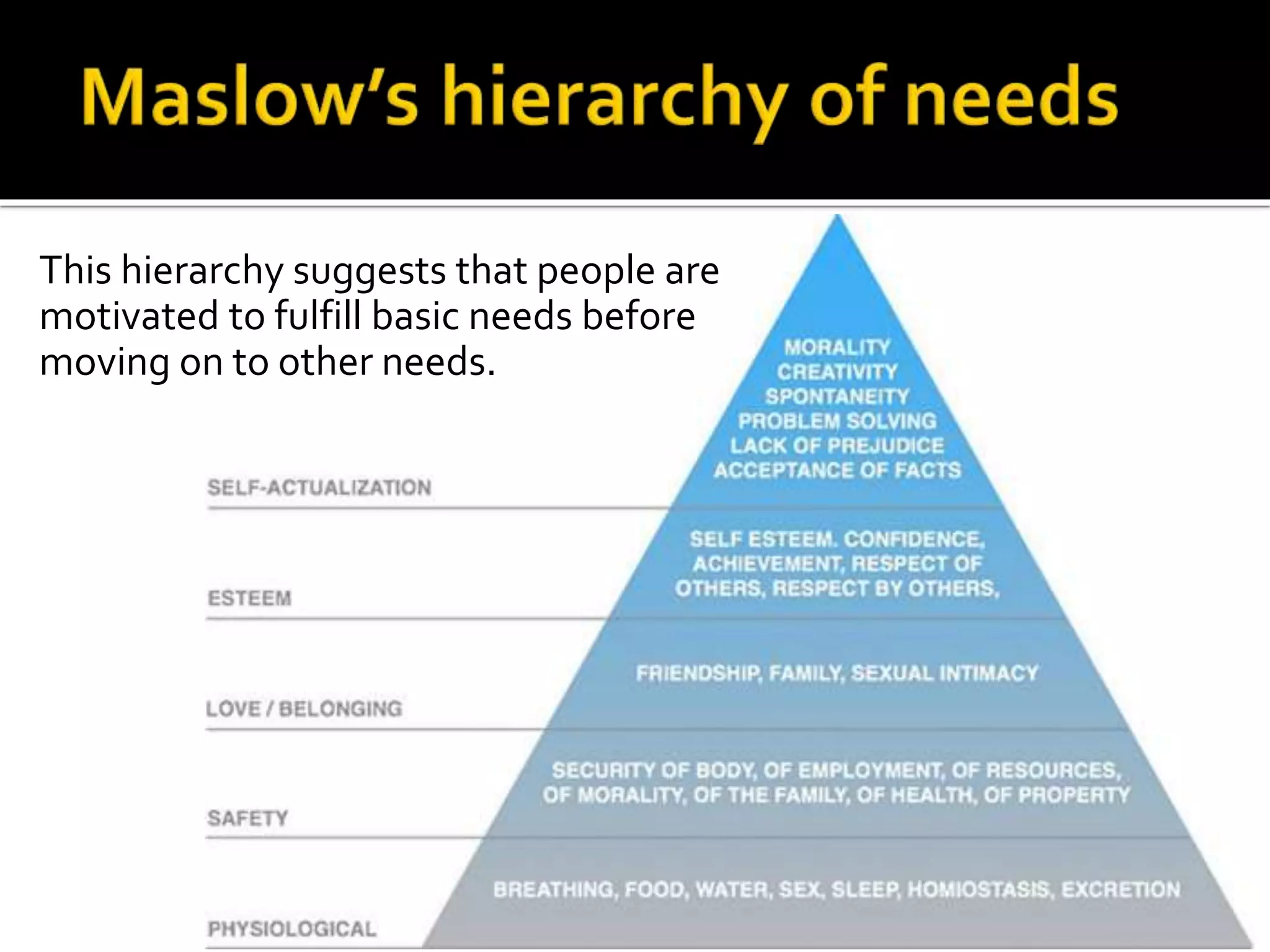
This hierarchy suggests that people are 
motivated to fulfill basic needs before 
moving on to other needs.
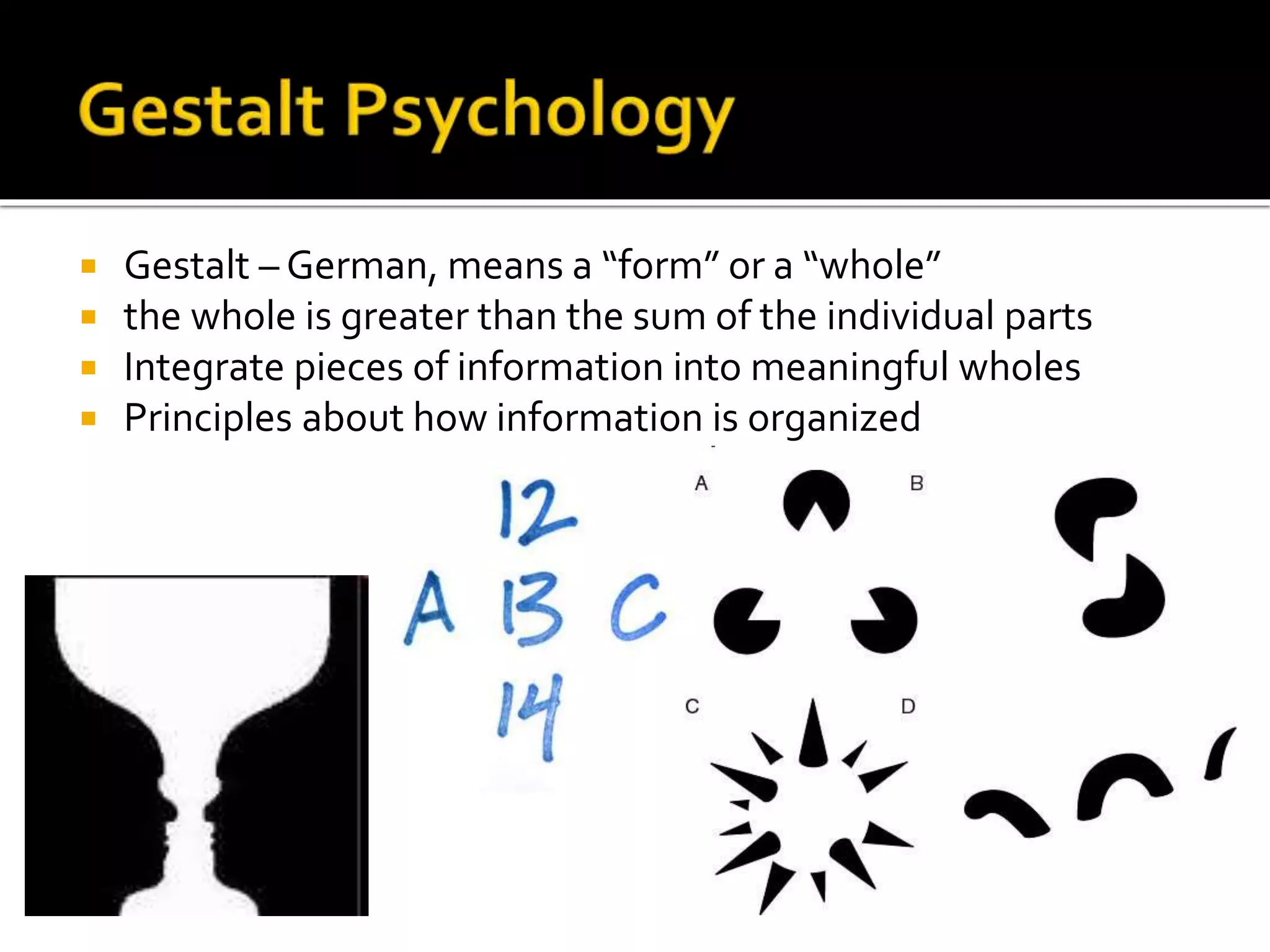
 Gestalt – German, means a “form” or a “whole” 
 the whole is greater than the sum of the individual parts 
 Integrate pieces of information into meaningful wholes 
 Principles about how information is organized
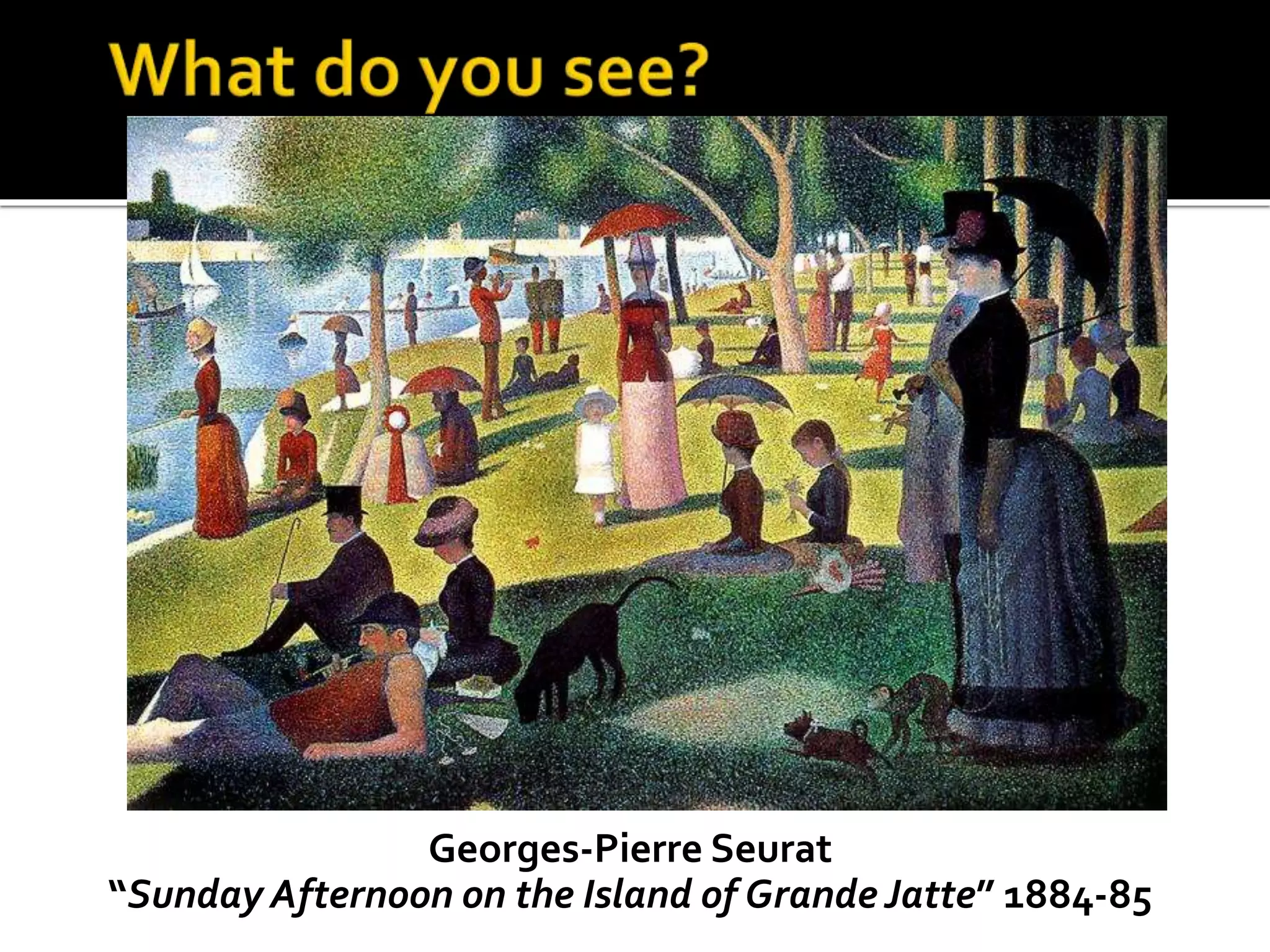
Georges-Pierre Seurat 
“Sunday Afternoon on the Island of Grande Jatte” 1884-85
 What do you think?
 Nature vs. Nurture 
 Something occurred in life to make you that way 
OR 
 You came out of the womb that way

History ppt

  • 1.
  • 2.
     The scientificstudy of human and animal behavior
  • 3.
     Pretty muchANYTHING that you do, think or feel.
  • 4.
     Research: Studies why things happen.  Deals with theories and lab experiments ▪ “Lab tests show people’s anxiety level increases when surrounded by the color red.”  Applied:  Figures out how to USE information found by researchers  “NASA scientists study which colors to paint the inside of the International Space Station”
  • 5.
     Separated fromphilosophy in the middle of 19th century with roots in biology  Psychology" comes from the Greek words:  "psyche" meaning mind or soul,  and "logos", meaning reason. Reasoning about soul – philosophy of the mind
  • 6.
     Starting inthe 1840’s fought for humane treatment of people with psychological disorders, in the US Dorothea Dix 1802-1887 Holding Chair
  • 7.
    – Not apsychologist – Developed theory of evolution – Believed we can study animals to understand ourselves – Explained animal diversity as evolutionary process: “natural selection” Charles Darwin (1809-1882)
  • 8.
    – Germany 1880’s – The “father of psychology” – Founder of modern psychology – Opened the first psychology lab in 1879 – applied laboratory techniques to study of the mind – was using scientific research methods to investigate reaction times – use the process known as introspection Wilhelm Wundt (1832–1920)
  • 10.
     American graduatestudent of WilhemWundt  Established first formal US psych lab at Johns Hopkins University G. Stanley Hall 1844-1924
  • 11.
     the founderwas Edward B. Titchener  the first school of psychology  focused on breaking down mental processes to understand the “structure” of the mind  researchers were using a method known as “introspection” (people reported on their experiences in experiments)  there were flaws in reports and required subjects with good communication and intellect  faded away with introspection  influenced experimental psychology Edward B. Titchener (1867-1923)
  • 12.
     1880’s-1900’s formed as a reaction to the structuralism and was heavily influenced by the work of William James and the evolutionary theory of Charles Darwin  focused on the function of consciousness  emphasized individual differences, which had a profound impact on education William James (First American Psychologist) 1842 - 1910
  • 13.
     Denied admissionto Harvard  William James let her take his classes anyway and she passed all exams  Harvard denied her Ph.D.  Became a memory researcher and first female president of APA Mary Whiton Calkins 1863-1930
  • 14.
     First womanto earn psychology Ph.D.  Second female APA president Margaret Floy Washburn 1871-1939
  • 15.
     Austrian late1800s – 1930s  Physician that focused on illness  Founder of the psychoanalytic perspective  Developed the Use of "Talk Therapy"  Believed that abnormal behavior originated from unconscious drives and conflicts  Psychoanalysts believe that childhood events and unconscious feelings, thoughts and motivations play a role in mental illness and maladaptive behaviors. Sigmund Freud (1856-1939)
  • 16.
    Personality is composedof three elements:  ID - includes the instinctive and primitive behaviors, id is driven by the pleasure principle  EGO - is responsible for dealing with reality, and is driven by the reality principle, which strives to satisfy the id's desires in realistic and socially appropriate ways  SUPEREGO - holds all of our internalized moral standards that we acquire from both parents and society - our sense of right and wrong
  • 17.
     Behaviorist Russian Physiologist early 1900s  Pavlov's research on the digestive systems of dogs led to his discovery of the classical conditioning process, which demonstrated that behaviors could be learned via conditioned associations.  Emphasized the study of observable behaviors Ivan Pavlov, 1849 –1936
  • 19.
    • Founder ofBehaviorism • Studied only observable and objectively described acts • Emphasized objective and scientific methodology • Believed consciousness was irrelevant to ppsychology John B. Watson (1878–1958)
  • 20.
    Before: “Oh, look!What a sweet fuzzy doggie.” After: “Aaah! Get this horrible, fuzzy bunny away from me!
  • 21.
     Studied children's’thinking  Observed and questioned them  Created a theory of human cognitive development Jean Piaget 1896-1980
  • 22.
     American -Mid– late 1900s  Behaviorist, famous for his research on operant conditioning  Focused on learning through rewards and observation  studied learning and effect of reinforcement  "The consequences of behavior determine the probability that the behavior will occur again" --B. F. Skinner B. F. Skinner (1904–1990)
  • 24.
     felt thatboth psychoanalysis and behaviorism were too pessimistic  emphasized the importance of self-actualization, which is a process of growing and developing as a person to achieve individual potential  healthy persons strive to reach his / her own potential  stressed the study of conscious experience and an individual’s free will Founders Carl Rogers 1902 – 1987 Abraham Maslow 1908 – 1970
  • 25.
    This hierarchy suggeststhat people are motivated to fulfill basic needs before moving on to other needs.
  • 26.
     Gestalt –German, means a “form” or a “whole”  the whole is greater than the sum of the individual parts  Integrate pieces of information into meaningful wholes  Principles about how information is organized
  • 27.
    Georges-Pierre Seurat “SundayAfternoon on the Island of Grande Jatte” 1884-85
  • 28.
     What doyou think?
  • 29.
     Nature vs.Nurture  Something occurred in life to make you that way OR  You came out of the womb that way