History of Psychology:
Aristotle, before 30 BC
Greek naturalist and
philosopher who theorized
about learning, memory,
motivation, emotion,
perception, and personality.
Charles Darwin:
1850s
 Studied the evolution
of finches and expands
his study to include humans.
 Opposed religious teachings of
the time by suggesting that
man was a common ancestor
to lower species.
Birth of Psychology
Wilhelm Wundt:
Father of Psychology
 1879: Leipzig, Germany.
 Intended to make psychology
a reputable science.
 Many American psychologists
eventually went on to study
in Leipzeig.
Wilhelm Wundt:
Father of Psychology
 Most of his experiments on
sensation and perception.
 Did not think that high order mental
processes could be studied
experimentally.
 Trained in medicine and philosophy.
 Wrote many books about psychology,
philosophy, ethics, and logic.
American Psychological
Association (APA)
Founded in 1892:
the governing body of all
research not conducted
by universities.
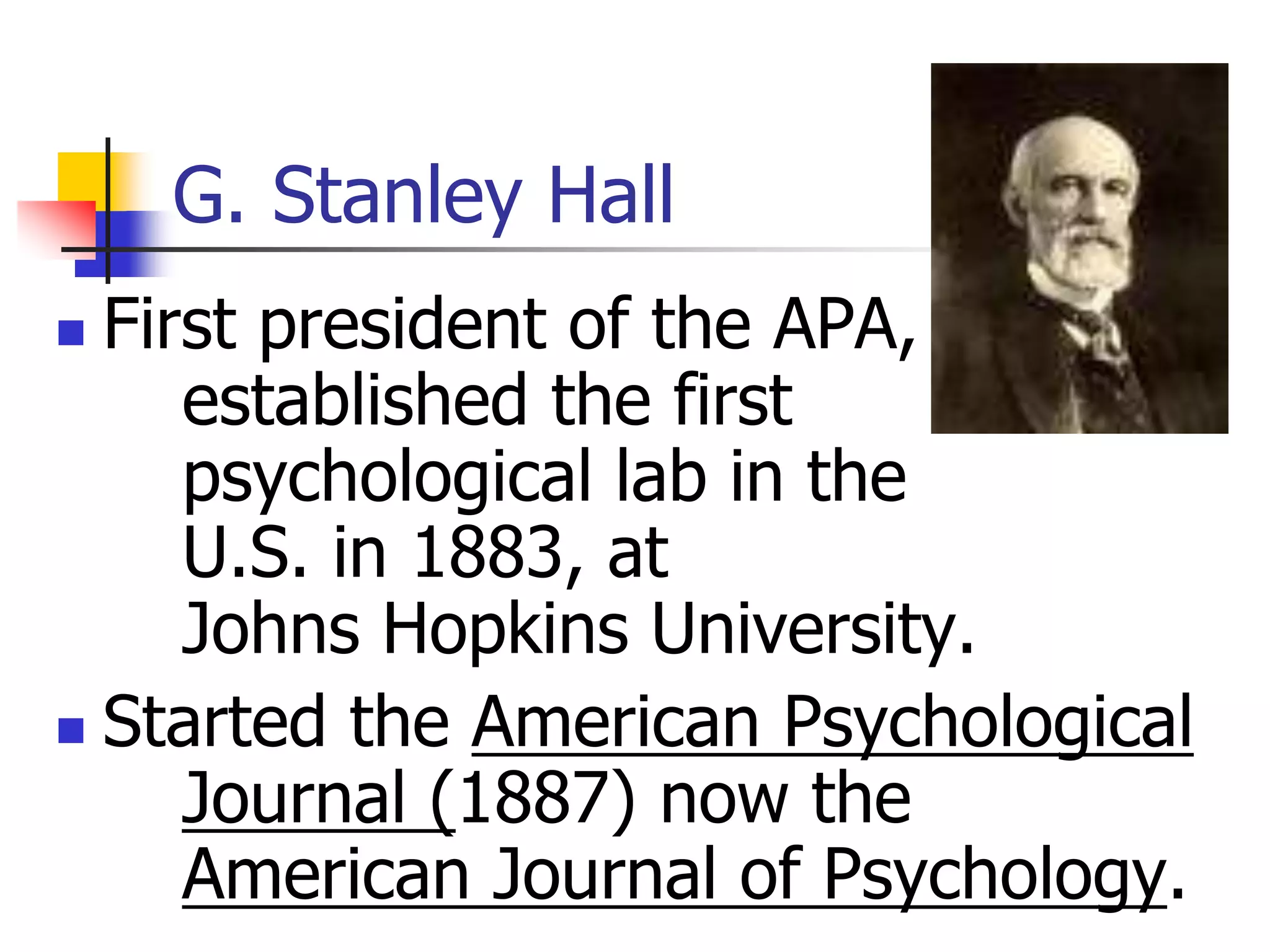
G. Stanley Hall
 First president of the APA,
established the first
psychological lab in the
U.S. in 1883, at
Johns Hopkins University.
 Started the American Psychological
Journal (1887) now the
American Journal of Psychology.
Can you read this?
This is bcuseae the
huammn mnid deos not
raed ervey lteter by
istlef, but the word as a
wlohe. Amzanig, huh?
Introspection
Looking inward at one’s
own mental processes.
Because it is not
objective, it fails
miserably.
E.B. Titchener
 Wundt’s student.
 Taught at Cornell University.
Studied nature of mental
experiences.
 Structuralism: Analyze
sensations, images and feelings
into their most basic elements.
William James:
1842-1910
 Claimed that searching for building
blocks was a waste of time
because brain and mind are constantly
changing: focused on function.
 Functionalism. Underlying causes and
practical consequences of certain
behaviors and mental strategies:
“Stream of Consciousness.”
 Expanded psychology to animal behavior.
Eclecticism
 Utilizing of diverse theories and schools
of thought.
 Mosaic, no single approach can create
the whole picture.
 Unlikely for psychology to ever have a
unifying paradigm.
 Grand theories replaced by more specific
ones.
Present Day Psychology
Behavioristic theory: Expanded
psychology into many groups
that could not be studied by
introspection. All behavior is
observable and measurable.
Abandoned mentalism for
behaviorism.
Behaviorism
 Ivan Pavlov, 1849-1936.
 Russian experimenter who showed
automatic/involuntary behavior in
learned responses to specific
stimuli in the environment.
 Created “Classical
Conditioning.”
Behaviorism
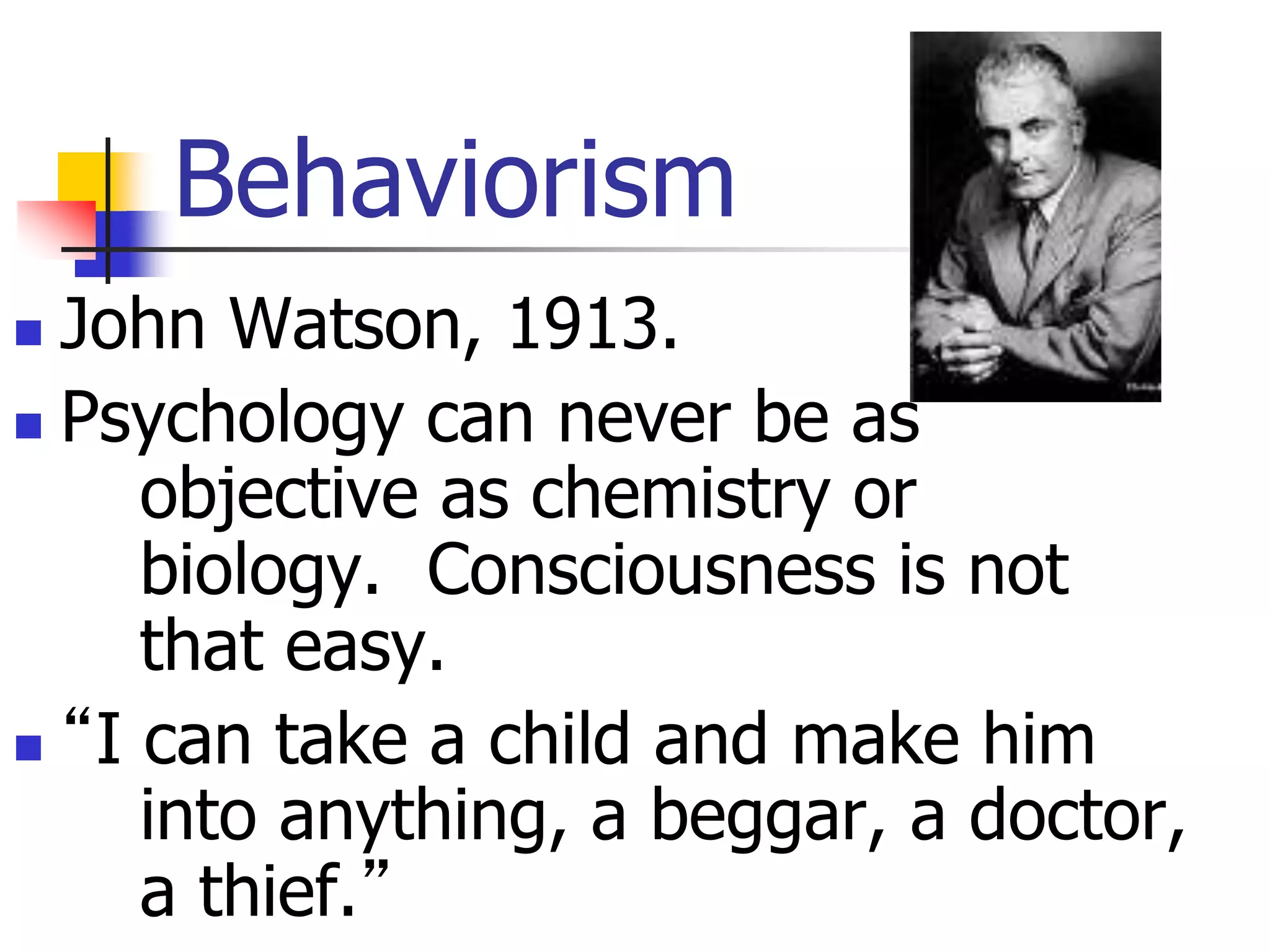
 John Watson, 1913.
 Psychology can never be as
objective as chemistry or
biology. Consciousness is not
that easy.
 “I can take a child and make him
into anything, a beggar, a doctor,
a thief.”
Behaviorism
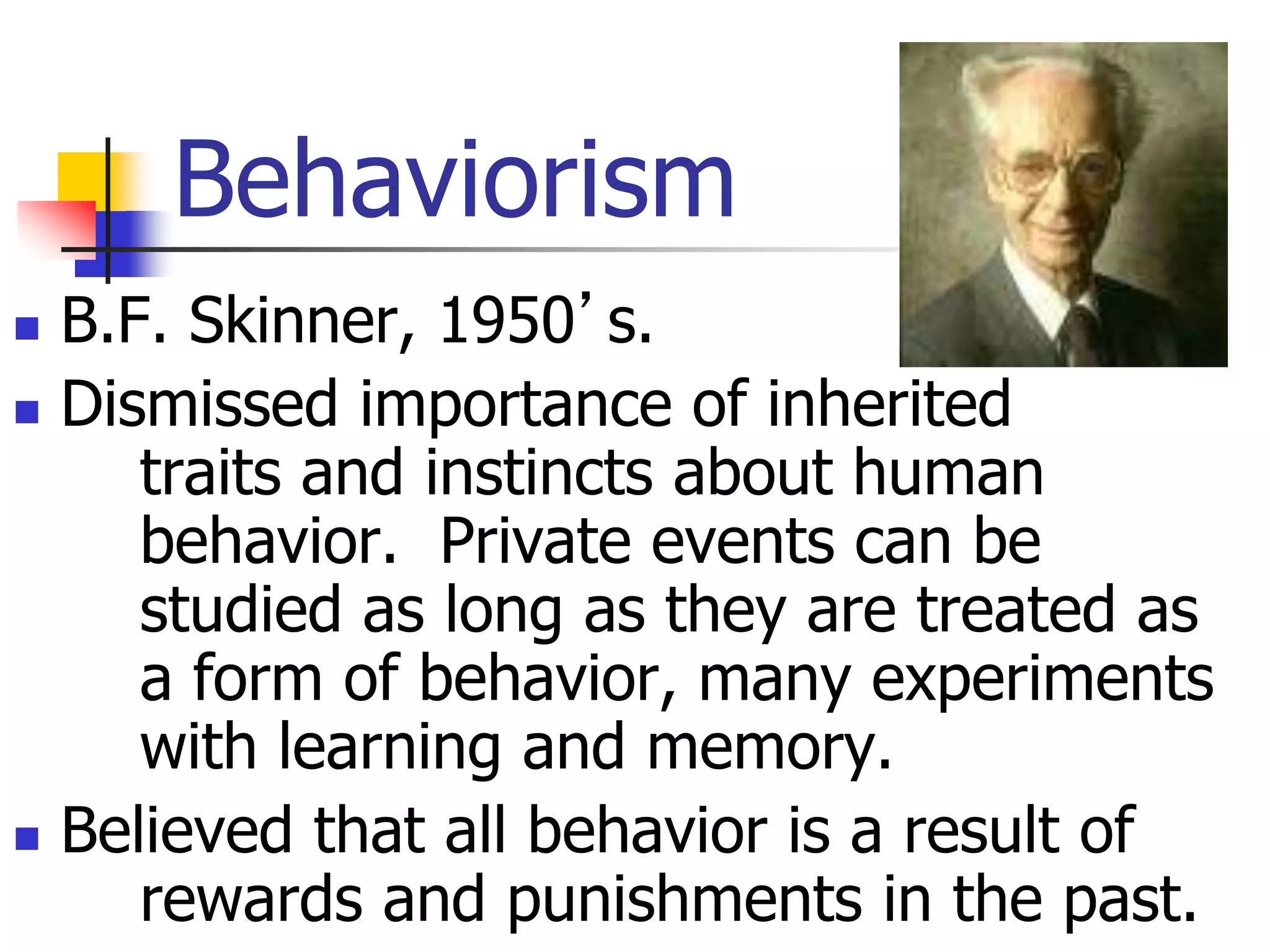
 B.F. Skinner, 1950’s.
 Dismissed importance of inherited
traits and instincts about human
behavior. Private events can be
studied as long as they are treated as
a form of behavior, many experiments
with learning and memory.
 Believed that all behavior is a result of
rewards and punishments in the past.
Behavioristic Theory
 Social Learning Theory: How people
acquire new behaviors by observing
and imitating others (modeling).
 Criticisms: Excluded all behavior that
cannot be seen. All behavior cannot
be explained by rewards and
punishments. Treats people like
robots as if they have no free-will.
Psychoanalytic Theory
 All behavior is meaningful, and
much of it is controlled by
digging below the surface to
uncover the roots of
personality.
 Sigmund Freud!!! (Da MAN!)
Psychoanalytic Theory
 Sigmund Freud, 1856-1939.
 Studied neurology, but wanted to
be a medical researcher, forced
into being a private physician.
 Became convinced that patients difficulties
were due to mental rather than physical
problems.
 Proposed that distress due to problems that
dated back to childhood.
Siggy Freud
 Psychoanalysis: Freud’s method for treating
people with emotional problems, free
association.
 Unconscious: Nearly all of our impulses are
sexual and aggressive in nature. Because
we cannot accept them in our conscious,
thoughts find their expression in dreams,
slips of the tongue that appear as
accidents, and even jokes.
Psychoanalytic Theory
 Interpretation of Dreams, 1900.
Sold 600 copies in 8 years; today sells
millions every year.
 Aggressive energy: Basic human instinct
lodged in unconscious; the duty of society
is to get people to channel their aggressive
energy into productive activity. If not,
aggression is released and violent activities
occur.
Psychoanalytic Theory
 Hidden Desires: Freud stated
that people are “cesspools of
hidden desires.”
 Unresolved Conflicts: If these
occur in childhood, this will
cause fixations in later life.
(Stages)
Psychoanalytic Theory
 Freud’s Stages: Oral (Birth - 1 yr.),
anal (1 yr.), phallic (4 yrs. - separates
males/females), latency (Puberty), genital
(adult)
 3 Personalities: Id, Ego, Superego:
 Id: Wants/Desires, Basic primal instincts.
“Pleasure Principle”
 Ego: “Reality Principle”
 Superego: Conscious mind. “Do the right
thing.”
Psychoanalytic Theory: Criticisms
 Does not focus on observable behavior,
negative viewpoint of mankind because
actions are provoked by unconscious
thoughts, cannot be scientifically proven
or disproven.
 Ignores political and social explanations of
people’s problems.
 Currently focuses on perceptions, memories,
and thinking in our unconscious
(Psychodynamic theory).
Humanistic Theory
1950’s-60’s: Emphasize free-will,
people not completely ruled by
environment or past experience,
able to control one’s own choices
and destinies to achieve full
human potential. (Existentialism)
Humanistic Theory
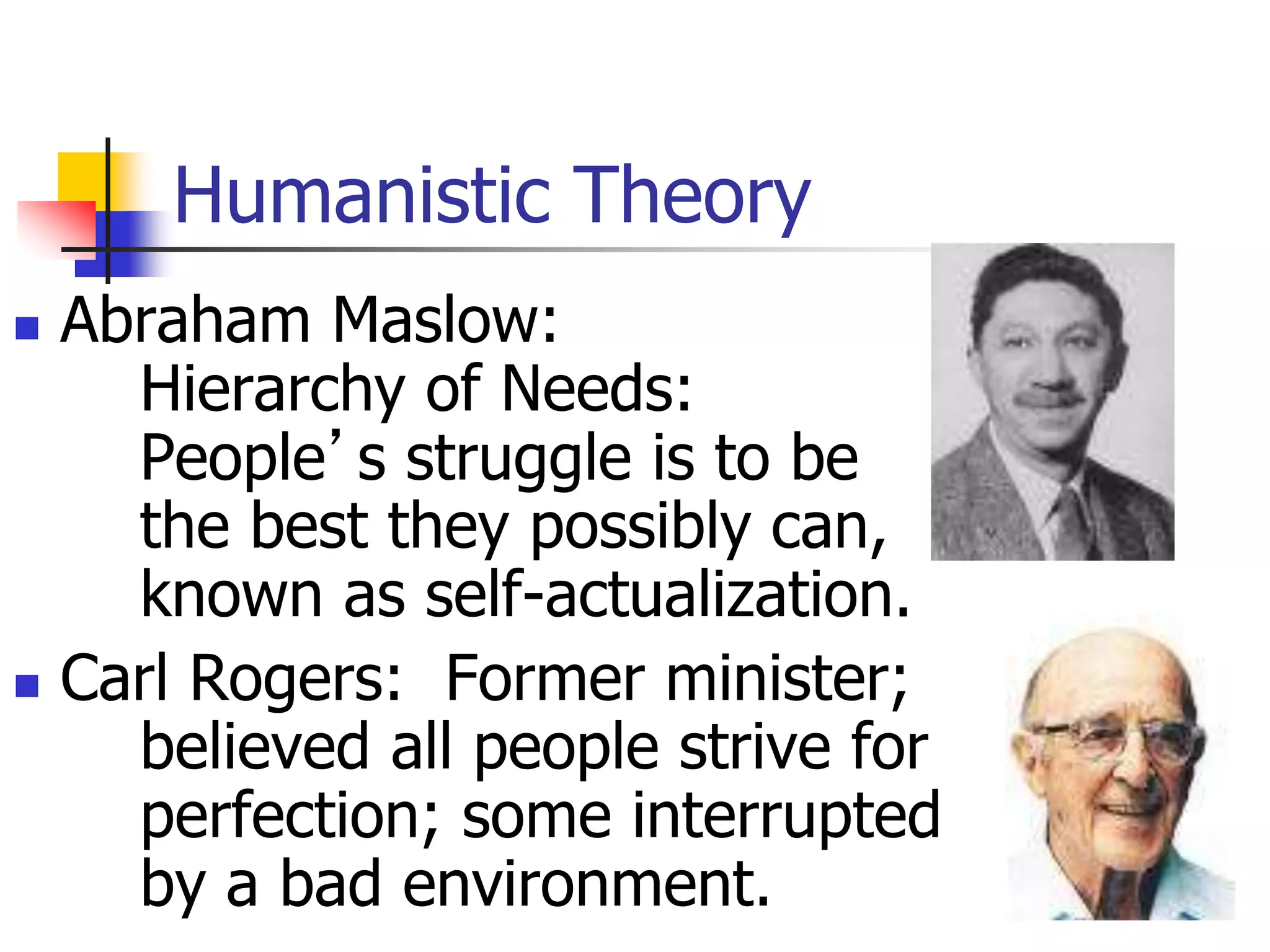
 Abraham Maslow:
Hierarchy of Needs:
People’s struggle is to be
the best they possibly can,
known as self-actualization.
 Carl Rogers: Former minister;
believed all people strive for
perfection; some interrupted
by a bad environment.
Humanistic Theory
 Human Potential: Everyone striving
to reach their highest potential.
 Criticisms: Believes all people are
good and that people have the
ability to heal themselves. Too
vague, more of a philosophy for
life than a psychology.
Biopsychological (Neurobiological)
 Seeks to understand the nervous system. All
actions, feelings associated with the nervous
system.
 Wilhelm Wundt: Expected psychology to rest
almost solely on Anatomy and Biology.
Interested in how bodily events interact with
events in the external environment to produce
perceptions, memory and behavior. Roger
Sperry won Nobel-Prize for his Split-Brain
research.
Biopsychological (Neurobiological)
 Nervous System: Responsible for our
behavior; Specifically abnormal and
immediate responses.
 Anatomy/Biology: Solely responsible for
human behavior.
 Criticisms: Ignores mental processes.
Explains too little of human behavior, rejects
environmental influences.
Cognitive Theory
 Thinking: how mental thoughts affect
behavior. Humanism gives rise to the
Cognitive Theory. Studies how we attend,
perceive, think, remember, solve problems
and arrive at beliefs. Know what’s going
on in people’s heads first, then
applies it to their behavior.
 Jean Piaget: studies children’s
cognitive development.
Cognitive Theory
 Thought Processes: Can infer mental
processes from observable behavior.
 Gestalt Psychology: means “pattern” or
“configuration.” Studies how people
interpret sensory information in order
to acquire knowledge.
 “The whole is larger than the sum of its
parts”
Cognitive Theory: Criticisms
 Downplays emotion, too
mentalistic, hard to decide
between competing cognitive
explanations.
 Strong approach today.
Sociocultural Psychology
 Examines how cultural and
political (religious) experience
effect our everyday life.
 Gender influences of behavior.
 Job opportunities to influence
people’s goals and ambitions.
Sociocultural Psychology
 It is NOT intrapsychic: Within
the mind or self.
 Cultural Values/Political
Systems: How norms and
social influences affect
behavior.
Sociocultural Psychology
 Ambition/Goals/Values: Environments
influence on one’s long-term ambitions.
 Criticisms: Underestimated personal and
overestimated social influences on our
behavior. Makes broad generalizations
about ethnic groups and cultures.
 http://bcs.worthpublishers.com/psychsim
5/Psychology%20Timeline/PsychSim_She
ll.html

history of psychology.ppt

  • 1.
    History of Psychology: Aristotle,before 30 BC Greek naturalist and philosopher who theorized about learning, memory, motivation, emotion, perception, and personality.
  • 2.
    Charles Darwin: 1850s  Studiedthe evolution of finches and expands his study to include humans.  Opposed religious teachings of the time by suggesting that man was a common ancestor to lower species.
  • 3.
    Birth of Psychology WilhelmWundt: Father of Psychology  1879: Leipzig, Germany.  Intended to make psychology a reputable science.  Many American psychologists eventually went on to study in Leipzeig.
  • 4.
    Wilhelm Wundt: Father ofPsychology  Most of his experiments on sensation and perception.  Did not think that high order mental processes could be studied experimentally.  Trained in medicine and philosophy.  Wrote many books about psychology, philosophy, ethics, and logic.
  • 5.
    American Psychological Association (APA) Foundedin 1892: the governing body of all research not conducted by universities.
  • 6.
    G. Stanley Hall First president of the APA, established the first psychological lab in the U.S. in 1883, at Johns Hopkins University.  Started the American Psychological Journal (1887) now the American Journal of Psychology.
  • 7.
    Can you readthis? This is bcuseae the huammn mnid deos not raed ervey lteter by istlef, but the word as a wlohe. Amzanig, huh?
  • 8.
    Introspection Looking inward atone’s own mental processes. Because it is not objective, it fails miserably.
  • 9.
    E.B. Titchener  Wundt’sstudent.  Taught at Cornell University. Studied nature of mental experiences.  Structuralism: Analyze sensations, images and feelings into their most basic elements.
  • 10.
    William James: 1842-1910  Claimedthat searching for building blocks was a waste of time because brain and mind are constantly changing: focused on function.  Functionalism. Underlying causes and practical consequences of certain behaviors and mental strategies: “Stream of Consciousness.”  Expanded psychology to animal behavior.
  • 11.
    Eclecticism  Utilizing ofdiverse theories and schools of thought.  Mosaic, no single approach can create the whole picture.  Unlikely for psychology to ever have a unifying paradigm.  Grand theories replaced by more specific ones.
  • 12.
    Present Day Psychology Behavioristictheory: Expanded psychology into many groups that could not be studied by introspection. All behavior is observable and measurable. Abandoned mentalism for behaviorism.
  • 13.
    Behaviorism  Ivan Pavlov,1849-1936.  Russian experimenter who showed automatic/involuntary behavior in learned responses to specific stimuli in the environment.  Created “Classical Conditioning.”
  • 14.
    Behaviorism  John Watson,1913.  Psychology can never be as objective as chemistry or biology. Consciousness is not that easy.  “I can take a child and make him into anything, a beggar, a doctor, a thief.”
  • 15.
    Behaviorism  B.F. Skinner,1950’s.  Dismissed importance of inherited traits and instincts about human behavior. Private events can be studied as long as they are treated as a form of behavior, many experiments with learning and memory.  Believed that all behavior is a result of rewards and punishments in the past.
  • 16.
    Behavioristic Theory  SocialLearning Theory: How people acquire new behaviors by observing and imitating others (modeling).  Criticisms: Excluded all behavior that cannot be seen. All behavior cannot be explained by rewards and punishments. Treats people like robots as if they have no free-will.
  • 17.
    Psychoanalytic Theory  Allbehavior is meaningful, and much of it is controlled by digging below the surface to uncover the roots of personality.  Sigmund Freud!!! (Da MAN!)
  • 18.
    Psychoanalytic Theory  SigmundFreud, 1856-1939.  Studied neurology, but wanted to be a medical researcher, forced into being a private physician.  Became convinced that patients difficulties were due to mental rather than physical problems.  Proposed that distress due to problems that dated back to childhood.
  • 19.
    Siggy Freud  Psychoanalysis:Freud’s method for treating people with emotional problems, free association.  Unconscious: Nearly all of our impulses are sexual and aggressive in nature. Because we cannot accept them in our conscious, thoughts find their expression in dreams, slips of the tongue that appear as accidents, and even jokes.
  • 20.
    Psychoanalytic Theory  Interpretationof Dreams, 1900. Sold 600 copies in 8 years; today sells millions every year.  Aggressive energy: Basic human instinct lodged in unconscious; the duty of society is to get people to channel their aggressive energy into productive activity. If not, aggression is released and violent activities occur.
  • 21.
    Psychoanalytic Theory  HiddenDesires: Freud stated that people are “cesspools of hidden desires.”  Unresolved Conflicts: If these occur in childhood, this will cause fixations in later life. (Stages)
  • 22.
    Psychoanalytic Theory  Freud’sStages: Oral (Birth - 1 yr.), anal (1 yr.), phallic (4 yrs. - separates males/females), latency (Puberty), genital (adult)  3 Personalities: Id, Ego, Superego:  Id: Wants/Desires, Basic primal instincts. “Pleasure Principle”  Ego: “Reality Principle”  Superego: Conscious mind. “Do the right thing.”
  • 23.
    Psychoanalytic Theory: Criticisms Does not focus on observable behavior, negative viewpoint of mankind because actions are provoked by unconscious thoughts, cannot be scientifically proven or disproven.  Ignores political and social explanations of people’s problems.  Currently focuses on perceptions, memories, and thinking in our unconscious (Psychodynamic theory).
  • 24.
    Humanistic Theory 1950’s-60’s: Emphasizefree-will, people not completely ruled by environment or past experience, able to control one’s own choices and destinies to achieve full human potential. (Existentialism)
  • 25.
    Humanistic Theory  AbrahamMaslow: Hierarchy of Needs: People’s struggle is to be the best they possibly can, known as self-actualization.  Carl Rogers: Former minister; believed all people strive for perfection; some interrupted by a bad environment.
  • 26.
    Humanistic Theory  HumanPotential: Everyone striving to reach their highest potential.  Criticisms: Believes all people are good and that people have the ability to heal themselves. Too vague, more of a philosophy for life than a psychology.
  • 27.
    Biopsychological (Neurobiological)  Seeksto understand the nervous system. All actions, feelings associated with the nervous system.  Wilhelm Wundt: Expected psychology to rest almost solely on Anatomy and Biology. Interested in how bodily events interact with events in the external environment to produce perceptions, memory and behavior. Roger Sperry won Nobel-Prize for his Split-Brain research.
  • 28.
    Biopsychological (Neurobiological)  NervousSystem: Responsible for our behavior; Specifically abnormal and immediate responses.  Anatomy/Biology: Solely responsible for human behavior.  Criticisms: Ignores mental processes. Explains too little of human behavior, rejects environmental influences.
  • 29.
    Cognitive Theory  Thinking:how mental thoughts affect behavior. Humanism gives rise to the Cognitive Theory. Studies how we attend, perceive, think, remember, solve problems and arrive at beliefs. Know what’s going on in people’s heads first, then applies it to their behavior.  Jean Piaget: studies children’s cognitive development.
  • 30.
    Cognitive Theory  ThoughtProcesses: Can infer mental processes from observable behavior.  Gestalt Psychology: means “pattern” or “configuration.” Studies how people interpret sensory information in order to acquire knowledge.  “The whole is larger than the sum of its parts”
  • 31.
    Cognitive Theory: Criticisms Downplays emotion, too mentalistic, hard to decide between competing cognitive explanations.  Strong approach today.
  • 32.
    Sociocultural Psychology  Examineshow cultural and political (religious) experience effect our everyday life.  Gender influences of behavior.  Job opportunities to influence people’s goals and ambitions.
  • 33.
    Sociocultural Psychology  Itis NOT intrapsychic: Within the mind or self.  Cultural Values/Political Systems: How norms and social influences affect behavior.
  • 34.
    Sociocultural Psychology  Ambition/Goals/Values:Environments influence on one’s long-term ambitions.  Criticisms: Underestimated personal and overestimated social influences on our behavior. Makes broad generalizations about ethnic groups and cultures.  http://bcs.worthpublishers.com/psychsim 5/Psychology%20Timeline/PsychSim_She ll.html