








Micro-Pelletizing
Experts in process design and material
processing for over 60 years.
Intro to
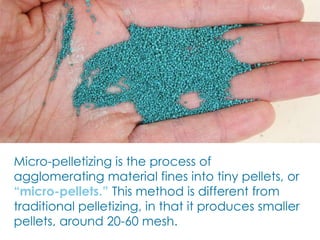
Micro-pelletizing is the process of
agglomerating material fines into tiny pellets, or
“micro-pellets.” This method is different from
traditional pelletizing, in that it produces smaller
pellets, around 20-60 mesh.
Micro-pelletizing can be carried out in either
a pin mixer (sometimes referred to as
conditioning), or a pin mixer/disc pelletizer
setup. When only small pellets, or material
conditioning is necessary, a pin mixer alone
can provide sufficient results.
Why Micro-Pelletize?
Micro-pelletizing is used to process fine
materials, allowing for easier handling
and transportation, as well as improved
end use.
Benefits of
Micro-Pelletizing
Dust Reduction/Elimination
The opportunity to significantly reduce
or even eliminate dust is one of the
most common reasons why someone
might choose to micro-pelletize their
material. Reducing dust is beneficial for
many reasons:
It prevents material from becoming
windblown, which is a common
concern for materials that are to be
landfilled, such as fly ash.
It creates a cleaner, safer processing
environment: fugitive dust can be
harmful to workers, and can also clog
up equipment, causing process upsets
and damage.
It creates a cleaner, safer processing
environment: fugitive dust can be
harmful to workers, and can also clog
up equipment, causing process upsets
and damage.
Coal fines are particularly dangerous,
because they are combustible when
sufficiently aerated. For this reason,
coal fines are commonly processed via
micro-pelletizing.
Dust also results in the loss of raw
material/product. The ability to prevent
material or product lost as dust offers
significant value.
Improved Handling and Transport
A micro-pelletized material is
significantly more easy to handle and
transport without the loss of material
than a dusty material.
Improved Application and Use
Micro-pelletizing also offers the
opportunity to improve product
performance and application in a
variety of ways:
Improved Application and Use
Micro-pelletizing also offers the
opportunity to improve product
performance and application in a
variety of ways:
• More accurate application: micro-
pellets move through spreading
equipment much more easily.
• More predictable results: micro-
pellets won’t blow away like a dusty
material would.
• More predictable results: micro-
pellets won’t blow away like a dusty
material would.
• Faster product breakdown: smaller
pellets break down faster than larger
ones.
• Reduced visibility – micro-pellets sink
between grass blades, so they are not
easily visible, an ideal characteristic
for professional applications such as
golf courses and lawns.
Micro-Pelletizing
Applications
As a process that can benefit nearly
any material that comes in powder
form, micro-pelletizing can be found in
many industries. Some of the most
common applications include:
As a process that can benefit nearly
any material that comes in powder
form, micro-pelletizing can be found in
many industries. Some of the most
common applications include:
• Pigments & Dyestuffs
As a process that can benefit nearly
any material that comes in powder
form, micro-pelletizing can be found in
many industries. Some of the most
common applications include:
• Pigments & Dyestuffs
• Carbon Black
As a process that can benefit nearly
any material that comes in powder
form, micro-pelletizing can be found in
many industries. Some of the most
common applications include:
• Pigments & Dyestuffs
• Carbon Black
• Coal Dust
As a process that can benefit nearly
any material that comes in powder
form, micro-pelletizing can be found in
many industries. Some of the most
common applications include:
• Pigments & Dyestuffs
• Carbon Black
• Coal Dust
• Fly Ash
As a process that can benefit nearly
any material that comes in powder
form, micro-pelletizing can be found in
many industries. Some of the most
common applications include:
• Pigments & Dyestuffs
• Carbon Black
• Coal Dust
• Fly Ash
• Specialty Powders
As a process that can benefit nearly
any material that comes in powder
form, micro-pelletizing can be found in
many industries. Some of the most
common applications include:
• Pigments & Dyestuffs
• Carbon Black
• Coal Dust
• Fly Ash
• Specialty Powders
• Filter Media
As a process that can benefit nearly
any material that comes in powder
form, micro-pelletizing can be found in
many industries. Some of the most
common applications include:
• Pigments & Dyestuffs
• Carbon Black
• Coal Dust
• Fly Ash
• Specialty Powders
• Filter Media
• Catalysts
The Process
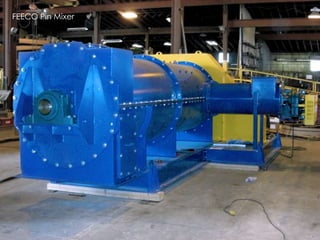
Pin mixers are the industry standard when it
comes to micro-pelletizing. These industrial
mixers are an ideal solution for mixing solid
and liquid feed, as well as for agglomerating
ultra-fine materials into small agglomerates.
Pin mixers use a high-speed spinning action
to densify and agglomerate material fines.
FEECO Pin Mixer
While the pin mixer can be used in
combination with a disc pelletizing unit, it is
often used as a stand-alone agglomeration
device to reliably produce micro-pellets in a
continuous process setting.
While the pin mixer can be used in
combination with a disc pelletizing unit, it is
often used as a stand-alone agglomeration
device to reliably produce micro-pellets in a
continuous process setting.
A typical micro-pelletizing operation looks like
this…
Raw feed material and binder are fed at a
continuous, specified rate into the pin mixer.
The materials are thoroughly mixed, and
begin to agglomerate, forming micro-pellets
as the mixture moves down the length of the
pin mixer. Pellets are discharged from the pin
mixer.
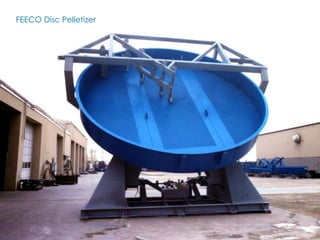
At this point, the material could be fed
onto a disc pelletizer to further grow
and/or round the pellets.
FEECO Disc Pelletizer
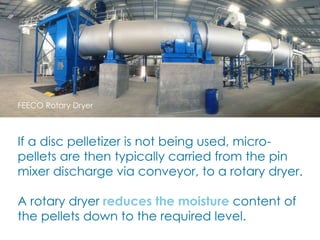
FEECO Rotary Dryer
If a disc pelletizer is not being used, micro-
pellets are then typically carried from the pin
mixer discharge via conveyor, to a rotary dryer.
A rotary dryer reduces the moisture content of
the pellets down to the required level.
Here, pellets tumble through the
rotating drum, as flights pick up the
pellets and drop them through the
stream of combustion gas in order to
maximize efficiency. Fluid bed dryers
are an alternate choice for drying.
Here, pellets tumble through the
rotating drum, as flights pick up the
pellets and drop them through the
stream of combustion gas in order to
maximize efficiency. Fluid bed dryers
are an alternate choice for drying.
Once dried, pellets are taken via
conveyor to their next processing stop
(screening), or to storage or bagging.
Some processes utilize a cooling step prior to
bagging or storage, in order to prevent caking
issues during storage.
Conclusion
Micro-pelletizing offers a valuable solution to
making powdered materials more easy to
handle, transport, apply, and use.
Conclusion
Micro-pelletizing offers a valuable solution to
making powdered materials more easy to
handle, transport, apply, and use.
Furthermore, when only rough agglomeration
is desired, micro-pelletizing in a pin mixer
alone offers a cost-effective alternative to a
full-scale disc pelletizing or drum setup.
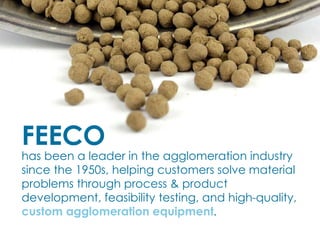
has been a leader in the agglomeration industry
since the 1950s, helping customers solve material
problems through process & product
development, feasibility testing, and high-quality,
custom agglomeration equipment.
FEECO
Want to learn more?
Download our
Agglomeration Handbook
Intro to Agglomeration
Processing Techniques
Considerations in Agglomeration
And more…
Download Now

Intro to Micro-Pelletizing

  • 1.
    Micro-Pelletizing Experts in processdesign and material processing for over 60 years. Intro to
  • 2.
    Micro-pelletizing is theprocess of agglomerating material fines into tiny pellets, or “micro-pellets.” This method is different from traditional pelletizing, in that it produces smaller pellets, around 20-60 mesh.
  • 3.
    Micro-pelletizing can becarried out in either a pin mixer (sometimes referred to as conditioning), or a pin mixer/disc pelletizer setup. When only small pellets, or material conditioning is necessary, a pin mixer alone can provide sufficient results.
  • 4.
    Why Micro-Pelletize? Micro-pelletizing isused to process fine materials, allowing for easier handling and transportation, as well as improved end use.
  • 5.
  • 6.
    Dust Reduction/Elimination The opportunityto significantly reduce or even eliminate dust is one of the most common reasons why someone might choose to micro-pelletize their material. Reducing dust is beneficial for many reasons:
  • 7.
    It prevents materialfrom becoming windblown, which is a common concern for materials that are to be landfilled, such as fly ash.
  • 8.
    It creates acleaner, safer processing environment: fugitive dust can be harmful to workers, and can also clog up equipment, causing process upsets and damage.
  • 9.
    It creates acleaner, safer processing environment: fugitive dust can be harmful to workers, and can also clog up equipment, causing process upsets and damage. Coal fines are particularly dangerous, because they are combustible when sufficiently aerated. For this reason, coal fines are commonly processed via micro-pelletizing.
  • 10.
    Dust also resultsin the loss of raw material/product. The ability to prevent material or product lost as dust offers significant value.
  • 11.
    Improved Handling andTransport A micro-pelletized material is significantly more easy to handle and transport without the loss of material than a dusty material.
  • 12.
    Improved Application andUse Micro-pelletizing also offers the opportunity to improve product performance and application in a variety of ways:
  • 13.
    Improved Application andUse Micro-pelletizing also offers the opportunity to improve product performance and application in a variety of ways: • More accurate application: micro- pellets move through spreading equipment much more easily.
  • 14.
    • More predictableresults: micro- pellets won’t blow away like a dusty material would.
  • 15.
    • More predictableresults: micro- pellets won’t blow away like a dusty material would. • Faster product breakdown: smaller pellets break down faster than larger ones.
  • 16.
    • Reduced visibility– micro-pellets sink between grass blades, so they are not easily visible, an ideal characteristic for professional applications such as golf courses and lawns.
  • 17.
  • 18.
    As a processthat can benefit nearly any material that comes in powder form, micro-pelletizing can be found in many industries. Some of the most common applications include:
  • 19.
    As a processthat can benefit nearly any material that comes in powder form, micro-pelletizing can be found in many industries. Some of the most common applications include: • Pigments & Dyestuffs
  • 20.
    As a processthat can benefit nearly any material that comes in powder form, micro-pelletizing can be found in many industries. Some of the most common applications include: • Pigments & Dyestuffs • Carbon Black
  • 21.
    As a processthat can benefit nearly any material that comes in powder form, micro-pelletizing can be found in many industries. Some of the most common applications include: • Pigments & Dyestuffs • Carbon Black • Coal Dust
  • 22.
    As a processthat can benefit nearly any material that comes in powder form, micro-pelletizing can be found in many industries. Some of the most common applications include: • Pigments & Dyestuffs • Carbon Black • Coal Dust • Fly Ash
  • 23.
    As a processthat can benefit nearly any material that comes in powder form, micro-pelletizing can be found in many industries. Some of the most common applications include: • Pigments & Dyestuffs • Carbon Black • Coal Dust • Fly Ash • Specialty Powders
  • 24.
    As a processthat can benefit nearly any material that comes in powder form, micro-pelletizing can be found in many industries. Some of the most common applications include: • Pigments & Dyestuffs • Carbon Black • Coal Dust • Fly Ash • Specialty Powders • Filter Media
  • 25.
    As a processthat can benefit nearly any material that comes in powder form, micro-pelletizing can be found in many industries. Some of the most common applications include: • Pigments & Dyestuffs • Carbon Black • Coal Dust • Fly Ash • Specialty Powders • Filter Media • Catalysts
  • 26.
  • 27.
    Pin mixers arethe industry standard when it comes to micro-pelletizing. These industrial mixers are an ideal solution for mixing solid and liquid feed, as well as for agglomerating ultra-fine materials into small agglomerates. Pin mixers use a high-speed spinning action to densify and agglomerate material fines.
  • 28.
  • 29.
    While the pinmixer can be used in combination with a disc pelletizing unit, it is often used as a stand-alone agglomeration device to reliably produce micro-pellets in a continuous process setting.
  • 30.
    While the pinmixer can be used in combination with a disc pelletizing unit, it is often used as a stand-alone agglomeration device to reliably produce micro-pellets in a continuous process setting. A typical micro-pelletizing operation looks like this…
  • 31.
    Raw feed materialand binder are fed at a continuous, specified rate into the pin mixer. The materials are thoroughly mixed, and begin to agglomerate, forming micro-pellets as the mixture moves down the length of the pin mixer. Pellets are discharged from the pin mixer.
  • 32.
    At this point,the material could be fed onto a disc pelletizer to further grow and/or round the pellets.
  • 33.
  • 34.
    FEECO Rotary Dryer Ifa disc pelletizer is not being used, micro- pellets are then typically carried from the pin mixer discharge via conveyor, to a rotary dryer. A rotary dryer reduces the moisture content of the pellets down to the required level.
  • 35.
    Here, pellets tumblethrough the rotating drum, as flights pick up the pellets and drop them through the stream of combustion gas in order to maximize efficiency. Fluid bed dryers are an alternate choice for drying.
  • 36.
    Here, pellets tumblethrough the rotating drum, as flights pick up the pellets and drop them through the stream of combustion gas in order to maximize efficiency. Fluid bed dryers are an alternate choice for drying. Once dried, pellets are taken via conveyor to their next processing stop (screening), or to storage or bagging.
  • 37.
    Some processes utilizea cooling step prior to bagging or storage, in order to prevent caking issues during storage.
  • 38.
    Conclusion Micro-pelletizing offers avaluable solution to making powdered materials more easy to handle, transport, apply, and use.
  • 39.
    Conclusion Micro-pelletizing offers avaluable solution to making powdered materials more easy to handle, transport, apply, and use. Furthermore, when only rough agglomeration is desired, micro-pelletizing in a pin mixer alone offers a cost-effective alternative to a full-scale disc pelletizing or drum setup.
  • 40.
    has been aleader in the agglomeration industry since the 1950s, helping customers solve material problems through process & product development, feasibility testing, and high-quality, custom agglomeration equipment. FEECO
  • 41.
    Want to learnmore? Download our Agglomeration Handbook Agglomeration Handbook Intro to Agglomeration Processing Techniques Considerations in Agglomeration And more… Download Now