Introduction to Ecohealth
Nguyen Viet Hung
Center for Public Health and Ecosystem Research
Hanoi School of Public Health
EcoZD-FBLI Ecohealth/One Health training course
27-30 May 2013, Pullman hotel, Hanoi
Content
• Ecohealth: history and concept
• Ecohealth: main principles
• Application of ecohealth in SEA
• Integrative Approach
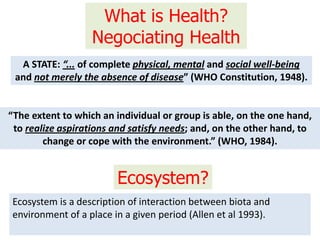
“The extent to which an individual or group is able, on the one hand,
to realize aspirations and satisfy needs; and, on the other hand, to
change or cope with the environment.” (WHO, 1984).
A STATE: “... of complete physical, mental and social well-being
and not merely the absence of disease” (WHO Constitution, 1948).
What is Health?
Negociating Health
Ecosystem is a description of interaction between biota and
environment of a place in a given period (Allen et al 1993).
Ecosystem?
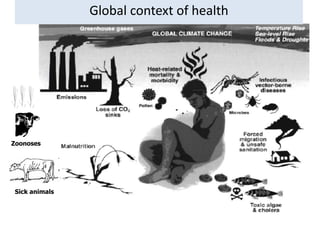
Sick animals
Zoonoses
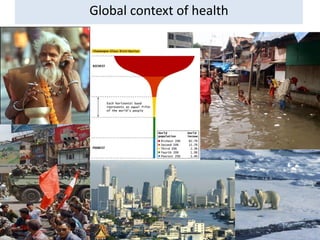
Global context of health
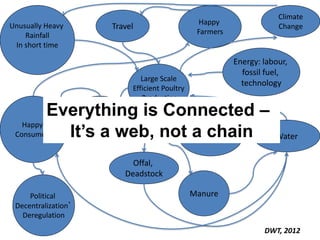
Large Scale
Efficient Poultry
Production
Water
Manure
Feed Imports
Travel
Happy
Consumers
Energy: labour,
fossil fuel,
technology
Unusually Heavy
Rainfall
In short time
Food
Exports
Offal,
Deadstock
Happy
Farmers
Climate
Change
Political
Decentralization’
Deregulation
Everything is Connected –
It’s a web, not a chain
DWT, 2012
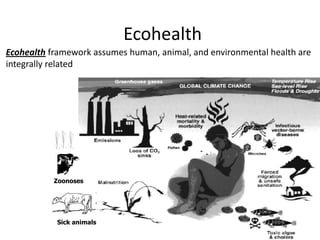
Sick animals
Zoonoses
Ecohealth framework assumes human, animal, and environmental health are
integrally related
Ecohealth
Ecohealth: Ecosystem approaches to health
A way of thinking about and tackling complex
problems at the intersection of health,
environment, livelihoods and development
Ecosystem approaches to health
• Systemic, participatory approaches to
understanding and promoting health and
wellbeing in the context of complex social-
ecological interactions.
• Ecosystem approaches to health formally connect
ideas of environmental and social determinants
of health with those of ecology and systems
thinking in an action-research framework applied
mostly within a context of social and economic
development (Charron).
1970s and 80s
• Ecosystem approach to transboundary lakes and
rivers; ecosystem health; sustainable development
1990s
• Government of Canada funds transdisciplinary
research on ecosystem and human health
• Canadian Veterinary Schools promote the approach
• An international research program at IDRC
History and Concept of Ecohealth
2000s
• A major international conference (Montreal Forum, Mexico,
London, Kunming, Montreal…)
• A scholarly Journal and an international association
• Communities of Practice around the world
• Recently, validation and recognition
• Canadian Public Health Association and Canadian Institutes of
Health Research (Webb et al CJPH, 2010)
• WHO-TDR creates new unit: Vectors, Environment and
Society
• One Health, and other multi-sectoral approaches advocated
at highest levels of health policy
History and Concept of Ecohealth
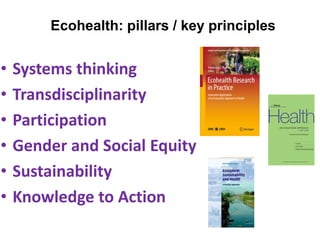
Ecohealth: pillars / key principles
• Systems thinking
• Transdisciplinarity
• Participation
• Gender and Social Equity
• Sustainability
• Knowledge to Action
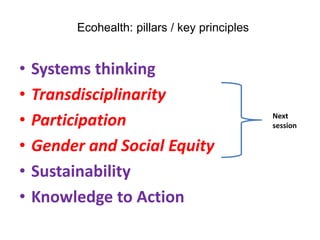
Ecohealth: pillars / key principles
• Systems thinking
• Transdisciplinarity
• Participation
• Gender and Social Equity
• Sustainability
• Knowledge to Action
Next
session
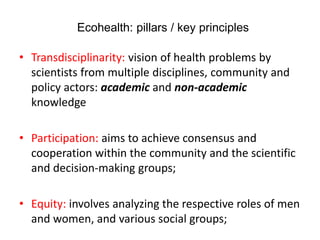
Ecohealth: pillars / key principles
• Transdisciplinarity: vision of health problems by
scientists from multiple disciplines, community and
policy actors: academic and non-academic
knowledge
• Participation: aims to achieve consensus and
cooperation within the community and the scientific
and decision-making groups;
• Equity: involves analyzing the respective roles of men
and women, and various social groups;
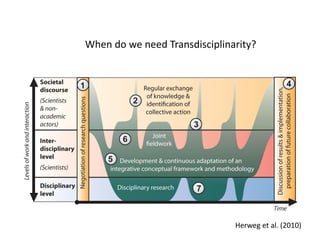
When do we need Transdisciplinarity?
Herweg et al. (2010)
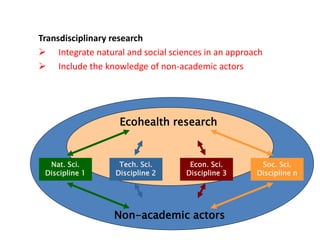
Transdisciplinary research
 Integrate natural and social sciences in an approach
 Include the knowledge of non-academic actors
Nat. Sci.
Discipline 1
Tech. Sci.
Discipline 2
Econ. Sci.
Discipline 3
Soc. Sci.
Discipline n
Ecohealth research
Non-academic actors
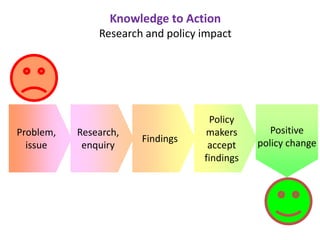
Knowledge to Action
Research and policy impact
Problem,
issue
Research,
enquiry
Findings
Policy
makers
accept
findings
Positive
policy change
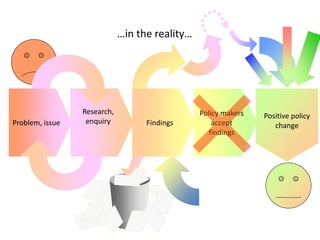
…in the reality…
Problem, issue
Research,
enquiry Findings
Policy makers
accept
findings ?Positive policy
change
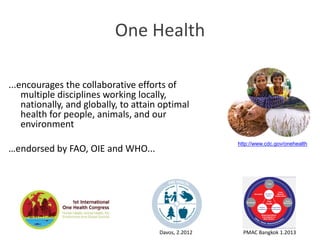
One Health
...encourages the collaborative efforts of
multiple disciplines working locally,
nationally, and globally, to attain optimal
health for people, animals, and our
environment
…endorsed by FAO, OIE and WHO...
Davos, 2.2012 PMAC Bangkok 1.2013
http://www.cdc.gov/onehealth
CDC STONE MOUTAIN meeting
One Health
• One Health is the collaborative effort of multiple
disciplines working locally, nationally, and
globally, to address critical challenges and attain
optimal health for people, domestic animals,
wildlife, and our environment
One Health Commission (http://www.onehealthcommission.org/ )
• The One Health concept is a worldwide strategy
for expanding interdisciplinary collaborations and
communications in all aspects of health care for
humans and animals. One Health Initiative
(http://onehealthinitiative.com/)
Application of ecohealth
– Helps understand and make changes to complex problems
– Reframes health issues in the context of ecosystems, people
and their livelihoods
– Requires multi-disciplinary teams
– Has impact because it involves local people and responds
to their needs
– Promotes social justice for women and other marginalized
groups
– Facilitates multi-sectorial policy, application and
intervention
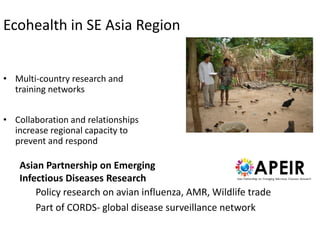
• Multi-country research and
training networks
• Collaboration and relationships
increase regional capacity to
prevent and respond
Ecohealth in SE Asia Region
Asian Partnership on Emerging
Infectious Diseases Research
Policy research on avian influenza, AMR, Wildlife trade
Part of CORDS- global disease surveillance network
Ecohealth in SE Asia Region
Ecohealth Field-building Leadership Initiative
Research on agriculture intensification and health
Training, knowledge translation
Emerging zoonoses of livestock (ILRI)
National research teams
Ecohealth Resource Centers (Chiang Mai, Yogyakarta)
AusAID-CIDA-IDRC Emerging Infectious Diseases initiative
Capacity building (VWB Canada)
Research Competition: Avian influenza, Dengue, foodborne
helminths and schistosomiasis
From infectious to non-infectious diseases
We need to change:
Current training is largely medical science based on the biomedical
model and multidisciplinary studies focusing on molecular and
individual organisation level. We are not prepared to work with the
infectious disease emergence and global health
Action:
• Go beyond biomedical models
• Learn to work with disciplines and integrate them
• Use “systems thinking”
Integrative approach
• Integrative research (interdisciplinary and transdisciplinary research)
uses systems thinking to create new knowledge and skills by combining
principles, theory and methods from different disciplines.
• The new knowledge and skills not only benefit the problem being
addressed (EIDs), the capacity gained “spills-over” to help address other
problems, but also generally strengthen science and science education.
Integrative approach
Challenges for Ecohealth/One
Health/Integrative approach
Meaningful transdisicplinary, participatory and
multi-sector action-research is hard to do
Localized research is difficult to take to larger scale
Quality of evidence often inadequate vs
evertightening standards
Demonstrating value for money of proposed
changes in policy or practice
Time to achieve lasting results often very long-term
(10yrs or more)
Take home messages:
- Ecohealth framework assumes human, animal, and
environmental health are integrally related
- New approach: participatory, transdisciplinary,
translational research, systemic
- One Health movement and integrative approach
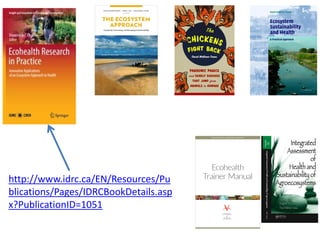
http://www.idrc.ca/EN/Resources/Pu
blications/Pages/IDRCBookDetails.asp
x?PublicationID=1051
Thank you!
EcoZD-FBLI Ecohealth/One Health course
27-30 May 2013, Pullman hotel, Hanoi

Introduction to EcoHealth

  • 1.
    Introduction to Ecohealth NguyenViet Hung Center for Public Health and Ecosystem Research Hanoi School of Public Health EcoZD-FBLI Ecohealth/One Health training course 27-30 May 2013, Pullman hotel, Hanoi
  • 2.
    Content • Ecohealth: historyand concept • Ecohealth: main principles • Application of ecohealth in SEA • Integrative Approach
  • 3.
    “The extent towhich an individual or group is able, on the one hand, to realize aspirations and satisfy needs; and, on the other hand, to change or cope with the environment.” (WHO, 1984). A STATE: “... of complete physical, mental and social well-being and not merely the absence of disease” (WHO Constitution, 1948). What is Health? Negociating Health Ecosystem is a description of interaction between biota and environment of a place in a given period (Allen et al 1993). Ecosystem?
  • 4.
  • 5.
  • 6.
    Large Scale Efficient Poultry Production Water Manure FeedImports Travel Happy Consumers Energy: labour, fossil fuel, technology Unusually Heavy Rainfall In short time Food Exports Offal, Deadstock Happy Farmers Climate Change Political Decentralization’ Deregulation Everything is Connected – It’s a web, not a chain DWT, 2012
  • 7.
    Sick animals Zoonoses Ecohealth frameworkassumes human, animal, and environmental health are integrally related Ecohealth
  • 8.
    Ecohealth: Ecosystem approachesto health A way of thinking about and tackling complex problems at the intersection of health, environment, livelihoods and development
  • 9.
    Ecosystem approaches tohealth • Systemic, participatory approaches to understanding and promoting health and wellbeing in the context of complex social- ecological interactions. • Ecosystem approaches to health formally connect ideas of environmental and social determinants of health with those of ecology and systems thinking in an action-research framework applied mostly within a context of social and economic development (Charron).
  • 10.
    1970s and 80s •Ecosystem approach to transboundary lakes and rivers; ecosystem health; sustainable development 1990s • Government of Canada funds transdisciplinary research on ecosystem and human health • Canadian Veterinary Schools promote the approach • An international research program at IDRC History and Concept of Ecohealth
  • 11.
    2000s • A majorinternational conference (Montreal Forum, Mexico, London, Kunming, Montreal…) • A scholarly Journal and an international association • Communities of Practice around the world • Recently, validation and recognition • Canadian Public Health Association and Canadian Institutes of Health Research (Webb et al CJPH, 2010) • WHO-TDR creates new unit: Vectors, Environment and Society • One Health, and other multi-sectoral approaches advocated at highest levels of health policy History and Concept of Ecohealth
  • 12.
    Ecohealth: pillars /key principles • Systems thinking • Transdisciplinarity • Participation • Gender and Social Equity • Sustainability • Knowledge to Action
  • 13.
    Ecohealth: pillars /key principles • Systems thinking • Transdisciplinarity • Participation • Gender and Social Equity • Sustainability • Knowledge to Action Next session
  • 14.
    Ecohealth: pillars /key principles • Transdisciplinarity: vision of health problems by scientists from multiple disciplines, community and policy actors: academic and non-academic knowledge • Participation: aims to achieve consensus and cooperation within the community and the scientific and decision-making groups; • Equity: involves analyzing the respective roles of men and women, and various social groups;
  • 15.
    When do weneed Transdisciplinarity? Herweg et al. (2010)
  • 16.
    Transdisciplinary research  Integratenatural and social sciences in an approach  Include the knowledge of non-academic actors Nat. Sci. Discipline 1 Tech. Sci. Discipline 2 Econ. Sci. Discipline 3 Soc. Sci. Discipline n Ecohealth research Non-academic actors
  • 17.
    Knowledge to Action Researchand policy impact Problem, issue Research, enquiry Findings Policy makers accept findings Positive policy change
  • 18.
    …in the reality… Problem,issue Research, enquiry Findings Policy makers accept findings ?Positive policy change
  • 19.
    One Health ...encourages thecollaborative efforts of multiple disciplines working locally, nationally, and globally, to attain optimal health for people, animals, and our environment …endorsed by FAO, OIE and WHO... Davos, 2.2012 PMAC Bangkok 1.2013 http://www.cdc.gov/onehealth
  • 20.
  • 21.
    One Health • OneHealth is the collaborative effort of multiple disciplines working locally, nationally, and globally, to address critical challenges and attain optimal health for people, domestic animals, wildlife, and our environment One Health Commission (http://www.onehealthcommission.org/ ) • The One Health concept is a worldwide strategy for expanding interdisciplinary collaborations and communications in all aspects of health care for humans and animals. One Health Initiative (http://onehealthinitiative.com/)
  • 22.
    Application of ecohealth –Helps understand and make changes to complex problems – Reframes health issues in the context of ecosystems, people and their livelihoods – Requires multi-disciplinary teams – Has impact because it involves local people and responds to their needs – Promotes social justice for women and other marginalized groups – Facilitates multi-sectorial policy, application and intervention
  • 23.
    • Multi-country researchand training networks • Collaboration and relationships increase regional capacity to prevent and respond Ecohealth in SE Asia Region Asian Partnership on Emerging Infectious Diseases Research Policy research on avian influenza, AMR, Wildlife trade Part of CORDS- global disease surveillance network
  • 24.
    Ecohealth in SEAsia Region Ecohealth Field-building Leadership Initiative Research on agriculture intensification and health Training, knowledge translation Emerging zoonoses of livestock (ILRI) National research teams Ecohealth Resource Centers (Chiang Mai, Yogyakarta) AusAID-CIDA-IDRC Emerging Infectious Diseases initiative Capacity building (VWB Canada) Research Competition: Avian influenza, Dengue, foodborne helminths and schistosomiasis From infectious to non-infectious diseases
  • 25.
    We need tochange: Current training is largely medical science based on the biomedical model and multidisciplinary studies focusing on molecular and individual organisation level. We are not prepared to work with the infectious disease emergence and global health Action: • Go beyond biomedical models • Learn to work with disciplines and integrate them • Use “systems thinking” Integrative approach
  • 26.
    • Integrative research(interdisciplinary and transdisciplinary research) uses systems thinking to create new knowledge and skills by combining principles, theory and methods from different disciplines. • The new knowledge and skills not only benefit the problem being addressed (EIDs), the capacity gained “spills-over” to help address other problems, but also generally strengthen science and science education. Integrative approach
  • 27.
    Challenges for Ecohealth/One Health/Integrativeapproach Meaningful transdisicplinary, participatory and multi-sector action-research is hard to do Localized research is difficult to take to larger scale Quality of evidence often inadequate vs evertightening standards Demonstrating value for money of proposed changes in policy or practice Time to achieve lasting results often very long-term (10yrs or more)
  • 28.
    Take home messages: -Ecohealth framework assumes human, animal, and environmental health are integrally related - New approach: participatory, transdisciplinary, translational research, systemic - One Health movement and integrative approach
  • 29.
  • 30.
    Thank you! EcoZD-FBLI Ecohealth/OneHealth course 27-30 May 2013, Pullman hotel, Hanoi