Interviewing Basics


        Darren Kaltved
   Associate Career Counselor
    School of Public Health
    University of Minnesota
Agenda
• Purpose of the Interview


• Interview Preparation


• Expectations of the Interview


• Interview Follow-up
Purpose of an Interview
•       The purpose of an interview is not to get a job, but a job offer.

•       The more offers you receive, the stronger your opportunity to
        choose the position that best fits your goals.

•       From a company standpoint, an initial interview should
        answer three basic questions:

    •      Is the candidate ABLE to do the job effectively?
    •      Is the candidate WILLING to put for the effort to be
           successful in the position?
    •      Is the candidate MANAGABLE?
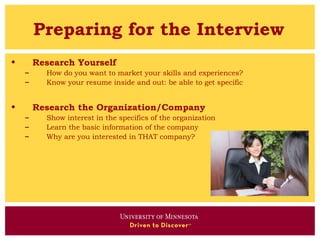
Preparing for the Interview
•       Research Yourself
    –     How do you want to market your skills and experiences?
    –     Know your resume inside and out: be able to get specific


•       Research the Organization/Company
    –     Show interest in the specifics of the organization
    –     Learn the basic information of the company
    –     Why are you interested in THAT company?
Preparing for the Interview
•       Review Interview Questions
    –     The more you prepare ahead of time, the less nervous you will be in the
          interview
    –     Sample/typical questions available in CCSE


•       Prepare Questions to Ask Interviewer
    –     It is expected candidates will have at least 3 questions prepared
    –     Base questions on information you could still need to know or came
          across in your research
    –     Interviews are not the appropriate time to discuss salary
Preparing for the Interview
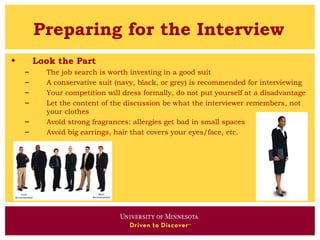
•       Look the Part
    –     The job search is worth investing in a good suit
    –     A conservative suit (navy, black, or grey) is recommended for interviewing
    –     Your competition will dress formally, do not put yourself at a disadvantage
    –     Let the content of the discussion be what the interviewer remembers, not
          your clothes
    –     Avoid strong fragrances: allergies get bad in small spaces
    –     Avoid big earrings, hair that covers your eyes/face, etc.
The Interview Process
•       Introduction
    –     Ice breaking: making you feel comfortable
    –     First impressions (appearance/manners) formed here
    –     Engage the interviewer; this aspect impacts your success as much as your
          formal answers

•       Body of the Interview
    –     The interviewer requesting specific information
    –     You will be evaluated on qualifications, likelihood of success, experience,
          attitude, work ethic and others
    –     Much like a good story, interview answers are better when they are specific
    –     Be prepared to discuss your short-term and long-term goals
    –     Could include technical and/or behavioral questions
Types of Questions
•       Tell me about yourself…
    –     Keep it professional: avoid personal information
    –     Present, Past, Future…

•       Motivation/Goal Questions
    –     Why did you choose this major?
    –     Where do you see yourself in 5 years?
    –     Are you a good fit with the organization

•       Strengths/Weakness/Qualifications/Skills Questions
    –     Rule of 3…back it up with proof (example)
    –     The actual weakness is not the most important part…
    –     The job or position description is your answer key
Types of Questions
•       Behavioral Questions
    –     The best predictor of future behavior is past behavior
    –     Makes hiring decisions legally defensible
    –     Focus on specific times when you have had to use specific skills
    –     Primary interviewing style
    –     “Tell me about a time when…”


•       STAR Technique
    –     Situation: Describe the situation/setting you were in
    –     Task: Describe a SPECIFIC task when you used the skill(s) identified in
          the question
    –     Action: What actions did you take to complete the task?
    –     Result: What is the outcome of the task and your actions?
Types of Questions
•       Case Interview Questions

    –     Tests your analytical abilities, organizational skills, poise, ability to deal
          with ambiguity, and problem solving

    –     Many given in the form of a brain teaser: How many jelly beans fit inside a
          747?

    –     Make sure you get the information needed to answer the question

    –     It is not about getting the right answer - talk them through your reasoning

    –     The purpose is for you to walk the interviewer through your thought
          process and how you approach a problem
Types of Questions
• Technical Questions – Trading

   – Ability to synthesize, act upon information quickly

   – Understanding of macro relationships: impact of data, relationships between
     different asset classes & securities

   – Self-awareness: ability to understand and account for biases, control
     emotions

   – Communication/coordination: ability to communicate ideas, work in global
     teams, gather different viewpoints
Types of Questions
• Technical Questions – Quantitative Risk Analyst:

   – Experience with large datasets & Excel, VBA, Matlab, SAS, R/S-plus

   – Experience developing quantitative models /basic finance & economics
     knowledge

   – Exposure to credit/market/operational/business risk

   – Examples of strong time management and multi tasking skills

   – Ability to communicate analytical results clearly to non technical groups

   – Ability to take initiative /work independently on analysis assignments
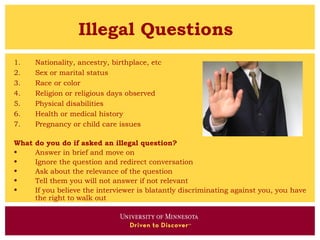
Illegal Questions
1.     Nationality, ancestry, birthplace, etc
2.     Sex or marital status
3.     Race or color
4.     Religion or religious days observed
5.     Physical disabilities
6.     Health or medical history
7.     Pregnancy or child care issues

What   do you do if asked an illegal question?
•      Answer in brief and move on
•      Ignore the question and redirect conversation
•      Ask about the relevance of the question
•      Tell them you will not answer if not relevant
•      If you believe the interviewer is blatantly discriminating against you, you have
       the right to walk out
The Interview Process
•       Closing

    –     You will be given the opportunity to ask your prepared questions

    –     The interviewer will discuss the next stages in the process

    –     If they do not give you a timeline – ASK

    –     End on a courteous note: thank the interviewer for the opportunity
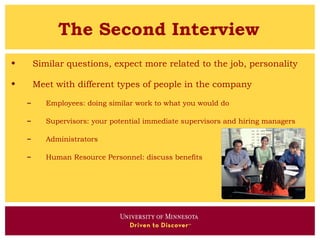
The Second Interview
•       Similar questions, expect more related to the job, personality

•       Meet with different types of people in the company

    –      Employees: doing similar work to what you would do

    –      Supervisors: your potential immediate supervisors and hiring managers

    –      Administrators

    –      Human Resource Personnel: discuss benefits
Assessing Your Interview
•       Assess your performance
    –     What went well?
    –     What could you improve on?
    –     What was your overall impression?


•       Assess your interest
    –     How well do you understand the position/Company
    –     Has your interest increased or decreased?
    –     Do I still consider this a worthy position?
    –     Was I impressed with the people I met?
    –     Do you still want to work for the company?


•       What did I learn from this interview?
Interview Follow-up
•       Always send a thank-you to the interviewer(s) within 48 hours
        of the interview
    –      Some people wait for thank-you notes before deciding who to advance to
           the next stages

    –      Deciding between sending an e-mail or hard copy letter

    –      Emphasis what you liked about the process/Interview

    –      If there was something you wanted to mention and didn’t, include it in the
           thank-you letter
Questions?
  Darren Kaltved
dkaltved@umn.edu

Interviewing Basics

  • 1.
    Interviewing Basics Darren Kaltved Associate Career Counselor School of Public Health University of Minnesota
  • 2.
    Agenda • Purpose ofthe Interview • Interview Preparation • Expectations of the Interview • Interview Follow-up
  • 3.
    Purpose of anInterview • The purpose of an interview is not to get a job, but a job offer. • The more offers you receive, the stronger your opportunity to choose the position that best fits your goals. • From a company standpoint, an initial interview should answer three basic questions: • Is the candidate ABLE to do the job effectively? • Is the candidate WILLING to put for the effort to be successful in the position? • Is the candidate MANAGABLE?
  • 4.
    Preparing for theInterview • Research Yourself – How do you want to market your skills and experiences? – Know your resume inside and out: be able to get specific • Research the Organization/Company – Show interest in the specifics of the organization – Learn the basic information of the company – Why are you interested in THAT company?
  • 5.
    Preparing for theInterview • Review Interview Questions – The more you prepare ahead of time, the less nervous you will be in the interview – Sample/typical questions available in CCSE • Prepare Questions to Ask Interviewer – It is expected candidates will have at least 3 questions prepared – Base questions on information you could still need to know or came across in your research – Interviews are not the appropriate time to discuss salary
  • 6.
    Preparing for theInterview • Look the Part – The job search is worth investing in a good suit – A conservative suit (navy, black, or grey) is recommended for interviewing – Your competition will dress formally, do not put yourself at a disadvantage – Let the content of the discussion be what the interviewer remembers, not your clothes – Avoid strong fragrances: allergies get bad in small spaces – Avoid big earrings, hair that covers your eyes/face, etc.
  • 7.
    The Interview Process • Introduction – Ice breaking: making you feel comfortable – First impressions (appearance/manners) formed here – Engage the interviewer; this aspect impacts your success as much as your formal answers • Body of the Interview – The interviewer requesting specific information – You will be evaluated on qualifications, likelihood of success, experience, attitude, work ethic and others – Much like a good story, interview answers are better when they are specific – Be prepared to discuss your short-term and long-term goals – Could include technical and/or behavioral questions
  • 8.
    Types of Questions • Tell me about yourself… – Keep it professional: avoid personal information – Present, Past, Future… • Motivation/Goal Questions – Why did you choose this major? – Where do you see yourself in 5 years? – Are you a good fit with the organization • Strengths/Weakness/Qualifications/Skills Questions – Rule of 3…back it up with proof (example) – The actual weakness is not the most important part… – The job or position description is your answer key
  • 9.
    Types of Questions • Behavioral Questions – The best predictor of future behavior is past behavior – Makes hiring decisions legally defensible – Focus on specific times when you have had to use specific skills – Primary interviewing style – “Tell me about a time when…” • STAR Technique – Situation: Describe the situation/setting you were in – Task: Describe a SPECIFIC task when you used the skill(s) identified in the question – Action: What actions did you take to complete the task? – Result: What is the outcome of the task and your actions?
  • 10.
    Types of Questions • Case Interview Questions – Tests your analytical abilities, organizational skills, poise, ability to deal with ambiguity, and problem solving – Many given in the form of a brain teaser: How many jelly beans fit inside a 747? – Make sure you get the information needed to answer the question – It is not about getting the right answer - talk them through your reasoning – The purpose is for you to walk the interviewer through your thought process and how you approach a problem
  • 11.
    Types of Questions •Technical Questions – Trading – Ability to synthesize, act upon information quickly – Understanding of macro relationships: impact of data, relationships between different asset classes & securities – Self-awareness: ability to understand and account for biases, control emotions – Communication/coordination: ability to communicate ideas, work in global teams, gather different viewpoints
  • 12.
    Types of Questions •Technical Questions – Quantitative Risk Analyst: – Experience with large datasets & Excel, VBA, Matlab, SAS, R/S-plus – Experience developing quantitative models /basic finance & economics knowledge – Exposure to credit/market/operational/business risk – Examples of strong time management and multi tasking skills – Ability to communicate analytical results clearly to non technical groups – Ability to take initiative /work independently on analysis assignments
  • 13.
    Illegal Questions 1. Nationality, ancestry, birthplace, etc 2. Sex or marital status 3. Race or color 4. Religion or religious days observed 5. Physical disabilities 6. Health or medical history 7. Pregnancy or child care issues What do you do if asked an illegal question? • Answer in brief and move on • Ignore the question and redirect conversation • Ask about the relevance of the question • Tell them you will not answer if not relevant • If you believe the interviewer is blatantly discriminating against you, you have the right to walk out
  • 14.
    The Interview Process • Closing – You will be given the opportunity to ask your prepared questions – The interviewer will discuss the next stages in the process – If they do not give you a timeline – ASK – End on a courteous note: thank the interviewer for the opportunity
  • 15.
    The Second Interview • Similar questions, expect more related to the job, personality • Meet with different types of people in the company – Employees: doing similar work to what you would do – Supervisors: your potential immediate supervisors and hiring managers – Administrators – Human Resource Personnel: discuss benefits
  • 16.
    Assessing Your Interview • Assess your performance – What went well? – What could you improve on? – What was your overall impression? • Assess your interest – How well do you understand the position/Company – Has your interest increased or decreased? – Do I still consider this a worthy position? – Was I impressed with the people I met? – Do you still want to work for the company? • What did I learn from this interview?
  • 17.
    Interview Follow-up • Always send a thank-you to the interviewer(s) within 48 hours of the interview – Some people wait for thank-you notes before deciding who to advance to the next stages – Deciding between sending an e-mail or hard copy letter – Emphasis what you liked about the process/Interview – If there was something you wanted to mention and didn’t, include it in the thank-you letter
  • 18.
    Questions? DarrenKaltved dkaltved@umn.edu

Editor's Notes

  • #4 For 3-5, companies identify universities that match their needs and focus recruitment on these schools.