Techniques For Successful Job Interview
Wazeefa1.com
“…think of an interview as having two purposes: establishing basic
trust with the interviewer, and giving the interviewer a few clear facts
about what you can do for the company.”1
“In essence you need to ‘connect’ with the interviewer interpersonally.”2
TRENDS IN JOB INTERVIEWING
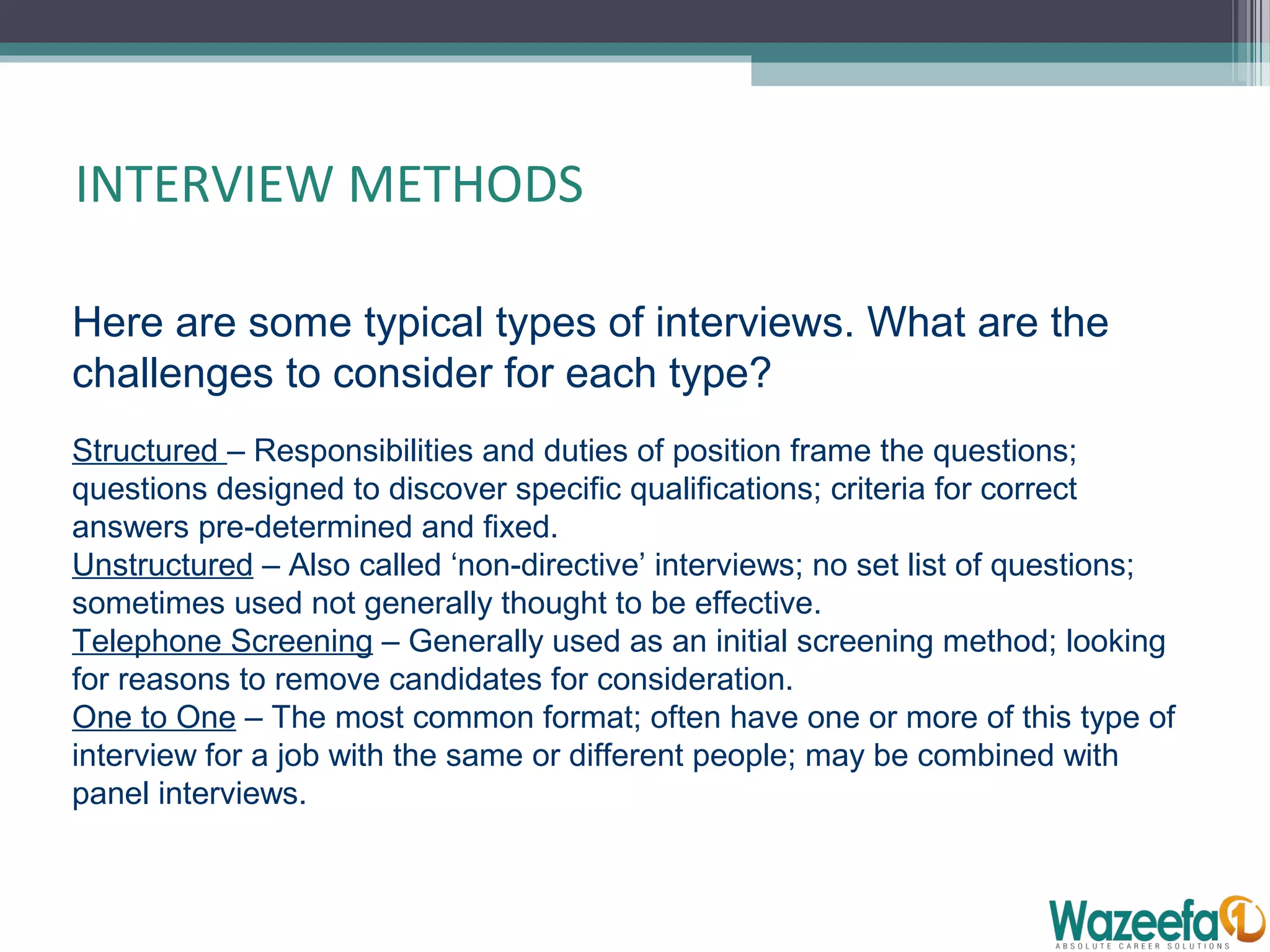
INTERVIEW METHODS
Here are some typical types of interviews. What are the
challenges to consider for each type?
Structured – Responsibilities and duties of position frame the questions;
questions designed to discover specific qualifications; criteria for correct
answers pre-determined and fixed.
Unstructured – Also called ‘non-directive’ interviews; no set list of questions;
sometimes used not generally thought to be effective.
Telephone Screening – Generally used as an initial screening method; looking
for reasons to remove candidates for consideration.
One to One – The most common format; often have one or more of this type of
interview for a job with the same or different people; may be combined with
panel interviews.
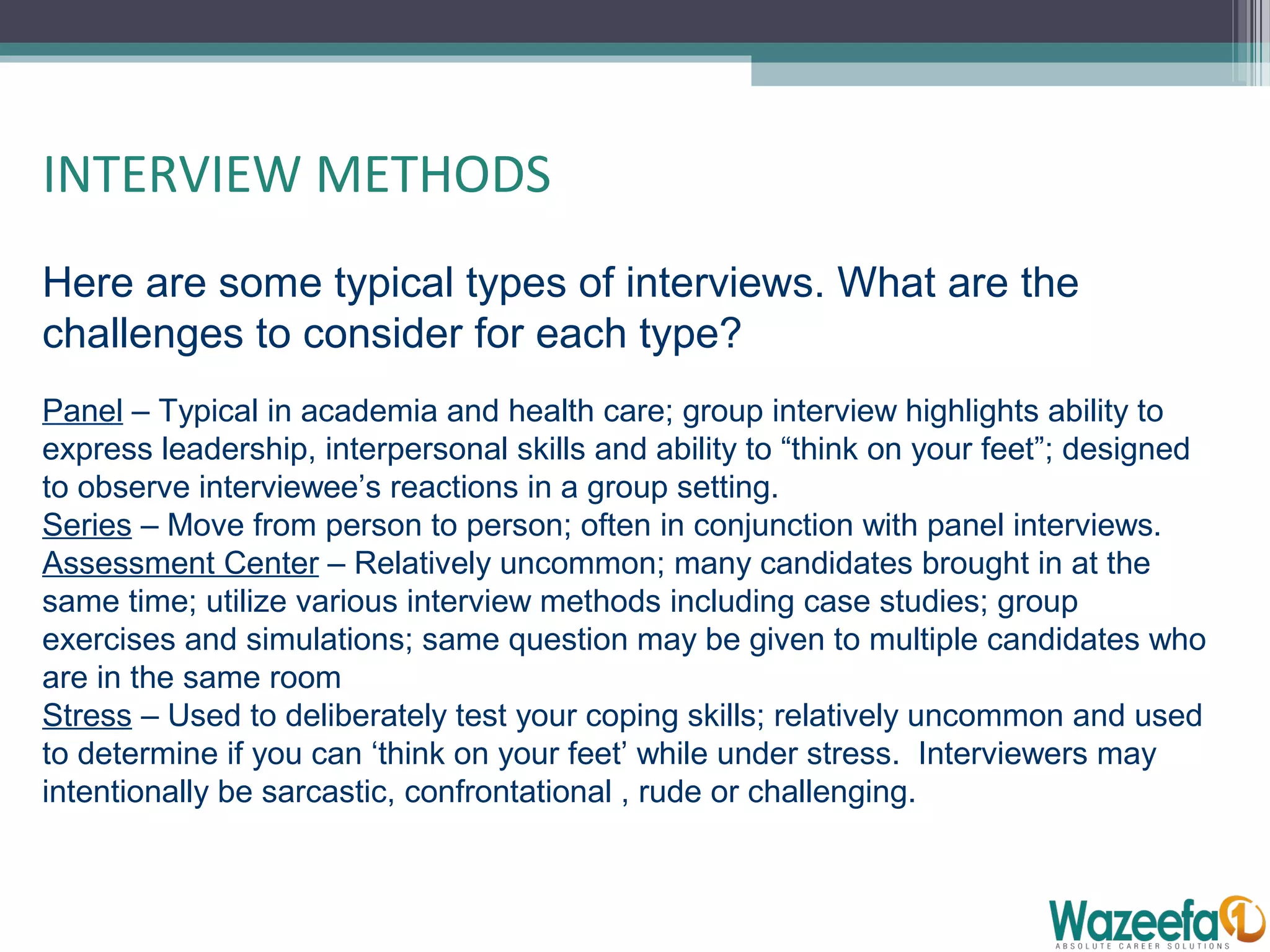
INTERVIEW METHODS
Here are some typical types of interviews. What are the
challenges to consider for each type?
Panel – Typical in academia and health care; group interview highlights ability to
express leadership, interpersonal skills and ability to “think on your feet”; designed
to observe interviewee’s reactions in a group setting.
Series – Move from person to person; often in conjunction with panel interviews.
Assessment Center – Relatively uncommon; many candidates brought in at the
same time; utilize various interview methods including case studies; group
exercises and simulations; same question may be given to multiple candidates who
are in the same room
Stress – Used to deliberately test your coping skills; relatively uncommon and used
to determine if you can ‘think on your feet’ while under stress. Interviewers may
intentionally be sarcastic, confrontational , rude or challenging.
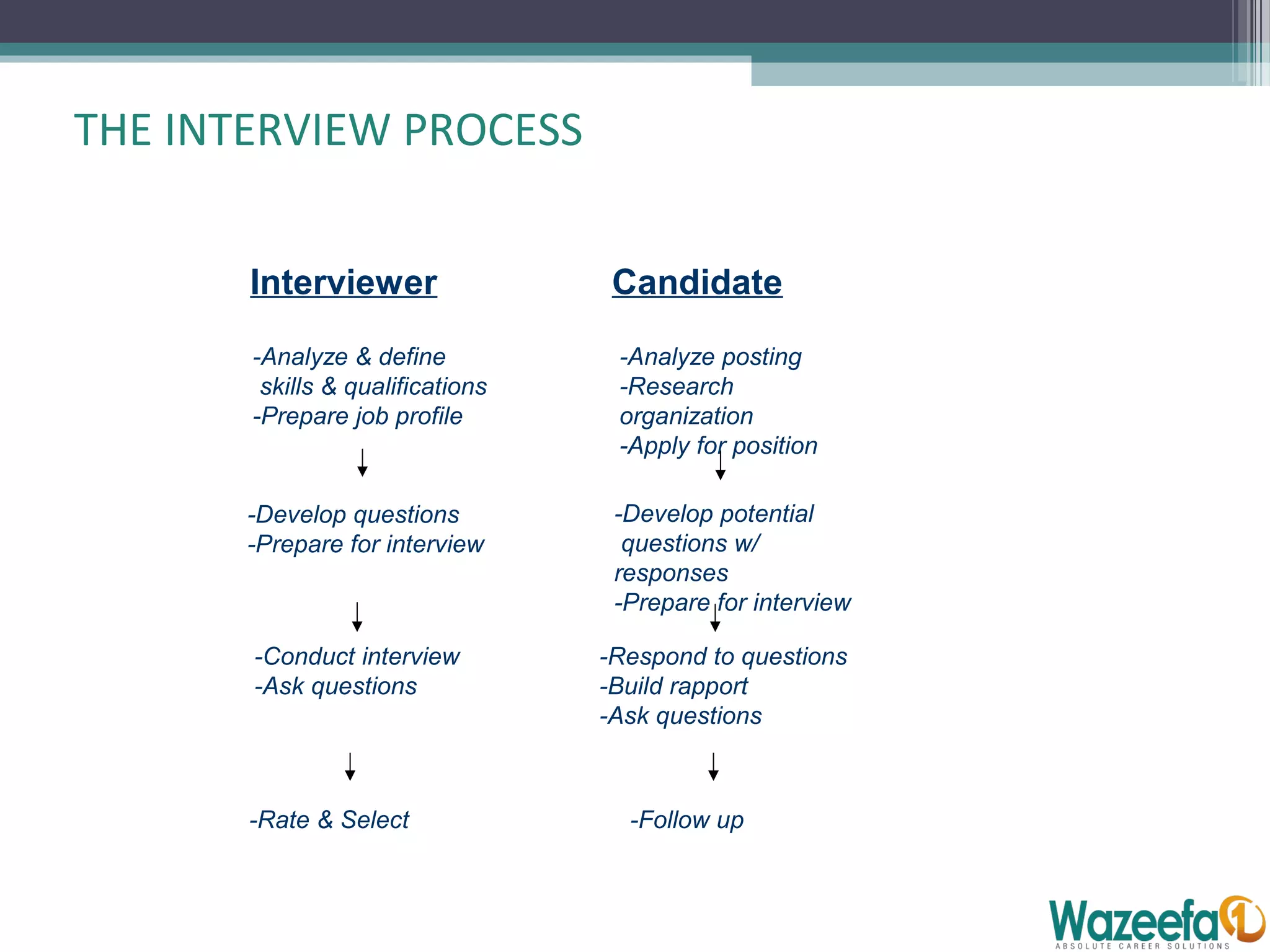
THE INTERVIEW PROCESS
-Analyze & define
skills & qualifications
-Prepare job profile
-Develop questions
-Prepare for interview
-Conduct interview
-Ask questions
-Develop potential
questions w/
responses
-Prepare for interview
-Respond to questions
-Build rapport
-Ask questions
-Analyze posting
-Research
organization
-Apply for position
Interviewer Candidate
-Rate & Select -Follow up
THINK LIKE AN INTERVIEWER…
Preparing a Job Profile
Prepare for your interview by developing a “working” job profile.
Using a job posting or job description:
1. List the key skills necessary for job-required duties and responsibilities.
2. List the important qualifications for the position.
Key Skills: Qualifications:
-Starting point in designing a job
-Build from this foundation
THINK LIKE AN INTERVIEWER…
Question Formats
Job-Related
To determine your current knowledge and capabilities for the
position.
What do you know about our competition?
How will you help the organization?
Behavioral
To define your experience looking back.
Describe a time when you…
Give an example of a time when you…
Question Formats
Brain Teaser
To determine how well candidates can logically and creatively think on their
feet.
How far apart are the minute and hour hand of a clock at 3:15?
Why is a manhole cover round?
Creating Job-Related Questions
Job Related questions may test your knowledge of the position, the company,
the institution, and the industry.
Using the information from your job profile on page 5, create 3 job related questions:
1.
2.
3.
RESPONDING TO JOB RELATED QUESTIONS
This exercise will require you to work with a partner.
1. Find a partner with whom you can exchange job related questions.
One of you is the interviewer, the other is being interviewed.
2. Interviewer ask the job related questions. Candidate, answer as you
would in an interview. Begin the interview.
3. Interviewer provide feedback on the question and the answer.
-Is the question clearly job related?
-Was the answer specific and concise?
4. Switch roles and repeat.
RESPONDING TO BEHAVIORAL QUESTIONS: STORYTELLING
The creation of one-to-two minute stories of your experiences, skills and
accomplishments are especially useful for behavioral based questions.
Define a challenge, a problem or situation you faced,
such as being required to:
• Meet objectives with same or fewer resources.
• Increase efficiency.
• Develop something for the first time.
• Prepare original papers, reports, articles.
• Manage work group or department.
• Save the organization money.
• Increase production.
• Identify problem others did not see.
• Meet goals under difficult circumstances.
Describe the actions you took to meet the challenge.
Explain the results of your actions.
Challenge:
Actions:
Results:
MIRRORING & MATCHING
Mirroring and matching the expressions, posture, rate of speech and tone of
voice is a good non-verbal communication technique.
This exercise requires that you work with a partner.
1. With your partner, exchange behavioral questions. One of you is
the interviewer, the other is being interviewed.
2. Interviewer ask the behavioral questions. Candidate answer as
you would in an interview (use storytelling) while paying attention to
mirroring and matching the interviewer. Begin the interview.
3. Interviewer take notes & provide feedback on what worked and
what needs improvement.
4. Switch roles and repeat.
TWO GUARANTEED QUESTIONS
1. Tell me about you?
2. Why are you leaving your current position?
Personal Infomercial:
Memorize a 30-60 second summary.
-Who you are
-Where you have been
-Where you are going
Reason for Leaving Statement:
Be brief, positive, truthful.
I’ve enjoyed working at XX for the past XX
years, and now I’m looking for an
opportunity to make a new contribution.
I was hired as an XX, and after a few
months it was clear that the position
was not a good fit for my skills.
MORE EXAMPLES OF QUESTIONS YOU MAY BE ASKED
GENERAL
• Tell me about yourself?
• What is your approach to managing others?
• Why did you apply for this position?
JOB RELATED
•What do you know about this position?
•What do you see as the direction of this company?
•How will you help our organization?
MORE EXAMPLES OF QUESTIONS YOU MAY BE ASKED
SITUATIONAL
• In your department you may be pulled in many directions at
once. How will you manage your priorities and time?
• Assume you are working in a project in which you need to get
people to work together effectively. How will you do this
BEHAVIORAL
•Describe a time when you inspired others to reach a common
goal?
•What was your biggest decision in the past year? Why?
•Tell me about a time when you anticipated a potential problem
and developed successful prevention measures
QUESTIONS TO ASK THEM
Do you have any questions for us?
• Keep your questions focused on the work, the tasks, or the function.
• Avoid jumping to your needs before an offer is made.
The types of questions you ask and how you ask them do as much to
differentiate you from the competition as the ones you answer. For
example:
• How will you know if the person you hire for this position is successful?
• Can you tell me why this position is open?
• Can you describe your organizational culture?
• What are the greatest challenges facing the person in this position?
• What are the organizations plans for growth in the next 3-5 years?
PRACTICE & REHEARSE
Successful job seekers know what to expect. They prepare for the
interview by:
• Researching the organization to determine the skills and
qualifications a
successful candidate will need.
• Preparing sample questions with complete responses.
• Rehearsing their responses, including one to two minute stories.
• Practicing their rapport building skills.
For additional support…
Wazeefa1
Absolute Career Solutions
Kuwait
www.wazeefa1.com

Techniques for successful job interview

  • 1.
    Techniques For SuccessfulJob Interview Wazeefa1.com
  • 2.
    “…think of aninterview as having two purposes: establishing basic trust with the interviewer, and giving the interviewer a few clear facts about what you can do for the company.”1 “In essence you need to ‘connect’ with the interviewer interpersonally.”2 TRENDS IN JOB INTERVIEWING
  • 3.
    INTERVIEW METHODS Here aresome typical types of interviews. What are the challenges to consider for each type? Structured – Responsibilities and duties of position frame the questions; questions designed to discover specific qualifications; criteria for correct answers pre-determined and fixed. Unstructured – Also called ‘non-directive’ interviews; no set list of questions; sometimes used not generally thought to be effective. Telephone Screening – Generally used as an initial screening method; looking for reasons to remove candidates for consideration. One to One – The most common format; often have one or more of this type of interview for a job with the same or different people; may be combined with panel interviews.
  • 4.
    INTERVIEW METHODS Here aresome typical types of interviews. What are the challenges to consider for each type? Panel – Typical in academia and health care; group interview highlights ability to express leadership, interpersonal skills and ability to “think on your feet”; designed to observe interviewee’s reactions in a group setting. Series – Move from person to person; often in conjunction with panel interviews. Assessment Center – Relatively uncommon; many candidates brought in at the same time; utilize various interview methods including case studies; group exercises and simulations; same question may be given to multiple candidates who are in the same room Stress – Used to deliberately test your coping skills; relatively uncommon and used to determine if you can ‘think on your feet’ while under stress. Interviewers may intentionally be sarcastic, confrontational , rude or challenging.
  • 5.
    THE INTERVIEW PROCESS -Analyze& define skills & qualifications -Prepare job profile -Develop questions -Prepare for interview -Conduct interview -Ask questions -Develop potential questions w/ responses -Prepare for interview -Respond to questions -Build rapport -Ask questions -Analyze posting -Research organization -Apply for position Interviewer Candidate -Rate & Select -Follow up
  • 6.
    THINK LIKE ANINTERVIEWER… Preparing a Job Profile Prepare for your interview by developing a “working” job profile. Using a job posting or job description: 1. List the key skills necessary for job-required duties and responsibilities. 2. List the important qualifications for the position. Key Skills: Qualifications: -Starting point in designing a job -Build from this foundation
  • 7.
    THINK LIKE ANINTERVIEWER… Question Formats Job-Related To determine your current knowledge and capabilities for the position. What do you know about our competition? How will you help the organization? Behavioral To define your experience looking back. Describe a time when you… Give an example of a time when you…
  • 8.
    Question Formats Brain Teaser Todetermine how well candidates can logically and creatively think on their feet. How far apart are the minute and hour hand of a clock at 3:15? Why is a manhole cover round?
  • 9.
    Creating Job-Related Questions JobRelated questions may test your knowledge of the position, the company, the institution, and the industry. Using the information from your job profile on page 5, create 3 job related questions: 1. 2. 3.
  • 10.
    RESPONDING TO JOBRELATED QUESTIONS This exercise will require you to work with a partner. 1. Find a partner with whom you can exchange job related questions. One of you is the interviewer, the other is being interviewed. 2. Interviewer ask the job related questions. Candidate, answer as you would in an interview. Begin the interview. 3. Interviewer provide feedback on the question and the answer. -Is the question clearly job related? -Was the answer specific and concise? 4. Switch roles and repeat.
  • 11.
    RESPONDING TO BEHAVIORALQUESTIONS: STORYTELLING The creation of one-to-two minute stories of your experiences, skills and accomplishments are especially useful for behavioral based questions. Define a challenge, a problem or situation you faced, such as being required to: • Meet objectives with same or fewer resources. • Increase efficiency. • Develop something for the first time. • Prepare original papers, reports, articles. • Manage work group or department. • Save the organization money. • Increase production. • Identify problem others did not see. • Meet goals under difficult circumstances. Describe the actions you took to meet the challenge. Explain the results of your actions. Challenge: Actions: Results:
  • 12.
    MIRRORING & MATCHING Mirroringand matching the expressions, posture, rate of speech and tone of voice is a good non-verbal communication technique. This exercise requires that you work with a partner. 1. With your partner, exchange behavioral questions. One of you is the interviewer, the other is being interviewed. 2. Interviewer ask the behavioral questions. Candidate answer as you would in an interview (use storytelling) while paying attention to mirroring and matching the interviewer. Begin the interview. 3. Interviewer take notes & provide feedback on what worked and what needs improvement. 4. Switch roles and repeat.
  • 13.
    TWO GUARANTEED QUESTIONS 1.Tell me about you? 2. Why are you leaving your current position? Personal Infomercial: Memorize a 30-60 second summary. -Who you are -Where you have been -Where you are going Reason for Leaving Statement: Be brief, positive, truthful. I’ve enjoyed working at XX for the past XX years, and now I’m looking for an opportunity to make a new contribution. I was hired as an XX, and after a few months it was clear that the position was not a good fit for my skills.
  • 14.
    MORE EXAMPLES OFQUESTIONS YOU MAY BE ASKED GENERAL • Tell me about yourself? • What is your approach to managing others? • Why did you apply for this position? JOB RELATED •What do you know about this position? •What do you see as the direction of this company? •How will you help our organization?
  • 15.
    MORE EXAMPLES OFQUESTIONS YOU MAY BE ASKED SITUATIONAL • In your department you may be pulled in many directions at once. How will you manage your priorities and time? • Assume you are working in a project in which you need to get people to work together effectively. How will you do this BEHAVIORAL •Describe a time when you inspired others to reach a common goal? •What was your biggest decision in the past year? Why? •Tell me about a time when you anticipated a potential problem and developed successful prevention measures
  • 16.
    QUESTIONS TO ASKTHEM Do you have any questions for us? • Keep your questions focused on the work, the tasks, or the function. • Avoid jumping to your needs before an offer is made. The types of questions you ask and how you ask them do as much to differentiate you from the competition as the ones you answer. For example: • How will you know if the person you hire for this position is successful? • Can you tell me why this position is open? • Can you describe your organizational culture? • What are the greatest challenges facing the person in this position? • What are the organizations plans for growth in the next 3-5 years?
  • 17.
    PRACTICE & REHEARSE Successfuljob seekers know what to expect. They prepare for the interview by: • Researching the organization to determine the skills and qualifications a successful candidate will need. • Preparing sample questions with complete responses. • Rehearsing their responses, including one to two minute stories. • Practicing their rapport building skills. For additional support… Wazeefa1 Absolute Career Solutions Kuwait www.wazeefa1.com