Interviews
Presented by
Jaweria Akhtar
Outline:
Definition
Types of interviews
When to use interview
Asking questions
Interviewing difficult people
Analyzing interview data
Interviews
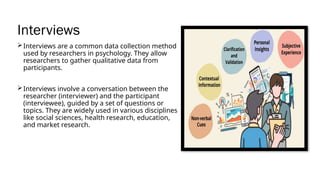
Interviews are a common data collection method
used by researchers in psychology. They allow
researchers to gather qualitative data from
participants.
Interviews involve a conversation between the
researcher (interviewer) and the participant
(interviewee), guided by a set of questions or
topics. They are widely used in various disciplines
like social sciences, health research, education,
and market research.
Purpose of Interview
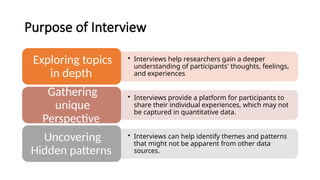
• Interviews help researchers gain a deeper
understanding of participants' thoughts, feelings,
and experiences
Exploring topics
in depth
• Interviews provide a platform for participants to
share their individual experiences, which may not
be captured in quantitative data.
Gathering
unique
Perspective
• Interviews can help identify themes and patterns
that might not be apparent from other data
sources.
Uncovering
Hidden patterns
Conti…..
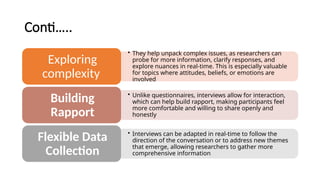
• They help unpack complex issues, as researchers can
probe for more information, clarify responses, and
explore nuances in real-time. This is especially valuable
for topics where attitudes, beliefs, or emotions are
involved
Exploring
complexity
• Unlike questionnaires, interviews allow for interaction,
which can help build rapport, making participants feel
more comfortable and willing to share openly and
honestly
Building
Rapport
• Interviews can be adapted in real-time to follow the
direction of the conversation or to address new themes
that emerge, allowing researchers to gather more
comprehensive information.
Flexible Data
Collection
Conti…..
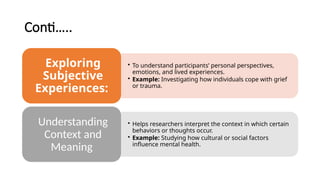
• To understand participants’ personal perspectives,
emotions, and lived experiences.
• Example: Investigating how individuals cope with grief
or trauma.
Exploring
Subjective
Experiences:
• Helps researchers interpret the context in which certain
behaviors or thoughts occur.
• Example: Studying how cultural or social factors
influence mental health.
Understanding
Context and
Meaning
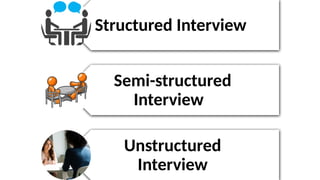
Structured Interview
Semi-structured
Interview
Unstructured
Interview
Structured Interviews
A structured interview is a systematic method of data collection in which the
interviewer asks a pre-determined set of standardized questions in a fixed order.
This type of interview is designed to ensure uniformity across all participants,
making it easier to compare responses and reduce interviewer bias.
Structured interviews are commonly used in research, clinical practice, job
recruitment, and educational settings, where consistency and reliability are
important.
Example
A researcher wants to investigate sleep patterns and prepares a fixed set of questions that they
will ask every participant.
Questions:
1. "How many hours do you usually sleep each night?“
Options for response: 4-6 hours, 6-8 hours, 8+ hours.
2. "Do you go to bed and wake up at the same time every day?“
Response type: Yes/No.
3. "How often do you experience trouble falling asleep?“
Options: Never, Sometimes, Often, Always.
"Do you use any devices (like a phone or TV) right before bed?“
Response type: Yes/No.
"On a scale from 1 to 10, how would you rate the quality of your sleep?"
Semi-structured
Interview
 A semi-structured interview is
a type of interview where the
researcher has a set of prepared
questions or topics to guide the
conversation but also allows
flexibility to explore new ideas or
issues that come up during the
discussion.
 This approach is often used in
research to gather detailed and
meaningful insights because it lets
participants share their thoughts
freely while still keeping the
conversation focused on the main
topics.
If you're interviewing someone about their favorite hobbies, you might start with
questions like, “What hobbies do you enjoy?” but also ask follow-up questions like,
“Why do you enjoy that particular hobby?” based on their answers.
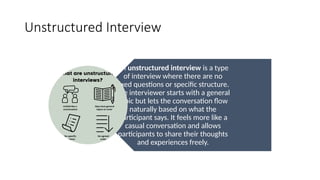
Unstructured Interview
An unstructured interview is a type
of interview where there are no
fixed questions or specific structure.
The interviewer starts with a general
topic but lets the conversation flow
naturally based on what the
participant says. It feels more like a
casual conversation and allows
participants to share their thoughts
and experiences freely.
Example
A psychologist wants to understand how young adults feel about their emotional well-
being but does not prepare a strict list of questions. They start with a broad opening
and follow the participant’s lead.
Opening Question:
"How have you been feeling emotionally lately?“
Participant’s Response:
If they talk about stress, the interviewer might ask:
"What do you think is causing your stress?"
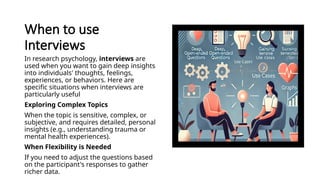
When to use
Interviews
In research psychology, interviews are
used when you want to gain deep insights
into individuals' thoughts, feelings,
experiences, or behaviors. Here are
specific situations when interviews are
particularly useful
Exploring Complex Topics
When the topic is sensitive, complex, or
subjective, and requires detailed, personal
insights (e.g., understanding trauma or
mental health experiences).
When Flexibility is Needed
If you need to adjust the questions based
on the participant's responses to gather
richer data.
Cont.…..
• Supplementing Quantitative Data
To provide context or deeper explanations for findings from surveys or
experiments.
• Exploring New or Unfamiliar Topics
Use interviews in exploratory research when studying areas where little prior
research exists, and there are no predefined hypotheses or frameworks.
• Ethnographic or Longitudinal Studies
In studies where relationships, trust, or long-term engagement with participants
are key, interviews help build rapport and gather authentic responses.
Cont.….
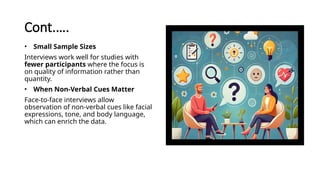
• Small Sample Sizes
Interviews work well for studies with
fewer participants where the focus is
on quality of information rather than
quantity.
• When Non-Verbal Cues Matter
Face-to-face interviews allow
observation of non-verbal cues like facial
expressions, tone, and body language,
which can enrich the data.
When are interviews most effective
compared to other methods?
Interviews are best when understanding personal or sensitive topics is essential.
• Example: Investigating trauma experiences, where surveys may not capture
emotional nuances.
Asking Questions
Be Clear and Concise:
Ensure the questions are easy to understand. Avoid jargon or complex terms that
might confuse participants.
Example: Instead of "Can you elaborate on the psychodynamic mechanisms
influencing your behavior?" ask, "How do you think your past experiences affect the
way you handle stress now?“
Use Open-Ended Questions:
Encourage participants to express their thoughts and feelings fully. Open-ended
questions (those starting with "how," "why," or "what") allow for richer, more detailed
responses.
Example: "What strategies do you use to manage anxiety?" instead of "Do you use any
strategies to manage anxiety?"
Conti…….
Be Neutral:
Avoid leading questions that might suggest an answer. Your goal is to understand the
participant’s view, not to confirm your own assumptions.
Example: Instead of "Don’t you think stress is harmful to your health?" ask "How do you
think stress affects your health?“
Be Sensitive to the Participant:
Psychology interviews often deal with sensitive topics, such as mental health, trauma, or
personal beliefs. Always be respectful, patient, and non-judgmental in your questioning.
Be Flexible:
While it's important to have prepared questions, be willing to adapt based on the flow of
conversation. If the participant brings up a relevant topic, feel free to explore it further.
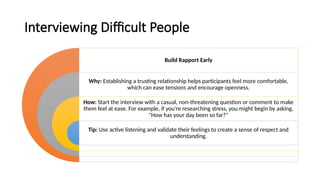
Interviewing Difficult People
Build Rapport Early
Why: Establishing a trusting relationship helps participants feel more comfortable,
which can ease tensions and encourage openness.
How: Start the interview with a casual, non-threatening question or comment to make
them feel at ease. For example, if you're researching stress, you might begin by asking,
"How has your day been so far?"
Tip: Use active listening and validate their feelings to create a sense of respect and
understanding.
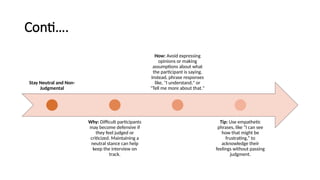
Conti….
Stay Neutral and Non-
Judgmental
Why: Difficult participants
may become defensive if
they feel judged or
criticized. Maintaining a
neutral stance can help
keep the interview on
track.
How: Avoid expressing
opinions or making
assumptions about what
the participant is saying.
Instead, phrase responses
like, "I understand," or
"Tell me more about that."
Tip: Use empathetic
phrases, like “I can see
how that might be
frustrating,” to
acknowledge their
feelings without passing
judgment.
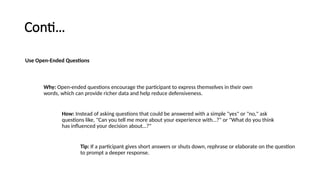
Conti…
Use Open-Ended Questions
Why: Open-ended questions encourage the participant to express themselves in their own
words, which can provide richer data and help reduce defensiveness.
How: Instead of asking questions that could be answered with a simple "yes" or "no," ask
questions like, "Can you tell me more about your experience with…?" or "What do you think
has influenced your decision about…?"
Tip: If a participant gives short answers or shuts down, rephrase or elaborate on the question
to prompt a deeper response.
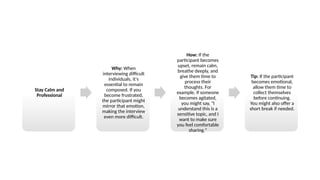
Stay Calm and
Professional
Why: When
interviewing difficult
individuals, it's
essential to remain
composed. If you
become frustrated,
the participant might
mirror that emotion,
making the interview
even more difficult.
How: If the
participant becomes
upset, remain calm,
breathe deeply, and
give them time to
process their
thoughts. For
example, if someone
becomes agitated,
you might say, "I
understand this is a
sensitive topic, and I
want to make sure
you feel comfortable
sharing."
Tip: If the participant
becomes emotional,
allow them time to
collect themselves
before continuing.
You might also offer a
short break if needed.
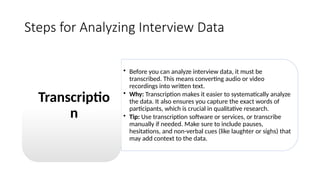
Steps for Analyzing Interview Data
• Before you can analyze interview data, it must be
transcribed. This means converting audio or video
recordings into written text.
• Why: Transcription makes it easier to systematically analyze
the data. It also ensures you capture the exact words of
participants, which is crucial in qualitative research.
• Tip: Use transcription software or services, or transcribe
manually if needed. Make sure to include pauses,
hesitations, and non-verbal cues (like laughter or sighs) that
may add context to the data.
Transcriptio
n
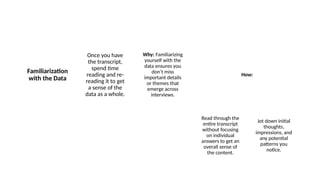
Familiarization
with the Data
Once you have
the transcript,
spend time
reading and re-
reading it to get
a sense of the
data as a whole.
Why: Familiarizing
yourself with the
data ensures you
don’t miss
important details
or themes that
emerge across
interviews.
How:
Read through the
entire transcript
without focusing
on individual
answers to get an
overall sense of
the content.
Jot down initial
thoughts,
impressions, and
any potential
patterns you
notice.
interviews in advances in research methodology

interviews in advances in research methodology

  • 1.
  • 2.
    Outline: Definition Types of interviews Whento use interview Asking questions Interviewing difficult people Analyzing interview data
  • 3.
    Interviews Interviews are acommon data collection method used by researchers in psychology. They allow researchers to gather qualitative data from participants. Interviews involve a conversation between the researcher (interviewer) and the participant (interviewee), guided by a set of questions or topics. They are widely used in various disciplines like social sciences, health research, education, and market research.
  • 4.
    Purpose of Interview •Interviews help researchers gain a deeper understanding of participants' thoughts, feelings, and experiences Exploring topics in depth • Interviews provide a platform for participants to share their individual experiences, which may not be captured in quantitative data. Gathering unique Perspective • Interviews can help identify themes and patterns that might not be apparent from other data sources. Uncovering Hidden patterns
  • 5.
    Conti….. • They helpunpack complex issues, as researchers can probe for more information, clarify responses, and explore nuances in real-time. This is especially valuable for topics where attitudes, beliefs, or emotions are involved Exploring complexity • Unlike questionnaires, interviews allow for interaction, which can help build rapport, making participants feel more comfortable and willing to share openly and honestly Building Rapport • Interviews can be adapted in real-time to follow the direction of the conversation or to address new themes that emerge, allowing researchers to gather more comprehensive information. Flexible Data Collection
  • 6.
    Conti….. • To understandparticipants’ personal perspectives, emotions, and lived experiences. • Example: Investigating how individuals cope with grief or trauma. Exploring Subjective Experiences: • Helps researchers interpret the context in which certain behaviors or thoughts occur. • Example: Studying how cultural or social factors influence mental health. Understanding Context and Meaning
  • 7.
  • 8.
    Structured Interviews A structuredinterview is a systematic method of data collection in which the interviewer asks a pre-determined set of standardized questions in a fixed order. This type of interview is designed to ensure uniformity across all participants, making it easier to compare responses and reduce interviewer bias. Structured interviews are commonly used in research, clinical practice, job recruitment, and educational settings, where consistency and reliability are important.
  • 9.
    Example A researcher wantsto investigate sleep patterns and prepares a fixed set of questions that they will ask every participant. Questions: 1. "How many hours do you usually sleep each night?“ Options for response: 4-6 hours, 6-8 hours, 8+ hours. 2. "Do you go to bed and wake up at the same time every day?“ Response type: Yes/No. 3. "How often do you experience trouble falling asleep?“ Options: Never, Sometimes, Often, Always. "Do you use any devices (like a phone or TV) right before bed?“ Response type: Yes/No. "On a scale from 1 to 10, how would you rate the quality of your sleep?"
  • 10.
    Semi-structured Interview  A semi-structuredinterview is a type of interview where the researcher has a set of prepared questions or topics to guide the conversation but also allows flexibility to explore new ideas or issues that come up during the discussion.  This approach is often used in research to gather detailed and meaningful insights because it lets participants share their thoughts freely while still keeping the conversation focused on the main topics.
  • 11.
    If you're interviewingsomeone about their favorite hobbies, you might start with questions like, “What hobbies do you enjoy?” but also ask follow-up questions like, “Why do you enjoy that particular hobby?” based on their answers.
  • 12.
    Unstructured Interview An unstructuredinterview is a type of interview where there are no fixed questions or specific structure. The interviewer starts with a general topic but lets the conversation flow naturally based on what the participant says. It feels more like a casual conversation and allows participants to share their thoughts and experiences freely.
  • 13.
    Example A psychologist wantsto understand how young adults feel about their emotional well- being but does not prepare a strict list of questions. They start with a broad opening and follow the participant’s lead. Opening Question: "How have you been feeling emotionally lately?“ Participant’s Response: If they talk about stress, the interviewer might ask: "What do you think is causing your stress?"
  • 14.
    When to use Interviews Inresearch psychology, interviews are used when you want to gain deep insights into individuals' thoughts, feelings, experiences, or behaviors. Here are specific situations when interviews are particularly useful Exploring Complex Topics When the topic is sensitive, complex, or subjective, and requires detailed, personal insights (e.g., understanding trauma or mental health experiences). When Flexibility is Needed If you need to adjust the questions based on the participant's responses to gather richer data.
  • 15.
    Cont.….. • Supplementing QuantitativeData To provide context or deeper explanations for findings from surveys or experiments. • Exploring New or Unfamiliar Topics Use interviews in exploratory research when studying areas where little prior research exists, and there are no predefined hypotheses or frameworks. • Ethnographic or Longitudinal Studies In studies where relationships, trust, or long-term engagement with participants are key, interviews help build rapport and gather authentic responses.
  • 16.
    Cont.…. • Small SampleSizes Interviews work well for studies with fewer participants where the focus is on quality of information rather than quantity. • When Non-Verbal Cues Matter Face-to-face interviews allow observation of non-verbal cues like facial expressions, tone, and body language, which can enrich the data.
  • 17.
    When are interviewsmost effective compared to other methods? Interviews are best when understanding personal or sensitive topics is essential. • Example: Investigating trauma experiences, where surveys may not capture emotional nuances.
  • 18.
    Asking Questions Be Clearand Concise: Ensure the questions are easy to understand. Avoid jargon or complex terms that might confuse participants. Example: Instead of "Can you elaborate on the psychodynamic mechanisms influencing your behavior?" ask, "How do you think your past experiences affect the way you handle stress now?“ Use Open-Ended Questions: Encourage participants to express their thoughts and feelings fully. Open-ended questions (those starting with "how," "why," or "what") allow for richer, more detailed responses. Example: "What strategies do you use to manage anxiety?" instead of "Do you use any strategies to manage anxiety?"
  • 19.
    Conti……. Be Neutral: Avoid leadingquestions that might suggest an answer. Your goal is to understand the participant’s view, not to confirm your own assumptions. Example: Instead of "Don’t you think stress is harmful to your health?" ask "How do you think stress affects your health?“ Be Sensitive to the Participant: Psychology interviews often deal with sensitive topics, such as mental health, trauma, or personal beliefs. Always be respectful, patient, and non-judgmental in your questioning. Be Flexible: While it's important to have prepared questions, be willing to adapt based on the flow of conversation. If the participant brings up a relevant topic, feel free to explore it further.
  • 20.
    Interviewing Difficult People BuildRapport Early Why: Establishing a trusting relationship helps participants feel more comfortable, which can ease tensions and encourage openness. How: Start the interview with a casual, non-threatening question or comment to make them feel at ease. For example, if you're researching stress, you might begin by asking, "How has your day been so far?" Tip: Use active listening and validate their feelings to create a sense of respect and understanding.
  • 21.
    Conti…. Stay Neutral andNon- Judgmental Why: Difficult participants may become defensive if they feel judged or criticized. Maintaining a neutral stance can help keep the interview on track. How: Avoid expressing opinions or making assumptions about what the participant is saying. Instead, phrase responses like, "I understand," or "Tell me more about that." Tip: Use empathetic phrases, like “I can see how that might be frustrating,” to acknowledge their feelings without passing judgment.
  • 22.
    Conti… Use Open-Ended Questions Why:Open-ended questions encourage the participant to express themselves in their own words, which can provide richer data and help reduce defensiveness. How: Instead of asking questions that could be answered with a simple "yes" or "no," ask questions like, "Can you tell me more about your experience with…?" or "What do you think has influenced your decision about…?" Tip: If a participant gives short answers or shuts down, rephrase or elaborate on the question to prompt a deeper response.
  • 23.
    Stay Calm and Professional Why:When interviewing difficult individuals, it's essential to remain composed. If you become frustrated, the participant might mirror that emotion, making the interview even more difficult. How: If the participant becomes upset, remain calm, breathe deeply, and give them time to process their thoughts. For example, if someone becomes agitated, you might say, "I understand this is a sensitive topic, and I want to make sure you feel comfortable sharing." Tip: If the participant becomes emotional, allow them time to collect themselves before continuing. You might also offer a short break if needed.
  • 24.
    Steps for AnalyzingInterview Data • Before you can analyze interview data, it must be transcribed. This means converting audio or video recordings into written text. • Why: Transcription makes it easier to systematically analyze the data. It also ensures you capture the exact words of participants, which is crucial in qualitative research. • Tip: Use transcription software or services, or transcribe manually if needed. Make sure to include pauses, hesitations, and non-verbal cues (like laughter or sighs) that may add context to the data. Transcriptio n
  • 25.
    Familiarization with the Data Onceyou have the transcript, spend time reading and re- reading it to get a sense of the data as a whole. Why: Familiarizing yourself with the data ensures you don’t miss important details or themes that emerge across interviews. How: Read through the entire transcript without focusing on individual answers to get an overall sense of the content. Jot down initial thoughts, impressions, and any potential patterns you notice.

Editor's Notes

  • #2 When conducting research, it is easy to go to one source: Wikipedia. However, you need to include a variety of sources in your research. Consider the following sources: Who can I interview to get more information on the topic? Is the topic current and will it be relevant to my audience? What articles, blogs, and magazines may have something related to my topic? Is there a YouTube video on the topic? If so, what is it about? What images can I find related to the topic?
  • #3 Once you find your sources, you will want to evaluate your sources using the following questions: Author: Who is the author? Why should I believe what he or she has to say on the topic? Is the author seen as an expert on the topic? How do you know? Current: How current is the information in the source? When was the source published? Is the information out-of-date? Accuracy: Is the content accurate? Is the information presented objectively? Do they share the pros and cons?
  • #7 After consulting a variety of sources, you will need to narrow your topic. For example, the topic of internet safety is huge, but you could narrow that topic to include internet safety in regards to social media apps that teenagers are using heavily. A topic like that is more specific and will be relevant to your peers. Some questions to think about to help you narrow your topic: What topics of the research interest me the most? What topics of the research will interest my audience the most? What topics will the audience find more engaging? Shocking? Inspiring?
  • #8 Now, that you have narrowed your topic, you will want to organize your research in a structure that works. There are some common organizational patterns based on the kind of research you are doing. Organizational Structures: Cause and Effect- this kind of structure is great for explaining the causes and effects of a topic Compare and Contrast- in this pattern you highlight the similarities and differences of the topic Explain process- this structure is great for outlining a series of steps to follow; Definition- if you want to make sure your audience understands what something is using illustrations, meanings, clarifying misconceptions, you may want to use this structure Classification- a common organizational structure is grouping like topics or facts from the research together. For instance, in the internet safety about social media apps, you may organize the research where you look at each social media app one at a time