Intersections
Big and Small:
Michelle Reed @LibrariansReed
Open Education Librarian
University of Texas at Arlington
https://www.slideshare.net/oelib
A Review of
Three Projects that Merge
Scholarly Communication
& Information Literacy
Openness is the only means of doing education. If there is
no sharing, there is no education. Successful educators
share most thoroughly with the most students.
- David Wiley
“Be a champion of a cause and don't give up.”
- TJ Bliss
“Research provides the foundation of modern society. Research leads
to breakthroughs, and communicating the results of research is what
allows us to turn breakthroughs into better lives—to provide new
treatments for disease, to implement solutions for challenges like
global warming, and to build entire industries around what were once
just ideas. However, our current system for communicating research is
crippled by a centuries old model that hasn’t been updated to take
advantage of 21st century technology.”
- Scholarly Publishing and Academic Resources Coalition (SPARC)
“Isn’t it amazing that
what serves social justice
also serves effective
pedagogy
and is empirically
supported?”
- Rajiv Jhangiani
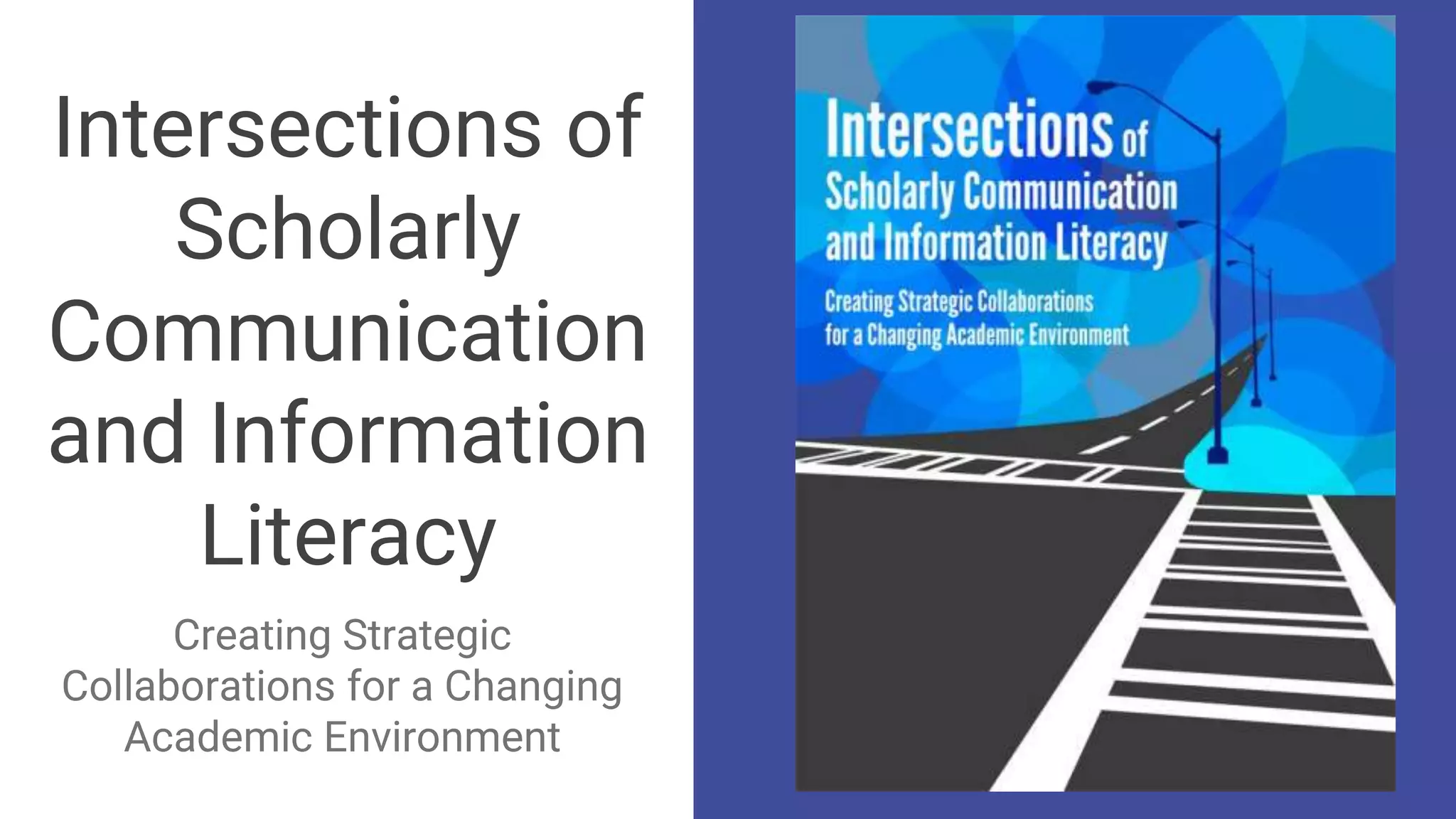
Intersections of
Scholarly
Communication
and Information
Literacy
Creating Strategic
Collaborations for a Changing
Academic Environment
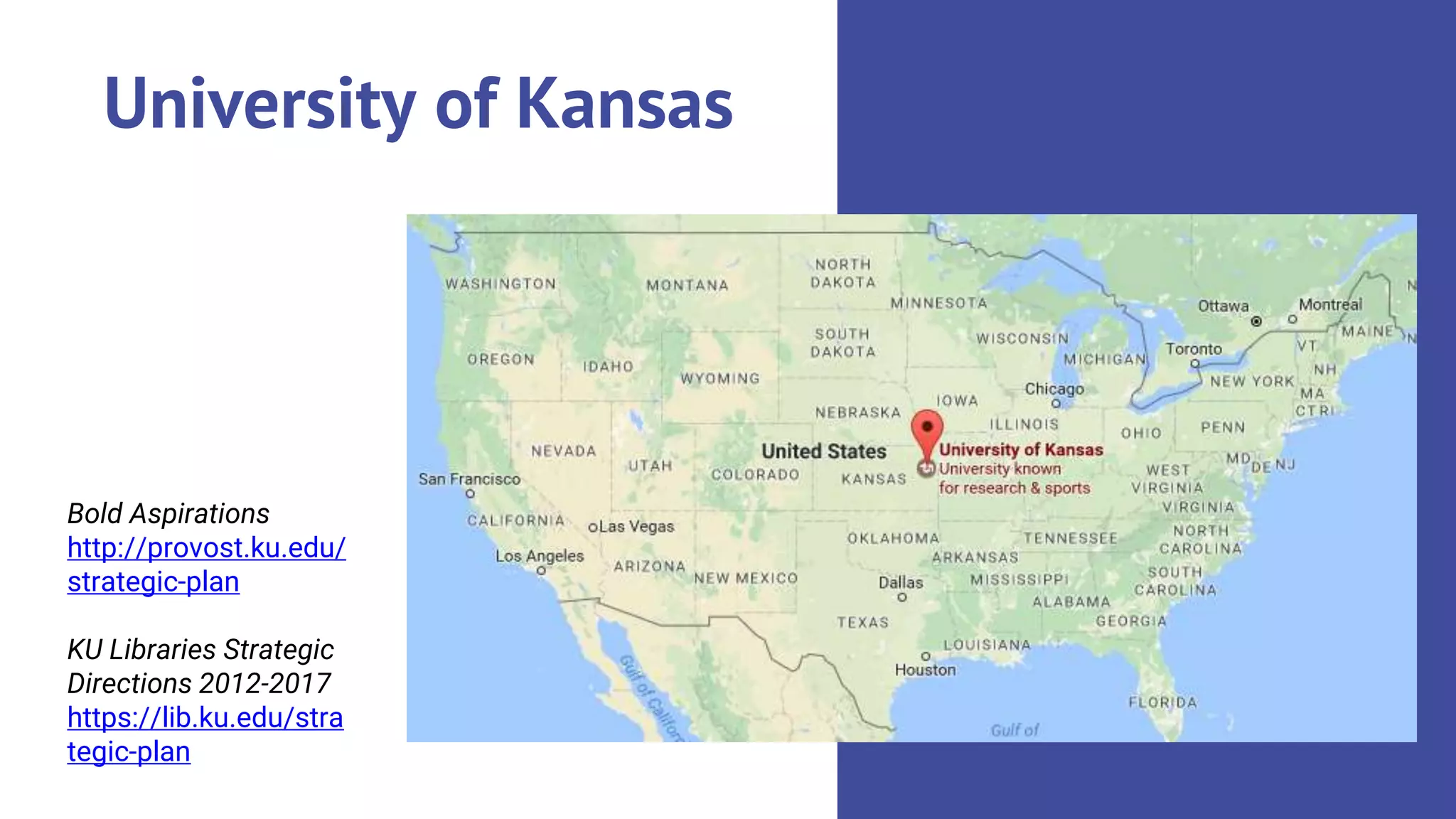
University of Kansas
Bold Aspirations
http://provost.ku.edu/
strategic-plan
KU Libraries Strategic
Directions 2012-2017
https://lib.ku.edu/stra
tegic-plan
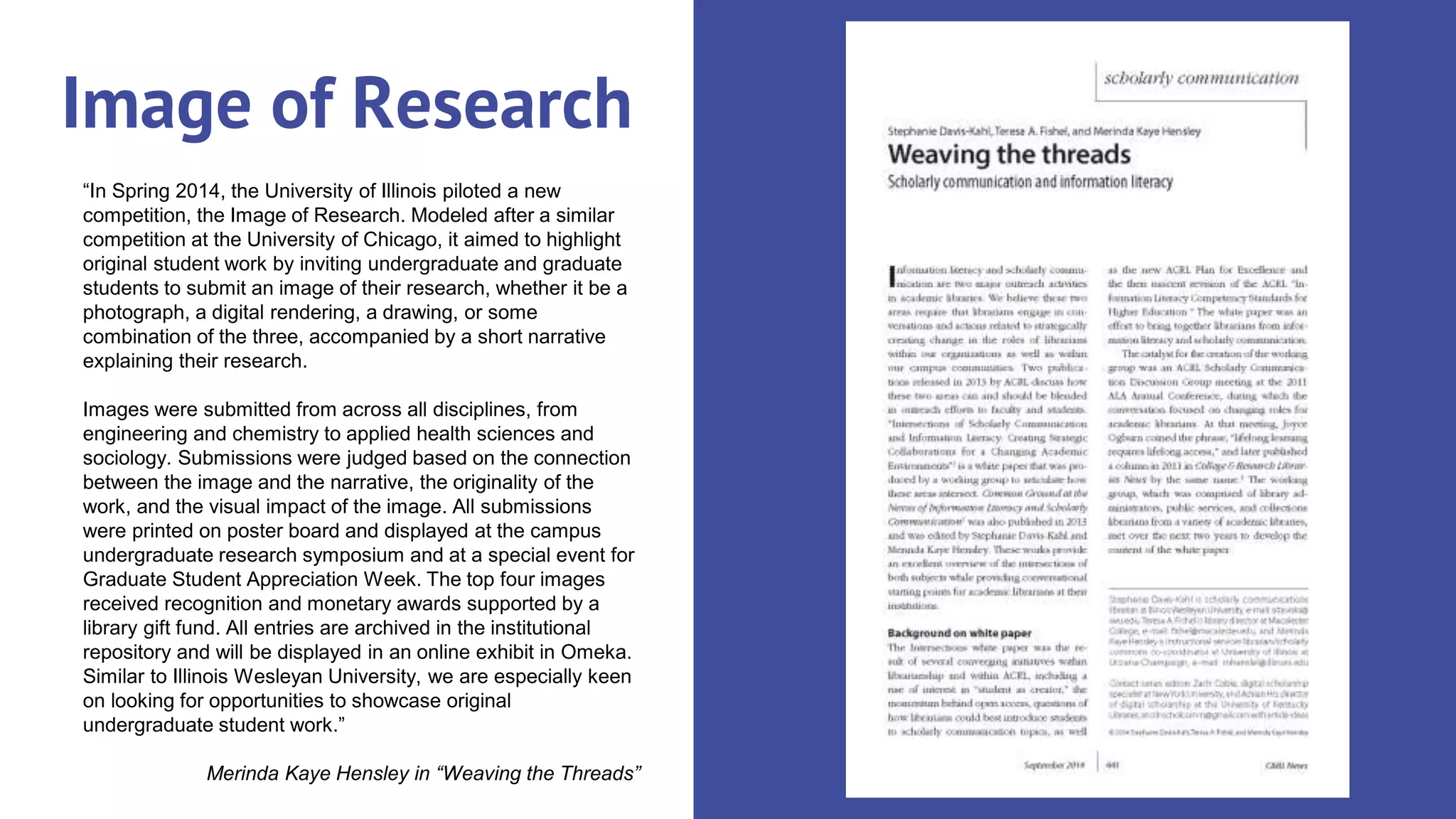
“In Spring 2014, the University of Illinois piloted a new
competition, the Image of Research. Modeled after a similar
competition at the University of Chicago, it aimed to highlight
original student work by inviting undergraduate and graduate
students to submit an image of their research, whether it be a
photograph, a digital rendering, a drawing, or some
combination of the three, accompanied by a short narrative
explaining their research.
Images were submitted from across all disciplines, from
engineering and chemistry to applied health sciences and
sociology. Submissions were judged based on the connection
between the image and the narrative, the originality of the
work, and the visual impact of the image. All submissions
were printed on poster board and displayed at the campus
undergraduate research symposium and at a special event for
Graduate Student Appreciation Week. The top four images
received recognition and monetary awards supported by a
library gift fund. All entries are archived in the institutional
repository and will be displayed in an online exhibit in Omeka.
Similar to Illinois Wesleyan University, we are especially keen
on looking for opportunities to showcase original
undergraduate student work.”
Merinda Kaye Hensley in “Weaving the Threads”
Image of Research
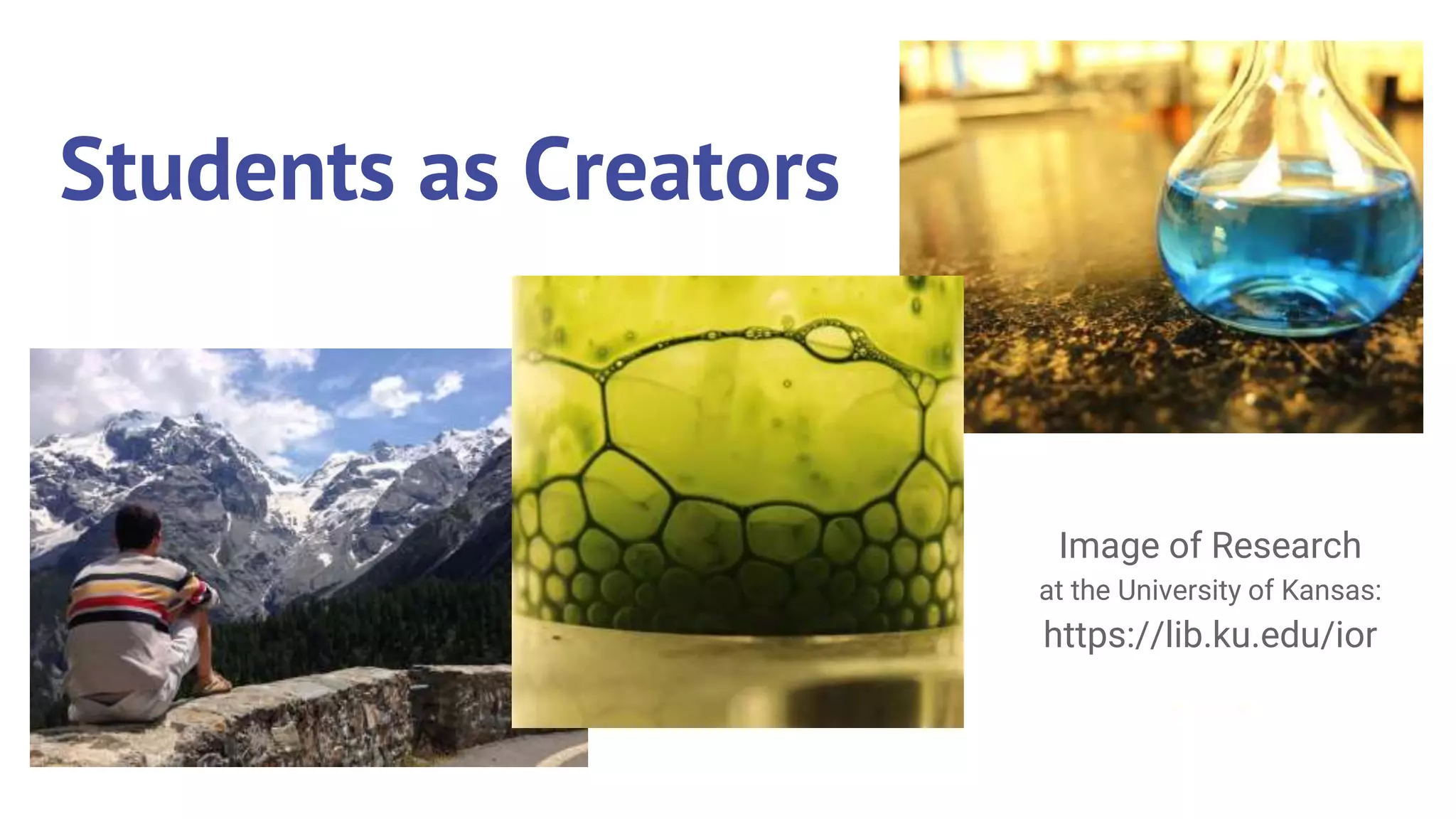
Students as Creators
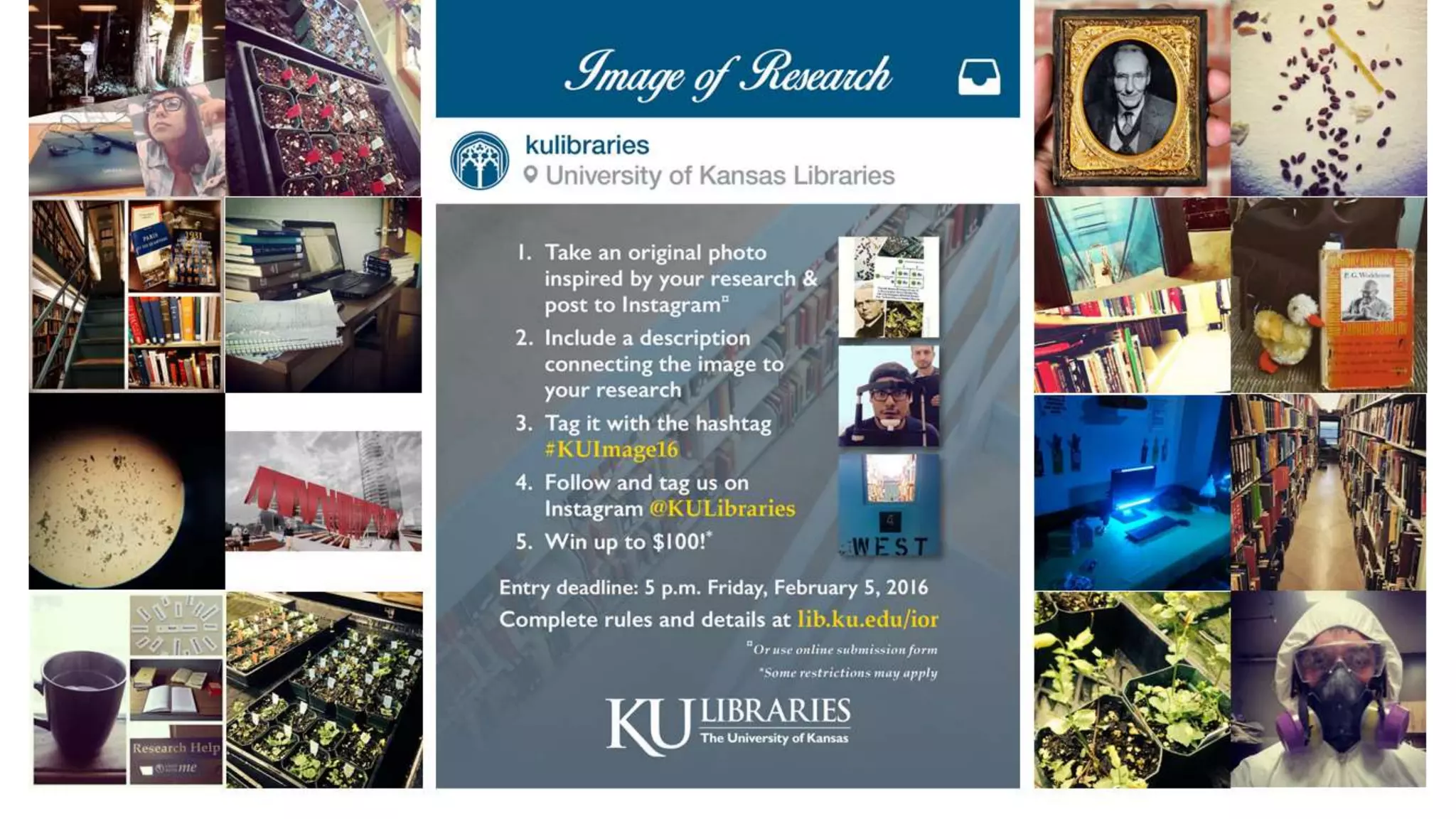
Image of Research
at the University of Kansas:
https://lib.ku.edu/ior
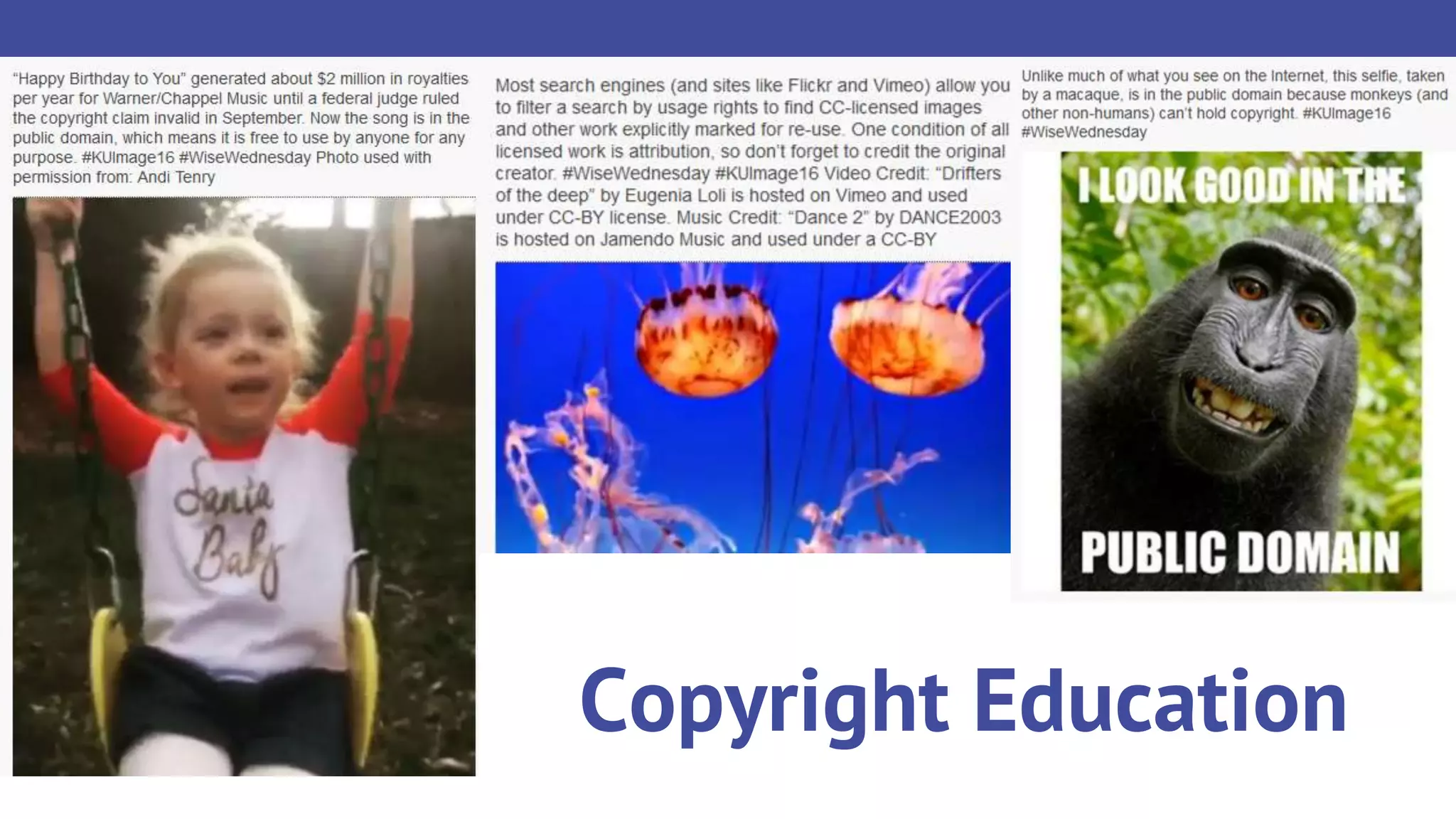
Copyright Education
Award: Research Is a Process
Research as Inquiry
“Research is iterative and depends upon
asking increasingly complex or new questions
whose answers in turn develop additional
questions or lines of inquiry in any field.”
Searching as Strategic Exploration
“Searching for information is often nonlinear
and iterative, requiring the evaluation of a
range of information sources and the mental
flexibility to pursue alternate avenues as new
understanding develops.”
Information Creation as a Process
“Information in any format is produced to
convey a message and is shared via a
selected delivery method. The iterative
processes of researching, creating, revising,
and disseminating information vary, and the
resulting product reflects these differences.”
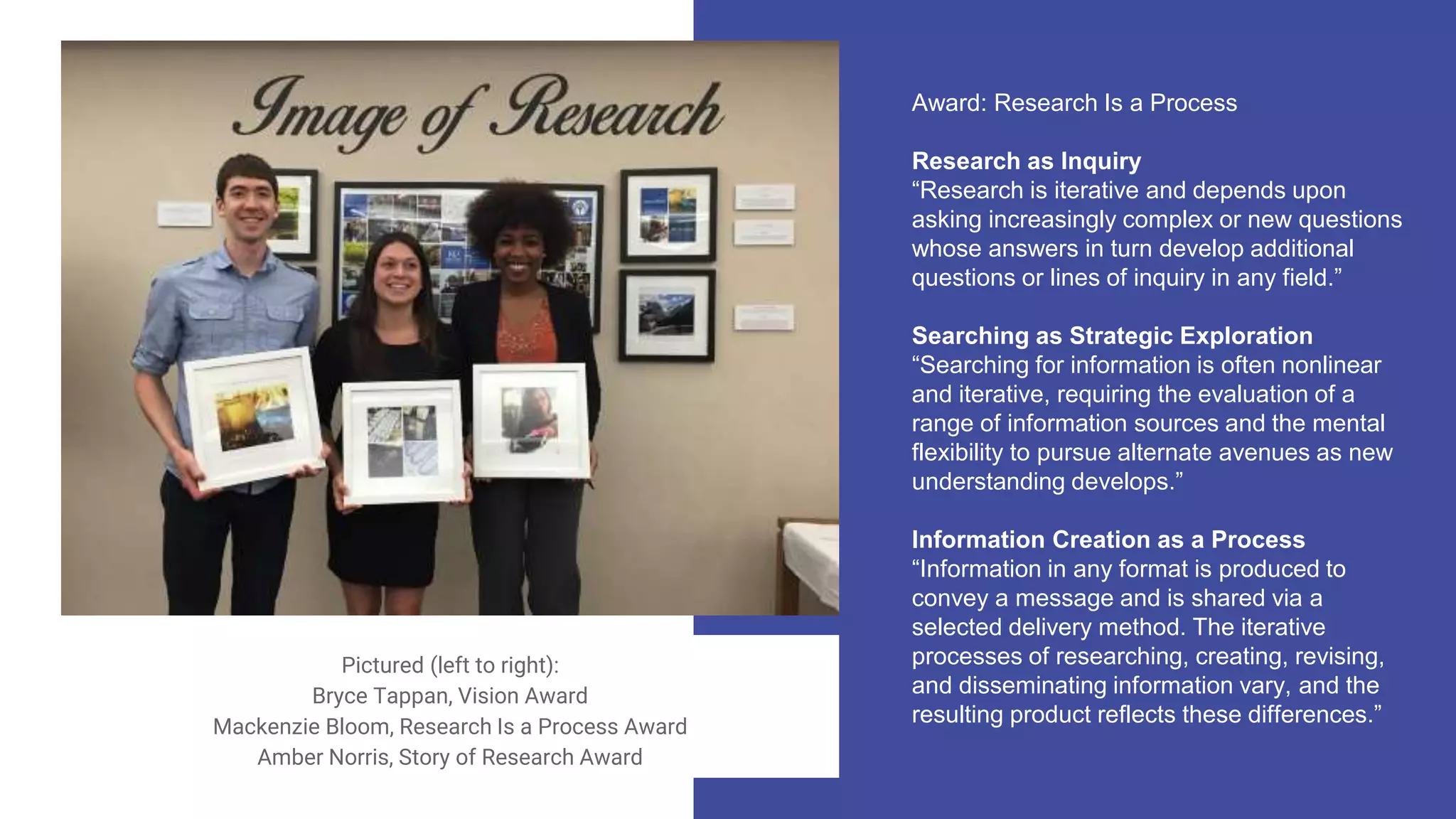
Pictured (left to right):
Bryce Tappan, Vision Award
Mackenzie Bloom, Research Is a Process Award
Amber Norris, Story of Research Award
Schulenburger Office of Scholarly Communication
& Copyright
● Presented at Image of Research Awards
Reception
● Sponsored Open for Collaboration Award
● Brainstormed content for copyright
education series
Office of Communications & Advancement
● Developed branding and promotional
materials
● Monitored and managed social media
activity
● Coordinated event catering
● Contributed to installation of library display
Digital Initiatives & Discovery Services Division
● Created and populated Image of Research
Collection in KU ScholarWorks (IR)
● Built web pages and web forms
Internal External
KU Center for Undergraduate Research
● Selected image from submissions for Undergraduate
Research Symposium posters and program cover
● Shared tabling at events
● Provided direct access to mailing lists
● Shared competition details via newsletters and social
media
KU Honors Program
● Launched IOR16 at University Honors Program
Freshman Symposium
● Shared competition details via newsletters and social
media
KU Faculty
● Served as competition judges
● Shared competition details with students
University Daily Kansan
● Covered Image of Research Awards Reception
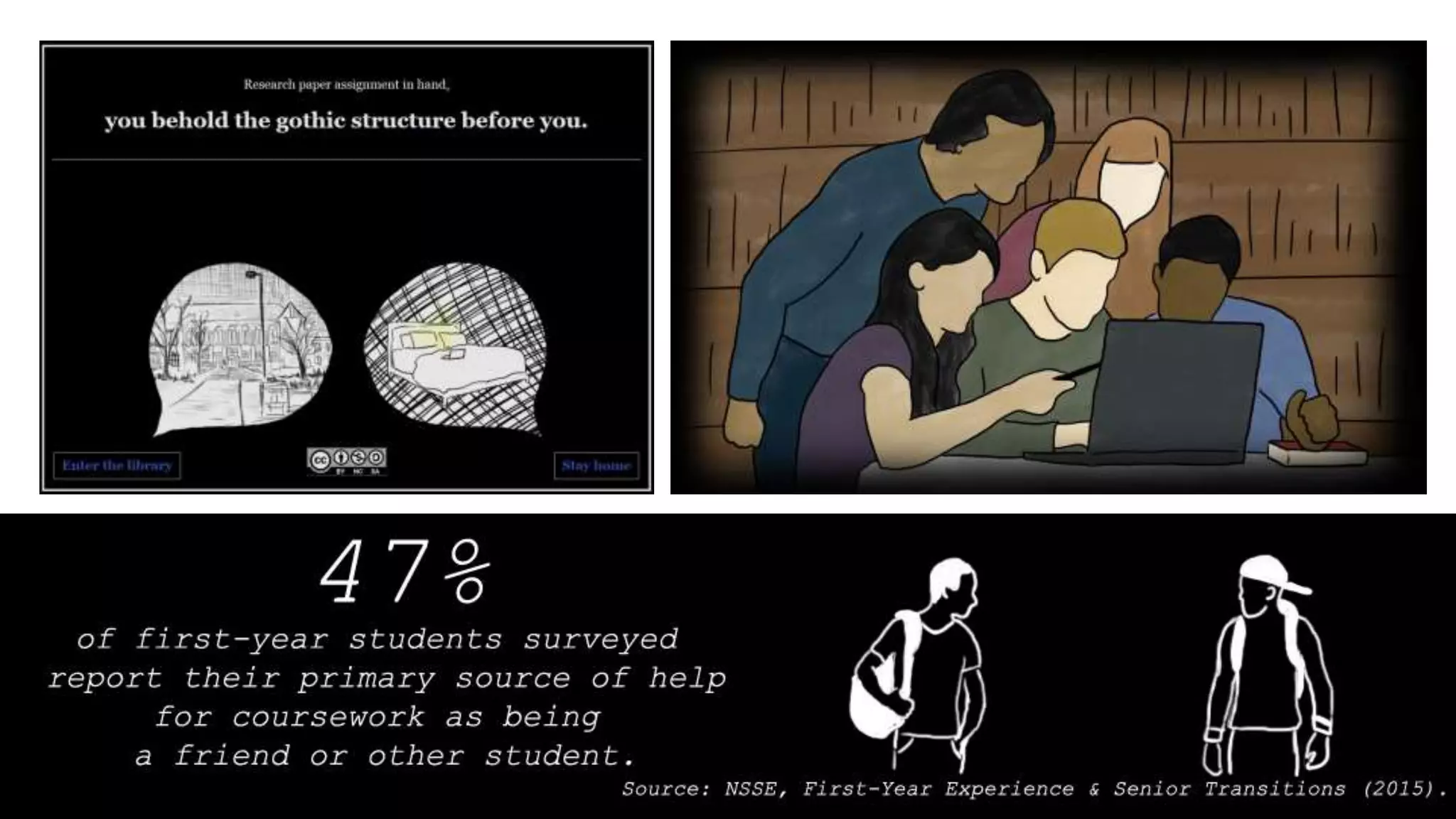
Digital Storytelling Project
on Library Anxiety
Service Learning
With gratitude to Germaine Halegoua,
Meg Jamieson, Alaine Caudle, Luke
Austin, and Ricky Yang of KU.
The project received financial support
from the KU Libraries’ Research Fund
& KU Libraries' Center for
Undergraduate Initiatives &
Engagement.
Project files are available as an
open educational resource
in KU ScholarWorks at
http://hdl.handle.net/1808/21508
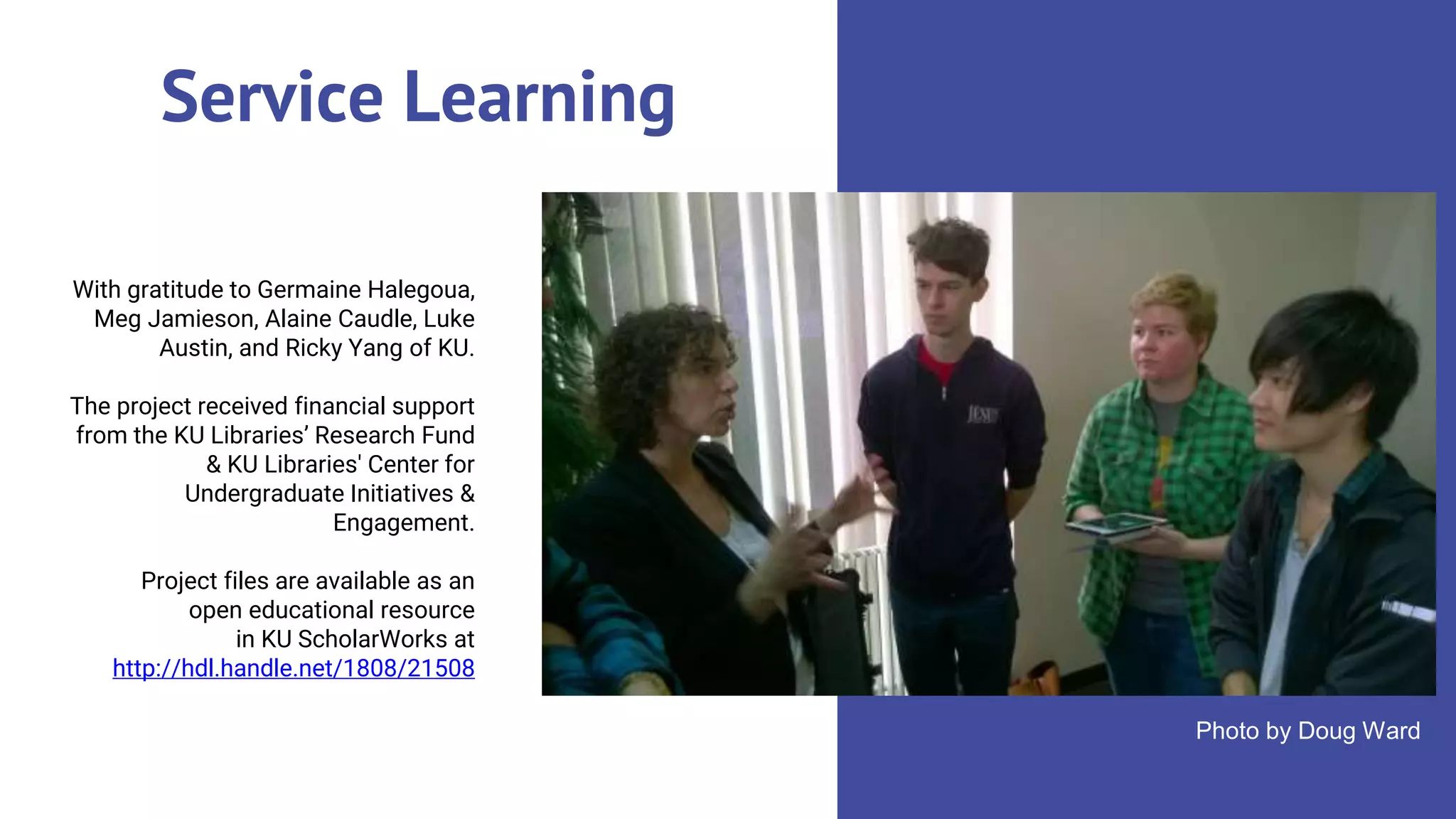
Photo by Doug Ward
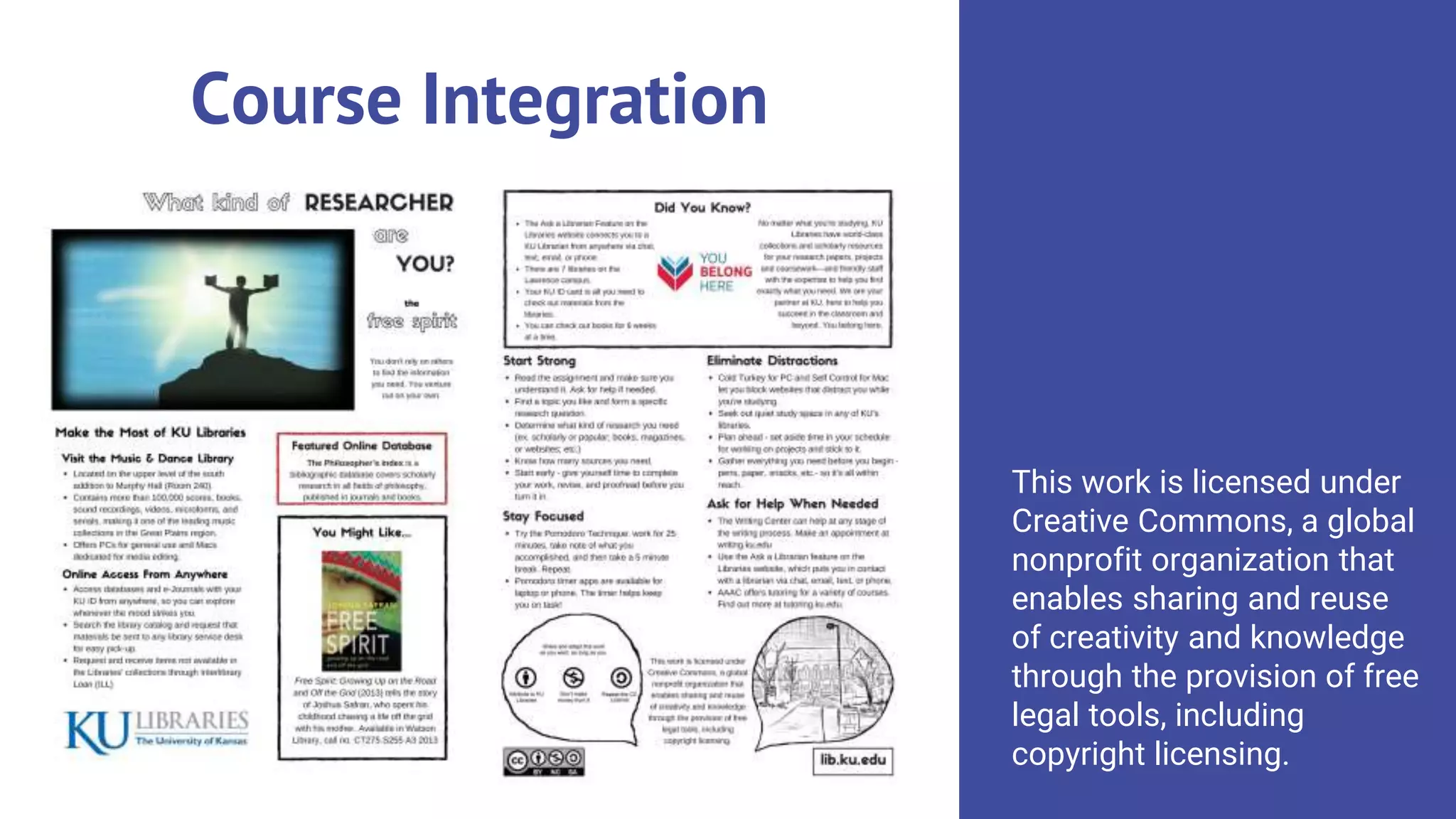
Course Integration
This work is licensed under
Creative Commons, a global
nonprofit organization that
enables sharing and reuse
of creativity and knowledge
through the provision of free
legal tools, including
copyright licensing.
Undergraduates Speak:
Our Rights & Access
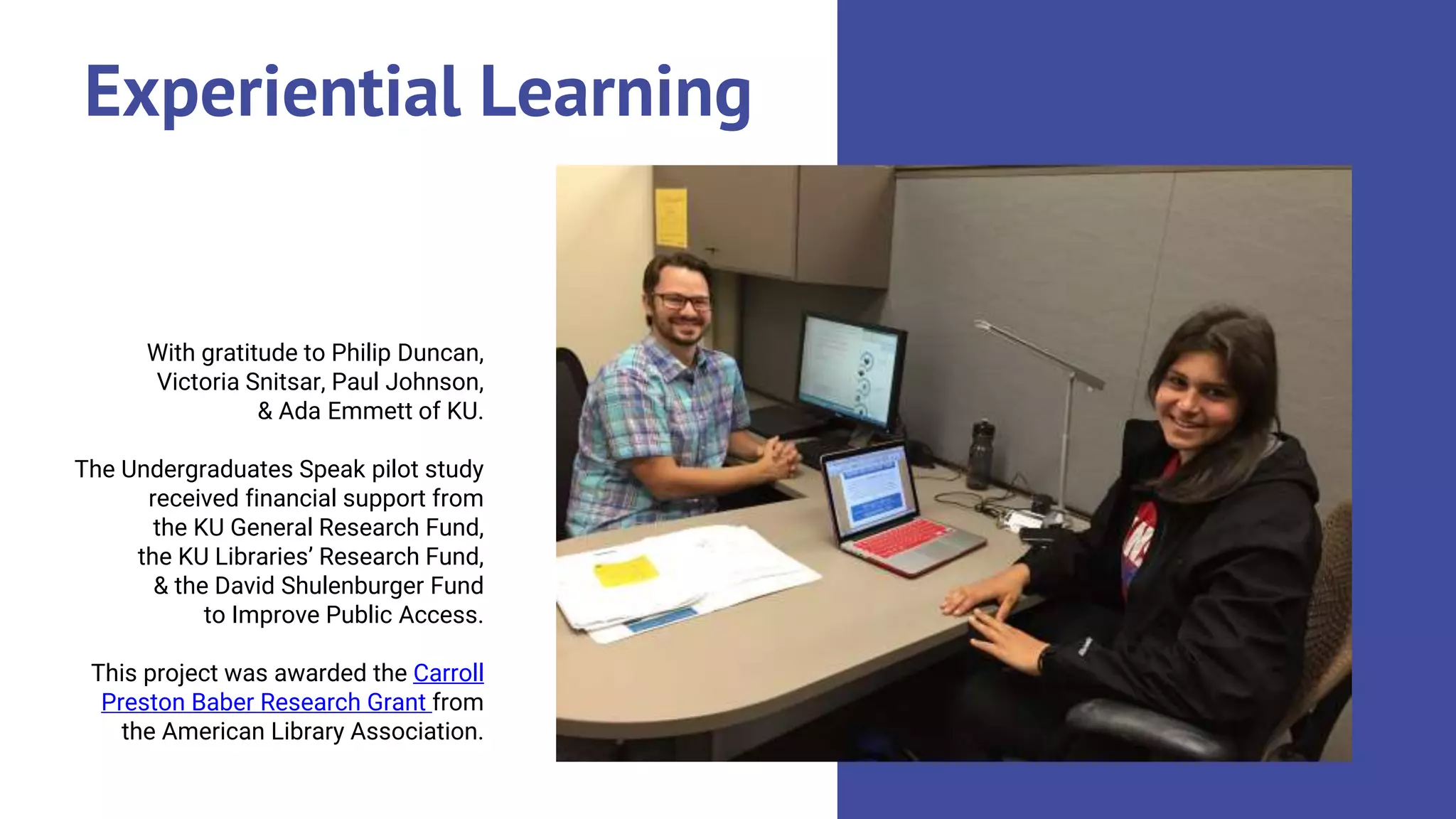
Experiential Learning
With gratitude to Philip Duncan,
Victoria Snitsar, Paul Johnson,
& Ada Emmett of KU.
The Undergraduates Speak pilot study
received financial support from
the KU General Research Fund,
the KU Libraries’ Research Fund,
& the David Shulenburger Fund
to Improve Public Access.
This project was awarded the Carroll
Preston Baber Research Grant from
the American Library Association.
• To what extent are undergraduate students aware of the rights and restrictions of
copyright law?
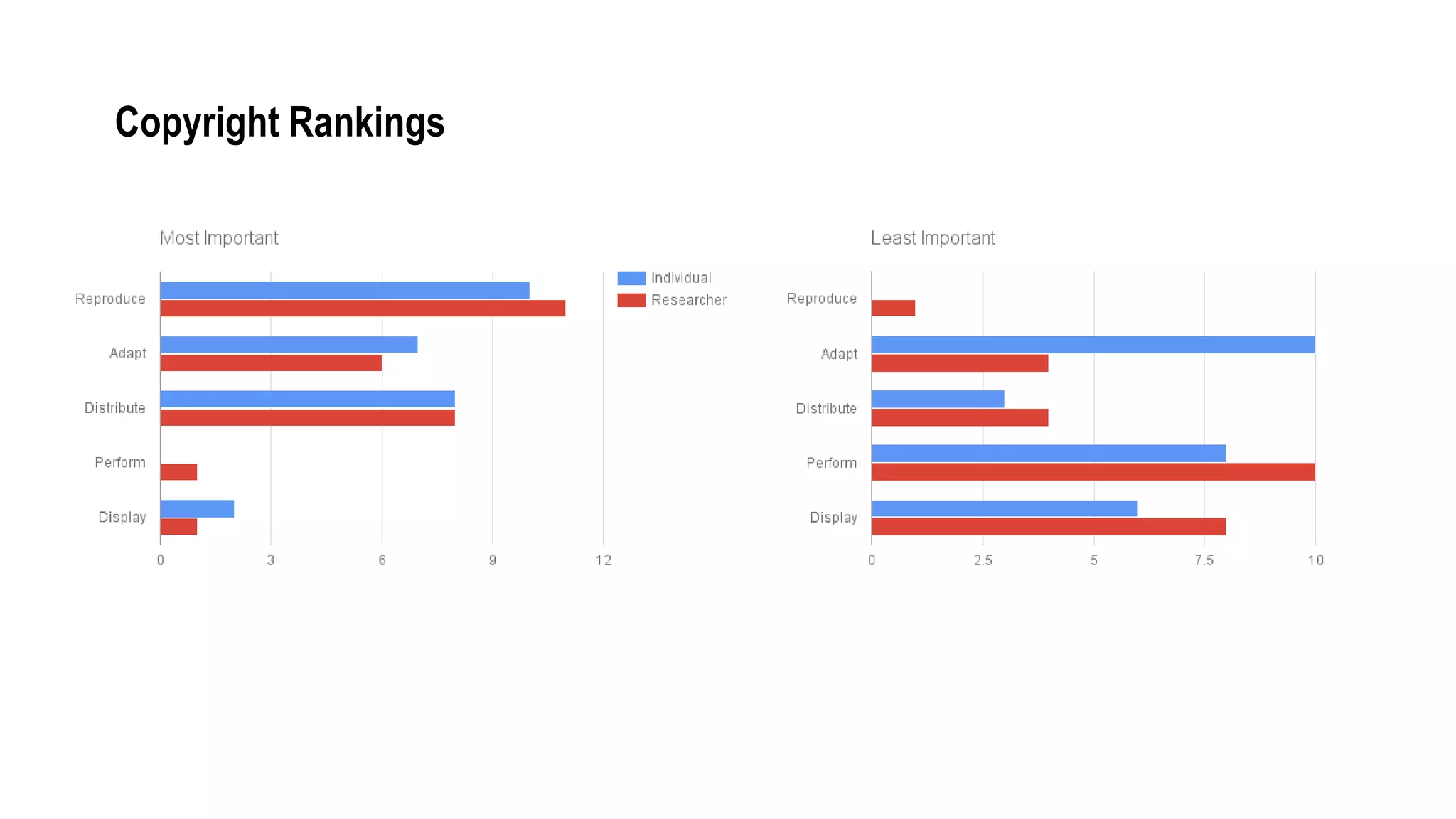
• What rights associated with copyright do students value most and is there a
correlation between these values and students’ online behaviors?
• To what extent are undergraduate students aware of Open Access publishing?
• To what extent do undergraduate students support “open” models of scholarly
publishing?
Research Questions
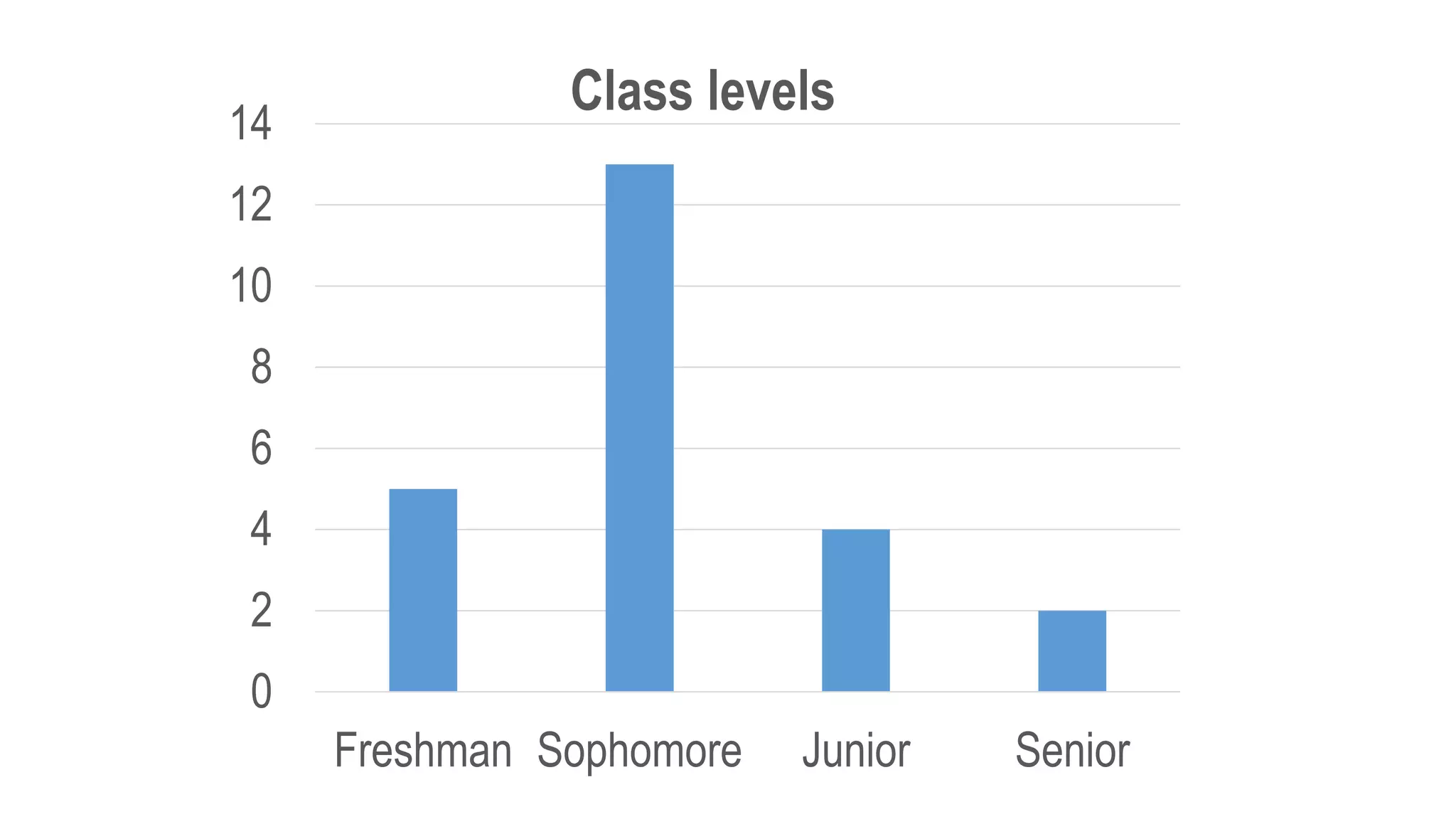
0
2
4
6
8
10
12
14
Freshman Sophomore Junior Senior
Class levels
0
1
2
3
4
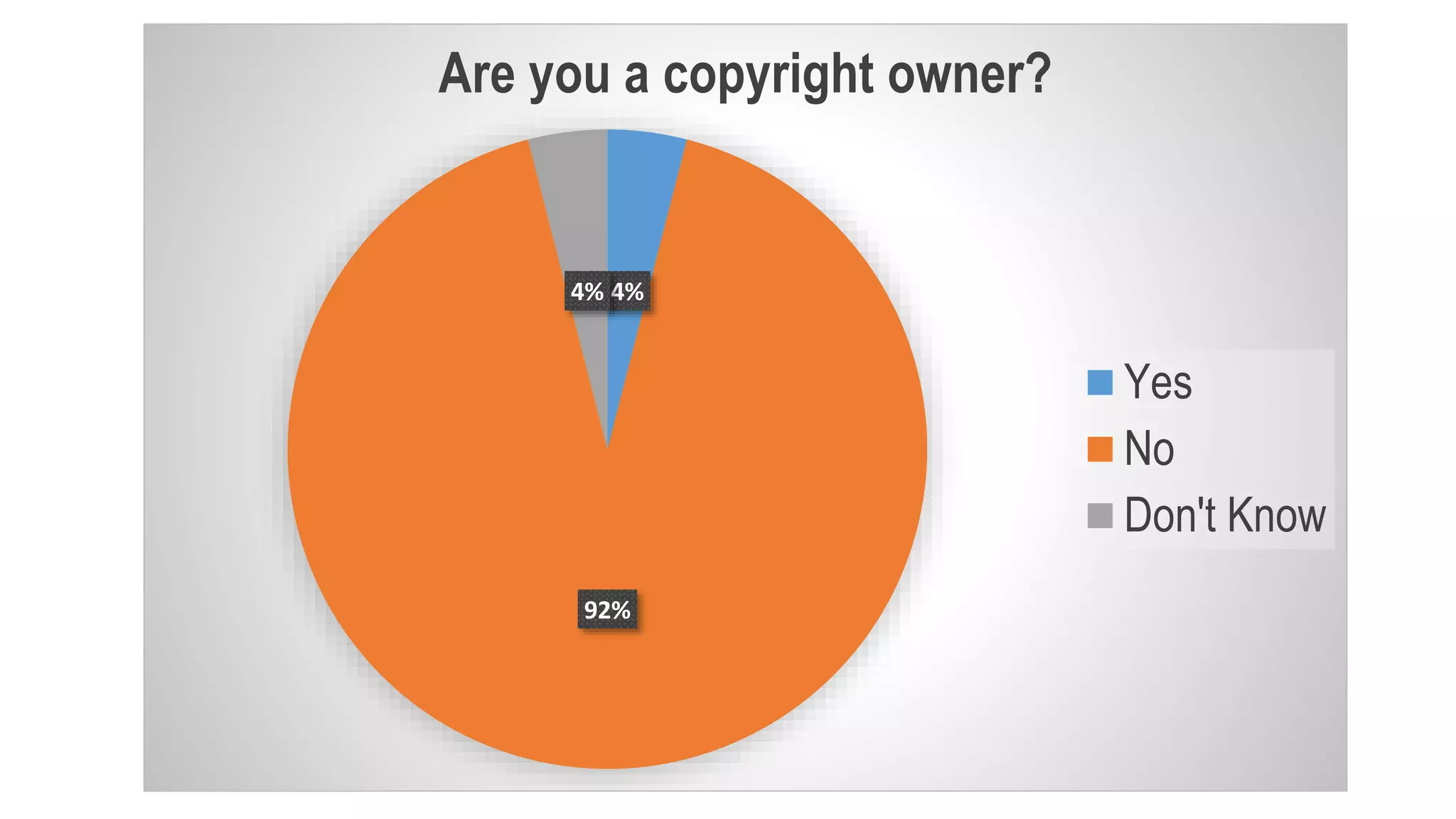
4%
92%
4%
Are you a copyright owner?
Yes
No
Don't Know
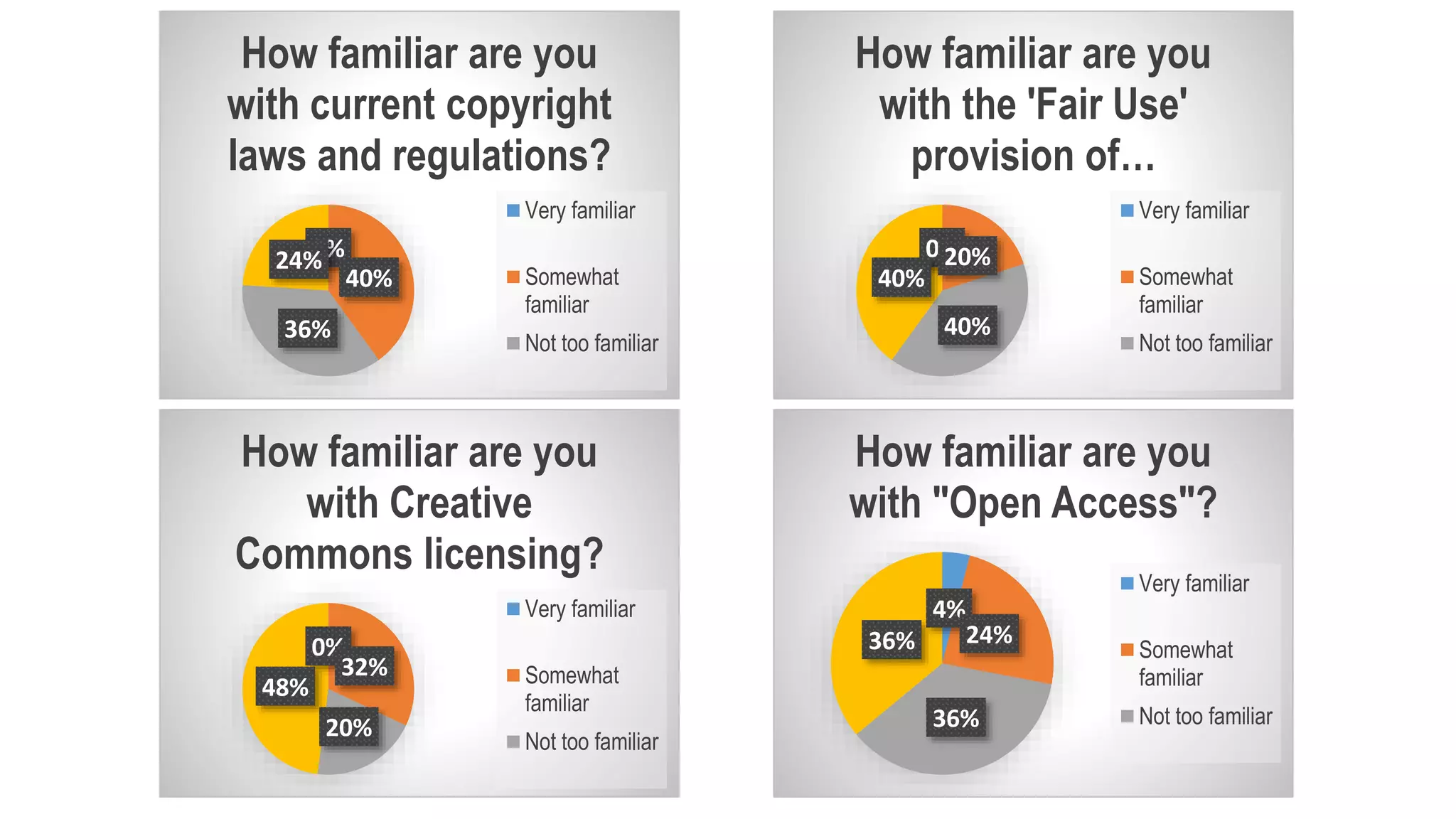
0%
40%
36%
24%
How familiar are you
with current copyright
laws and regulations?
Very familiar
Somewhat
familiar
Not too familiar
0%20%
40%
40%
How familiar are you
with the 'Fair Use'
provision of…
Very familiar
Somewhat
familiar
Not too familiar
0%
32%
20%
48%
How familiar are you
with Creative
Commons licensing?
Very familiar
Somewhat
familiar
Not too familiar
4%
24%
36%
36%
How familiar are you
with "Open Access"?
Very familiar
Somewhat
familiar
Not too familiar
Copyright Rankings
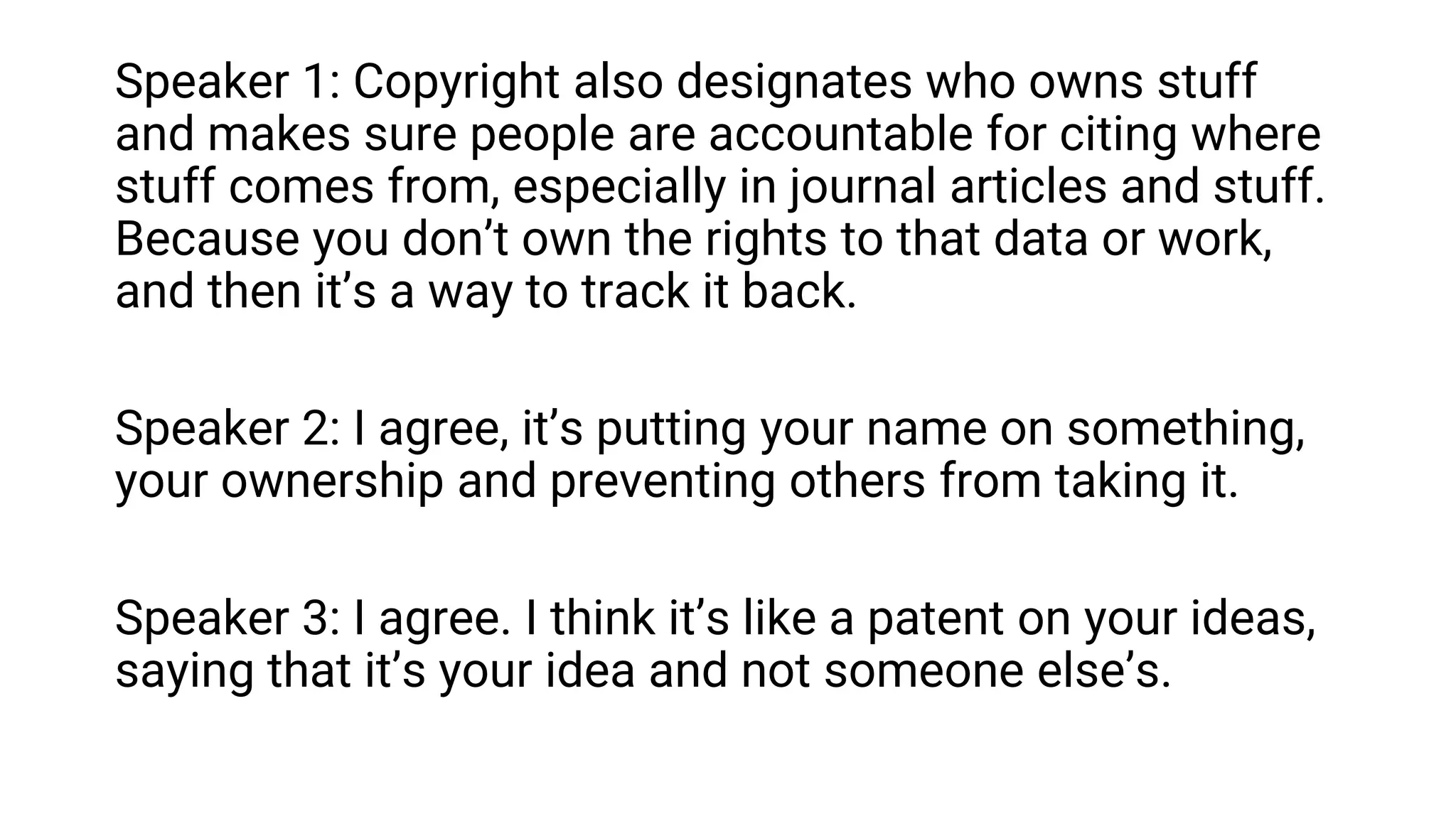
Speaker 1: Copyright also designates who owns stuff
and makes sure people are accountable for citing where
stuff comes from, especially in journal articles and stuff.
Because you don’t own the rights to that data or work,
and then it’s a way to track it back.
Speaker 2: I agree, it’s putting your name on something,
your ownership and preventing others from taking it.
Speaker 3: I agree. I think it’s like a patent on your ideas,
saying that it’s your idea and not someone else’s.
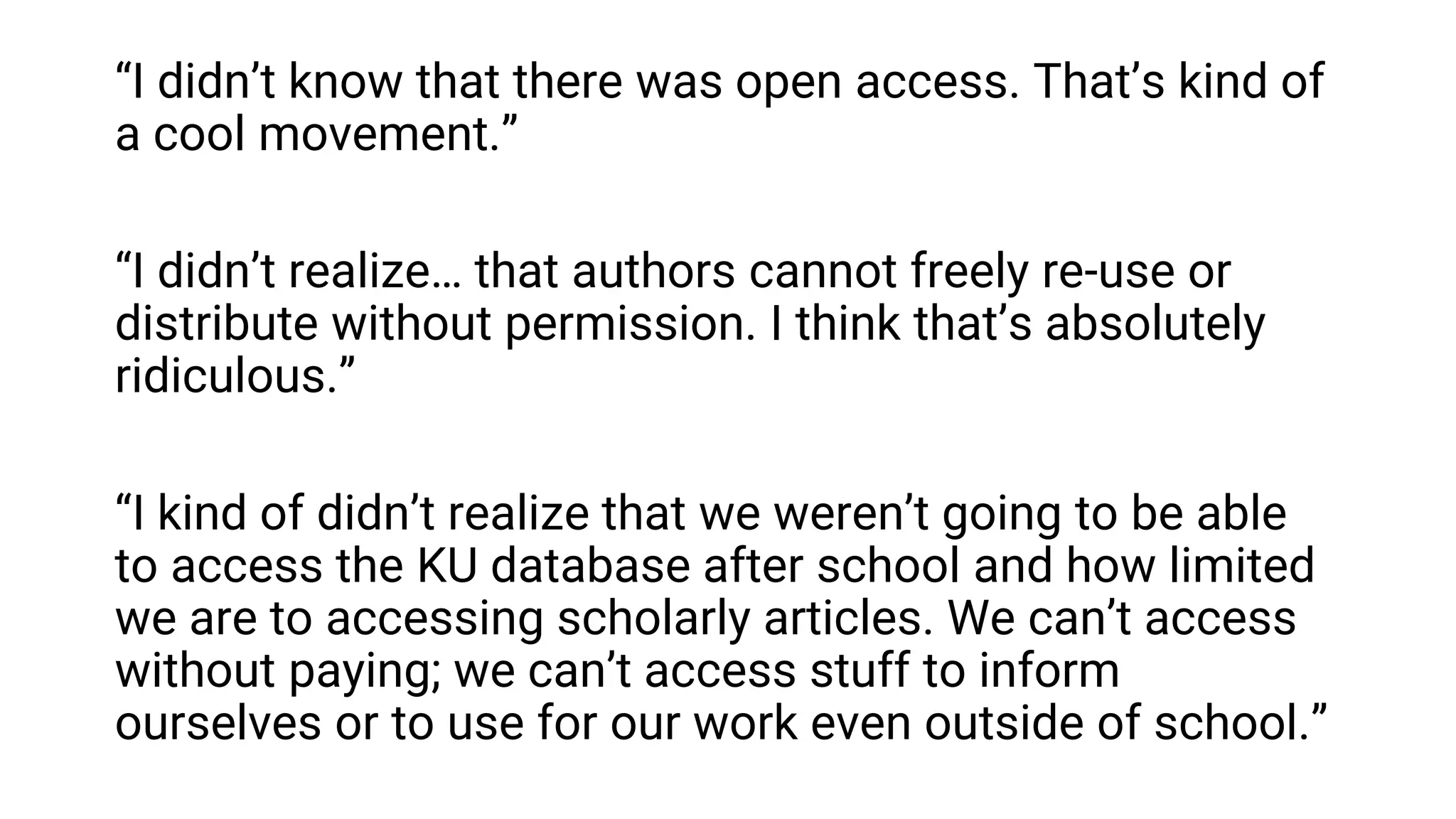
“I didn’t know that there was open access. That’s kind of
a cool movement.”
“I didn’t realize… that authors cannot freely re-use or
distribute without permission. I think that’s absolutely
ridiculous.”
“I kind of didn’t realize that we weren’t going to be able
to access the KU database after school and how limited
we are to accessing scholarly articles. We can’t access
without paying; we can’t access stuff to inform
ourselves or to use for our work even outside of school.”
Questions?
Thank you!
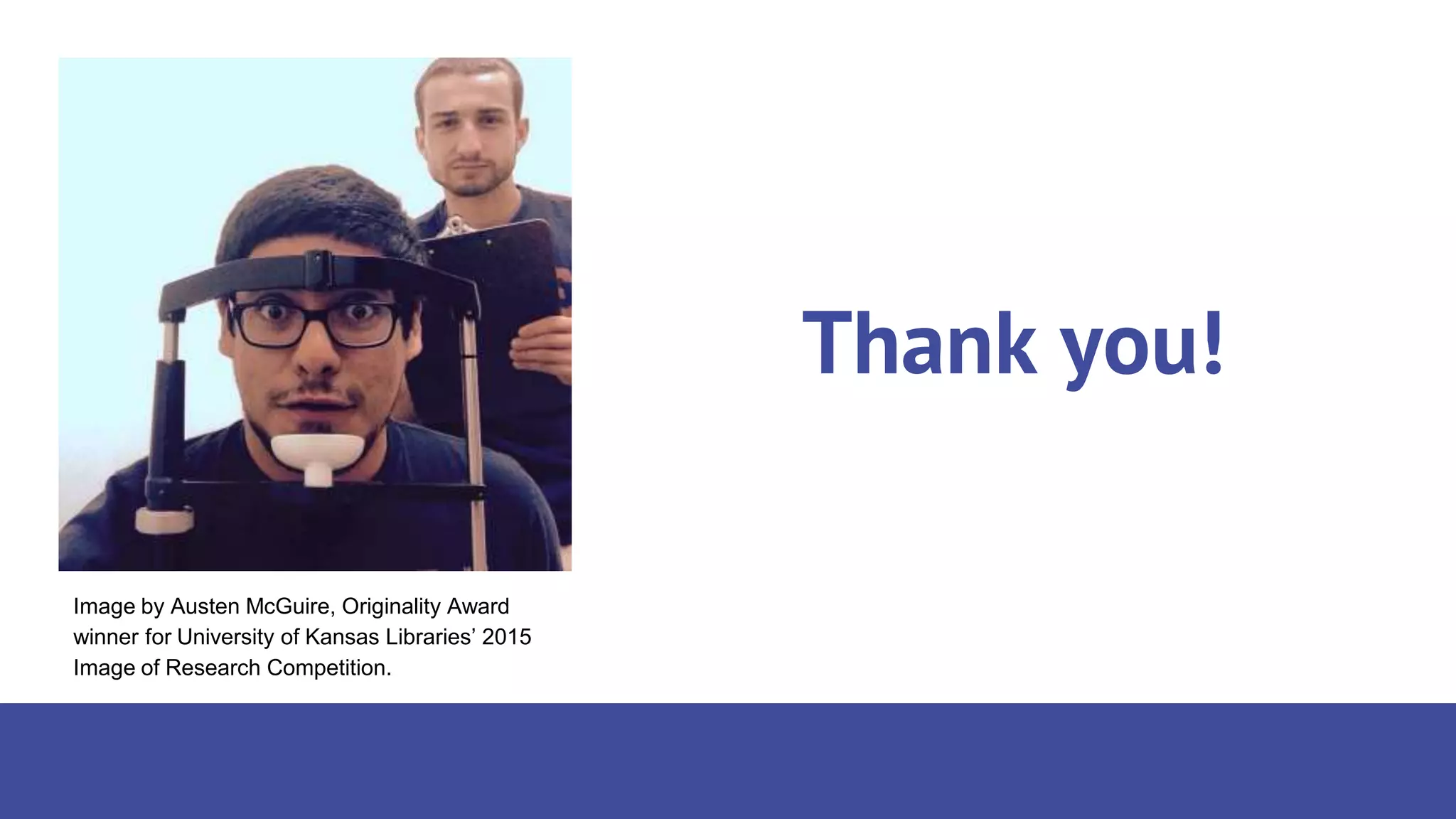
Image by Austen McGuire, Originality Award
winner for University of Kansas Libraries’ 2015
Image of Research Competition.

Intersections Big and Small: A Review of Three Projects that Merge Scholarly Communication and Information Literacy

  • 1.
    Intersections Big and Small: MichelleReed @LibrariansReed Open Education Librarian University of Texas at Arlington https://www.slideshare.net/oelib A Review of Three Projects that Merge Scholarly Communication & Information Literacy
  • 2.
    Openness is theonly means of doing education. If there is no sharing, there is no education. Successful educators share most thoroughly with the most students. - David Wiley “Be a champion of a cause and don't give up.” - TJ Bliss “Research provides the foundation of modern society. Research leads to breakthroughs, and communicating the results of research is what allows us to turn breakthroughs into better lives—to provide new treatments for disease, to implement solutions for challenges like global warming, and to build entire industries around what were once just ideas. However, our current system for communicating research is crippled by a centuries old model that hasn’t been updated to take advantage of 21st century technology.” - Scholarly Publishing and Academic Resources Coalition (SPARC) “Isn’t it amazing that what serves social justice also serves effective pedagogy and is empirically supported?” - Rajiv Jhangiani
  • 3.
    Intersections of Scholarly Communication and Information Literacy CreatingStrategic Collaborations for a Changing Academic Environment
  • 4.
    University of Kansas BoldAspirations http://provost.ku.edu/ strategic-plan KU Libraries Strategic Directions 2012-2017 https://lib.ku.edu/stra tegic-plan
  • 5.
    “In Spring 2014,the University of Illinois piloted a new competition, the Image of Research. Modeled after a similar competition at the University of Chicago, it aimed to highlight original student work by inviting undergraduate and graduate students to submit an image of their research, whether it be a photograph, a digital rendering, a drawing, or some combination of the three, accompanied by a short narrative explaining their research. Images were submitted from across all disciplines, from engineering and chemistry to applied health sciences and sociology. Submissions were judged based on the connection between the image and the narrative, the originality of the work, and the visual impact of the image. All submissions were printed on poster board and displayed at the campus undergraduate research symposium and at a special event for Graduate Student Appreciation Week. The top four images received recognition and monetary awards supported by a library gift fund. All entries are archived in the institutional repository and will be displayed in an online exhibit in Omeka. Similar to Illinois Wesleyan University, we are especially keen on looking for opportunities to showcase original undergraduate student work.” Merinda Kaye Hensley in “Weaving the Threads” Image of Research
  • 6.
    Students as Creators Imageof Research at the University of Kansas: https://lib.ku.edu/ior
  • 8.
  • 9.
    Award: Research Isa Process Research as Inquiry “Research is iterative and depends upon asking increasingly complex or new questions whose answers in turn develop additional questions or lines of inquiry in any field.” Searching as Strategic Exploration “Searching for information is often nonlinear and iterative, requiring the evaluation of a range of information sources and the mental flexibility to pursue alternate avenues as new understanding develops.” Information Creation as a Process “Information in any format is produced to convey a message and is shared via a selected delivery method. The iterative processes of researching, creating, revising, and disseminating information vary, and the resulting product reflects these differences.” Pictured (left to right): Bryce Tappan, Vision Award Mackenzie Bloom, Research Is a Process Award Amber Norris, Story of Research Award
  • 10.
    Schulenburger Office ofScholarly Communication & Copyright ● Presented at Image of Research Awards Reception ● Sponsored Open for Collaboration Award ● Brainstormed content for copyright education series Office of Communications & Advancement ● Developed branding and promotional materials ● Monitored and managed social media activity ● Coordinated event catering ● Contributed to installation of library display Digital Initiatives & Discovery Services Division ● Created and populated Image of Research Collection in KU ScholarWorks (IR) ● Built web pages and web forms Internal External KU Center for Undergraduate Research ● Selected image from submissions for Undergraduate Research Symposium posters and program cover ● Shared tabling at events ● Provided direct access to mailing lists ● Shared competition details via newsletters and social media KU Honors Program ● Launched IOR16 at University Honors Program Freshman Symposium ● Shared competition details via newsletters and social media KU Faculty ● Served as competition judges ● Shared competition details with students University Daily Kansan ● Covered Image of Research Awards Reception
  • 11.
  • 12.
    Service Learning With gratitudeto Germaine Halegoua, Meg Jamieson, Alaine Caudle, Luke Austin, and Ricky Yang of KU. The project received financial support from the KU Libraries’ Research Fund & KU Libraries' Center for Undergraduate Initiatives & Engagement. Project files are available as an open educational resource in KU ScholarWorks at http://hdl.handle.net/1808/21508 Photo by Doug Ward
  • 14.
    Course Integration This workis licensed under Creative Commons, a global nonprofit organization that enables sharing and reuse of creativity and knowledge through the provision of free legal tools, including copyright licensing.
  • 15.
  • 16.
    Experiential Learning With gratitudeto Philip Duncan, Victoria Snitsar, Paul Johnson, & Ada Emmett of KU. The Undergraduates Speak pilot study received financial support from the KU General Research Fund, the KU Libraries’ Research Fund, & the David Shulenburger Fund to Improve Public Access. This project was awarded the Carroll Preston Baber Research Grant from the American Library Association.
  • 17.
    • To whatextent are undergraduate students aware of the rights and restrictions of copyright law? • What rights associated with copyright do students value most and is there a correlation between these values and students’ online behaviors? • To what extent are undergraduate students aware of Open Access publishing? • To what extent do undergraduate students support “open” models of scholarly publishing? Research Questions
  • 18.
  • 19.
  • 20.
    4% 92% 4% Are you acopyright owner? Yes No Don't Know
  • 21.
    0% 40% 36% 24% How familiar areyou with current copyright laws and regulations? Very familiar Somewhat familiar Not too familiar 0%20% 40% 40% How familiar are you with the 'Fair Use' provision of… Very familiar Somewhat familiar Not too familiar 0% 32% 20% 48% How familiar are you with Creative Commons licensing? Very familiar Somewhat familiar Not too familiar 4% 24% 36% 36% How familiar are you with "Open Access"? Very familiar Somewhat familiar Not too familiar
  • 22.
  • 23.
    Speaker 1: Copyrightalso designates who owns stuff and makes sure people are accountable for citing where stuff comes from, especially in journal articles and stuff. Because you don’t own the rights to that data or work, and then it’s a way to track it back. Speaker 2: I agree, it’s putting your name on something, your ownership and preventing others from taking it. Speaker 3: I agree. I think it’s like a patent on your ideas, saying that it’s your idea and not someone else’s.
  • 24.
    “I didn’t knowthat there was open access. That’s kind of a cool movement.” “I didn’t realize… that authors cannot freely re-use or distribute without permission. I think that’s absolutely ridiculous.” “I kind of didn’t realize that we weren’t going to be able to access the KU database after school and how limited we are to accessing scholarly articles. We can’t access without paying; we can’t access stuff to inform ourselves or to use for our work even outside of school.”
  • 25.
  • 26.
    Thank you! Image byAusten McGuire, Originality Award winner for University of Kansas Libraries’ 2015 Image of Research Competition.