Cultivating Creators:
Copyright in the Classroom
Stephanie Davis-Kahl & Molly Keener
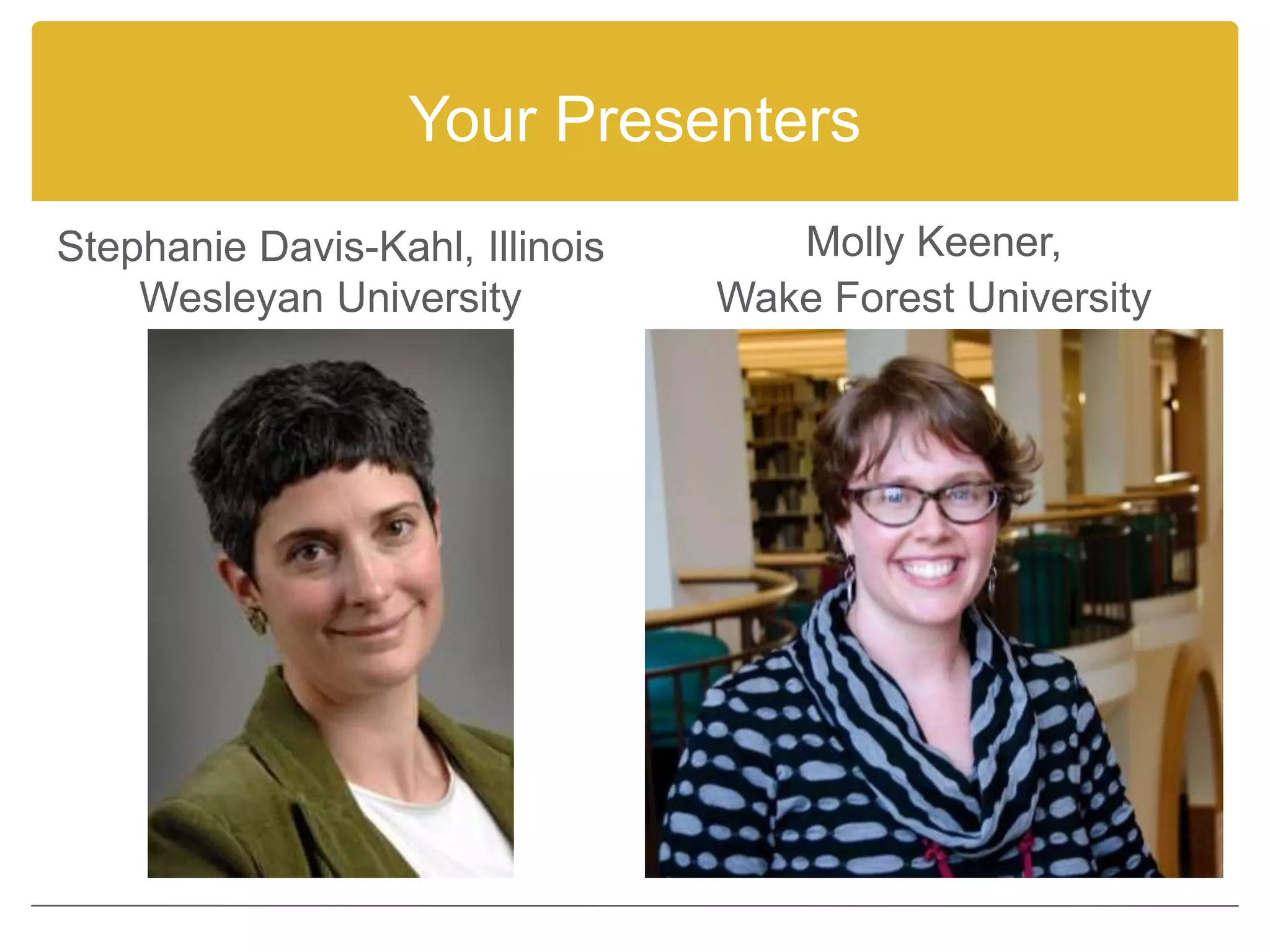
Your Presenters
Stephanie Davis-Kahl, Illinois
Wesleyan University
Molly Keener,
Wake Forest University
Who are you?
a. Instruction librarians
b. Scholarly Communications librarians
c. Administrators
d. Liaison librarians
e. Other? Please describe in the chat box.
Session Outcomes
 Share strategies for discussing copyright with students in
order to build instructional literacy for librarians.
 Contextualize copyright and Creative Commons licenses
within information literacy instruction in order to increase
professional knowledge about scholarly communication.
 Raise awareness of different options for sharing
scholarship and creative activity among librarians in order
to close the loop in information literacy instruction.
In Your Teaching…
Who is currently talking about copyright
with students?
a. I am!
b. I am, sometimes.
c. I am not.
If you ARE talking about copyright, how
confident are you?
a. Extremely
b. Solidly
c. Somewhat
d. Not
e. Ack! Get me out of here!
If you AREN’T talking about copyright,
why not?
a. Too little time in instruction sessions
b. Not in faculty member’s requested outline
c. Lack of own knowledge
d. Lack of own skills in teaching copyright
e. Other
Hold for Whiteboard
Instruction Strategies
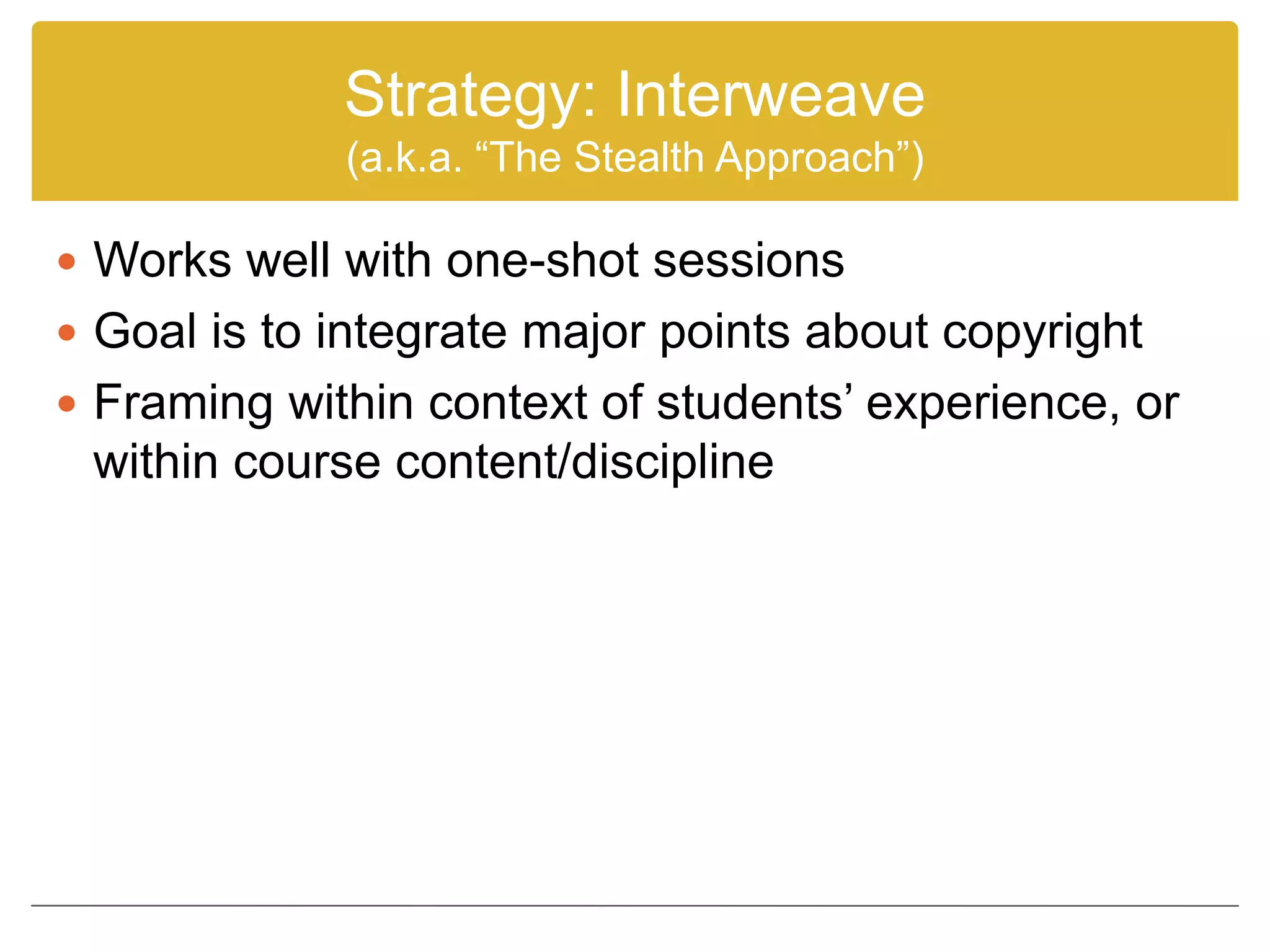
Strategy: Interweave
(a.k.a. “The Stealth Approach”)
 Works well with one-shot sessions
 Goal is to integrate major points about copyright
 Framing within context of students’ experience, or
within course content/discipline
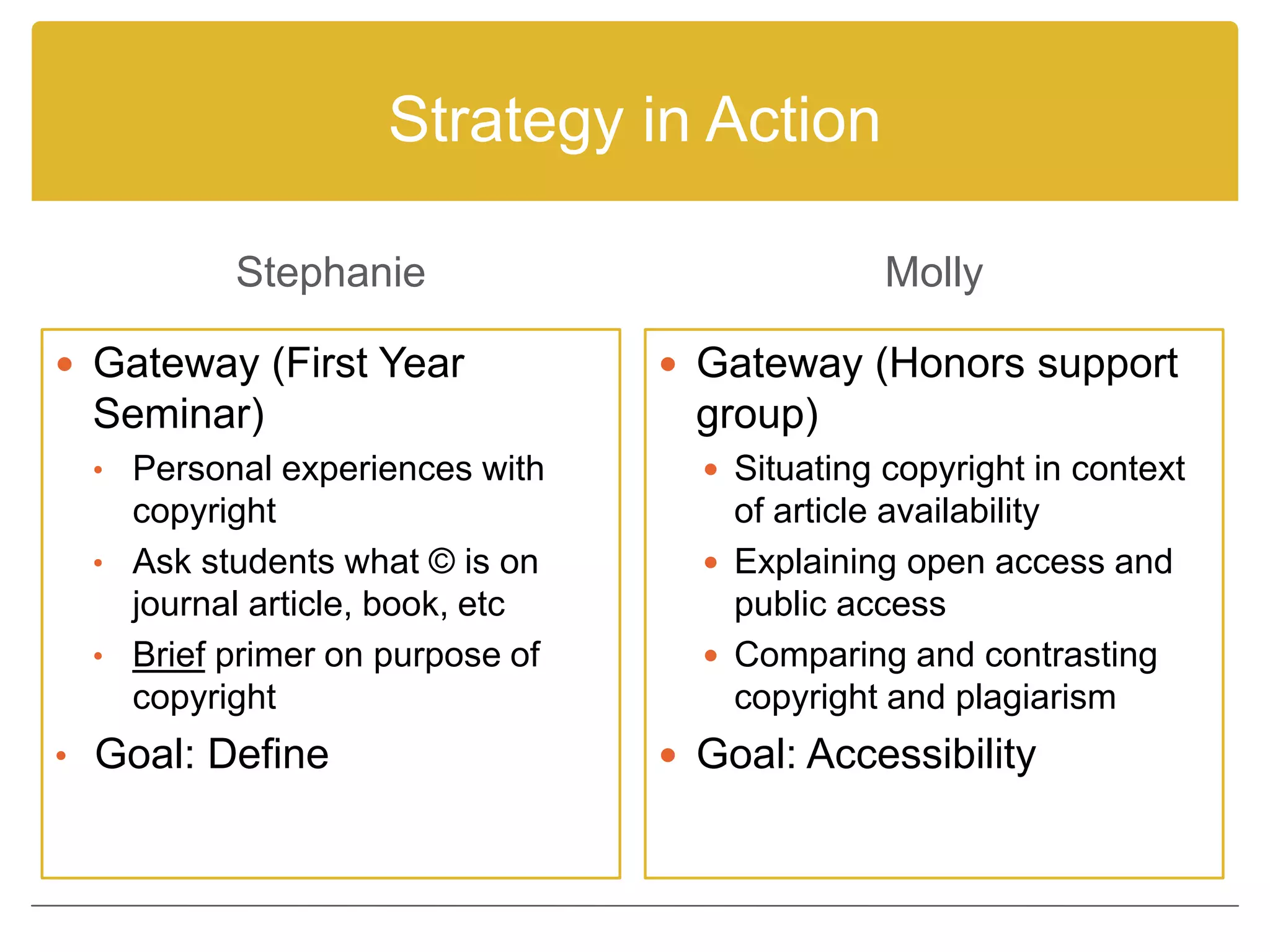
Strategy in Action
Stephanie
 Gateway (First Year
Seminar)
• Personal experiences with
copyright
• Ask students what © is on
journal article, book, etc
• Brief primer on purpose of
copyright
• Goal: Define
Molly
 Gateway (Honors support
group)
 Situating copyright in context
of article availability
 Explaining open access and
public access
 Comparing and contrasting
copyright and plagiarism
 Goal: Accessibility
Who has tried this strategy?
a. I have!
b. I haven’t, but now I’m strategizing.
c. This doesn’t fit my library’s instructional model.
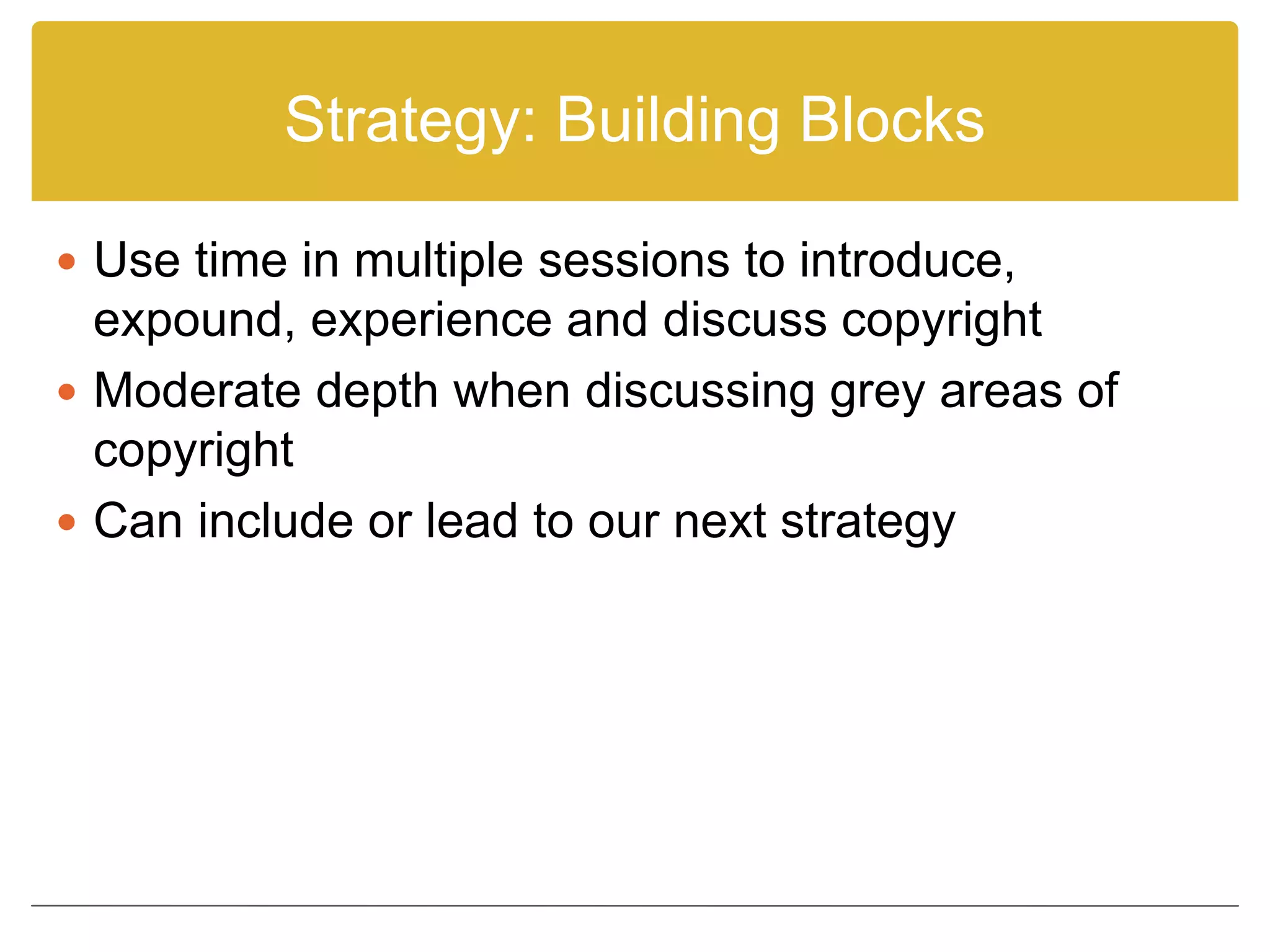
Strategy: Building Blocks
 Use time in multiple sessions to introduce,
expound, experience and discuss copyright
 Moderate depth when discussing grey areas of
copyright
 Can include or lead to our next strategy
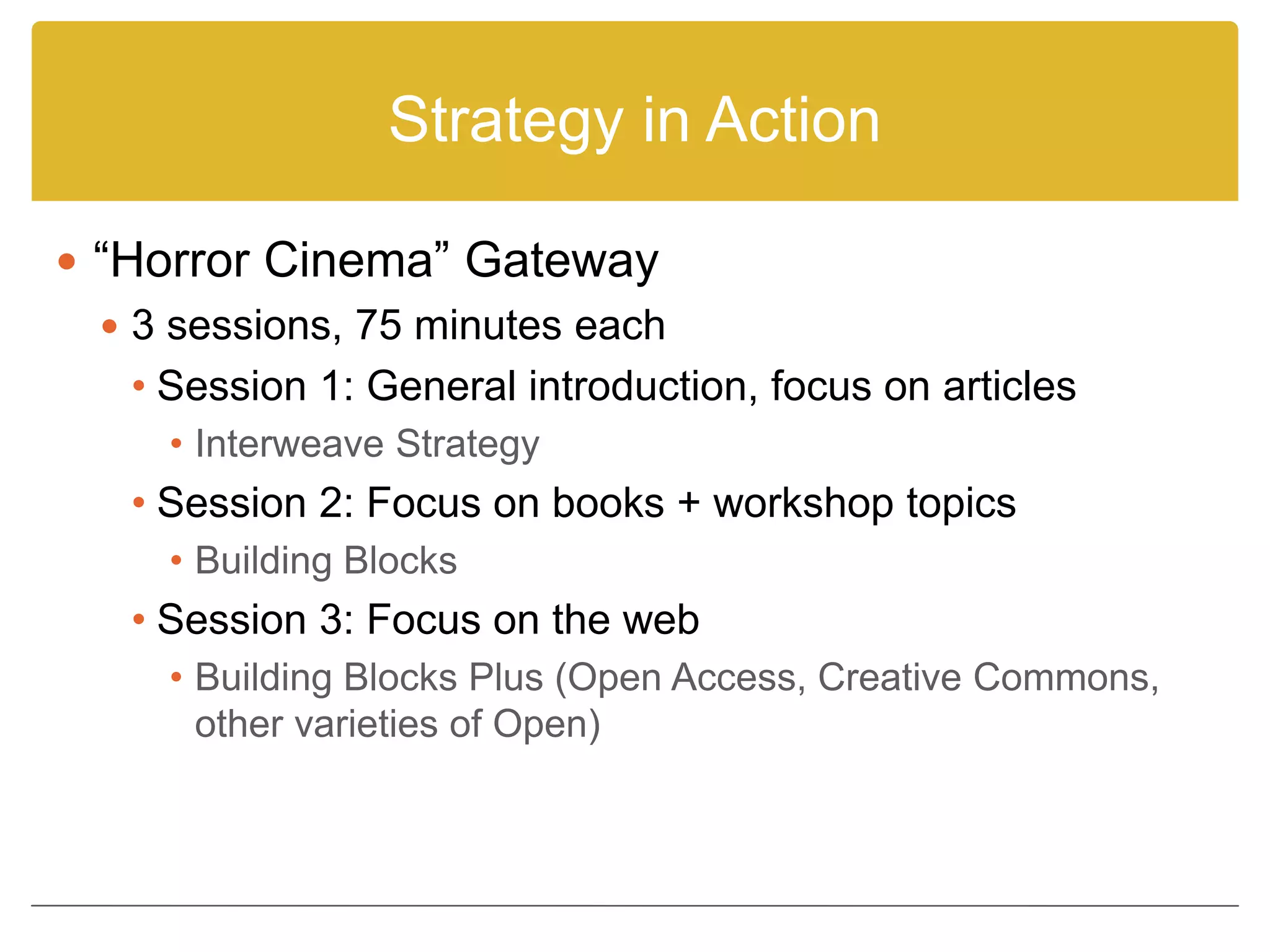
Strategy in Action
 “Horror Cinema” Gateway
 3 sessions, 75 minutes each
• Session 1: General introduction, focus on articles
• Interweave Strategy
• Session 2: Focus on books + workshop topics
• Building Blocks
• Session 3: Focus on the web
• Building Blocks Plus (Open Access, Creative Commons,
other varieties of Open)
Who has tried this strategy?
a. I have!
b. I haven’t, but now I’m strategizing.
c. This doesn’t fit my library’s instructional model.
Strategy: The Dedicated Lecture
(a.k.a. “All Copyright All The Time”)
 In-depth introduction to copyright and author rights
 Emphasize role of students as creators and
copyright owners
 Highlight academic and non-academic implications
of owning and using copyrights
 Opportunities to tie-in other areas of intellectual
property
Strategy in Action
 Undergraduate Gateway
 LIB 100: Real-world scenarios
• Students work in groups to answer copyright and IP scenarios
• Interweave: Share and discuss answers with class
 LIB 200: Discipline-specific instruction
• Discuss copyright and author rights within framework of disciplinary
scholarship practices
• Building Blocks Plus: Introduce students to OA, CC
 Graduate Gateway
 Seminar course
• Principles of copyright, author rights, authorship ethics, publishing,
scholarship cycle
Who has tried this strategy?
a. I have!
b. I haven’t, but now I’m strategizing.
c. This doesn’t fit my library’s instructional model.
Strategy: Beyond the Classroom
(a.k.a. “Copyright in Context”)
 Opportunities to consult and instruct on copyright
with various campus groups
 Timely, practical advice
 Framed within experiential context
 Expectation that work will be shared
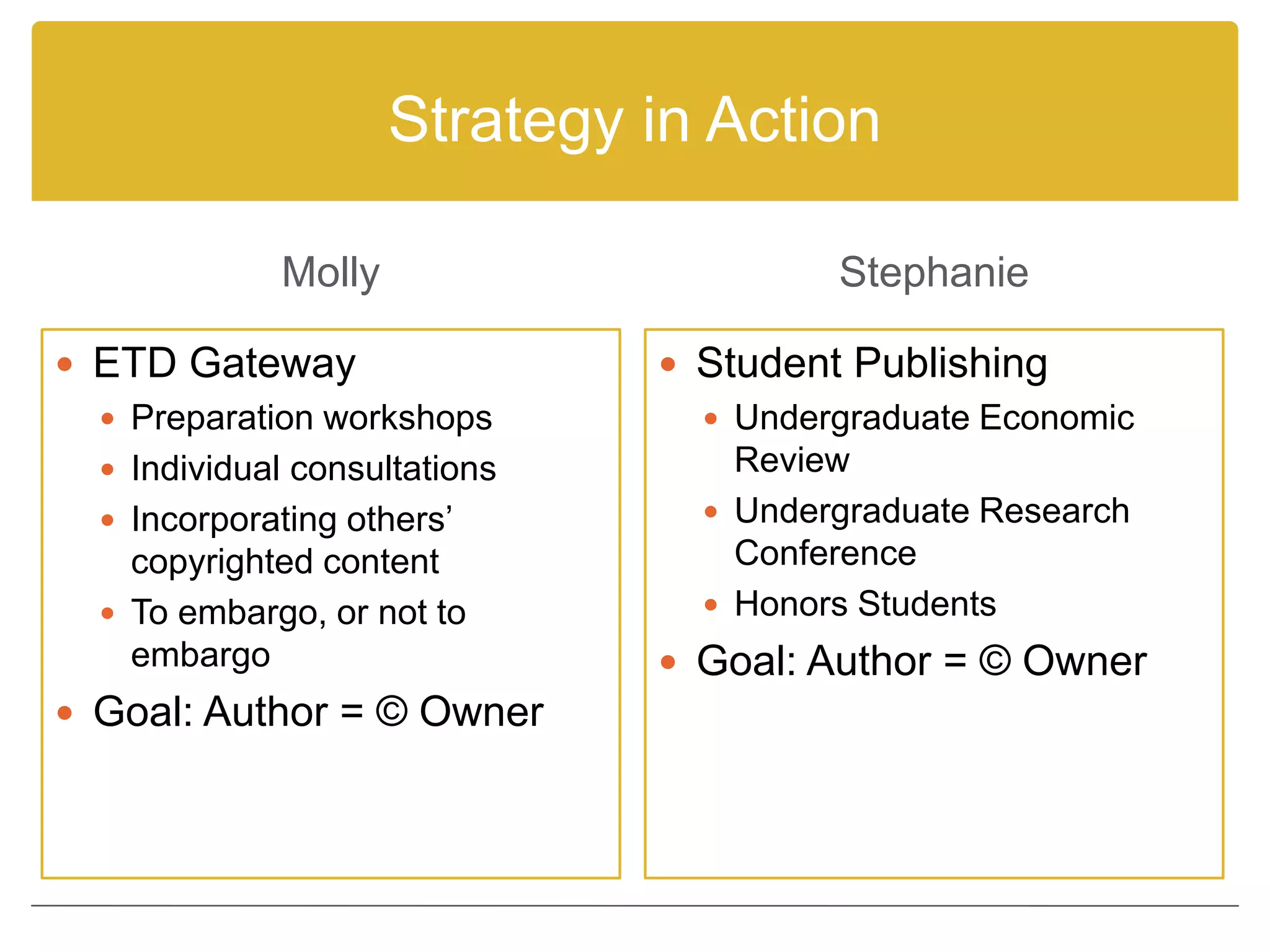
Strategy in Action
Molly
 ETD Gateway
 Preparation workshops
 Individual consultations
 Incorporating others’
copyrighted content
 To embargo, or not to
embargo
 Goal: Author = © Owner
Stephanie
 Student Publishing
 Undergraduate Economic
Review
 Undergraduate Research
Conference
 Honors Students
 Goal: Author = © Owner
Who has tried this strategy?
a. I have!
b. I haven’t, but now I’m strategizing.
c. This doesn’t fit my library’s instructional model.
All Roads Lead to
Copyright
External Requirements
 Excellent way to bring in policy and advocacy into
discussions of copyright
 Connect with open movement, public access
Disciplinary Approaches
 Examples:
 Physics
 History
 Anthropology
 Humanities (writ large)
 Experiments in publishing:
 Open Humanities Press
 Library Publishing Coalition
 Library Publishers – Amherst, Purdue, Michigan…
 Open Textbooks – Temple, UMass-Amherst, Oregon
State
Let’s Discuss!
Hold for Whiteboard
Resources/Further Reading
 Intersections of Scholarly Communication and Information Literacy:
Creating Strategic Collaborations for a Changing Academic
Environment, ACRL, 2013. Online at http://acrl.ala.org/intersections/
 Chapters from Common Ground at the Nexus of Information Literacy &
Scholarly Communication. Online at
http://digitalcommons.iwu.edu/bookshelf/36/:
 Gail Clement and Stephanie Brenenson, “Theft of the Mind: An Innovative
Approach to Plagiarism and Copyright Education”
 Isaac Gilman, “Scholarly Communication for Credit: Integrating Publishing
Education into Undergraduate Curriculum”
 Margeaux Johnson, Amy G. Buhler, and Sara Russell Gonzalez, “Communicating
with Future Scholars: Lesson Plans to Engage Undergraduate Science Students
with Open Access Issues in a Semester-Long Course”
 Jennifer Duncan, Susanne K. Clement, and Betty Rozum, “Teaching Our Faculty:
Developing Copyright and Scholarly Communication Outreach Programs”
 Copyright Basics: http://www.copyright.gov/circs/circ01.pdf
 Composition & Copyright: Perspectives on Teaching, Text-making, and
Fair Use, edited by Steve Westbrook, SUNY: 2010.
Thank You!
 Stephanie Davis-Kahl
 sdaviska@iwu.edu
 @StephDK
 Molly Keener
 keenerm@wfu.edu
Thanks to Margot Conahan of ACRL and Hope Kandel of
LearningTimes for their time and help!

Cultivating Creators: Copyright in the Classroom

  • 1.
    Cultivating Creators: Copyright inthe Classroom Stephanie Davis-Kahl & Molly Keener
  • 2.
    Your Presenters Stephanie Davis-Kahl,Illinois Wesleyan University Molly Keener, Wake Forest University
  • 3.
    Who are you? a.Instruction librarians b. Scholarly Communications librarians c. Administrators d. Liaison librarians e. Other? Please describe in the chat box.
  • 4.
    Session Outcomes  Sharestrategies for discussing copyright with students in order to build instructional literacy for librarians.  Contextualize copyright and Creative Commons licenses within information literacy instruction in order to increase professional knowledge about scholarly communication.  Raise awareness of different options for sharing scholarship and creative activity among librarians in order to close the loop in information literacy instruction.
  • 5.
  • 6.
    Who is currentlytalking about copyright with students? a. I am! b. I am, sometimes. c. I am not.
  • 7.
    If you AREtalking about copyright, how confident are you? a. Extremely b. Solidly c. Somewhat d. Not e. Ack! Get me out of here!
  • 8.
    If you AREN’Ttalking about copyright, why not? a. Too little time in instruction sessions b. Not in faculty member’s requested outline c. Lack of own knowledge d. Lack of own skills in teaching copyright e. Other
  • 9.
  • 10.
  • 11.
    Strategy: Interweave (a.k.a. “TheStealth Approach”)  Works well with one-shot sessions  Goal is to integrate major points about copyright  Framing within context of students’ experience, or within course content/discipline
  • 12.
    Strategy in Action Stephanie Gateway (First Year Seminar) • Personal experiences with copyright • Ask students what © is on journal article, book, etc • Brief primer on purpose of copyright • Goal: Define Molly  Gateway (Honors support group)  Situating copyright in context of article availability  Explaining open access and public access  Comparing and contrasting copyright and plagiarism  Goal: Accessibility
  • 13.
    Who has triedthis strategy? a. I have! b. I haven’t, but now I’m strategizing. c. This doesn’t fit my library’s instructional model.
  • 14.
    Strategy: Building Blocks Use time in multiple sessions to introduce, expound, experience and discuss copyright  Moderate depth when discussing grey areas of copyright  Can include or lead to our next strategy
  • 15.
    Strategy in Action “Horror Cinema” Gateway  3 sessions, 75 minutes each • Session 1: General introduction, focus on articles • Interweave Strategy • Session 2: Focus on books + workshop topics • Building Blocks • Session 3: Focus on the web • Building Blocks Plus (Open Access, Creative Commons, other varieties of Open)
  • 16.
    Who has triedthis strategy? a. I have! b. I haven’t, but now I’m strategizing. c. This doesn’t fit my library’s instructional model.
  • 17.
    Strategy: The DedicatedLecture (a.k.a. “All Copyright All The Time”)  In-depth introduction to copyright and author rights  Emphasize role of students as creators and copyright owners  Highlight academic and non-academic implications of owning and using copyrights  Opportunities to tie-in other areas of intellectual property
  • 18.
    Strategy in Action Undergraduate Gateway  LIB 100: Real-world scenarios • Students work in groups to answer copyright and IP scenarios • Interweave: Share and discuss answers with class  LIB 200: Discipline-specific instruction • Discuss copyright and author rights within framework of disciplinary scholarship practices • Building Blocks Plus: Introduce students to OA, CC  Graduate Gateway  Seminar course • Principles of copyright, author rights, authorship ethics, publishing, scholarship cycle
  • 19.
    Who has triedthis strategy? a. I have! b. I haven’t, but now I’m strategizing. c. This doesn’t fit my library’s instructional model.
  • 20.
    Strategy: Beyond theClassroom (a.k.a. “Copyright in Context”)  Opportunities to consult and instruct on copyright with various campus groups  Timely, practical advice  Framed within experiential context  Expectation that work will be shared
  • 21.
    Strategy in Action Molly ETD Gateway  Preparation workshops  Individual consultations  Incorporating others’ copyrighted content  To embargo, or not to embargo  Goal: Author = © Owner Stephanie  Student Publishing  Undergraduate Economic Review  Undergraduate Research Conference  Honors Students  Goal: Author = © Owner
  • 22.
    Who has triedthis strategy? a. I have! b. I haven’t, but now I’m strategizing. c. This doesn’t fit my library’s instructional model.
  • 23.
    All Roads Leadto Copyright
  • 25.
    External Requirements  Excellentway to bring in policy and advocacy into discussions of copyright  Connect with open movement, public access
  • 26.
    Disciplinary Approaches  Examples: Physics  History  Anthropology  Humanities (writ large)  Experiments in publishing:  Open Humanities Press  Library Publishing Coalition  Library Publishers – Amherst, Purdue, Michigan…  Open Textbooks – Temple, UMass-Amherst, Oregon State
  • 27.
  • 28.
  • 29.
    Resources/Further Reading  Intersectionsof Scholarly Communication and Information Literacy: Creating Strategic Collaborations for a Changing Academic Environment, ACRL, 2013. Online at http://acrl.ala.org/intersections/  Chapters from Common Ground at the Nexus of Information Literacy & Scholarly Communication. Online at http://digitalcommons.iwu.edu/bookshelf/36/:  Gail Clement and Stephanie Brenenson, “Theft of the Mind: An Innovative Approach to Plagiarism and Copyright Education”  Isaac Gilman, “Scholarly Communication for Credit: Integrating Publishing Education into Undergraduate Curriculum”  Margeaux Johnson, Amy G. Buhler, and Sara Russell Gonzalez, “Communicating with Future Scholars: Lesson Plans to Engage Undergraduate Science Students with Open Access Issues in a Semester-Long Course”  Jennifer Duncan, Susanne K. Clement, and Betty Rozum, “Teaching Our Faculty: Developing Copyright and Scholarly Communication Outreach Programs”  Copyright Basics: http://www.copyright.gov/circs/circ01.pdf  Composition & Copyright: Perspectives on Teaching, Text-making, and Fair Use, edited by Steve Westbrook, SUNY: 2010.
  • 30.
    Thank You!  StephanieDavis-Kahl  sdaviska@iwu.edu  @StephDK  Molly Keener  keenerm@wfu.edu Thanks to Margot Conahan of ACRL and Hope Kandel of LearningTimes for their time and help!

Editor's Notes

  • #3 SDK & MK introduce with title, institution name/type, short description of their work, why this topic is important to them.
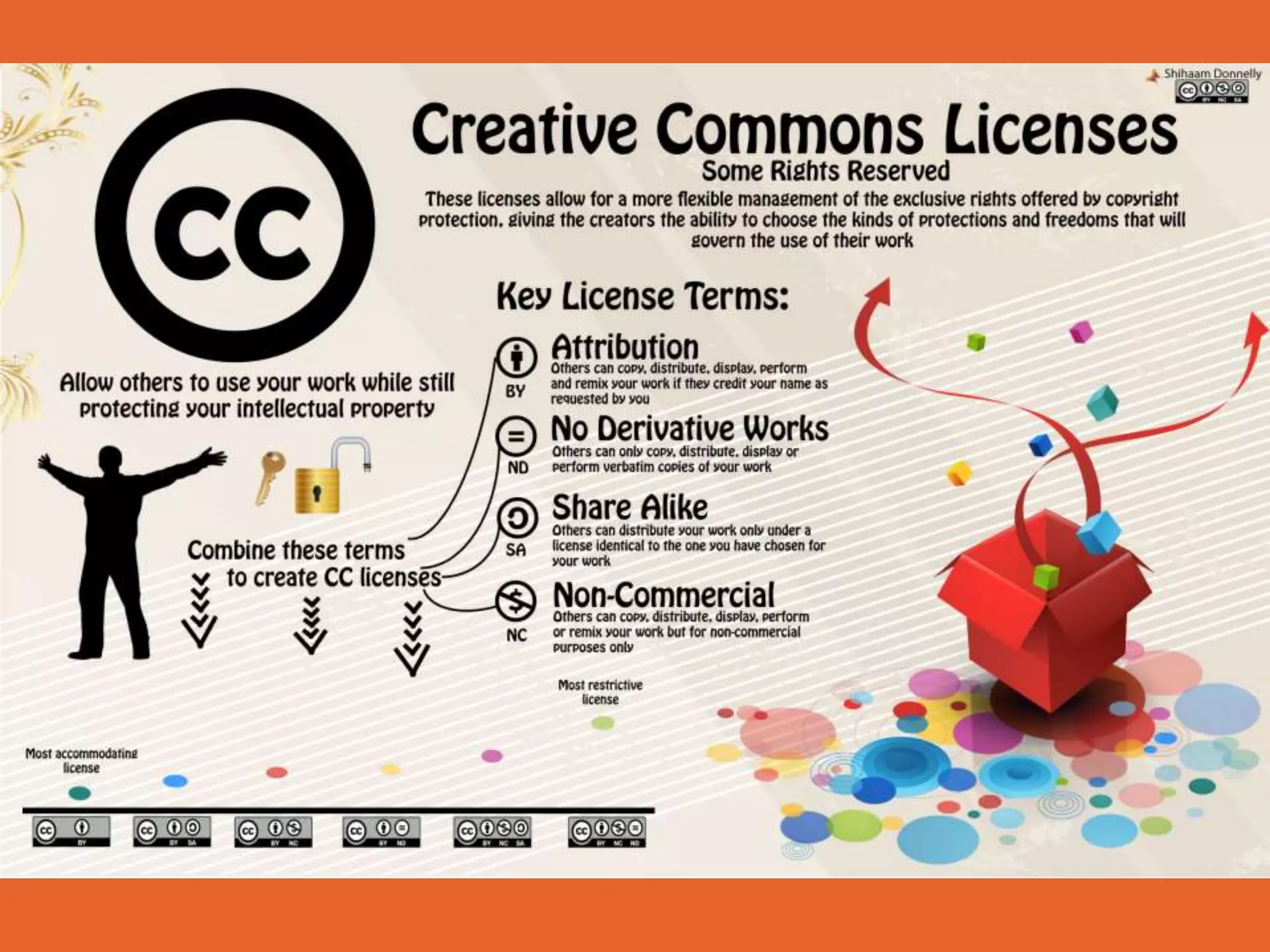
  • #24 Creative Commons External requirements Open Access/Authors Rights Disciplinary approaches
  • #25 Goal here is to…. Contextualize copyright and Creative Commons licenses within information literacy instruction in order to increase professional knowledge about scholarly communication. Raise awareness of different options for sharing scholarship and creative activity among librarians in order to close the loop in information literacy instruction.