CREEPY
COPYRIGHT
CONUNDRUM
S
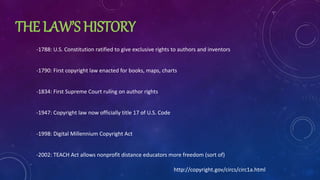
THE LAW’S HISTORY
-1788: U.S. Constitution ratified to give exclusive rights to authors and inventors
-1790: First copyright law enacted for books, maps, charts
-1834: First Supreme Court ruling on author rights
-1947: Copyright law now officially title 17 of U.S. Code
-1998: Digital Millennium Copyright Act
-2002: TEACH Act allows nonprofit distance educators more freedom (sort of)
http://copyright.gov/circs/circ1a.html
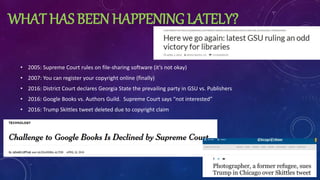
WHAT HAS BEEN HAPPENING LATELY?
• 2005: Supreme Court rules on file-sharing software (it’s not okay)
• 2007: You can register your copyright online (finally)
• 2016: District Court declares Georgia State the prevailing party in GSU vs. Publishers
• 2016: Google Books vs. Authors Guild. Supreme Court says “not interested”
• 2016: Trump Skittles tweet deleted due to copyright claim
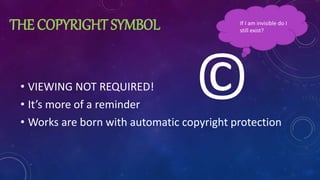
THE COPYRIGHT SYMBOL
• VIEWING NOT REQUIRED!
• It’s more of a reminder
• Works are born with automatic copyright protection
©
If I am invisible do I
still exist?
PUBLIC DOMAIN
• Before 1923
• Government publications
• 1923-1977 without a copyright notice
• Then it gets complicated
• 1989 and after: most likely copyright protected
CREEPY NOTE: The Count of Monte Cristo was published before 1923
and is in the public domain. A publisher may have copyright rights to
elements of their edition (layout, art, criticism/notes, translation).
http://copyright.cornell.edu/resources/publicdomain.cfm
WHY WE NEED COPYRIGHT LAW
-Protects creator’s rights to work
-Compensates the creator for their
intellectual ideas/efforts
-Encourages innovation of new
products/ideas in our fields
THE CREEPY PART
-We are trying to educate!
-We aren’t making $$ off of the ideas (usually)
-We don’t have the $$ to pay royalties to get
permission
-The laws are both vague and complicated at
the same time.
-Everyone interprets them differently.
WHO CAN HELP?
-Brittany! bllarson@carrollu.edu, 262-650-4887
-Give you an assessment on potential infringement
-Help you obtain permission if needed
-Arrange the royalty permissions
-Faculty guide on Library website:
http://pioguides.carrollu.edu/faculty/copyright
-Course Reserves Information for Faculty on Library Website:
http://www.carrollu.edu/library/
CARROLL’S POLICY
Copyright Infringement
Almost all forms of original expression that are fixed in a tangible medium are
subject to copyright protection, even if no formal copyright notice is attached.
You should assume materials that you find on the
Internet are copyrighted unless a disclaimer or waiver is expressly
stated. The copyright holder has extensive rights; you must contact
the copyright holder and ask permission to
copy, use or display the material.
Portal>Departments>ITS>Policies and Forms>General Policies
Unless Fair Use is a clear defense…
NOT TO BE CONFUSED WITH…
Copyright Policy for Course Materials.doc
My Groups> Information and Documents for Faculty and Staff
BEWARE OF THE CREATIVE COMMONS LICENSE
• Does not = Do whatever
• “Creative Commons provides free, easy-to-use copyright licenses
to make a simple and standardized way to give the public
permission to share and use your creative work–on conditions of
your choice.”
I’m not
necessarily who
you think I am
FAIR USE: NOT A LAW, BUT A DEFENSE
Purpose and character of the use, including whether the
use is of a commercial nature or is for nonprofit
educational purposes
Nature of the copyrighted work
Amount and substantiality of the portion used in relation
to the copyrighted work as a whole
Effect of the use upon the potential market for or value of
the copyrighted work
NOT ALL FAIR USE IS CREATED EQUAL…
What you will get caught for:
Amount and substantiality of the portion used in
relation to the copyrighted work as a whole
What you will get sued for:
Effect of the use upon the potential market for or value
of the copyrighted work
FAIR USE: WHEN IT HELPS
-When you are using the work for education purposes within
the setting (physical or in the spirit) of a classroom
-When you have transformed the work (Weird Al)
-When you use factual work
-When you would like to show a small portion of a work
-When you or the university is not making any money AND the
author doesn’t lose significant money from you not purchasing
the work or rights to the work
FAIR USE: WHEN IT DOESN’T HELP
-If you use the work for fun (showing a movie just
because)
-If you are reusing the work without any purposeful
change (a change can be providing an academic critique)
-Using more creative based works (novels, movies, songs)
-You use a significant portion of the work (this is when it
should be a required class text)
-Through your use there is a loss of profit
ATTRIBUTION IS NOT
ENOUGH SOMETIMES!
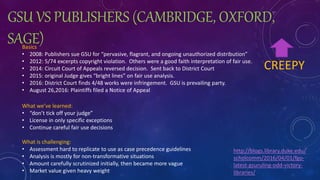
GSU VS PUBLISHERS (CAMBRIDGE, OXFORD,
SAGE)
What we’ve learned:
• “don’t tick off your judge”
• License in only specific exceptions
• Continue careful fair use decisions
What is challenging:
• Assessment hard to replicate to use as case precedence guidelines
• Analysis is mostly for non-transformative situations
• Amount carefully scrutinized initially, then became more vague
• Market value given heavy weight
Basics
• 2008: Publishers sue GSU for “pervasive, flagrant, and ongoing unauthorized distribution”
• 2012: 5/74 excerpts copyright violation. Others were a good faith interpretation of fair use.
• 2014: Circuit Court of Appeals reversed decision. Sent back to District Court
• 2015: original Judge gives “bright lines” on fair use analysis.
• 2016: District Court finds 4/48 works were infringement. GSU is prevailing party.
• August 26,2016: Plaintiffs filed a Notice of Appeal
http://blogs.library.duke.edu/
scholcomm/2016/04/01/fgo-
latest-gsuruling-odd-victory-
libraries/
CREEPY
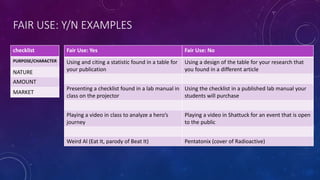
FAIR USE: Y/N EXAMPLES
Fair Use: Yes Fair Use: No
Using and citing a statistic found in a table for
your publication
Using a design of the table for your research that
you found in a different article
Presenting a checklist found in a lab manual in
class on the projector
Using the checklist in a published lab manual your
students will purchase
Playing a video in class to analyze a hero’s
journey
Playing a video in Shattuck for an event that is open
to the public
Weird Al (Eat It, parody of Beat It) Pentatonix (cover of Radioactive)
checklist
PURPOSE/CHARACTER
NATURE
AMOUNT
MARKET
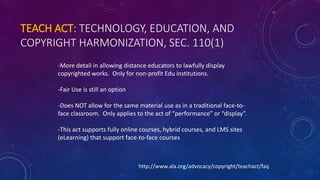
TEACH ACT: TECHNOLOGY, EDUCATION, AND
COPYRIGHT HARMONIZATION, SEC. 110(1)
-More detail in allowing distance educators to lawfully display
copyrighted works. Only for non-profit Edu institutions.
-Fair Use is still an option
-Does NOT allow for the same material use as in a traditional face-to-
face classroom. Only applies to the act of “performance” or “display”.
-This act supports fully online courses, hybrid courses, and LMS sites
(eLearning) that support face-to-face courses
http://www.ala.org/advocacy/copyright/teachact/faq
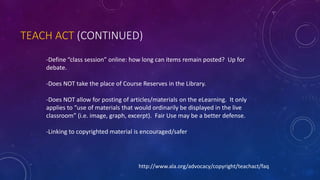
TEACH ACT (CONTINUED)
-Define “class session” online: how long can items remain posted? Up for
debate.
-Does NOT take the place of Course Reserves in the Library.
-Does NOT allow for posting of articles/materials on the eLearning. It only
applies to “use of materials that would ordinarily be displayed in the live
classroom” (i.e. image, graph, excerpt). Fair Use may be a better defense.
-Linking to copyrighted material is encouraged/safer
http://www.ala.org/advocacy/copyright/teachact/faq
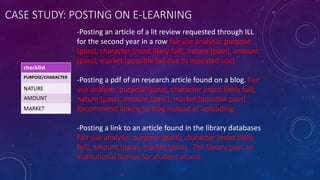
CASE STUDY: POSTING ON E-LEARNING
-Posting an article of a lit review requested through ILL
for the second year in a row fair use analysis: purpose
(pass), character (most likely fail), nature (pass), amount
(pass), market (possible fail due to repeated use)
-Posting a pdf of an research article found on a blog. Fair
use analysis: purpose (pass), character (most likely fail),
nature (pass), amount (pass), market (possible pass).
Recommend linking to blog instead of uploading.
-Posting a link to an article found in the library databases
Fair use analysis: purpose (pass), character (most likely
fail), amount (pass), market (pass). The library pays an
institutional license for student access.
checklist
PURPOSE/CHARACTER
NATURE
AMOUNT
MARKET
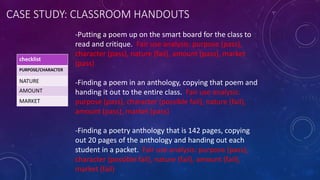
CASE STUDY: CLASSROOM HANDOUTS
-Putting a poem up on the smart board for the class to
read and critique. Fair use analysis: purpose (pass),
character (pass), nature (fail), amount (pass), market
(pass)
-Finding a poem in an anthology, copying that poem and
handing it out to the entire class. Fair use analysis:
purpose (pass), character (possible fail), nature (fail),
amount (pass), market (pass)
-Finding a poetry anthology that is 142 pages, copying
out 20 pages of the anthology and handing out each
student in a packet. Fair use analysis: purpose (pass),
character (possible fail), nature (fail), amount (fail),
market (fail)
checklist
PURPOSE/CHARACTER
NATURE
AMOUNT
MARKET
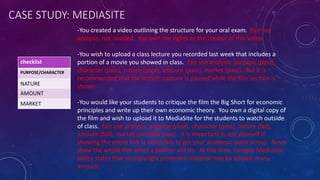
CASE STUDY: MEDIASITE
-You created a video outlining the structure for your oral exam. Fair use
analysis: not needed. You own the rights as the creator of this video.
-You wish to upload a class lecture you recorded last week that includes a
portion of a movie you showed in class. Fair use analysis: purpose (pass),
character (pass), nature (pass), amount (pass), market (pass). But it is
recommended that the lecture capture is paused while the film section is
shown.
-You would like your students to critique the film the Big Short for economic
principles and write up their own economic theory. You own a digital copy of
the film and wish to upload it to MediaSite for the students to watch outside
of class. Fair use analysis: purpose (pass), character (pass), nature (fail),
amount (fail), market (possible pass). It is important to ask yourself if
showing the entire film is necessary to get your academic point across. Never
show the whole film when a portion will do. At this time, campus Mediasite
policy states that no copyright protected material may be posted in any
amount.
checklist
PURPOSE/CHARACTER
NATURE
AMOUNT
MARKET
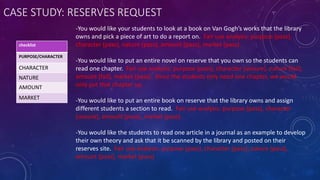
CASE STUDY: RESERVES REQUEST
-You would like your students to look at a book on Van Gogh’s works that the library
owns and pick a piece of art to do a report on. Fair use analysis: purpose (pass),
character (pass), nature (pass), amount (pass), market (pass)
-You would like to put an entire novel on reserve that you own so the students can
read one chapter. Fair use analysis: purpose (pass), character (unsure), nature (fail),
amount (fail), market (pass). Since the students only need one chapter, we would
only put that chapter up.
-You would like to put an entire book on reserve that the library owns and assign
different students a section to read. Fair use analysis: purpose (pass), character
(unsure), amount (pass), market (pass).
-You would like the students to read one article in a journal as an example to develop
their own theory and ask that it be scanned by the library and posted on their
reserves site. Fair use analysis: purpose (pass), character (pass), nature (pass),
amount (pass), market (pass)
checklist
PURPOSE/CHARACTER
CHARACTER
NATURE
AMOUNT
MARKET
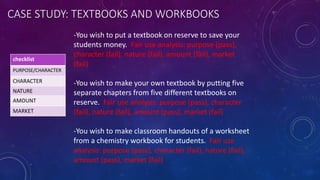
CASE STUDY: TEXTBOOKS AND WORKBOOKS
checklist
PURPOSE/CHARACTER
CHARACTER
NATURE
AMOUNT
MARKET
-You wish to put a textbook on reserve to save your
students money. Fair use analysis: purpose (pass),
character (fail), nature (fail), amount (fail), market
(fail)
-You wish to make your own textbook by putting five
separate chapters from five different textbooks on
reserve. Fair use analysis: purpose (pass), character
(fail), nature (fail), amount (pass), market (fail)
-You wish to make classroom handouts of a worksheet
from a chemistry workbook for students. Fair use
analysis: purpose (pass), character (fail), nature (fail),
amount (pass), market (fail)
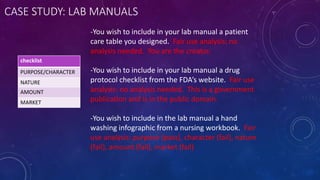
CASE STUDY: LAB MANUALS
-You wish to include in your lab manual a patient
care table you designed. Fair use analysis: no
analysis needed. You are the creator.
-You wish to include in your lab manual a drug
protocol checklist from the FDA’s website. Fair use
analysis: no analysis needed. This is a government
publication and is in the public domain.
-You wish to include in the lab manual a hand
washing infographic from a nursing workbook. Fair
use analysis: purpose (pass), character (fail), nature
(fail), amount (fail), market (fail)
checklist
PURPOSE/CHARACTER
NATURE
AMOUNT
MARKET
QUESTIONS?

Copyright_Carroll_2016

  • 1.
  • 2.
    THE LAW’S HISTORY -1788:U.S. Constitution ratified to give exclusive rights to authors and inventors -1790: First copyright law enacted for books, maps, charts -1834: First Supreme Court ruling on author rights -1947: Copyright law now officially title 17 of U.S. Code -1998: Digital Millennium Copyright Act -2002: TEACH Act allows nonprofit distance educators more freedom (sort of) http://copyright.gov/circs/circ1a.html
  • 3.
    WHAT HAS BEENHAPPENING LATELY? • 2005: Supreme Court rules on file-sharing software (it’s not okay) • 2007: You can register your copyright online (finally) • 2016: District Court declares Georgia State the prevailing party in GSU vs. Publishers • 2016: Google Books vs. Authors Guild. Supreme Court says “not interested” • 2016: Trump Skittles tweet deleted due to copyright claim
  • 4.
    THE COPYRIGHT SYMBOL •VIEWING NOT REQUIRED! • It’s more of a reminder • Works are born with automatic copyright protection © If I am invisible do I still exist?
  • 5.
    PUBLIC DOMAIN • Before1923 • Government publications • 1923-1977 without a copyright notice • Then it gets complicated • 1989 and after: most likely copyright protected CREEPY NOTE: The Count of Monte Cristo was published before 1923 and is in the public domain. A publisher may have copyright rights to elements of their edition (layout, art, criticism/notes, translation). http://copyright.cornell.edu/resources/publicdomain.cfm
  • 6.
    WHY WE NEEDCOPYRIGHT LAW -Protects creator’s rights to work -Compensates the creator for their intellectual ideas/efforts -Encourages innovation of new products/ideas in our fields
  • 7.
    THE CREEPY PART -Weare trying to educate! -We aren’t making $$ off of the ideas (usually) -We don’t have the $$ to pay royalties to get permission -The laws are both vague and complicated at the same time. -Everyone interprets them differently.
  • 8.
    WHO CAN HELP? -Brittany!bllarson@carrollu.edu, 262-650-4887 -Give you an assessment on potential infringement -Help you obtain permission if needed -Arrange the royalty permissions -Faculty guide on Library website: http://pioguides.carrollu.edu/faculty/copyright -Course Reserves Information for Faculty on Library Website: http://www.carrollu.edu/library/
  • 9.
    CARROLL’S POLICY Copyright Infringement Almostall forms of original expression that are fixed in a tangible medium are subject to copyright protection, even if no formal copyright notice is attached. You should assume materials that you find on the Internet are copyrighted unless a disclaimer or waiver is expressly stated. The copyright holder has extensive rights; you must contact the copyright holder and ask permission to copy, use or display the material. Portal>Departments>ITS>Policies and Forms>General Policies Unless Fair Use is a clear defense…
  • 10.
    NOT TO BECONFUSED WITH… Copyright Policy for Course Materials.doc My Groups> Information and Documents for Faculty and Staff
  • 11.
    BEWARE OF THECREATIVE COMMONS LICENSE • Does not = Do whatever • “Creative Commons provides free, easy-to-use copyright licenses to make a simple and standardized way to give the public permission to share and use your creative work–on conditions of your choice.” I’m not necessarily who you think I am
  • 12.
    FAIR USE: NOTA LAW, BUT A DEFENSE Purpose and character of the use, including whether the use is of a commercial nature or is for nonprofit educational purposes Nature of the copyrighted work Amount and substantiality of the portion used in relation to the copyrighted work as a whole Effect of the use upon the potential market for or value of the copyrighted work
  • 13.
    NOT ALL FAIRUSE IS CREATED EQUAL… What you will get caught for: Amount and substantiality of the portion used in relation to the copyrighted work as a whole What you will get sued for: Effect of the use upon the potential market for or value of the copyrighted work
  • 14.
    FAIR USE: WHENIT HELPS -When you are using the work for education purposes within the setting (physical or in the spirit) of a classroom -When you have transformed the work (Weird Al) -When you use factual work -When you would like to show a small portion of a work -When you or the university is not making any money AND the author doesn’t lose significant money from you not purchasing the work or rights to the work
  • 15.
    FAIR USE: WHENIT DOESN’T HELP -If you use the work for fun (showing a movie just because) -If you are reusing the work without any purposeful change (a change can be providing an academic critique) -Using more creative based works (novels, movies, songs) -You use a significant portion of the work (this is when it should be a required class text) -Through your use there is a loss of profit
  • 16.
  • 17.
    GSU VS PUBLISHERS(CAMBRIDGE, OXFORD, SAGE) What we’ve learned: • “don’t tick off your judge” • License in only specific exceptions • Continue careful fair use decisions What is challenging: • Assessment hard to replicate to use as case precedence guidelines • Analysis is mostly for non-transformative situations • Amount carefully scrutinized initially, then became more vague • Market value given heavy weight Basics • 2008: Publishers sue GSU for “pervasive, flagrant, and ongoing unauthorized distribution” • 2012: 5/74 excerpts copyright violation. Others were a good faith interpretation of fair use. • 2014: Circuit Court of Appeals reversed decision. Sent back to District Court • 2015: original Judge gives “bright lines” on fair use analysis. • 2016: District Court finds 4/48 works were infringement. GSU is prevailing party. • August 26,2016: Plaintiffs filed a Notice of Appeal http://blogs.library.duke.edu/ scholcomm/2016/04/01/fgo- latest-gsuruling-odd-victory- libraries/ CREEPY
  • 18.
    FAIR USE: Y/NEXAMPLES Fair Use: Yes Fair Use: No Using and citing a statistic found in a table for your publication Using a design of the table for your research that you found in a different article Presenting a checklist found in a lab manual in class on the projector Using the checklist in a published lab manual your students will purchase Playing a video in class to analyze a hero’s journey Playing a video in Shattuck for an event that is open to the public Weird Al (Eat It, parody of Beat It) Pentatonix (cover of Radioactive) checklist PURPOSE/CHARACTER NATURE AMOUNT MARKET
  • 19.
    TEACH ACT: TECHNOLOGY,EDUCATION, AND COPYRIGHT HARMONIZATION, SEC. 110(1) -More detail in allowing distance educators to lawfully display copyrighted works. Only for non-profit Edu institutions. -Fair Use is still an option -Does NOT allow for the same material use as in a traditional face-to- face classroom. Only applies to the act of “performance” or “display”. -This act supports fully online courses, hybrid courses, and LMS sites (eLearning) that support face-to-face courses http://www.ala.org/advocacy/copyright/teachact/faq
  • 20.
    TEACH ACT (CONTINUED) -Define“class session” online: how long can items remain posted? Up for debate. -Does NOT take the place of Course Reserves in the Library. -Does NOT allow for posting of articles/materials on the eLearning. It only applies to “use of materials that would ordinarily be displayed in the live classroom” (i.e. image, graph, excerpt). Fair Use may be a better defense. -Linking to copyrighted material is encouraged/safer http://www.ala.org/advocacy/copyright/teachact/faq
  • 21.
    CASE STUDY: POSTINGON E-LEARNING -Posting an article of a lit review requested through ILL for the second year in a row fair use analysis: purpose (pass), character (most likely fail), nature (pass), amount (pass), market (possible fail due to repeated use) -Posting a pdf of an research article found on a blog. Fair use analysis: purpose (pass), character (most likely fail), nature (pass), amount (pass), market (possible pass). Recommend linking to blog instead of uploading. -Posting a link to an article found in the library databases Fair use analysis: purpose (pass), character (most likely fail), amount (pass), market (pass). The library pays an institutional license for student access. checklist PURPOSE/CHARACTER NATURE AMOUNT MARKET
  • 22.
    CASE STUDY: CLASSROOMHANDOUTS -Putting a poem up on the smart board for the class to read and critique. Fair use analysis: purpose (pass), character (pass), nature (fail), amount (pass), market (pass) -Finding a poem in an anthology, copying that poem and handing it out to the entire class. Fair use analysis: purpose (pass), character (possible fail), nature (fail), amount (pass), market (pass) -Finding a poetry anthology that is 142 pages, copying out 20 pages of the anthology and handing out each student in a packet. Fair use analysis: purpose (pass), character (possible fail), nature (fail), amount (fail), market (fail) checklist PURPOSE/CHARACTER NATURE AMOUNT MARKET
  • 23.
    CASE STUDY: MEDIASITE -Youcreated a video outlining the structure for your oral exam. Fair use analysis: not needed. You own the rights as the creator of this video. -You wish to upload a class lecture you recorded last week that includes a portion of a movie you showed in class. Fair use analysis: purpose (pass), character (pass), nature (pass), amount (pass), market (pass). But it is recommended that the lecture capture is paused while the film section is shown. -You would like your students to critique the film the Big Short for economic principles and write up their own economic theory. You own a digital copy of the film and wish to upload it to MediaSite for the students to watch outside of class. Fair use analysis: purpose (pass), character (pass), nature (fail), amount (fail), market (possible pass). It is important to ask yourself if showing the entire film is necessary to get your academic point across. Never show the whole film when a portion will do. At this time, campus Mediasite policy states that no copyright protected material may be posted in any amount. checklist PURPOSE/CHARACTER NATURE AMOUNT MARKET
  • 24.
    CASE STUDY: RESERVESREQUEST -You would like your students to look at a book on Van Gogh’s works that the library owns and pick a piece of art to do a report on. Fair use analysis: purpose (pass), character (pass), nature (pass), amount (pass), market (pass) -You would like to put an entire novel on reserve that you own so the students can read one chapter. Fair use analysis: purpose (pass), character (unsure), nature (fail), amount (fail), market (pass). Since the students only need one chapter, we would only put that chapter up. -You would like to put an entire book on reserve that the library owns and assign different students a section to read. Fair use analysis: purpose (pass), character (unsure), amount (pass), market (pass). -You would like the students to read one article in a journal as an example to develop their own theory and ask that it be scanned by the library and posted on their reserves site. Fair use analysis: purpose (pass), character (pass), nature (pass), amount (pass), market (pass) checklist PURPOSE/CHARACTER CHARACTER NATURE AMOUNT MARKET
  • 25.
    CASE STUDY: TEXTBOOKSAND WORKBOOKS checklist PURPOSE/CHARACTER CHARACTER NATURE AMOUNT MARKET -You wish to put a textbook on reserve to save your students money. Fair use analysis: purpose (pass), character (fail), nature (fail), amount (fail), market (fail) -You wish to make your own textbook by putting five separate chapters from five different textbooks on reserve. Fair use analysis: purpose (pass), character (fail), nature (fail), amount (pass), market (fail) -You wish to make classroom handouts of a worksheet from a chemistry workbook for students. Fair use analysis: purpose (pass), character (fail), nature (fail), amount (pass), market (fail)
  • 26.
    CASE STUDY: LABMANUALS -You wish to include in your lab manual a patient care table you designed. Fair use analysis: no analysis needed. You are the creator. -You wish to include in your lab manual a drug protocol checklist from the FDA’s website. Fair use analysis: no analysis needed. This is a government publication and is in the public domain. -You wish to include in the lab manual a hand washing infographic from a nursing workbook. Fair use analysis: purpose (pass), character (fail), nature (fail), amount (fail), market (fail) checklist PURPOSE/CHARACTER NATURE AMOUNT MARKET
  • 27.