Open Licensing
The How and Why
Behind Sharing Your Work
Michelle Reed, Open Education Librarian
http://libguides.uta.edu/openlicensing
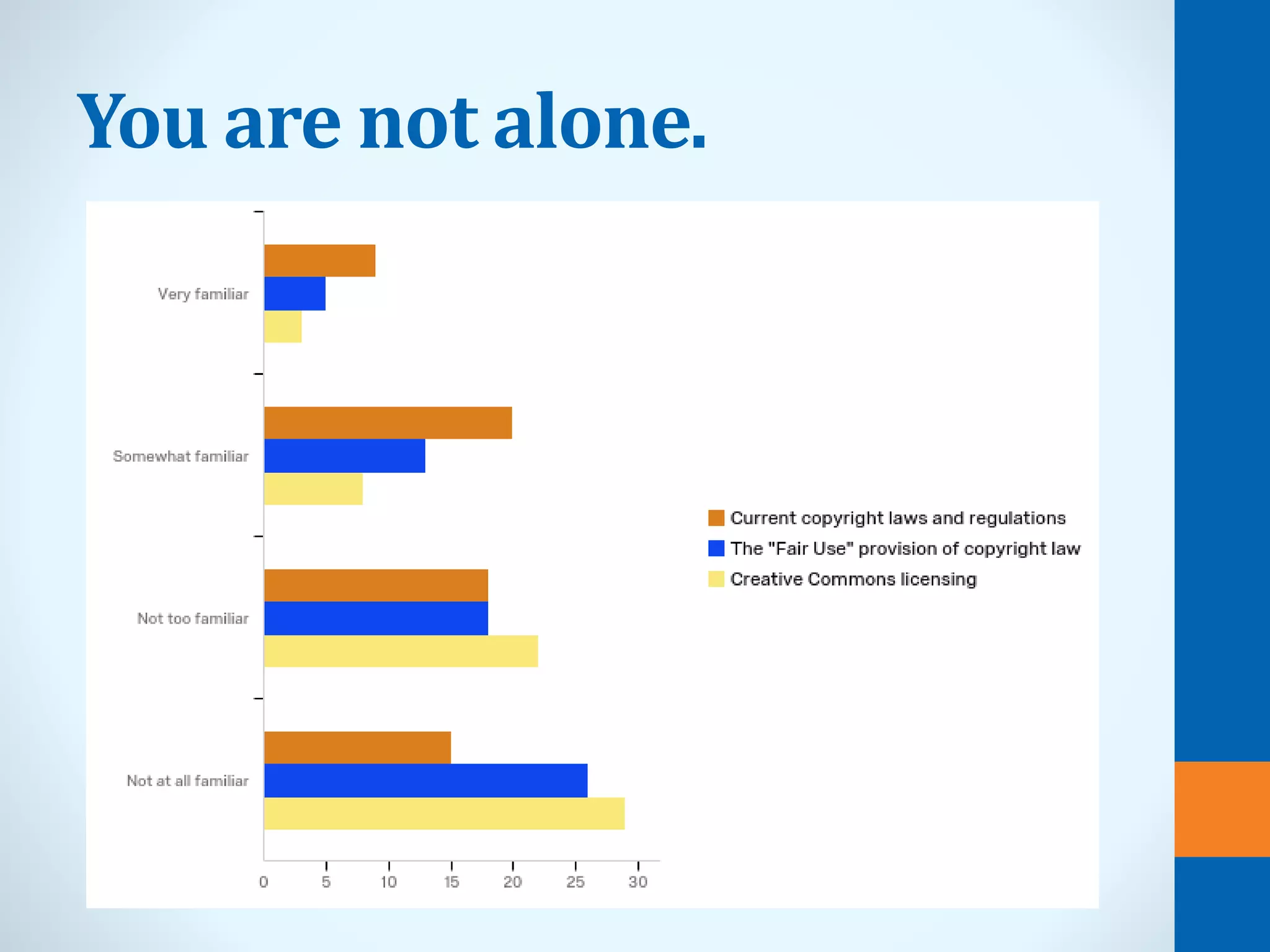
You are not alone.
Are you a copyright owner?
What is ©opyright?
The U.S. Constitution
“The Congress shall have the power…to promote the progress of science
and useful arts, by securing for limited times to authors and inventors
exclusive Right to their respective writings and discoveries.”
Article 1, Section 8
Copyright (Section 106)
Copyright protects “original works of authorship” that are fixed in a tangible
form of expression:
• literary works
• musical works
• dramatic works
• pantomimes & choreographic works
• pictorial, graphic, & sculptural works
• motion pictures & other audiovisual works
• sound recordings
• architectural works
Copyright is a bundle of rights
Rights are held by the OWNER of the work (not necessarily the
creator/author). Owners may:
• Reproduce - Make copies of their works publicly or privately.
• Adapt - Prepare additional works derived from their copyrighted work,
(aka, derivative works).
• Distribute - Disseminate copies of their works, to the public by sale or
other transfer of ownership, or by rental, lease, lending.
• Perform - Perform their work publicly (at location open to the public or
to persons other than close family and social acquaintances).
• Display - Display their work publicly (applies to all works except sound
recordings and architectural works).
Length/Term of Copyright
• Life of author plus 70 years
• Joint work – 70 years after last surviving author’s death
• Works made for hire – 95 years from year of first publication or 120
years from year of creation, whichever expires first
• Works published before 1923 are in the public domain
• Copyright slider to determine whether the work is in the public domain -
http://librarycopyright.net/resources/digitalslider/
Is this copyright
infringement?
http://tlinnovations.cikeys.com/digital-copyright/
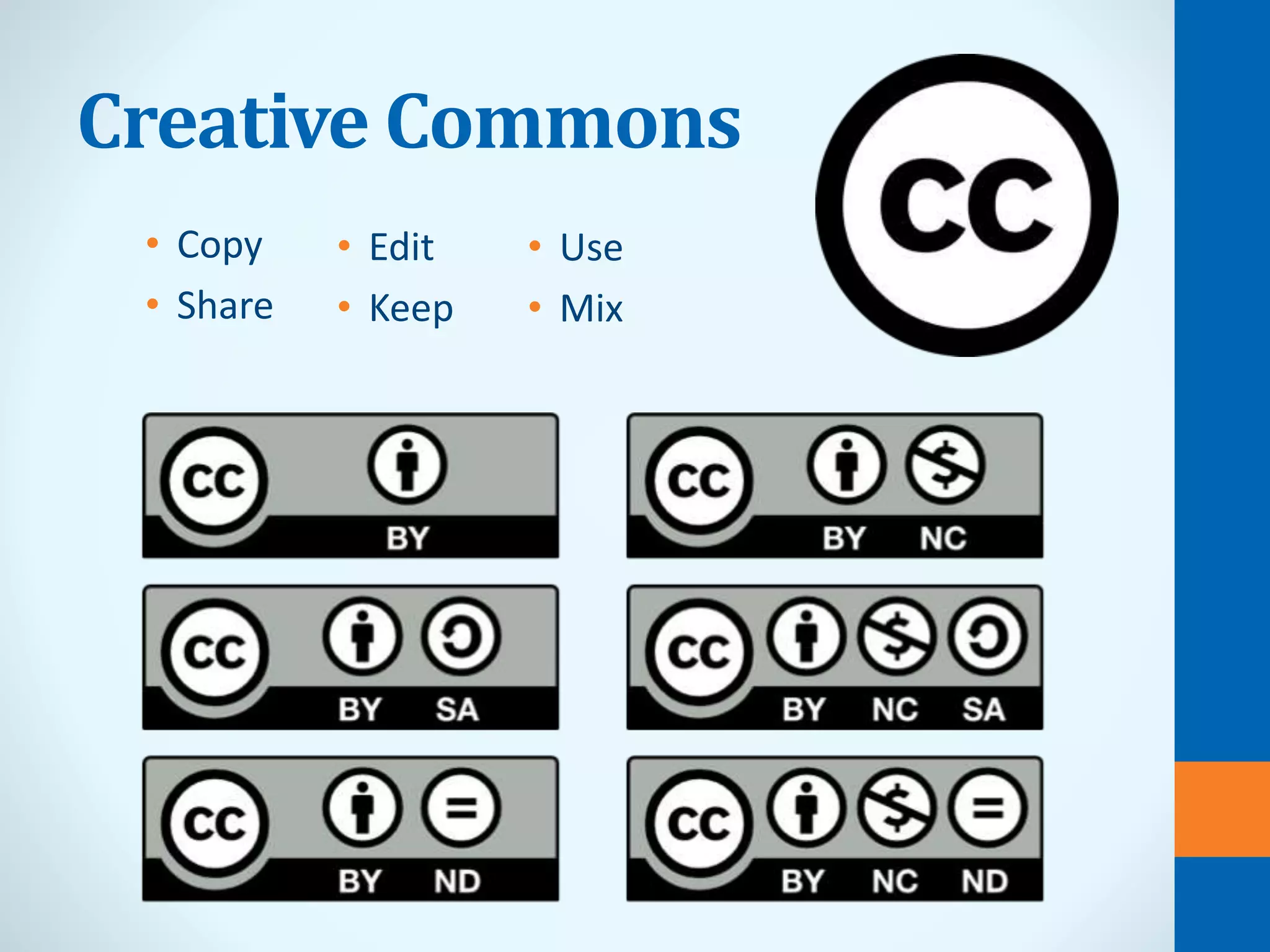
Creative Commons
• Copy
• Share
• Edit
• Keep
• Use
• Mix
What do you DO with your
intellectual property?
Intellectual property, like most property, has value. However, the value is
relative; it’s only as valuable as people perceive it to be. Value is usually
determined by how useful the work is to others, and how it is distributed
for consumption by others.
• What is the value of your intellectual property?
• How would you distribute it?
• Consider the enduring value of your work in advance.
YouALWAYSgettodecidewhattodowithyourintellectualproperty
(unlessitisworkforhire).
Decide how you want
to share your work.
Consider future users:
• Less restrictive licenses (such as CC-BY) are most adaptable for future
uses
• You will always get credit for your work - attribution is required with all
Creative Commons licenses
• Tell others how to give you credit (provide sample attribution)
How will what you share and how you share impact your digital identity?
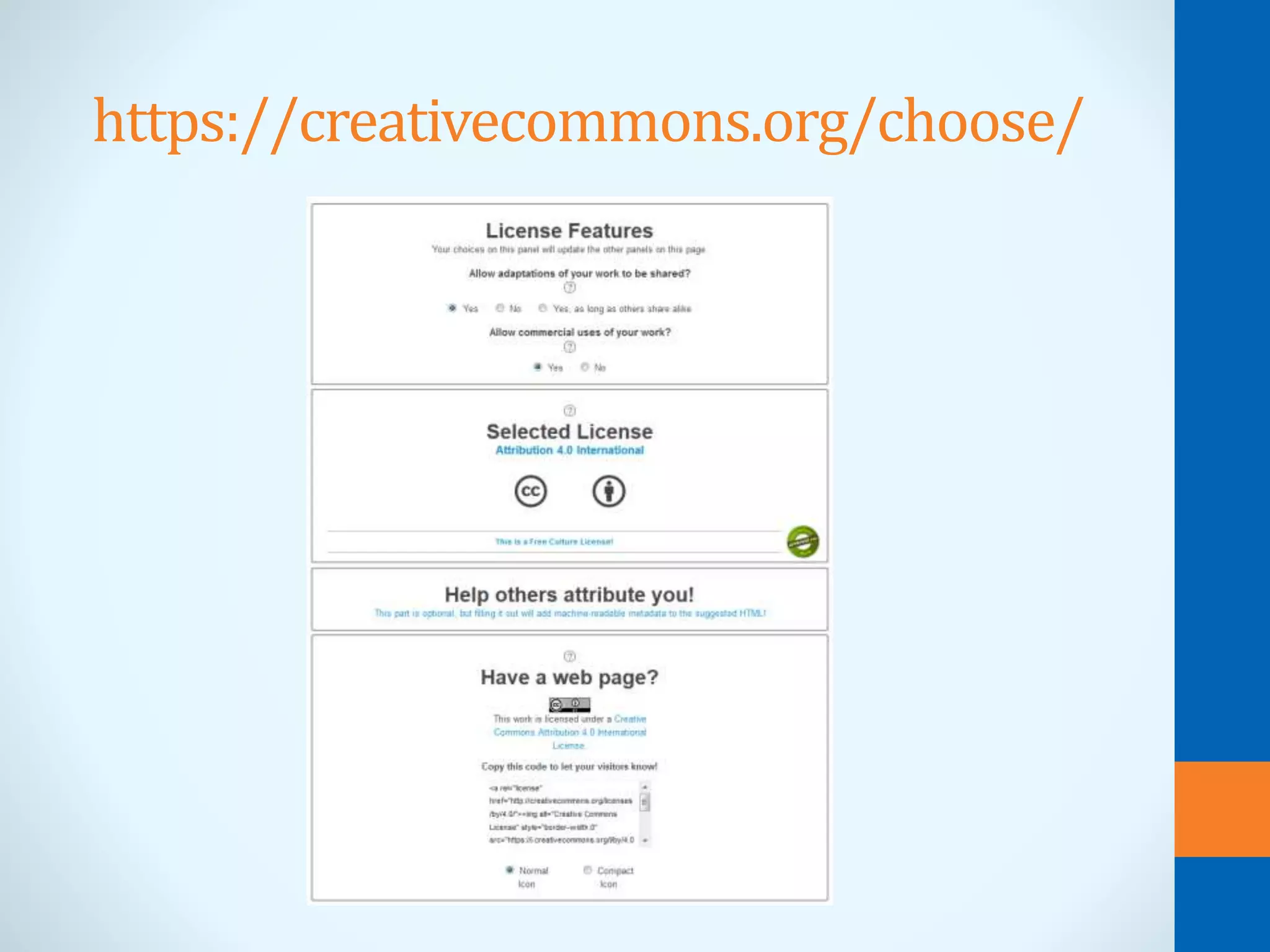
https://creativecommons.org/choose/
Using Openly Licensed Work
How to Find
• Flickr, YouTube, Vimeo, and Google all have advanced searches with
filters for Creative Commons licensed work
• Wikipedia and Wikimedia Commons are licensed CC-BY-SA
How to Attribute
• Title - What is the name of the material?
• Author - Who owns the material?
• Source - Provide the source of the material so others can, too. Since we
live in the age of the Internet, this is usually a URL or hyperlink where
the material resides.
• License – Name the specific license and link to it.
ATTRIBUTION gives credit to the original creator. This is a requirement of
all Creative Commons licenses. For additional information, visit
https://wiki.creativecommons.org/wiki/Best_practices_for_attribution
Example
https://wiki.creativecommons.org/wiki/Best_practices_for_attribution
Questions?

Open Licensing

  • 1.
    Open Licensing The Howand Why Behind Sharing Your Work Michelle Reed, Open Education Librarian http://libguides.uta.edu/openlicensing
  • 2.
  • 3.
    Are you acopyright owner?
  • 4.
  • 5.
    The U.S. Constitution “TheCongress shall have the power…to promote the progress of science and useful arts, by securing for limited times to authors and inventors exclusive Right to their respective writings and discoveries.” Article 1, Section 8
  • 6.
    Copyright (Section 106) Copyrightprotects “original works of authorship” that are fixed in a tangible form of expression: • literary works • musical works • dramatic works • pantomimes & choreographic works • pictorial, graphic, & sculptural works • motion pictures & other audiovisual works • sound recordings • architectural works
  • 7.
    Copyright is abundle of rights Rights are held by the OWNER of the work (not necessarily the creator/author). Owners may: • Reproduce - Make copies of their works publicly or privately. • Adapt - Prepare additional works derived from their copyrighted work, (aka, derivative works). • Distribute - Disseminate copies of their works, to the public by sale or other transfer of ownership, or by rental, lease, lending. • Perform - Perform their work publicly (at location open to the public or to persons other than close family and social acquaintances). • Display - Display their work publicly (applies to all works except sound recordings and architectural works).
  • 8.
    Length/Term of Copyright •Life of author plus 70 years • Joint work – 70 years after last surviving author’s death • Works made for hire – 95 years from year of first publication or 120 years from year of creation, whichever expires first • Works published before 1923 are in the public domain • Copyright slider to determine whether the work is in the public domain - http://librarycopyright.net/resources/digitalslider/
  • 11.
  • 12.
  • 13.
    Creative Commons • Copy •Share • Edit • Keep • Use • Mix
  • 14.
    What do youDO with your intellectual property? Intellectual property, like most property, has value. However, the value is relative; it’s only as valuable as people perceive it to be. Value is usually determined by how useful the work is to others, and how it is distributed for consumption by others. • What is the value of your intellectual property? • How would you distribute it? • Consider the enduring value of your work in advance. YouALWAYSgettodecidewhattodowithyourintellectualproperty (unlessitisworkforhire).
  • 15.
    Decide how youwant to share your work. Consider future users: • Less restrictive licenses (such as CC-BY) are most adaptable for future uses • You will always get credit for your work - attribution is required with all Creative Commons licenses • Tell others how to give you credit (provide sample attribution) How will what you share and how you share impact your digital identity?
  • 16.
  • 18.
    Using Openly LicensedWork How to Find • Flickr, YouTube, Vimeo, and Google all have advanced searches with filters for Creative Commons licensed work • Wikipedia and Wikimedia Commons are licensed CC-BY-SA How to Attribute • Title - What is the name of the material? • Author - Who owns the material? • Source - Provide the source of the material so others can, too. Since we live in the age of the Internet, this is usually a URL or hyperlink where the material resides. • License – Name the specific license and link to it. ATTRIBUTION gives credit to the original creator. This is a requirement of all Creative Commons licenses. For additional information, visit https://wiki.creativecommons.org/wiki/Best_practices_for_attribution
  • 19.
  • 20.

Editor's Notes

  • #2 This presentation is licensed under an Attribution 4.0 International license (CC-BY): https://creativecommons.org/licenses/by/4.0/. It was presented to students in Kinesiology 4330 on October 5, 2017.
  • #3 Pre-test results Very important to acknowledge this when we’re talking about complex and gray issues like copyright. The vast majority of you said that you are not very familiar with Creative Commons licensing. Only 11 out of 62 of you said you were somewhat or very familiar with these licensing options.
  • #4 Pre-test results I’ve asked this question of over 100 students at two different universities, and only one student has answered “yes.” Would any of you like to revise your answers based on what you learned from the homework?
  • #5 We’ll discuss four important facts related to copyright. https://www.copyright.gov/title17/
  • #6 Fact 1: Copyright is a legal right granted by the US Constitution. It was intended as a limited-term monopoly to incentivize creation and innovation. https://www.senate.gov/civics/constitution_item/constitution.htm#a1_sec8
  • #7 Fact 2: Copyright is automatic when a work is fixed in a tangible form. These categories should be viewed broadly. For example, computer programs and most “compilations” may be registered as “literary works”; maps and architectural plans may be registered as “pictorial, graphic, and sculptural works.” Some things may not be protected by copyright: ideas, symbols, ingredients and processes (recipes), ideas, phrases, names, titles, and slogans. However, other types of IP may apply (e.g., trademark, patent, or trade secret). Also, government documents are in the public domain. Copyright happens automatically and without any further action on your part when you fix an idea in a tangible form. Example: lyrics on a bar napkin. Making the copyright ownership and status of work easily visible is a good idea but not legally required. Registration is a procedural necessity in order to litagate a copyright claim but this can be done at any point and costs money. It would indicate to the court that you were aware of your ownership rights and intended to protect them. But again, not necessary to establish copyright; the act of expression brought the copyright into existence.
  • #8 Fact 3: Copyright is a bundle of rights that can be debundled. Rights may be transferred in whole or licensed collectively or individually. Exclusive rights must be transferred in writing.
  • #9 Fact 4: Copyright lasts a really long time-- continues beyond creator’s death. Original Copyright Term: 1790 – 14 yrs. + 14 renewal (28) Revisions: 1831 – 28 yrs. + 14 renewal (42) 1909 – 28 yrs. + 28 renewal (56) 1976 – life of author + 50 yrs. (fair use formalized, registration not required) 1998 – life of author + 70 yrs. Source: http://www.arl.org/focus-areas/copyright-ip/2486-copyright-timeline The Disney influence: Steamboat Willie (1928) - set to expire in 1984 - 1976 changes set new expiration at 75 years (2003) - 1998 changes set new expiration at 95 years (2023)
  • #10 Let’s take a look at your homework assignment. What license is used?
  • #11 Now let’s look at the original source. How is it licensed?
  • #12 Under what conditions would this use be considered legal?
  • #13 This work was created by T&L Innovations at CSU Channel Islands. It is licensed under a Creative Commons Attribution-NonCommercial 4.0 International License. http://tlinnovations.cikeys.com/digital-copyright/
  • #15 This slide is adapted from a presentation by Amy Hofer and is licensed under a Creative Commons Attribution 4.0 international license. Ms. Hofer’s presenation was adapted from Open Licensing Your Work by Quill West, Open Education Project Manager, Pierce Community College, CC-BY 4.0. Note that you can’t apply an open license to another person’s work without permission.
  • #16 This slide is adapted from a presentation by Amy Hofer and is licensed under a Creative Commons Attribution 4.0 international license. Ms. Hofer’s presenation was adapted from Open Licensing Your Work by Quill West, Open Education Project Manager, Pierce Community College, CC-BY 4.0.
  • #17 https://creativecommons.org/choose/
  • #18 Creative Commons Help: https://en.support.wordpress.com/creative-commons/ Widget Help: https://en.support.wordpress.com/widgets/text-widget/
  • #19 This slide is adapted from a presentation by Amy Hofer and is licensed under a Creative Commons Attribution 4.0 international license. Ms. Hofer’s presenation was adapted from Open Licensing Your Work by Quill West, Open Education Project Manager, Pierce Community College, CC-BY 4.0. Review best practices at https://wiki.creativecommons.org/wiki/Best_practices_for_attribution
  • #20 https://wiki.creativecommons.org/wiki/Best_practices_for_attribution