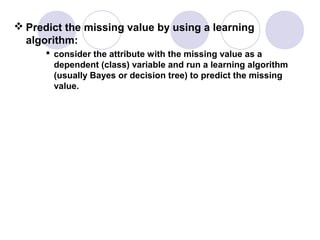
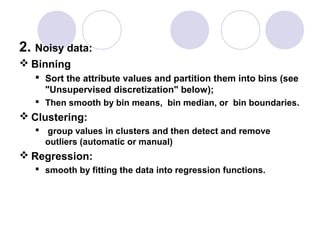
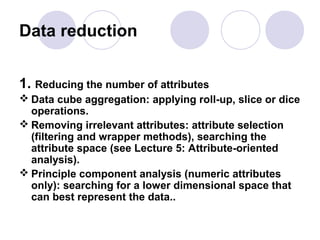
This document discusses data preprocessing techniques. It describes how real-world data can be incomplete, noisy, or inconsistent. The main tasks in data preprocessing are cleaning the data by handling missing values and outliers, integrating and transforming the data by normalization and aggregation, reducing the data through dimensionality reduction, and discretizing numeric values. Specific techniques discussed include binning, clustering, regression, principle component analysis, and information-based discretization. The goal is to prepare raw data for further analysis.

![Data transformation
1. Normalization:
Scaling attribute values to fall within a specified
range.
Example: to transform V in [min, max] to V' in [0,1],
apply V'=(V-Min)/(Max-Min)
Scaling by using mean and standard deviation
(useful when min and max are unknown or when
there are outliers): V'=(V-Mean)/StDev](https://image.slidesharecdn.com/datapreprocessing-140223201712-phpapp02/85/Data-preprocessing-8-320.jpg)


![ Entropy (information)-based discretization. Example:
Information in a class distribution:
Denote a set of five values occurring in tuples belonging to two
classes (+ and -) as [+,+,+,-,-]
That is, the first 3 belong to "+" tuples and the last 2 - to "-" tuples
Then, Info([+,+,+,-,-]) = -(3/5)*log(3/5)-(2/5)*log(2/5) (logs are base 2)
3/5 and 2/5 are relative frequencies (probabilities)
Ignoring the order of the values, we can use the following
notation: [3,2] meaning 3 values from one class and 2 - from the
other.
Then, Info([3,2]) = -(3/5)*log(3/5)-(2/5)*log(2/5)](https://image.slidesharecdn.com/datapreprocessing-140223201712-phpapp02/85/Data-preprocessing-13-320.jpg)
![ Information in a split (2/5 and 3/5 are weight coefficients):
Info([+,+],[+,-,-]) = (2/5)*Info([+,+]) + (3/5)*Info([+,-,-])
§ Or, Info([2,0],[1,2]) = (2/5)*Info([2,0]) + (3/5)*Info([1,2])
Method:
Sort the values;
Calculate information in all possible splits;
Choose the split that minimizes information;
§ Do not include breakpoints between values belonging to the
same class (this will increase information);
§ Apply the same to the resulting intervals until some stopping
criterion is satisfied.
](https://image.slidesharecdn.com/datapreprocessing-140223201712-phpapp02/85/Data-preprocessing-14-320.jpg)