A Study on Interpersonal
Communication & Behavior Skill
Presented by: Mukul Kr. Ranjan
What is Communication....
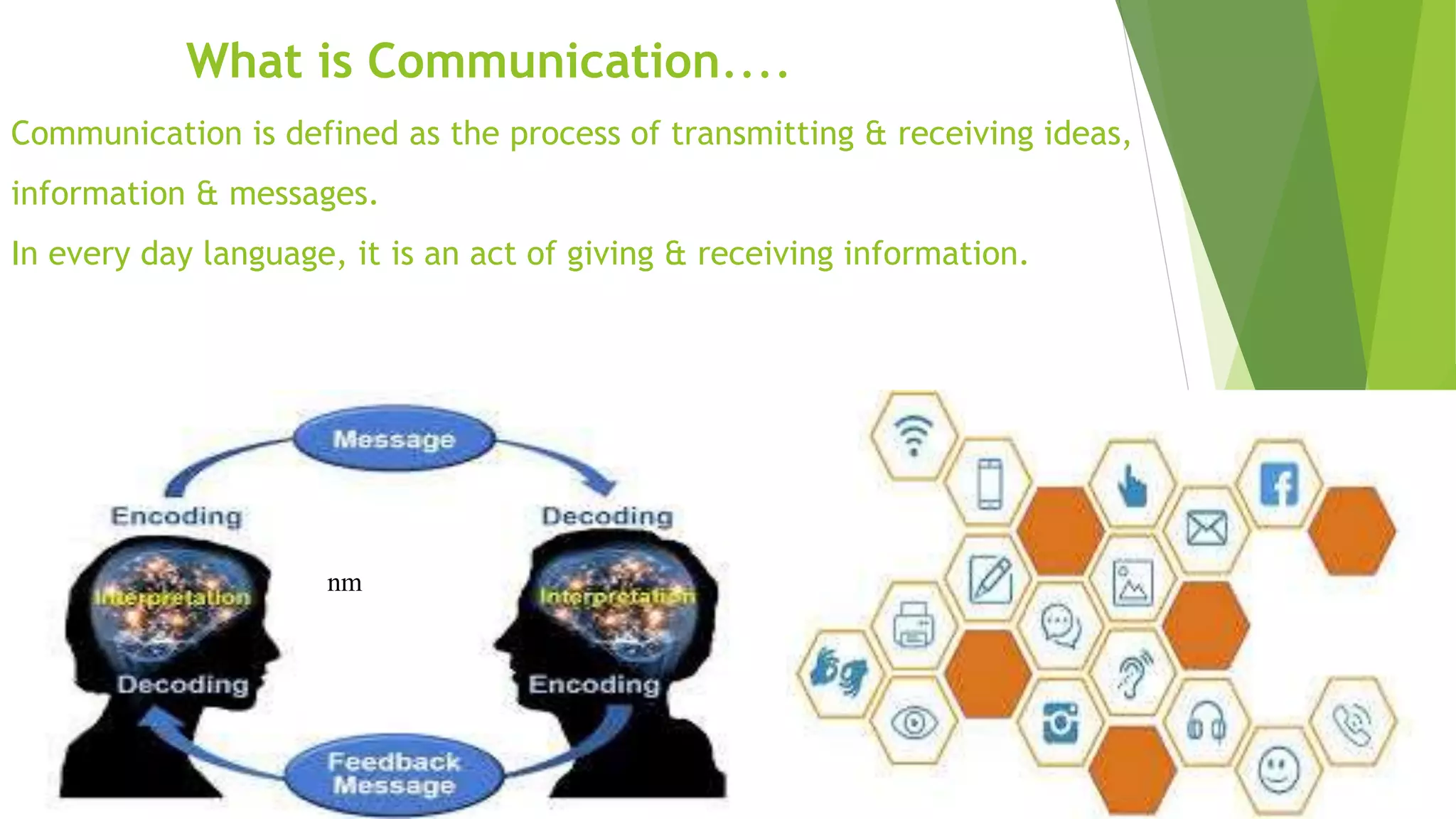
Communication is defined as the process of transmitting & receiving ideas,
information & messages.
In every day language, it is an act of giving & receiving information.
nm
EFFECTIVE COMMUINCATION
• Every platform for communication involves a large number of experiences, actions
and emotions
• Communication is said to be effective when the receiver understand the same
 meaning that the sender intends to convey
• In other words, excellent or effective communication is the ability to receive a
transmitted message by the sender and have the receiver be able to replicate the
form and intent of the message in the receiver’s mind
7C’s OF EFFECTIVE COMMUNICATION
• Completeness
• Conciseness
• Consideration
• Clarity
• Concreteness/Contribution
• Courtesy
• Correctness
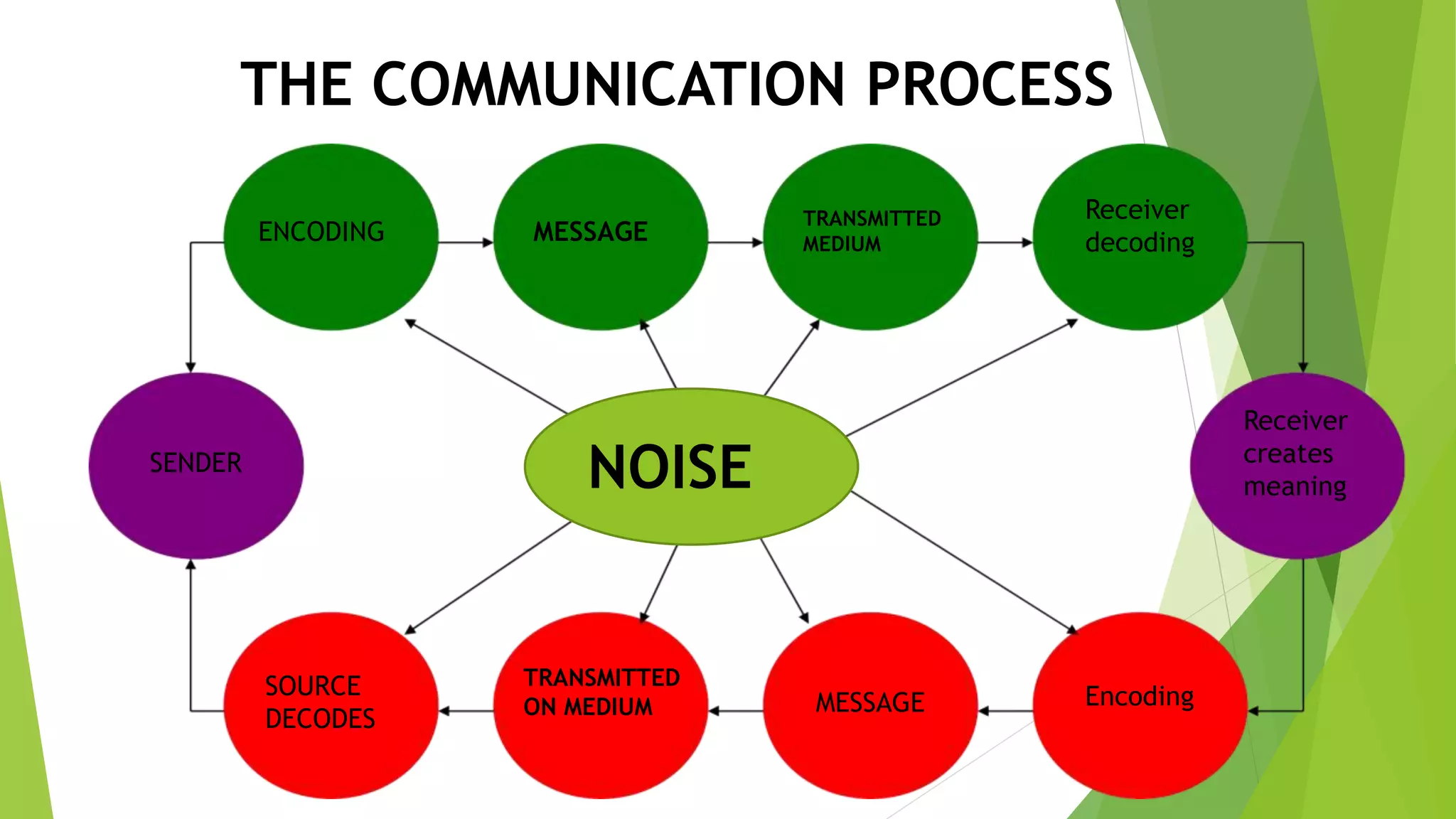
NOISE
ENCODING MESSAGE
TRANSMITTED
MEDIUM
Receiver
decoding
Receiver
creates
meaning
EncodingMESSAGE
TRANSMITTED
ON MEDIUM
SOURCE
DECODES
SENDER
THE COMMUNICATION PROCESS
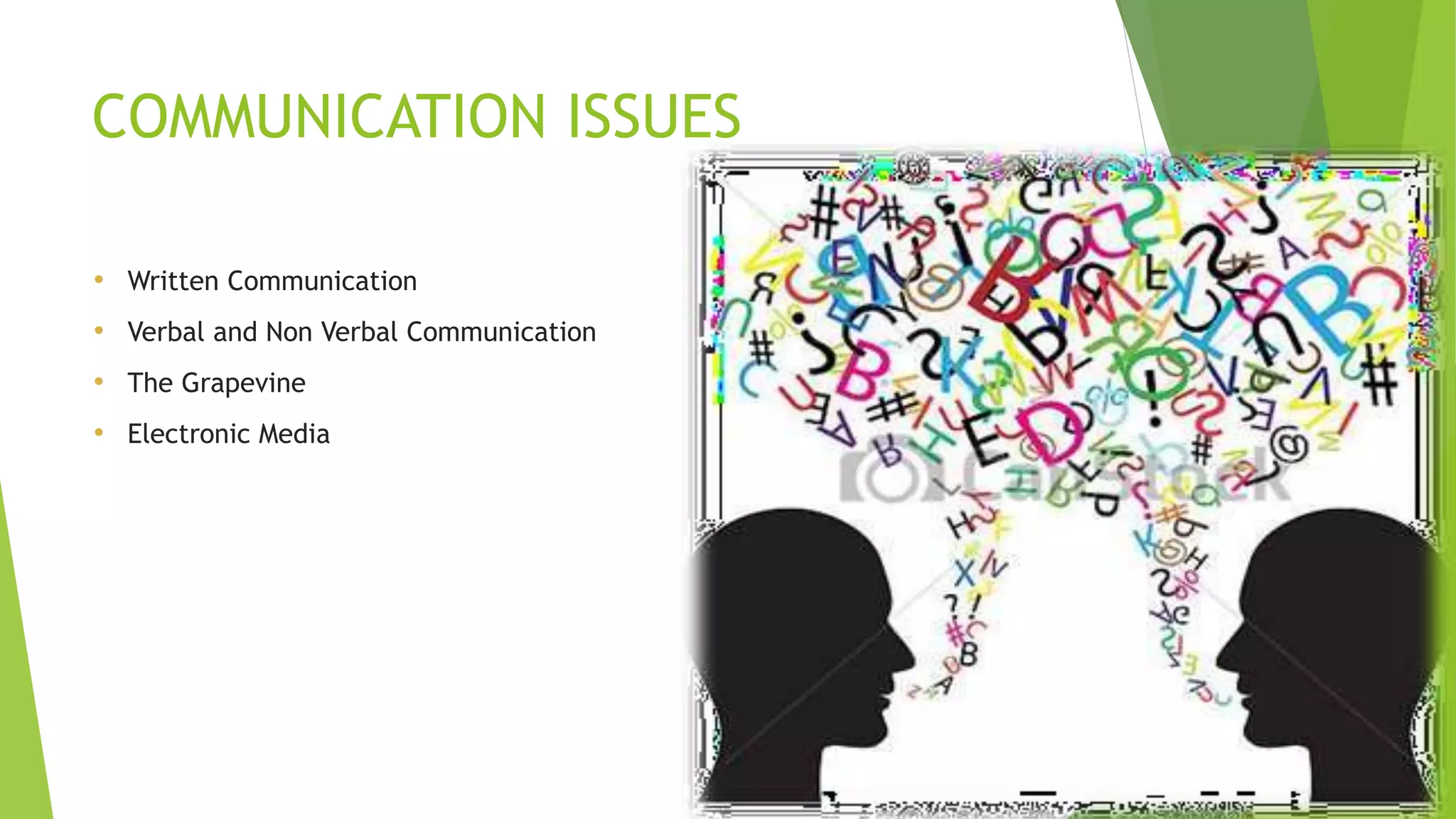
COMMUNICATION ISSUES
• Written Communication
• Verbal and Non Verbal Communication
• The Grapevine
• Electronic Media
BARRIERS OF COMMUNICATION
• The noise barrier
• The feedback problem
• The problem of media selection
• Mental barriers
• The problems of language and articulation
• Physical barriers
• Personal barriers
• Cultural barriers
• Interpersonal barriers
• Information overload
• Passive listening
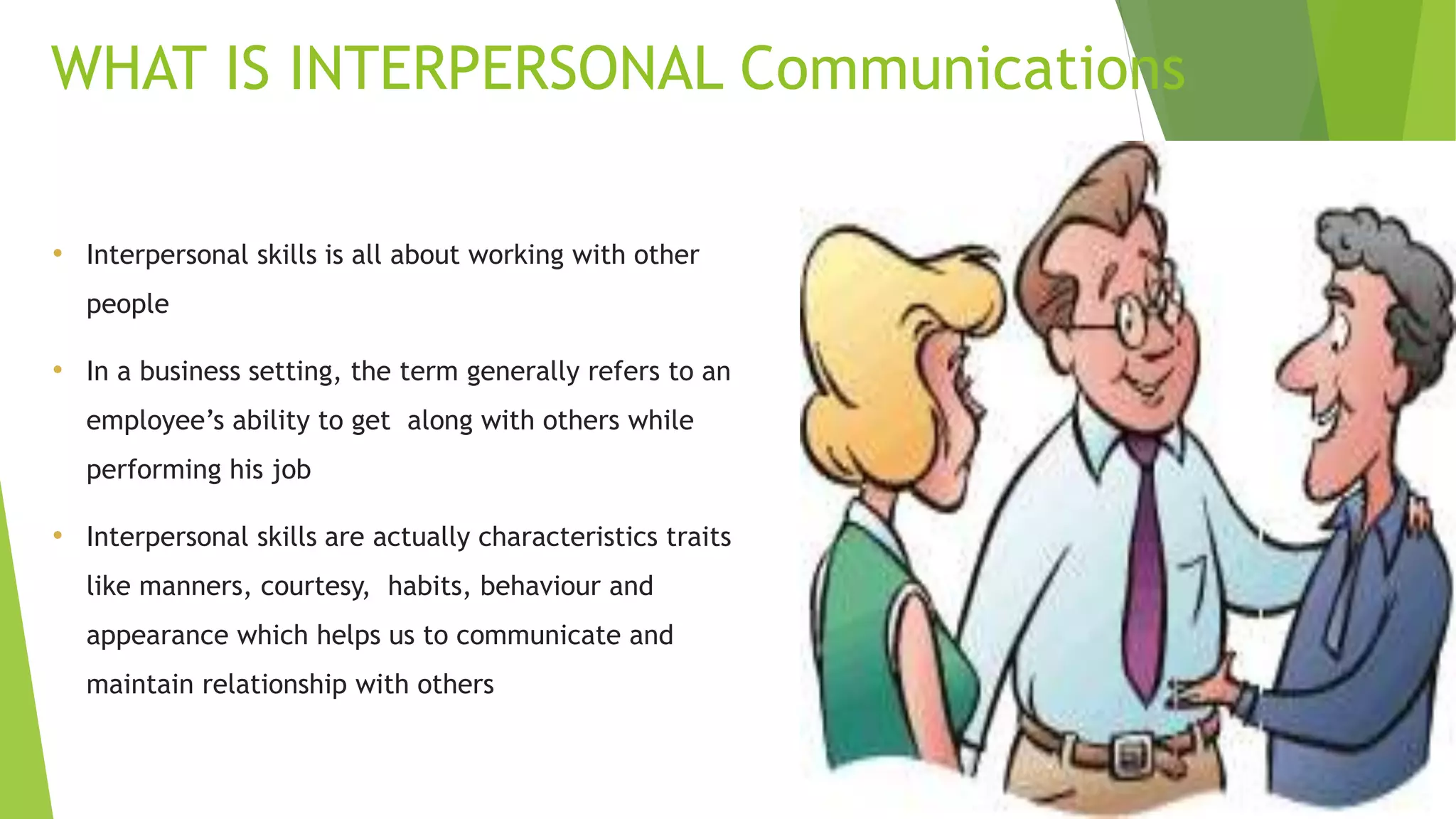
WHAT IS INTERPERSONAL Communications
• Interpersonal skills is all about working with other
people
• In a business setting, the term generally refers to an
employee’s ability to get along with others while
performing his job
• Interpersonal skills are actually characteristics traits
like manners, courtesy, habits, behaviour and
appearance which helps us to communicate and
maintain relationship with others
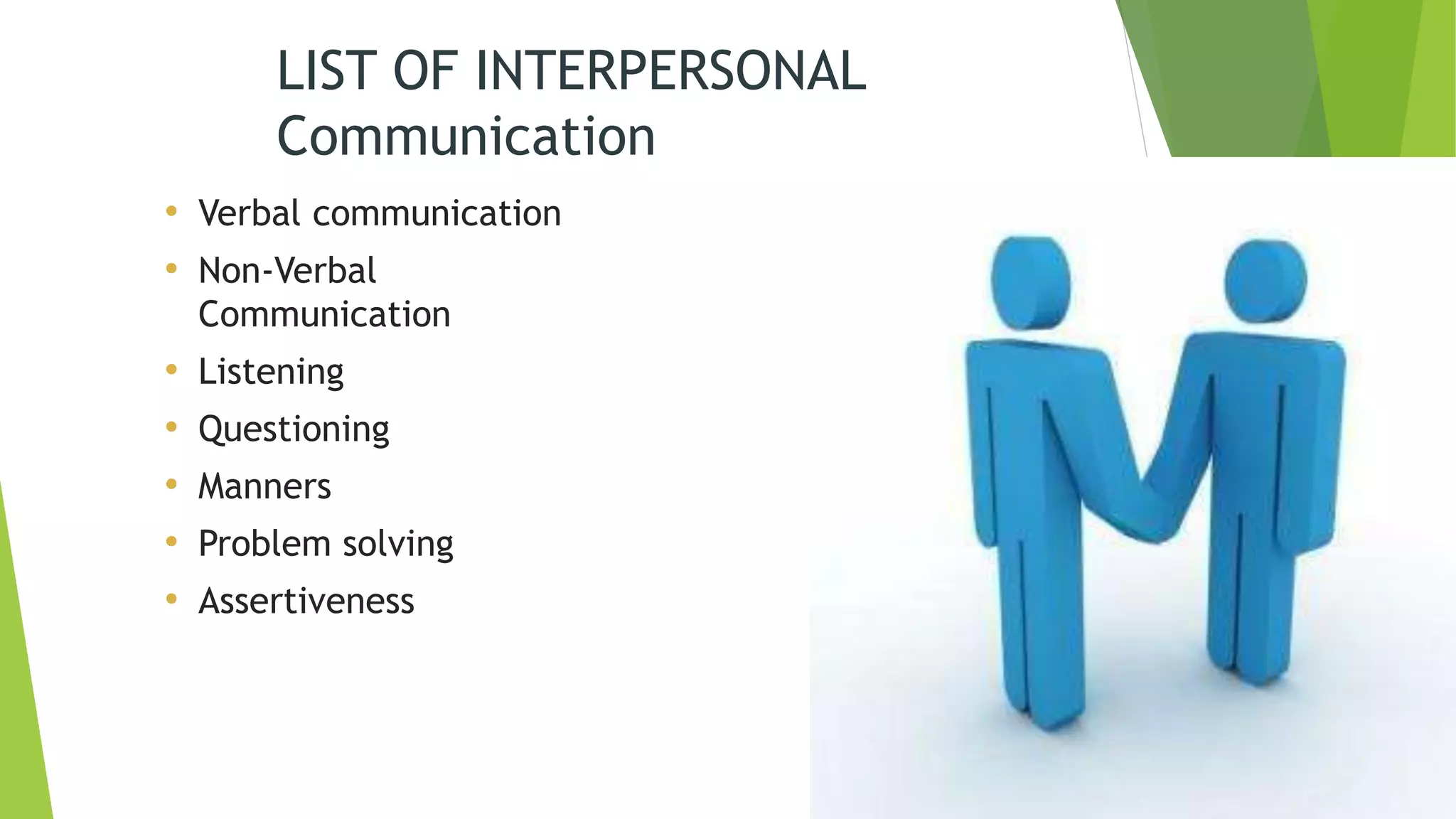
LIST OF INTERPERSONAL
Communication
• Verbal communication
• Non-Verbal
Communication
• Listening
• Questioning
• Manners
• Problem solving
• Assertiveness
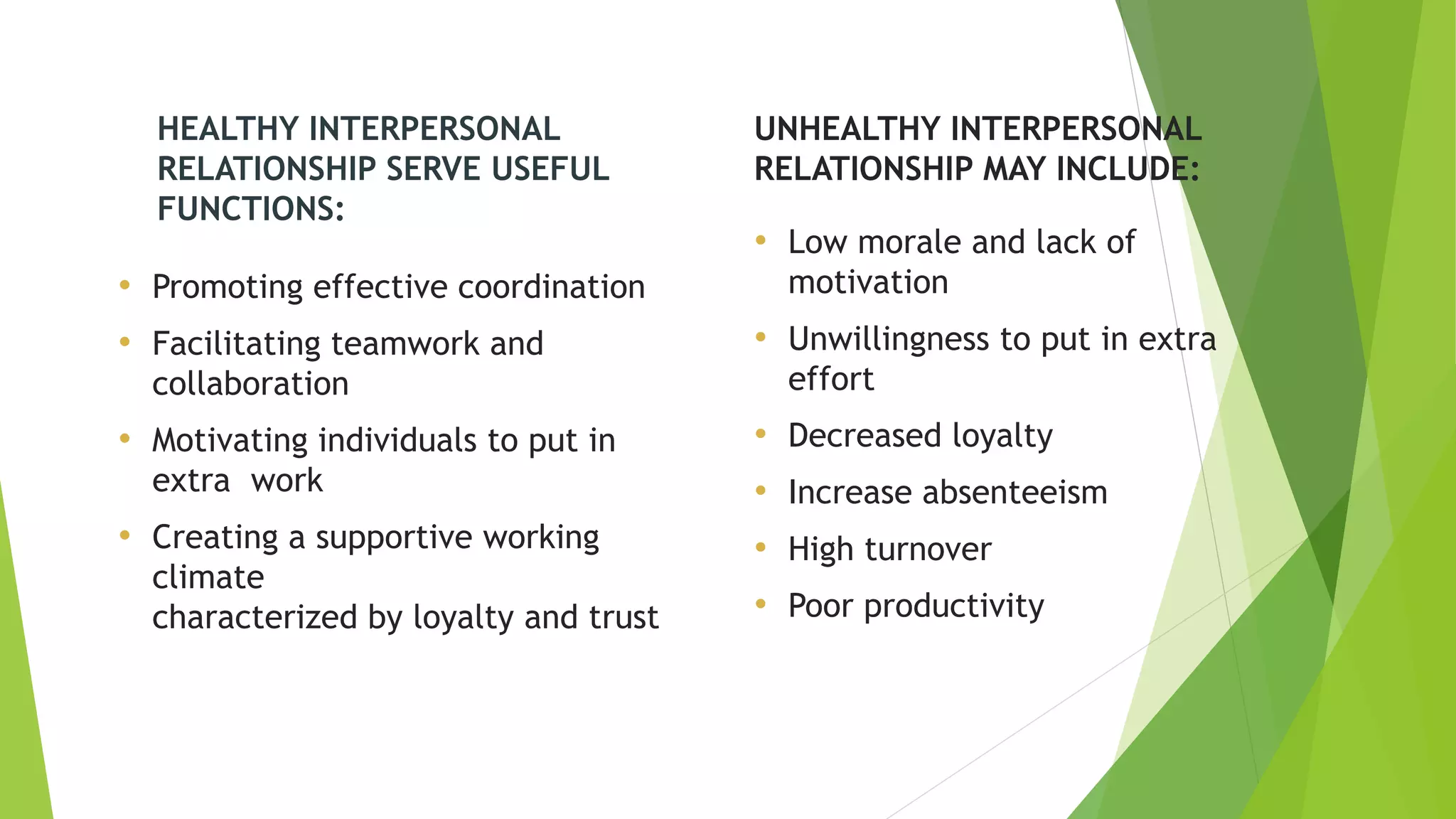
HEALTHY INTERPERSONAL
RELATIONSHIP SERVE USEFUL
FUNCTIONS:
• Promoting effective coordination
• Facilitating teamwork and
collaboration
• Motivating individuals to put in
extra work
• Creating a supportive working
climate
characterized by loyalty and trust
UNHEALTHY INTERPERSONAL
RELATIONSHIP MAY INCLUDE:
• Low morale and lack of
motivation
• Unwillingness to put in extra
effort
• Decreased loyalty
• Increase absenteeism
• High turnover
• Poor productivity
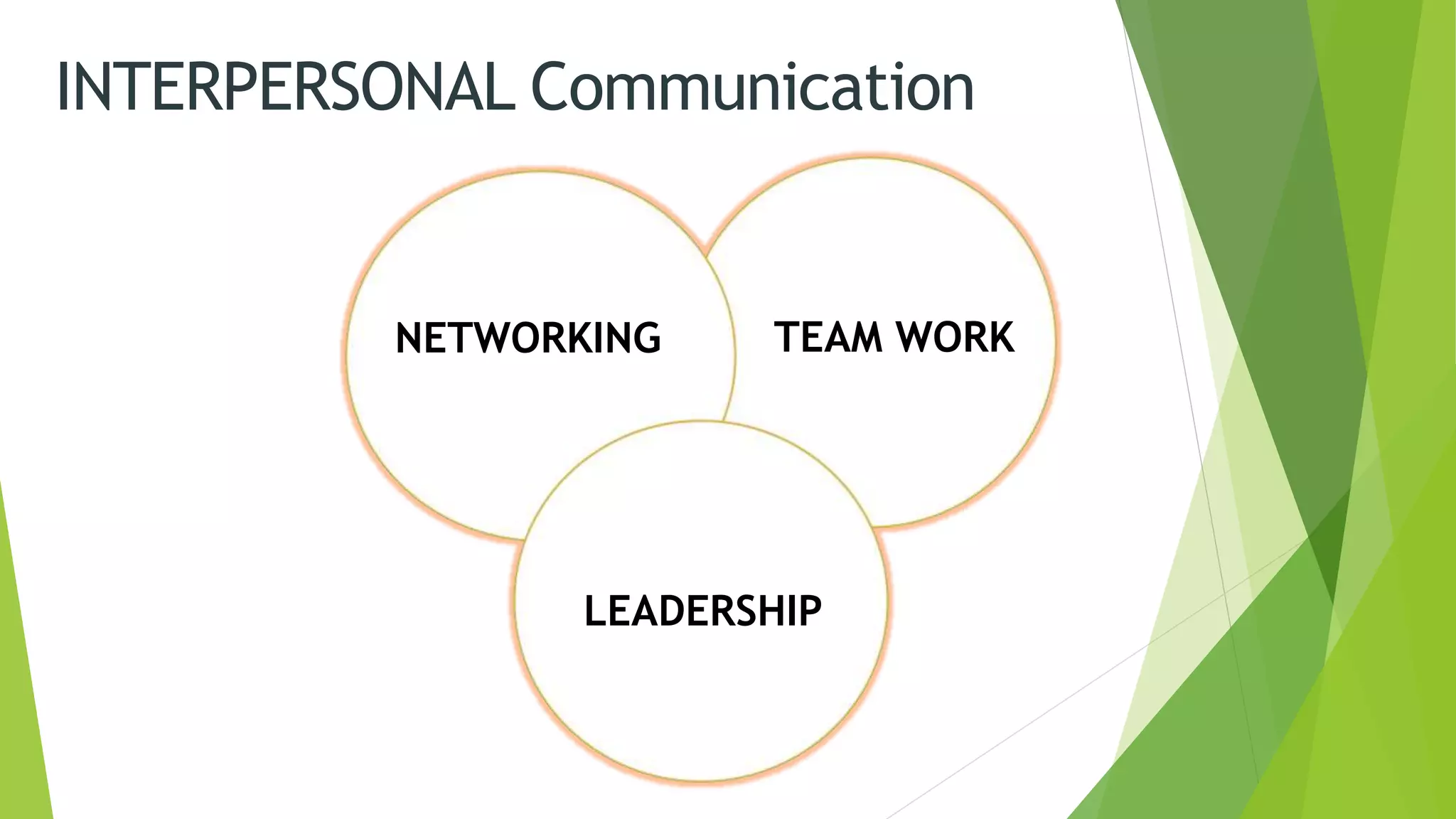
INTERPERSONAL Communication
NETWORKING TEAM WORK
LEADERSHIP
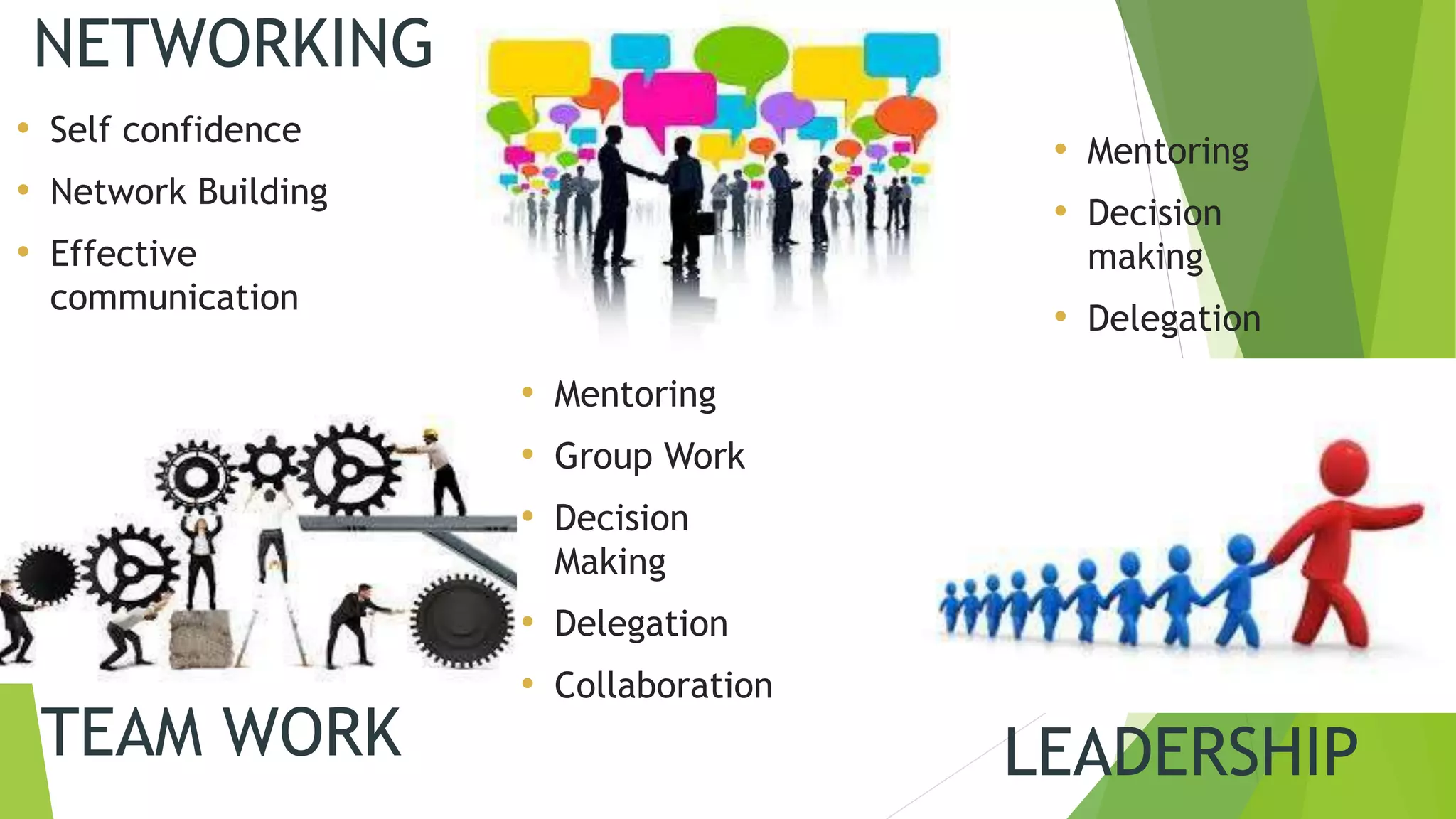
NETWORKING
• Self confidence
• Network Building
• Effective
communication
TEAM WORK
• Mentoring
• Group Work
• Decision
Making
• Delegation
• Collaboration
LEADERSHIP
• Mentoring
• Decision
making
• Delegation
• Motivating
others
BARRIERS TO INTERPERSONAL
COMMUNICATION
• Ego
• Personal
attitude
• Stress
• Position
• Distance
• Culture
• Technology
Communication is more than just verbal…
• Nonverbal communication
– Words account for only 7% of emotional
impact of a message
– Voice tones- 38%
– Facial Expressions- 55%
– High context vs. Low Context Cultures
Categories of Non-Verbal Messages
• Environment
• Interpersonal Distance
• Posture
• Gestures
• Facial Expressions
• Voice Quality
• Personal Appearance
Skills and Best Practices: Advice to
Improve Nonverbal
Communication Skills
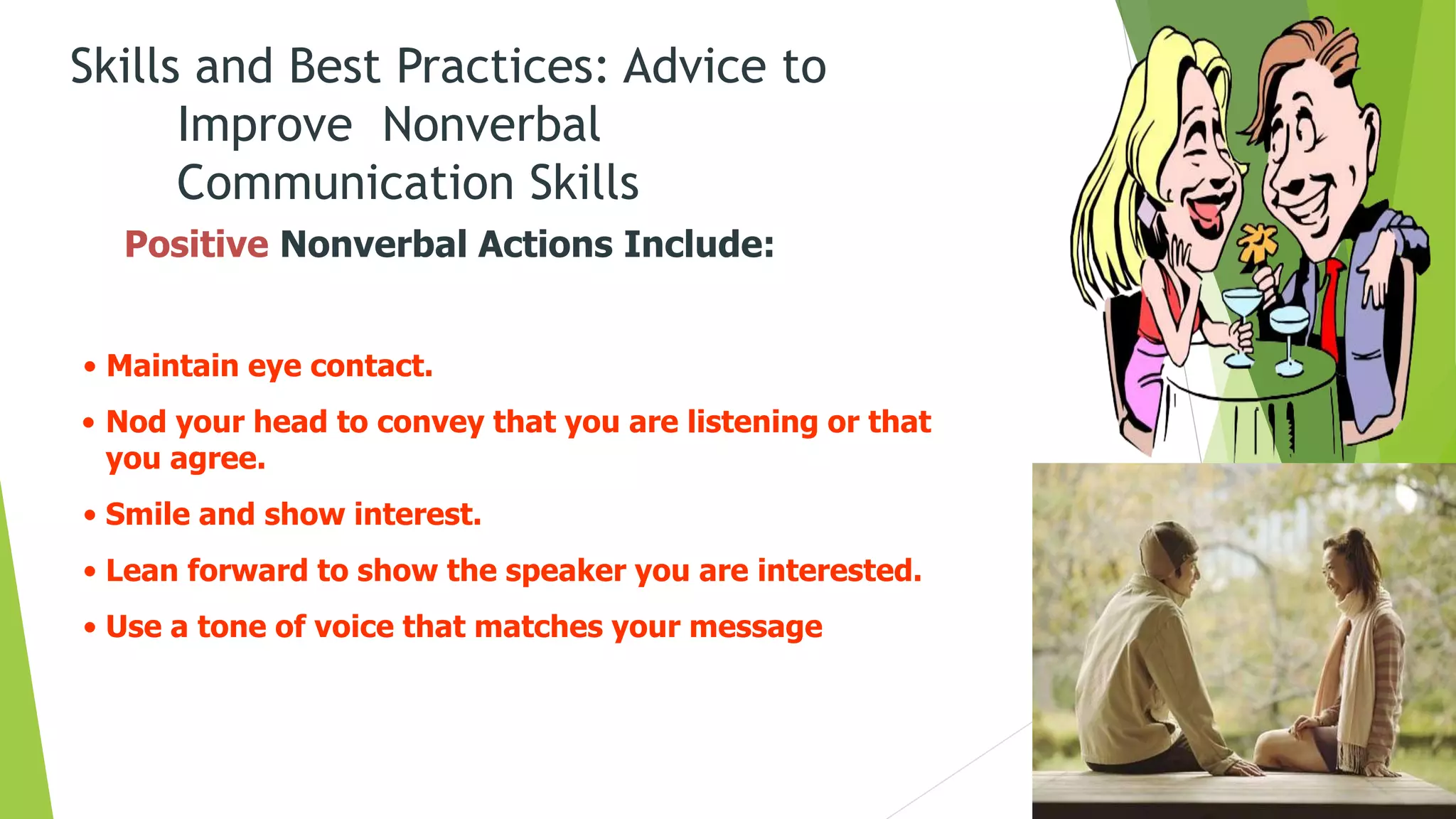
Positive Nonverbal Actions Include:
• Maintain eye contact.
• Nod your head to convey that you are listening or that
you agree.
• Smile and show interest.
• Lean forward to show the speaker you are interested.
• Use a tone of voice that matches your message
Advice to Improve Nonverbal
Communication
Skills (cont)
Negative Nonverbal Actions Include:
• Avoiding eye contact and looking away from the
speaker.
• Closing your eyes or tensing your facial muscles.
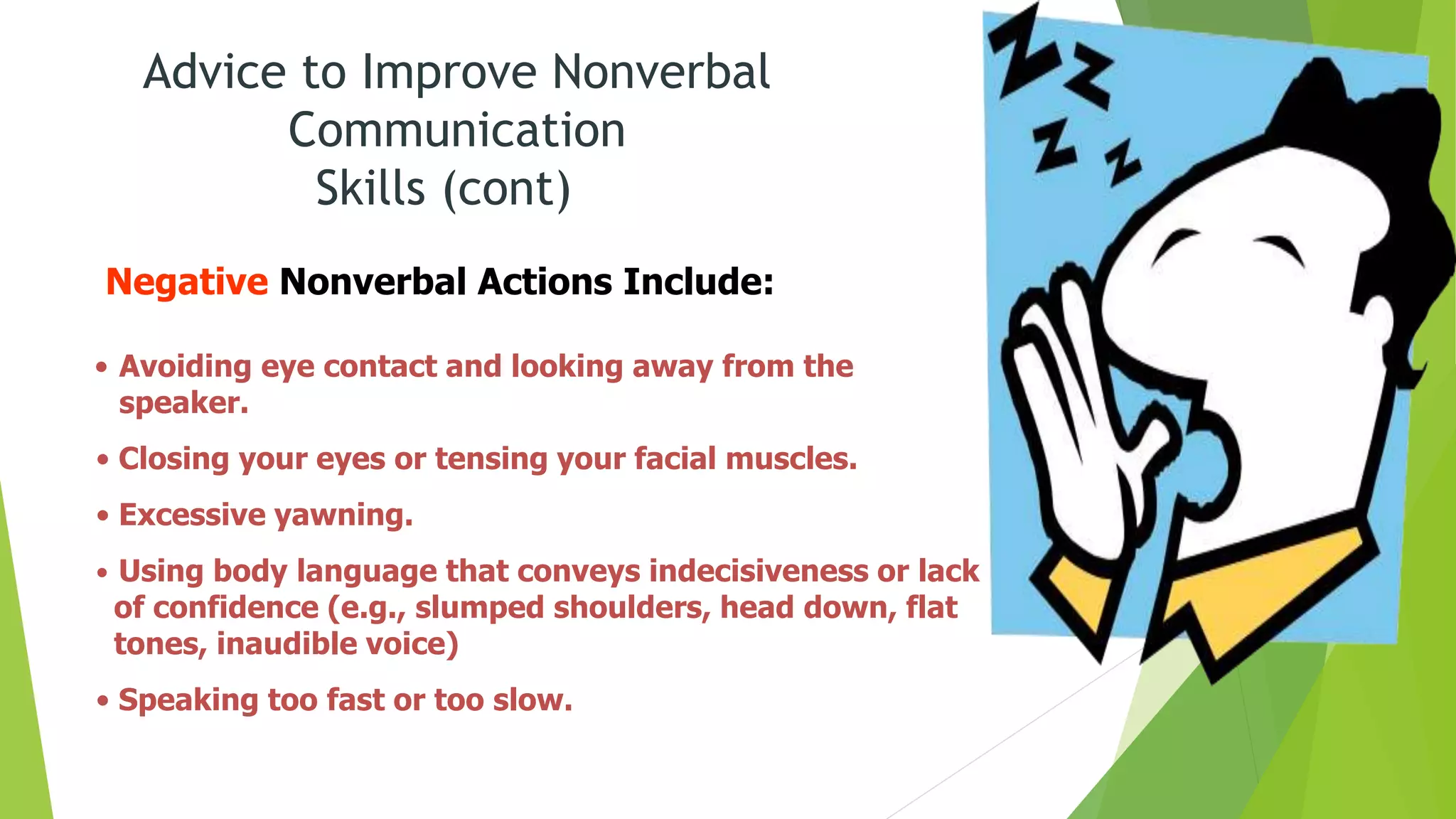
• Excessive yawning.
• Using body language that conveys indecisiveness or lack
of confidence (e.g., slumped shoulders, head down, flat
tones, inaudible voice)
• Speaking too fast or too slow.
Listening Styles
Results-style: Interested in the
bottom line or result of a
message.
Reasons-style: Interested in
hearing the rationale behind a
message.
Process-style: Likes to discuss
issues in detail.
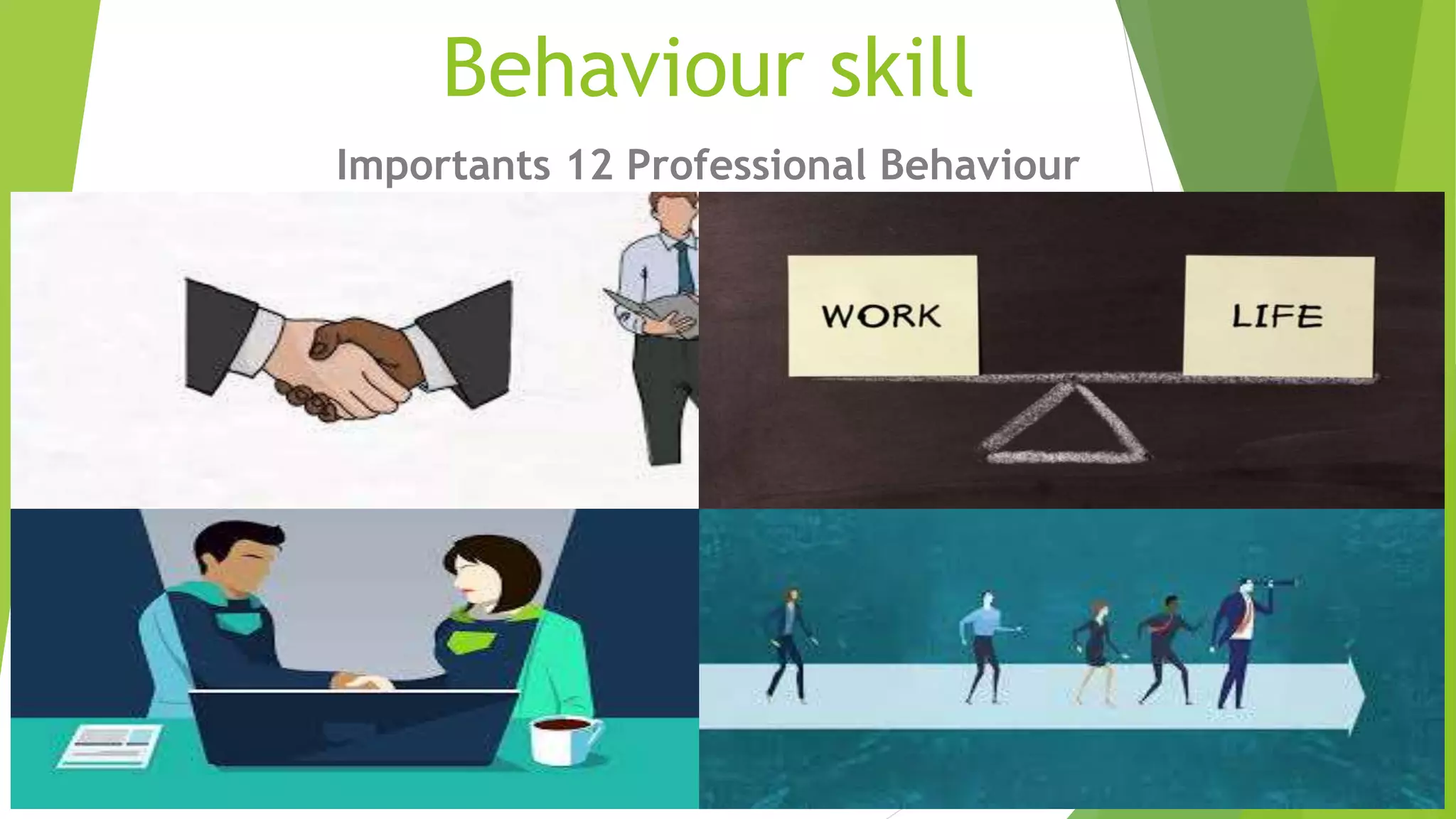
Behaviour skill
Importants 12 Professional Behaviour
1. Honesty:
Always act openly. Never share confidential,
privileged or client information unnecessarily,
and don’t tolerate or justify dishonest
conduct by others. Report any conflicts of
interest immediately.
2. Respect:
Maintain a respectful attitude to others at all
times, even during stressful times. Don’t lash
out at colleagues or disrespect anyone
(senior or otherwise). Always use appropriate
language (verbally and in writing) and don’t
swear. Apologise for errors or
misunderstandings, and keep your personal
opinions of others private.
3. Meetings:
Arrive on time and be prepared by reviewing
the agenda or meeting notes in advance.
Make contributions to discussions where
appropriate, and don’t take over when
someone else is trying to talk. Respect the
meeting convenor or chair, follow the
appropriate format, and ask considerate
questions.
4. Communication:
Speak clearly and in language others can
easily understand, act courteously and use
good manners when engaging with others.
Follow any company guidelines regarding
content, read information provided before
asking questions, listen to others when they
are talking or explaining, and don’t engage in
office gossip. Be careful of language and tone
in written communications, and don’t copy in
others unnecessarily when emailing (but
don’t intentionally exclude others either).
5. Time Management:
Don’t be late to work, instead arrive a few
minutes early to settle, get your coffee and
greet co-workers. Follow lunch and break
schedules by leaving and returning on time.
At the beginning of every day, review your
schedule so you know what time you have to
be where, and what workload you have on
that day.
6. Integrity:
Act ethically and do the ‘right’ thing at all
times, always report suspicious people in the
office, misconduct, or other violations of
company policy. Remain impartial keeping
any personal bias and intolerances out of the
workplace.
7. Safety:
Understand the company safety policy and
report any maintenance or other hazards
immediately.
8. Corporate Goals:
Have an understanding of your company’s
missions, goals and objectives and the role
that you play in achieving those.
9. Dress:
Dress in clean, appropriate clothing. Follow
any dress code standards or guidelines and if
there aren’t any, avoid clothing that is
revealing, provocative, or includes offensive
language or pictures.
10. Accountability:
Take responsibility for your work and actions,
do what needs to be done, and don’t leave it
for others. Be honest if things go wrong, or
you don’t finish something on time, then
work out an effective resolution to move
forward. Seek help early if you need it.
11. Teamwork:
You often need to work with people that you
may not necessarily like. Set aside
differences to work well with others since
teamwork sometimes even outweighs
performance – with people who work well
with others often advancing based on that
aspect.
12. Commitment:
Dedication and a positive action to your role
and the organization can carry you a long
way. Plus, dedication from employees is
often contagious with others being inspired
to go the extra effort themselves.
Essentially, being professional is about giving
your best at all times. Think about how your
behavior will be perceived by others and
make sure to understand and follow company
codes of conduct where they exist.
INTERPERSONAL COMMUNICATIONS & BEHAVIOR SKILLS

INTERPERSONAL COMMUNICATIONS & BEHAVIOR SKILLS

  • 1.
    A Study onInterpersonal Communication & Behavior Skill Presented by: Mukul Kr. Ranjan
  • 2.
    What is Communication.... Communicationis defined as the process of transmitting & receiving ideas, information & messages. In every day language, it is an act of giving & receiving information. nm
  • 3.
    EFFECTIVE COMMUINCATION • Everyplatform for communication involves a large number of experiences, actions and emotions • Communication is said to be effective when the receiver understand the same  meaning that the sender intends to convey • In other words, excellent or effective communication is the ability to receive a transmitted message by the sender and have the receiver be able to replicate the form and intent of the message in the receiver’s mind
  • 4.
    7C’s OF EFFECTIVECOMMUNICATION • Completeness • Conciseness • Consideration • Clarity • Concreteness/Contribution • Courtesy • Correctness
  • 5.
  • 6.
    COMMUNICATION ISSUES • WrittenCommunication • Verbal and Non Verbal Communication • The Grapevine • Electronic Media
  • 7.
    BARRIERS OF COMMUNICATION •The noise barrier • The feedback problem • The problem of media selection • Mental barriers • The problems of language and articulation • Physical barriers • Personal barriers • Cultural barriers • Interpersonal barriers • Information overload • Passive listening
  • 8.
    WHAT IS INTERPERSONALCommunications • Interpersonal skills is all about working with other people • In a business setting, the term generally refers to an employee’s ability to get along with others while performing his job • Interpersonal skills are actually characteristics traits like manners, courtesy, habits, behaviour and appearance which helps us to communicate and maintain relationship with others
  • 9.
    LIST OF INTERPERSONAL Communication •Verbal communication • Non-Verbal Communication • Listening • Questioning • Manners • Problem solving • Assertiveness
  • 10.
    HEALTHY INTERPERSONAL RELATIONSHIP SERVEUSEFUL FUNCTIONS: • Promoting effective coordination • Facilitating teamwork and collaboration • Motivating individuals to put in extra work • Creating a supportive working climate characterized by loyalty and trust UNHEALTHY INTERPERSONAL RELATIONSHIP MAY INCLUDE: • Low morale and lack of motivation • Unwillingness to put in extra effort • Decreased loyalty • Increase absenteeism • High turnover • Poor productivity
  • 11.
  • 12.
    NETWORKING • Self confidence •Network Building • Effective communication TEAM WORK • Mentoring • Group Work • Decision Making • Delegation • Collaboration LEADERSHIP • Mentoring • Decision making • Delegation • Motivating others
  • 13.
    BARRIERS TO INTERPERSONAL COMMUNICATION •Ego • Personal attitude • Stress • Position • Distance • Culture • Technology
  • 14.
    Communication is morethan just verbal… • Nonverbal communication – Words account for only 7% of emotional impact of a message – Voice tones- 38% – Facial Expressions- 55% – High context vs. Low Context Cultures
  • 15.
    Categories of Non-VerbalMessages • Environment • Interpersonal Distance • Posture • Gestures • Facial Expressions • Voice Quality • Personal Appearance
  • 16.
    Skills and BestPractices: Advice to Improve Nonverbal Communication Skills Positive Nonverbal Actions Include: • Maintain eye contact. • Nod your head to convey that you are listening or that you agree. • Smile and show interest. • Lean forward to show the speaker you are interested. • Use a tone of voice that matches your message
  • 17.
    Advice to ImproveNonverbal Communication Skills (cont) Negative Nonverbal Actions Include: • Avoiding eye contact and looking away from the speaker. • Closing your eyes or tensing your facial muscles. • Excessive yawning. • Using body language that conveys indecisiveness or lack of confidence (e.g., slumped shoulders, head down, flat tones, inaudible voice) • Speaking too fast or too slow.
  • 18.
    Listening Styles Results-style: Interestedin the bottom line or result of a message. Reasons-style: Interested in hearing the rationale behind a message. Process-style: Likes to discuss issues in detail.
  • 19.
    Behaviour skill Importants 12Professional Behaviour
  • 20.
    1. Honesty: Always actopenly. Never share confidential, privileged or client information unnecessarily, and don’t tolerate or justify dishonest conduct by others. Report any conflicts of interest immediately.
  • 21.
    2. Respect: Maintain arespectful attitude to others at all times, even during stressful times. Don’t lash out at colleagues or disrespect anyone (senior or otherwise). Always use appropriate language (verbally and in writing) and don’t swear. Apologise for errors or misunderstandings, and keep your personal opinions of others private.
  • 22.
    3. Meetings: Arrive ontime and be prepared by reviewing the agenda or meeting notes in advance. Make contributions to discussions where appropriate, and don’t take over when someone else is trying to talk. Respect the meeting convenor or chair, follow the appropriate format, and ask considerate questions.
  • 23.
    4. Communication: Speak clearlyand in language others can easily understand, act courteously and use good manners when engaging with others. Follow any company guidelines regarding content, read information provided before asking questions, listen to others when they are talking or explaining, and don’t engage in office gossip. Be careful of language and tone in written communications, and don’t copy in others unnecessarily when emailing (but don’t intentionally exclude others either).
  • 24.
    5. Time Management: Don’tbe late to work, instead arrive a few minutes early to settle, get your coffee and greet co-workers. Follow lunch and break schedules by leaving and returning on time. At the beginning of every day, review your schedule so you know what time you have to be where, and what workload you have on that day.
  • 25.
    6. Integrity: Act ethicallyand do the ‘right’ thing at all times, always report suspicious people in the office, misconduct, or other violations of company policy. Remain impartial keeping any personal bias and intolerances out of the workplace.
  • 26.
    7. Safety: Understand thecompany safety policy and report any maintenance or other hazards immediately.
  • 27.
    8. Corporate Goals: Havean understanding of your company’s missions, goals and objectives and the role that you play in achieving those.
  • 28.
    9. Dress: Dress inclean, appropriate clothing. Follow any dress code standards or guidelines and if there aren’t any, avoid clothing that is revealing, provocative, or includes offensive language or pictures.
  • 29.
    10. Accountability: Take responsibilityfor your work and actions, do what needs to be done, and don’t leave it for others. Be honest if things go wrong, or you don’t finish something on time, then work out an effective resolution to move forward. Seek help early if you need it.
  • 30.
    11. Teamwork: You oftenneed to work with people that you may not necessarily like. Set aside differences to work well with others since teamwork sometimes even outweighs performance – with people who work well with others often advancing based on that aspect.
  • 31.
    12. Commitment: Dedication anda positive action to your role and the organization can carry you a long way. Plus, dedication from employees is often contagious with others being inspired to go the extra effort themselves.
  • 32.
    Essentially, being professionalis about giving your best at all times. Think about how your behavior will be perceived by others and make sure to understand and follow company codes of conduct where they exist.