
Presented by: Asad
Nouman
M.Sc – Mass Communication
1st Semester
Presented to: Mr. Inam Ur Rehman
Dated:1 April 2014
According to George Terry
“Communication is an exchange of
Facts,Ideas,opinions or Emotions
between two or more persons”
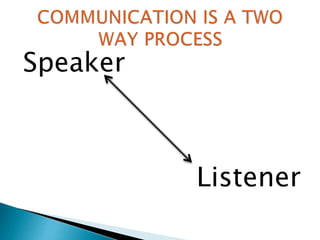
Speaker
Listener
“A distinctive,transactional form of
communication involving mutual
influence,usually for the purpose
of managing relationship”
There are certain Myths about
Interpersonal communication.
Which makes its quality weaker.
We should avoid these myths.
 Our communication should be concise,
precise and clear.
 We should observe silence as well. Let the
other person speak while you listen.
 Listen more and talk less. You should be a
good listener as well.
 Analyse the situation whether it requires
more verbal clarification or not.
 One word alone does not have a meaning
unless associated with other words or
utterances. Ah! What a bad/good morning.
 Speaker meaning can be different from
sentence meaning.
1. The poor man ‘kicked the bucket’ (died)
2. A: There is someone at the door.
B: I am busy
A: OK
 Mere information is not communication.
 If you say something and no one has heard it,
it has not been communicated.
Example: Placing a notice on the notice board
is information placement. Unless someone
reads it, it will not be communicated.
 There can be misunderstandings when
communication problems arise.
 There can be other issues that lead to
Interpersonal communication gaps.
 There can be disagreements between two
individuals.
 There can be differences in viewpoints.
Interpersonal communication myths

Interpersonal communication myths

  • 1.
    Presented by: Asad Nouman M.Sc– Mass Communication 1st Semester Presented to: Mr. Inam Ur Rehman Dated:1 April 2014
  • 2.
    According to GeorgeTerry “Communication is an exchange of Facts,Ideas,opinions or Emotions between two or more persons”
  • 3.
  • 4.
    “A distinctive,transactional formof communication involving mutual influence,usually for the purpose of managing relationship”
  • 5.
    There are certainMyths about Interpersonal communication. Which makes its quality weaker. We should avoid these myths.
  • 6.
     Our communicationshould be concise, precise and clear.  We should observe silence as well. Let the other person speak while you listen.  Listen more and talk less. You should be a good listener as well.  Analyse the situation whether it requires more verbal clarification or not.
  • 7.
     One wordalone does not have a meaning unless associated with other words or utterances. Ah! What a bad/good morning.  Speaker meaning can be different from sentence meaning. 1. The poor man ‘kicked the bucket’ (died) 2. A: There is someone at the door. B: I am busy A: OK
  • 8.
     Mere informationis not communication.  If you say something and no one has heard it, it has not been communicated. Example: Placing a notice on the notice board is information placement. Unless someone reads it, it will not be communicated.
  • 9.
     There canbe misunderstandings when communication problems arise.  There can be other issues that lead to Interpersonal communication gaps.  There can be disagreements between two individuals.  There can be differences in viewpoints.