THE INTERNET AS THE
NETWORK
INFRASTRUCTURE
Presented by
Dr. R.S.Mohana
Associate Professor
Department of Computer
Science and Engineering
Kongu Engineering College
13
THE INTERNET AS THE
NETWORK INFRASTRUCTURE
The Internet
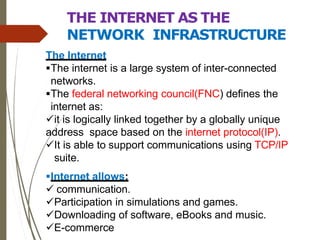
The internet is a large system of inter-connected
networks.
The federal networking council(FNC) defines the
internet as:
it is logically linked together by a globally unique
address space based on the internet protocol(IP).
It is able to support communications using TCP/IP
suite.
Internet allows:
 communication.
Participation in simulations and games.
Downloading of software, eBooks and music.
E-commerce
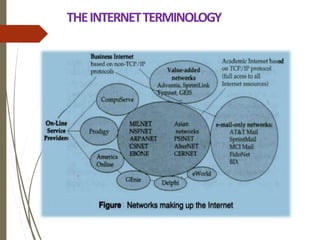
THEINTERNETTERMINOLOGY
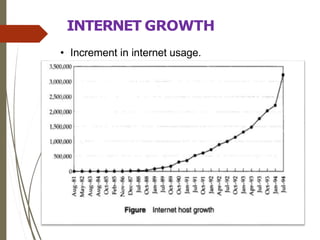
INTERNET GROWTH
• Increment in internet usage.
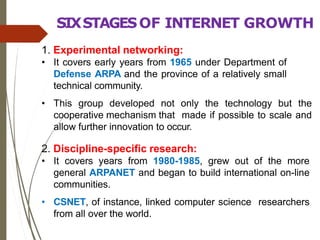
SIXSTAGESOF INTERNET GROWTH
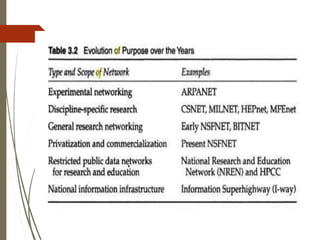
1. Experimental networking:
• It covers early years from 1965 under Department of
Defense ARPA and the province of a relatively small
technical community.
• This group developed not only the technology but the
cooperative mechanism that made if possible to scale and
allow further innovation to occur.
2. Discipline-specific research:
• It covers years from 1980-1985, grew out of the more
general ARPANET and began to build international on-line
communities.
• CSNET, of instance, linked computer science researchers
from all over the world.
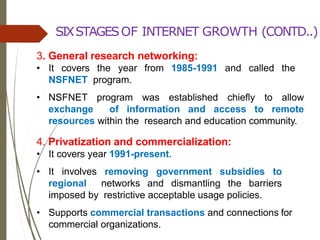
SIXSTAGESOF INTERNET GROWTH (CONTD..)
3. General research networking:
• It covers the year from 1985-1991 and called the
NSFNET program.
• NSFNET program was established chiefly to allow
exchange of information and access to remote
resources within the research and education community.
4. Privatization and commercialization:
• It covers year 1991-present.
• It involves removing government subsidies to
regional networks and dismantling the barriers
imposed by restrictive acceptable usage policies.
• Supports commercial transactions and connections for
commercial organizations.
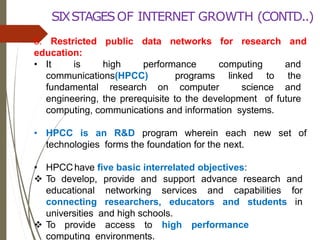
5. Restricted public data networks for research and
education:
• It is high performance computing and
communications(HPCC) programs linked to the
fundamental research on computer science and
engineering, the prerequisite to the development of future
computing, communications and information systems.
• HPCC is an R&D program wherein each new set of
technologies forms the foundation for the next.
• HPCChave five basic interrelated objectives:
 To develop, provide and support advance research and
educational networking services and capabilities for
connecting researchers, educators and students in
universities and high schools.
 To provide access to high performance
computing environments.
SIXSTAGESOF INTERNET GROWTH (CONTD..)
To generate fundamental knowledge that can lay the
foundation for future advances in high performance computing
and communications.
To enhance innovation, technology transfer, productivity and
industrial competitiveness through academic industrial
partnership.
To make computing and communication infrastructure
available to large society.
6.National information infrastructure:
• It is known as the I-way and its objective is to extend
networking everywhere(ubiquitous) and enable new
consumer applications.
SIXSTAGESOF INTERNET GROWTH (CONTD..)
NSFNET(National Science Foundation Net)
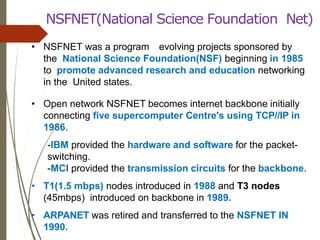
• NSFNET was a program evolving projects sponsored by
the National Science Foundation(NSF) beginning in 1985
to promote advanced research and education networking
in the United states.
• Open network NSFNET becomes internet backbone initially
connecting five supercomputer Centre's using TCP//IP in
1986.
-IBM provided the hardware and software for the packet-
switching.
-MCI provided the transmission circuits for the backbone.
• T1(1.5 mbps) nodes introduced in 1988 and T3 nodes
(45mbps) introduced on backbone in 1989.
• ARPANET was retired and transferred to the NSFNET IN
1990.
NSFNET architecture and components
NSFNET backbone
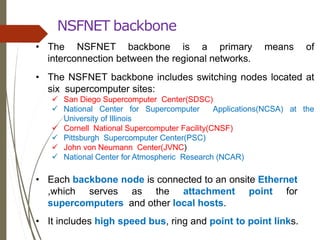
• The NSFNET backbone is a primary means of
interconnection between the regional networks.
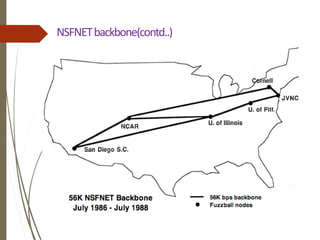
• The NSFNET backbone includes switching nodes located at
six supercomputer sites:
 San Diego Supercomputer Center(SDSC)
 National Center for Supercomputer Applications(NCSA) at the
University of Illinois
 Cornell National Supercomputer Facility(CNSF)
 Pittsburgh Supercomputer Center(PSC)
 John von Neumann Center(JVNC)
 National Center for Atmospheric Research (NCAR)
• Each backbone node is connected to an onsite Ethernet
,which serves as the attachment point for
supercomputers and other local hosts.
• It includes high speed bus, ring and point to point links.
NSFNET backbone(contd..)
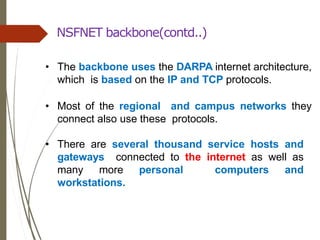
• The backbone uses the DARPA internet architecture,
which is based on the IP and TCP protocols.
• Most of the regional and campus networks they
connect also use these protocols.
• There are several thousand service hosts and
gateways connected to the internet as well as
many more personal computers and
workstations.
NSFNETbackbone(contd..)
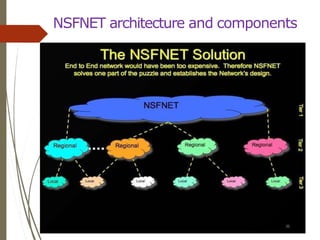
Midlevel regional network
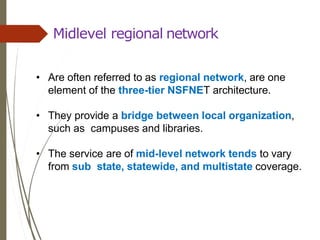
• Are often referred to as regional network, are one
element of the three-tier NSFNET architecture.
• They provide a bridge between local organization,
such as campuses and libraries.
• The service are of mid-level network tends to vary
from sub state, statewide, and multistate coverage.
State and campus networks
• It link into regional networks.
• It provides local connectivity and access to wider are
services for state governments, schools, higher education,
and research institutes.
• This networks include university and college campuses,
research laboratories, private companies, and educational
sites such as school districts.
• These are the most important components of the network
hierarchy, as the investment in these infrastructures far
exceeds that of the government’s investments in the national
and regional networks.
Financially leveraged
NSFNET succeeded because it was ….
Dumb network
Designed by highly
qualified researchers
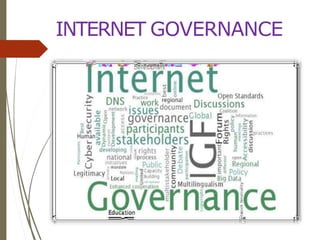
INTERNET GOVERNANCE
30
INTERNET GOVERNANCE(contd…)
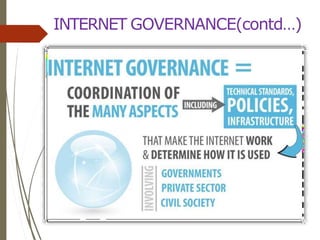
Determines how the internet is managed and used now
and in the future
The development and application by governments, the
private sector and civil society, in their respective
roles.
 shared principles, norms, rules, decision-making
procedures, and programmes that shape the evolution
and use of the internet
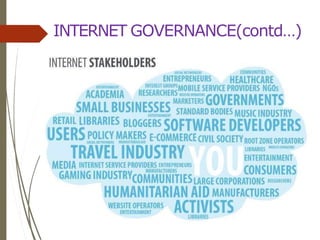
Outcomes may affect all stakeholders
INTERNET GOVERNANCE(contd…)
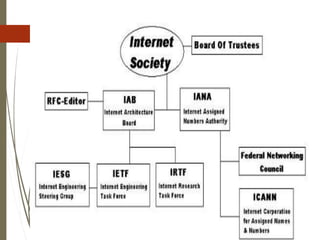
GOVERNANCE HIERARCHY
THE INTERNET SOCIETY (ISOC)
WHAT IS INTERNET SOCIETY?
The Internet Society is a global cause-driven organization,
dedicated to ensuring that the Internet stays open,
transparent and defined by user
WHAT INTERNET SOCIETY DO?
The Internet Society engages in a wide spectrum of Internet
issues, including policy, governance, technology and
development.
It also ensure that Internet continues to grow and evolve as a
platform for innovation, economic development, and social
progress for people around the world
THE INTERNET SOCIETY (ISOC) contd…
BRIEF HISTORY
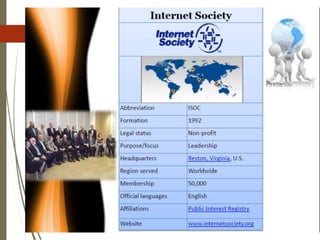
 Was formed in 1992 by Vint Cerf and Bob Kahn
 Mission—to promote the open development, evolution, and
use of the Internet for the benefit of all people throughout the
world
 Has its headquarters in Reston, Virginia, United States
 Has a membership base of more than 140 organizations and
more than 80,000 individual members.
WORKING PRINCIPLE
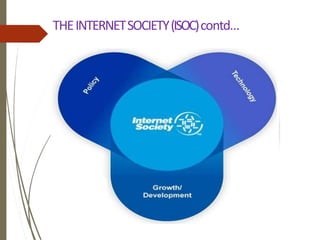
 Works at intersection of policy, standards, and development
THEINTERNETSOCIETY(ISOC)contd…
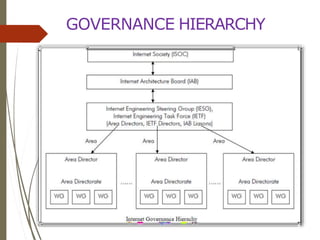
INTERNET ARCHITECTURE BOARD
 Has the responsibility for the technical management and
direction of the internet
 Is responsible for the overall architectural consideration in the
internet, technical direction, establishing standards and
 settlement of conflicts in the standard process
 IAB meets regularly to discuss Internet Standards
 Also keeps track of various network address(IP) and develops
rules for assigning IP addresses
 Even works out for the current problem of IP(IPV4) (addresses
it using IPV6)
INTERNET ENGINEERING TASK FORCE
 The protocol engineering and development arm of internet
 IAB is supported by IETF
 Is a large international community of network designers,
operators, vendors and researchers
 Concerned with the evolution of the internet architecture
and the smooth operation of the internet
 Is open to any interested individual and meets regularly to
discuss operational and technical problems of the
internet
IETF Working Groups
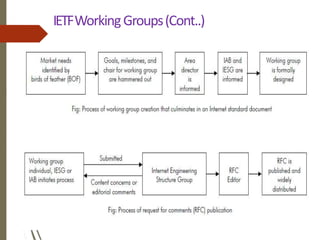
 Actual technical work of IETF is done in its working
groups
 Organized by topic into several areas
 Most workgroup have finite lifetime and area dispersed
after the initial goal is achieved
 Currently divided into 8 functional areas:
 Applications
 Internet
 Network Management
 Operational requirements
 Routing
 Security
 Transport
 User services
IETFWorkingGroups(Cont..)
https://youtu.be/ej_eHwC44x4

Internet as the network infrastructure

  • 1.
    THE INTERNET ASTHE NETWORK INFRASTRUCTURE Presented by Dr. R.S.Mohana Associate Professor Department of Computer Science and Engineering Kongu Engineering College 13
  • 2.
    THE INTERNET ASTHE NETWORK INFRASTRUCTURE The Internet The internet is a large system of inter-connected networks. The federal networking council(FNC) defines the internet as: it is logically linked together by a globally unique address space based on the internet protocol(IP). It is able to support communications using TCP/IP suite. Internet allows:  communication. Participation in simulations and games. Downloading of software, eBooks and music. E-commerce
  • 3.
  • 4.
  • 5.
    SIXSTAGESOF INTERNET GROWTH 1.Experimental networking: • It covers early years from 1965 under Department of Defense ARPA and the province of a relatively small technical community. • This group developed not only the technology but the cooperative mechanism that made if possible to scale and allow further innovation to occur. 2. Discipline-specific research: • It covers years from 1980-1985, grew out of the more general ARPANET and began to build international on-line communities. • CSNET, of instance, linked computer science researchers from all over the world.
  • 6.
    SIXSTAGESOF INTERNET GROWTH(CONTD..) 3. General research networking: • It covers the year from 1985-1991 and called the NSFNET program. • NSFNET program was established chiefly to allow exchange of information and access to remote resources within the research and education community. 4. Privatization and commercialization: • It covers year 1991-present. • It involves removing government subsidies to regional networks and dismantling the barriers imposed by restrictive acceptable usage policies. • Supports commercial transactions and connections for commercial organizations.
  • 7.
    5. Restricted publicdata networks for research and education: • It is high performance computing and communications(HPCC) programs linked to the fundamental research on computer science and engineering, the prerequisite to the development of future computing, communications and information systems. • HPCC is an R&D program wherein each new set of technologies forms the foundation for the next. • HPCChave five basic interrelated objectives:  To develop, provide and support advance research and educational networking services and capabilities for connecting researchers, educators and students in universities and high schools.  To provide access to high performance computing environments. SIXSTAGESOF INTERNET GROWTH (CONTD..)
  • 8.
    To generate fundamentalknowledge that can lay the foundation for future advances in high performance computing and communications. To enhance innovation, technology transfer, productivity and industrial competitiveness through academic industrial partnership. To make computing and communication infrastructure available to large society. 6.National information infrastructure: • It is known as the I-way and its objective is to extend networking everywhere(ubiquitous) and enable new consumer applications. SIXSTAGESOF INTERNET GROWTH (CONTD..)
  • 10.
    NSFNET(National Science FoundationNet) • NSFNET was a program evolving projects sponsored by the National Science Foundation(NSF) beginning in 1985 to promote advanced research and education networking in the United states. • Open network NSFNET becomes internet backbone initially connecting five supercomputer Centre's using TCP//IP in 1986. -IBM provided the hardware and software for the packet- switching. -MCI provided the transmission circuits for the backbone. • T1(1.5 mbps) nodes introduced in 1988 and T3 nodes (45mbps) introduced on backbone in 1989. • ARPANET was retired and transferred to the NSFNET IN 1990.
  • 11.
  • 12.
    NSFNET backbone • TheNSFNET backbone is a primary means of interconnection between the regional networks. • The NSFNET backbone includes switching nodes located at six supercomputer sites:  San Diego Supercomputer Center(SDSC)  National Center for Supercomputer Applications(NCSA) at the University of Illinois  Cornell National Supercomputer Facility(CNSF)  Pittsburgh Supercomputer Center(PSC)  John von Neumann Center(JVNC)  National Center for Atmospheric Research (NCAR) • Each backbone node is connected to an onsite Ethernet ,which serves as the attachment point for supercomputers and other local hosts. • It includes high speed bus, ring and point to point links.
  • 13.
    NSFNET backbone(contd..) • Thebackbone uses the DARPA internet architecture, which is based on the IP and TCP protocols. • Most of the regional and campus networks they connect also use these protocols. • There are several thousand service hosts and gateways connected to the internet as well as many more personal computers and workstations.
  • 14.
  • 15.
    Midlevel regional network •Are often referred to as regional network, are one element of the three-tier NSFNET architecture. • They provide a bridge between local organization, such as campuses and libraries. • The service are of mid-level network tends to vary from sub state, statewide, and multistate coverage.
  • 16.
    State and campusnetworks • It link into regional networks. • It provides local connectivity and access to wider are services for state governments, schools, higher education, and research institutes. • This networks include university and college campuses, research laboratories, private companies, and educational sites such as school districts. • These are the most important components of the network hierarchy, as the investment in these infrastructures far exceeds that of the government’s investments in the national and regional networks.
  • 17.
    Financially leveraged NSFNET succeededbecause it was …. Dumb network Designed by highly qualified researchers
  • 18.
  • 19.
    INTERNET GOVERNANCE(contd…) Determines howthe internet is managed and used now and in the future The development and application by governments, the private sector and civil society, in their respective roles.  shared principles, norms, rules, decision-making procedures, and programmes that shape the evolution and use of the internet Outcomes may affect all stakeholders
  • 20.
  • 21.
  • 22.
  • 23.
    THE INTERNET SOCIETY(ISOC) WHAT IS INTERNET SOCIETY? The Internet Society is a global cause-driven organization, dedicated to ensuring that the Internet stays open, transparent and defined by user WHAT INTERNET SOCIETY DO? The Internet Society engages in a wide spectrum of Internet issues, including policy, governance, technology and development. It also ensure that Internet continues to grow and evolve as a platform for innovation, economic development, and social progress for people around the world
  • 24.
    THE INTERNET SOCIETY(ISOC) contd… BRIEF HISTORY  Was formed in 1992 by Vint Cerf and Bob Kahn  Mission—to promote the open development, evolution, and use of the Internet for the benefit of all people throughout the world  Has its headquarters in Reston, Virginia, United States  Has a membership base of more than 140 organizations and more than 80,000 individual members. WORKING PRINCIPLE  Works at intersection of policy, standards, and development
  • 26.
  • 27.
    INTERNET ARCHITECTURE BOARD Has the responsibility for the technical management and direction of the internet  Is responsible for the overall architectural consideration in the internet, technical direction, establishing standards and  settlement of conflicts in the standard process  IAB meets regularly to discuss Internet Standards  Also keeps track of various network address(IP) and develops rules for assigning IP addresses  Even works out for the current problem of IP(IPV4) (addresses it using IPV6)
  • 28.
    INTERNET ENGINEERING TASKFORCE  The protocol engineering and development arm of internet  IAB is supported by IETF  Is a large international community of network designers, operators, vendors and researchers  Concerned with the evolution of the internet architecture and the smooth operation of the internet  Is open to any interested individual and meets regularly to discuss operational and technical problems of the internet
  • 29.
    IETF Working Groups Actual technical work of IETF is done in its working groups  Organized by topic into several areas  Most workgroup have finite lifetime and area dispersed after the initial goal is achieved  Currently divided into 8 functional areas:  Applications  Internet  Network Management  Operational requirements  Routing  Security  Transport  User services
  • 30.
  • 36.