Your Interactive Guide
to the Digital World
Discovering
Computers 2012
The Internet
• The Internet is a worldwide collection of networks
that links millions of businesses, government
agencies, educational institutions, and individuals
Discovering Computers 2012: Chapter 2
2Page 74
Figure 2-1
Evolution of the Internet
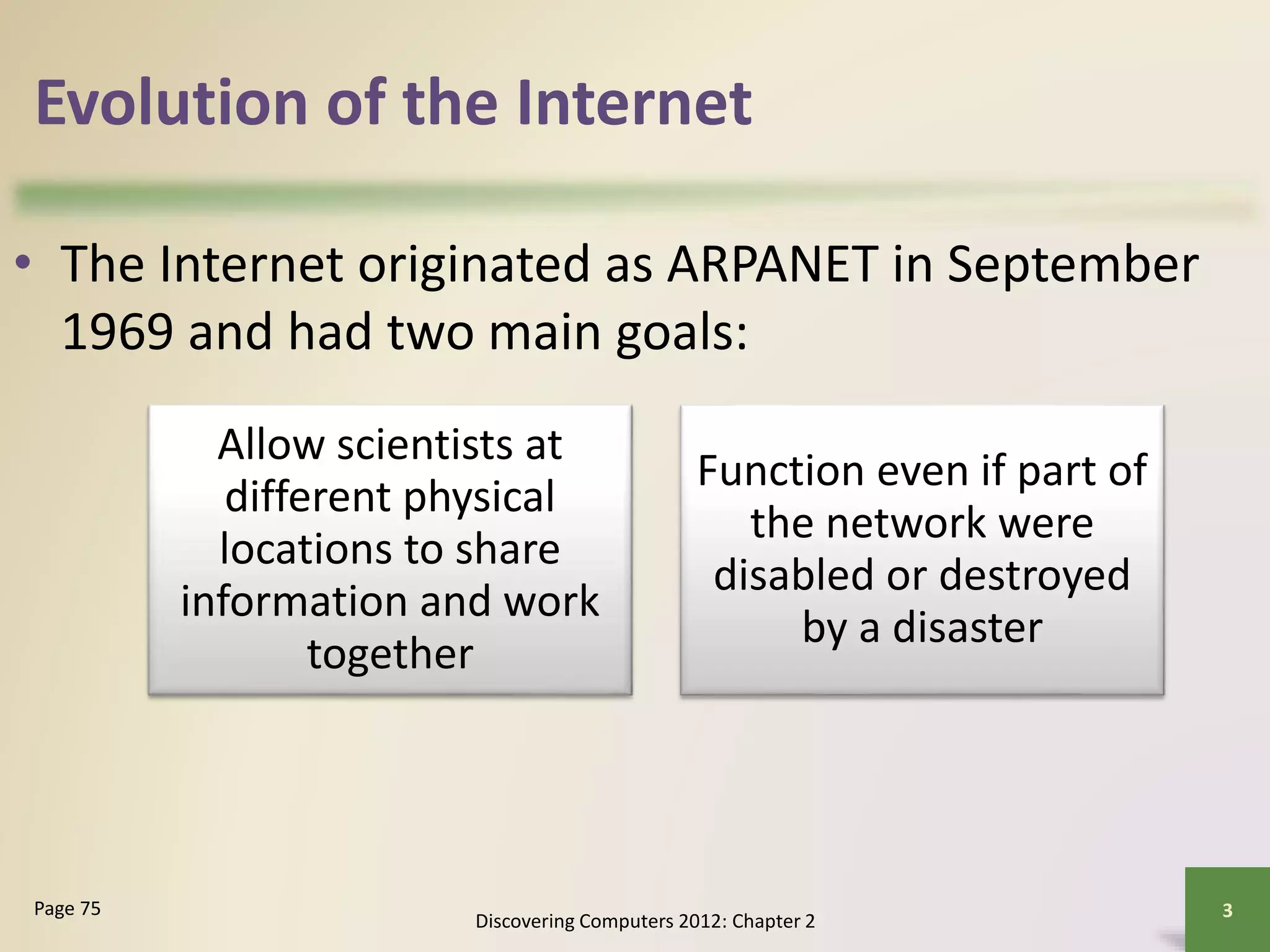
• The Internet originated as ARPANET in September
1969 and had two main goals:
Discovering Computers 2012: Chapter 2
3Page 75
Allow scientists at
different physical
locations to share
information and work
together
Function even if part of
the network were
disabled or destroyed
by a disaster
Evolution of the Internet
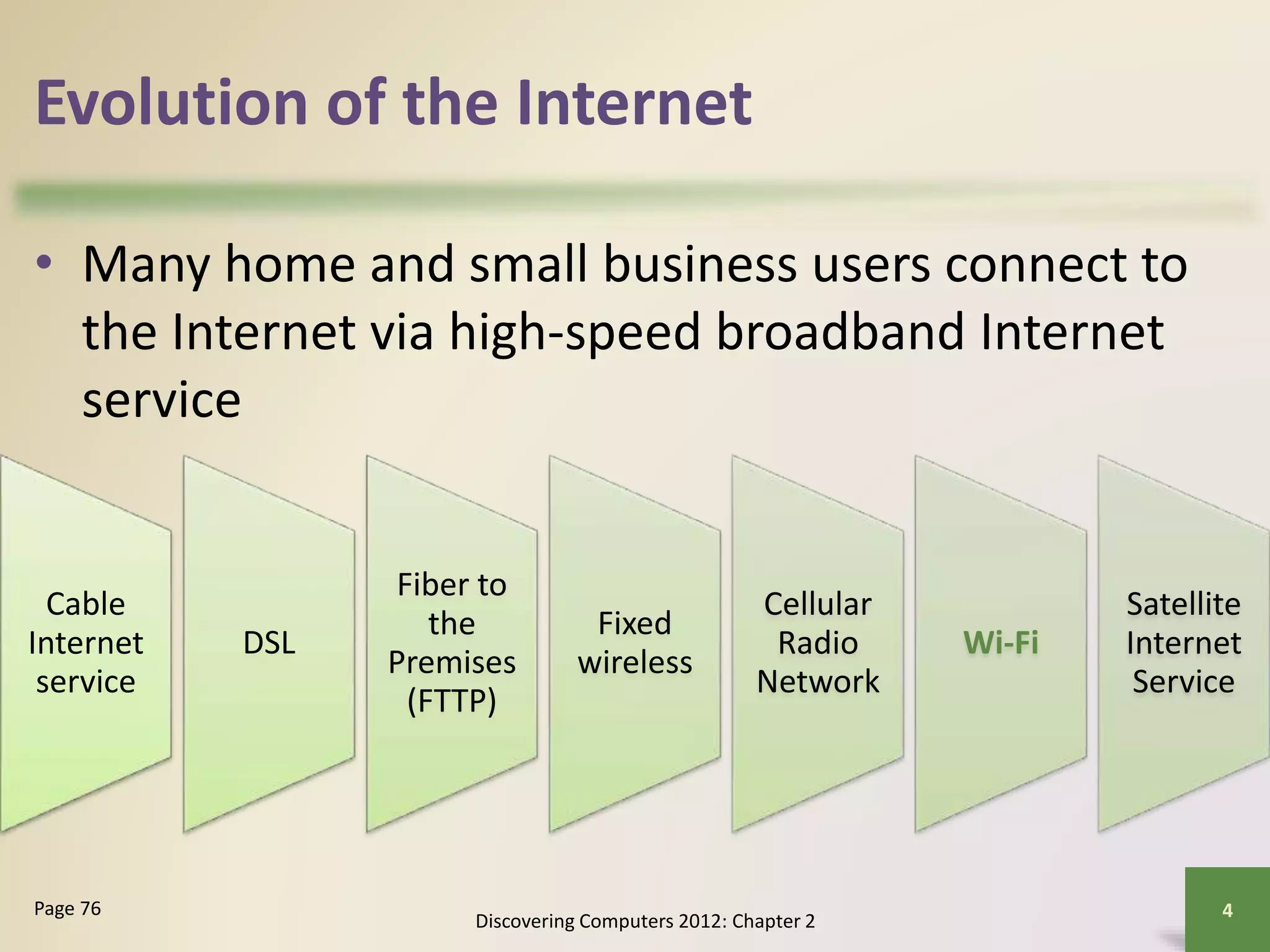
• Many home and small business users connect to
the Internet via high-speed broadband Internet
service
Discovering Computers 2012: Chapter 2
4Page 76
Cable
Internet
service
DSL
Fiber to
the
Premises
(FTTP)
Fixed
wireless
Cellular
Radio
Network
Wi-Fi
Satellite
Internet
Service
Evolution of the Internet
• An access provider is a business that provides individuals
and organizations access to the Internet free or for a fee
Discovering Computers 2012: Chapter 2
5Page 77
Figure 2-2
Evolution of the Internet
ISP (Internet
service provider)
Regional ISPs
provide Internet
access to a specific
geographical area
National ISPs
provide Internet
access in cities and
towns nationwide
Online service
provider (OSP)
Has many members-
only features
Popular OSPs include
AOL (America
Online) and MSN
(Microsoft Network)
Wireless Internet
service provider
Provides wireless
Internet access to
computers and
mobile devices
May require a
wireless modem
Discovering Computers 2012: Chapter 2
6Page 78
Evolution of the Internet
Discovering Computers 2012: Chapter 2
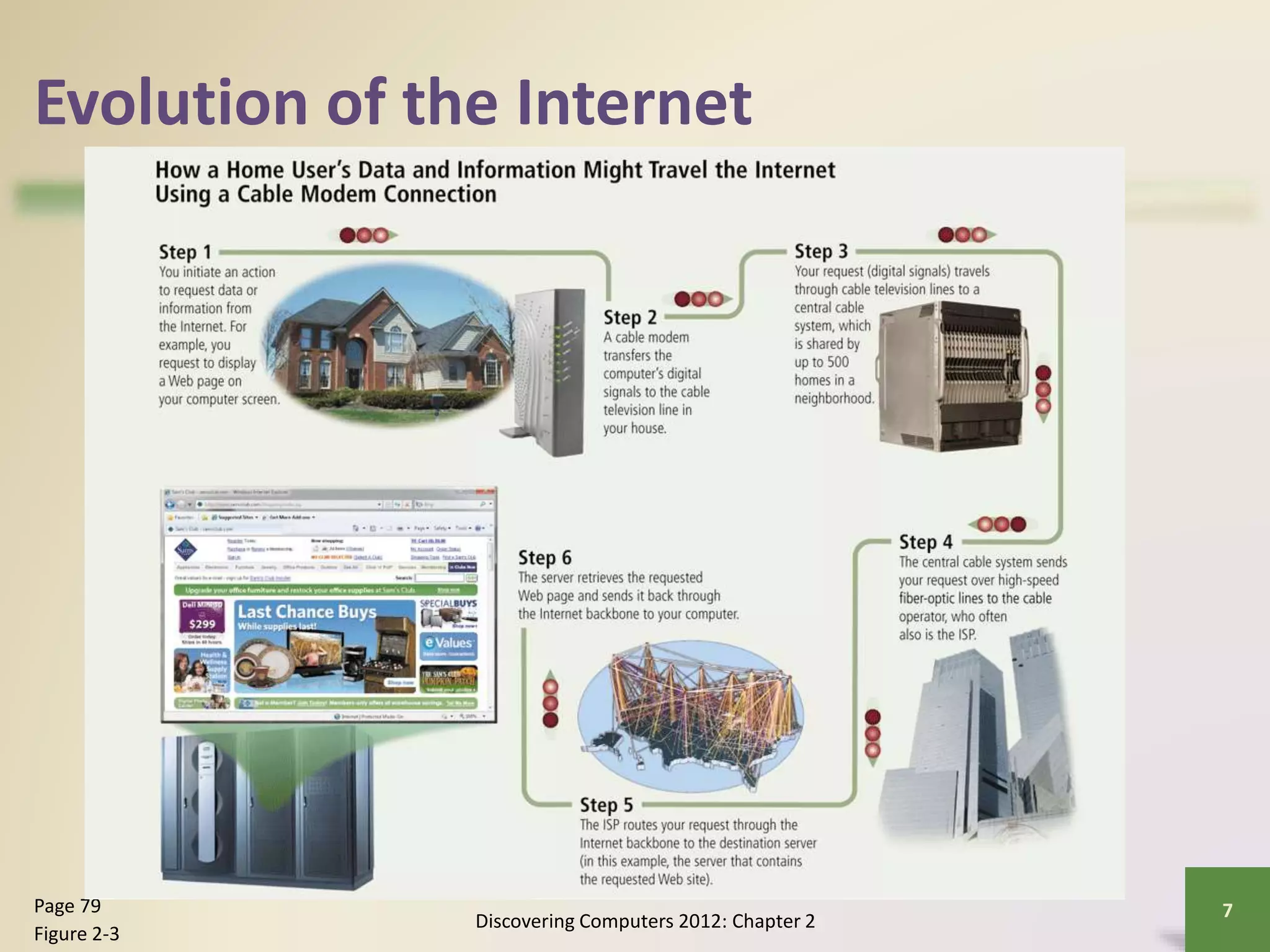
7Page 79
Figure 2-3
Evolution of the Internet
• An IP address is a number that uniquely identifies each
computer or device connected to the Internet
• A domain name is the text version of an IP address
– Top-level domain (TLD)
• A DNS server translates the domain name into its
associated IP address
Discovering Computers 2012: Chapter 2
8Pages 79 – 80
Figure 2-4
Evolution of the Internet
Discovering Computers 2012: Chapter 2
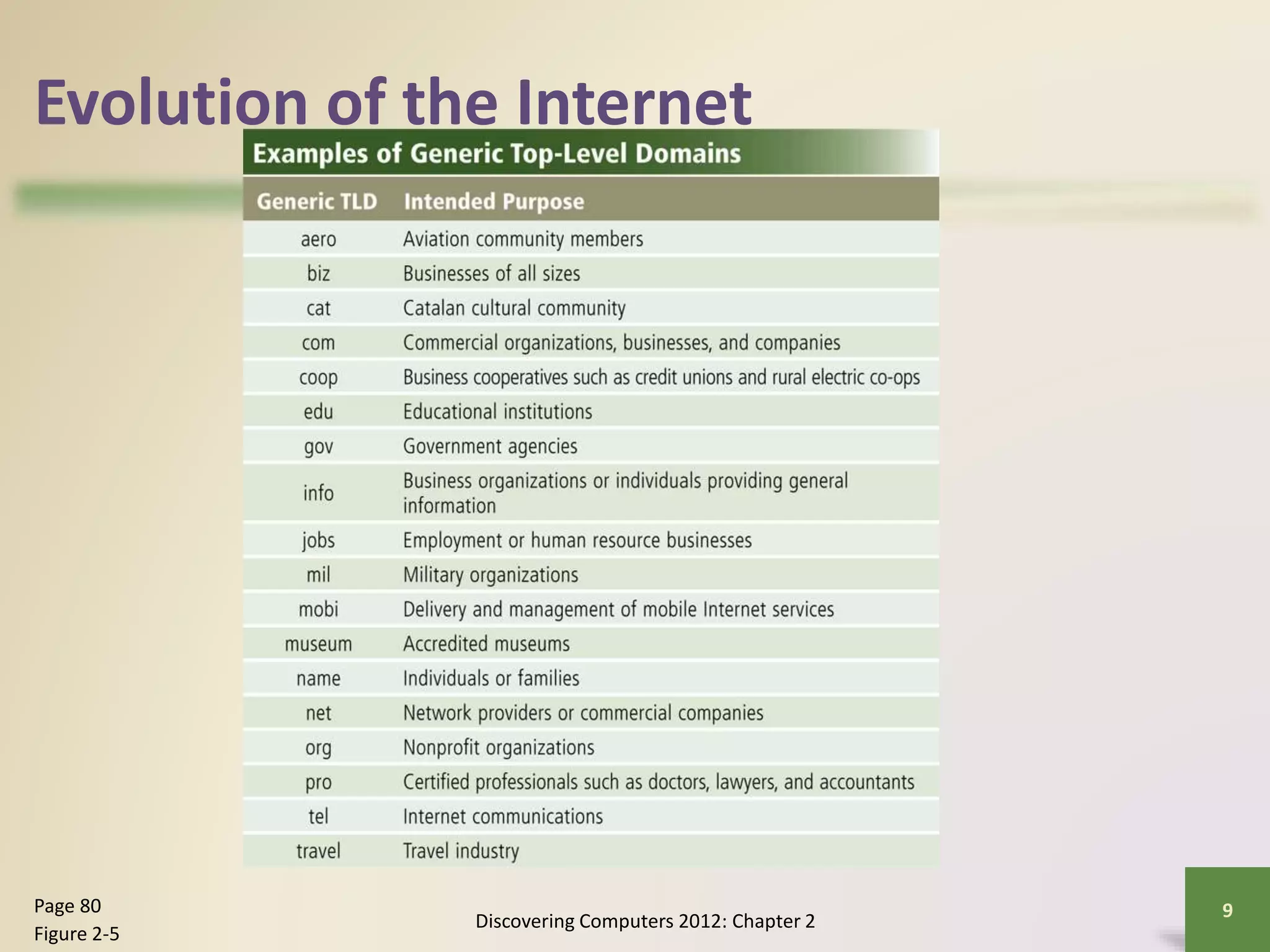
9Page 80
Figure 2-5
The World Wide Web
• The World Wide Web, or Web, consists of a
worldwide collection of electronic documents
(Web pages)
• A Web site is a collection of related Web pages
and associated items
• A Web server is a computer that delivers
requested Web pages to your computer
Discovering Computers 2012: Chapter 2
10Pages 80 - 81
The World Wide Web
• A Web browser, or browser, allows users to
access Web pages and Web 2.0 programs
Discovering Computers 2012: Chapter 2
11Page 81
Internet
Explorer
Firefox Opera
Safari
Google
Chrome
The World Wide Web
Discovering Computers 2012: Chapter 2
12Page 81
Figure 2-6
The World Wide Web
• A home page is the first
page that a Web site
displays
• Web pages provide links to
other related Web pages
– Surfing the Web
• Downloading is the
process of receiving
information
Discovering Computers 2012: Chapter 2
13Pages 82 - 83
Figure 2-7
• Some Web pages are
designed specifically for
microbrowsers
The World Wide Web
• A Web page has a unique address called a URL or
Web address
Discovering Computers 2012: Chapter 2
14Pages 82 – 83
Figure 2-8
The World Wide Web
• Tabbed browsing allows you to open and view multiple
Web pages in a single Web browser window
Discovering Computers 2012: Chapter 2
15Page 84
Figure 2-9
The World Wide Web
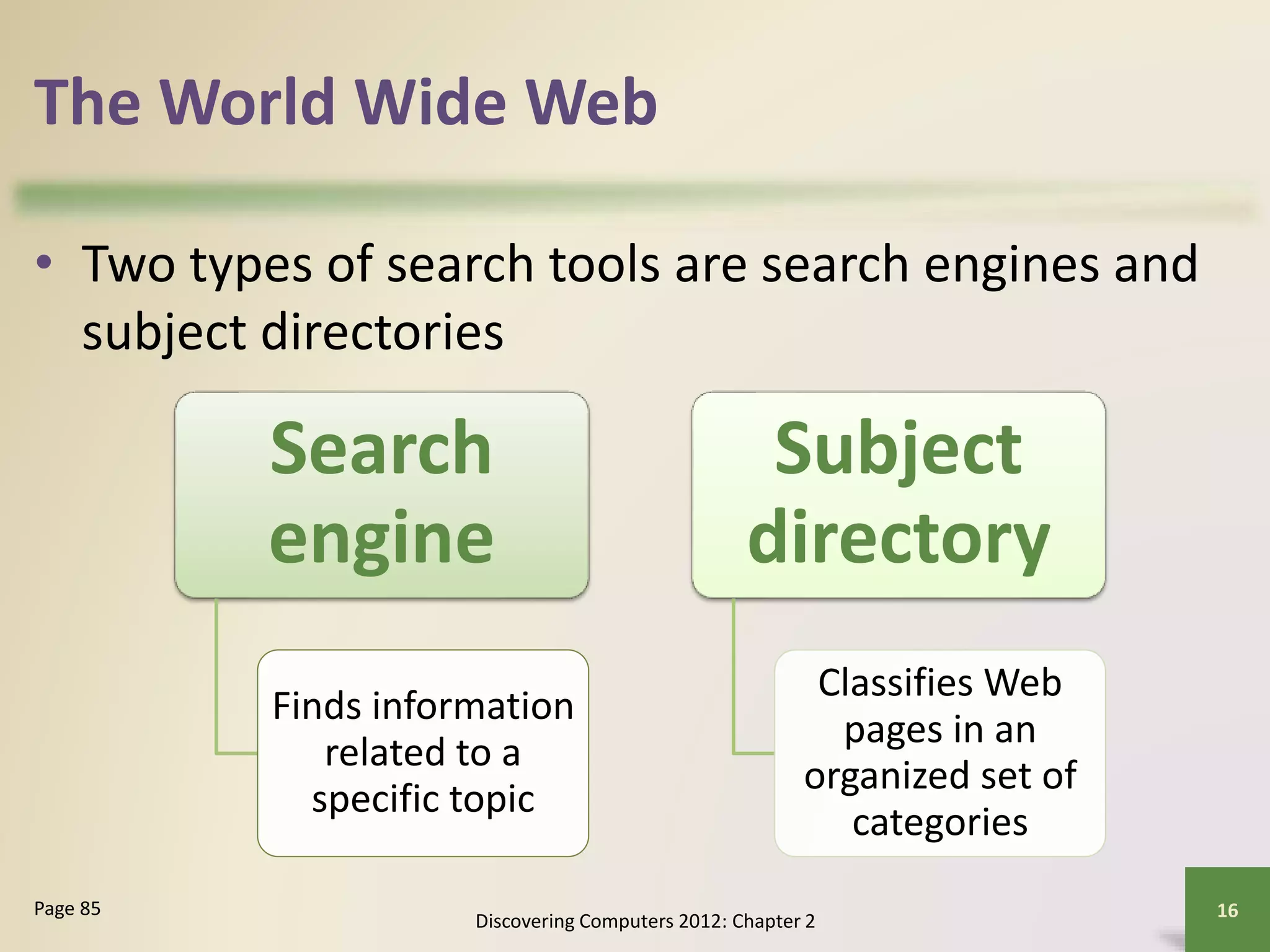
• Two types of search tools are search engines and
subject directories
Discovering Computers 2012: Chapter 2
16Page 85
Search
engine
Finds information
related to a
specific topic
Subject
directory
Classifies Web
pages in an
organized set of
categories
The World Wide Web
• A search engine is helpful in locating items such
as:
Discovering Computers 2012: Chapter 2
17Page 85
Images Videos Audio Publications
Maps
People or
Businesses
Blogs
The World Wide Web
Discovering Computers 2012: Chapter 2
18Page 86
Figure 2-11
The World Wide Web
• Some Web browsers contain an Instant Search
box to eliminate the steps of displaying the search
engine’s Web page prior to entering the search
text
Discovering Computers 2012: Chapter 2
19Page 87
Figure 2-12
The World Wide Web
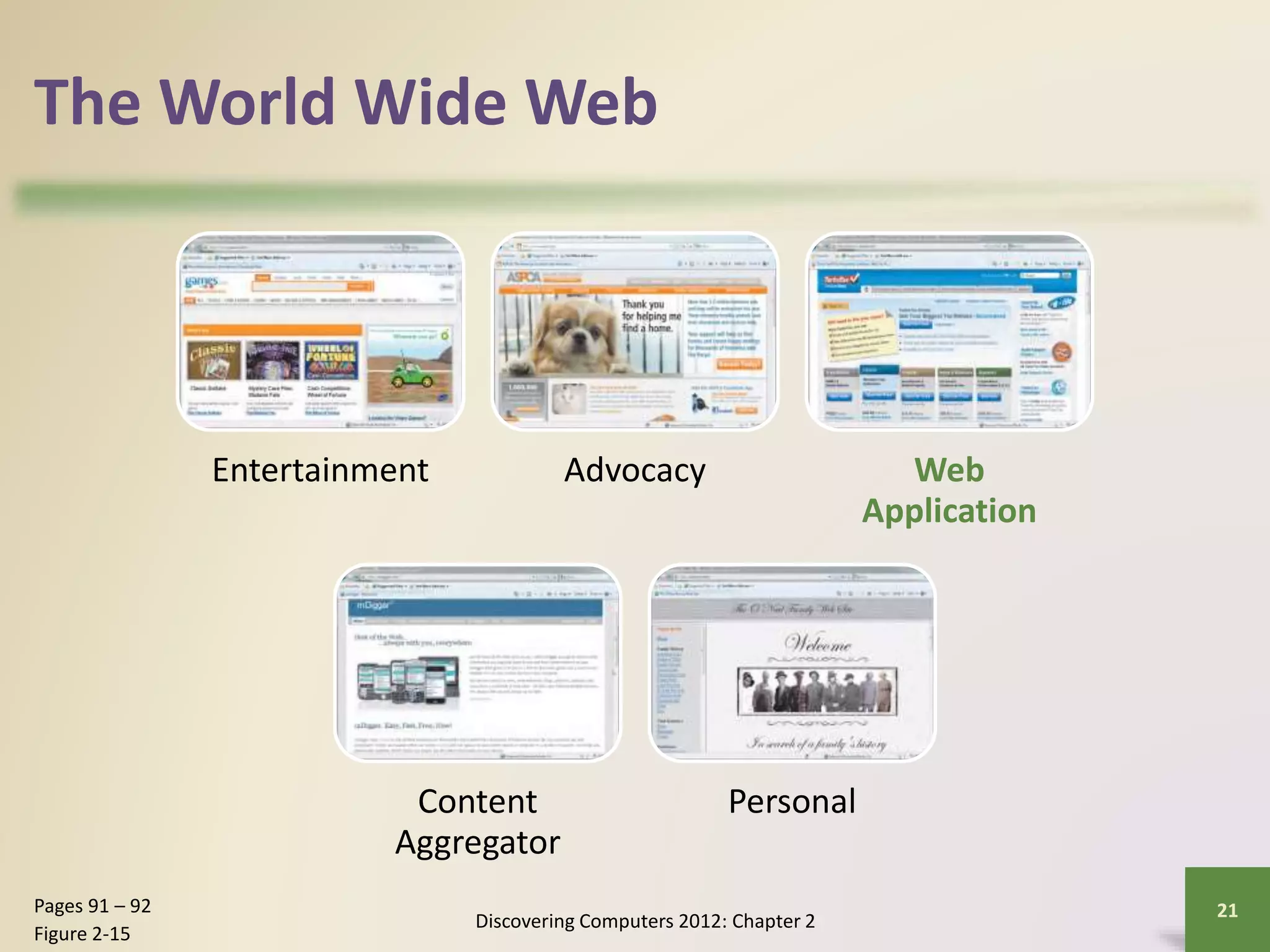
• There are thirteen types of Web sites
Discovering Computers 2012: Chapter 2
20Pages 88 – 91
Figure 2-15
Portal News Informational Business/Marketing
Blog Wiki Online Social
Network
Educational
The World Wide Web
Entertainment Advocacy Web
Application
Content
Aggregator
Personal
Discovering Computers 2012: Chapter 2
21Pages 91 – 92
Figure 2-15
The World Wide Web
• Multimedia refers to any application that
combines text with:
Discovering Computers 2012: Chapter 2
22Page 92
The World Wide Web
• A graphic is a digital
representation of
nontext information
• Graphic formats include
BMP, GIF, JPEG, PNG,
and TIFF
Discovering Computers 2012: Chapter 2
23Page 93
Figure 2-17
The World Wide Web
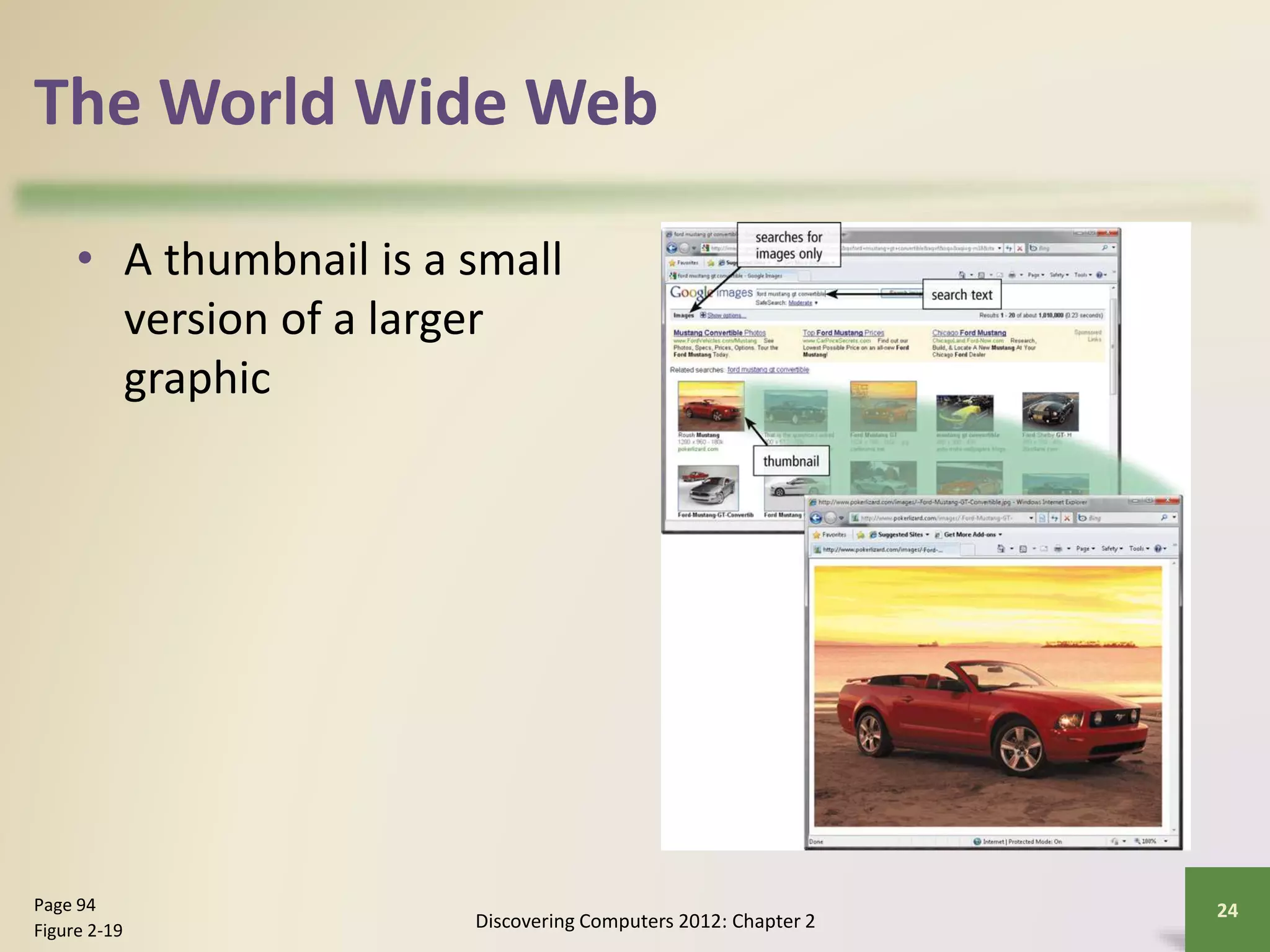
• A thumbnail is a small
version of a larger
graphic
Discovering Computers 2012: Chapter 2
24Page 94
Figure 2-19
The World Wide Web
• Animation is the appearance of motion created
by displaying a series of still images in sequence
Discovering Computers 2012: Chapter 2
25Page 94
The World Wide Web
• Audio includes music, speech, or any other sound
– Compressed to reduce file size
• You listen to audio on your computer using a player
• Streaming is the process of transferring data in a
continuous and even flow
Discovering Computers 2012: Chapter 2
26Pages 94 – 95
Figure 2-20
The World Wide Web
Discovering Computers 2012: Chapter 2
27Page 95
Figure 2-21
The World Wide Web
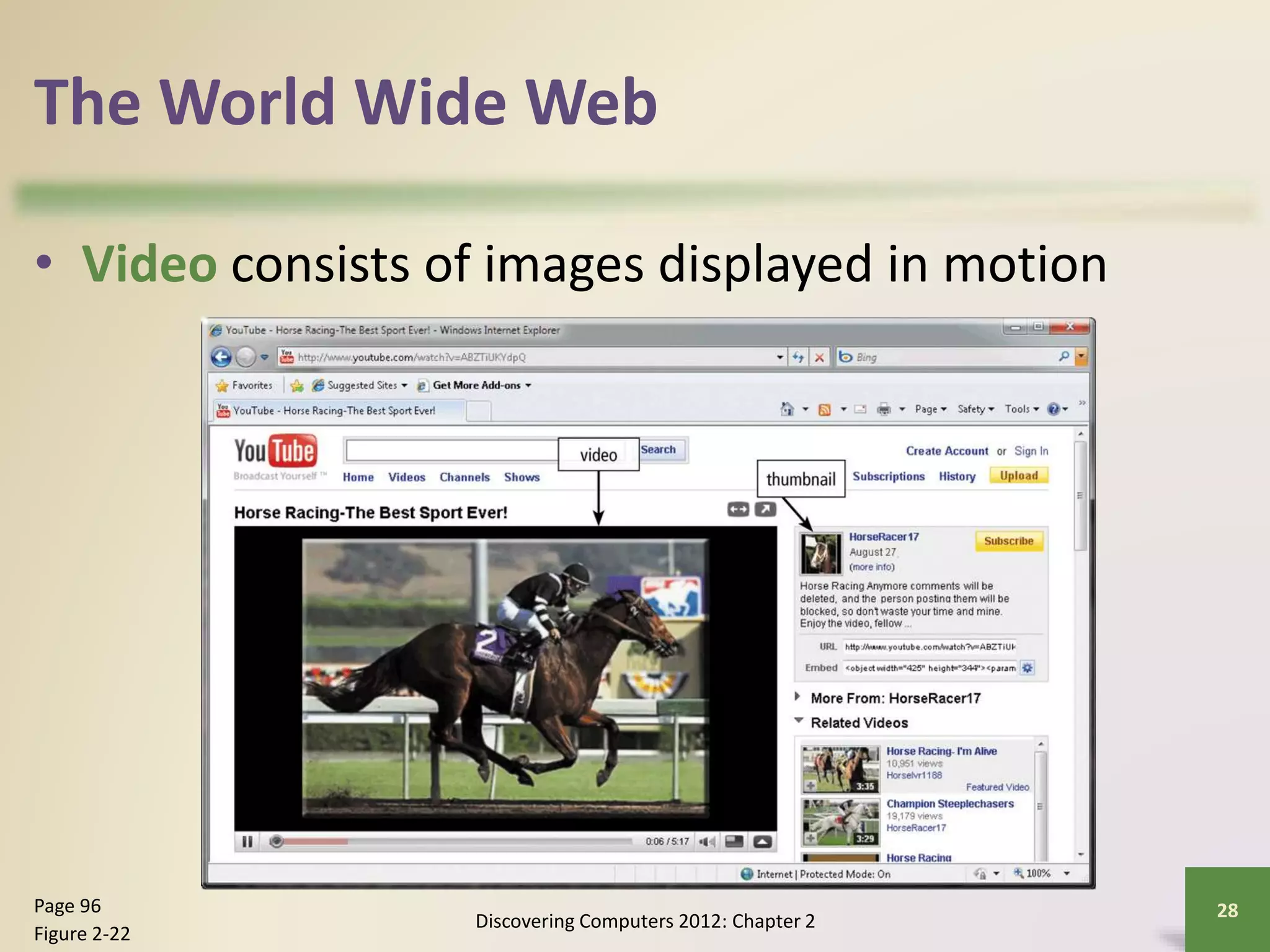
• Video consists of images displayed in motion
Discovering Computers 2012: Chapter 2
28Page 96
Figure 2-22
The World Wide Web
• Virtual reality (VR) is the use of computers to
simulate a real or imagined environment that
appears as a three-dimensional space
Discovering Computers 2012: Chapter 2
29Pages 96 – 97
Figure 2-23
The World Wide Web
• A plug-in is a program that extends the capability
of a Web browser
Discovering Computers 2012: Chapter 2
30Page 97
Figure 2-24
The World Wide Web
• Web publishing is the development and
maintenance of Web pages
Discovering Computers 2012: Chapter 2
31Page 98
Plan a
Web site
Analyze
and
design a
Web site
Create a
Web site
Deploy a
Web site
Maintain
a Web
site
E-Commerce
• E-commerce is a business transaction that occurs
over an electronic network
– M-commerce identifies e-commerce that takes place
using mobile devices
Discovering Computers 2012: Chapter 2
32Page 98
E-Commerce
Discovering Computers 2012: Chapter 2
33Pages 98 - 99
E-commerce
Business-
to-
consumer
(B2C)
Consumer-
to-
consumer
(C2C)
Business-
to-
business
(B2B)
Other Internet Services
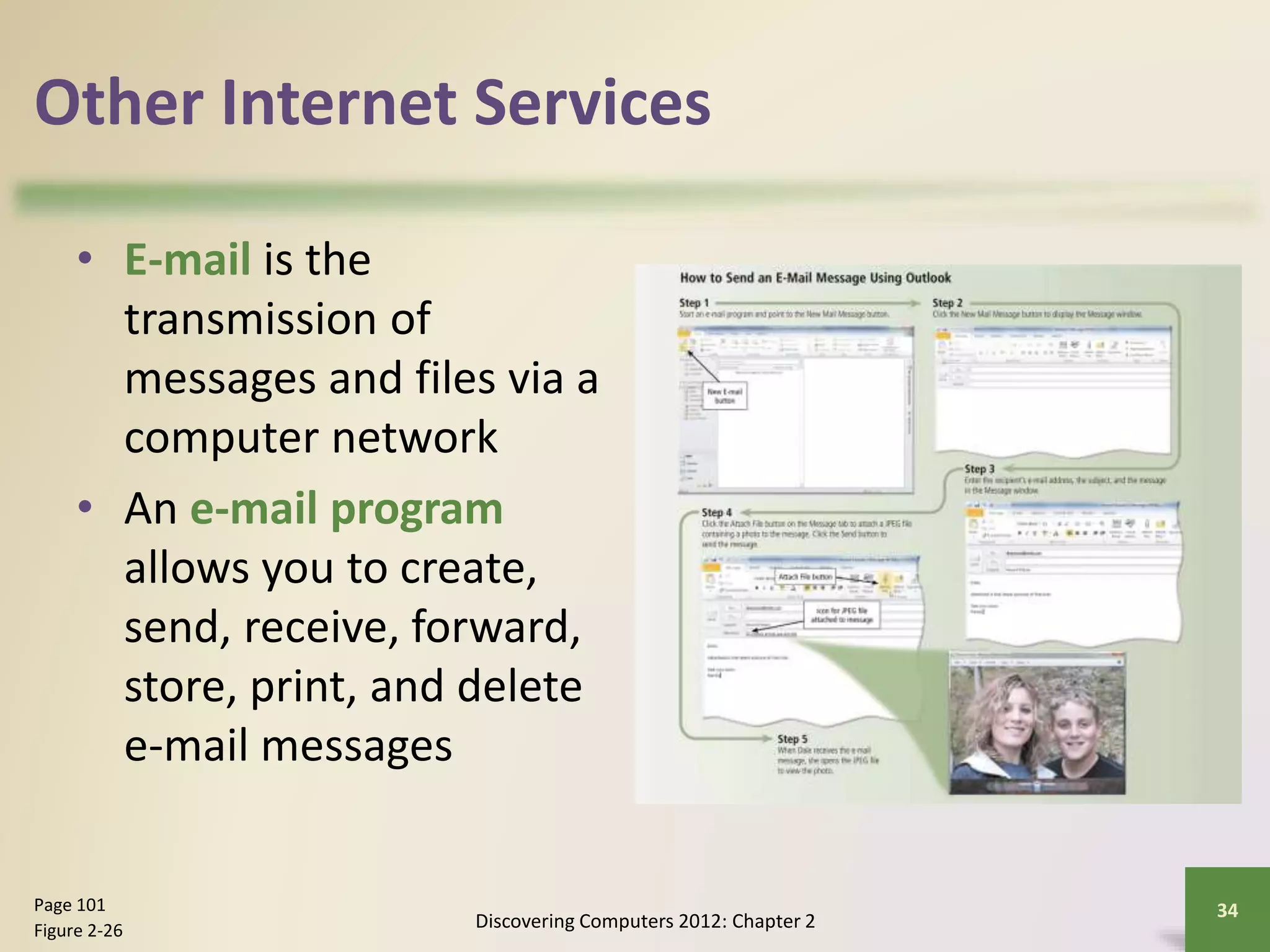
• E-mail is the
transmission of
messages and files via a
computer network
• An e-mail program
allows you to create,
send, receive, forward,
store, print, and delete
e-mail messages
Discovering Computers 2012: Chapter 2
34Page 101
Figure 2-26
Other Internet Services
Discovering Computers 2012: Chapter 2
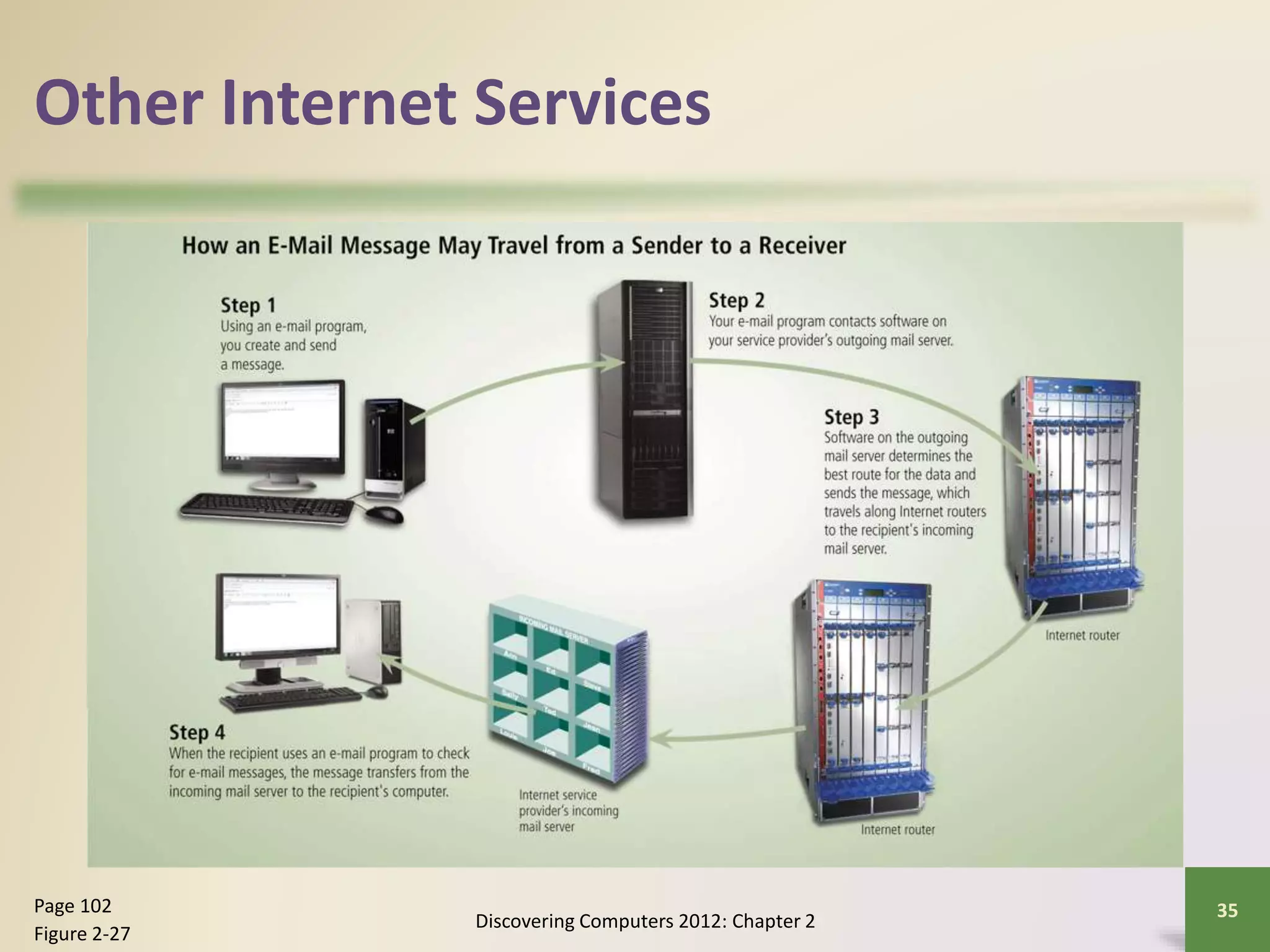
35Page 102
Figure 2-27
Other Internet Services
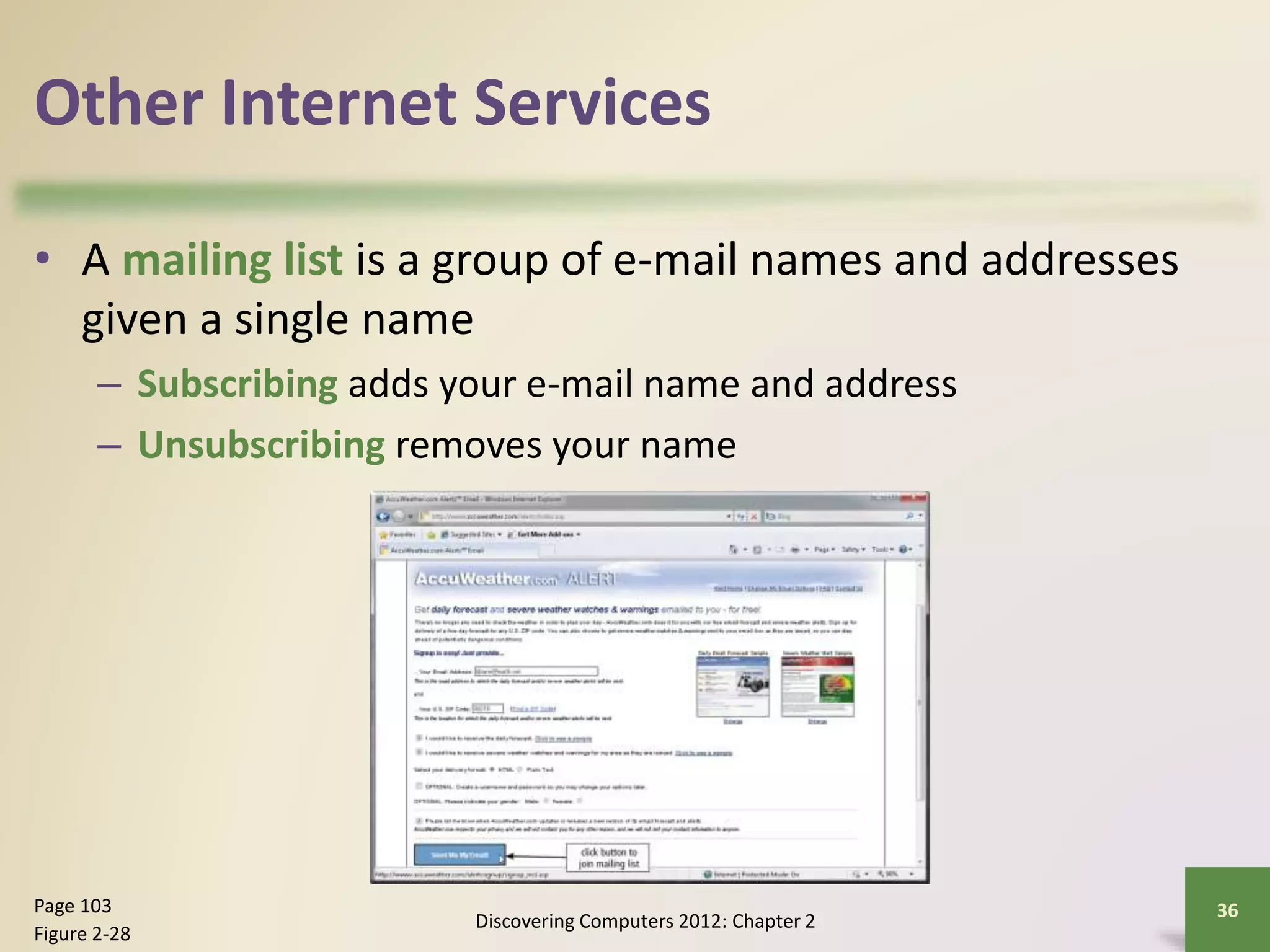
• A mailing list is a group of e-mail names and addresses
given a single name
– Subscribing adds your e-mail name and address
– Unsubscribing removes your name
Discovering Computers 2012: Chapter 2
36Page 103
Figure 2-28
Other Internet Services
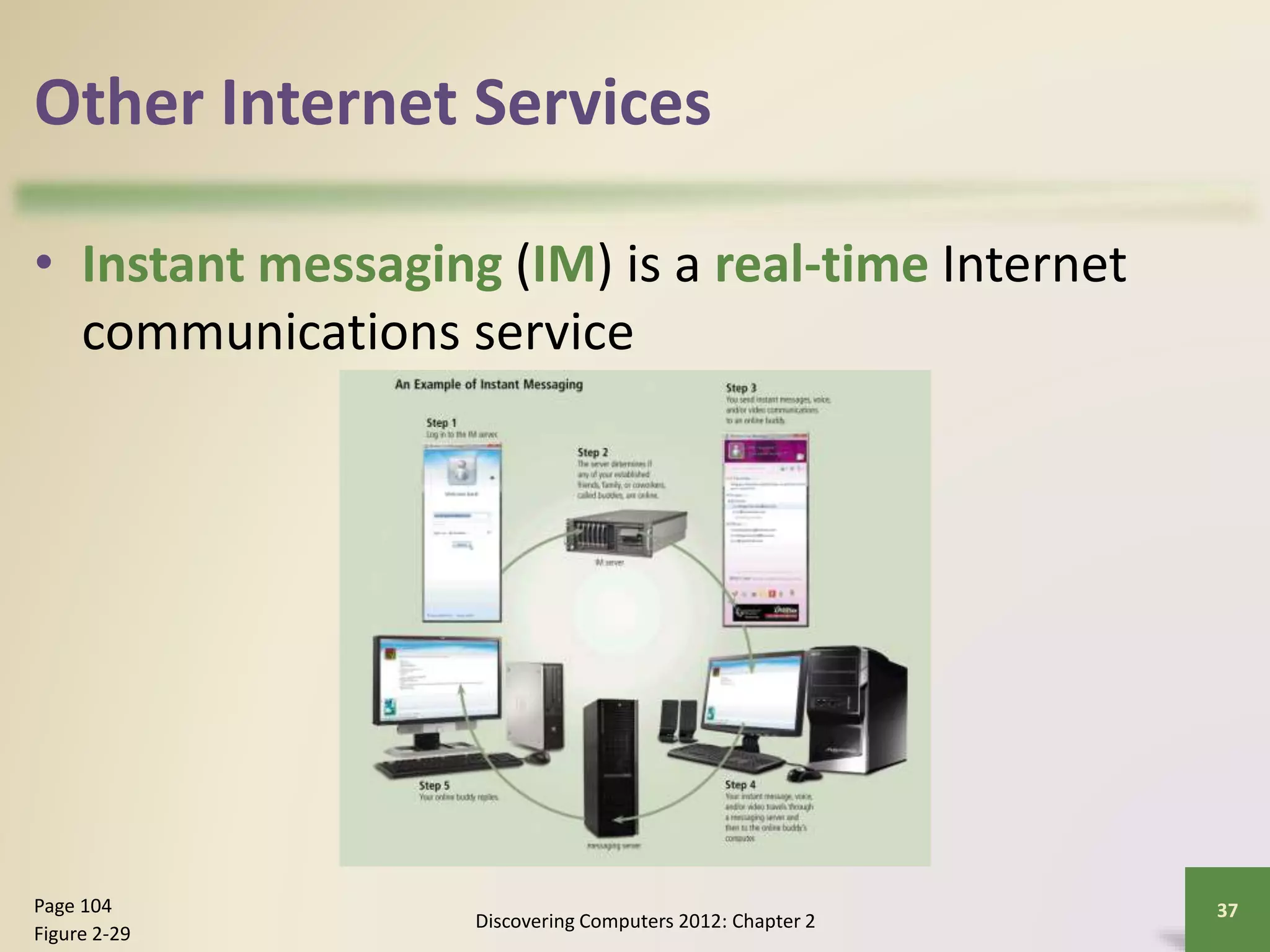
• Instant messaging (IM) is a real-time Internet
communications service
Discovering Computers 2012: Chapter 2
37Page 104
Figure 2-29
Other Internet Services
• A chat is a real-time
typed conversation that
takes place on a
computer
• A chat room is a
location on an Internet
server that permits
users to chat with each
other
Discovering Computers 2012: Chapter 2
38Page 105
Figure 2-30
Other Internet Services
• VoIP (Voice over IP)
enables users to speak
to other users over the
Internet
– Also called Internet
telephony
Discovering Computers 2012: Chapter 2
39Page 106
Figure 2-31
Other Internet Services
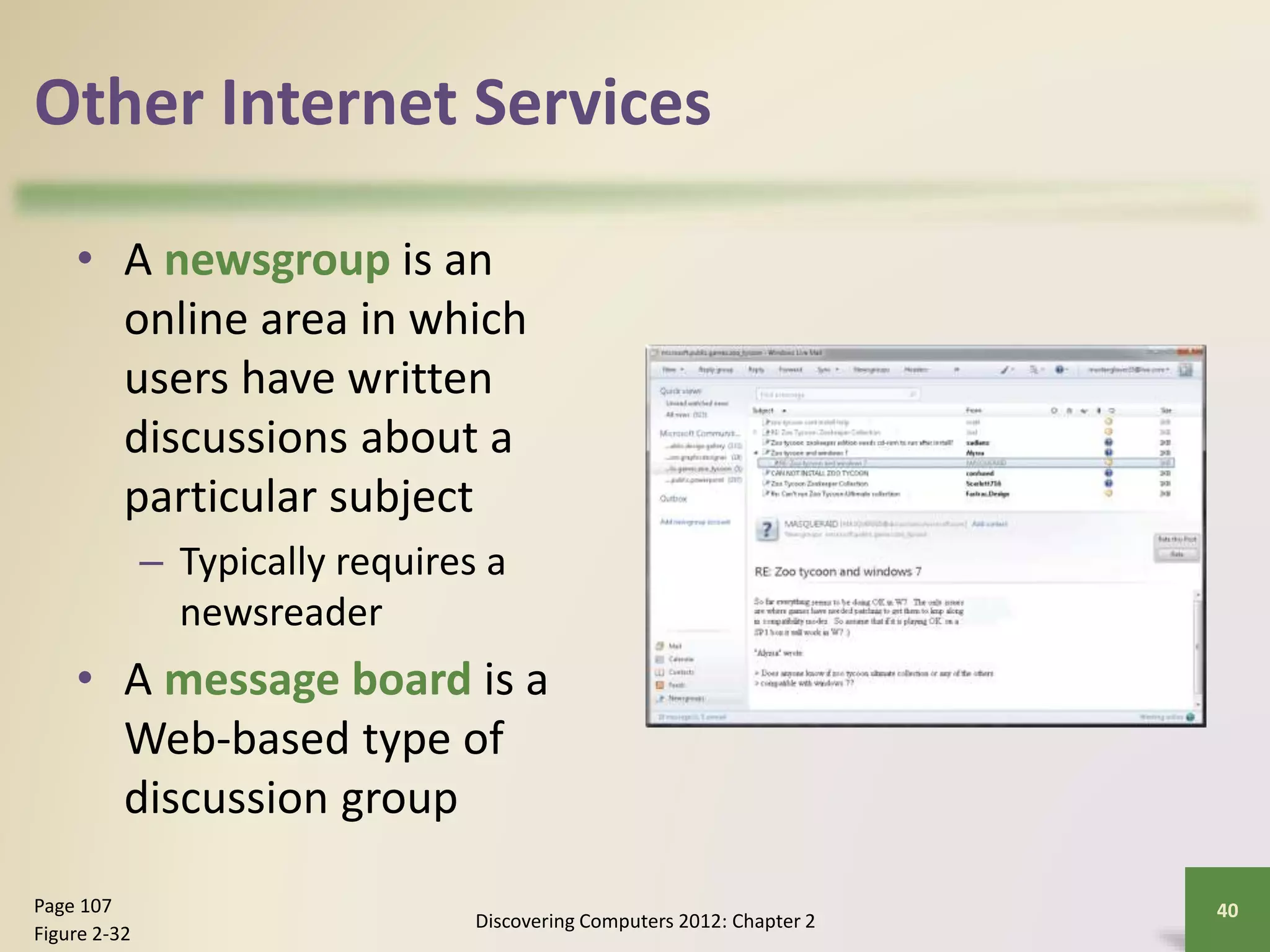
• A newsgroup is an
online area in which
users have written
discussions about a
particular subject
– Typically requires a
newsreader
• A message board is a
Web-based type of
discussion group
Discovering Computers 2012: Chapter 2
40Page 107
Figure 2-32
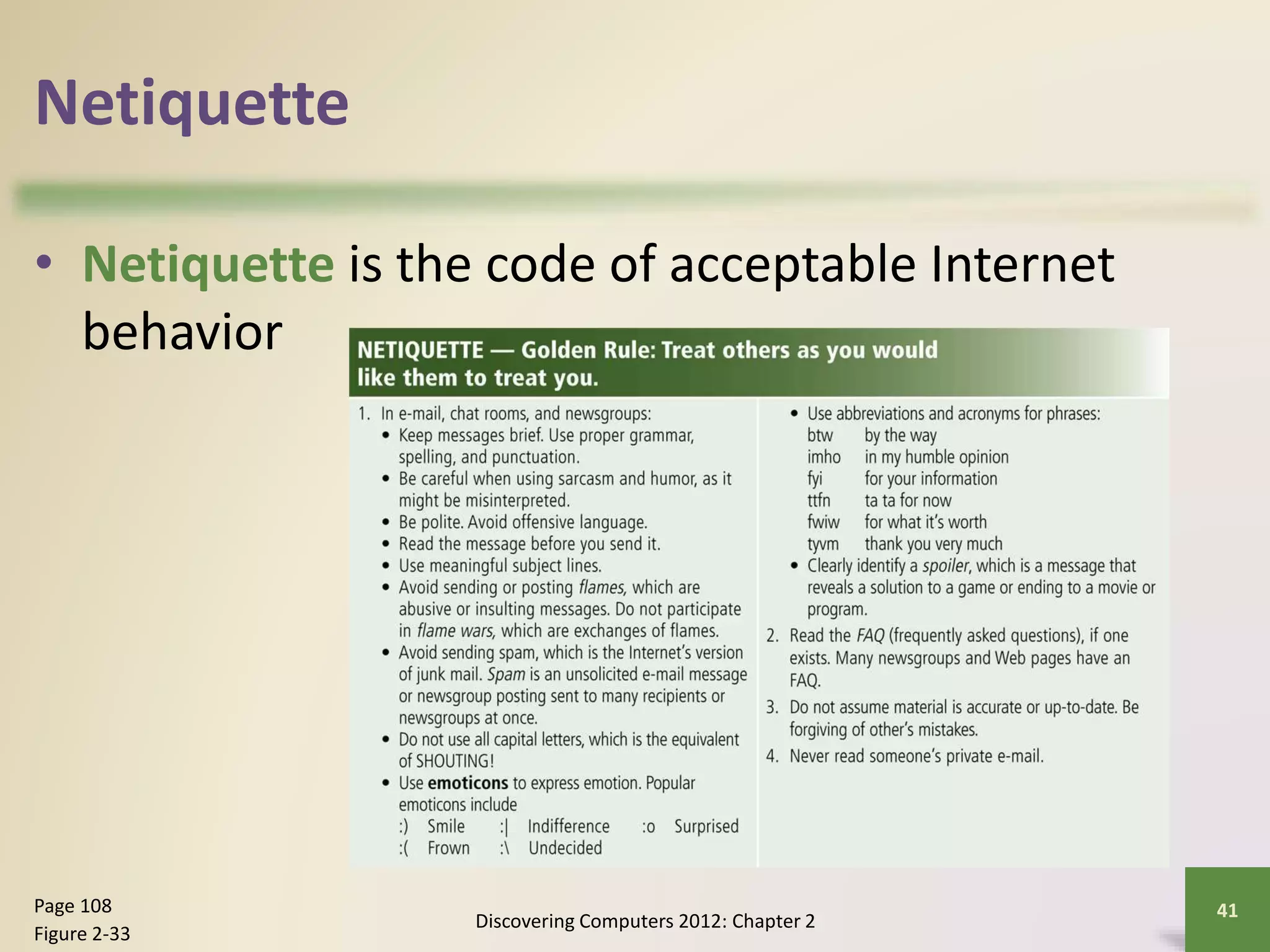
Netiquette
• Netiquette is the code of acceptable Internet
behavior
Discovering Computers 2012: Chapter 2
41Page 108
Figure 2-33

Chapter 02

  • 1.
    Your Interactive Guide tothe Digital World Discovering Computers 2012
  • 2.
    The Internet • TheInternet is a worldwide collection of networks that links millions of businesses, government agencies, educational institutions, and individuals Discovering Computers 2012: Chapter 2 2Page 74 Figure 2-1
  • 3.
    Evolution of theInternet • The Internet originated as ARPANET in September 1969 and had two main goals: Discovering Computers 2012: Chapter 2 3Page 75 Allow scientists at different physical locations to share information and work together Function even if part of the network were disabled or destroyed by a disaster
  • 4.
    Evolution of theInternet • Many home and small business users connect to the Internet via high-speed broadband Internet service Discovering Computers 2012: Chapter 2 4Page 76 Cable Internet service DSL Fiber to the Premises (FTTP) Fixed wireless Cellular Radio Network Wi-Fi Satellite Internet Service
  • 5.
    Evolution of theInternet • An access provider is a business that provides individuals and organizations access to the Internet free or for a fee Discovering Computers 2012: Chapter 2 5Page 77 Figure 2-2
  • 6.
    Evolution of theInternet ISP (Internet service provider) Regional ISPs provide Internet access to a specific geographical area National ISPs provide Internet access in cities and towns nationwide Online service provider (OSP) Has many members- only features Popular OSPs include AOL (America Online) and MSN (Microsoft Network) Wireless Internet service provider Provides wireless Internet access to computers and mobile devices May require a wireless modem Discovering Computers 2012: Chapter 2 6Page 78
  • 7.
    Evolution of theInternet Discovering Computers 2012: Chapter 2 7Page 79 Figure 2-3
  • 8.
    Evolution of theInternet • An IP address is a number that uniquely identifies each computer or device connected to the Internet • A domain name is the text version of an IP address – Top-level domain (TLD) • A DNS server translates the domain name into its associated IP address Discovering Computers 2012: Chapter 2 8Pages 79 – 80 Figure 2-4
  • 9.
    Evolution of theInternet Discovering Computers 2012: Chapter 2 9Page 80 Figure 2-5
  • 10.
    The World WideWeb • The World Wide Web, or Web, consists of a worldwide collection of electronic documents (Web pages) • A Web site is a collection of related Web pages and associated items • A Web server is a computer that delivers requested Web pages to your computer Discovering Computers 2012: Chapter 2 10Pages 80 - 81
  • 11.
    The World WideWeb • A Web browser, or browser, allows users to access Web pages and Web 2.0 programs Discovering Computers 2012: Chapter 2 11Page 81 Internet Explorer Firefox Opera Safari Google Chrome
  • 12.
    The World WideWeb Discovering Computers 2012: Chapter 2 12Page 81 Figure 2-6
  • 13.
    The World WideWeb • A home page is the first page that a Web site displays • Web pages provide links to other related Web pages – Surfing the Web • Downloading is the process of receiving information Discovering Computers 2012: Chapter 2 13Pages 82 - 83 Figure 2-7 • Some Web pages are designed specifically for microbrowsers
  • 14.
    The World WideWeb • A Web page has a unique address called a URL or Web address Discovering Computers 2012: Chapter 2 14Pages 82 – 83 Figure 2-8
  • 15.
    The World WideWeb • Tabbed browsing allows you to open and view multiple Web pages in a single Web browser window Discovering Computers 2012: Chapter 2 15Page 84 Figure 2-9
  • 16.
    The World WideWeb • Two types of search tools are search engines and subject directories Discovering Computers 2012: Chapter 2 16Page 85 Search engine Finds information related to a specific topic Subject directory Classifies Web pages in an organized set of categories
  • 17.
    The World WideWeb • A search engine is helpful in locating items such as: Discovering Computers 2012: Chapter 2 17Page 85 Images Videos Audio Publications Maps People or Businesses Blogs
  • 18.
    The World WideWeb Discovering Computers 2012: Chapter 2 18Page 86 Figure 2-11
  • 19.
    The World WideWeb • Some Web browsers contain an Instant Search box to eliminate the steps of displaying the search engine’s Web page prior to entering the search text Discovering Computers 2012: Chapter 2 19Page 87 Figure 2-12
  • 20.
    The World WideWeb • There are thirteen types of Web sites Discovering Computers 2012: Chapter 2 20Pages 88 – 91 Figure 2-15 Portal News Informational Business/Marketing Blog Wiki Online Social Network Educational
  • 21.
    The World WideWeb Entertainment Advocacy Web Application Content Aggregator Personal Discovering Computers 2012: Chapter 2 21Pages 91 – 92 Figure 2-15
  • 22.
    The World WideWeb • Multimedia refers to any application that combines text with: Discovering Computers 2012: Chapter 2 22Page 92
  • 23.
    The World WideWeb • A graphic is a digital representation of nontext information • Graphic formats include BMP, GIF, JPEG, PNG, and TIFF Discovering Computers 2012: Chapter 2 23Page 93 Figure 2-17
  • 24.
    The World WideWeb • A thumbnail is a small version of a larger graphic Discovering Computers 2012: Chapter 2 24Page 94 Figure 2-19
  • 25.
    The World WideWeb • Animation is the appearance of motion created by displaying a series of still images in sequence Discovering Computers 2012: Chapter 2 25Page 94
  • 26.
    The World WideWeb • Audio includes music, speech, or any other sound – Compressed to reduce file size • You listen to audio on your computer using a player • Streaming is the process of transferring data in a continuous and even flow Discovering Computers 2012: Chapter 2 26Pages 94 – 95 Figure 2-20
  • 27.
    The World WideWeb Discovering Computers 2012: Chapter 2 27Page 95 Figure 2-21
  • 28.
    The World WideWeb • Video consists of images displayed in motion Discovering Computers 2012: Chapter 2 28Page 96 Figure 2-22
  • 29.
    The World WideWeb • Virtual reality (VR) is the use of computers to simulate a real or imagined environment that appears as a three-dimensional space Discovering Computers 2012: Chapter 2 29Pages 96 – 97 Figure 2-23
  • 30.
    The World WideWeb • A plug-in is a program that extends the capability of a Web browser Discovering Computers 2012: Chapter 2 30Page 97 Figure 2-24
  • 31.
    The World WideWeb • Web publishing is the development and maintenance of Web pages Discovering Computers 2012: Chapter 2 31Page 98 Plan a Web site Analyze and design a Web site Create a Web site Deploy a Web site Maintain a Web site
  • 32.
    E-Commerce • E-commerce isa business transaction that occurs over an electronic network – M-commerce identifies e-commerce that takes place using mobile devices Discovering Computers 2012: Chapter 2 32Page 98
  • 33.
    E-Commerce Discovering Computers 2012:Chapter 2 33Pages 98 - 99 E-commerce Business- to- consumer (B2C) Consumer- to- consumer (C2C) Business- to- business (B2B)
  • 34.
    Other Internet Services •E-mail is the transmission of messages and files via a computer network • An e-mail program allows you to create, send, receive, forward, store, print, and delete e-mail messages Discovering Computers 2012: Chapter 2 34Page 101 Figure 2-26
  • 35.
    Other Internet Services DiscoveringComputers 2012: Chapter 2 35Page 102 Figure 2-27
  • 36.
    Other Internet Services •A mailing list is a group of e-mail names and addresses given a single name – Subscribing adds your e-mail name and address – Unsubscribing removes your name Discovering Computers 2012: Chapter 2 36Page 103 Figure 2-28
  • 37.
    Other Internet Services •Instant messaging (IM) is a real-time Internet communications service Discovering Computers 2012: Chapter 2 37Page 104 Figure 2-29
  • 38.
    Other Internet Services •A chat is a real-time typed conversation that takes place on a computer • A chat room is a location on an Internet server that permits users to chat with each other Discovering Computers 2012: Chapter 2 38Page 105 Figure 2-30
  • 39.
    Other Internet Services •VoIP (Voice over IP) enables users to speak to other users over the Internet – Also called Internet telephony Discovering Computers 2012: Chapter 2 39Page 106 Figure 2-31
  • 40.
    Other Internet Services •A newsgroup is an online area in which users have written discussions about a particular subject – Typically requires a newsreader • A message board is a Web-based type of discussion group Discovering Computers 2012: Chapter 2 40Page 107 Figure 2-32
  • 41.
    Netiquette • Netiquette isthe code of acceptable Internet behavior Discovering Computers 2012: Chapter 2 41Page 108 Figure 2-33

Editor's Notes