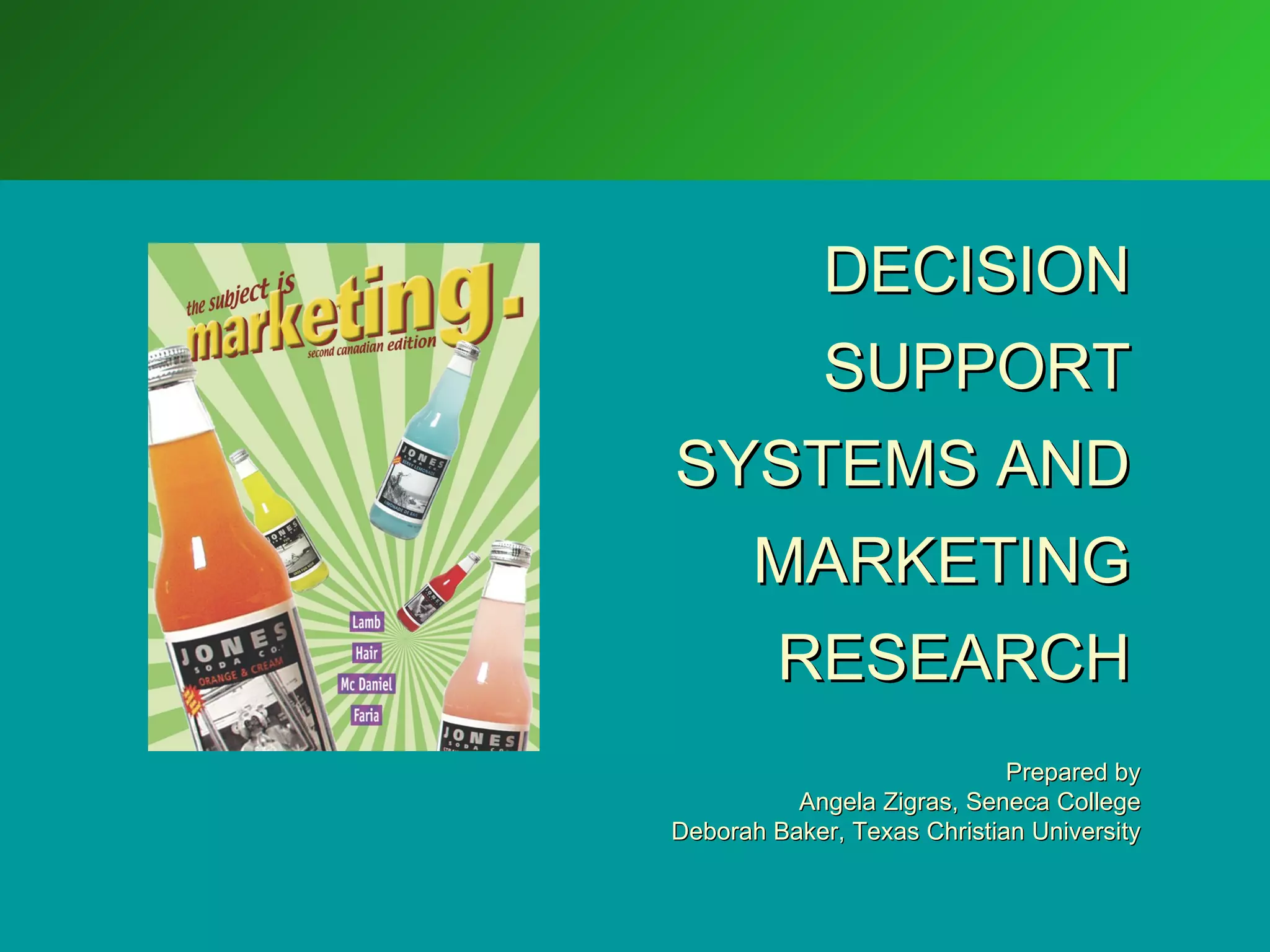
DECISION
             SUPPORT
SYSTEMS AND
  MARKETING
         RESEARCH
                             Prepared by
          Angela Zigras, Seneca College
Deborah Baker, Texas Christian University
You will learn to ...

1. Explain the concept and purpose of a
   marketing decision support system.

2. Define marketing research and explain its
   importance to marketing decision making.

3. Describe the steps involved in conducting
   a marketing research project.
You will learn to ...


4. Discuss the growing importance of scanner-
   based research.

5. Explain when marketing research should and
   should not be conducted.
Marketing Intelligence


          Everyday information about
             developments in the
          marketing environment that
         managers use to prepare and
            adjust marketing plans.
Decision Support System


            An interactive, flexible
           computerized information
             system that enables
            managers to obtain and
           manipulate information as
          they are making decisions.
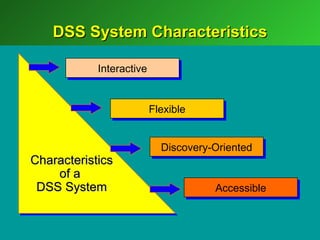
DSS System Characteristics

            Interactive


                          Flexible


                            Discovery-Oriented
Characteristics
    of a
 DSS System                           Accessible
Database Marketing


          The creation of a large
            computerized file of
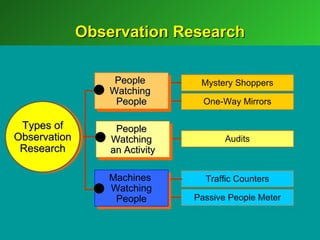
         customers’ and potential
          customers’ profiles and
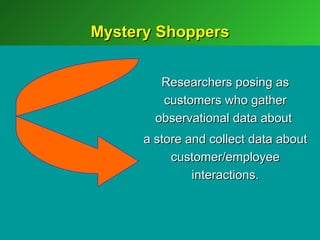
            purchase patterns.
Marketing Research


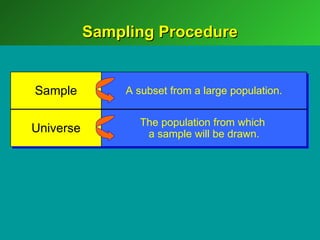
         The process of planning,
       collecting, and analyzing data
           relevant to a marketing
                   decision.
Defining Market Research        (1)


 Research is the systematic and objective
  approach to investigate a specific
  problem that needs a solution.
 Research is a process by which a series
  of well thought out and carefully
  executed activities enable one to
  enquire, investigate or examine a
  problem to discover new facts to deal
  with the problem.
Defining Research           (2)


 Systematic : well organised and planned
 Objectivity : unbiased and unemotional
 The information is used to identify and define
  opportunities and problems, and make
  recommendations on solutions
 Market Research links consumer, customer and
  the public to the marketers through information.
 Generate, refine and evaluate marketing
  actions, performance and the marketing
  process.
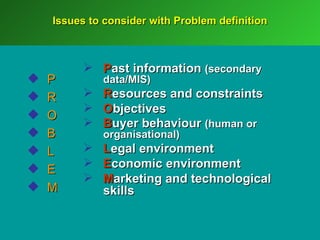
Issues to consider with Problem definition


          Past information (secondary
   P        data/MIS)
   R       Resources and constraints
            Objectives
   O
            Buyer behaviour (human or
   B        organisational)
   L       Legal environment
           Economic environment
    E
            Marketing and technological
   M        skills
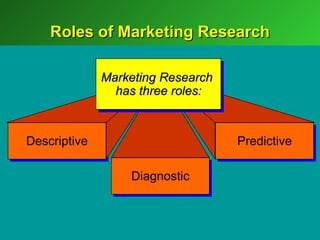
Roles of Marketing Research

              Marketing Research
                has three roles:


Descriptive                        Predictive

                  Diagnostic
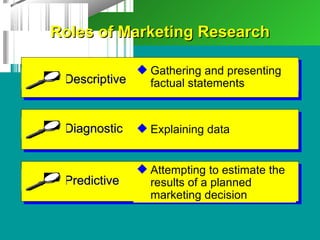
Roles of Marketing Research

              Gathering and presenting
 Descriptive   factual statements


 Diagnostic    Explaining data


               Attempting to estimate the
 Predictive     results of a planned
                marketing decision
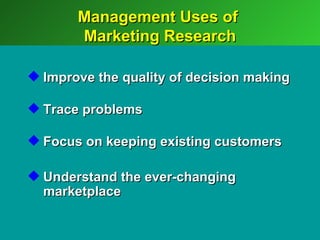
Management Uses of
       Marketing Research

 Improve the quality of decision making

 Trace problems

 Focus on keeping existing customers

 Understand the ever-changing
  marketplace
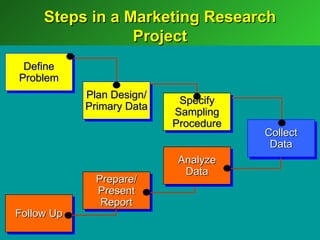
Steps in a Marketing Research
                 Project
 Define
Problem
            Plan Design/
                            Specify
            Primary Data
                           Sampling
                           Procedure
                                       Collect
                                        Data
                            Analyze
                             Data
              Prepare/
              Present
               Report
Follow Up
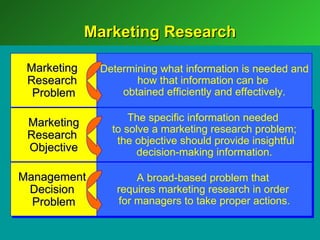
Marketing Research

 Marketing    Determining what information is needed and
 Research            how that information can be
  Problem         obtained efficiently and effectively.

 Marketing          The specific information needed
                to solve a marketing research problem;
 Research        the objective should provide insightful
 Objective            decision-making information.

Management           A broad-based problem that
 Decision        requires marketing research in order
  Problem        for managers to take proper actions.
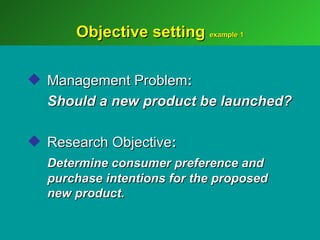
Objective setting example 1

 Management Problem:
  Should a new product be launched?

 Research Objective:
  Determine consumer preference and
  purchase intentions for the proposed
  new product.
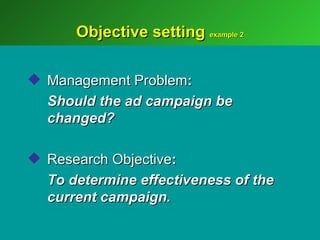
Objective setting example 2

 Management Problem:
  Should the ad campaign be
  changed?

 Research Objective:
  To determine effectiveness of the
  current campaign.
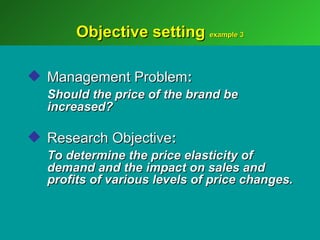
Objective setting example 3

 Management Problem:
  Should the price of the brand be
  increased?

 Research Objective:
  To determine the price elasticity of
  demand and the impact on sales and
  profits of various levels of price changes.
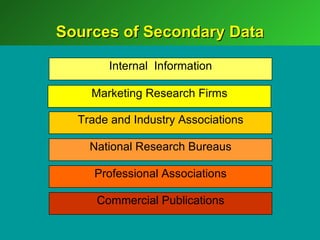
Sources of Secondary Data

       Internal Information

    Marketing Research Firms

  Trade and Industry Associations

    National Research Bureaus

     Professional Associations

     Commercial Publications
Secondary Data


     Data previously collected for
         any purpose other
        than the one at hand.
Advantages of Secondary Data


 Saves time and money if on target

 Aids in determining direction for primary
  data collection

 Pinpoints the kinds of people to
  approach

 Serves as a basis of comparison for other
  data
Disadvantages of Secondary Data


 May not be on target with the research
  problem

 Quality and accuracy of data may pose
  a problem
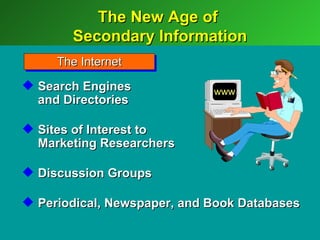
The New Age of
       Secondary Information
     The Internet

 Search Engines             www
  and Directories

 Sites of Interest to
  Marketing Researchers

 Discussion Groups

 Periodical, Newspaper, and Book Databases
Basic Types of Directories

 Academic and Professional
  Directories

 Commercial Portals
Research Design


       Specifies which research
     questions must be answered,
     how and when the data will be
      gathered, and how the data
           will be analyzed.
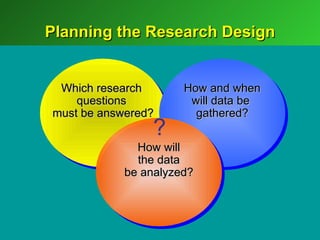
Planning the Research Design


 Which research       How and when
    questions          will data be
must be answered?       gathered?
                ?
              How will
              the data
            be analyzed?
Primary Data


    Information collected for the
         first time. Can be
    used for solving the particular
              problem
         under investigation.
Advantages of Primary Data

 Answers a specific research question

 Data are current

 Source of data is known

 Secrecy can be maintained
Disadvantages of Primary Data

 Expensive

 Quality declines if interviews are
  lengthy

 Reluctance to participate in lengthy
  interviews
Survey Research


      The most popular technique
      for gathering primary data in
      which a researcher interacts
       with people to obtain facts,
               opinions,
             and attitudes.
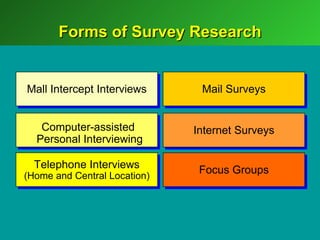
Forms of Survey Research


Mall Intercept Interviews      Mail Surveys


   Computer-assisted          Internet Surveys
  Personal Interviewing

  Telephone Interviews         Focus Groups
(Home and Central Location)
Mall Intercept Interview


         Survey research method that
         involves interviewing people
           in the common areas of
                shopping malls.
Computer-Assisted Personal
      Interviewing


             An interviewing method in
            which the interviewer reads
                the questions from a
            computer screen and enters
           the respondent’s data directly
                 into the computer.
Impact of the Internet

 Allows better and faster decision making
 Improves ability to respond quickly to
  customer needs and market shifts
 Makes follow-up studies and research
  easier
 Slashes labour-and time-intensive
  research activities
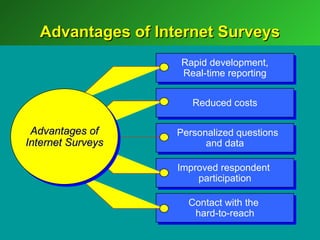
Advantages of Internet Surveys
                   Rapid development,
                   Real-time reporting


                      Reduced costs

 Advantages of     Personalized questions
Internet Surveys         and data

                   Improved respondent
                       participation

                     Contact with the
                      hard-to-reach
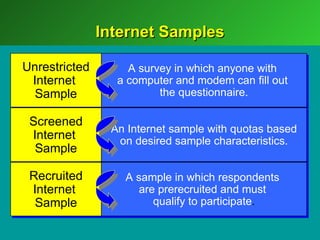
Internet Samples

Unrestricted       A survey in which anyone with
 Internet        a computer and modem can fill out
  Sample                 the questionnaire.

 Screened
                An Internet sample with quotas based
 Internet        on desired sample characteristics.
  Sample

 Recruited        A sample in which respondents
 Internet            are prerecruited and must
  Sample                qualify to participate.
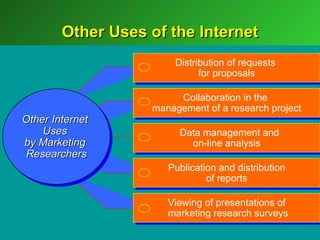
Other Uses of the Internet
                       Distribution of requests
                             for proposals

                        Collaboration in the
                   management of a research project
Other Internet
    Uses                Data management and
by Marketing              on-line analysis
 Researchers
                      Publication and distribution
                               of reports

                      Viewing of presentations of
                      marketing research surveys
Focus Group


     Seven to ten people who
      participate in a group
       discussion led by a
            moderator.
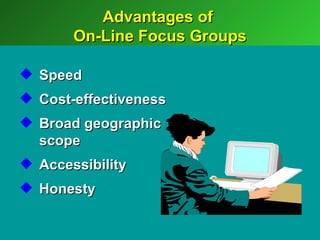
Advantages of
       On-Line Focus Groups

 Speed
 Cost-effectiveness
 Broad geographic
  scope
 Accessibility
 Honesty
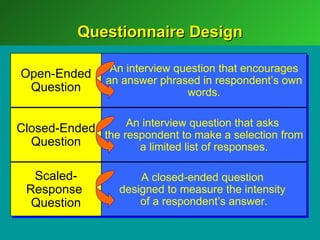
Questionnaire Design

                 An interview question that encourages
Open-Ended
                an answer phrased in respondent’s own
 Question                       words.

                  An interview question that asks
Closed-Ended
             the respondent to make a selection from
  Question          a limited list of responses.

  Scaled-             A closed-ended question
 Response         designed to measure the intensity
  Question            of a respondent’s answer.
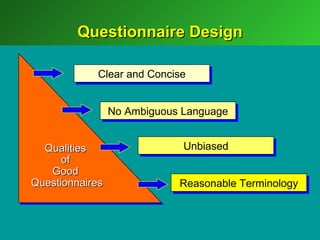
Questionnaire Design

            Clear and Concise


                 No Ambiguous Language


  Qualities                   Unbiased
      of
   Good
Questionnaires               Reasonable Terminology
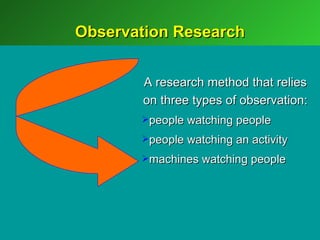
Observation Research


       A research method that relies
       on three types of observation:
       people watching people

       people watching an activity

       machines watching people
Observation Research

                   People        Mystery Shoppers
                  Watching
                   People         One-Way Mirrors

 Types of          People
Observation       Watching             Audits
 Research         an Activity

                 Machines         Traffic Counters
                 Watching
                  People        Passive People Meter
Mystery Shoppers


         Researchers posing as
         customers who gather
        observational data about
      a store and collect data about
           customer/employee
               interactions.
Experiment


   A method a researcher uses
     to gather primary data.
Sampling Procedure


Sample          A subset from a large population.

                   The population from which
Universe            a sample will be drawn.
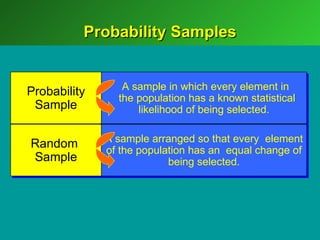
Probability Samples


                 A sample in which every element in
Probability     the population has a known statistical
 Sample             likelihood of being selected.

              A sample arranged so that every element
Random        of the population has an equal change of
Sample                     being selected.
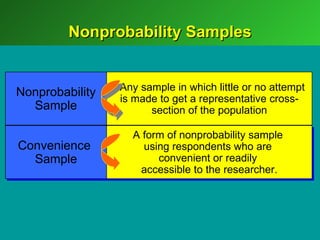
Nonprobability Samples


                 Any sample in which little or no attempt
Nonprobability   is made to get a representative cross-
  Sample               section of the population

                   A form of nonprobability sample
Convenience          using respondents who are
  Sample                convenient or readily
                    accessible to the researcher.
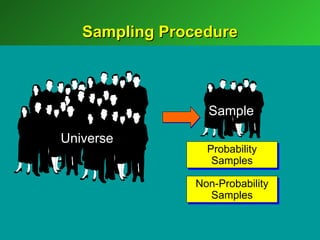
Sampling Procedure


                  Sample

Universe
                  Probability
                   Samples

                Non-Probability
                  Samples
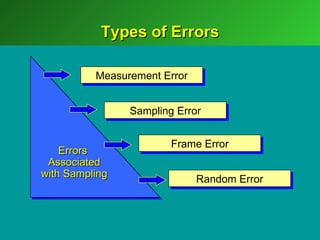
Types of Errors

          Measurement Error


                Sampling Error


                        Frame Error
    Errors
 Associated
with Sampling
                              Random Error
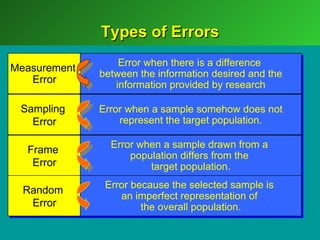
Types of Errors
                  Error when there is a difference
Measurement
              between the information desired and the
   Error         information provided by research

 Sampling     Error when a sample somehow does not
   Error          represent the target population.

                Error when a sample drawn from a
  Frame
                    population differs from the
   Error                target population.
               Error because the selected sample is
  Random
                  an imperfect representation of
   Error               the overall population.
Field Service Firm


         A firm that specializes in
      interviewing respondents on a
           subcontracted basis.
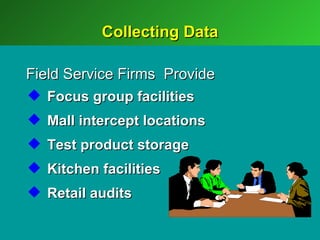
Collecting Data

Field Service Firms Provide
 Focus group facilities
 Mall intercept locations
 Test product storage
 Kitchen facilities
 Retail audits
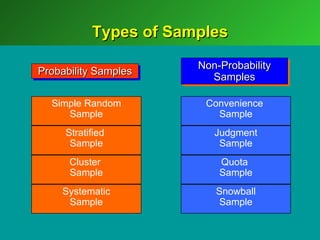
Types of Samples
                       Non-Probability
Probability Samples
                         Samples

  Simple Random         Convenience
     Sample               Sample
     Stratified           Judgment
      Sample               Sample
      Cluster              Quota
      Sample               Sample
    Systematic            Snowball
     Sample                Sample
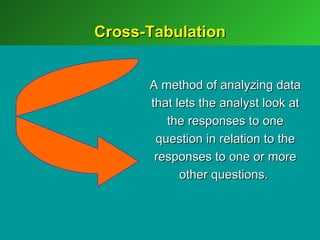
Cross-Tabulation


      A method of analyzing data
      that lets the analyst look at
         the responses to one
       question in relation to the
       responses to one or more
            other questions.
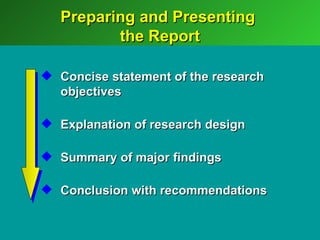
Preparing and Presenting
          the Report

 Concise statement of the research
  objectives

 Explanation of research design

 Summary of major findings

 Conclusion with recommendations
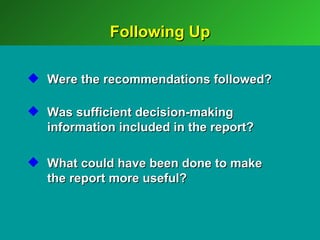
Following Up

 Were the recommendations followed?

 Was sufficient decision-making
  information included in the report?

 What could have been done to make
  the report more useful?
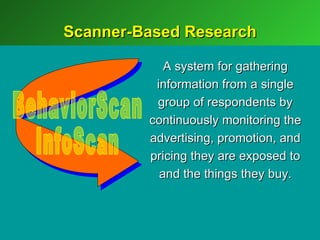
Scanner-Based Research

            A system for gathering
          information from a single
          group of respondents by
         continuously monitoring the
         advertising, promotion, and
         pricing they are exposed to
           and the things they buy.
When Should Marketing
Research be Conducted?

        Where there is a high level
         of uncertainty

        When value of research
         information exceeds the
         cost of generating the
         information

3 marketing research

  • 1.
    DECISION SUPPORT SYSTEMS AND MARKETING RESEARCH Prepared by Angela Zigras, Seneca College Deborah Baker, Texas Christian University
  • 2.
    You will learnto ... 1. Explain the concept and purpose of a marketing decision support system. 2. Define marketing research and explain its importance to marketing decision making. 3. Describe the steps involved in conducting a marketing research project.
  • 3.
    You will learnto ... 4. Discuss the growing importance of scanner- based research. 5. Explain when marketing research should and should not be conducted.
  • 4.
    Marketing Intelligence Everyday information about developments in the marketing environment that managers use to prepare and adjust marketing plans.
  • 5.
    Decision Support System An interactive, flexible computerized information system that enables managers to obtain and manipulate information as they are making decisions.
  • 6.
    DSS System Characteristics Interactive Flexible Discovery-Oriented Characteristics of a DSS System Accessible
  • 7.
    Database Marketing The creation of a large computerized file of customers’ and potential customers’ profiles and purchase patterns.
  • 8.
    Marketing Research The process of planning, collecting, and analyzing data relevant to a marketing decision.
  • 9.
    Defining Market Research (1)  Research is the systematic and objective approach to investigate a specific problem that needs a solution.  Research is a process by which a series of well thought out and carefully executed activities enable one to enquire, investigate or examine a problem to discover new facts to deal with the problem.
  • 10.
    Defining Research (2)  Systematic : well organised and planned  Objectivity : unbiased and unemotional  The information is used to identify and define opportunities and problems, and make recommendations on solutions  Market Research links consumer, customer and the public to the marketers through information.  Generate, refine and evaluate marketing actions, performance and the marketing process.
  • 11.
    Issues to considerwith Problem definition  Past information (secondary  P data/MIS)  R  Resources and constraints  Objectives  O  Buyer behaviour (human or  B organisational)  L  Legal environment   Economic environment E  Marketing and technological  M skills
  • 12.
    Roles of MarketingResearch Marketing Research has three roles: Descriptive Predictive Diagnostic
  • 13.
    Roles of MarketingResearch  Gathering and presenting Descriptive factual statements Diagnostic  Explaining data  Attempting to estimate the Predictive results of a planned marketing decision
  • 14.
    Management Uses of Marketing Research  Improve the quality of decision making  Trace problems  Focus on keeping existing customers  Understand the ever-changing marketplace
  • 15.
    Steps in aMarketing Research Project Define Problem Plan Design/ Specify Primary Data Sampling Procedure Collect Data Analyze Data Prepare/ Present Report Follow Up
  • 16.
    Marketing Research Marketing Determining what information is needed and Research how that information can be Problem obtained efficiently and effectively. Marketing The specific information needed to solve a marketing research problem; Research the objective should provide insightful Objective decision-making information. Management A broad-based problem that Decision requires marketing research in order Problem for managers to take proper actions.
  • 17.
    Objective setting example1  Management Problem: Should a new product be launched?  Research Objective: Determine consumer preference and purchase intentions for the proposed new product.
  • 18.
    Objective setting example2  Management Problem: Should the ad campaign be changed?  Research Objective: To determine effectiveness of the current campaign.
  • 19.
    Objective setting example3  Management Problem: Should the price of the brand be increased?  Research Objective: To determine the price elasticity of demand and the impact on sales and profits of various levels of price changes.
  • 20.
    Sources of SecondaryData Internal Information Marketing Research Firms Trade and Industry Associations National Research Bureaus Professional Associations Commercial Publications
  • 21.
    Secondary Data Data previously collected for any purpose other than the one at hand.
  • 22.
    Advantages of SecondaryData  Saves time and money if on target  Aids in determining direction for primary data collection  Pinpoints the kinds of people to approach  Serves as a basis of comparison for other data
  • 23.
    Disadvantages of SecondaryData  May not be on target with the research problem  Quality and accuracy of data may pose a problem
  • 24.
    The New Ageof Secondary Information The Internet  Search Engines www and Directories  Sites of Interest to Marketing Researchers  Discussion Groups  Periodical, Newspaper, and Book Databases
  • 25.
    Basic Types ofDirectories  Academic and Professional Directories  Commercial Portals
  • 26.
    Research Design Specifies which research questions must be answered, how and when the data will be gathered, and how the data will be analyzed.
  • 27.
    Planning the ResearchDesign Which research How and when questions will data be must be answered? gathered? ? How will the data be analyzed?
  • 28.
    Primary Data Information collected for the first time. Can be used for solving the particular problem under investigation.
  • 29.
    Advantages of PrimaryData  Answers a specific research question  Data are current  Source of data is known  Secrecy can be maintained
  • 30.
    Disadvantages of PrimaryData  Expensive  Quality declines if interviews are lengthy  Reluctance to participate in lengthy interviews
  • 31.
    Survey Research The most popular technique for gathering primary data in which a researcher interacts with people to obtain facts, opinions, and attitudes.
  • 32.
    Forms of SurveyResearch Mall Intercept Interviews Mail Surveys Computer-assisted Internet Surveys Personal Interviewing Telephone Interviews Focus Groups (Home and Central Location)
  • 33.
    Mall Intercept Interview Survey research method that involves interviewing people in the common areas of shopping malls.
  • 34.
    Computer-Assisted Personal Interviewing An interviewing method in which the interviewer reads the questions from a computer screen and enters the respondent’s data directly into the computer.
  • 35.
    Impact of theInternet  Allows better and faster decision making  Improves ability to respond quickly to customer needs and market shifts  Makes follow-up studies and research easier  Slashes labour-and time-intensive research activities
  • 36.
    Advantages of InternetSurveys Rapid development, Real-time reporting Reduced costs Advantages of Personalized questions Internet Surveys and data Improved respondent participation Contact with the hard-to-reach
  • 37.
    Internet Samples Unrestricted A survey in which anyone with Internet a computer and modem can fill out Sample the questionnaire. Screened An Internet sample with quotas based Internet on desired sample characteristics. Sample Recruited A sample in which respondents Internet are prerecruited and must Sample qualify to participate.
  • 38.
    Other Uses ofthe Internet Distribution of requests for proposals Collaboration in the management of a research project Other Internet Uses Data management and by Marketing on-line analysis Researchers Publication and distribution of reports Viewing of presentations of marketing research surveys
  • 39.
    Focus Group Seven to ten people who participate in a group discussion led by a moderator.
  • 40.
    Advantages of On-Line Focus Groups  Speed  Cost-effectiveness  Broad geographic scope  Accessibility  Honesty
  • 41.
    Questionnaire Design An interview question that encourages Open-Ended an answer phrased in respondent’s own Question words. An interview question that asks Closed-Ended the respondent to make a selection from Question a limited list of responses. Scaled- A closed-ended question Response designed to measure the intensity Question of a respondent’s answer.
  • 42.
    Questionnaire Design Clear and Concise No Ambiguous Language Qualities Unbiased of Good Questionnaires Reasonable Terminology
  • 43.
    Observation Research A research method that relies on three types of observation: people watching people people watching an activity machines watching people
  • 44.
    Observation Research People Mystery Shoppers Watching People One-Way Mirrors Types of People Observation Watching Audits Research an Activity Machines Traffic Counters Watching People Passive People Meter
  • 45.
    Mystery Shoppers Researchers posing as customers who gather observational data about a store and collect data about customer/employee interactions.
  • 46.
    Experiment A method a researcher uses to gather primary data.
  • 47.
    Sampling Procedure Sample A subset from a large population. The population from which Universe a sample will be drawn.
  • 48.
    Probability Samples A sample in which every element in Probability the population has a known statistical Sample likelihood of being selected. A sample arranged so that every element Random of the population has an equal change of Sample being selected.
  • 49.
    Nonprobability Samples Any sample in which little or no attempt Nonprobability is made to get a representative cross- Sample section of the population A form of nonprobability sample Convenience using respondents who are Sample convenient or readily accessible to the researcher.
  • 50.
    Sampling Procedure Sample Universe Probability Samples Non-Probability Samples
  • 51.
    Types of Errors Measurement Error Sampling Error Frame Error Errors Associated with Sampling Random Error
  • 52.
    Types of Errors Error when there is a difference Measurement between the information desired and the Error information provided by research Sampling Error when a sample somehow does not Error represent the target population. Error when a sample drawn from a Frame population differs from the Error target population. Error because the selected sample is Random an imperfect representation of Error the overall population.
  • 53.
    Field Service Firm A firm that specializes in interviewing respondents on a subcontracted basis.
  • 54.
    Collecting Data Field ServiceFirms Provide  Focus group facilities  Mall intercept locations  Test product storage  Kitchen facilities  Retail audits
  • 55.
    Types of Samples Non-Probability Probability Samples Samples Simple Random Convenience Sample Sample Stratified Judgment Sample Sample Cluster Quota Sample Sample Systematic Snowball Sample Sample
  • 56.
    Cross-Tabulation A method of analyzing data that lets the analyst look at the responses to one question in relation to the responses to one or more other questions.
  • 57.
    Preparing and Presenting the Report  Concise statement of the research objectives  Explanation of research design  Summary of major findings  Conclusion with recommendations
  • 58.
    Following Up  Werethe recommendations followed?  Was sufficient decision-making information included in the report?  What could have been done to make the report more useful?
  • 59.
    Scanner-Based Research A system for gathering information from a single group of respondents by continuously monitoring the advertising, promotion, and pricing they are exposed to and the things they buy.
  • 60.
    When Should Marketing Researchbe Conducted?  Where there is a high level of uncertainty  When value of research information exceeds the cost of generating the information

Editor's Notes

  • #2 Decision Support Systems & Marketing Research Chapter 8 Version 6e