The Scope and Challenge of International Marketing
Chapter 1
McGraw-Hill/Irwin © 2005 The McGraw-Hill Companies, Inc. All rights reserved.
PowerPoint presentation prepared by:
Professor Rajiv Mehta
Associate Professor of Marketing
New Jersey Institute of Technology
Newark, N.J.
Chapter Learning Objectives
1. The changing face of U.S. business
2. The scope of the international marketing task
3. The increasing importance of global awareness
4. The progression of becoming a global marketer
5. The importance of the self-reference criterion (SRC) in
international marketing
Preface
“Never before in American history have U.S. businesses, large
and small, been so deeply involved in and affected by
international business. A global economic boom, unprecedented
in modern economic history, has been under way as the drive for
efficiency, productivity, and open, unregulated markets sweeps
the world. Powerful economic, technological, industrial, political,
and demographic forces are converging to build the foundation of
a new global economic order on which the structure of a
one-world economic and market system will be built”
(Cateora and Graham)
Global Perspective: Recent Events
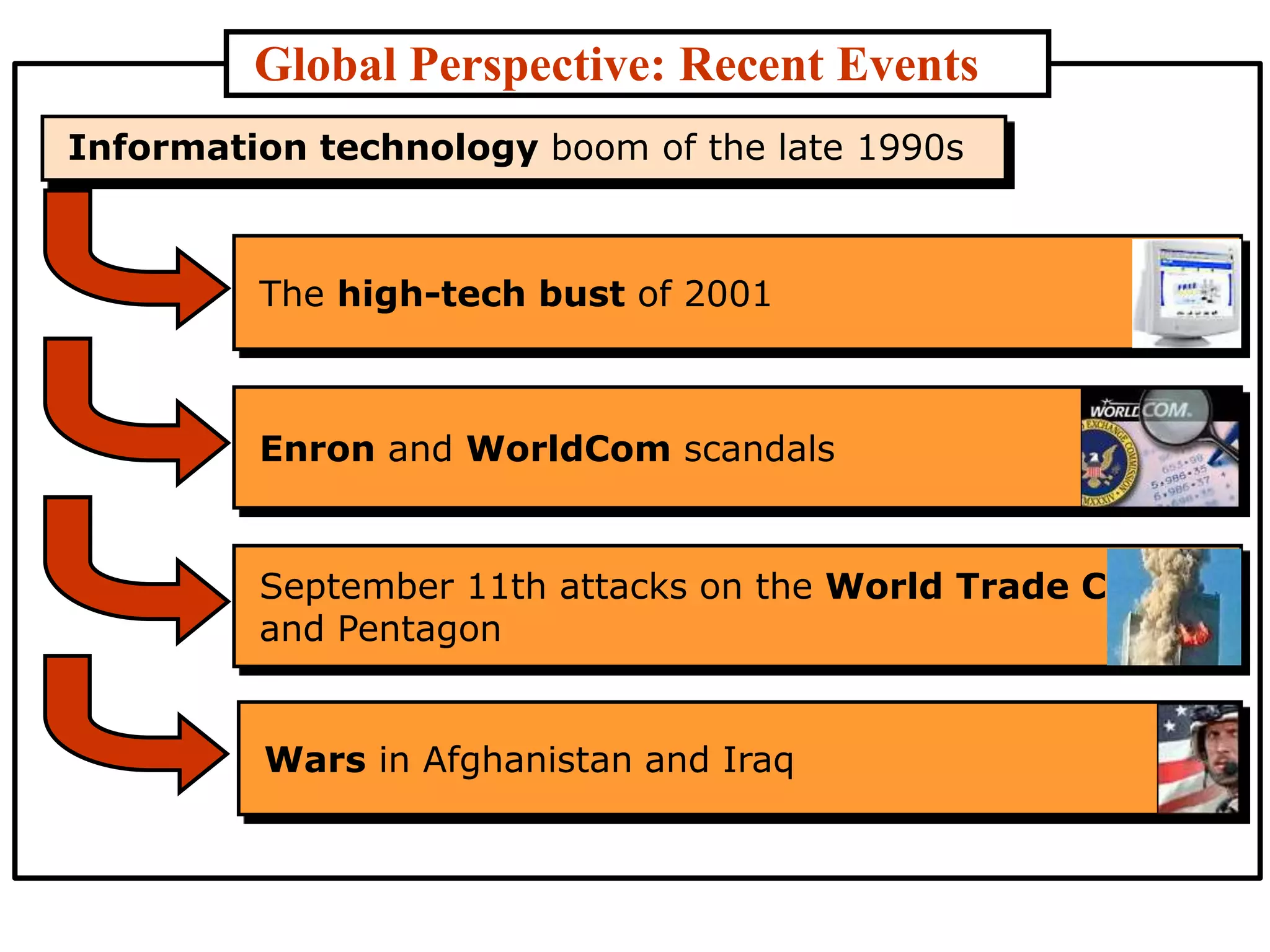
Information technology boom of the late 1990s
Wars in Afghanistan and Iraq
September 11th attacks on the World Trade Center
and Pentagon
Enron and WorldCom scandals
The high-tech bust of 2001
Global Perspective: Recent Events
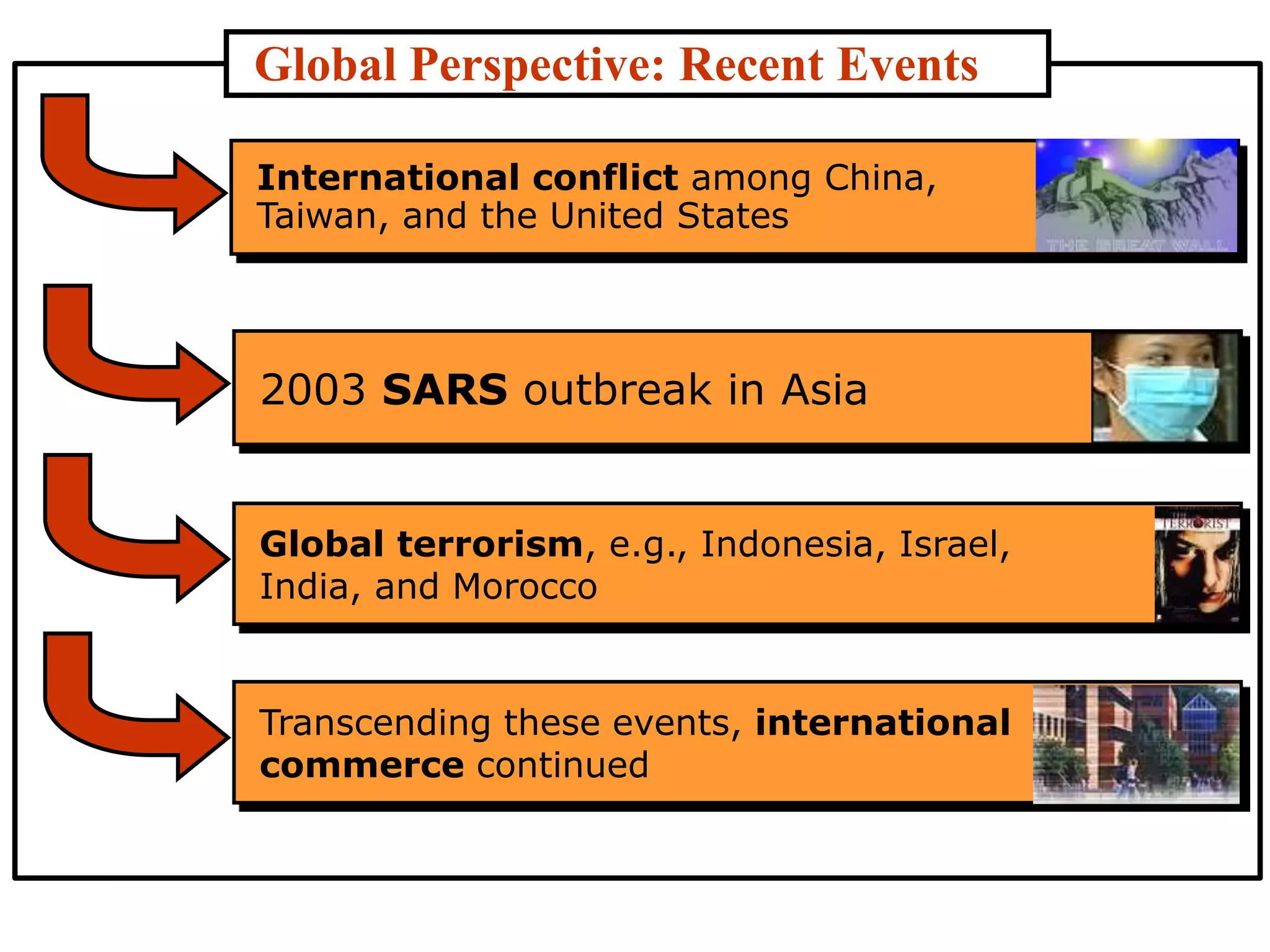
2003 SARS outbreak in Asia
Global terrorism, e.g., Indonesia, Israel,
India, and Morocco
Transcending these events, international
commerce continued
International conflict among China,
Taiwan, and the United States
Global Business Trends
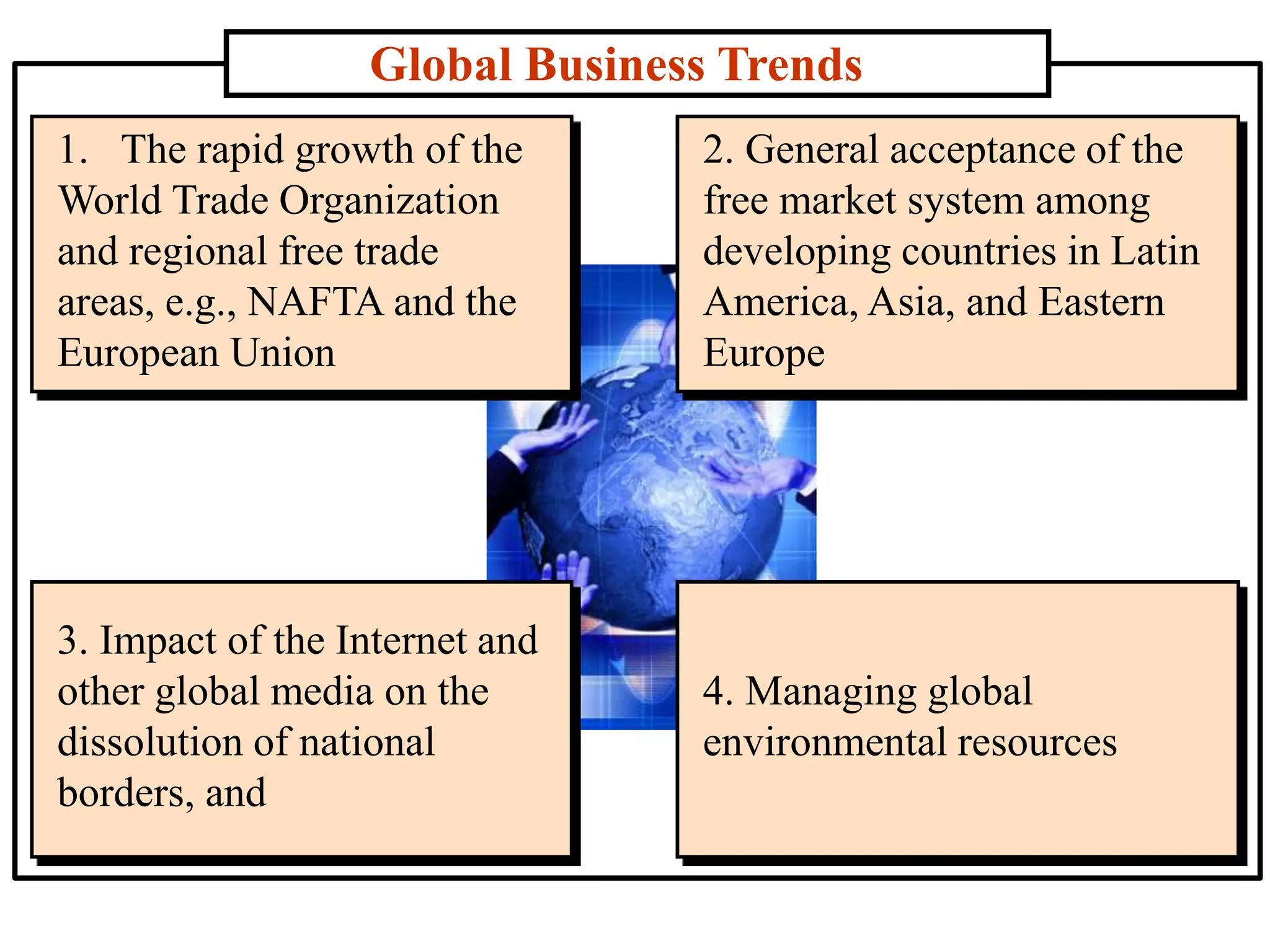
1. The rapid growth of the
World Trade Organization
and regional free trade
areas, e.g., NAFTA and the
European Union
2. General acceptance of the
free market system among
developing countries in Latin
America, Asia, and Eastern
Europe
3. Impact of the Internet and
other global media on the
dissolution of national
borders, and
4. Managing global
environmental resources
Internationalization of U.S. Business
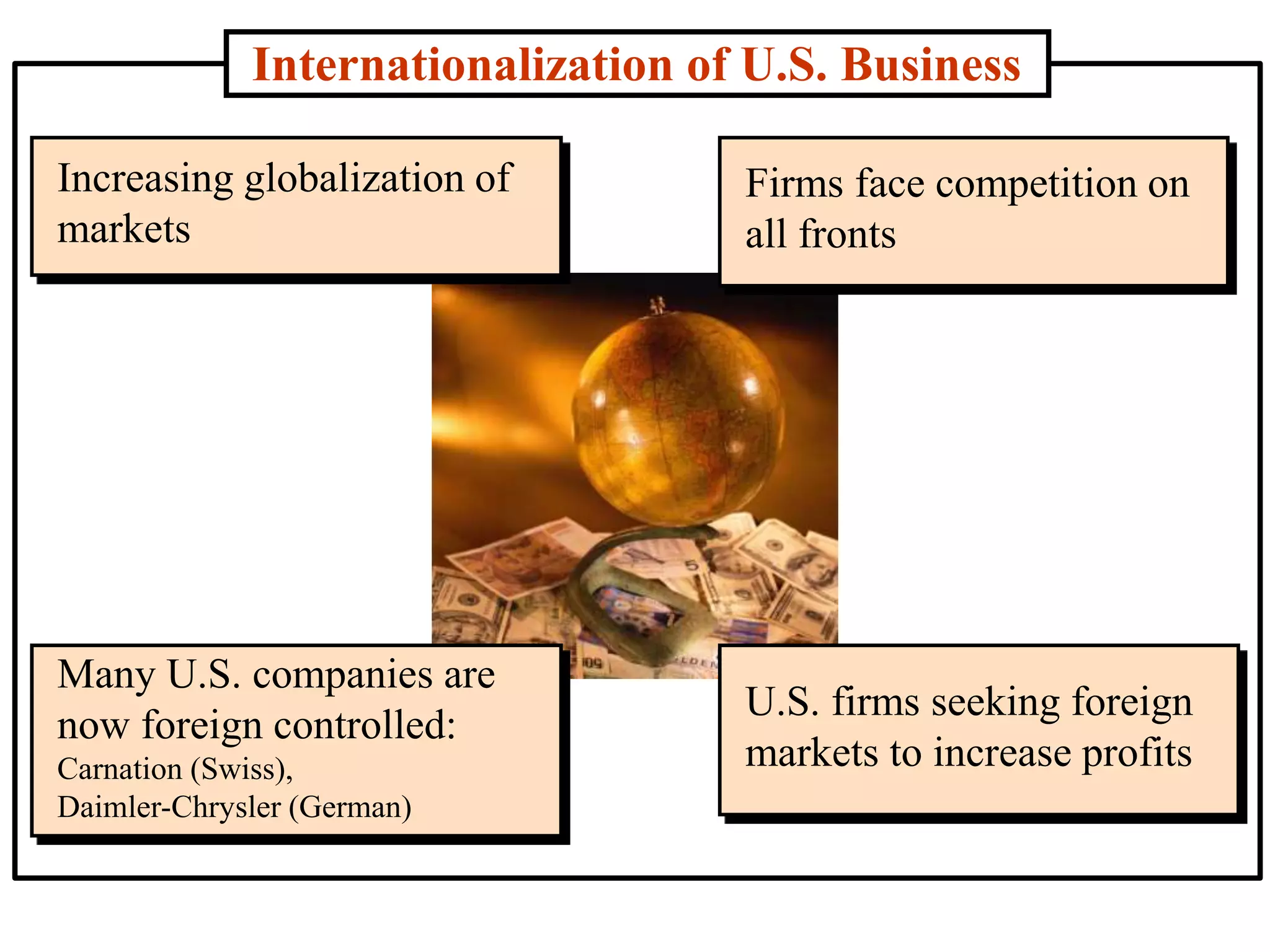
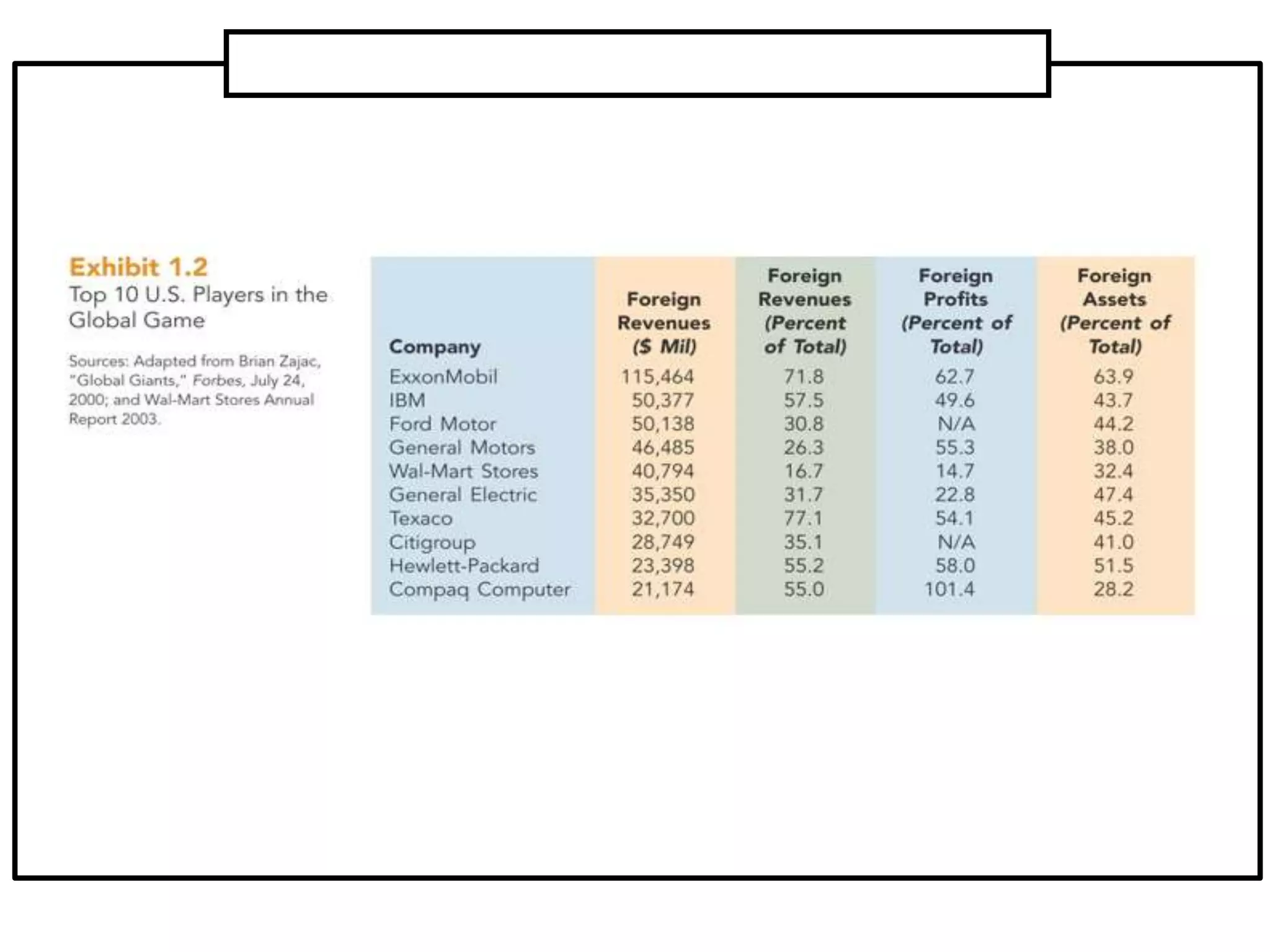
Increasing globalization of
markets
Firms face competition on
all fronts
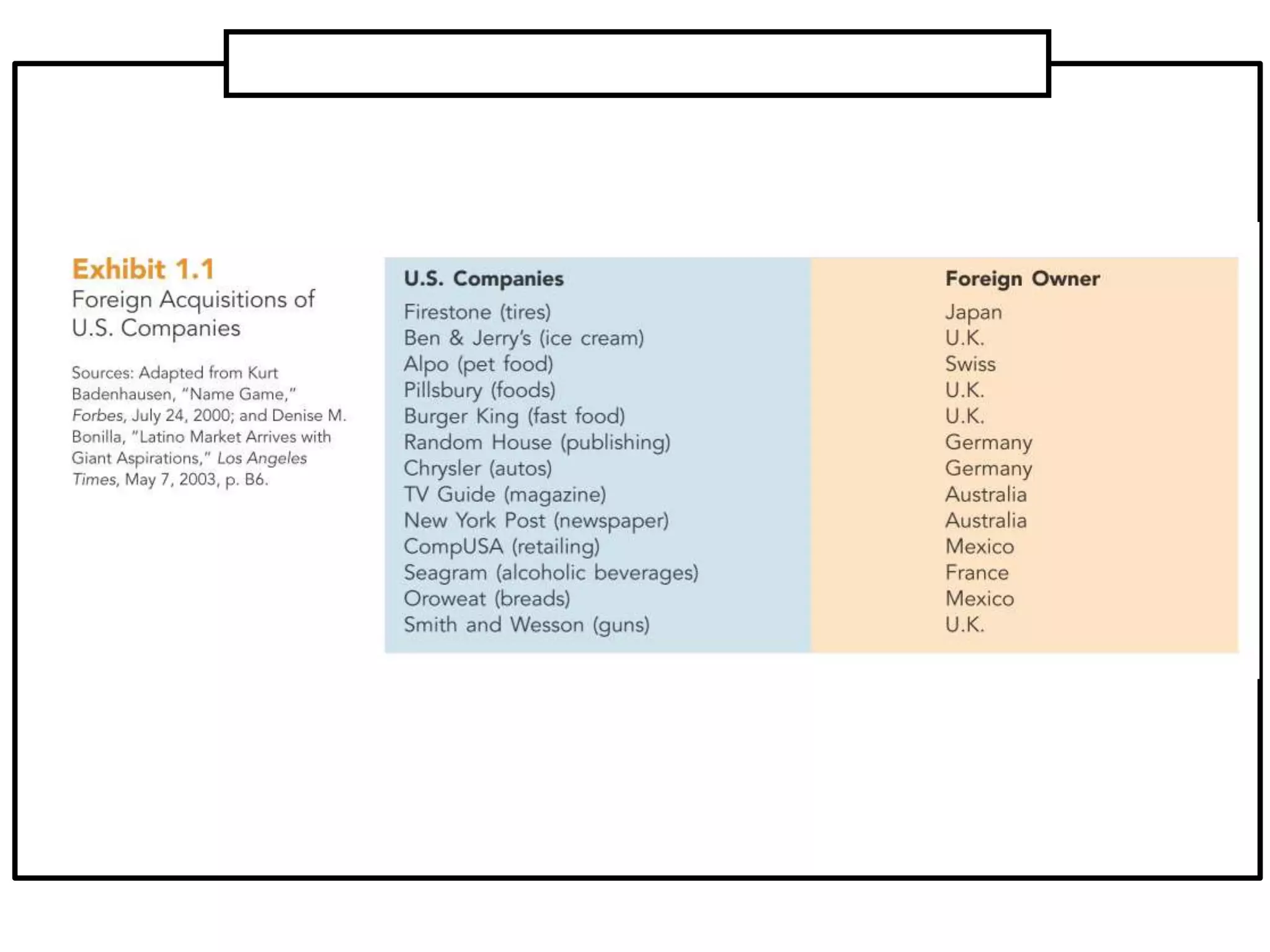
Many U.S. companies are
now foreign controlled:
Carnation (Swiss),
Daimler-Chrysler (German)
U.S. firms seeking foreign
markets to increase profits
International Marketing: A Definition
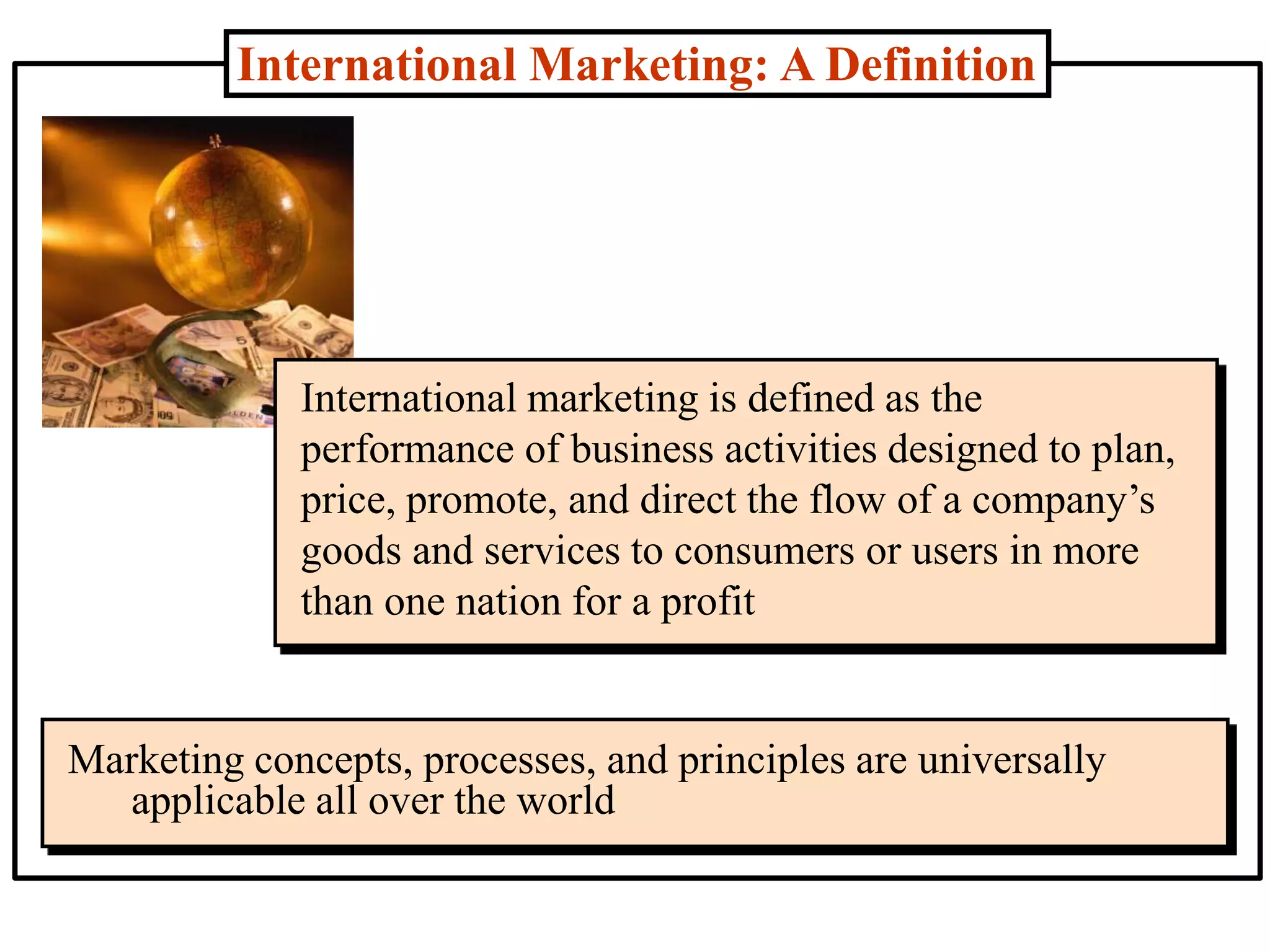
International marketing is defined as the
performance of business activities designed to plan,
price, promote, and direct the flow of a company’s
goods and services to consumers or users in more
than one nation for a profit
Marketing concepts, processes, and principles are universally
applicable all over the world
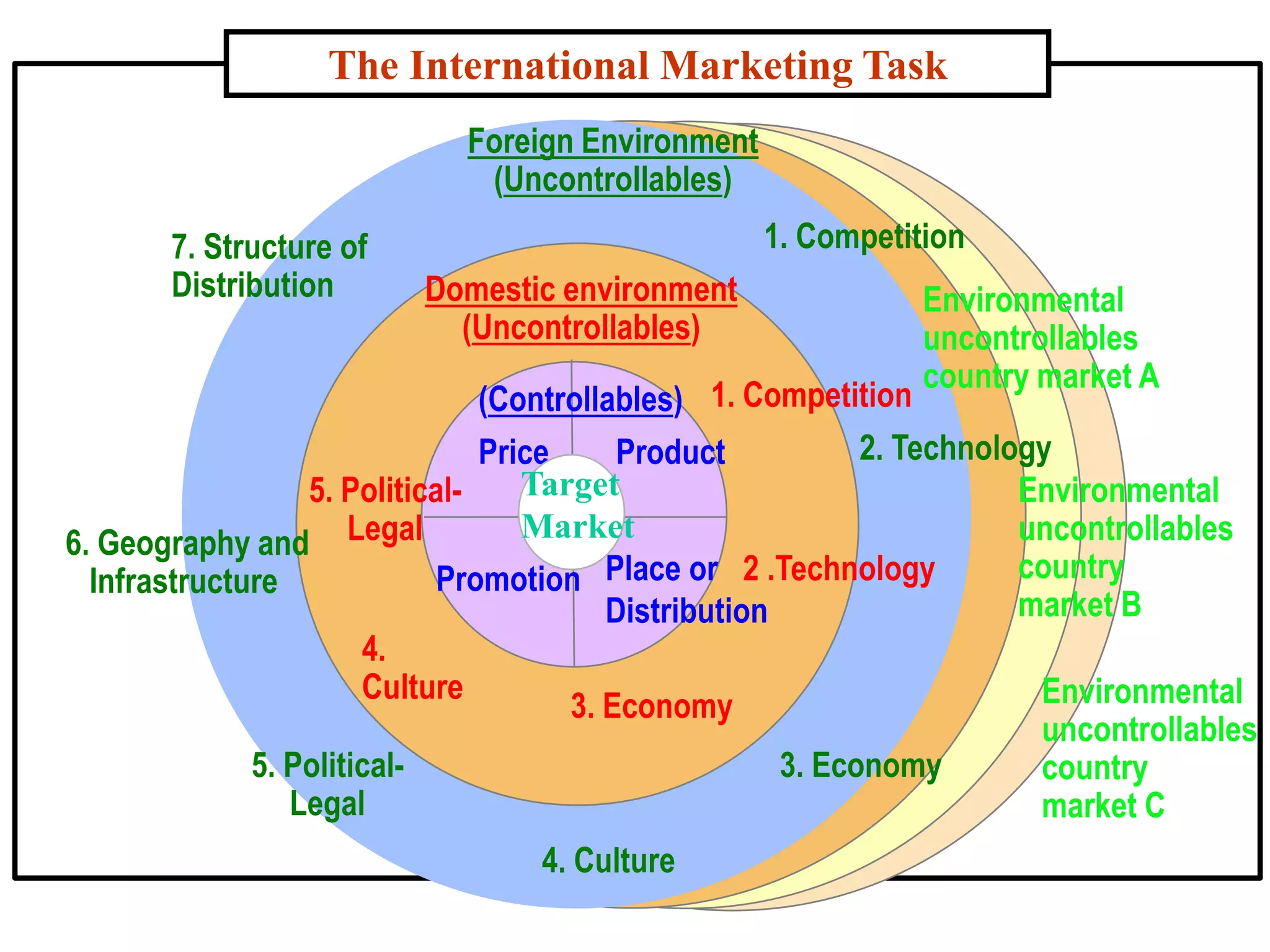
The International Marketing Task
7
3. Economy
Environmental
uncontrollables
country market A
Environmental
uncontrollables
country
market B
Environmental
uncontrollables
country
market C
1. Competition
1. Competition
2. Technology
Price Product
Promotion Place or
Distribution
6. Geography and
Infrastructure
Foreign Environment
(Uncontrollables)
7. Structure of
Distribution
3. Economy
5. Political-
Legal
Domestic environment
(Uncontrollables)
(Controllables)
2 .Technology
4.
Culture
5. Political-
Legal
4. Culture
Target
Market
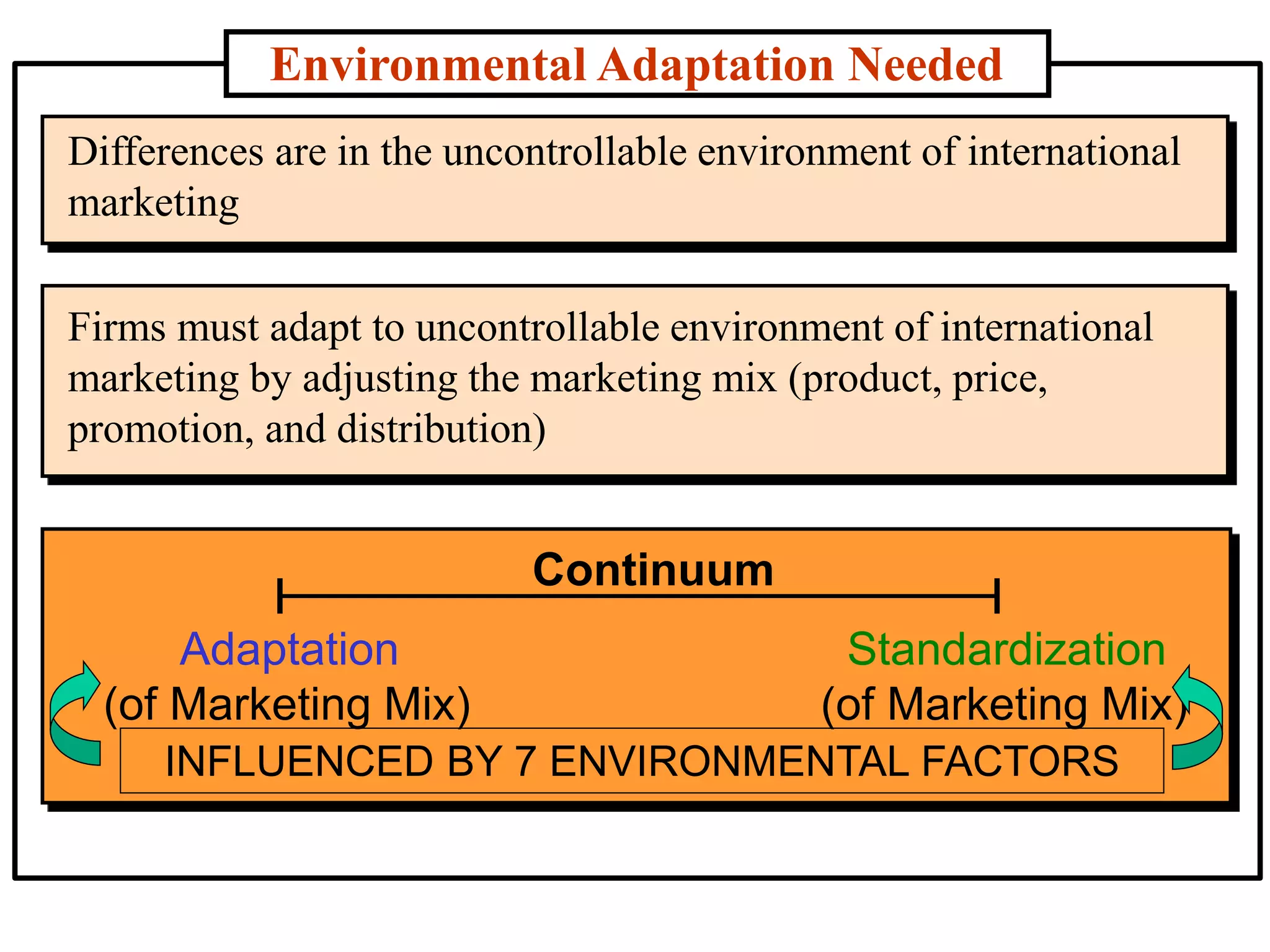
Environmental Adaptation Needed
Differences are in the uncontrollable environment of international
marketing
Firms must adapt to uncontrollable environment of international
marketing by adjusting the marketing mix (product, price,
promotion, and distribution)
Adaptation
(of Marketing Mix)
Standardization
(of Marketing Mix)
Continuum
INFLUENCED BY 7 ENVIRONMENTAL FACTORS
Self-Reference Criterion (SRC)
and Ethnocentrism:Major Obstacles
• SRC is an unconscious reference to one’s own cultural
values, experiences, and knowledge as a basis for
decisions
• Ethnocentrism refers to the notion that one’s own culture
or company knows best how to do things
• Both the SRC and ethnocentrism impede the ability to
assess a foreign market in its true light
• Reactions to meanings, values, symbols, and behavior
relevant to our own culture are different from those of
foreign
• Relying on one’s SRC could produce an unsuccessful
marketing program
Avoiding the Self Reference Criterion
To avoid the SRC, the following steps are suggested:
1: Define the business problem or goal in home-country
cultural traits, habits, or norms
2: Define the business problem or goal in foreign-country
cultural traits, habits, or norms. Make no value
judgments
3: Isolate the SRC Influence in the problem and examine it
carefully to see how it complicates the problem
4: Redefine the problem without the SRC influence and
solve for the optimum business goal situation*
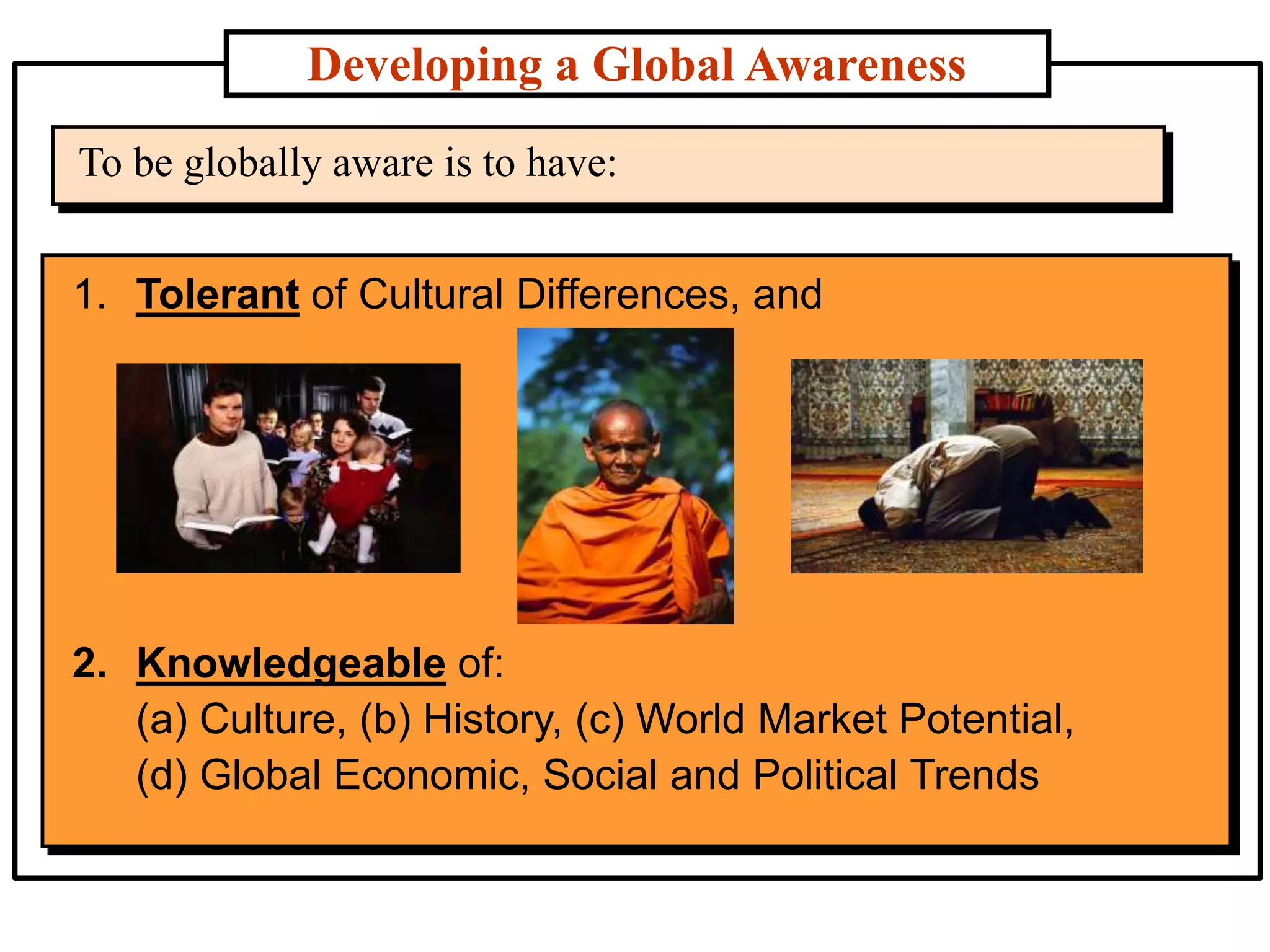
Developing a Global Awareness
To be globally aware is to have:
1. Tolerant of Cultural Differences, and
2. Knowledgeable of:
(a) Culture, (b) History, (c) World Market Potential,
(d) Global Economic, Social and Political Trends
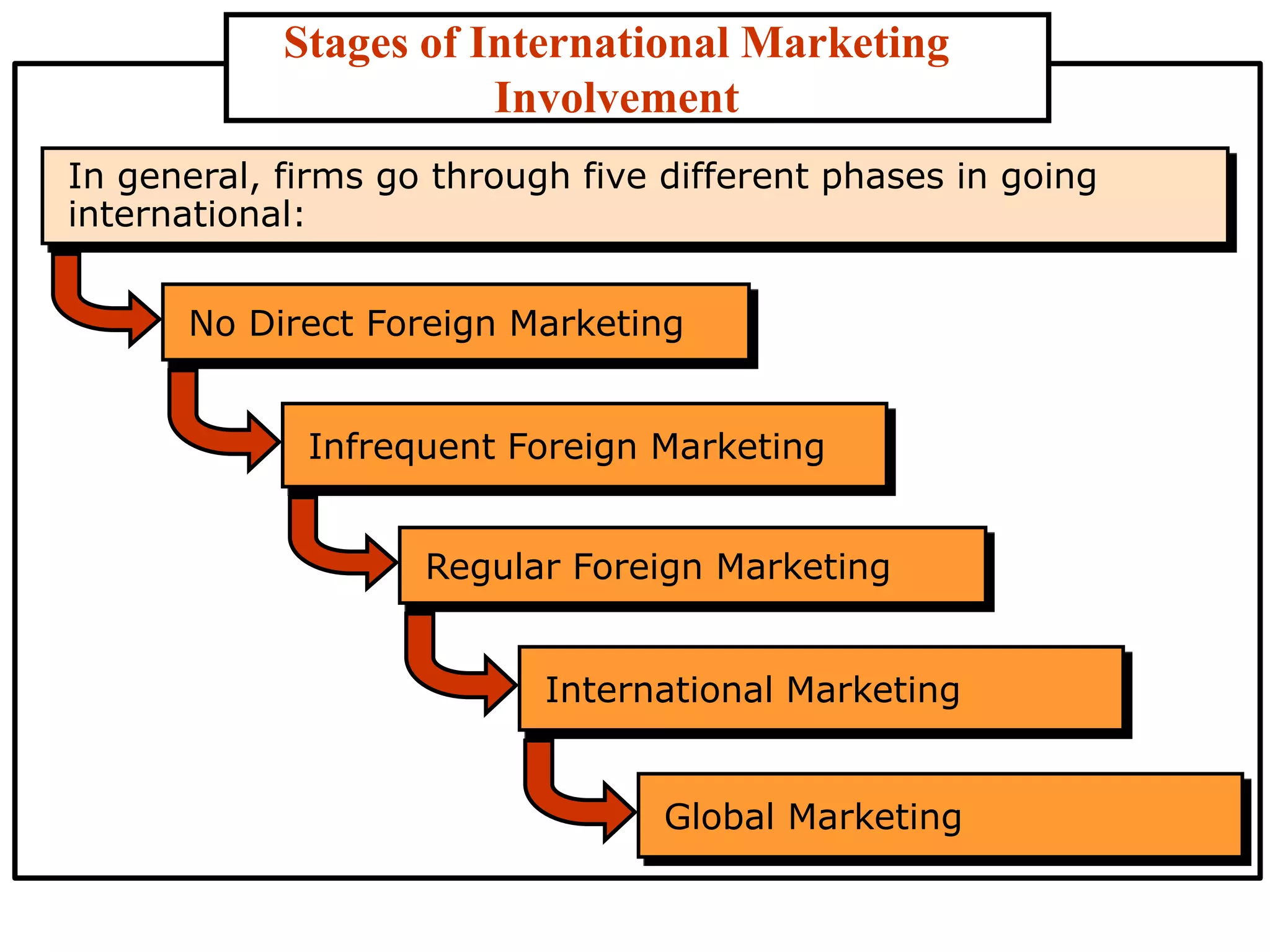
Stages of International Marketing
Involvement
In general, firms go through five different phases in going
international:
Infrequent Foreign Marketing
No Direct Foreign Marketing
International Marketing
Regular Foreign Marketing
Global Marketing
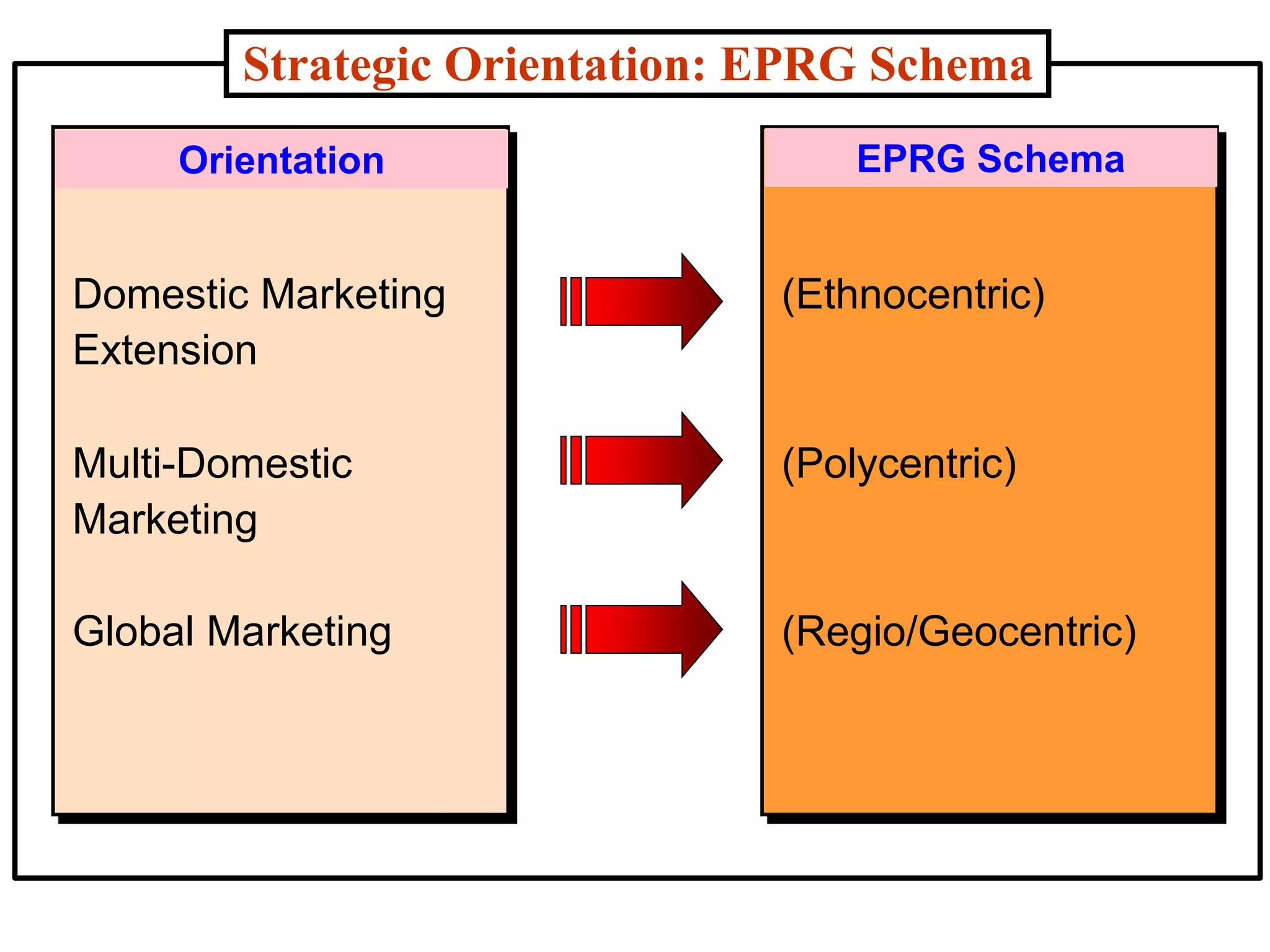
Strategic Orientation: EPRG Schema
Orientation EPRG Schema
Domestic Marketing
Extension
Multi-Domestic
Marketing
Global Marketing
(Ethnocentric)
(Polycentric)
(Regio/Geocentric)
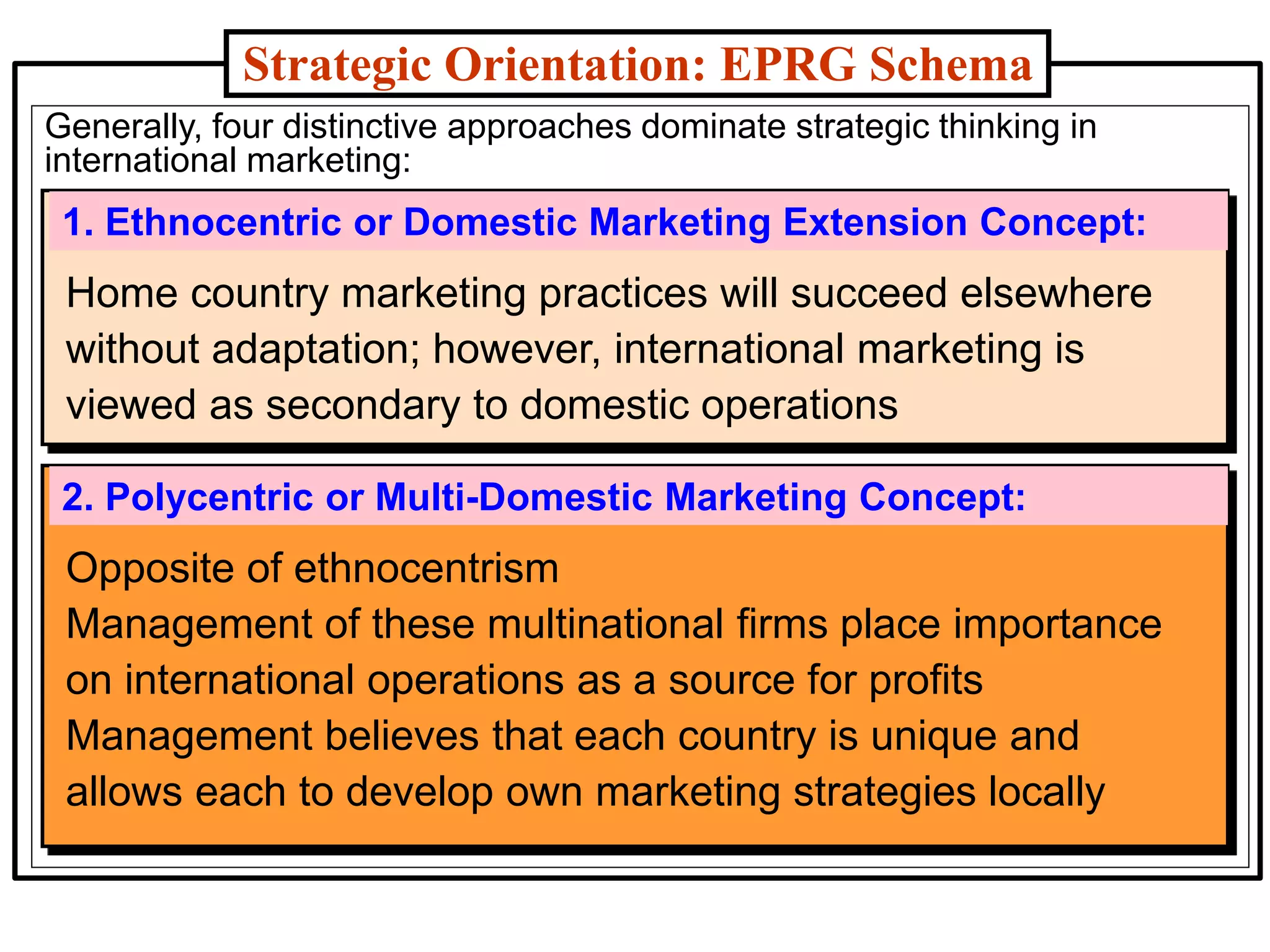
Generally, four distinctive approaches dominate strategic thinking in
international marketing:
Strategic Orientation: EPRG Schema
1. Ethnocentric or Domestic Marketing Extension Concept:
2. Polycentric or Multi-Domestic Marketing Concept:
Opposite of ethnocentrism
Management of these multinational firms place importance
on international operations as a source for profits
Management believes that each country is unique and
allows each to develop own marketing strategies locally
Home country marketing practices will succeed elsewhere
without adaptation; however, international marketing is
viewed as secondary to domestic operations
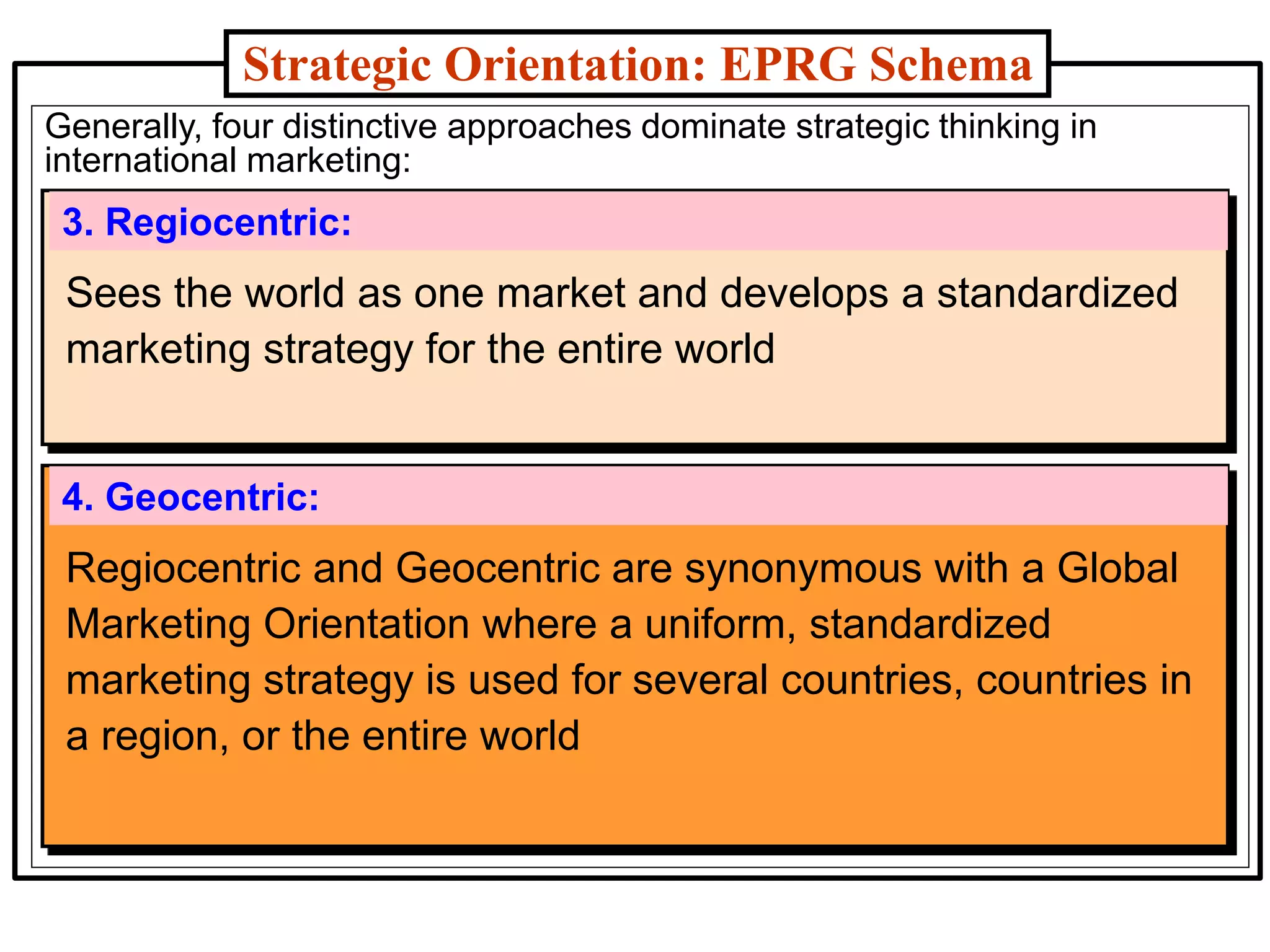
Generally, four distinctive approaches dominate strategic thinking in
international marketing:
Strategic Orientation: EPRG Schema
3. Regiocentric:
4. Geocentric:
Regiocentric and Geocentric are synonymous with a Global
Marketing Orientation where a uniform, standardized
marketing strategy is used for several countries, countries in
a region, or the entire world
Sees the world as one market and develops a standardized
marketing strategy for the entire world

Chap1-Cateora.ppt

  • 2.
    The Scope andChallenge of International Marketing Chapter 1 McGraw-Hill/Irwin © 2005 The McGraw-Hill Companies, Inc. All rights reserved. PowerPoint presentation prepared by: Professor Rajiv Mehta Associate Professor of Marketing New Jersey Institute of Technology Newark, N.J.
  • 3.
    Chapter Learning Objectives 1.The changing face of U.S. business 2. The scope of the international marketing task 3. The increasing importance of global awareness 4. The progression of becoming a global marketer 5. The importance of the self-reference criterion (SRC) in international marketing
  • 4.
    Preface “Never before inAmerican history have U.S. businesses, large and small, been so deeply involved in and affected by international business. A global economic boom, unprecedented in modern economic history, has been under way as the drive for efficiency, productivity, and open, unregulated markets sweeps the world. Powerful economic, technological, industrial, political, and demographic forces are converging to build the foundation of a new global economic order on which the structure of a one-world economic and market system will be built” (Cateora and Graham)
  • 5.
    Global Perspective: RecentEvents Information technology boom of the late 1990s Wars in Afghanistan and Iraq September 11th attacks on the World Trade Center and Pentagon Enron and WorldCom scandals The high-tech bust of 2001
  • 6.
    Global Perspective: RecentEvents 2003 SARS outbreak in Asia Global terrorism, e.g., Indonesia, Israel, India, and Morocco Transcending these events, international commerce continued International conflict among China, Taiwan, and the United States
  • 7.
    Global Business Trends 1.The rapid growth of the World Trade Organization and regional free trade areas, e.g., NAFTA and the European Union 2. General acceptance of the free market system among developing countries in Latin America, Asia, and Eastern Europe 3. Impact of the Internet and other global media on the dissolution of national borders, and 4. Managing global environmental resources
  • 8.
    Internationalization of U.S.Business Increasing globalization of markets Firms face competition on all fronts Many U.S. companies are now foreign controlled: Carnation (Swiss), Daimler-Chrysler (German) U.S. firms seeking foreign markets to increase profits
  • 11.
    International Marketing: ADefinition International marketing is defined as the performance of business activities designed to plan, price, promote, and direct the flow of a company’s goods and services to consumers or users in more than one nation for a profit Marketing concepts, processes, and principles are universally applicable all over the world
  • 12.
    The International MarketingTask 7 3. Economy Environmental uncontrollables country market A Environmental uncontrollables country market B Environmental uncontrollables country market C 1. Competition 1. Competition 2. Technology Price Product Promotion Place or Distribution 6. Geography and Infrastructure Foreign Environment (Uncontrollables) 7. Structure of Distribution 3. Economy 5. Political- Legal Domestic environment (Uncontrollables) (Controllables) 2 .Technology 4. Culture 5. Political- Legal 4. Culture Target Market
  • 13.
    Environmental Adaptation Needed Differencesare in the uncontrollable environment of international marketing Firms must adapt to uncontrollable environment of international marketing by adjusting the marketing mix (product, price, promotion, and distribution) Adaptation (of Marketing Mix) Standardization (of Marketing Mix) Continuum INFLUENCED BY 7 ENVIRONMENTAL FACTORS
  • 14.
    Self-Reference Criterion (SRC) andEthnocentrism:Major Obstacles • SRC is an unconscious reference to one’s own cultural values, experiences, and knowledge as a basis for decisions • Ethnocentrism refers to the notion that one’s own culture or company knows best how to do things • Both the SRC and ethnocentrism impede the ability to assess a foreign market in its true light • Reactions to meanings, values, symbols, and behavior relevant to our own culture are different from those of foreign • Relying on one’s SRC could produce an unsuccessful marketing program
  • 15.
    Avoiding the SelfReference Criterion To avoid the SRC, the following steps are suggested: 1: Define the business problem or goal in home-country cultural traits, habits, or norms 2: Define the business problem or goal in foreign-country cultural traits, habits, or norms. Make no value judgments 3: Isolate the SRC Influence in the problem and examine it carefully to see how it complicates the problem 4: Redefine the problem without the SRC influence and solve for the optimum business goal situation*
  • 16.
    Developing a GlobalAwareness To be globally aware is to have: 1. Tolerant of Cultural Differences, and 2. Knowledgeable of: (a) Culture, (b) History, (c) World Market Potential, (d) Global Economic, Social and Political Trends
  • 17.
    Stages of InternationalMarketing Involvement In general, firms go through five different phases in going international: Infrequent Foreign Marketing No Direct Foreign Marketing International Marketing Regular Foreign Marketing Global Marketing
  • 18.
    Strategic Orientation: EPRGSchema Orientation EPRG Schema Domestic Marketing Extension Multi-Domestic Marketing Global Marketing (Ethnocentric) (Polycentric) (Regio/Geocentric)
  • 19.
    Generally, four distinctiveapproaches dominate strategic thinking in international marketing: Strategic Orientation: EPRG Schema 1. Ethnocentric or Domestic Marketing Extension Concept: 2. Polycentric or Multi-Domestic Marketing Concept: Opposite of ethnocentrism Management of these multinational firms place importance on international operations as a source for profits Management believes that each country is unique and allows each to develop own marketing strategies locally Home country marketing practices will succeed elsewhere without adaptation; however, international marketing is viewed as secondary to domestic operations
  • 20.
    Generally, four distinctiveapproaches dominate strategic thinking in international marketing: Strategic Orientation: EPRG Schema 3. Regiocentric: 4. Geocentric: Regiocentric and Geocentric are synonymous with a Global Marketing Orientation where a uniform, standardized marketing strategy is used for several countries, countries in a region, or the entire world Sees the world as one market and develops a standardized marketing strategy for the entire world