INTERNATIONAL INSTITUTIONS
PRESENTED BY
SIMRAN KAUR
MBA 2ND YEAR
IGICM
UNCTAD
• United Nations Conference on Trade and Development
• 194 states are members
• Established in 1964 as a permanent intergovernmental body of UNO assembly
• Responsible for dealing with developmental issues particularly international trade, the main driver of
development
• UNCTAD Secretriat : Geneva Secretriat headed by Mukhisa Kituyi from Kenya
• Meets every 4 years
• 11 conferences have been held up to 2004
• Aim to help take informed decision and promote macro-economic policies best suitable to ending global
economic inequalities
ROLE OF UNCTAD
• Globalization and development
• Provide technical assistance on the management of public debt
• Promote integrated approach to trade, environment and sustainable development
• Focus on contribution of commodity sector to development, advocating diversification and risk
management
• Inform policy makers about the structure and evolution of FDI in the world
• Participate in setting international accounting standards
• Focus on issue related to international investment agreements
FUNCTIONS OF UNCTAD
• To promote international trade with a view to accelerating economic development
• To formulate principles of and policies on international trade and related problems of economic
development
• To negotiate multinational trade agreements
• To make proposals for putting its principles and policies into effect
PRINCIPLES OF UNCTAD
• Every country has the sovereign right freely to dispose of its natural resources in the interest of
economic development and freely to trade with other countries
• Economic relations including trade relations shall be based on the respect for the principles of sovereign
equality of states, self determination of people, and non-interference in internal affairs of other
countries
• There shall be no discrimination on the basis of differences in socio-economic systems
INTERNATIONAL MONETARY FUND(IMF)
• Established on December 27, 1945 with 29 countries
• Began financial operations on March 1, 1947
• Central institution of international monetary system
• Aims to prevent crises in the system by encouraging countries to adopt sound economic policies
• 187 countries on September 30, 2010
PURPOSES OF IMF
• Promote international monetary cooperation through a permanent institution
• Facilitate expansion and balanced growth of international trade
• Promote exchange stability
• Assist in establishment of multilateral system of payments
• Monitors economic and financial developments and policies
• Provides the governments and central banks of its member countries with technical assistance and
training in its area of expertise
VISION OF IMF
• Strive to promote sustained non-inflationary economic growth that benefits all people
• Be the centre of competence for the stability of the international financial system
• Focus on its core macroeconomic and financial areas of responsibility
• Be an open institution, learning from experience and dialogue
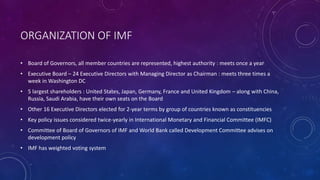
ORGANIZATION OF IMF
• Board of Governors, all member countries are represented, highest authority : meets once a year
• Executive Board – 24 Executive Directors with Managing Director as Chairman : meets three times a
week in Washington DC
• 5 largest shareholders : United States, Japan, Germany, France and United Kingdom – along with China,
Russia, Saudi Arabia, have their own seats on the Board
• Other 16 Executive Directors elected for 2-year terms by group of countries known as constituencies
• Key policy issues considered twice-yearly in International Monetary and Financial Committee (IMFC)
• Committee of Board of Governors of IMF and World Bank called Development Committee advises on
development policy
• IMF has weighted voting system
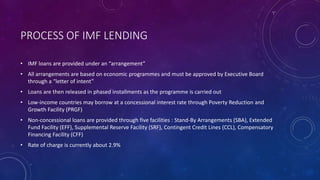
PROCESS OF IMF LENDING
• IMF loans are provided under an “arrangement”
• All arrangements are based on economic programmes and must be approved by Executive Board
through a “letter of intent”
• Loans are then released in phased installments as the programme is carried out
• Low-income countries may borrow at a concessional interest rate through Poverty Reduction and
Growth Facility (PRGF)
• Non-concessional loans are provided through five facilities : Stand-By Arrangements (SBA), Extended
Fund Facility (EFF), Supplemental Reserve Facility (SRF), Contingent Credit Lines (CCL), Compensatory
Financing Facility (CFF)
• Rate of charge is currently about 2.9%
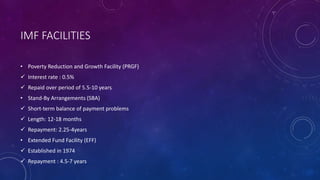
IMF FACILITIES
• Poverty Reduction and Growth Facility (PRGF)
 Interest rate : 0.5%
 Repaid over period of 5.5-10 years
• Stand-By Arrangements (SBA)
 Short-term balance of payment problems
 Length: 12-18 months
 Repayment: 2.25-4years
• Extended Fund Facility (EFF)
 Established in 1974
 Repayment : 4.5-7 years
IMF FACILITIES
• Supplemental Reserve Facility (SRF)
 Introduced in 1997
 Surcharge : 3-5%
 Repayment : 1-1.5 years
• Contingent Credit Lines (CCL)
 Established in 1999
 Repayment :1-1.5 years
 Surcharge : 1.5-3.5%
• Compensatory Financing Facility (CFF)
 Established in 1960s
 No surcharge
 Same as SBA
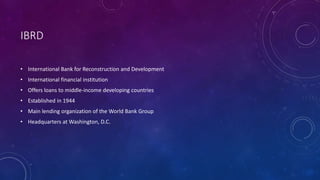
IBRD
• International Bank for Reconstruction and Development
• International financial institution
• Offers loans to middle-income developing countries
• Established in 1944
• Main lending organization of the World Bank Group
• Headquarters at Washington, D.C.
ORGANIZATIONAL STRUCTURE OF IBRD
• President
• Board of Governors
• Board of Executive Directors
• Board Committee
• Development Committee
FUNCTIONS OF IRBD
• To assist in the reconstructions and development of territories of its member countries by facilitating
the investment of capital for productive purpose
• To promote private foreign investment by means of guarantees or participations in loans and other
investment made by private investors
• To arrange the loans made or guaranteed by it in relation to international loans through other channels
so that more useful and urgent small and large projects are dealt with first
• To promote the long ranged balanced growth of international trade and maintenance of equilibrium in
the balance of payments of member countries
FUNDING STRATEGY OF IBRD
• Ensure the availability of funds to the Bank
• Minimise the effective cost of those funds to its borrowers
• Control volatility in net income and over all loan charges
• Provide an appropriate degree of maturity transformation between its borrowing and lending
WORLD TRADE ORGANIZATION (WTO)
• Only global international organization dealing with the rules of trade between nations
• Formed on 1 January 1995
• Headquarter : Central William, Geneva, Switzerland
• Members : 167 nations
• India joined on 1 January, 1995
• Older form : GATT (General Agreement of Tarriffs and Trade)
• Official language : English, French, Spanish
• Current Director General : Roberto Azeuedo
PRINCIPLES OF WTO
• Non-discrimination
• Freer trade, predictable policies, encouraging competition
• Extra provisions for less developed countries
• Achieve further liberalization gradually through negotiation
FUNCTIONS OF WTO
• Administering the WTO trade agreements
• Monitoring national trade policies
• Providing technical assistance and training for developing countries
• Administering mechanism for settling trade disputes
• Cooperating with other international organizations like IMF and IBRD
• Providing the forum for negotiations among its members concerning their multilateral trade relations
BENEFITS OF WTO
• Achievements in reducing the tariff and non-tariff barriers to trade
• Liberalization of investments has been fostering economic growth of a number of countries
• Increase in competition, efficiency of resource utilization, improvement in quality and productivity and
fall in prices and acceleration of economic development
• Provides forum for multilateral discussion of economic relations
• Mechanism to deal with violation of trade agreements
• Considerable research related to global trade and disseminates a wealth of information
DRAWBACKS OF WTO
• Negotiations and decision making dominated by the developed countries
• Many developing countries don’t have the financial and knowledge resources to effectively participate
in WTO discussions and negotiations
• The developing countries have been getting a raw deal from WTO
• WTO has not been successful in imposing organization’s disciplines on the developed countries
• Because of dependence of developing countries on developed countries, developed countries are able
to resort to arms-twisting tactics
ORGANIZATION STRUCTURE OF WTO
• Top level decision-making body is the Ministerial Conference which meets at least once every two years
• General Council : ambassadors and heads of delegations in Geneva which meets several times a year
• General Council also meets as Trade Policy Review Body and Dispute Settlement Body
• Goods Council, Services Council and Intellectual Property (TRIPs) Council report to General Council
• Numerous specialized committees, working groups and working parties deal with individual agreements
• All WTO members may participate in all councils, committees, etc except Appellate Body, Dispute
Settlement panels, Textiles Monitoring Body and plurilateral committees
PROCESS OF SETTLING A DISPUTE BY WTO
• 60 days: Consultations, meditation, etc
• 45 days: Panel set up and panelists appointment
• 6 months: Final panel report to parties
• 3 weeks: Final panel report to WTO members
• 60 days: Dispute Settlement Body adopts report (if no appeal)
• 60-90 days: Appeals report
• 30 days: Dispute Settlement Body adopts appeals report
ECONOMIC INTEGRATION
• Type of arrangement that removes artificial trade barriers between integrating economies
• Balassa drew distinction between integration and cooperation
• Abolition of discrimination within an area
DEGREES OF ECONOMIC INTEGRATION
• Free trade area
• Customs union
• Common market
• Economic union
• Economic integration
EUROPEAN UNION (EU)
• Most successful of regional economic integration schemes
• Originally comprised 6 countries, namely, Belgium, France, Federal Republic of Germany, Italy,
Luxembourg and Netherlands
• Brought on January 1, 1958 by virtue of Treaty of Rome, 1957
• Expanded in 1973 with inclusion of UK, Denmark and Ireland
• Greek joined in 1981
• Spain and Portugal in 1986
• Abolished tariffs on trade among themselves
• Largest market in the world
• Boost competitiveness of European industry against its rivals particularly USA, SAARC, Japan
BARRIERS TO EU
• Border control
• Limitations on movement of people and their right to establishment
• Differing internal taxation regimes
• Lack of a common legal framework for business
• Controls on movement of capital
• Heavy-and differing- regulation of services
• Divergent product regulations and standards
• Protectionist public procurement policies
BENEFITS OF EU
• Uniform policy and regulatory environment of Union and reduction in transaction costs
• Expansion of markets
• Availability of new ports reducing transportation costs
• Removal of quota restrictions for textiles and clothing will reduce protection presently available to
Acs(accession countries) exports in EU market
• Harmonization of tariff structures will increase import duty of some countries above pre-accession level
and reduce those of others
CHALLENGES OF EU
• Many Indian products will have to face stiffer competition in EU market
• Low labour costs give rise to competition
• As Acs are labour abundant and low income countries, it could affect BPO by EU to India
• Acs may affect FDI inflow to India
• Exports of textiles may be adversely affected with low cost production in Central and Eastern European
Countries(CEECs) eating into India’s EU(15) markets
INDO-EU TRADE
• EU is India’s largest trading partner
• India’s exports to EU grew from Rs.282 crore in 1970-71 to Rs.1447 crore in 1980-81 and Rs.8951 crore
in 1990-91. Correspondingly, imports were Rs.320 crore, Rs.2639 crore andRs.12,680 crore
• Within EU, largest trade partners of India have been UK, Germany, Belgium, France
• Exports include textiles, jute, leather, polished diamonds, chemicals, engineering goods, etc
• Imports include edible oils, dairy products, capital goods, optical instruments, synthetic rubber, etc
• India should pay sufficient attention in order to take advantage of “enlarging opportunity”
ENLARGED EU & INDIA
• Accession of 10 new members
• Exports were insignificant and imports were lower than exports
• Main exports include gems and jewellery, drugs and pharmaceuticals, leather, textiles, plastics and
agricultural commodities
NAFTA
• Signed between USA and Canada in 1988, enlarged by inclusion of Mexico in 1994
• Eliminate all tariffs on products moving among three countries and end other barriers to services and
investment capital within North America
AREAS OF NAFTA
• Market access
• Trade rules
• Services
• Investment
• Intellectual property
• Dispute settlement
ADVANTAGES OF NAFTA
• Reduced Tariffs
• The Three Countries Take Advantage Of Real Income Increases
• Increased Of Trade Between, Canada, Mexico and the United States
• Provided More Employment Opportunities for the US Workers
DISADVANTAGES OF NAFTA
• Less Benefits To Mexican Workers Than Expected
• Increased Tariffs Yet Not Regulations
ASEAN
• Association of South East Asian Nations
• Formed by Bangkok Declaration,1967
• 5 countries viz Indonesia, Malaysia, Philippines, Singapore and Thailand
• Brunei joined in 1984
• Economic growth rate has been very high
• Important producer of coffee, sugar, timber, petroleum, nickel, bauxite, tungsten and charcoal
• ASEAN Free Trade Area(AFTA) created in 1992 which calls for elimination of all custom duties
• ASEAN-India summit held in November 2002
• Free Trade Agreement was signed between ASEAN and India in 2009
SAARC
• South Asian Association for Regional Cooperation
• Seven countries: India, Bangladesh, Pakistan, Nepal, Bhutan, Sri Lanka, Maldives
• Formally launched in December, 1985
• Secretriat of Association: Kathmandu, Nepal
• Fundamental goal: accelerate economic and social development through optimum utilization of their
human and material resources
OBJECTIVES OF SAARC
• To promote welfare of people of South Asia
• To accelerate economic growth, social progress and cultural development in the group
• To promote and strengthen collective self-reliance among countries of South Asia
• To contribute to mutual trust, understanding and appreciation of each other’s problems
• To strengthen cooperation with other developing countries
• To strengthen cooperation among themselves in international forums
• To cooperate with international and regional organizations with similar aims and purposes
• To promote active collaboration and mutual assistance in economic, social, cultural, technical and
scientific fields
PRINCIPLES OF SAARC
• Cooperation should be based on respect for principles of sovereign equality, territorial integrity, political
independence, non-interference in the internal affairs of other States and mutual benefits
• Such cooperation shall not be a substitute for bilateral cooperation but shall complement them
• Such cooperation shall not be inconsistent with bilateral and multilateral obligations
ADVANTAGES OF SAARC
• Greater cultural co-operation
• Promoted global objective of shelter for all
• SAFTA : a Free Trade Agreement confined to goods reduced custom duties to zero
• Provided forum for bilateral and regional agreements to the small poor nations for collaboration among
themselves for development
LIMITATIONS OF SAARC
• Domination of India
• Political differences
• Inequality among members
• Excludes bilateral and contentious issues discussion on forum
• No progress in road and rail connectivity which is obstacle for trade
• Lack of financial resources and technology
• Most of the countries are poor except for India and lack full fledged democratic structure
ECONOMIC INTEGRATION OF BUSINESS
• Provides opportunity for free trade with other countries that are at similar levels of development
• Presents a way to trade with advanced countries without being harmed by their superior economic
power
• Generate economic growth and development
THANK YOU!!!

International institutions

  • 1.
  • 2.
    UNCTAD • United NationsConference on Trade and Development • 194 states are members • Established in 1964 as a permanent intergovernmental body of UNO assembly • Responsible for dealing with developmental issues particularly international trade, the main driver of development • UNCTAD Secretriat : Geneva Secretriat headed by Mukhisa Kituyi from Kenya • Meets every 4 years • 11 conferences have been held up to 2004 • Aim to help take informed decision and promote macro-economic policies best suitable to ending global economic inequalities
  • 3.
    ROLE OF UNCTAD •Globalization and development • Provide technical assistance on the management of public debt • Promote integrated approach to trade, environment and sustainable development • Focus on contribution of commodity sector to development, advocating diversification and risk management • Inform policy makers about the structure and evolution of FDI in the world • Participate in setting international accounting standards • Focus on issue related to international investment agreements
  • 4.
    FUNCTIONS OF UNCTAD •To promote international trade with a view to accelerating economic development • To formulate principles of and policies on international trade and related problems of economic development • To negotiate multinational trade agreements • To make proposals for putting its principles and policies into effect
  • 5.
    PRINCIPLES OF UNCTAD •Every country has the sovereign right freely to dispose of its natural resources in the interest of economic development and freely to trade with other countries • Economic relations including trade relations shall be based on the respect for the principles of sovereign equality of states, self determination of people, and non-interference in internal affairs of other countries • There shall be no discrimination on the basis of differences in socio-economic systems
  • 6.
    INTERNATIONAL MONETARY FUND(IMF) •Established on December 27, 1945 with 29 countries • Began financial operations on March 1, 1947 • Central institution of international monetary system • Aims to prevent crises in the system by encouraging countries to adopt sound economic policies • 187 countries on September 30, 2010
  • 7.
    PURPOSES OF IMF •Promote international monetary cooperation through a permanent institution • Facilitate expansion and balanced growth of international trade • Promote exchange stability • Assist in establishment of multilateral system of payments • Monitors economic and financial developments and policies • Provides the governments and central banks of its member countries with technical assistance and training in its area of expertise
  • 8.
    VISION OF IMF •Strive to promote sustained non-inflationary economic growth that benefits all people • Be the centre of competence for the stability of the international financial system • Focus on its core macroeconomic and financial areas of responsibility • Be an open institution, learning from experience and dialogue
  • 9.
    ORGANIZATION OF IMF •Board of Governors, all member countries are represented, highest authority : meets once a year • Executive Board – 24 Executive Directors with Managing Director as Chairman : meets three times a week in Washington DC • 5 largest shareholders : United States, Japan, Germany, France and United Kingdom – along with China, Russia, Saudi Arabia, have their own seats on the Board • Other 16 Executive Directors elected for 2-year terms by group of countries known as constituencies • Key policy issues considered twice-yearly in International Monetary and Financial Committee (IMFC) • Committee of Board of Governors of IMF and World Bank called Development Committee advises on development policy • IMF has weighted voting system
  • 10.
    PROCESS OF IMFLENDING • IMF loans are provided under an “arrangement” • All arrangements are based on economic programmes and must be approved by Executive Board through a “letter of intent” • Loans are then released in phased installments as the programme is carried out • Low-income countries may borrow at a concessional interest rate through Poverty Reduction and Growth Facility (PRGF) • Non-concessional loans are provided through five facilities : Stand-By Arrangements (SBA), Extended Fund Facility (EFF), Supplemental Reserve Facility (SRF), Contingent Credit Lines (CCL), Compensatory Financing Facility (CFF) • Rate of charge is currently about 2.9%
  • 11.
    IMF FACILITIES • PovertyReduction and Growth Facility (PRGF)  Interest rate : 0.5%  Repaid over period of 5.5-10 years • Stand-By Arrangements (SBA)  Short-term balance of payment problems  Length: 12-18 months  Repayment: 2.25-4years • Extended Fund Facility (EFF)  Established in 1974  Repayment : 4.5-7 years
  • 12.
    IMF FACILITIES • SupplementalReserve Facility (SRF)  Introduced in 1997  Surcharge : 3-5%  Repayment : 1-1.5 years • Contingent Credit Lines (CCL)  Established in 1999  Repayment :1-1.5 years  Surcharge : 1.5-3.5% • Compensatory Financing Facility (CFF)  Established in 1960s  No surcharge  Same as SBA
  • 13.
    IBRD • International Bankfor Reconstruction and Development • International financial institution • Offers loans to middle-income developing countries • Established in 1944 • Main lending organization of the World Bank Group • Headquarters at Washington, D.C.
  • 14.
    ORGANIZATIONAL STRUCTURE OFIBRD • President • Board of Governors • Board of Executive Directors • Board Committee • Development Committee
  • 15.
    FUNCTIONS OF IRBD •To assist in the reconstructions and development of territories of its member countries by facilitating the investment of capital for productive purpose • To promote private foreign investment by means of guarantees or participations in loans and other investment made by private investors • To arrange the loans made or guaranteed by it in relation to international loans through other channels so that more useful and urgent small and large projects are dealt with first • To promote the long ranged balanced growth of international trade and maintenance of equilibrium in the balance of payments of member countries
  • 16.
    FUNDING STRATEGY OFIBRD • Ensure the availability of funds to the Bank • Minimise the effective cost of those funds to its borrowers • Control volatility in net income and over all loan charges • Provide an appropriate degree of maturity transformation between its borrowing and lending
  • 17.
    WORLD TRADE ORGANIZATION(WTO) • Only global international organization dealing with the rules of trade between nations • Formed on 1 January 1995 • Headquarter : Central William, Geneva, Switzerland • Members : 167 nations • India joined on 1 January, 1995 • Older form : GATT (General Agreement of Tarriffs and Trade) • Official language : English, French, Spanish • Current Director General : Roberto Azeuedo
  • 18.
    PRINCIPLES OF WTO •Non-discrimination • Freer trade, predictable policies, encouraging competition • Extra provisions for less developed countries • Achieve further liberalization gradually through negotiation
  • 19.
    FUNCTIONS OF WTO •Administering the WTO trade agreements • Monitoring national trade policies • Providing technical assistance and training for developing countries • Administering mechanism for settling trade disputes • Cooperating with other international organizations like IMF and IBRD • Providing the forum for negotiations among its members concerning their multilateral trade relations
  • 20.
    BENEFITS OF WTO •Achievements in reducing the tariff and non-tariff barriers to trade • Liberalization of investments has been fostering economic growth of a number of countries • Increase in competition, efficiency of resource utilization, improvement in quality and productivity and fall in prices and acceleration of economic development • Provides forum for multilateral discussion of economic relations • Mechanism to deal with violation of trade agreements • Considerable research related to global trade and disseminates a wealth of information
  • 21.
    DRAWBACKS OF WTO •Negotiations and decision making dominated by the developed countries • Many developing countries don’t have the financial and knowledge resources to effectively participate in WTO discussions and negotiations • The developing countries have been getting a raw deal from WTO • WTO has not been successful in imposing organization’s disciplines on the developed countries • Because of dependence of developing countries on developed countries, developed countries are able to resort to arms-twisting tactics
  • 22.
    ORGANIZATION STRUCTURE OFWTO • Top level decision-making body is the Ministerial Conference which meets at least once every two years • General Council : ambassadors and heads of delegations in Geneva which meets several times a year • General Council also meets as Trade Policy Review Body and Dispute Settlement Body • Goods Council, Services Council and Intellectual Property (TRIPs) Council report to General Council • Numerous specialized committees, working groups and working parties deal with individual agreements • All WTO members may participate in all councils, committees, etc except Appellate Body, Dispute Settlement panels, Textiles Monitoring Body and plurilateral committees
  • 23.
    PROCESS OF SETTLINGA DISPUTE BY WTO • 60 days: Consultations, meditation, etc • 45 days: Panel set up and panelists appointment • 6 months: Final panel report to parties • 3 weeks: Final panel report to WTO members • 60 days: Dispute Settlement Body adopts report (if no appeal) • 60-90 days: Appeals report • 30 days: Dispute Settlement Body adopts appeals report
  • 24.
    ECONOMIC INTEGRATION • Typeof arrangement that removes artificial trade barriers between integrating economies • Balassa drew distinction between integration and cooperation • Abolition of discrimination within an area
  • 25.
    DEGREES OF ECONOMICINTEGRATION • Free trade area • Customs union • Common market • Economic union • Economic integration
  • 26.
    EUROPEAN UNION (EU) •Most successful of regional economic integration schemes • Originally comprised 6 countries, namely, Belgium, France, Federal Republic of Germany, Italy, Luxembourg and Netherlands • Brought on January 1, 1958 by virtue of Treaty of Rome, 1957 • Expanded in 1973 with inclusion of UK, Denmark and Ireland • Greek joined in 1981 • Spain and Portugal in 1986 • Abolished tariffs on trade among themselves • Largest market in the world • Boost competitiveness of European industry against its rivals particularly USA, SAARC, Japan
  • 27.
    BARRIERS TO EU •Border control • Limitations on movement of people and their right to establishment • Differing internal taxation regimes • Lack of a common legal framework for business • Controls on movement of capital • Heavy-and differing- regulation of services • Divergent product regulations and standards • Protectionist public procurement policies
  • 28.
    BENEFITS OF EU •Uniform policy and regulatory environment of Union and reduction in transaction costs • Expansion of markets • Availability of new ports reducing transportation costs • Removal of quota restrictions for textiles and clothing will reduce protection presently available to Acs(accession countries) exports in EU market • Harmonization of tariff structures will increase import duty of some countries above pre-accession level and reduce those of others
  • 29.
    CHALLENGES OF EU •Many Indian products will have to face stiffer competition in EU market • Low labour costs give rise to competition • As Acs are labour abundant and low income countries, it could affect BPO by EU to India • Acs may affect FDI inflow to India • Exports of textiles may be adversely affected with low cost production in Central and Eastern European Countries(CEECs) eating into India’s EU(15) markets
  • 30.
    INDO-EU TRADE • EUis India’s largest trading partner • India’s exports to EU grew from Rs.282 crore in 1970-71 to Rs.1447 crore in 1980-81 and Rs.8951 crore in 1990-91. Correspondingly, imports were Rs.320 crore, Rs.2639 crore andRs.12,680 crore • Within EU, largest trade partners of India have been UK, Germany, Belgium, France • Exports include textiles, jute, leather, polished diamonds, chemicals, engineering goods, etc • Imports include edible oils, dairy products, capital goods, optical instruments, synthetic rubber, etc • India should pay sufficient attention in order to take advantage of “enlarging opportunity”
  • 31.
    ENLARGED EU &INDIA • Accession of 10 new members • Exports were insignificant and imports were lower than exports • Main exports include gems and jewellery, drugs and pharmaceuticals, leather, textiles, plastics and agricultural commodities
  • 32.
    NAFTA • Signed betweenUSA and Canada in 1988, enlarged by inclusion of Mexico in 1994 • Eliminate all tariffs on products moving among three countries and end other barriers to services and investment capital within North America
  • 33.
    AREAS OF NAFTA •Market access • Trade rules • Services • Investment • Intellectual property • Dispute settlement
  • 34.
    ADVANTAGES OF NAFTA •Reduced Tariffs • The Three Countries Take Advantage Of Real Income Increases • Increased Of Trade Between, Canada, Mexico and the United States • Provided More Employment Opportunities for the US Workers
  • 35.
    DISADVANTAGES OF NAFTA •Less Benefits To Mexican Workers Than Expected • Increased Tariffs Yet Not Regulations
  • 36.
    ASEAN • Association ofSouth East Asian Nations • Formed by Bangkok Declaration,1967 • 5 countries viz Indonesia, Malaysia, Philippines, Singapore and Thailand • Brunei joined in 1984 • Economic growth rate has been very high • Important producer of coffee, sugar, timber, petroleum, nickel, bauxite, tungsten and charcoal • ASEAN Free Trade Area(AFTA) created in 1992 which calls for elimination of all custom duties • ASEAN-India summit held in November 2002 • Free Trade Agreement was signed between ASEAN and India in 2009
  • 37.
    SAARC • South AsianAssociation for Regional Cooperation • Seven countries: India, Bangladesh, Pakistan, Nepal, Bhutan, Sri Lanka, Maldives • Formally launched in December, 1985 • Secretriat of Association: Kathmandu, Nepal • Fundamental goal: accelerate economic and social development through optimum utilization of their human and material resources
  • 38.
    OBJECTIVES OF SAARC •To promote welfare of people of South Asia • To accelerate economic growth, social progress and cultural development in the group • To promote and strengthen collective self-reliance among countries of South Asia • To contribute to mutual trust, understanding and appreciation of each other’s problems • To strengthen cooperation with other developing countries • To strengthen cooperation among themselves in international forums • To cooperate with international and regional organizations with similar aims and purposes • To promote active collaboration and mutual assistance in economic, social, cultural, technical and scientific fields
  • 39.
    PRINCIPLES OF SAARC •Cooperation should be based on respect for principles of sovereign equality, territorial integrity, political independence, non-interference in the internal affairs of other States and mutual benefits • Such cooperation shall not be a substitute for bilateral cooperation but shall complement them • Such cooperation shall not be inconsistent with bilateral and multilateral obligations
  • 40.
    ADVANTAGES OF SAARC •Greater cultural co-operation • Promoted global objective of shelter for all • SAFTA : a Free Trade Agreement confined to goods reduced custom duties to zero • Provided forum for bilateral and regional agreements to the small poor nations for collaboration among themselves for development
  • 41.
    LIMITATIONS OF SAARC •Domination of India • Political differences • Inequality among members • Excludes bilateral and contentious issues discussion on forum • No progress in road and rail connectivity which is obstacle for trade • Lack of financial resources and technology • Most of the countries are poor except for India and lack full fledged democratic structure
  • 42.
    ECONOMIC INTEGRATION OFBUSINESS • Provides opportunity for free trade with other countries that are at similar levels of development • Presents a way to trade with advanced countries without being harmed by their superior economic power • Generate economic growth and development
  • 43.