WELCOME
TO
PRESENTATION
ON “ASIAN DEVELOPMENT BANK”
Presented by
Md.Muklisur Rahman Rubel
Shahjalal University of Science and Technology,
Sylhet, Bangladesh
Presentation Outline
Historical background of ADB
Basic information about ADB
Members
Dominated country of ADB
Voting power distribution
Objectives
Vision & mission
Functions of ADB
Division and types of project
Structure of ADB
Board of governors: Powers
Board of directors: Powers
Working procedures of Board of directors
President
Criticism
Presentation Outline
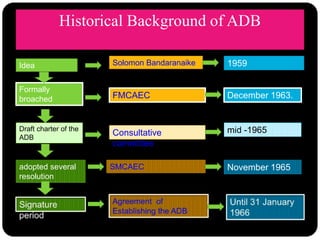
Historical Background of ADB
Idea
December 1963.
Consultative
committee
Solomon Bandaranaike 1959
Formally
broached FMCAEC
mid -1965Draft charter of the
ADB
November 1965SMCAECadopted several
resolution
About ADB
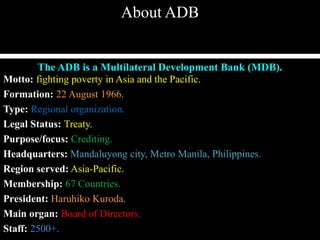
The ADB is a Multilateral Development Bank (MDB).
Motto: fighting poverty in Asia and the Pacific.
Formation: 22 August 1966.
Type: Regional organization.
Legal Status: Treaty.
Purpose/focus: Crediting.
Headquarters: Mandaluyong city, Metro Manila, Philippines.
Region served: Asia-Pacific.
Membership: 67 Countries.
President: Haruhiko Kuroda.
Main organ: Board of Directors.
Staff: 2500+.
Members:
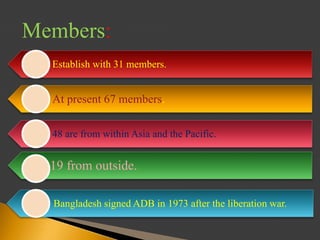
Establish with 31 members.
At present 67 members.
48 are from within Asia and the Pacific.
19 from outside.
Bangladesh signed ADB in 1973 after the liberation war.
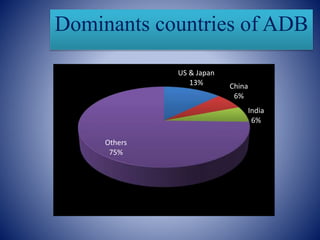
Dominants countries of ADB
US & Japan
13% China
6%
India
6%
Others
75%
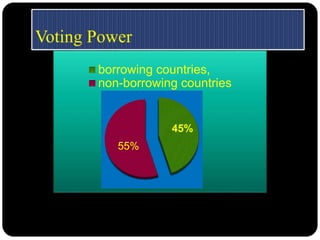
45%
55%
borrowing countries,
non-borrowing countries
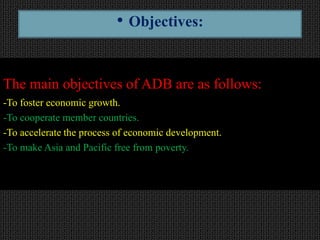
The main objectives of ADB are as follows:
-To foster economic growth.
-To cooperate member countries.
-To accelerate the process of economic development.
-To make Asia and Pacific free from poverty.
• Objectives:
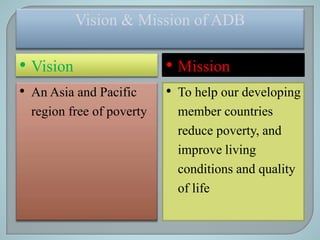
Vision & Mission of ADB
• Vision • Mission
• An Asia and Pacific
region free of poverty
• To help our developing
member countries
reduce poverty, and
improve living
conditions and quality
of life
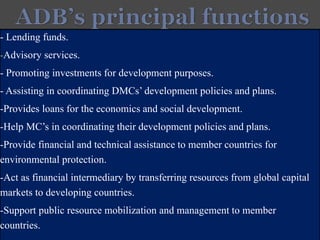
- Lending funds.
-Advisory services.
- Promoting investments for development purposes.
- Assisting in coordinating DMCs’development policies and plans.
-Provides loans for the economics and social development.
-Help MC’s in coordinating their development policies and plans.
-Provide financial and technical assistance to member countries for
environmental protection.
-Act as financial intermediary by transferring resources from global capital
markets to developing countries.
-Support public resource mobilization and management to member
countries.
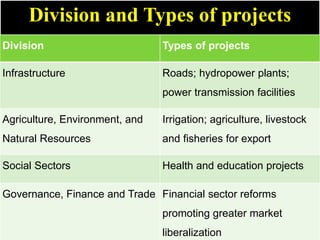
Division and Types of projects
Division Types of projects
Infrastructure Roads; hydropower plants;
power transmission facilities
Agriculture, Environment, and
Natural Resources
Irrigation; agriculture, livestock
and fisheries for export
Social Sectors Health and education projects
Governance, Finance and Trade Financial sector reforms
promoting greater market
liberalization
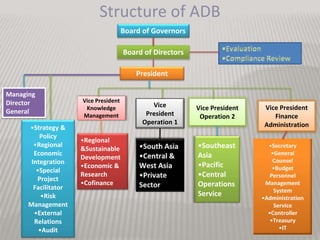
Structure of ADB
Board of Governors
Board of Directors
President
Managing
Director
General
•Strategy &
Policy
•Regional
Economic
Integration
•Special
Project
Facilitator
•Risk
Management
•External
Relations
•Audit
Vice President
Knowledge
Management
•Regional
&Sustainable
Development
•Economic &
Research
•Cofinance
Vice
President
Operation 1
Vice President
Operation 2
•Southeast
Asia
•Pacific
•Central
Operations
Service
Vice President
Finance
Administration
•Secretary
•General
Counsel
•Budget
Personnel
Management
System
•Administration
Service
•Controller
•Treasury
•IT
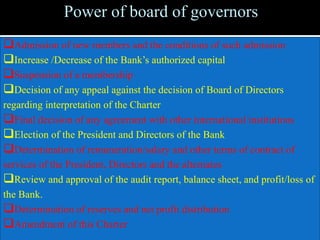
Power of board of governors
Admission of new members and the conditions of such admission
Increase /Decrease of the Bank’s authorized capital
Suspension of a membership
Decision of any appeal against the decision of Board of Directors
regarding interpretation of the Charter
Final decision of any agreement with other international institutions
Election of the President and Directors of the Bank
Determination of remuneration/salary and other terms of contract of
services of the President, Directors and the alternates
Review and approval of the audit report, balance sheet, and profit/loss of
the Bank.
Determination of reserves and net profit distribution
Amendment of this Charter
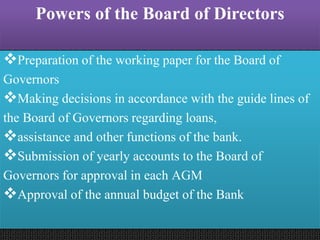
Powers of the Board of Directors
Preparation of the working paper for the Board of
Governors
Making decisions in accordance with the guide lines of
the Board of Governors regarding loans,
assistance and other functions of the bank.
Submission of yearly accounts to the Board of
Governors for approval in each AGM
Approval of the annual budget of the Bank
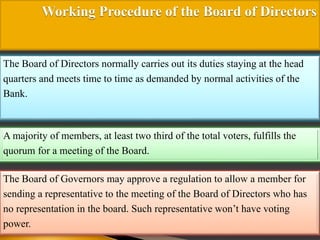
Working Procedure of the Board of Directors
The Board of Directors normally carries out its duties staying at the head
quarters and meets time to time as demanded by normal activities of the
Bank.
A majority of members, at least two third of the total voters, fulfills the
quorum for a meeting of the Board.
The Board of Governors may approve a regulation to allow a member for
sending a representative to the meeting of the Board of Directors who has
no representation in the board. Such representative won’t have voting
power.
The President
Elected by the Board of Governors
Term is five years.
As a President takes up his/her office, can’t remain a
governor or a Director or an alternate of any of them.
After completion of term a President may be re-elected.
The President is the Chairperson of the Board of
Directors without any voting power except deciding vote.
From legal point of view the President represents the
Bank.
They suggest some rules and regulation for expend money.
It interferes in the policy of subscriber’s country.
The voting power of ADB is share based.
It affects the internal system of subscriber’s country.
It serves the purpose of capitalism.
ADB plays a dominating role in developing countries like
Bangladesh.
In most cases it is similar to IMF and World Bank.
It follows the systems of World Bank to provide lone.
The ADB President has always been from Japan.
Representation in the board determined by the financial
contribution to the ADB.
Asian Development Bank ADB

Asian Development Bank ADB

  • 1.
  • 2.
    Presented by Md.Muklisur RahmanRubel Shahjalal University of Science and Technology, Sylhet, Bangladesh
  • 3.
    Presentation Outline Historical backgroundof ADB Basic information about ADB Members Dominated country of ADB Voting power distribution Objectives Vision & mission Functions of ADB Division and types of project Structure of ADB Board of governors: Powers Board of directors: Powers Working procedures of Board of directors President Criticism
  • 4.
  • 5.
    Historical Background ofADB Idea December 1963. Consultative committee Solomon Bandaranaike 1959 Formally broached FMCAEC mid -1965Draft charter of the ADB November 1965SMCAECadopted several resolution
  • 6.
    About ADB The ADBis a Multilateral Development Bank (MDB). Motto: fighting poverty in Asia and the Pacific. Formation: 22 August 1966. Type: Regional organization. Legal Status: Treaty. Purpose/focus: Crediting. Headquarters: Mandaluyong city, Metro Manila, Philippines. Region served: Asia-Pacific. Membership: 67 Countries. President: Haruhiko Kuroda. Main organ: Board of Directors. Staff: 2500+.
  • 7.
    Members: Establish with 31members. At present 67 members. 48 are from within Asia and the Pacific. 19 from outside. Bangladesh signed ADB in 1973 after the liberation war.
  • 8.
    Dominants countries ofADB US & Japan 13% China 6% India 6% Others 75%
  • 9.
  • 10.
    The main objectivesof ADB are as follows: -To foster economic growth. -To cooperate member countries. -To accelerate the process of economic development. -To make Asia and Pacific free from poverty. • Objectives:
  • 11.
    Vision & Missionof ADB • Vision • Mission • An Asia and Pacific region free of poverty • To help our developing member countries reduce poverty, and improve living conditions and quality of life
  • 12.
    - Lending funds. -Advisoryservices. - Promoting investments for development purposes. - Assisting in coordinating DMCs’development policies and plans. -Provides loans for the economics and social development. -Help MC’s in coordinating their development policies and plans. -Provide financial and technical assistance to member countries for environmental protection. -Act as financial intermediary by transferring resources from global capital markets to developing countries. -Support public resource mobilization and management to member countries.
  • 13.
    Division and Typesof projects Division Types of projects Infrastructure Roads; hydropower plants; power transmission facilities Agriculture, Environment, and Natural Resources Irrigation; agriculture, livestock and fisheries for export Social Sectors Health and education projects Governance, Finance and Trade Financial sector reforms promoting greater market liberalization
  • 14.
    Structure of ADB Boardof Governors Board of Directors President Managing Director General •Strategy & Policy •Regional Economic Integration •Special Project Facilitator •Risk Management •External Relations •Audit Vice President Knowledge Management •Regional &Sustainable Development •Economic & Research •Cofinance Vice President Operation 1 Vice President Operation 2 •Southeast Asia •Pacific •Central Operations Service Vice President Finance Administration •Secretary •General Counsel •Budget Personnel Management System •Administration Service •Controller •Treasury •IT
  • 15.
    Power of boardof governors Admission of new members and the conditions of such admission Increase /Decrease of the Bank’s authorized capital Suspension of a membership Decision of any appeal against the decision of Board of Directors regarding interpretation of the Charter Final decision of any agreement with other international institutions Election of the President and Directors of the Bank Determination of remuneration/salary and other terms of contract of services of the President, Directors and the alternates Review and approval of the audit report, balance sheet, and profit/loss of the Bank. Determination of reserves and net profit distribution Amendment of this Charter
  • 16.
    Powers of theBoard of Directors Preparation of the working paper for the Board of Governors Making decisions in accordance with the guide lines of the Board of Governors regarding loans, assistance and other functions of the bank. Submission of yearly accounts to the Board of Governors for approval in each AGM Approval of the annual budget of the Bank
  • 17.
    Working Procedure ofthe Board of Directors The Board of Directors normally carries out its duties staying at the head quarters and meets time to time as demanded by normal activities of the Bank. A majority of members, at least two third of the total voters, fulfills the quorum for a meeting of the Board. The Board of Governors may approve a regulation to allow a member for sending a representative to the meeting of the Board of Directors who has no representation in the board. Such representative won’t have voting power.
  • 18.
    The President Elected bythe Board of Governors Term is five years. As a President takes up his/her office, can’t remain a governor or a Director or an alternate of any of them. After completion of term a President may be re-elected. The President is the Chairperson of the Board of Directors without any voting power except deciding vote. From legal point of view the President represents the Bank.
  • 19.
    They suggest somerules and regulation for expend money. It interferes in the policy of subscriber’s country. The voting power of ADB is share based. It affects the internal system of subscriber’s country. It serves the purpose of capitalism. ADB plays a dominating role in developing countries like Bangladesh. In most cases it is similar to IMF and World Bank. It follows the systems of World Bank to provide lone. The ADB President has always been from Japan. Representation in the board determined by the financial contribution to the ADB.