Unit V
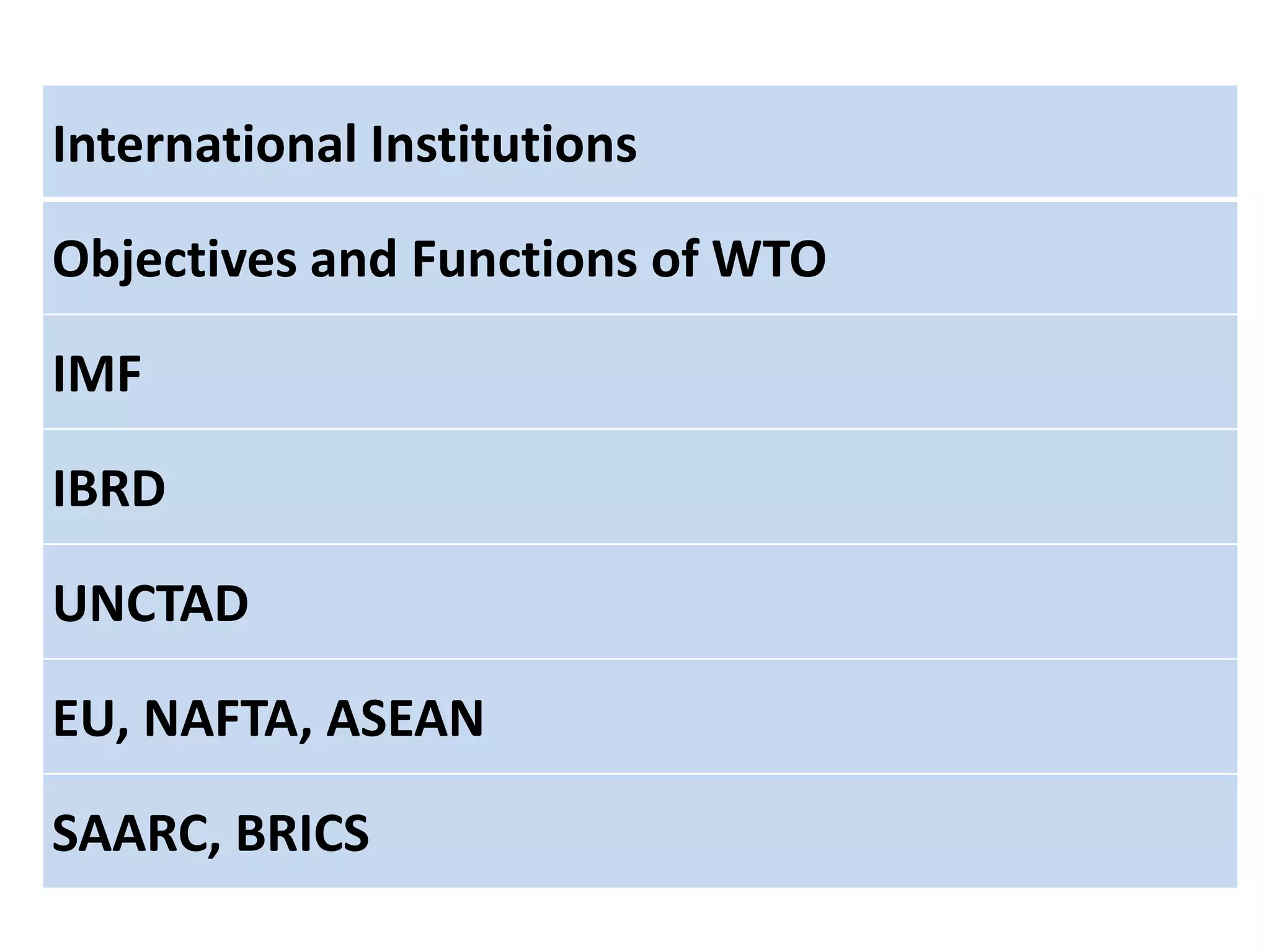
International Institutions
Objectives and Functions of WTO
IMF
IBRD
UNCTAD
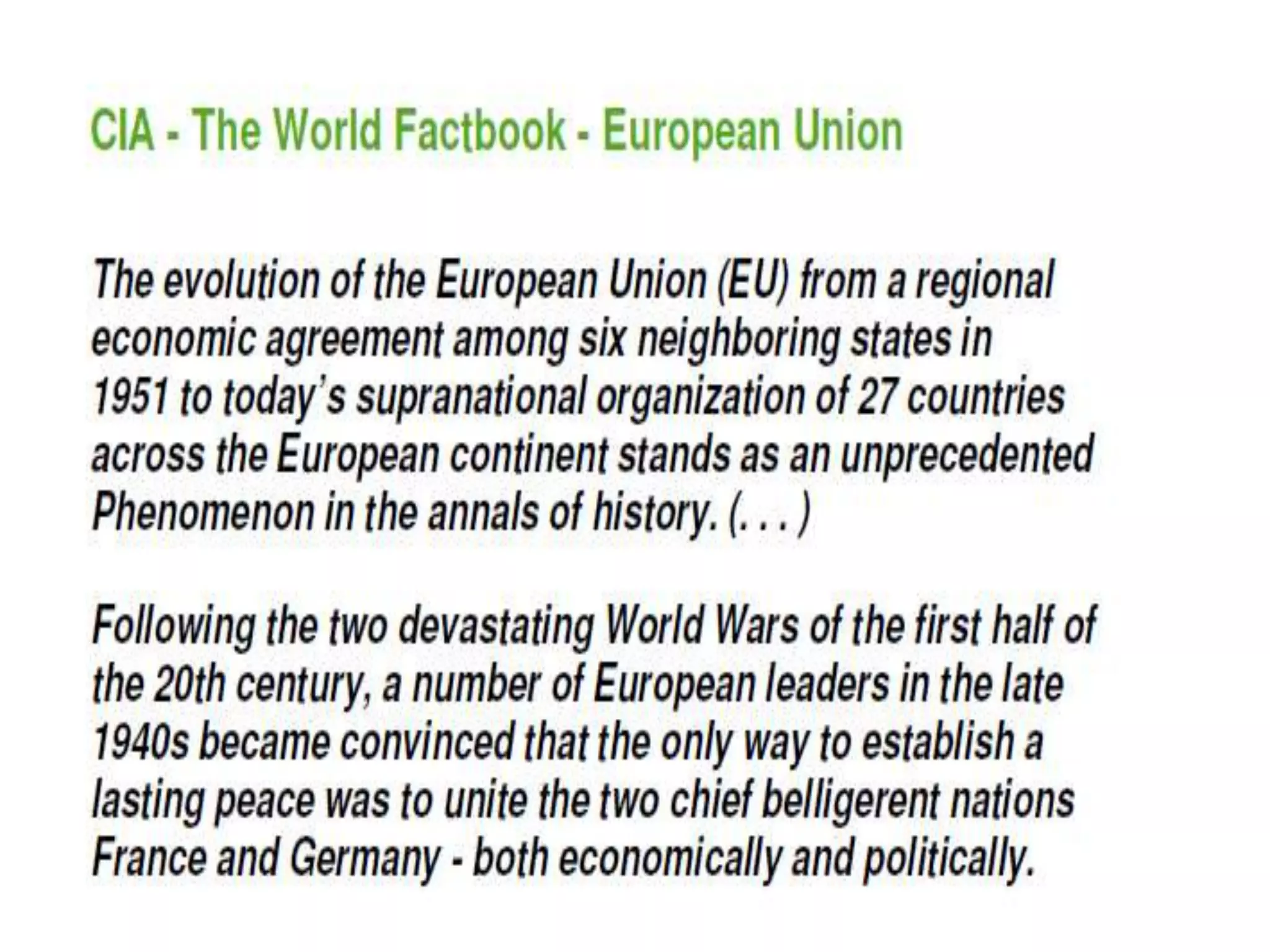
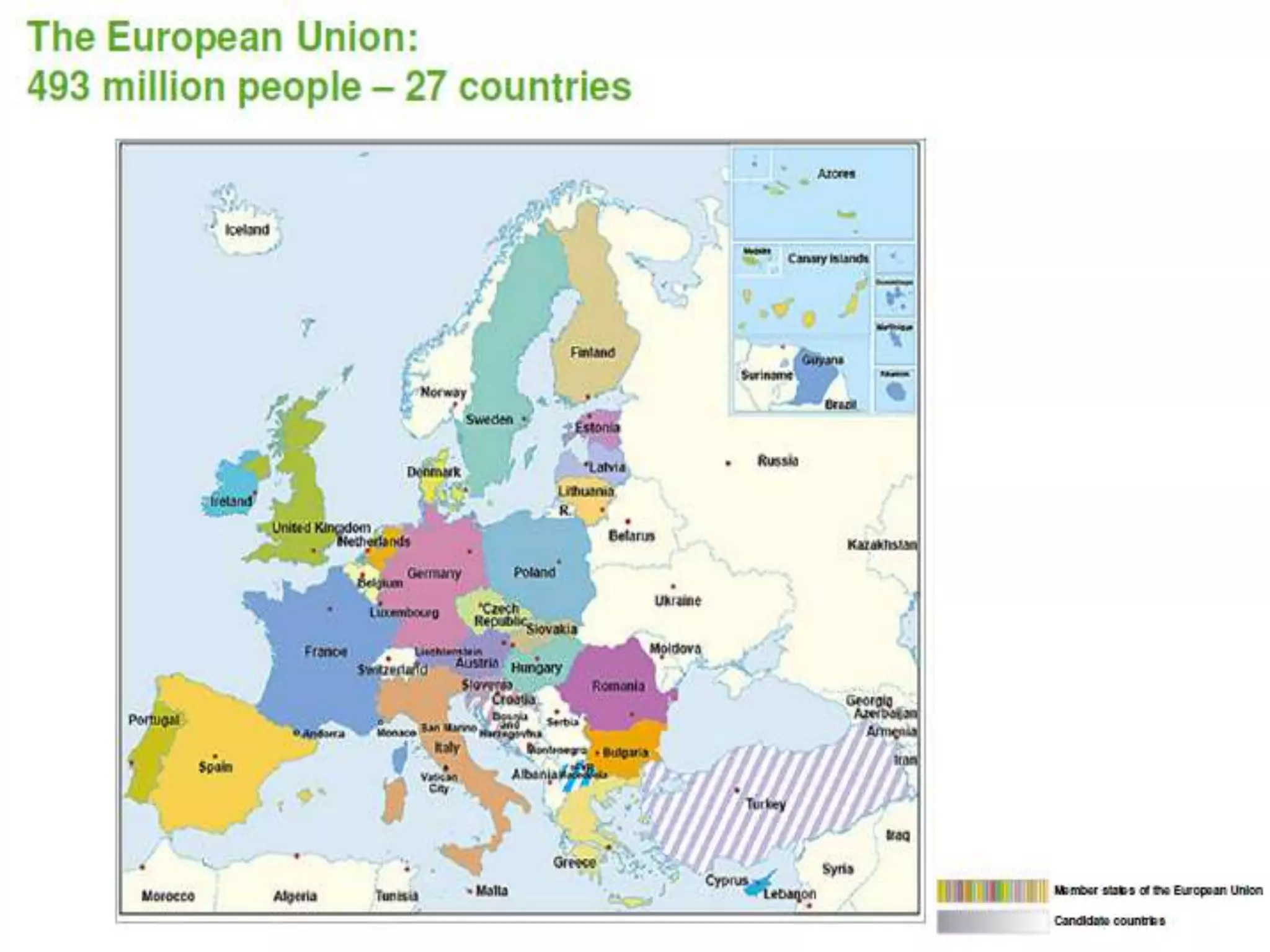
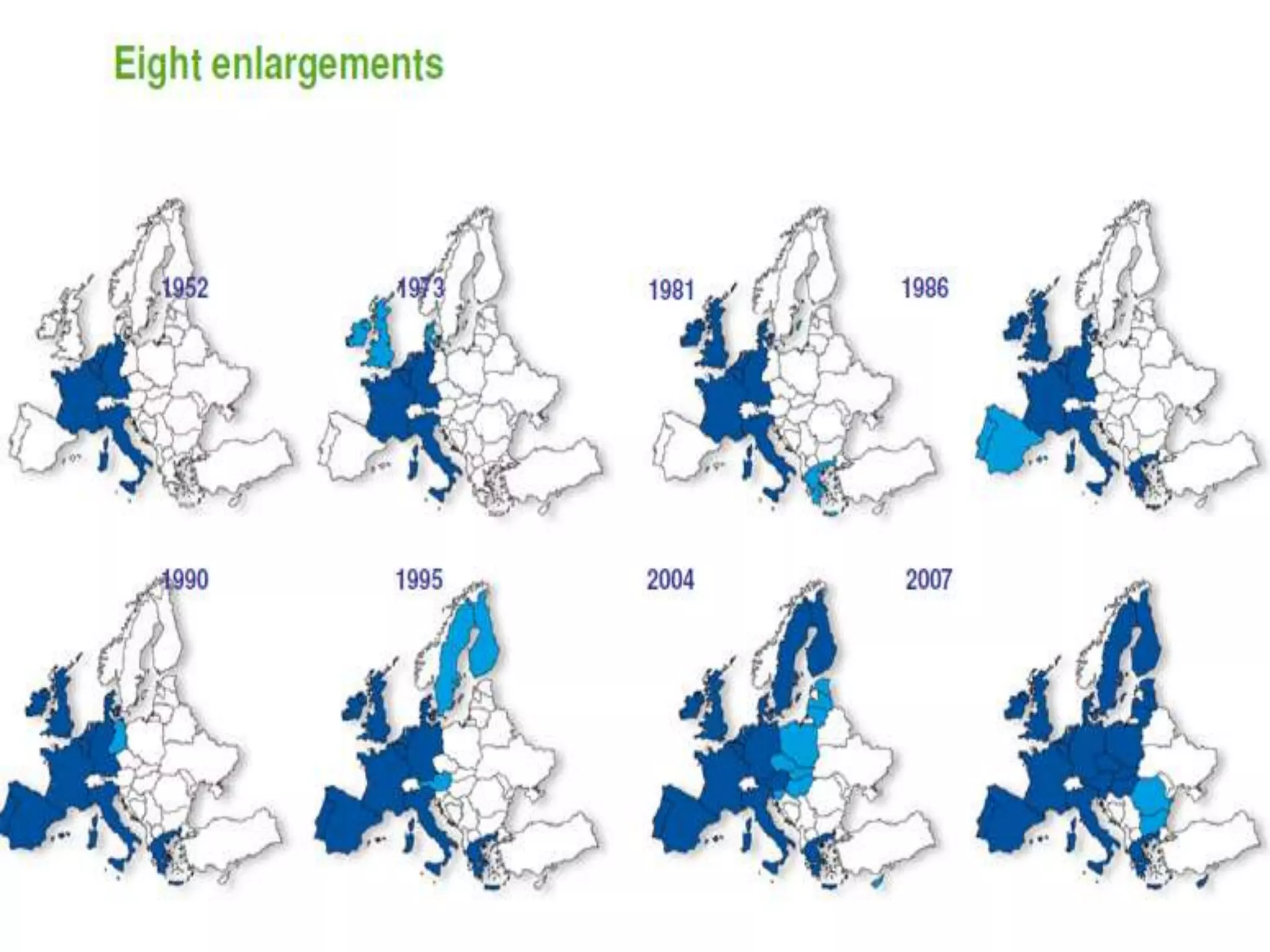
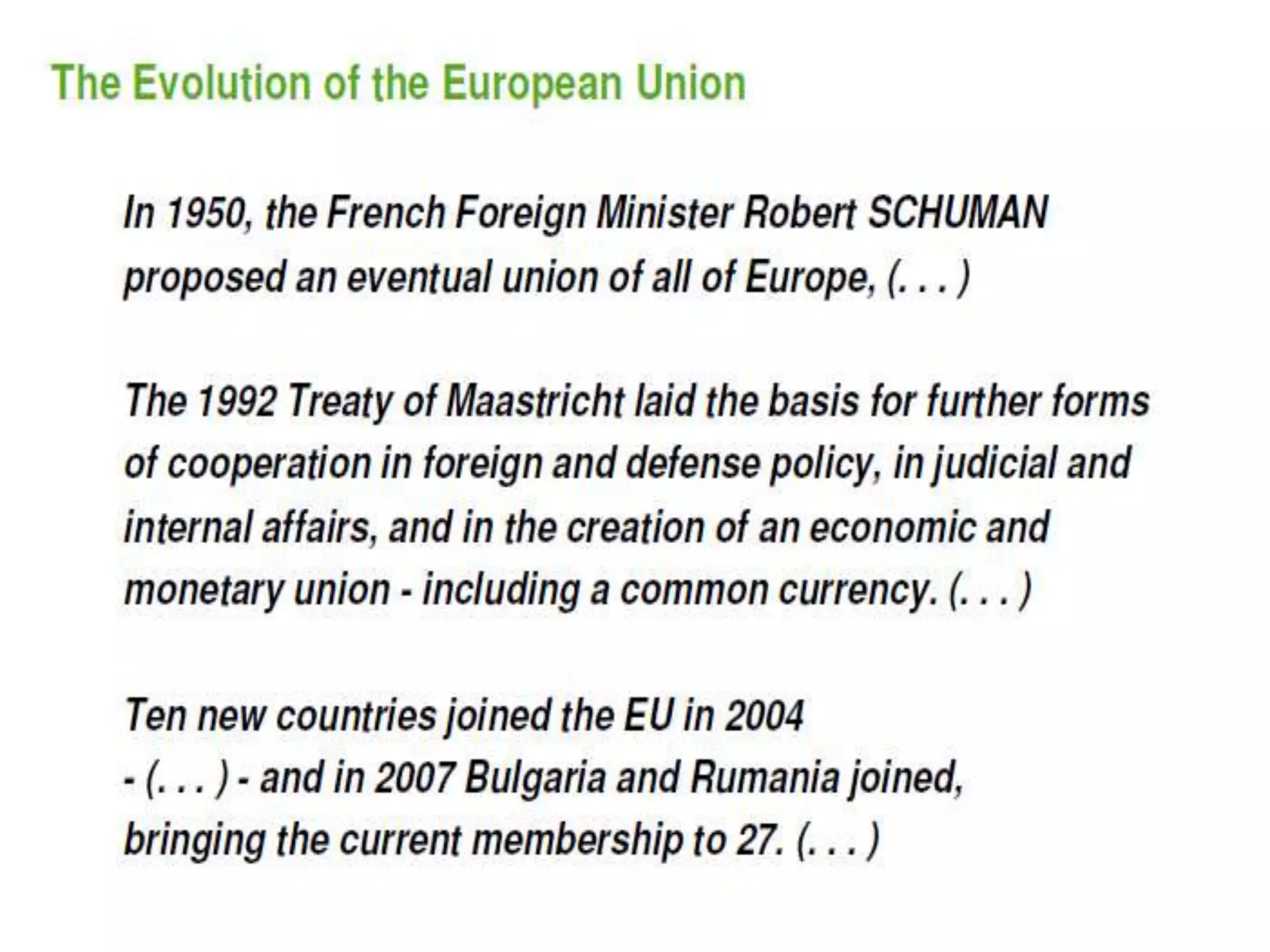
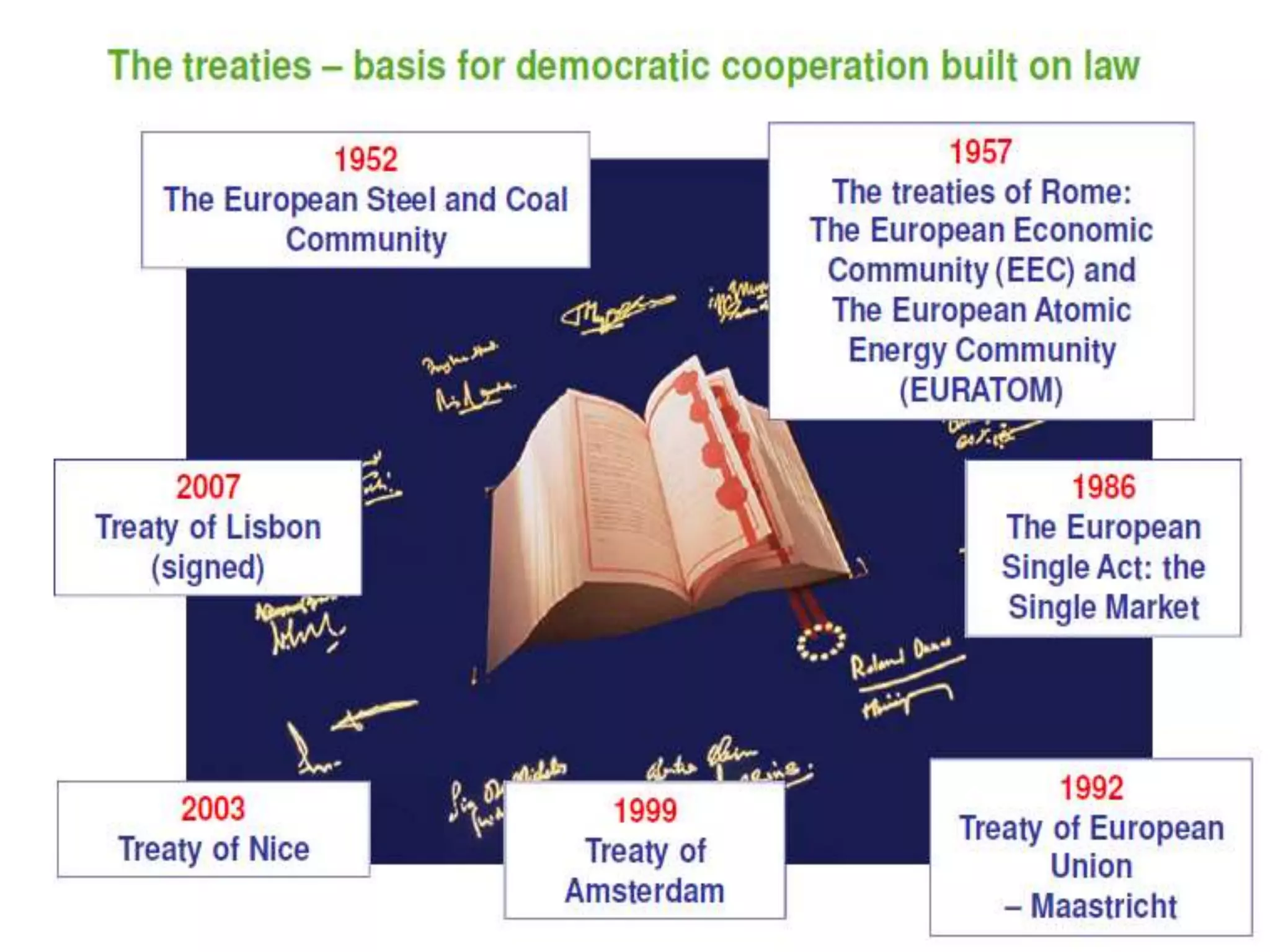
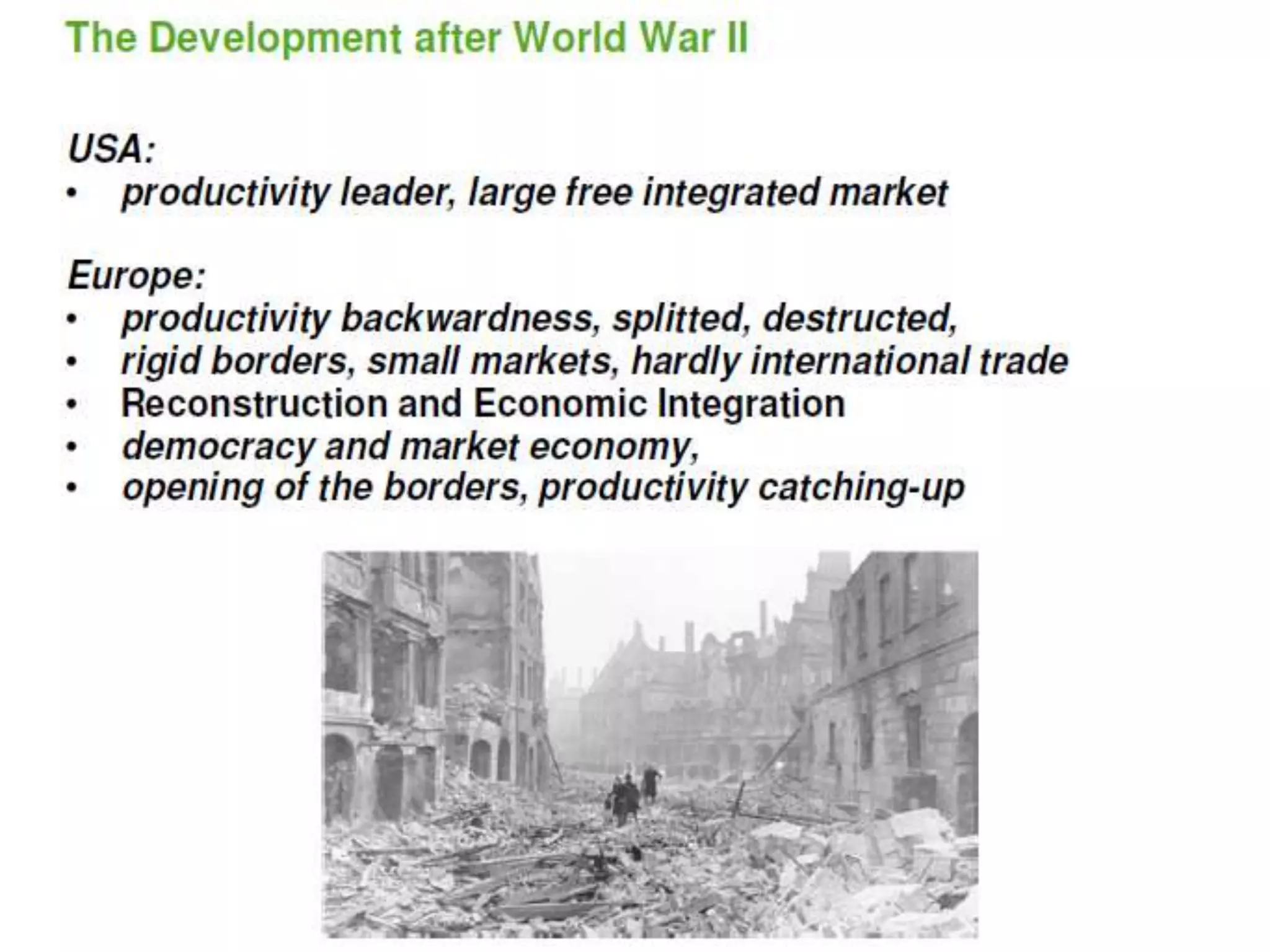
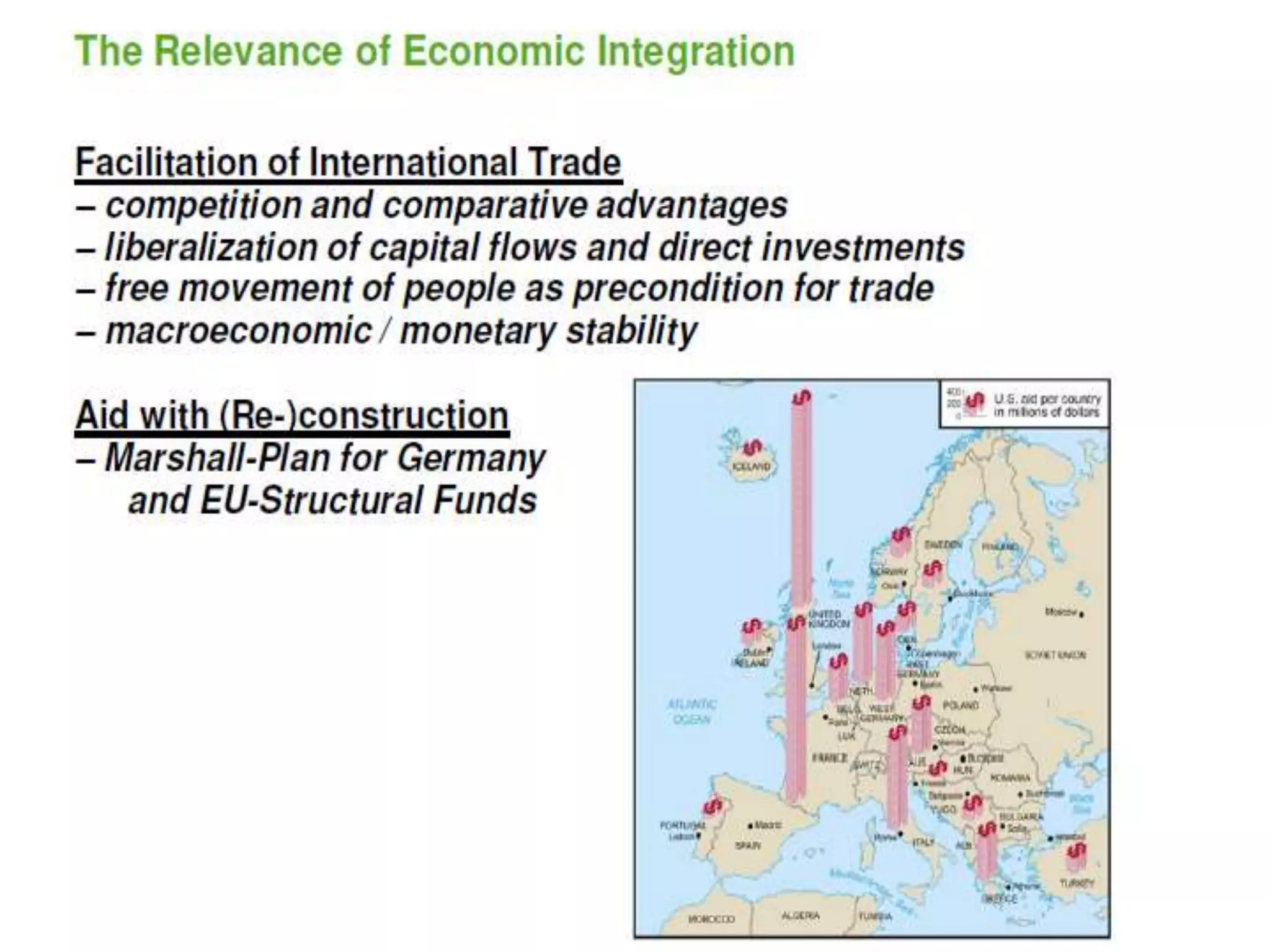
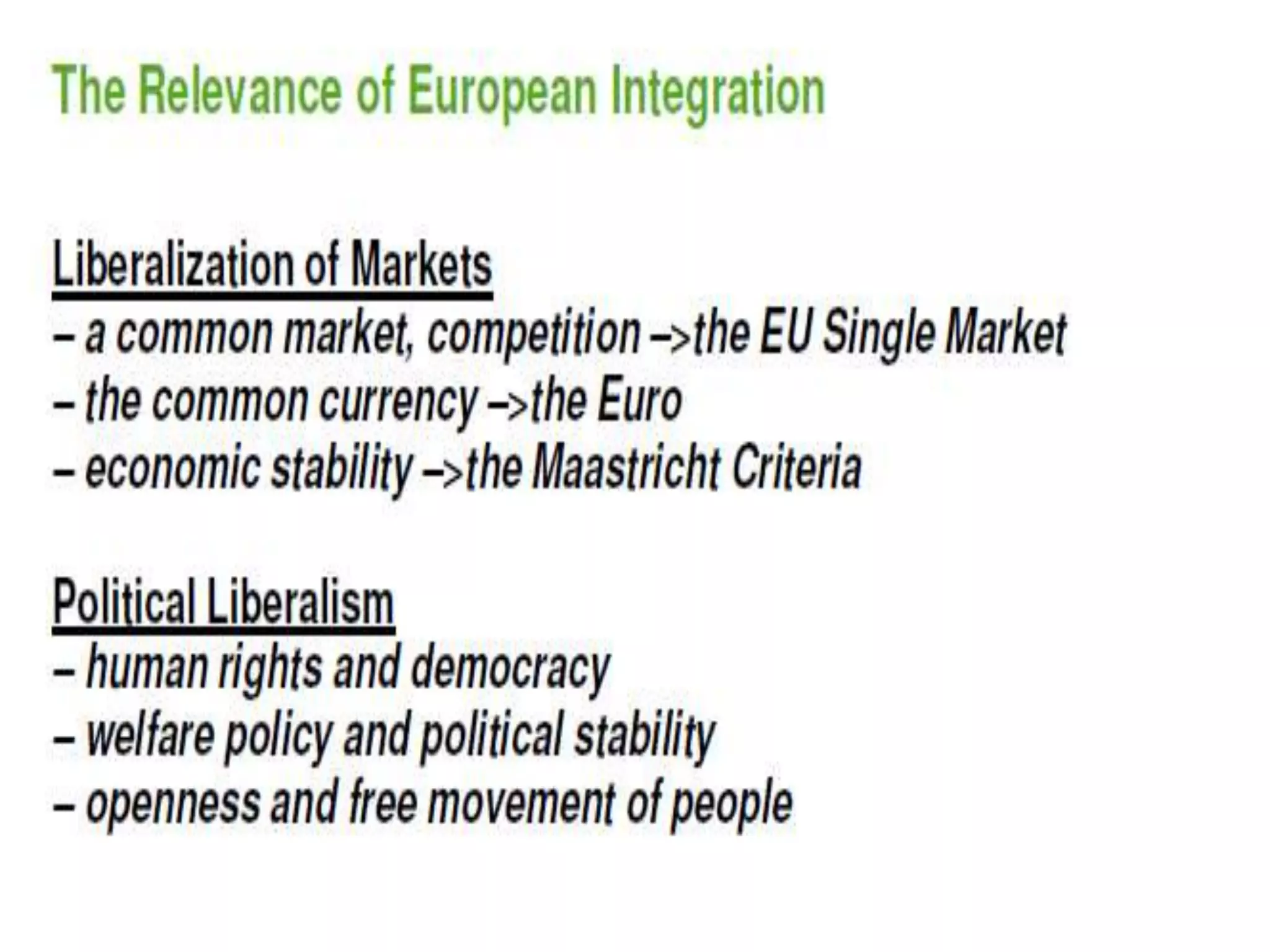
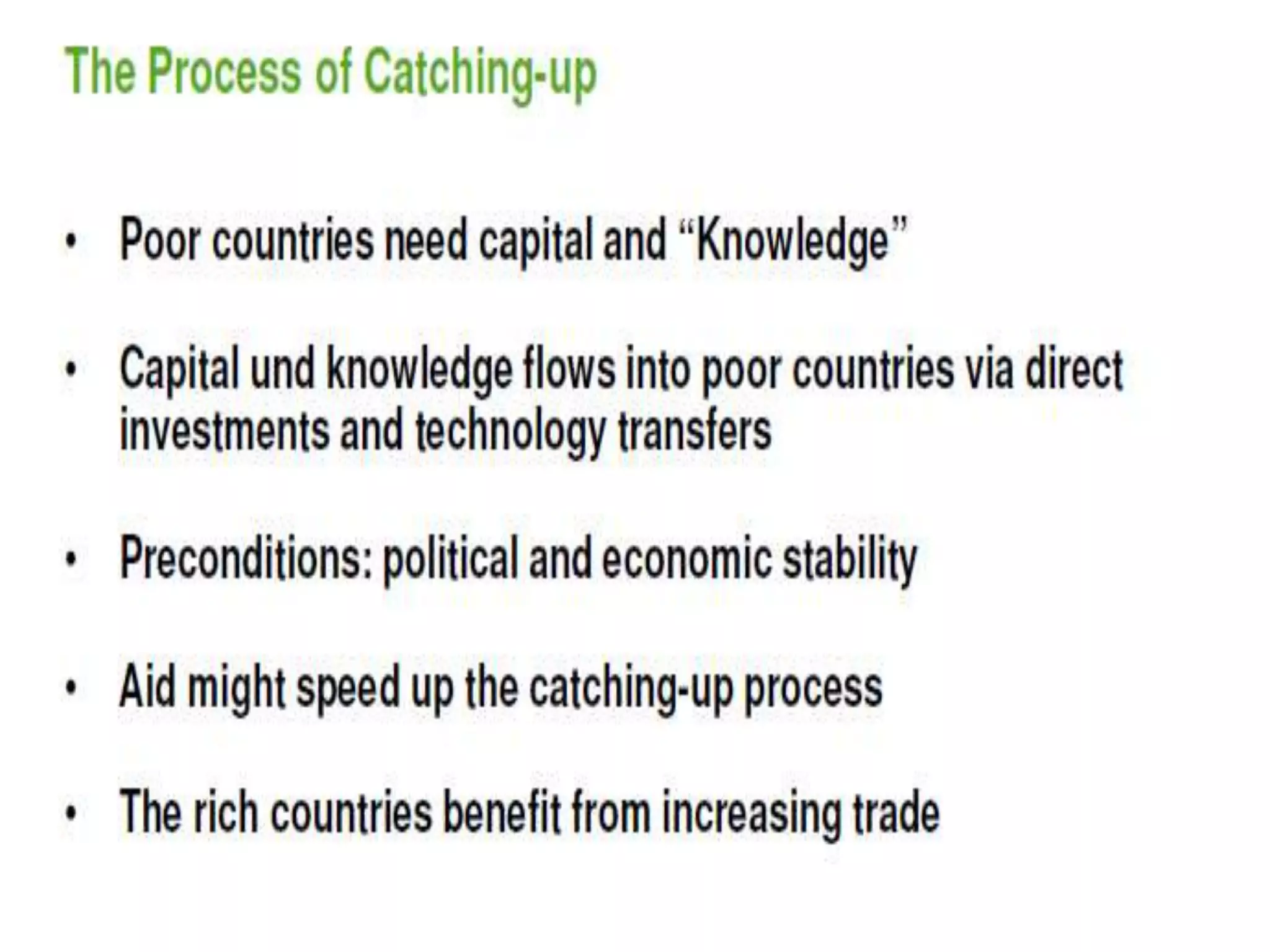
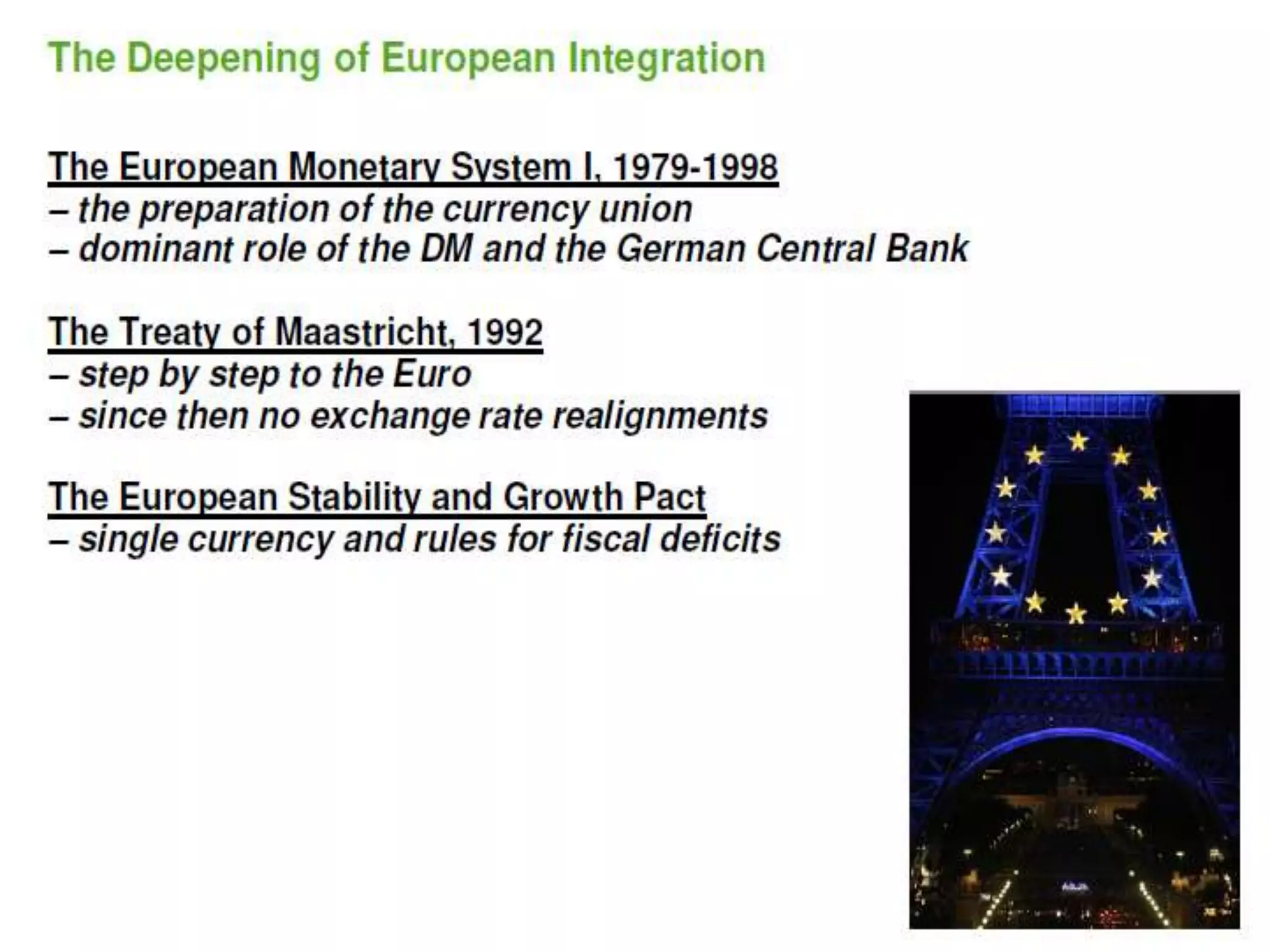
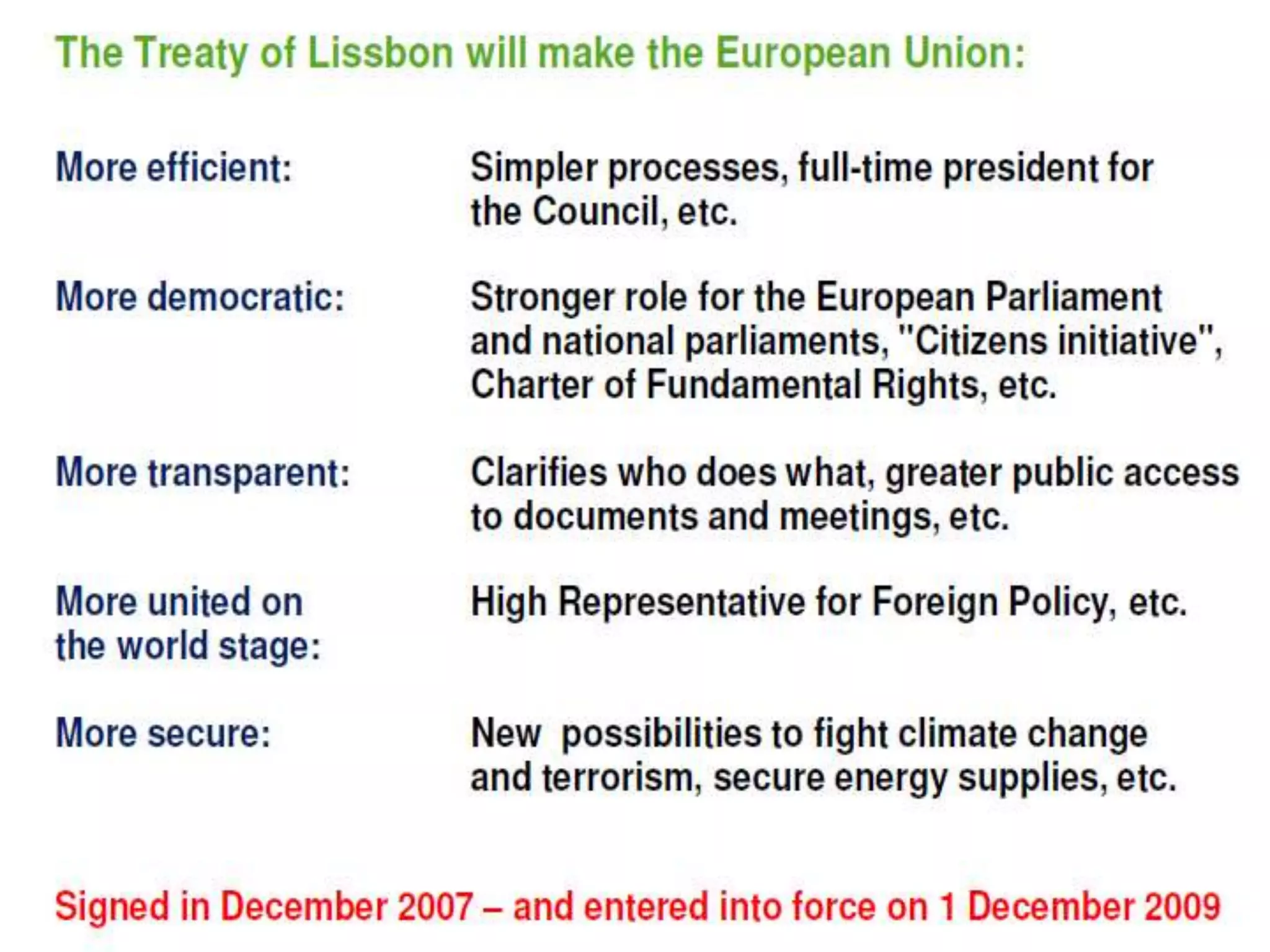
EU, NAFTA, ASEAN
SAARC, BRICS
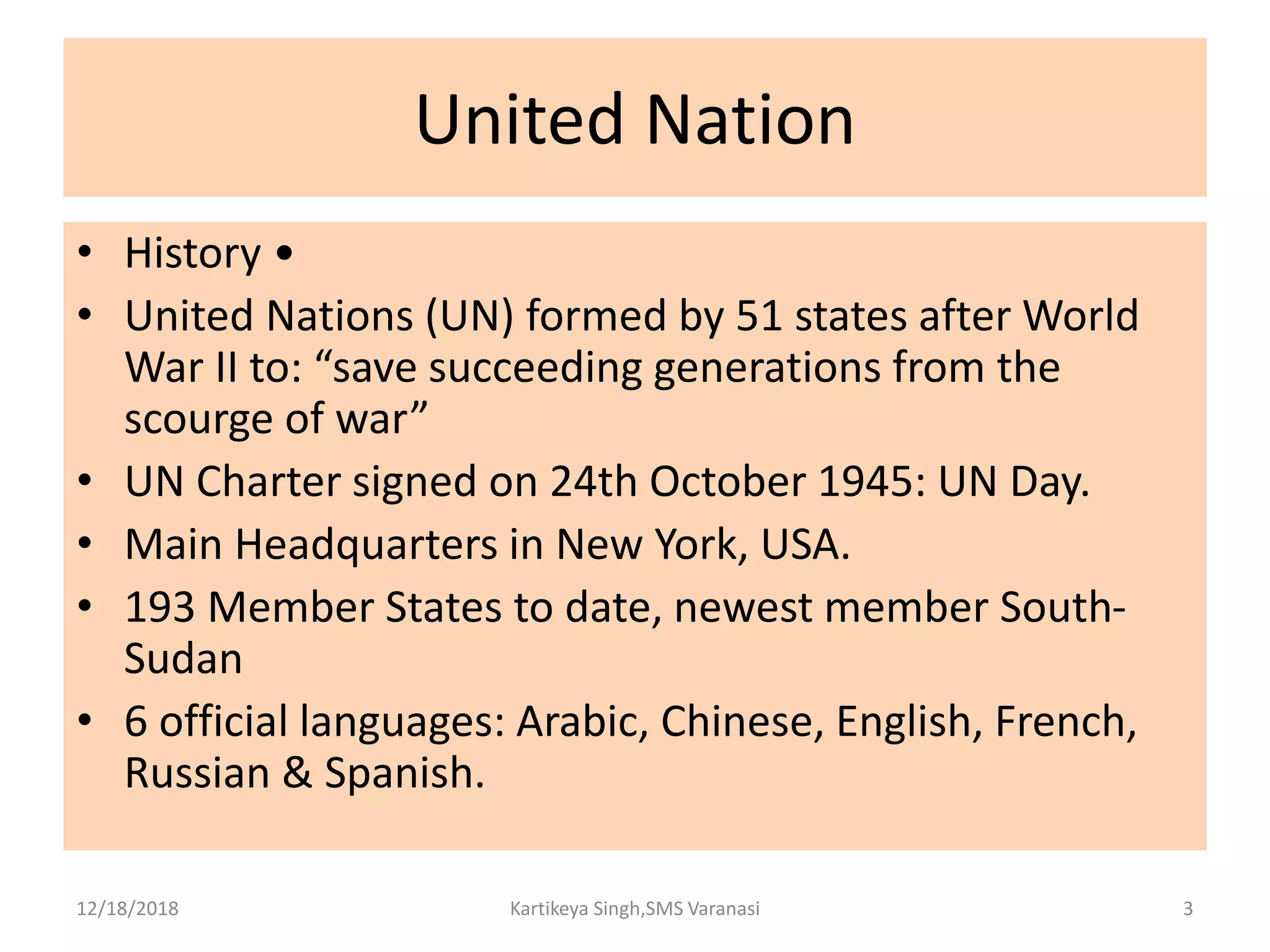
United Nation
• History •
• United Nations (UN) formed by 51 states after World
War II to: “save succeeding generations from the
scourge of war”
• UN Charter signed on 24th October 1945: UN Day.
• Main Headquarters in New York, USA.
• 193 Member States to date, newest member South-
Sudan
• 6 official languages: Arabic, Chinese, English, French,
Russian & Spanish.
12/18/2018 Kartikeya Singh,SMS Varanasi 3
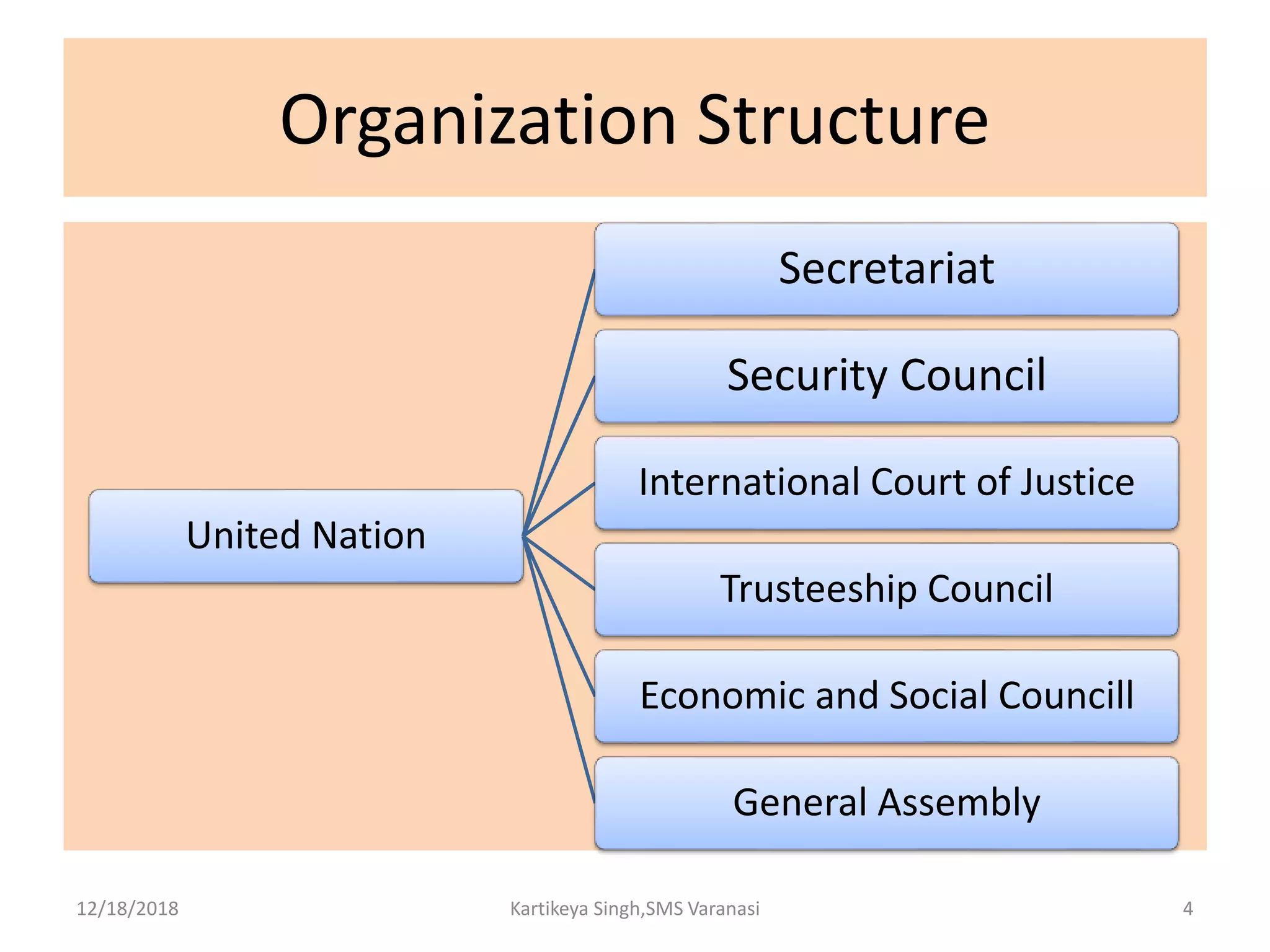
Organization Structure
United Nation
Secretariat
Security Council
International Court of Justice
Trusteeship Council
Economic and Social Councill
General Assembly
12/18/2018 Kartikeya Singh,SMS Varanasi 4
12/18/2018 Kartikeya Singh,SMS Varanasi 5
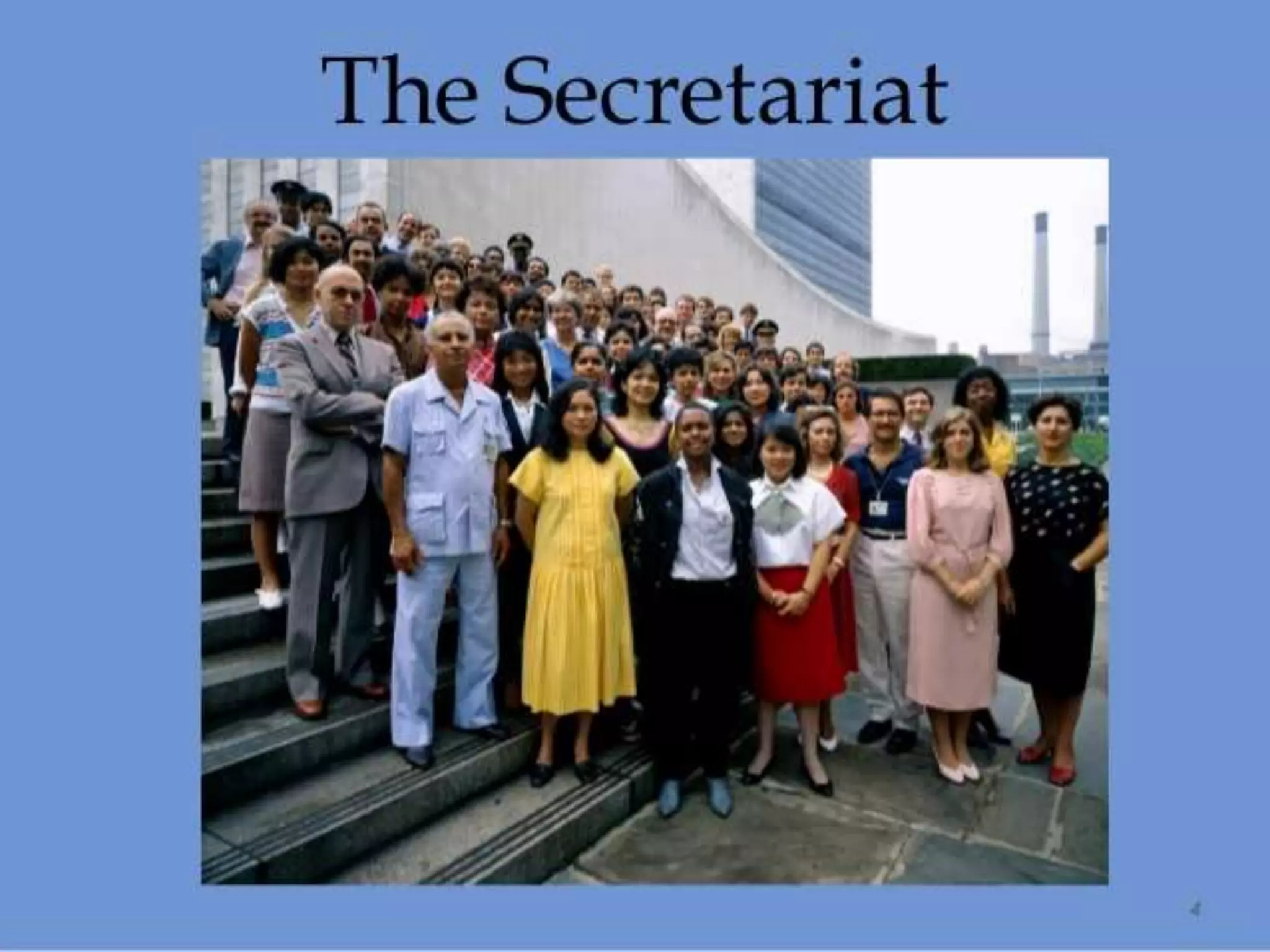
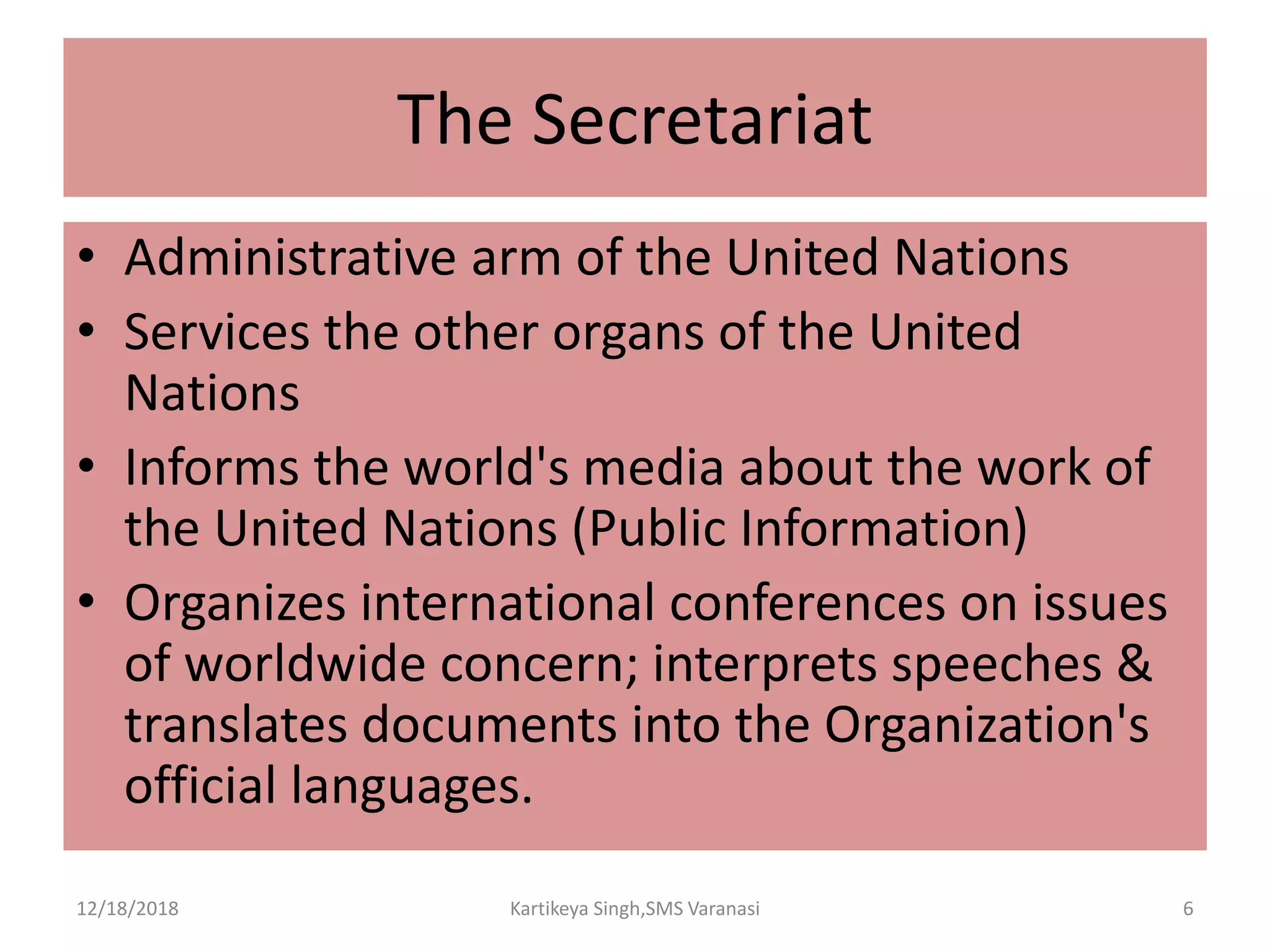
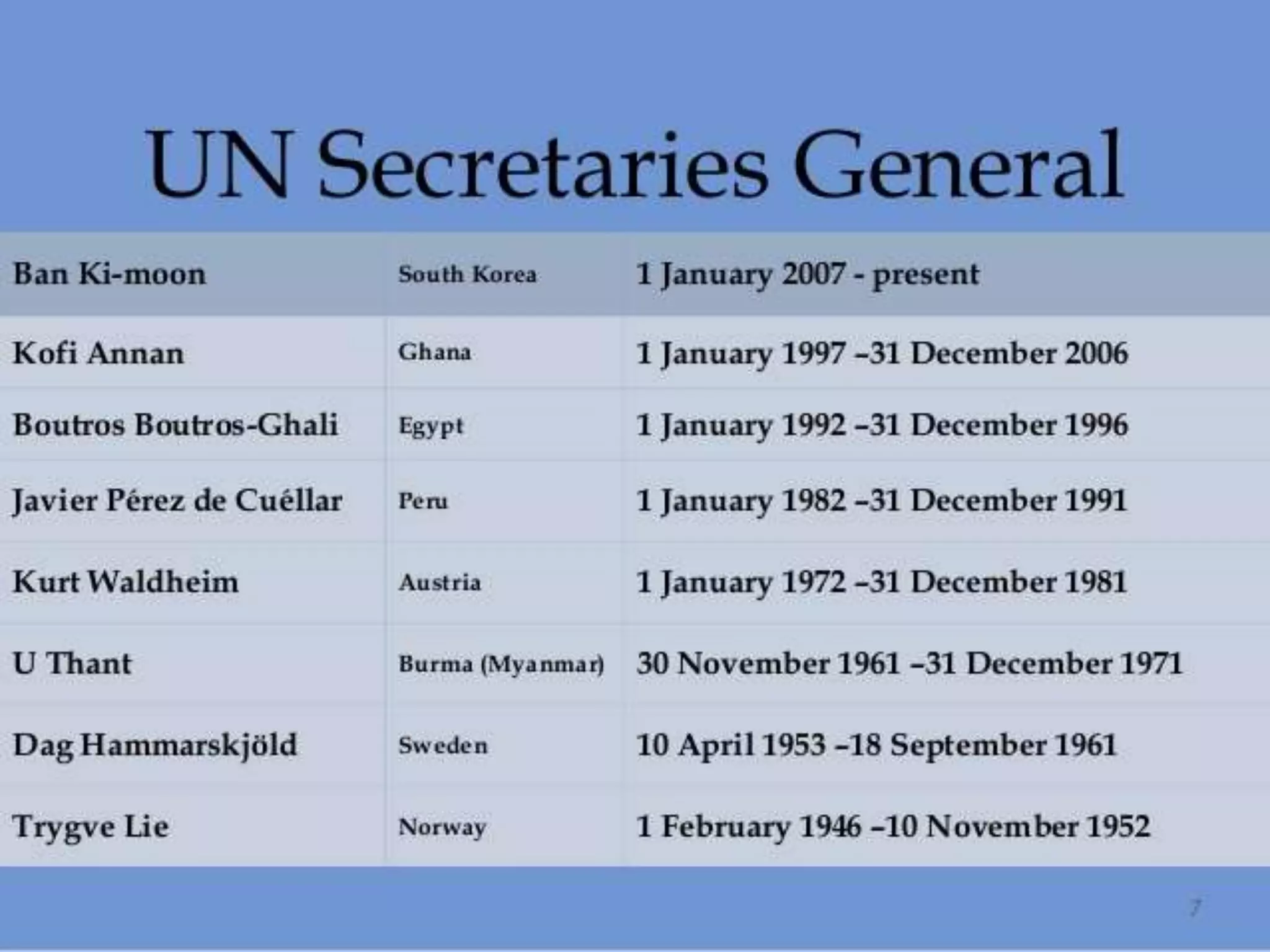
The Secretariat
• Administrative arm of the United Nations
• Services the other organs of the United
Nations
• Informs the world's media about the work of
the United Nations (Public Information)
• Organizes international conferences on issues
of worldwide concern; interprets speeches &
translates documents into the Organization's
official languages.
12/18/2018 Kartikeya Singh,SMS Varanasi 6
12/18/2018 Kartikeya Singh,SMS Varanasi 7
12/18/2018 Kartikeya Singh,SMS Varanasi 8
12/18/2018 Kartikeya Singh,SMS Varanasi 9
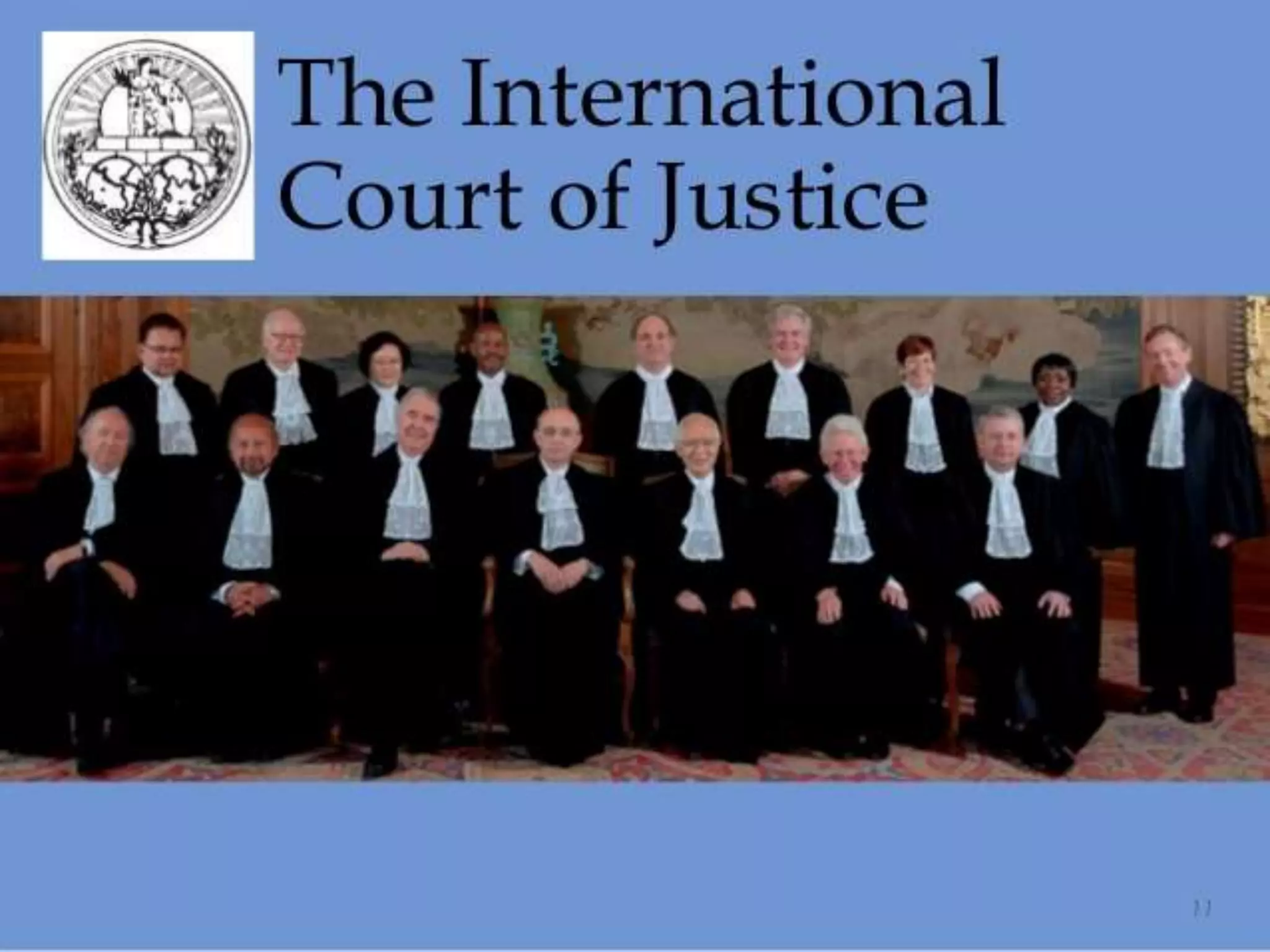
The International Court of Justice
• Principal judicial organ of the UN.
• Established in June 1945 by the Charter of the
UN.
• Work commenced in April 1946.
• 15 judges elected by the General Assembly and
Security Council for 9 year terms.
• Main role:
– settles legal disputes submitted to it by States & to
gives advisory opinions on legal questions referred to
it by authorized UN organs & specialized agencies
12/18/2018 Kartikeya Singh,SMS Varanasi 10
12/18/2018 Kartikeya Singh,SMS Varanasi 11
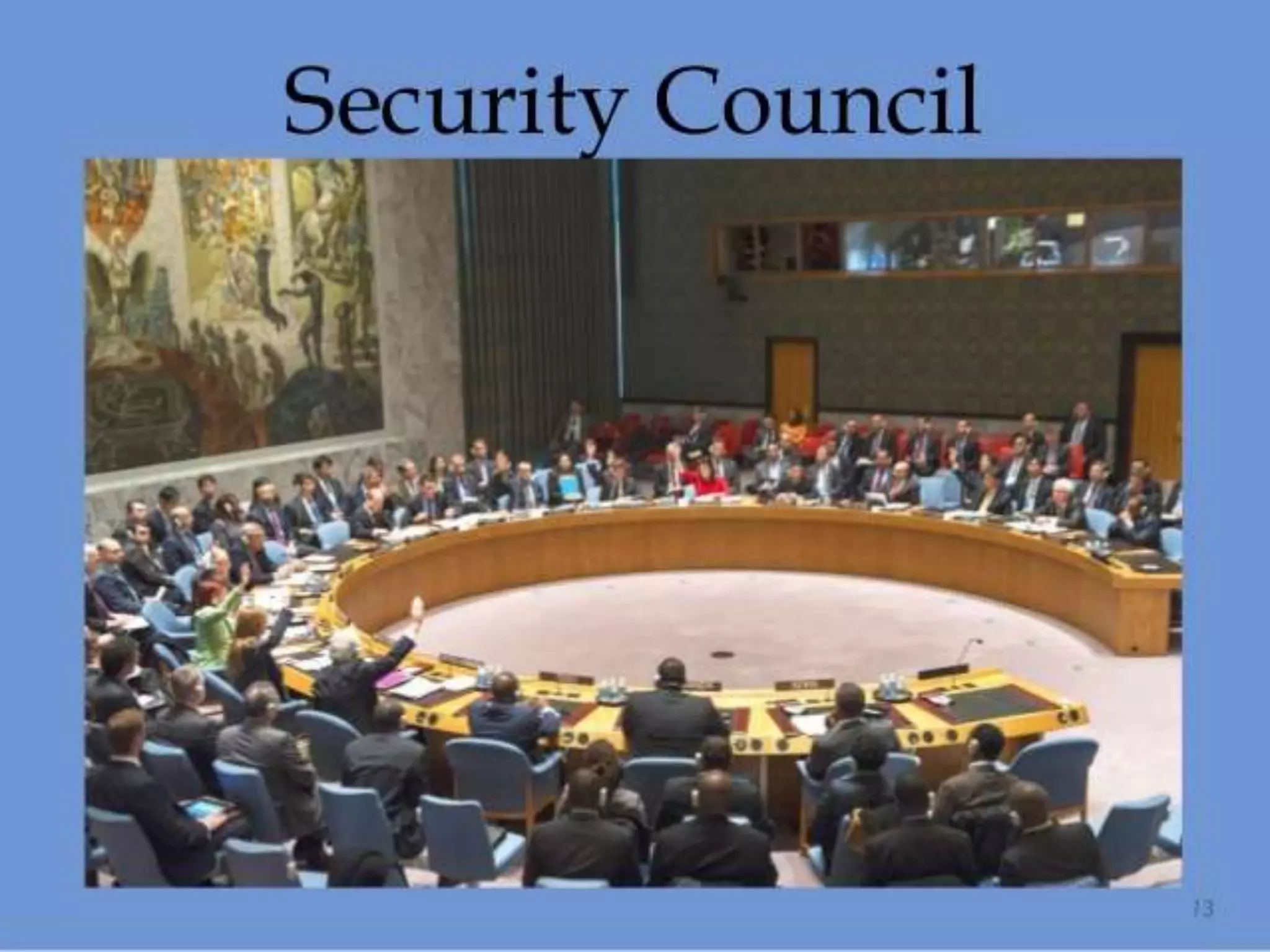
Security Council
• Main role: maintenance of international peace & security.
• 15 members;
• 5 permanent and 10 non-permanent.
• Non-permanent members elected from different regions in
the world to serve 2 year terms.
• Council on a 24-hr call (can meet any day, at any time)
• 9 out of 15 votes required to pass a resolution (no veto from
the permanent members!).
• Only UN-Organ which can enforce it’s resolutions – they are
legally binding
12/18/2018 Kartikeya Singh,SMS Varanasi 12
Security Council
• Actions the Security Council may take:
– Peaceful settlement of disputes (i.e. negotiations,
peace talks, good offices of the Secretary-General,
also Special Representatives of the Secretary-
general)
– Establish Peacekeeping Operations
– Enforcement measures (i.e. targeted sanctions,
multinational forces)
12/18/2018 Kartikeya Singh,SMS Varanasi 13
12/18/2018 Kartikeya Singh,SMS Varanasi 14
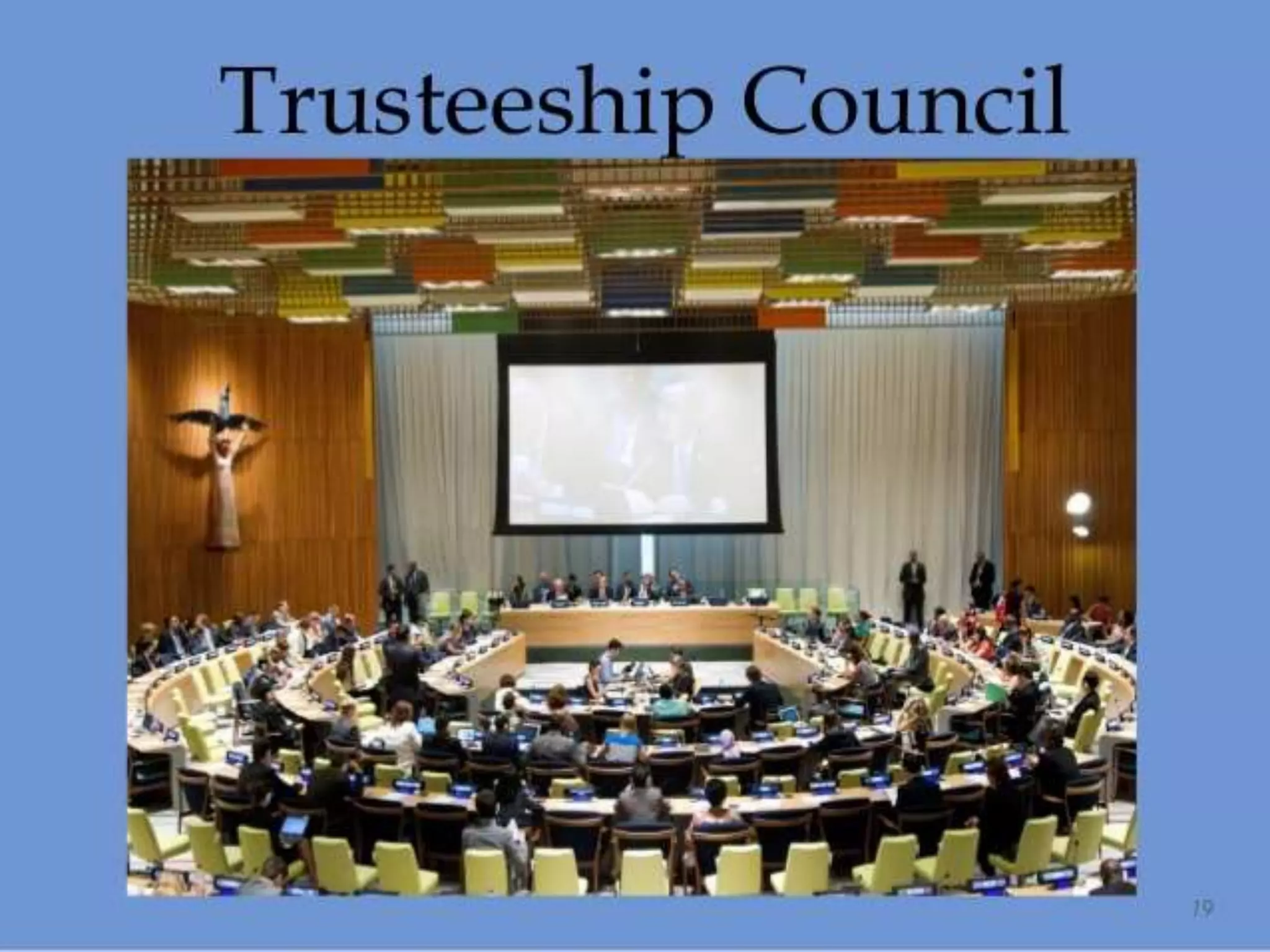
Trusteeship Council
• Has suspended it’s work, no longer active! Previously
supervised the administration of Trust Territories
placed under the Trusteeship System.
• Main goal:
– to promote the advancement of the inhabitants of Trust
Territories and their progressive development towards
self-determination.
– Special Committee on Decolonization still active to date!
– 17 non-self-governing territories remaining today
12/18/2018 Kartikeya Singh,SMS Varanasi 15
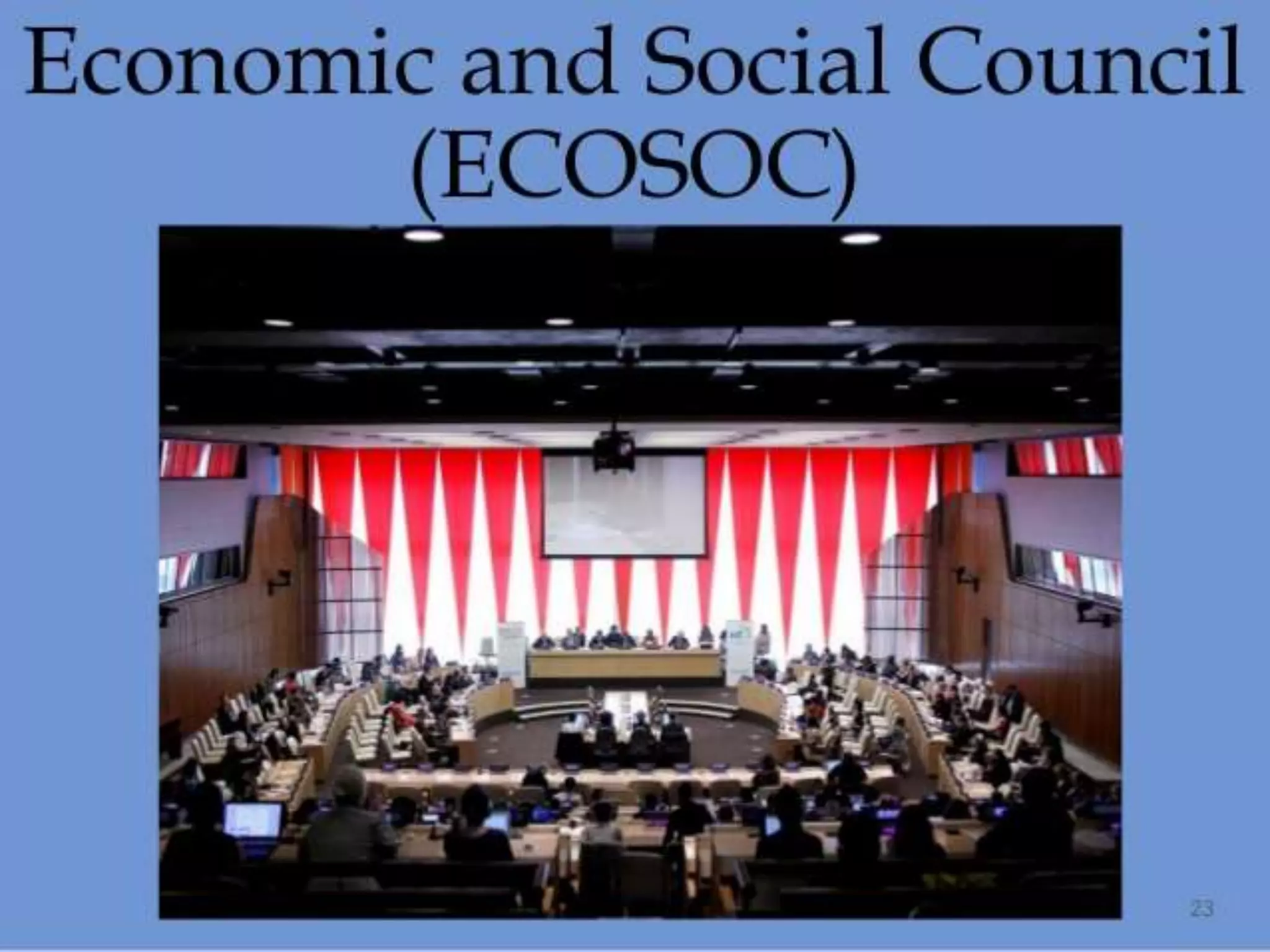
Economic and Social Council (ECOSOC)
• Main goal:
• To improve the world’s living standards and to promote the
respect of human rights – no peace & security without
economic & social stability!
• Coordinates the work of UN funds, programmes & specialized
agencies; i.e. UNHCR, UNICEF, WFP, UNEP, UN-HABITAT, ILO,
World Bank…
• Sets international standards; i.e. Children’s Rights
• World’s economic, social & environmental challenges are
discussed, debated and recommendations made by this
organ.
12/18/2018 Kartikeya Singh,SMS Varanasi 16
12/18/2018 Kartikeya Singh,SMS Varanasi 17
Economic and Social Council (ECOSOC)
• Main goal:
• to improve the world’s living standards and to promote the
respect of human rights – no peace & security without
economic & social stability!
• Coordinates the work of UN funds, programmes & specialized
agencies; i.e. UNHCR, UNICEF, WFP, UNEP, UN-HABITAT, ILO,
World Bank…
• Sets international standards; i.e. Children’s Rights
• World’s economic, social & environmental challenges are
discussed, debated and recommendations made by this
organ.
12/18/2018 Kartikeya Singh,SMS Varanasi 18
12/18/2018 Kartikeya Singh,SMS Varanasi 19
12/18/2018 Kartikeya Singh,SMS Varanasi 20
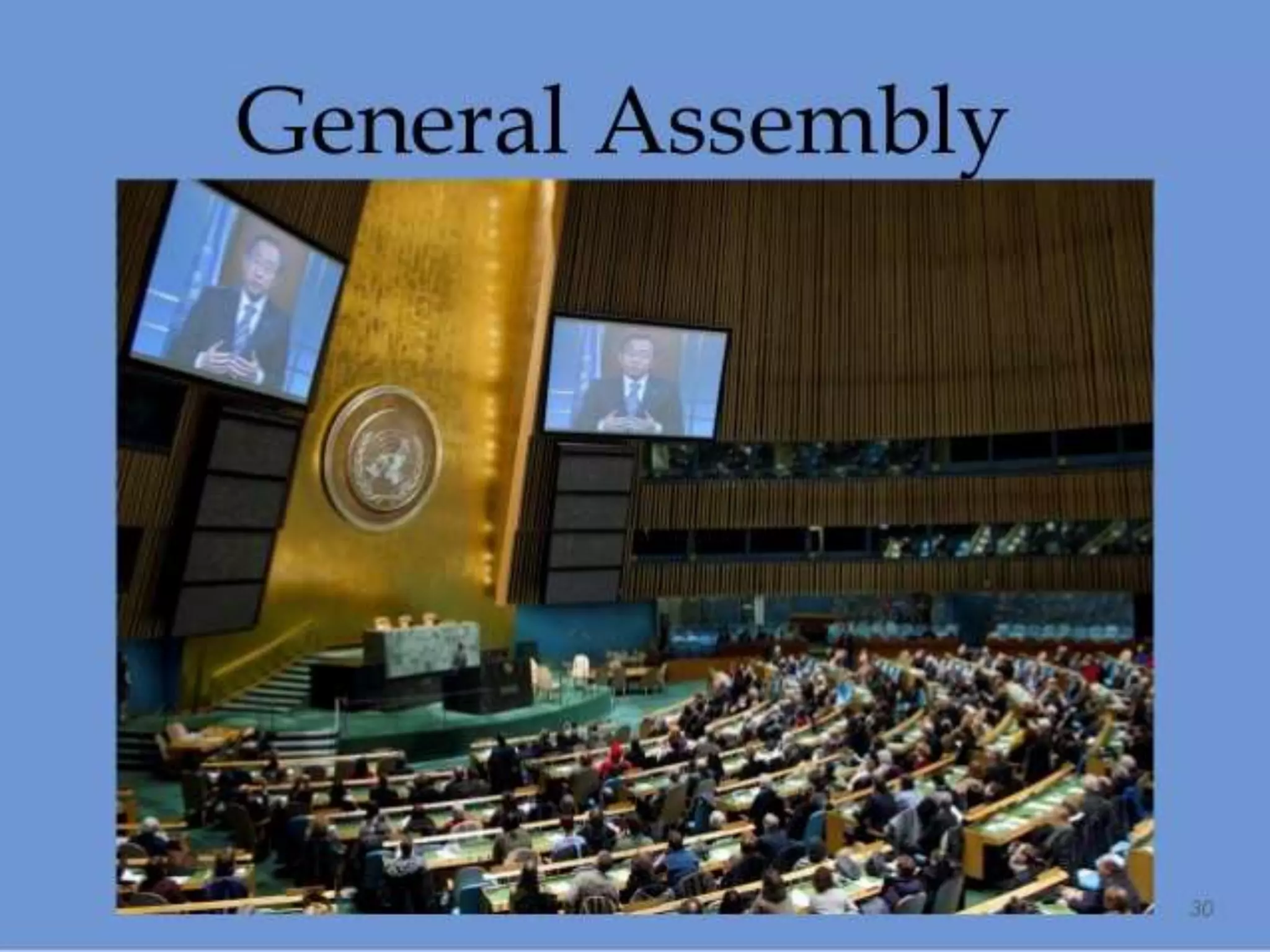
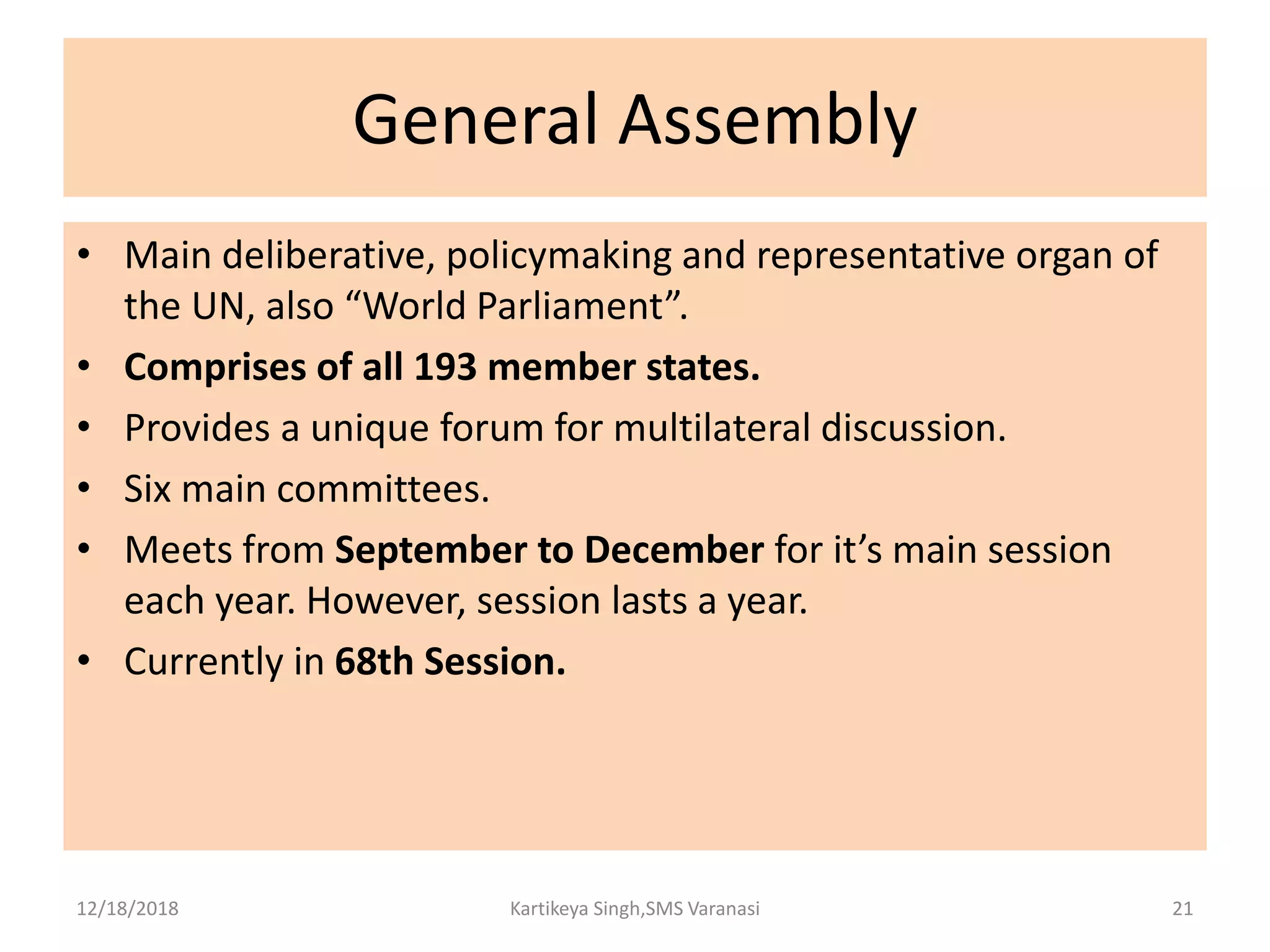
General Assembly
• Main deliberative, policymaking and representative organ of
the UN, also “World Parliament”.
• Comprises of all 193 member states.
• Provides a unique forum for multilateral discussion.
• Six main committees.
• Meets from September to December for it’s main session
each year. However, session lasts a year.
• Currently in 68th Session.
12/18/2018 Kartikeya Singh,SMS Varanasi 21
II. UNCTAD - United Nations Conference on Trade and
Development.
12/18/2018 Kartikeya Singh,SMS Varanasi 22
II. UNCTAD - United Nations Conference on Trade and
Development.
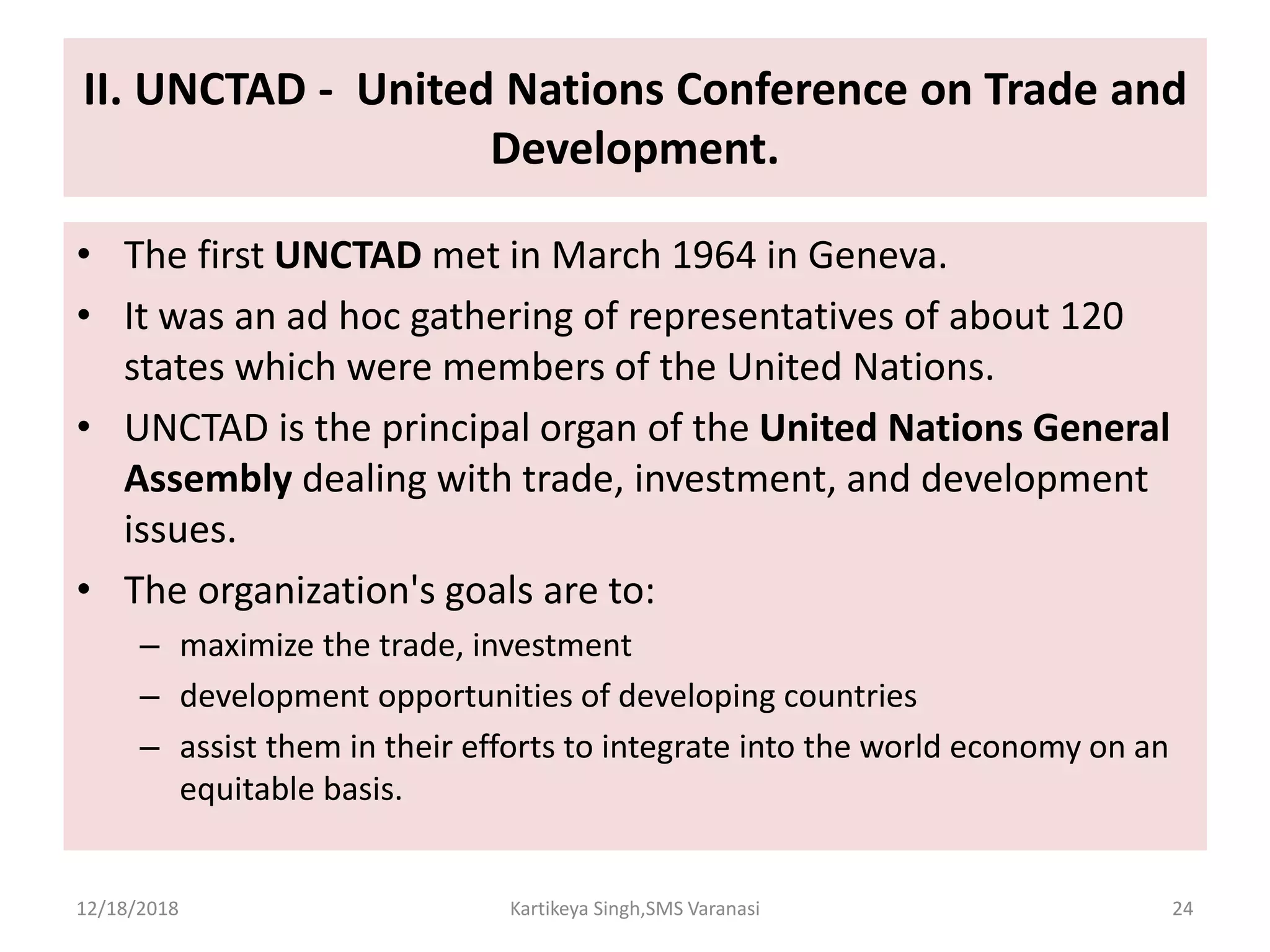
• The first UNCTAD met in March 1964 in Geneva.
• It was an ad hoc gathering of representatives of about 120
states which were members of the United Nations.
• It however, marked a turning point in international economic
relations and ushered a new era in the evolution of world
trade and development,
• Since it represented the first major Endeavour to examine all
the problems of International economic relations, with special
reference to the needs of developing countries.
12/18/2018 Kartikeya Singh,SMS Varanasi 23
II. UNCTAD - United Nations Conference on Trade and
Development.
• The first UNCTAD met in March 1964 in Geneva.
• It was an ad hoc gathering of representatives of about 120
states which were members of the United Nations.
• UNCTAD is the principal organ of the United Nations General
Assembly dealing with trade, investment, and development
issues.
• The organization's goals are to:
– maximize the trade, investment
– development opportunities of developing countries
– assist them in their efforts to integrate into the world economy on an
equitable basis.
12/18/2018 Kartikeya Singh,SMS Varanasi 24
II. UNCTAD - United Nations Conference on Trade and
Development.
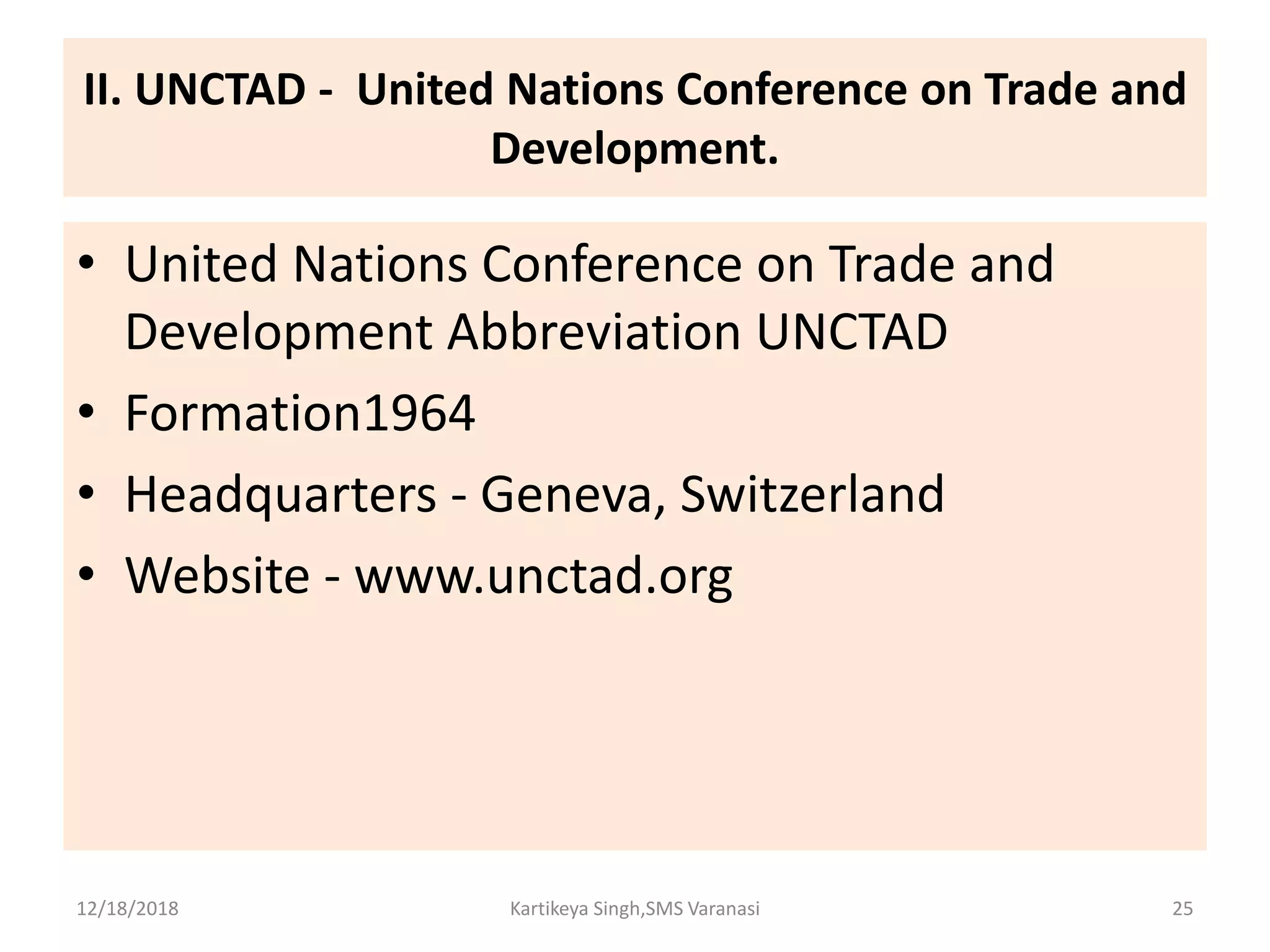
• United Nations Conference on Trade and
Development Abbreviation UNCTAD
• Formation1964
• Headquarters - Geneva, Switzerland
• Website - www.unctad.org
12/18/2018 Kartikeya Singh,SMS Varanasi 25
II. UNCTAD - United Nations Conference on Trade and
Development.
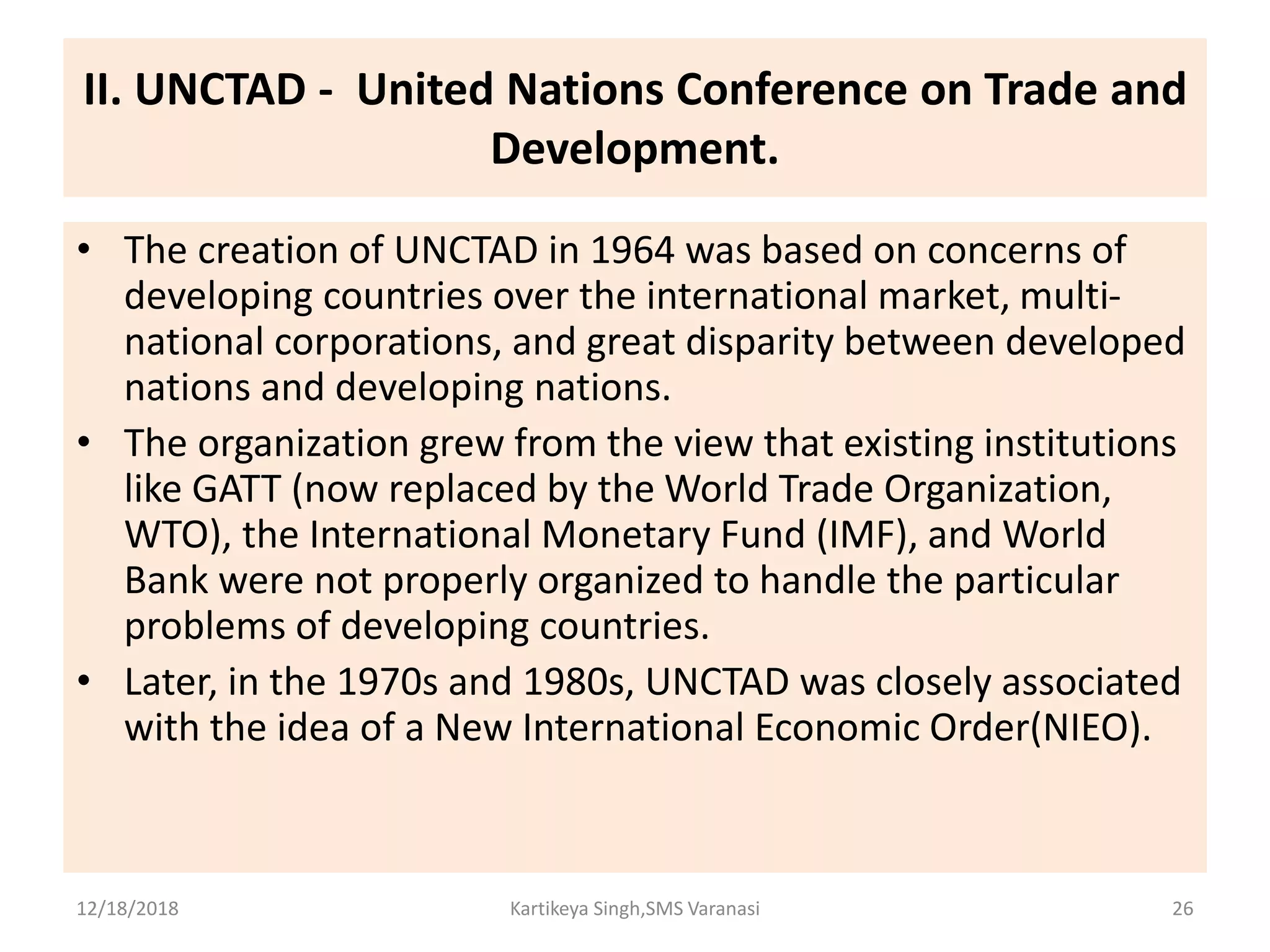
• The creation of UNCTAD in 1964 was based on concerns of
developing countries over the international market, multi-
national corporations, and great disparity between developed
nations and developing nations.
• The organization grew from the view that existing institutions
like GATT (now replaced by the World Trade Organization,
WTO), the International Monetary Fund (IMF), and World
Bank were not properly organized to handle the particular
problems of developing countries.
• Later, in the 1970s and 1980s, UNCTAD was closely associated
with the idea of a New International Economic Order(NIEO).
12/18/2018 Kartikeya Singh,SMS Varanasi 26
II. UNCTAD - United Nations Conference on Trade and
Development.
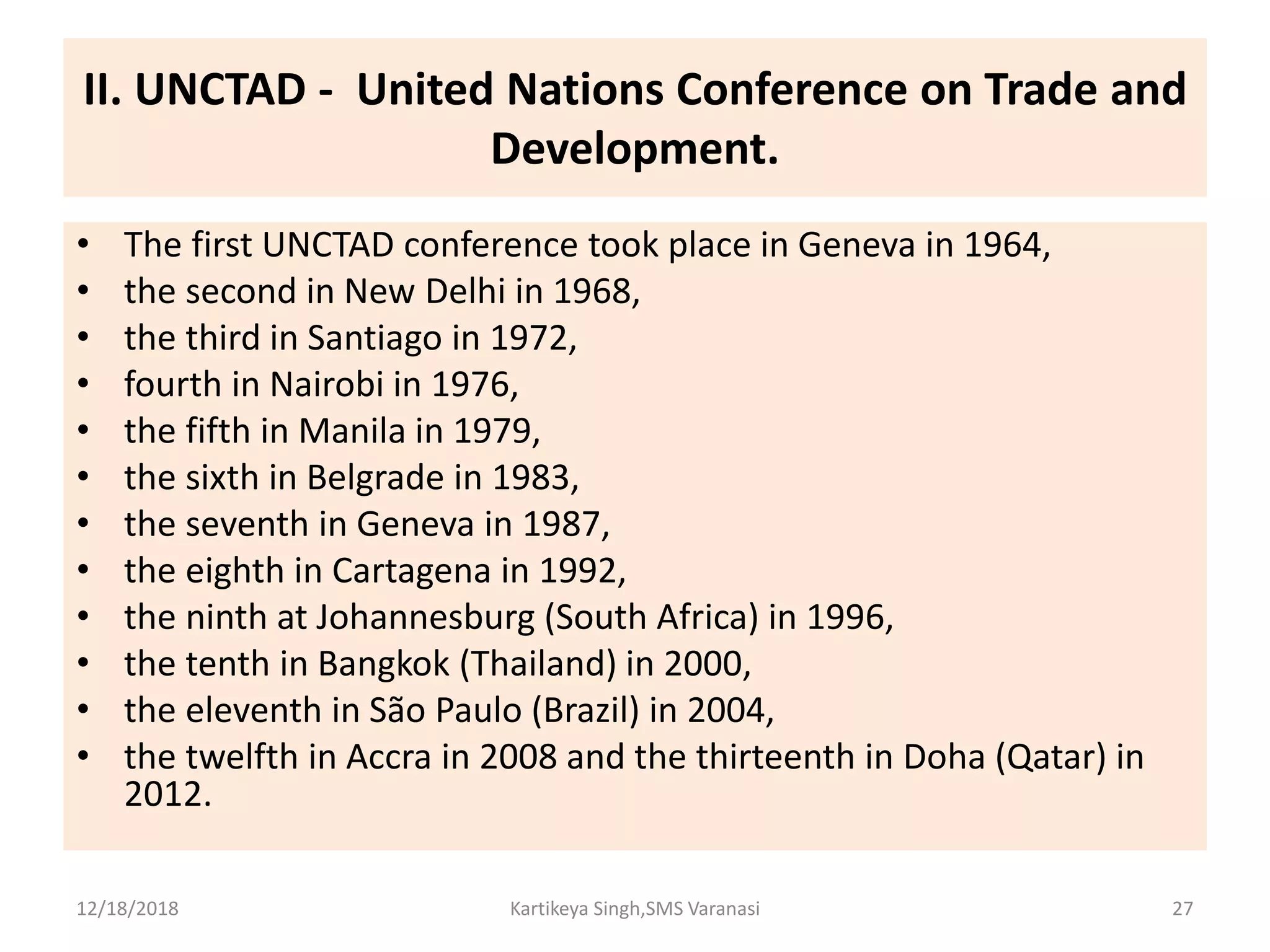
• The first UNCTAD conference took place in Geneva in 1964,
• the second in New Delhi in 1968,
• the third in Santiago in 1972,
• fourth in Nairobi in 1976,
• the fifth in Manila in 1979,
• the sixth in Belgrade in 1983,
• the seventh in Geneva in 1987,
• the eighth in Cartagena in 1992,
• the ninth at Johannesburg (South Africa) in 1996,
• the tenth in Bangkok (Thailand) in 2000,
• the eleventh in São Paulo (Brazil) in 2004,
• the twelfth in Accra in 2008 and the thirteenth in Doha (Qatar) in
2012.
12/18/2018 Kartikeya Singh,SMS Varanasi 27
Unit IV – International Monitory
fund - IMF
• International Monetary Fund (IMF) : The Bretton
Woods Conference (1944) paved the way for the
establishment of the International Monetary
Fund (IMF). The Fund came into existence in
December, 1945 with a modest membership of
45 nations.
• At present 188 nations are members of the IMF.
• Head quarter - Washington DC in USA.- Mrs.
Christine Lagarde is the Head of IMF.
12/18/2018 Kartikeya Singh
Unit IV – Objective of IMF.
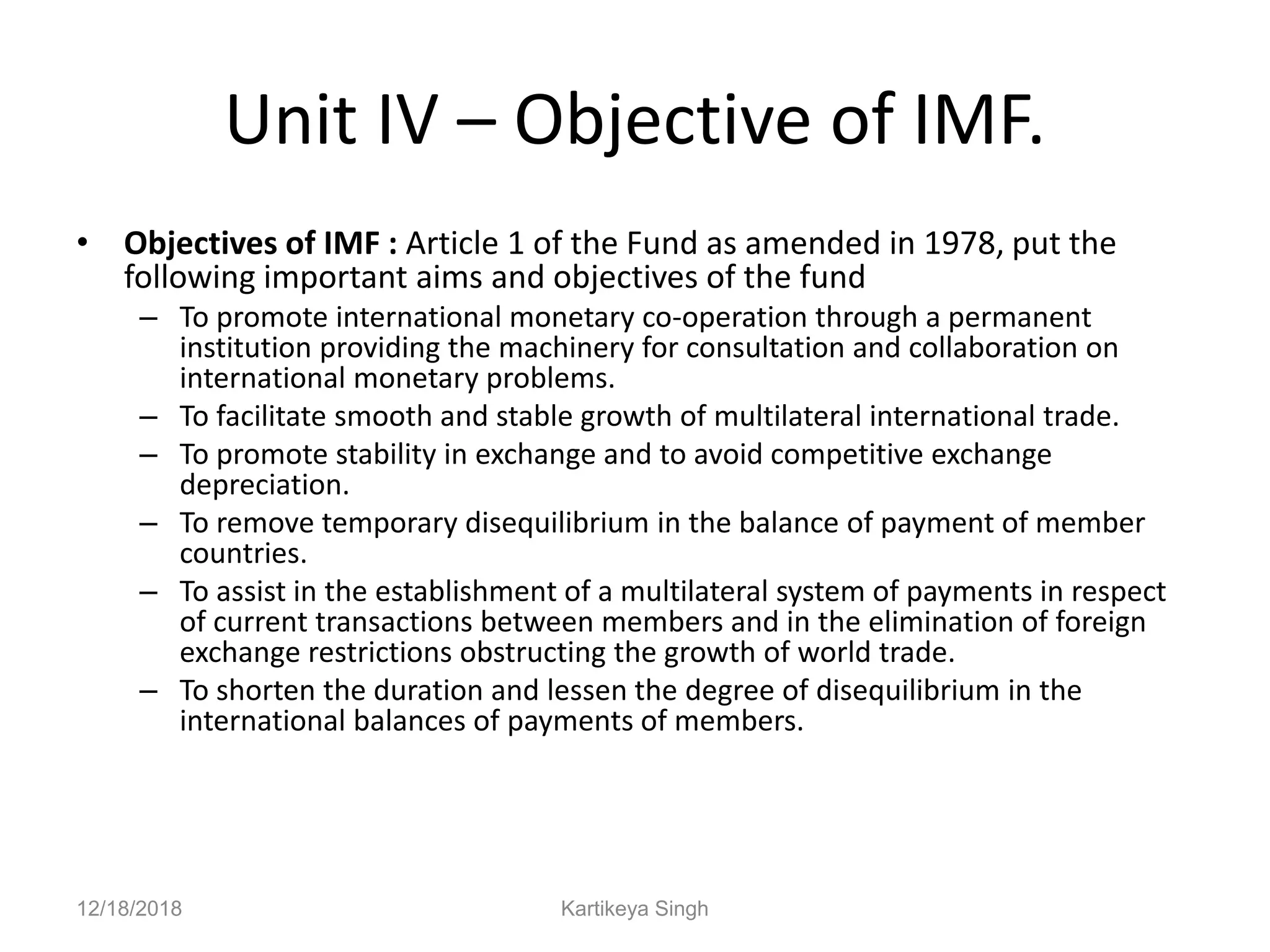
• Objectives of IMF : Article 1 of the Fund as amended in 1978, put the
following important aims and objectives of the fund
– To promote international monetary co-operation through a permanent
institution providing the machinery for consultation and collaboration on
international monetary problems.
– To facilitate smooth and stable growth of multilateral international trade.
– To promote stability in exchange and to avoid competitive exchange
depreciation.
– To remove temporary disequilibrium in the balance of payment of member
countries.
– To assist in the establishment of a multilateral system of payments in respect
of current transactions between members and in the elimination of foreign
exchange restrictions obstructing the growth of world trade.
– To shorten the duration and lessen the degree of disequilibrium in the
international balances of payments of members.
12/18/2018 Kartikeya Singh
Unit IV – Management of IMF.
• IMF is controlled by board of
Governors.
• Each member country nominates
a Governor.
• All the nominated Governors
make the board of Governors.
• Each country also nominates an
alternate Governor who casts his
vote in the absence of the
governor.
• Each governor is allotted a
number of votes which is
determined by the quota allotted
to the respective country in the
capital of IMF.
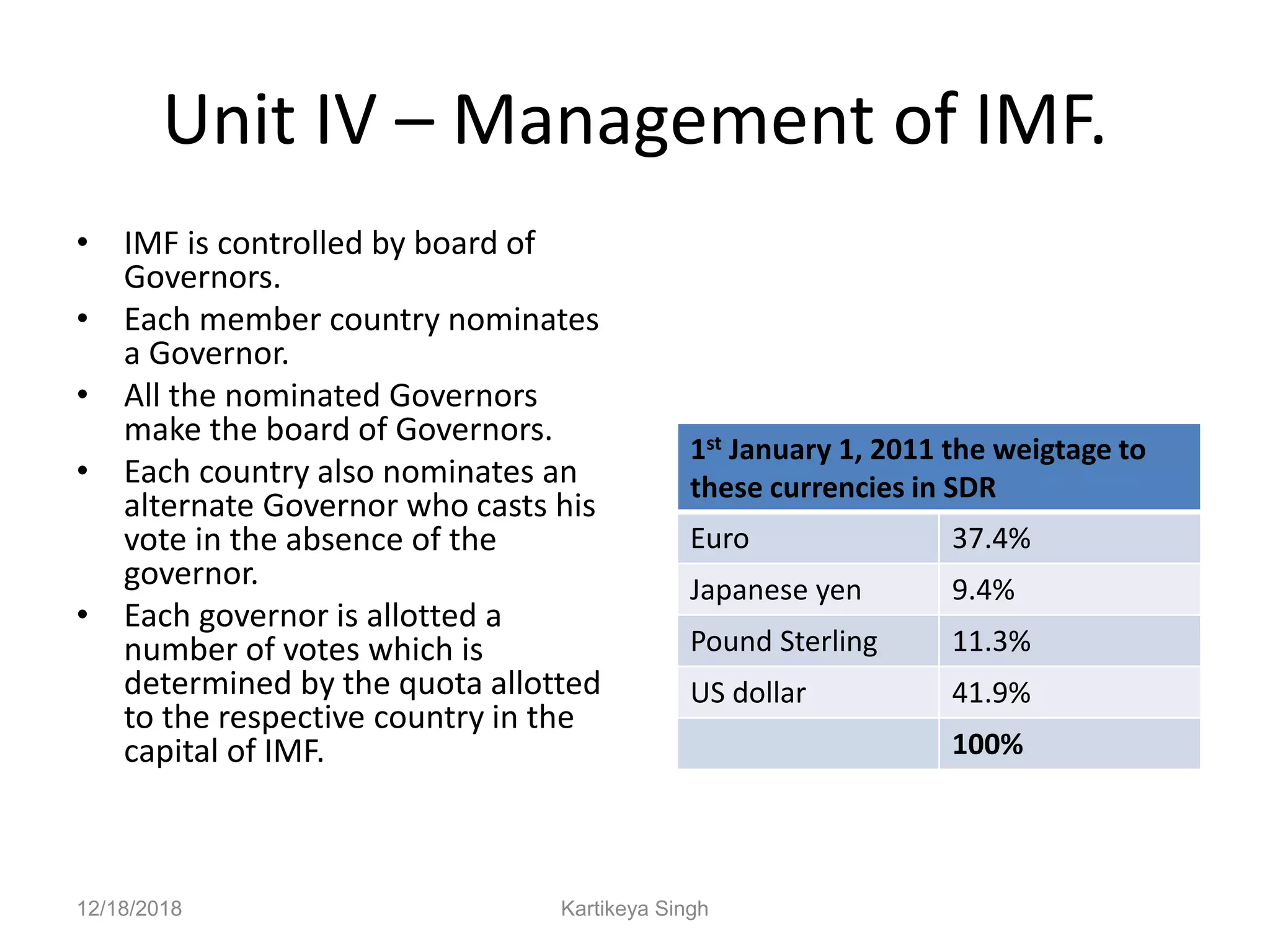
1st January 1, 2011 the weigtage to
these currencies in SDR
Euro 37.4%
Japanese yen 9.4%
Pound Sterling 11.3%
US dollar 41.9%
100%
12/18/2018 Kartikeya Singh
Unit IV- IBRD – International bank for
reconstruction and development.
• IBRD (World Bank)was established in December 1945 with the
IMF on the basis of the recommendation of the Bretton
Wood Conference. That is the reason why IMF and IBRD are
called `Bretton Wood Twins'. IBRD started functioning in June
1946. World Bank and IMF are Complementary institutions.
• Head office – Washington DC
• Headed by – Mr. Jim Yuong Kim
12/18/2018 Kartikeya Singh
Unit IV – Objective of World Bank
• Reconstruction
• Economic Development
• Reducing Economic
disparities
• Raising Living Standard
• Productive International
Investment.
12/18/2018 Kartikeya Singh
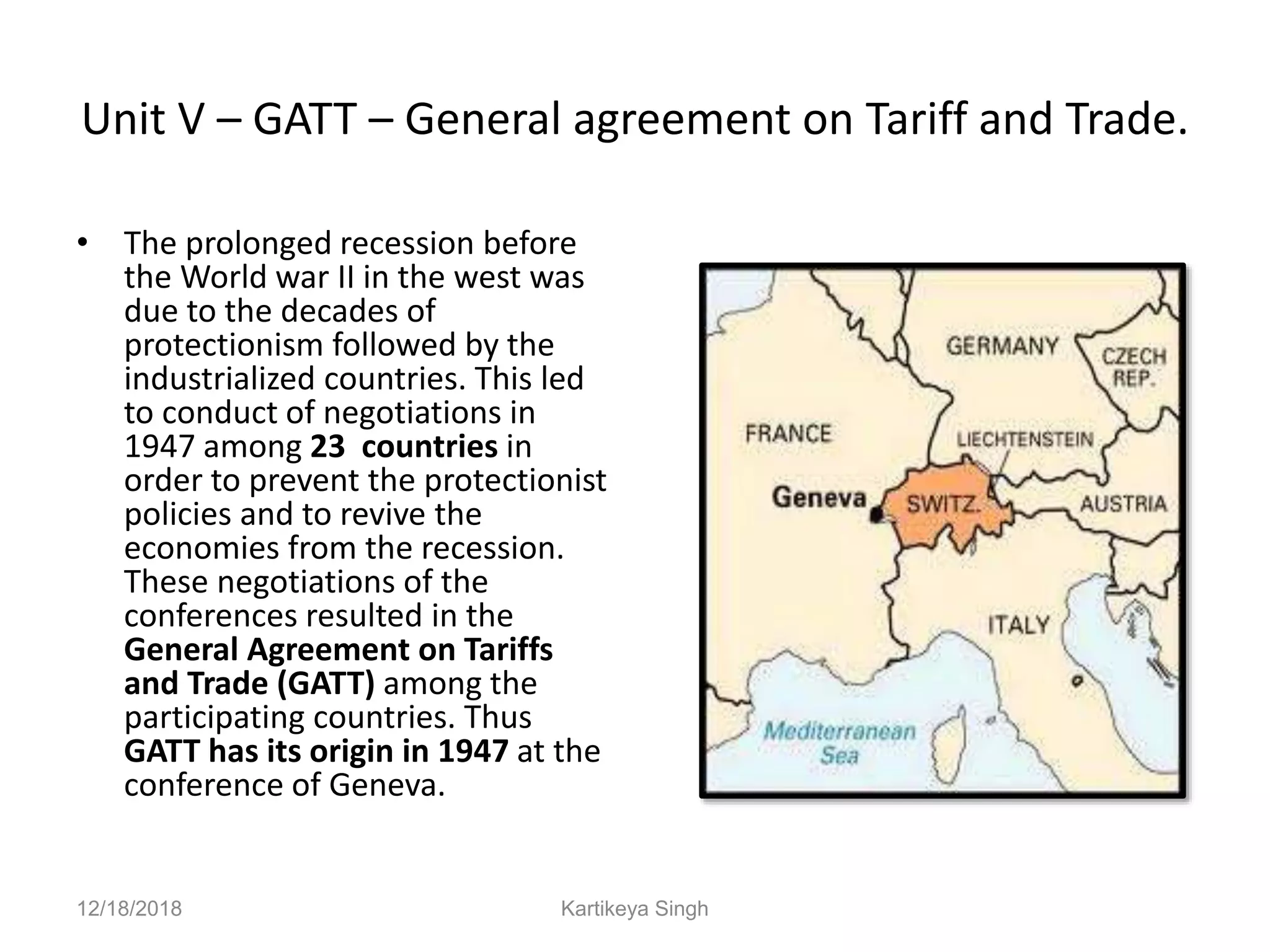
Unit V – GATT – General agreement on Tariff and Trade.
• The prolonged recession before
the World war II in the west was
due to the decades of
protectionism followed by the
industrialized countries. This led
to conduct of negotiations in
1947 among 23 countries in
order to prevent the protectionist
policies and to revive the
economies from the recession.
These negotiations of the
conferences resulted in the
General Agreement on Tariffs
and Trade (GATT) among the
participating countries. Thus
GATT has its origin in 1947 at the
conference of Geneva.
12/18/2018 Kartikeya Singh
Unit V – GATT – General
agreement on Tariff and Trade.
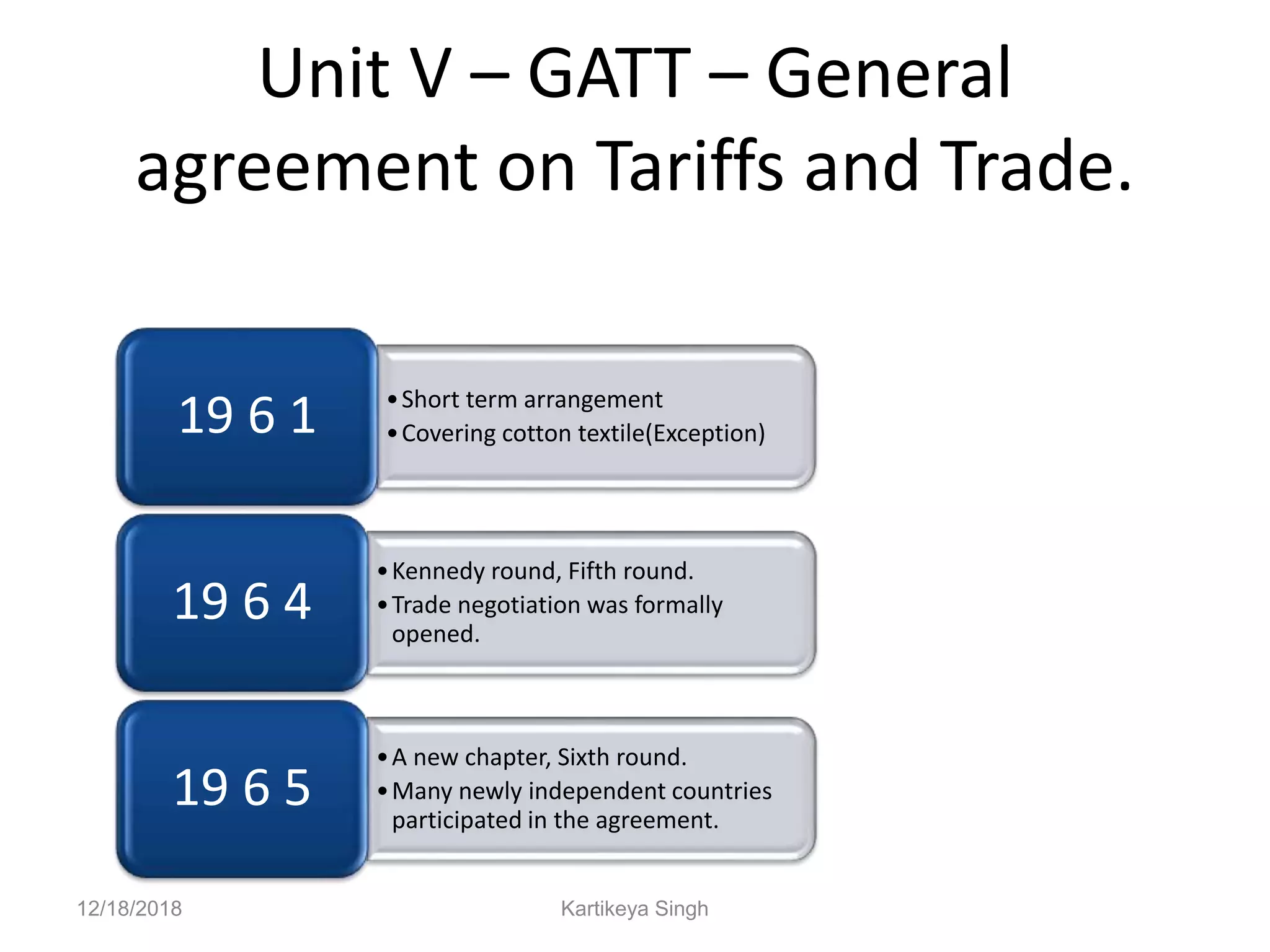
• The birth of GATT
• 30th October 1947, the General Agreement of
Tariffs and Trade was signed by 23 countries.1947
• 1st January 1948
• GAAT Came into force1948
• Second Round at Annecy, France.
• Exchanged some 5000 tariff concessions.1949
12/18/2018 Kartikeya Singh
Unit V – GATT – General
agreement on Tariff and Trade.
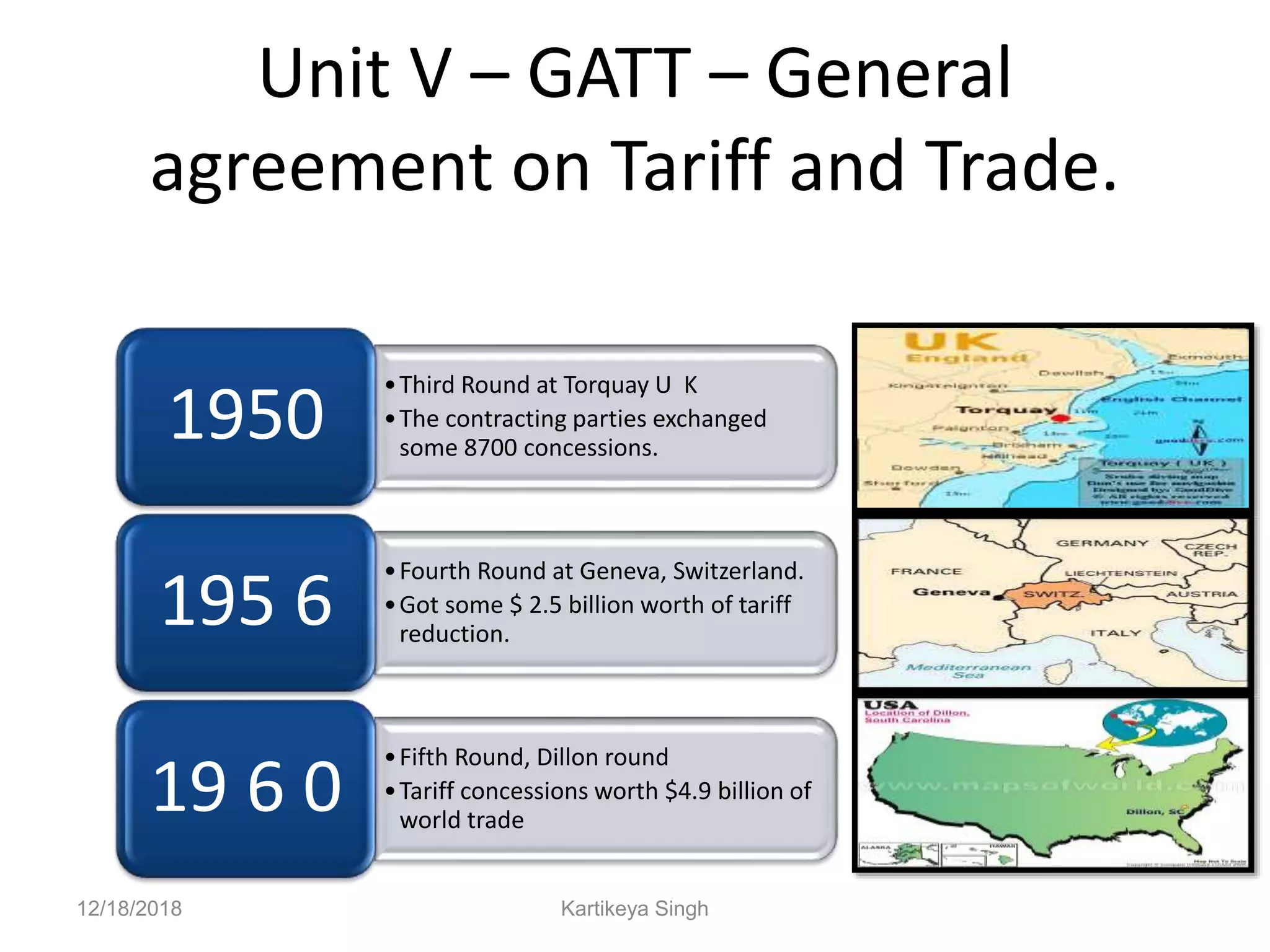
•Third Round at Torquay U K
•The contracting parties exchanged
some 8700 concessions.
1950
•Fourth Round at Geneva, Switzerland.
•Got some $ 2.5 billion worth of tariff
reduction.
195 6
•Fifth Round, Dillon round
•Tariff concessions worth $4.9 billion of
world trade
19 6 0
12/18/2018 Kartikeya Singh
Unit V – GATT – General
agreement on Tariffs and Trade.
•Short term arrangement
•Covering cotton textile(Exception)19 6 1
•Kennedy round, Fifth round.
•Trade negotiation was formally
opened.
19 6 4
•A new chapter, Sixth round.
•Many newly independent countries
participated in the agreement.
19 6 5
12/18/2018 Kartikeya Singh
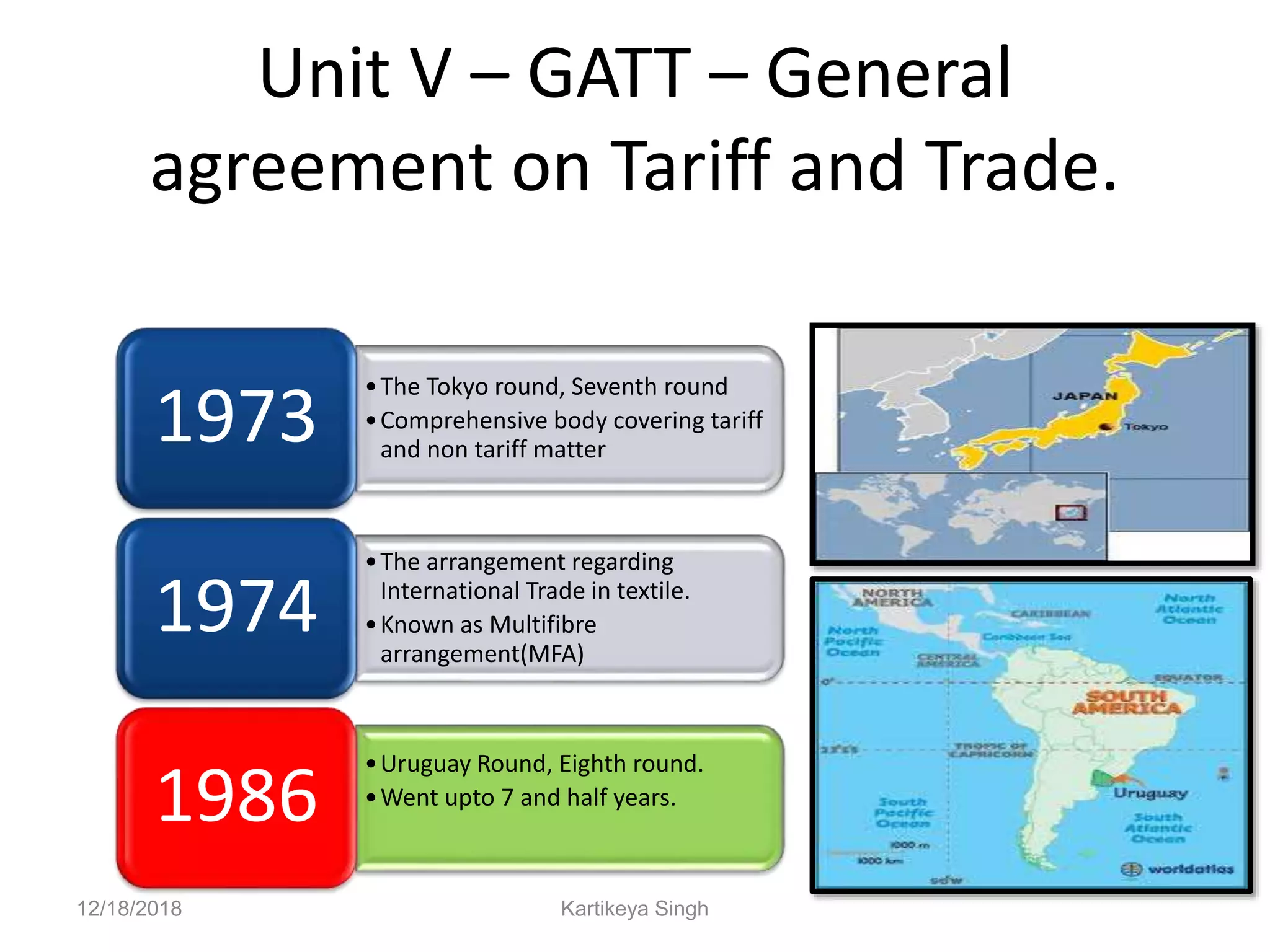
Unit V – GATT – General
agreement on Tariff and Trade.
•The Tokyo round, Seventh round
•Comprehensive body covering tariff
and non tariff matter
1973
•The arrangement regarding
International Trade in textile.
•Known as Multifibre
arrangement(MFA)
1974
•Uruguay Round, Eighth round.
•Went upto 7 and half years.
1986
12/18/2018 Kartikeya Singh
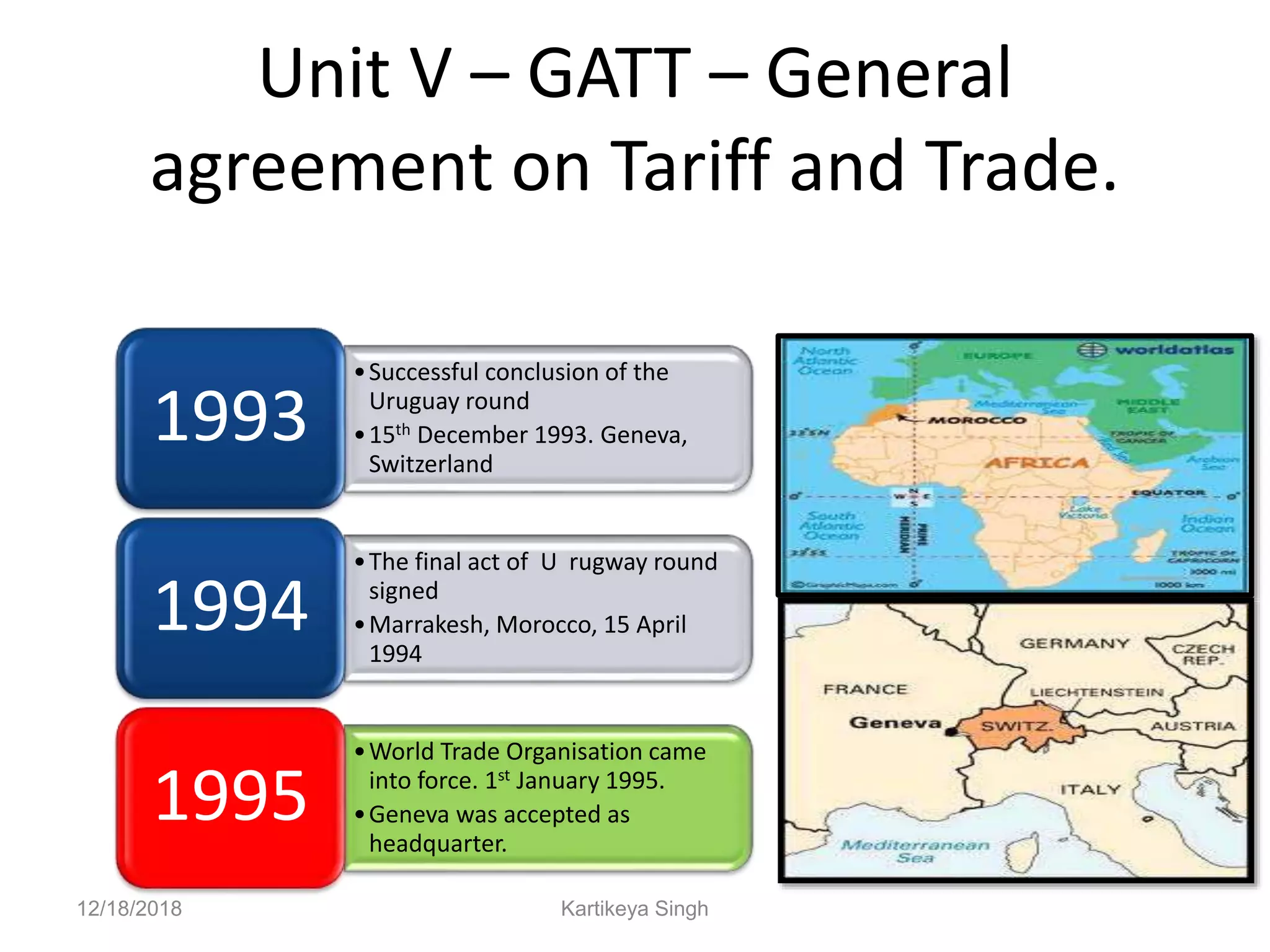
Unit V – GATT – General
agreement on Tariff and Trade.
•Successful conclusion of the
Uruguay round
•15th December 1993. Geneva,
Switzerland
1993
•The final act of U rugway round
signed
•Marrakesh, Morocco, 15 April
1994
1994
•World Trade Organisation came
into force. 1st January 1995.
•Geneva was accepted as
headquarter.
1995
12/18/2018 Kartikeya Singh
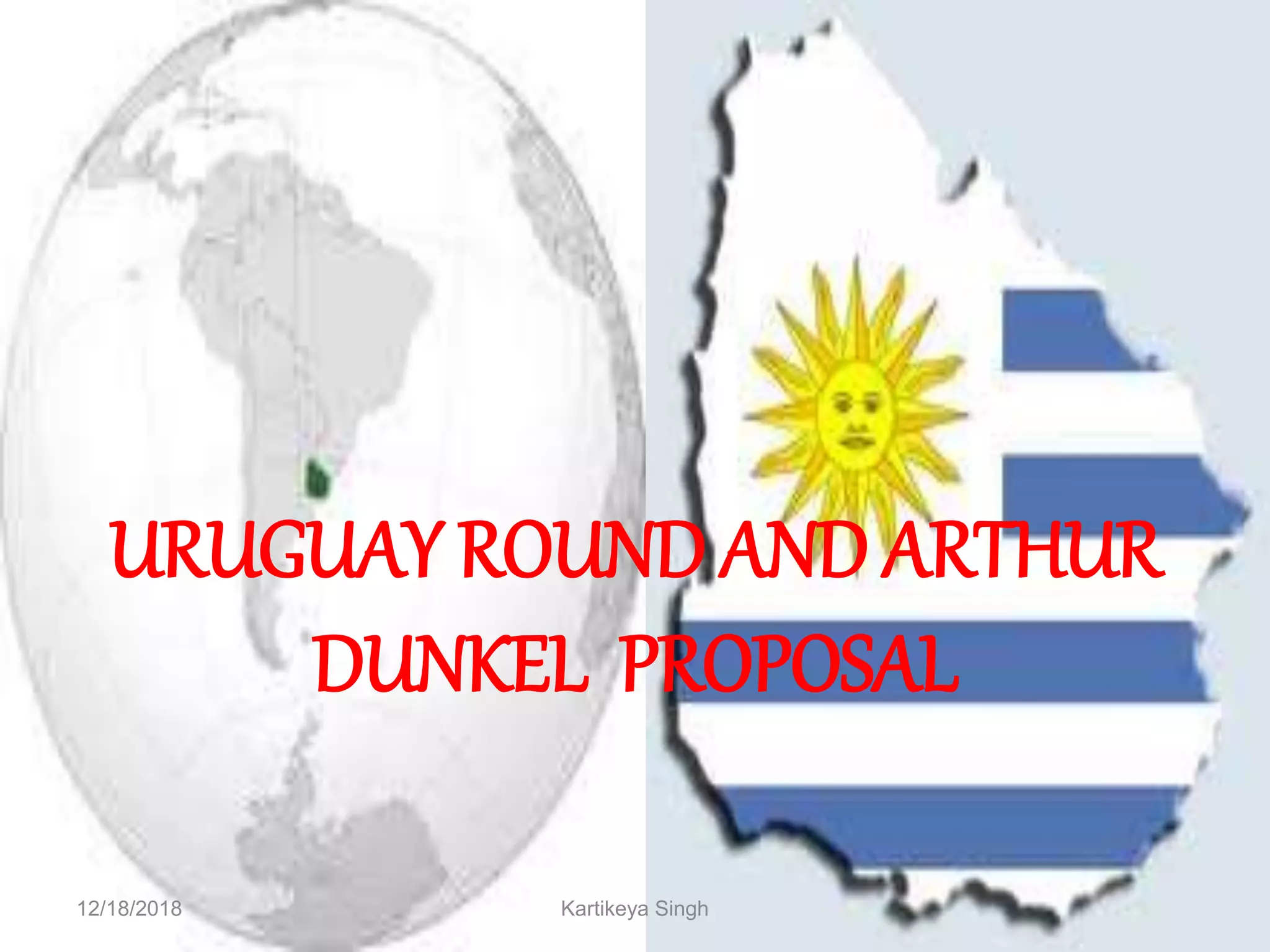
URUGUAY ROUND AND ARTHUR
DUNKEL PROPOSAL
12/18/2018 Kartikeya Singh
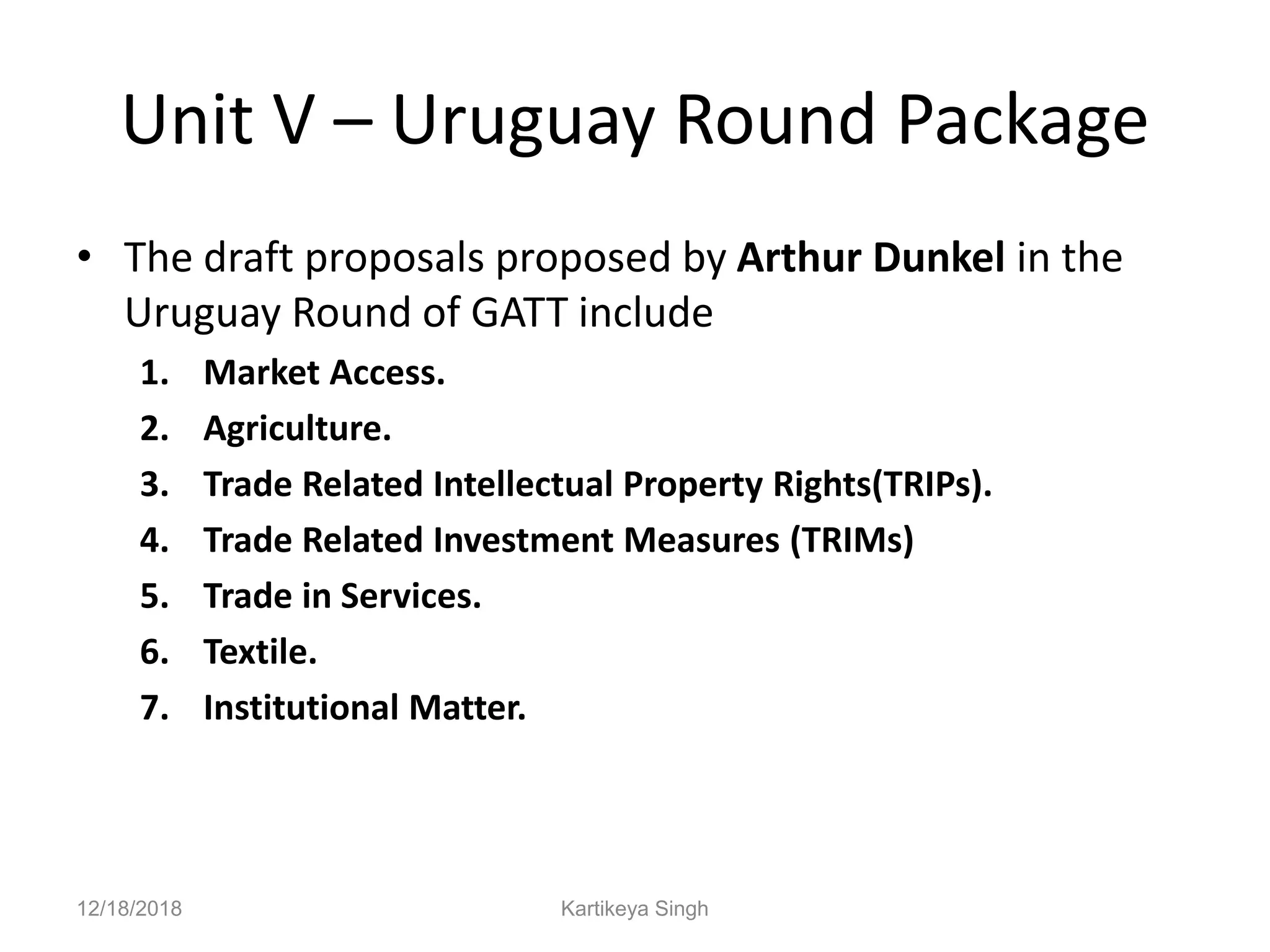
Unit V – Uruguay Round Package
• The draft proposals proposed by Arthur Dunkel in the
Uruguay Round of GATT include
1. Market Access.
2. Agriculture.
3. Trade Related Intellectual Property Rights(TRIPs).
4. Trade Related Investment Measures (TRIMs)
5. Trade in Services.
6. Textile.
7. Institutional Matter.
12/18/2018 Kartikeya Singh
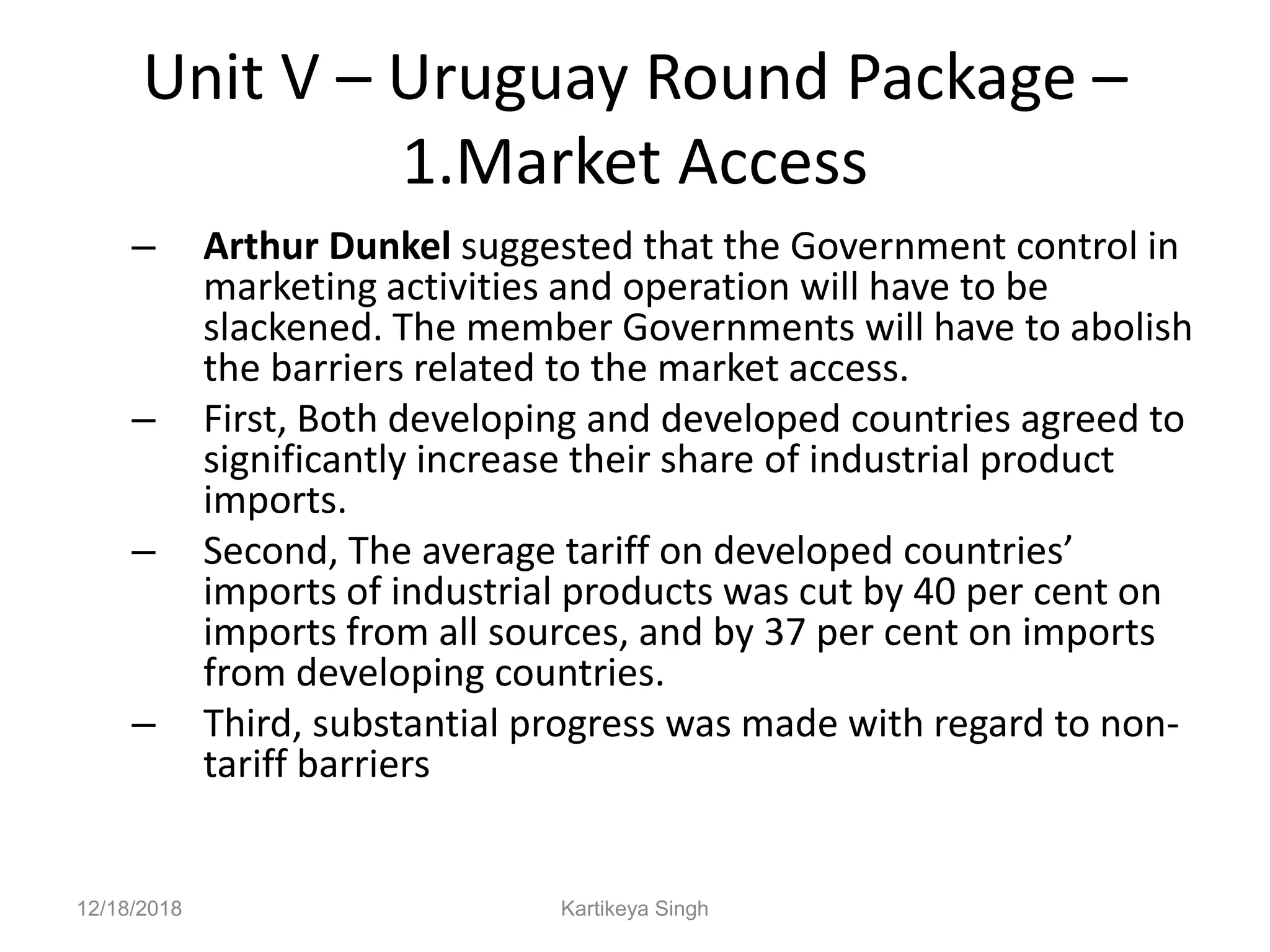
Unit V – Uruguay Round Package –
1.Market Access
– Arthur Dunkel suggested that the Government control in
marketing activities and operation will have to be
slackened. The member Governments will have to abolish
the barriers related to the market access.
– First, Both developing and developed countries agreed to
significantly increase their share of industrial product
imports.
– Second, The average tariff on developed countries’
imports of industrial products was cut by 40 per cent on
imports from all sources, and by 37 per cent on imports
from developing countries.
– Third, substantial progress was made with regard to non-
tariff barriers
12/18/2018 Kartikeya Singh
Unit V – Uruguay Round Package –
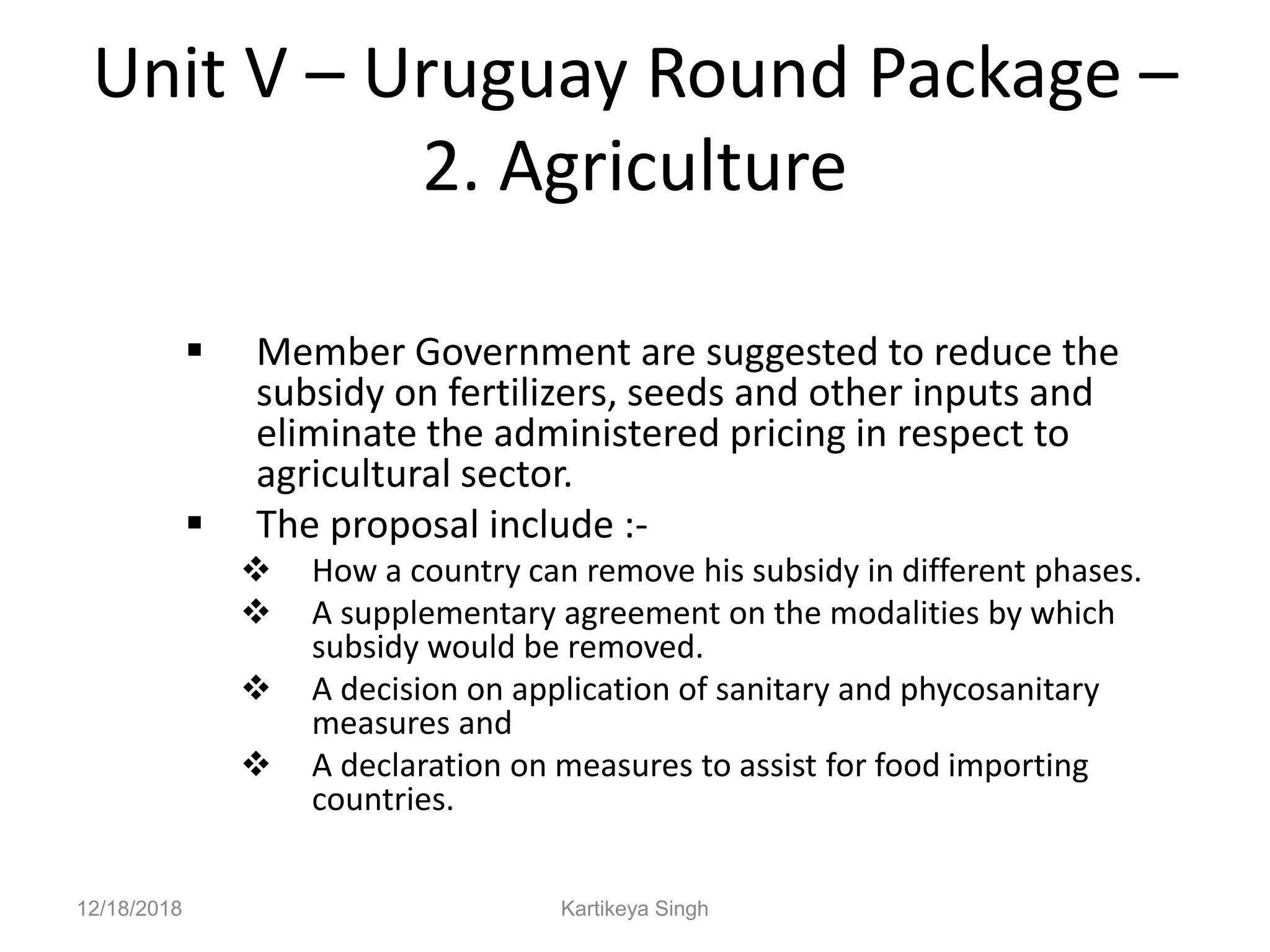
2. Agriculture
 Member Government are suggested to reduce the
subsidy on fertilizers, seeds and other inputs and
eliminate the administered pricing in respect to
agricultural sector.
 The proposal include :-
 How a country can remove his subsidy in different phases.
 A supplementary agreement on the modalities by which
subsidy would be removed.
 A decision on application of sanitary and phycosanitary
measures and
 A declaration on measures to assist for food importing
countries.
12/18/2018 Kartikeya Singh
Unit V – Uruguay Round Package –
2. Agriculture
12/18/2018 Kartikeya Singh
Amber box
Blue box
Green box
Total Aggregate Measurement of
Support (AMS)
De Minimis –Minimum Limit
5% - Developed Countries
10% - Developing Countries
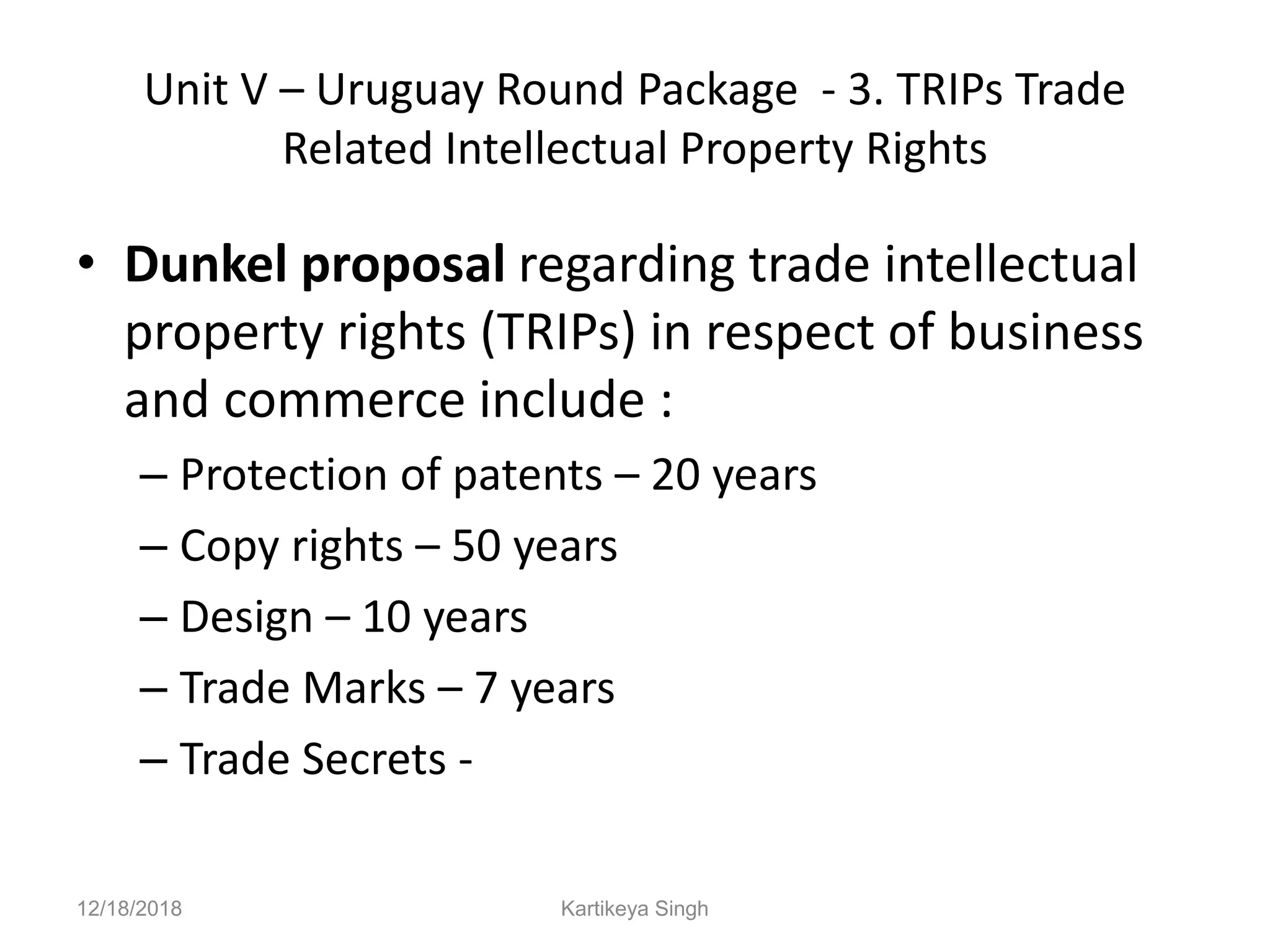
Unit V – Uruguay Round Package - 3. TRIPs Trade
Related Intellectual Property Rights
• Dunkel proposal regarding trade intellectual
property rights (TRIPs) in respect of business
and commerce include :
– Protection of patents – 20 years
– Copy rights – 50 years
– Design – 10 years
– Trade Marks – 7 years
– Trade Secrets -
12/18/2018 Kartikeya Singh
Unit V – Uruguay Round Package – 4. TRIMS - Trade
Related Investment Measures
– Abolition of Restrictions imposed on foreign capital.
– Offering equal rights to the foreign investor equal to
those of the domestic investor.
– No restriction on investment
– No limitations or ceiling on the quantum of foreign
investment.
– Granting of permission without restrictions to import
raw materials and other companies.
– No force on the foreign investors to use total products
or materials.
12/18/2018 Kartikeya Singh
Unit V – Uruguay Round Package – 5. Trade in Services.
• Trade in services like, insurance, travel,
tourism, hotel, banking, maritime,
transportation, mobility of human resources
etc. have been included in the proposal
• GATS – General agreement in Trade in services
provides a multilateral framework of
principles and services.
• GATS governs trade in services.
12/18/2018 Kartikeya Singh
Unit V – Uruguay Round Package –
6. Textile.
• An attempt was made to
re-integrate textile into
GATT in order to do away
with Multi Fiber
Arrangement.(MBA).
• Textile was included in
Dunkel Proposal
• Developed countries
dismantled the import
quotas on garment and
textile from 1st January,
2005.
• Strategies for Textile
firms.
– Product Specialization
– Cross-border cooperation
– Improve sourcing skills
– Focus on higher value
products
– More flexible rules of
origin
– Interregional Cooperation
– Creation of Conducive
Environment.
12/18/2018 Kartikeya Singh
Unit V – Uruguay Round Package – 7. Institutional
Matter.
• It handles the grievances of two participating
nations.
• Try to remove barriers to trade
• Try to implement guidelines of the WTO/GATT.
• Takes care of the breach of the law.
12/18/2018 Kartikeya Singh
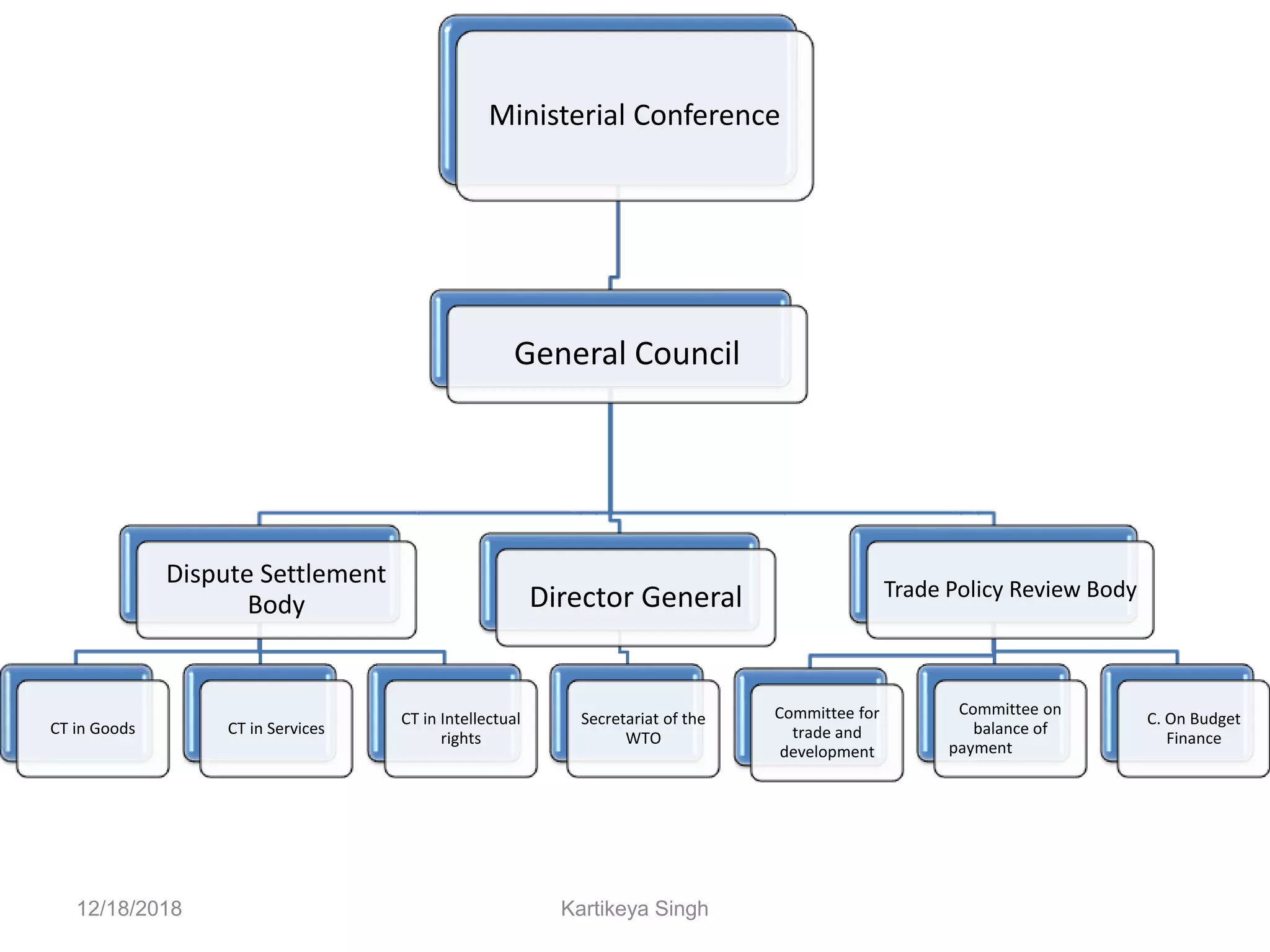
Ministerial Conference
General Council
Dispute Settlement
Body
CT in Goods CT in Services
CT in Intellectual
rights
Director General
Secretariat of the
WTO
Trade Policy Review Body
Committee for
trade and
development
Committee on
balance of
payment
C. On Budget
Finance
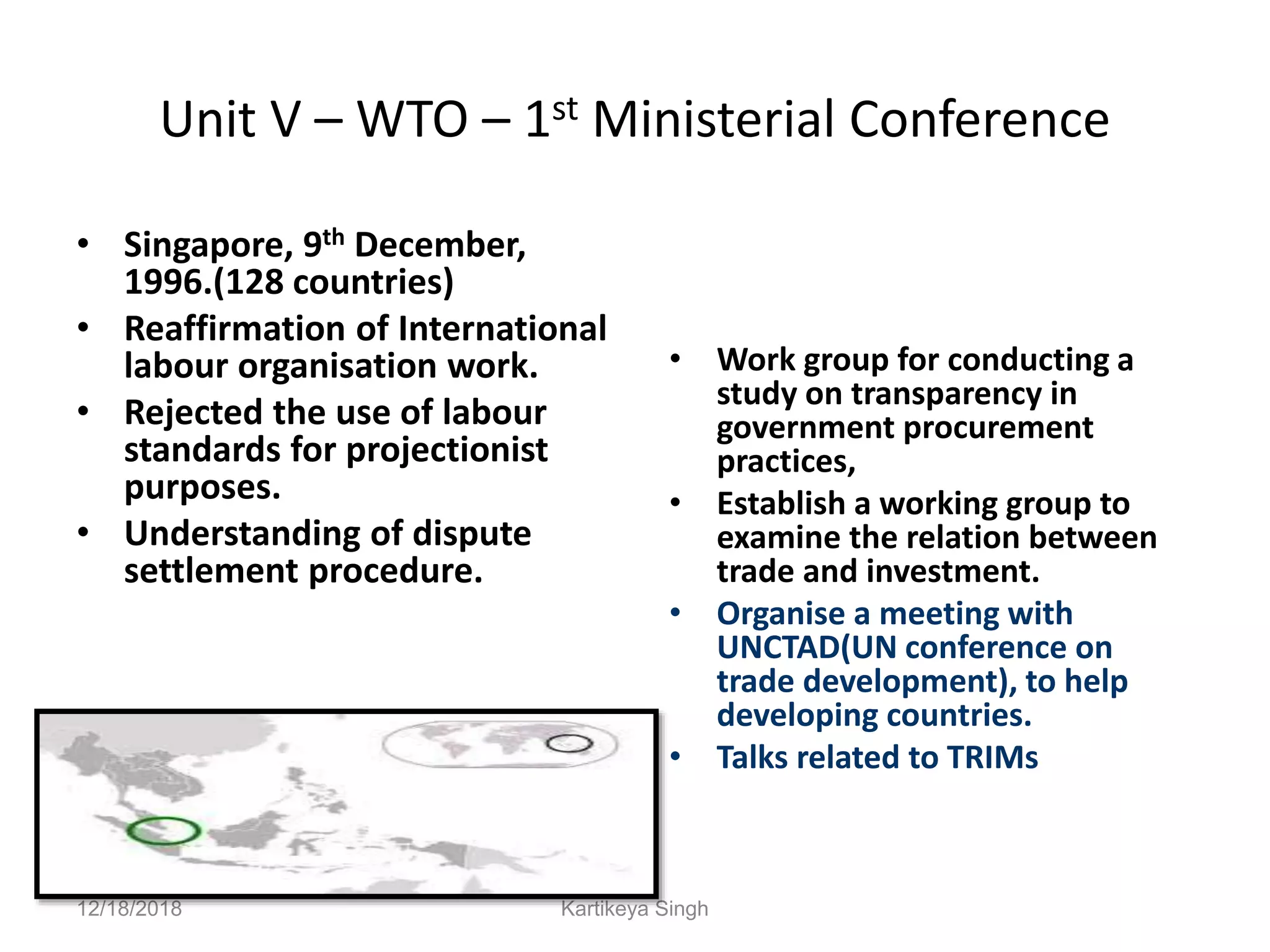
Unit V – WTO – 1st Ministerial Conference
• Singapore, 9th December,
1996.(128 countries)
• Reaffirmation of International
labour organisation work.
• Rejected the use of labour
standards for projectionist
purposes.
• Understanding of dispute
settlement procedure.
• Work group for conducting a
study on transparency in
government procurement
practices,
• Establish a working group to
examine the relation between
trade and investment.
• Organise a meeting with
UNCTAD(UN conference on
trade development), to help
developing countries.
• Talks related to TRIMs
12/18/2018 Kartikeya Singh
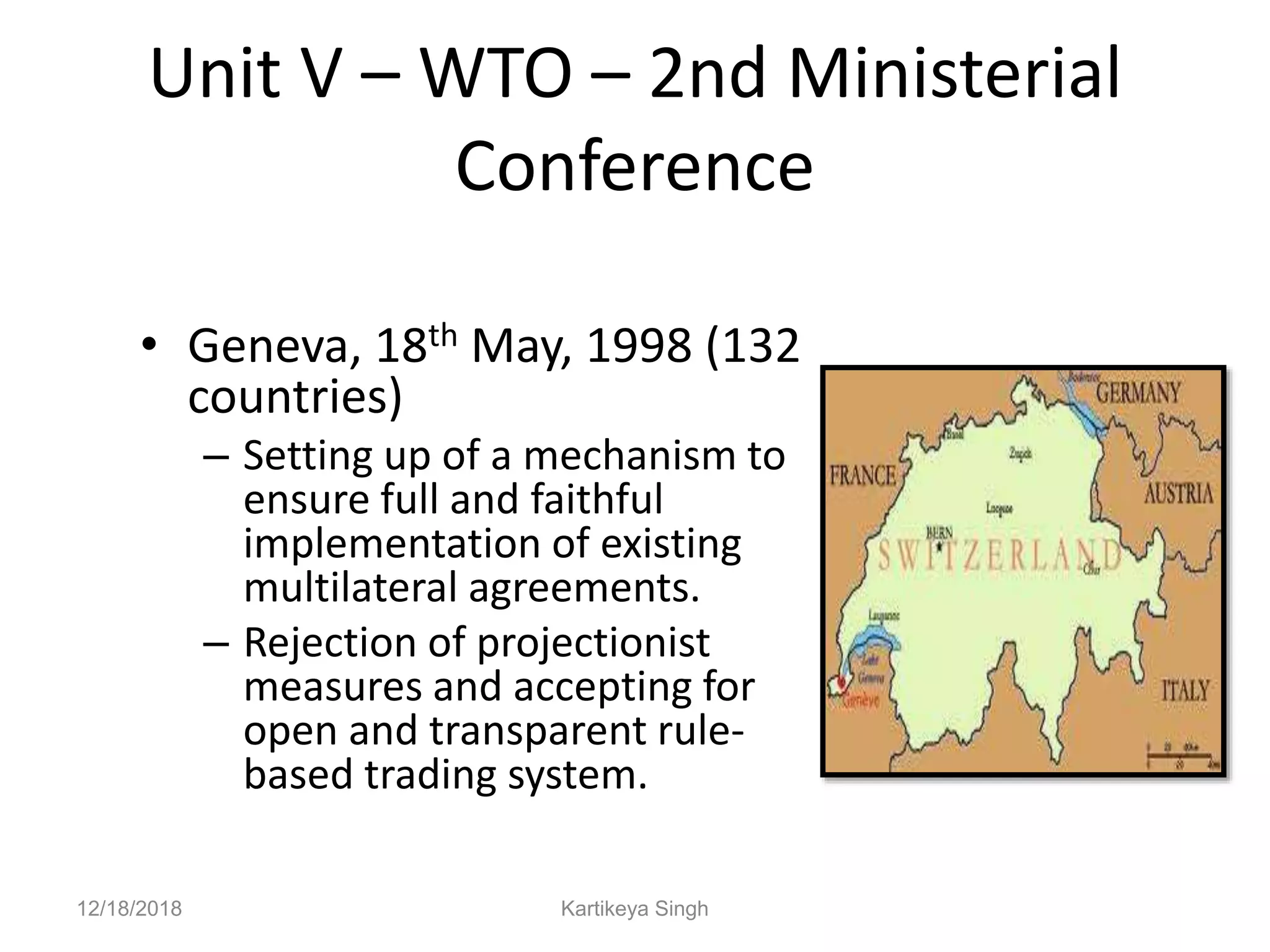
Unit V – WTO – 2nd Ministerial
Conference
• Geneva, 18th May, 1998 (132
countries)
– Setting up of a mechanism to
ensure full and faithful
implementation of existing
multilateral agreements.
– Rejection of projectionist
measures and accepting for
open and transparent rule-
based trading system.
12/18/2018 Kartikeya Singh
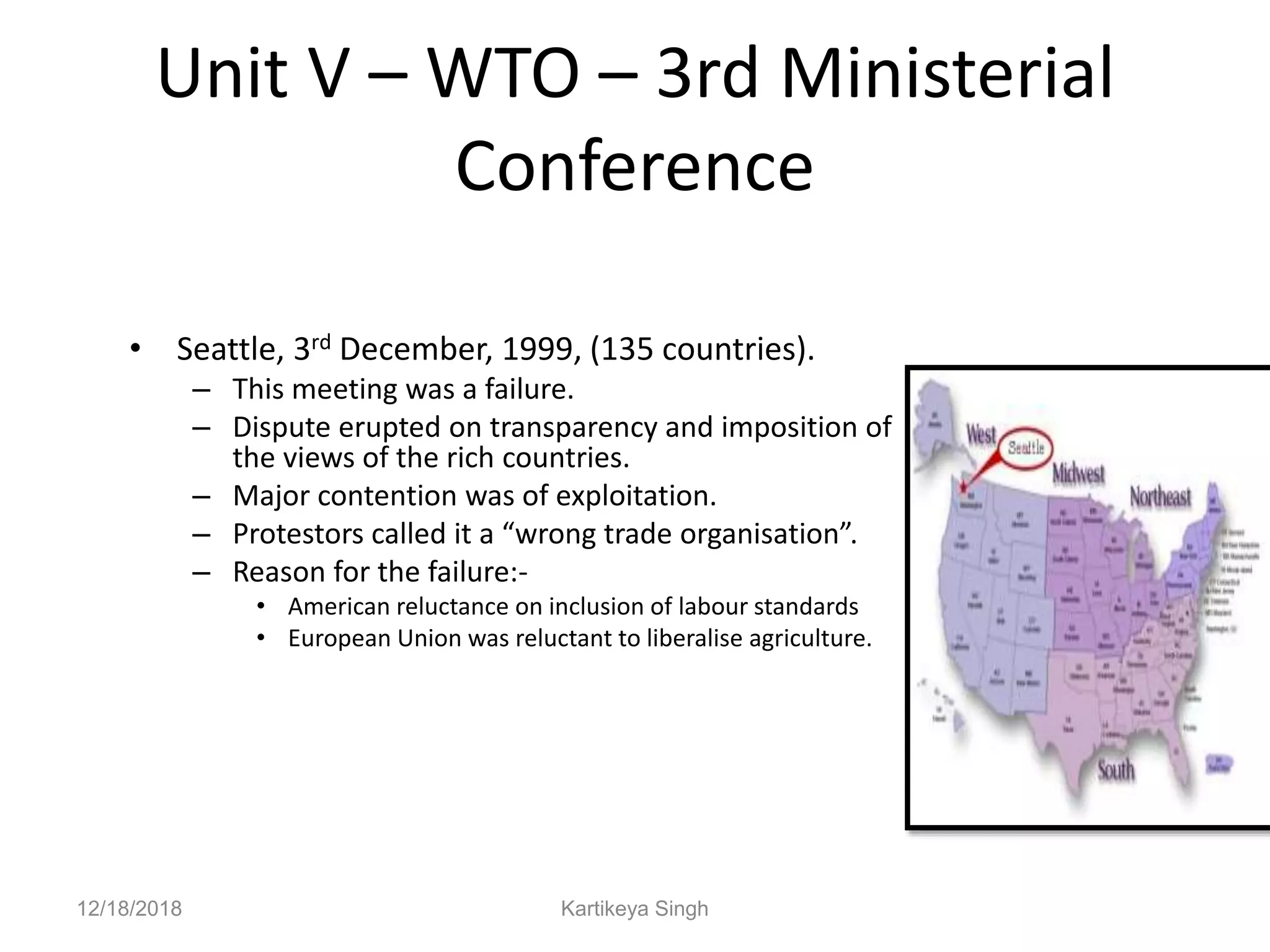
Unit V – WTO – 3rd Ministerial
Conference
• Seattle, 3rd December, 1999, (135 countries).
– This meeting was a failure.
– Dispute erupted on transparency and imposition of
the views of the rich countries.
– Major contention was of exploitation.
– Protestors called it a “wrong trade organisation”.
– Reason for the failure:-
• American reluctance on inclusion of labour standards
• European Union was reluctant to liberalise agriculture.
12/18/2018 Kartikeya Singh
Unit V – WTO – 4th Ministerial
Conference
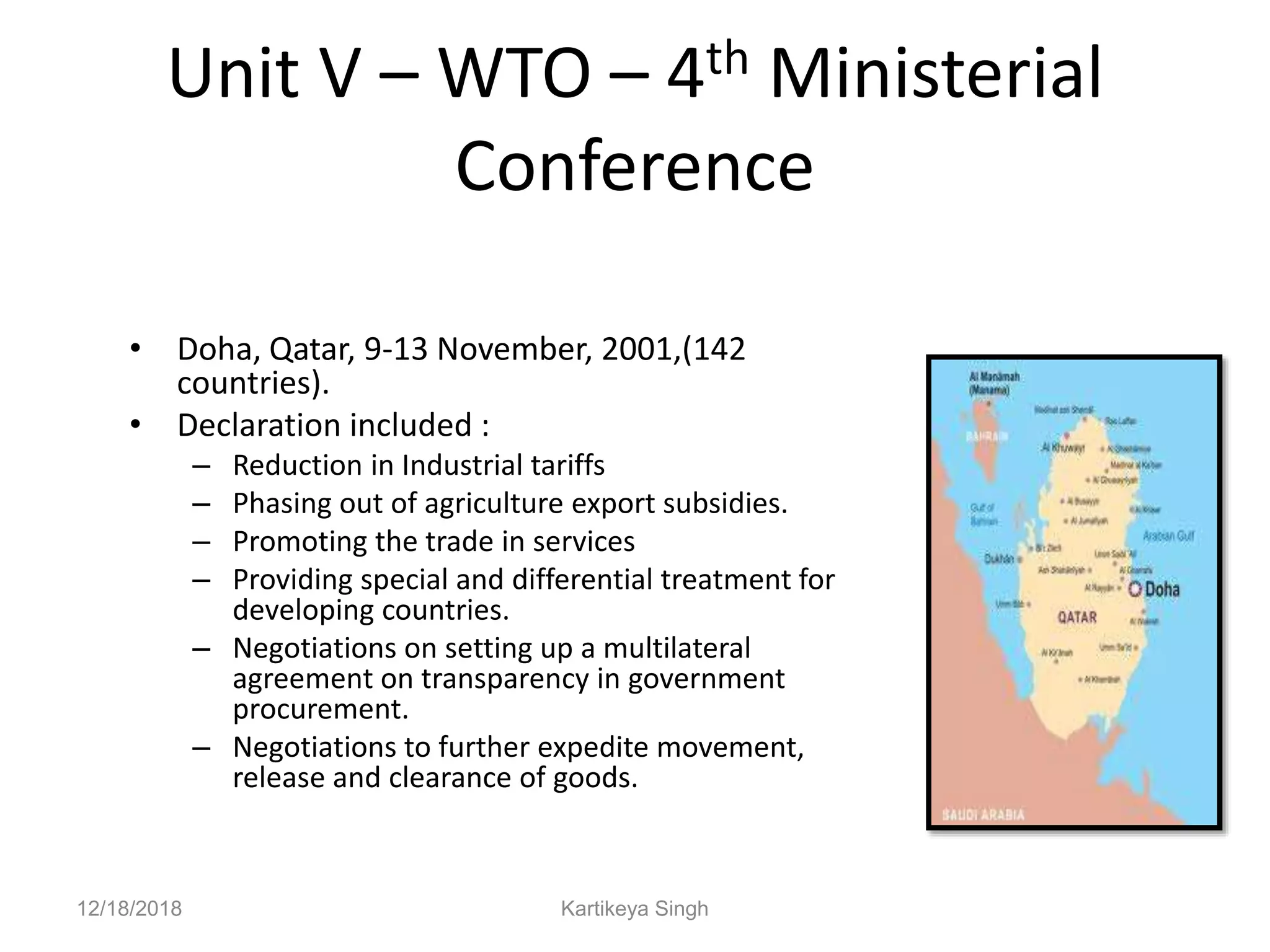
• Doha, Qatar, 9-13 November, 2001,(142
countries).
• Declaration included :
– Reduction in Industrial tariffs
– Phasing out of agriculture export subsidies.
– Promoting the trade in services
– Providing special and differential treatment for
developing countries.
– Negotiations on setting up a multilateral
agreement on transparency in government
procurement.
– Negotiations to further expedite movement,
release and clearance of goods.
12/18/2018 Kartikeya Singh
Unit V – WTO – 5th Ministerial
Conference
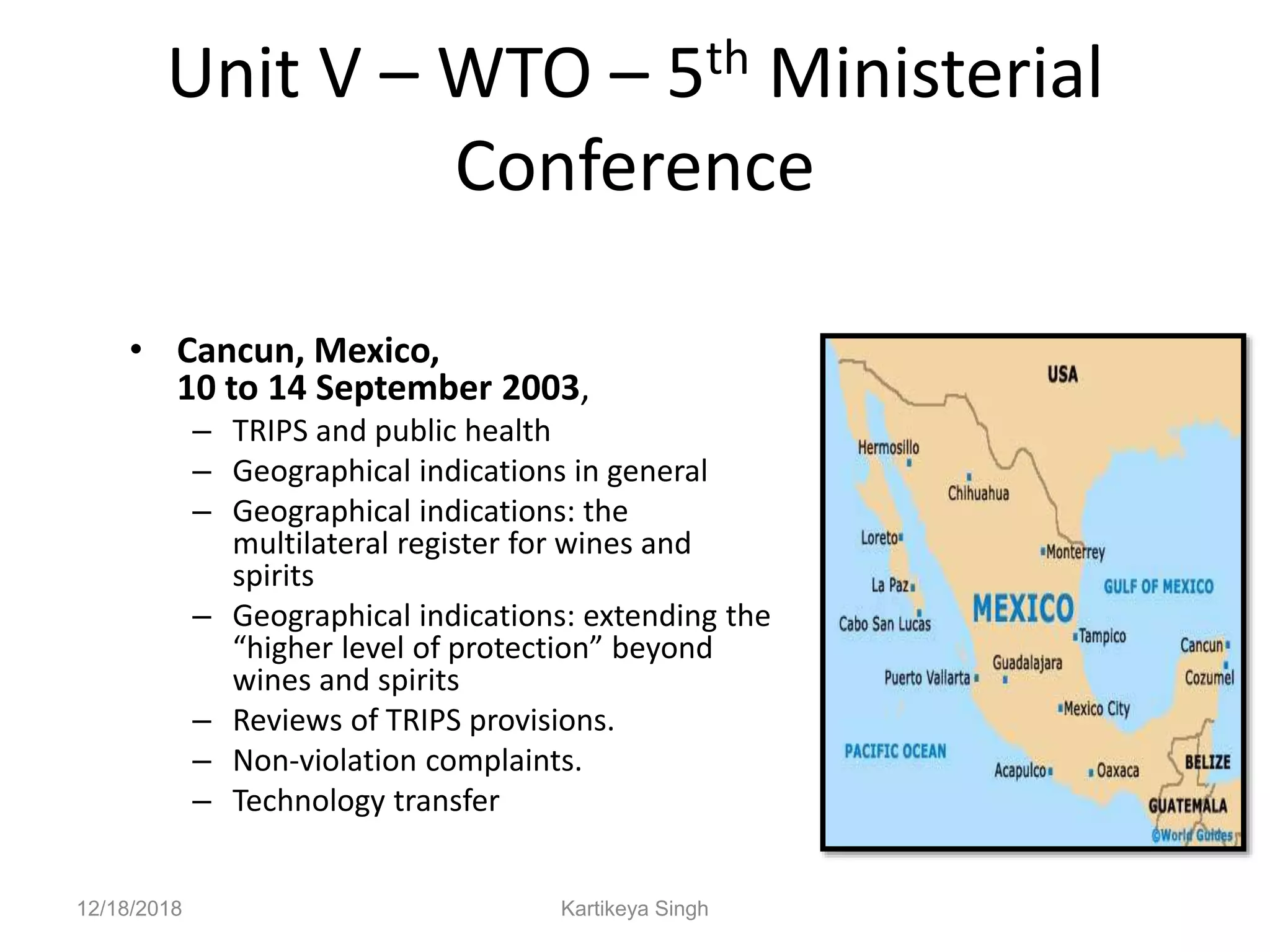
• Cancun, Mexico,
10 to 14 September 2003,
– TRIPS and public health
– Geographical indications in general
– Geographical indications: the
multilateral register for wines and
spirits
– Geographical indications: extending the
“higher level of protection” beyond
wines and spirits
– Reviews of TRIPS provisions.
– Non-violation complaints.
– Technology transfer
12/18/2018 Kartikeya Singh
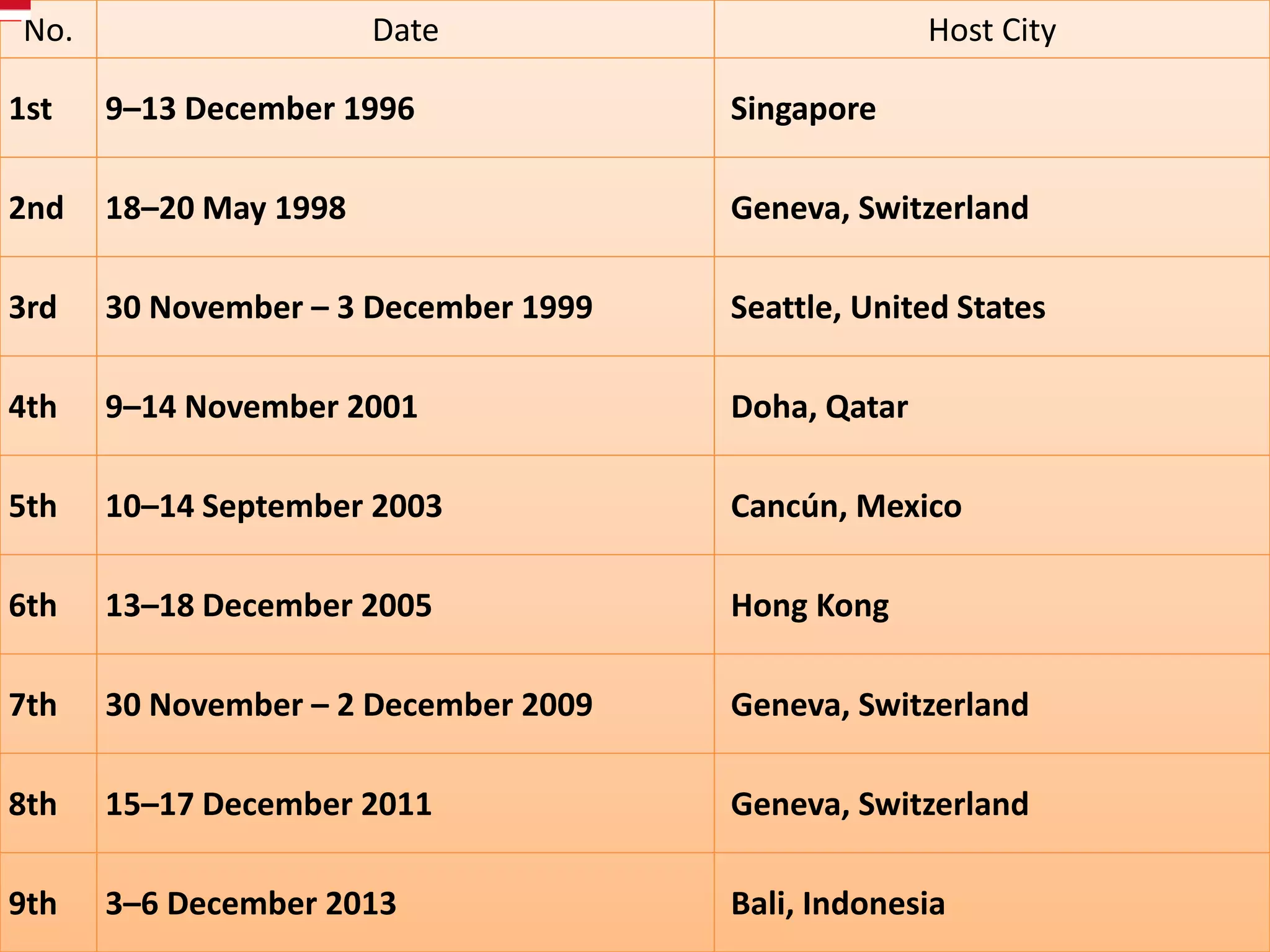
No. Date Host City
1st 9–13 December 1996 Singapore
2nd 18–20 May 1998 Geneva, Switzerland
3rd 30 November – 3 December 1999 Seattle, United States
4th 9–14 November 2001 Doha, Qatar
5th 10–14 September 2003 Cancún, Mexico
6th 13–18 December 2005 Hong Kong
7th 30 November – 2 December 2009 Geneva, Switzerland
8th 15–17 December 2011 Geneva, Switzerland
9th 3–6 December 2013 Bali, Indonesia
Unit V – WTO and the India.
• A growth Story….
12/18/2018 Kartikeya Singh
(WTO). Roberto
Azevedo Joined after
France'sPascal Lamy
Unit V – WTO and India
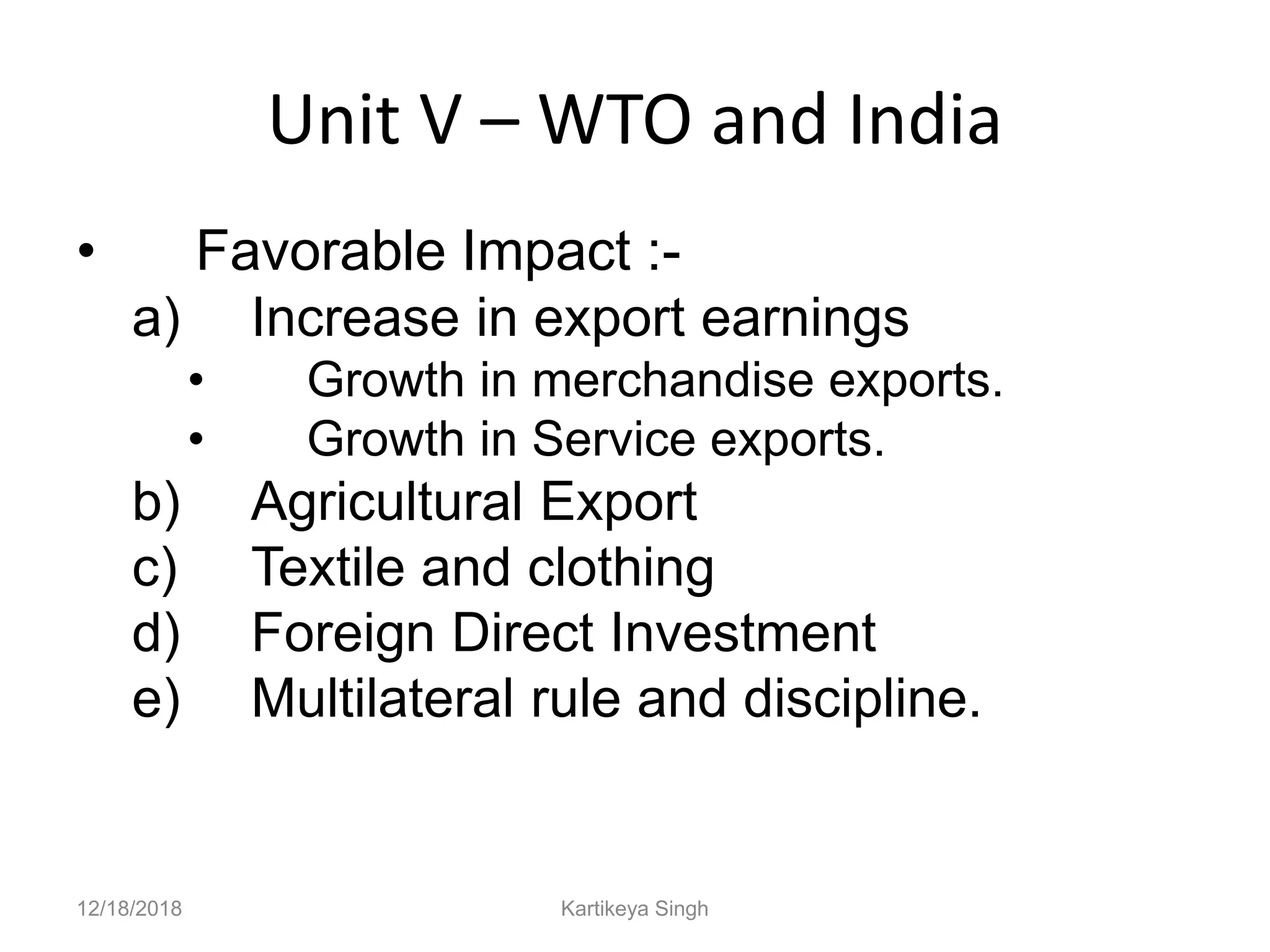
• Favorable Impact :-
a) Increase in export earnings
• Growth in merchandise exports.
• Growth in Service exports.
b) Agricultural Export
c) Textile and clothing
d) Foreign Direct Investment
e) Multilateral rule and discipline.
12/18/2018 Kartikeya Singh
Unit V – WTO and India
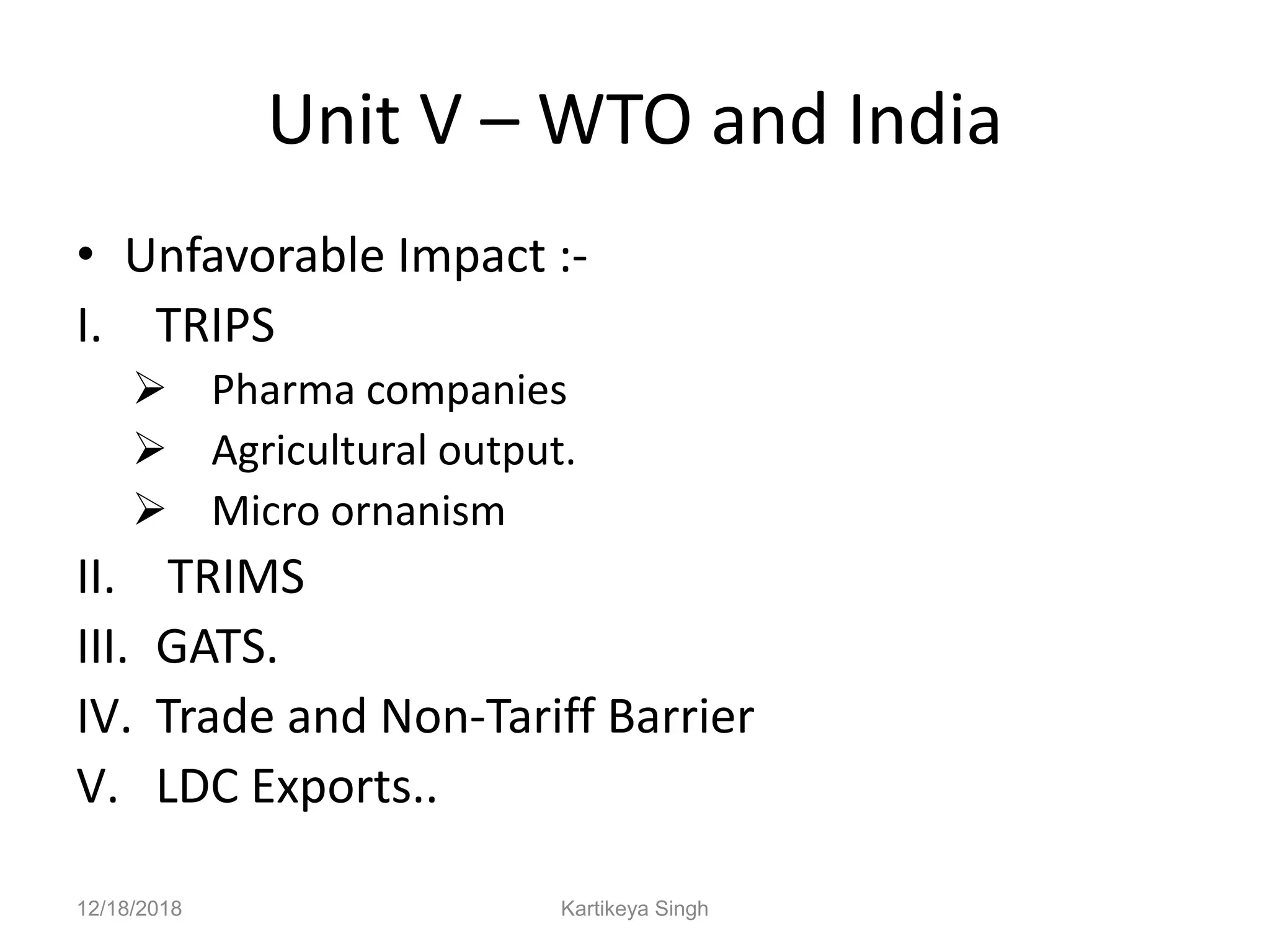
• Unfavorable Impact :-
I. TRIPS
 Pharma companies
 Agricultural output.
 Micro ornanism
II. TRIMS
III. GATS.
IV. Trade and Non-Tariff Barrier
V. LDC Exports..
12/18/2018 Kartikeya Singh
Unit V – WTO and Anti Dumping
Measures.
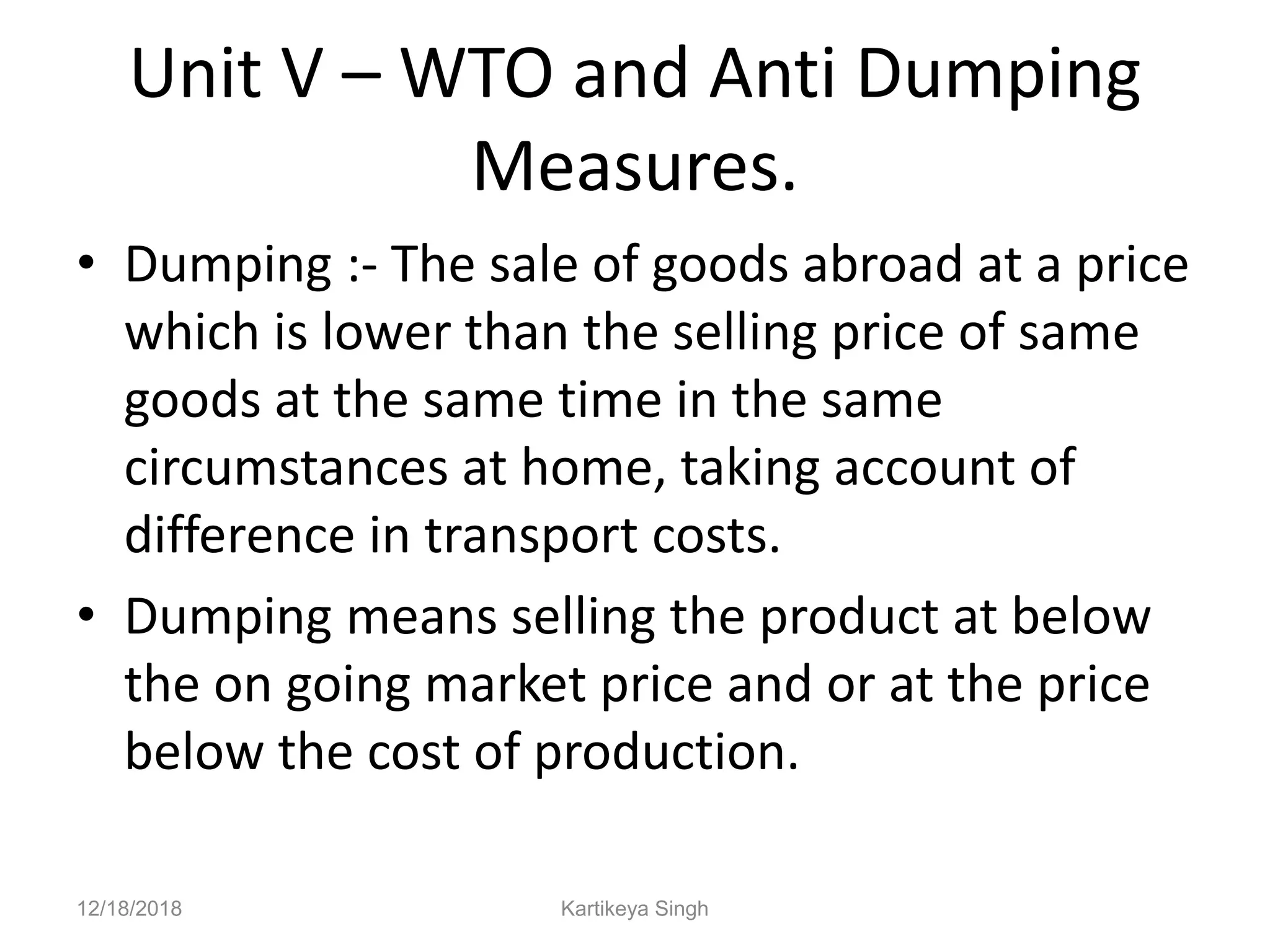
• Dumping :- The sale of goods abroad at a price
which is lower than the selling price of same
goods at the same time in the same
circumstances at home, taking account of
difference in transport costs.
• Dumping means selling the product at below
the on going market price and or at the price
below the cost of production.
12/18/2018 Kartikeya Singh
Unit V – Impact of Globalisation
• See the text box….
12/18/2018 Kartikeya Singh
Unit V – WTO members..
• List of WTO Members(see the text box).
12/18/2018 Kartikeya Singh
12/18/2018 Kartikeya Singh,SMS Varanasi 63
12/18/2018 Kartikeya Singh,SMS Varanasi 64
12/18/2018 Kartikeya Singh,SMS Varanasi 65
12/18/2018 Kartikeya Singh,SMS Varanasi 66
12/18/2018 Kartikeya Singh,SMS Varanasi 67
12/18/2018 Kartikeya Singh,SMS Varanasi 68
12/18/2018 Kartikeya Singh,SMS Varanasi 69
12/18/2018 Kartikeya Singh,SMS Varanasi 70
12/18/2018 Kartikeya Singh,SMS Varanasi 71
12/18/2018 Kartikeya Singh,SMS Varanasi 72
12/18/2018 Kartikeya Singh,SMS Varanasi 73
12/18/2018 Kartikeya Singh,SMS Varanasi 74
12/18/2018 Kartikeya Singh,SMS Varanasi 75
12/18/2018 Kartikeya Singh,SMS Varanasi 76
12/18/2018 Kartikeya Singh,SMS Varanasi 77
12/18/2018 Kartikeya Singh,SMS Varanasi 78
12/18/2018 Kartikeya Singh,SMS Varanasi 79
12/18/2018 Kartikeya Singh,SMS Varanasi 80
12/18/2018 Kartikeya Singh,SMS Varanasi 81
12/18/2018 Kartikeya Singh,SMS Varanasi 82
12/18/2018 Kartikeya Singh,SMS Varanasi 83
12/18/2018 Kartikeya Singh,SMS Varanasi 84
12/18/2018 Kartikeya Singh,SMS Varanasi 85
12/18/2018 Kartikeya Singh,SMS Varanasi 86
12/18/2018 Kartikeya Singh,SMS Varanasi 87
12/18/2018 Kartikeya Singh,SMS Varanasi 88
Headquarters Kathmandu, Nepal
Official languages English
Membership
8 members[show]
9 observers[show]
Leaders
Directors:
Afghanistan Md Ibrahim Ghafoor
Bangladesh MJH Jabed
Bhutan Singye Dorjee
India L. Savithri
Maldives
a
Fathimath Najwa
Nepal Harpal Sing Nepali
[
Pakistan Ahmar Ismail
Sri Lanka Prasanna Gamage
Establishment 8 December 1985
GDP (PPP) 2014 estimate
Total US$ 9.05 trillion
GDP (nominal) 2014 estimate
Total US$ 2.599 trillion
Website
www.saarc-sec.org
12/18/2018 Kartikeya Singh,SMS Varanasi 89

IBM - RMB302 - Unit V

  • 1.
  • 2.
    International Institutions Objectives andFunctions of WTO IMF IBRD UNCTAD EU, NAFTA, ASEAN SAARC, BRICS
  • 3.
    United Nation • History• • United Nations (UN) formed by 51 states after World War II to: “save succeeding generations from the scourge of war” • UN Charter signed on 24th October 1945: UN Day. • Main Headquarters in New York, USA. • 193 Member States to date, newest member South- Sudan • 6 official languages: Arabic, Chinese, English, French, Russian & Spanish. 12/18/2018 Kartikeya Singh,SMS Varanasi 3
  • 4.
    Organization Structure United Nation Secretariat SecurityCouncil International Court of Justice Trusteeship Council Economic and Social Councill General Assembly 12/18/2018 Kartikeya Singh,SMS Varanasi 4
  • 5.
  • 6.
    The Secretariat • Administrativearm of the United Nations • Services the other organs of the United Nations • Informs the world's media about the work of the United Nations (Public Information) • Organizes international conferences on issues of worldwide concern; interprets speeches & translates documents into the Organization's official languages. 12/18/2018 Kartikeya Singh,SMS Varanasi 6
  • 7.
  • 8.
  • 9.
  • 10.
    The International Courtof Justice • Principal judicial organ of the UN. • Established in June 1945 by the Charter of the UN. • Work commenced in April 1946. • 15 judges elected by the General Assembly and Security Council for 9 year terms. • Main role: – settles legal disputes submitted to it by States & to gives advisory opinions on legal questions referred to it by authorized UN organs & specialized agencies 12/18/2018 Kartikeya Singh,SMS Varanasi 10
  • 11.
  • 12.
    Security Council • Mainrole: maintenance of international peace & security. • 15 members; • 5 permanent and 10 non-permanent. • Non-permanent members elected from different regions in the world to serve 2 year terms. • Council on a 24-hr call (can meet any day, at any time) • 9 out of 15 votes required to pass a resolution (no veto from the permanent members!). • Only UN-Organ which can enforce it’s resolutions – they are legally binding 12/18/2018 Kartikeya Singh,SMS Varanasi 12
  • 13.
    Security Council • Actionsthe Security Council may take: – Peaceful settlement of disputes (i.e. negotiations, peace talks, good offices of the Secretary-General, also Special Representatives of the Secretary- general) – Establish Peacekeeping Operations – Enforcement measures (i.e. targeted sanctions, multinational forces) 12/18/2018 Kartikeya Singh,SMS Varanasi 13
  • 14.
  • 15.
    Trusteeship Council • Hassuspended it’s work, no longer active! Previously supervised the administration of Trust Territories placed under the Trusteeship System. • Main goal: – to promote the advancement of the inhabitants of Trust Territories and their progressive development towards self-determination. – Special Committee on Decolonization still active to date! – 17 non-self-governing territories remaining today 12/18/2018 Kartikeya Singh,SMS Varanasi 15
  • 16.
    Economic and SocialCouncil (ECOSOC) • Main goal: • To improve the world’s living standards and to promote the respect of human rights – no peace & security without economic & social stability! • Coordinates the work of UN funds, programmes & specialized agencies; i.e. UNHCR, UNICEF, WFP, UNEP, UN-HABITAT, ILO, World Bank… • Sets international standards; i.e. Children’s Rights • World’s economic, social & environmental challenges are discussed, debated and recommendations made by this organ. 12/18/2018 Kartikeya Singh,SMS Varanasi 16
  • 17.
  • 18.
    Economic and SocialCouncil (ECOSOC) • Main goal: • to improve the world’s living standards and to promote the respect of human rights – no peace & security without economic & social stability! • Coordinates the work of UN funds, programmes & specialized agencies; i.e. UNHCR, UNICEF, WFP, UNEP, UN-HABITAT, ILO, World Bank… • Sets international standards; i.e. Children’s Rights • World’s economic, social & environmental challenges are discussed, debated and recommendations made by this organ. 12/18/2018 Kartikeya Singh,SMS Varanasi 18
  • 19.
  • 20.
  • 21.
    General Assembly • Maindeliberative, policymaking and representative organ of the UN, also “World Parliament”. • Comprises of all 193 member states. • Provides a unique forum for multilateral discussion. • Six main committees. • Meets from September to December for it’s main session each year. However, session lasts a year. • Currently in 68th Session. 12/18/2018 Kartikeya Singh,SMS Varanasi 21
  • 22.
    II. UNCTAD -United Nations Conference on Trade and Development. 12/18/2018 Kartikeya Singh,SMS Varanasi 22
  • 23.
    II. UNCTAD -United Nations Conference on Trade and Development. • The first UNCTAD met in March 1964 in Geneva. • It was an ad hoc gathering of representatives of about 120 states which were members of the United Nations. • It however, marked a turning point in international economic relations and ushered a new era in the evolution of world trade and development, • Since it represented the first major Endeavour to examine all the problems of International economic relations, with special reference to the needs of developing countries. 12/18/2018 Kartikeya Singh,SMS Varanasi 23
  • 24.
    II. UNCTAD -United Nations Conference on Trade and Development. • The first UNCTAD met in March 1964 in Geneva. • It was an ad hoc gathering of representatives of about 120 states which were members of the United Nations. • UNCTAD is the principal organ of the United Nations General Assembly dealing with trade, investment, and development issues. • The organization's goals are to: – maximize the trade, investment – development opportunities of developing countries – assist them in their efforts to integrate into the world economy on an equitable basis. 12/18/2018 Kartikeya Singh,SMS Varanasi 24
  • 25.
    II. UNCTAD -United Nations Conference on Trade and Development. • United Nations Conference on Trade and Development Abbreviation UNCTAD • Formation1964 • Headquarters - Geneva, Switzerland • Website - www.unctad.org 12/18/2018 Kartikeya Singh,SMS Varanasi 25
  • 26.
    II. UNCTAD -United Nations Conference on Trade and Development. • The creation of UNCTAD in 1964 was based on concerns of developing countries over the international market, multi- national corporations, and great disparity between developed nations and developing nations. • The organization grew from the view that existing institutions like GATT (now replaced by the World Trade Organization, WTO), the International Monetary Fund (IMF), and World Bank were not properly organized to handle the particular problems of developing countries. • Later, in the 1970s and 1980s, UNCTAD was closely associated with the idea of a New International Economic Order(NIEO). 12/18/2018 Kartikeya Singh,SMS Varanasi 26
  • 27.
    II. UNCTAD -United Nations Conference on Trade and Development. • The first UNCTAD conference took place in Geneva in 1964, • the second in New Delhi in 1968, • the third in Santiago in 1972, • fourth in Nairobi in 1976, • the fifth in Manila in 1979, • the sixth in Belgrade in 1983, • the seventh in Geneva in 1987, • the eighth in Cartagena in 1992, • the ninth at Johannesburg (South Africa) in 1996, • the tenth in Bangkok (Thailand) in 2000, • the eleventh in São Paulo (Brazil) in 2004, • the twelfth in Accra in 2008 and the thirteenth in Doha (Qatar) in 2012. 12/18/2018 Kartikeya Singh,SMS Varanasi 27
  • 28.
    Unit IV –International Monitory fund - IMF • International Monetary Fund (IMF) : The Bretton Woods Conference (1944) paved the way for the establishment of the International Monetary Fund (IMF). The Fund came into existence in December, 1945 with a modest membership of 45 nations. • At present 188 nations are members of the IMF. • Head quarter - Washington DC in USA.- Mrs. Christine Lagarde is the Head of IMF. 12/18/2018 Kartikeya Singh
  • 29.
    Unit IV –Objective of IMF. • Objectives of IMF : Article 1 of the Fund as amended in 1978, put the following important aims and objectives of the fund – To promote international monetary co-operation through a permanent institution providing the machinery for consultation and collaboration on international monetary problems. – To facilitate smooth and stable growth of multilateral international trade. – To promote stability in exchange and to avoid competitive exchange depreciation. – To remove temporary disequilibrium in the balance of payment of member countries. – To assist in the establishment of a multilateral system of payments in respect of current transactions between members and in the elimination of foreign exchange restrictions obstructing the growth of world trade. – To shorten the duration and lessen the degree of disequilibrium in the international balances of payments of members. 12/18/2018 Kartikeya Singh
  • 30.
    Unit IV –Management of IMF. • IMF is controlled by board of Governors. • Each member country nominates a Governor. • All the nominated Governors make the board of Governors. • Each country also nominates an alternate Governor who casts his vote in the absence of the governor. • Each governor is allotted a number of votes which is determined by the quota allotted to the respective country in the capital of IMF. 1st January 1, 2011 the weigtage to these currencies in SDR Euro 37.4% Japanese yen 9.4% Pound Sterling 11.3% US dollar 41.9% 100% 12/18/2018 Kartikeya Singh
  • 31.
    Unit IV- IBRD– International bank for reconstruction and development. • IBRD (World Bank)was established in December 1945 with the IMF on the basis of the recommendation of the Bretton Wood Conference. That is the reason why IMF and IBRD are called `Bretton Wood Twins'. IBRD started functioning in June 1946. World Bank and IMF are Complementary institutions. • Head office – Washington DC • Headed by – Mr. Jim Yuong Kim 12/18/2018 Kartikeya Singh
  • 32.
    Unit IV –Objective of World Bank • Reconstruction • Economic Development • Reducing Economic disparities • Raising Living Standard • Productive International Investment. 12/18/2018 Kartikeya Singh
  • 33.
  • 34.
    Unit V –GATT – General agreement on Tariff and Trade. • The prolonged recession before the World war II in the west was due to the decades of protectionism followed by the industrialized countries. This led to conduct of negotiations in 1947 among 23 countries in order to prevent the protectionist policies and to revive the economies from the recession. These negotiations of the conferences resulted in the General Agreement on Tariffs and Trade (GATT) among the participating countries. Thus GATT has its origin in 1947 at the conference of Geneva. 12/18/2018 Kartikeya Singh
  • 35.
    Unit V –GATT – General agreement on Tariff and Trade. • The birth of GATT • 30th October 1947, the General Agreement of Tariffs and Trade was signed by 23 countries.1947 • 1st January 1948 • GAAT Came into force1948 • Second Round at Annecy, France. • Exchanged some 5000 tariff concessions.1949 12/18/2018 Kartikeya Singh
  • 36.
    Unit V –GATT – General agreement on Tariff and Trade. •Third Round at Torquay U K •The contracting parties exchanged some 8700 concessions. 1950 •Fourth Round at Geneva, Switzerland. •Got some $ 2.5 billion worth of tariff reduction. 195 6 •Fifth Round, Dillon round •Tariff concessions worth $4.9 billion of world trade 19 6 0 12/18/2018 Kartikeya Singh
  • 37.
    Unit V –GATT – General agreement on Tariffs and Trade. •Short term arrangement •Covering cotton textile(Exception)19 6 1 •Kennedy round, Fifth round. •Trade negotiation was formally opened. 19 6 4 •A new chapter, Sixth round. •Many newly independent countries participated in the agreement. 19 6 5 12/18/2018 Kartikeya Singh
  • 38.
    Unit V –GATT – General agreement on Tariff and Trade. •The Tokyo round, Seventh round •Comprehensive body covering tariff and non tariff matter 1973 •The arrangement regarding International Trade in textile. •Known as Multifibre arrangement(MFA) 1974 •Uruguay Round, Eighth round. •Went upto 7 and half years. 1986 12/18/2018 Kartikeya Singh
  • 39.
    Unit V –GATT – General agreement on Tariff and Trade. •Successful conclusion of the Uruguay round •15th December 1993. Geneva, Switzerland 1993 •The final act of U rugway round signed •Marrakesh, Morocco, 15 April 1994 1994 •World Trade Organisation came into force. 1st January 1995. •Geneva was accepted as headquarter. 1995 12/18/2018 Kartikeya Singh
  • 40.
    URUGUAY ROUND ANDARTHUR DUNKEL PROPOSAL 12/18/2018 Kartikeya Singh
  • 41.
    Unit V –Uruguay Round Package • The draft proposals proposed by Arthur Dunkel in the Uruguay Round of GATT include 1. Market Access. 2. Agriculture. 3. Trade Related Intellectual Property Rights(TRIPs). 4. Trade Related Investment Measures (TRIMs) 5. Trade in Services. 6. Textile. 7. Institutional Matter. 12/18/2018 Kartikeya Singh
  • 42.
    Unit V –Uruguay Round Package – 1.Market Access – Arthur Dunkel suggested that the Government control in marketing activities and operation will have to be slackened. The member Governments will have to abolish the barriers related to the market access. – First, Both developing and developed countries agreed to significantly increase their share of industrial product imports. – Second, The average tariff on developed countries’ imports of industrial products was cut by 40 per cent on imports from all sources, and by 37 per cent on imports from developing countries. – Third, substantial progress was made with regard to non- tariff barriers 12/18/2018 Kartikeya Singh
  • 43.
    Unit V –Uruguay Round Package – 2. Agriculture  Member Government are suggested to reduce the subsidy on fertilizers, seeds and other inputs and eliminate the administered pricing in respect to agricultural sector.  The proposal include :-  How a country can remove his subsidy in different phases.  A supplementary agreement on the modalities by which subsidy would be removed.  A decision on application of sanitary and phycosanitary measures and  A declaration on measures to assist for food importing countries. 12/18/2018 Kartikeya Singh
  • 44.
    Unit V –Uruguay Round Package – 2. Agriculture 12/18/2018 Kartikeya Singh Amber box Blue box Green box Total Aggregate Measurement of Support (AMS) De Minimis –Minimum Limit 5% - Developed Countries 10% - Developing Countries
  • 45.
    Unit V –Uruguay Round Package - 3. TRIPs Trade Related Intellectual Property Rights • Dunkel proposal regarding trade intellectual property rights (TRIPs) in respect of business and commerce include : – Protection of patents – 20 years – Copy rights – 50 years – Design – 10 years – Trade Marks – 7 years – Trade Secrets - 12/18/2018 Kartikeya Singh
  • 46.
    Unit V –Uruguay Round Package – 4. TRIMS - Trade Related Investment Measures – Abolition of Restrictions imposed on foreign capital. – Offering equal rights to the foreign investor equal to those of the domestic investor. – No restriction on investment – No limitations or ceiling on the quantum of foreign investment. – Granting of permission without restrictions to import raw materials and other companies. – No force on the foreign investors to use total products or materials. 12/18/2018 Kartikeya Singh
  • 47.
    Unit V –Uruguay Round Package – 5. Trade in Services. • Trade in services like, insurance, travel, tourism, hotel, banking, maritime, transportation, mobility of human resources etc. have been included in the proposal • GATS – General agreement in Trade in services provides a multilateral framework of principles and services. • GATS governs trade in services. 12/18/2018 Kartikeya Singh
  • 48.
    Unit V –Uruguay Round Package – 6. Textile. • An attempt was made to re-integrate textile into GATT in order to do away with Multi Fiber Arrangement.(MBA). • Textile was included in Dunkel Proposal • Developed countries dismantled the import quotas on garment and textile from 1st January, 2005. • Strategies for Textile firms. – Product Specialization – Cross-border cooperation – Improve sourcing skills – Focus on higher value products – More flexible rules of origin – Interregional Cooperation – Creation of Conducive Environment. 12/18/2018 Kartikeya Singh
  • 49.
    Unit V –Uruguay Round Package – 7. Institutional Matter. • It handles the grievances of two participating nations. • Try to remove barriers to trade • Try to implement guidelines of the WTO/GATT. • Takes care of the breach of the law. 12/18/2018 Kartikeya Singh
  • 50.
    12/18/2018 Kartikeya Singh MinisterialConference General Council Dispute Settlement Body CT in Goods CT in Services CT in Intellectual rights Director General Secretariat of the WTO Trade Policy Review Body Committee for trade and development Committee on balance of payment C. On Budget Finance
  • 51.
    Unit V –WTO – 1st Ministerial Conference • Singapore, 9th December, 1996.(128 countries) • Reaffirmation of International labour organisation work. • Rejected the use of labour standards for projectionist purposes. • Understanding of dispute settlement procedure. • Work group for conducting a study on transparency in government procurement practices, • Establish a working group to examine the relation between trade and investment. • Organise a meeting with UNCTAD(UN conference on trade development), to help developing countries. • Talks related to TRIMs 12/18/2018 Kartikeya Singh
  • 52.
    Unit V –WTO – 2nd Ministerial Conference • Geneva, 18th May, 1998 (132 countries) – Setting up of a mechanism to ensure full and faithful implementation of existing multilateral agreements. – Rejection of projectionist measures and accepting for open and transparent rule- based trading system. 12/18/2018 Kartikeya Singh
  • 53.
    Unit V –WTO – 3rd Ministerial Conference • Seattle, 3rd December, 1999, (135 countries). – This meeting was a failure. – Dispute erupted on transparency and imposition of the views of the rich countries. – Major contention was of exploitation. – Protestors called it a “wrong trade organisation”. – Reason for the failure:- • American reluctance on inclusion of labour standards • European Union was reluctant to liberalise agriculture. 12/18/2018 Kartikeya Singh
  • 54.
    Unit V –WTO – 4th Ministerial Conference • Doha, Qatar, 9-13 November, 2001,(142 countries). • Declaration included : – Reduction in Industrial tariffs – Phasing out of agriculture export subsidies. – Promoting the trade in services – Providing special and differential treatment for developing countries. – Negotiations on setting up a multilateral agreement on transparency in government procurement. – Negotiations to further expedite movement, release and clearance of goods. 12/18/2018 Kartikeya Singh
  • 55.
    Unit V –WTO – 5th Ministerial Conference • Cancun, Mexico, 10 to 14 September 2003, – TRIPS and public health – Geographical indications in general – Geographical indications: the multilateral register for wines and spirits – Geographical indications: extending the “higher level of protection” beyond wines and spirits – Reviews of TRIPS provisions. – Non-violation complaints. – Technology transfer 12/18/2018 Kartikeya Singh
  • 56.
    12/18/2018 Kartikeya Singh No.Date Host City 1st 9–13 December 1996 Singapore 2nd 18–20 May 1998 Geneva, Switzerland 3rd 30 November – 3 December 1999 Seattle, United States 4th 9–14 November 2001 Doha, Qatar 5th 10–14 September 2003 Cancún, Mexico 6th 13–18 December 2005 Hong Kong 7th 30 November – 2 December 2009 Geneva, Switzerland 8th 15–17 December 2011 Geneva, Switzerland 9th 3–6 December 2013 Bali, Indonesia
  • 57.
    Unit V –WTO and the India. • A growth Story…. 12/18/2018 Kartikeya Singh (WTO). Roberto Azevedo Joined after France'sPascal Lamy
  • 58.
    Unit V –WTO and India • Favorable Impact :- a) Increase in export earnings • Growth in merchandise exports. • Growth in Service exports. b) Agricultural Export c) Textile and clothing d) Foreign Direct Investment e) Multilateral rule and discipline. 12/18/2018 Kartikeya Singh
  • 59.
    Unit V –WTO and India • Unfavorable Impact :- I. TRIPS  Pharma companies  Agricultural output.  Micro ornanism II. TRIMS III. GATS. IV. Trade and Non-Tariff Barrier V. LDC Exports.. 12/18/2018 Kartikeya Singh
  • 60.
    Unit V –WTO and Anti Dumping Measures. • Dumping :- The sale of goods abroad at a price which is lower than the selling price of same goods at the same time in the same circumstances at home, taking account of difference in transport costs. • Dumping means selling the product at below the on going market price and or at the price below the cost of production. 12/18/2018 Kartikeya Singh
  • 61.
    Unit V –Impact of Globalisation • See the text box…. 12/18/2018 Kartikeya Singh
  • 62.
    Unit V –WTO members.. • List of WTO Members(see the text box). 12/18/2018 Kartikeya Singh
  • 63.
  • 64.
  • 65.
  • 66.
  • 67.
  • 68.
  • 69.
  • 70.
  • 71.
  • 72.
  • 73.
  • 74.
  • 75.
  • 76.
  • 77.
  • 78.
  • 79.
  • 80.
  • 81.
  • 82.
  • 83.
  • 84.
  • 85.
  • 86.
  • 87.
  • 88.
    12/18/2018 Kartikeya Singh,SMSVaranasi 88 Headquarters Kathmandu, Nepal Official languages English Membership 8 members[show] 9 observers[show] Leaders Directors: Afghanistan Md Ibrahim Ghafoor Bangladesh MJH Jabed Bhutan Singye Dorjee India L. Savithri Maldives a Fathimath Najwa Nepal Harpal Sing Nepali [ Pakistan Ahmar Ismail Sri Lanka Prasanna Gamage Establishment 8 December 1985 GDP (PPP) 2014 estimate Total US$ 9.05 trillion GDP (nominal) 2014 estimate Total US$ 2.599 trillion Website www.saarc-sec.org
  • 89.