International Business
Sriman Sawarthia
XI Commerce
Contents
1.   International Trade
2.   World Bank
•    Functions
3.   International Development Association
•    Objectives
4.   International Finance Corporation
5.   MIGA
•    Objectives
6.   IMF
•    Objectives
•    Functions
7.   WTO
•    Objectives
•    Functions
•    Benefits
•    Agreements
International Trade
• The world wars adversely affected the
  economies.
• Meeting was held at Bretton Woods, New
  Hampshire.
• JM Kynes lead 41 countries to restore peace and
  normalcy
• The meeting was concluded with the setting up
  of three international institutions, namely the
  International Monetary Fund (IMF),
  International Bank for Reconstruction and
  Development (IBRD) and the International
  Trade Organisation (ITO).
International Trade
• World Bank was assigned with the task of
  reconstructing war-torn economies.
• IMF was entrusted with the responsibility of
  ensuring stabilisation of exchange rates to pave
  way for the expansion of world trade.
• The idea of setting up of ITO, however, could not
  materialise due to stiff opposition from the
  United States.
World Bank
• The International Bank for
  Reconstruction and
  Development (IBRD), was
  result of the Bretton Woods
  Conference.
• The main objectives behind
  setting up this international
  organization were to aid the
  task of reconstruction of the
  war-affected economies of
  Europe and assist in the
  development of the
  underdeveloped nations of the
  world.
Functions of World Bank
• During its initial years of inception, it placed
  more emphasis on developing infrastructure
  facilities like energy, transportation and others.
• World Bank decided to divert resources to bring
  about industrial and agricultural development in
  under developed countries.
Functions of World Bank
• The bank has also been providing resources for
  education, sanitation, health care and small
  scale enterprises.
• It is rather significantly involved in areas like
  removal of rural poverty through raising
  productivity, increasing income of the rural
  poor, providing technical support, and initiating
  research and cooperative ventures.
International Development
Association
• International Development
  Association (IDA) was set up
  in 1960 as an affiliate of the
  World Bank.
• It is due to its objective of
  providing soft loans that it is
  called the Soft Loan Window
  of the IBRD.
Objectives of IDA

• To provide development finance on easy terms
  to the less developed member countries
• To provide assistance for poverty alleviation in
  the poorest countries
• To provide finance at concessional interest rates
  in order to promote economic development,
  raise productivity and living standards in less
  developed nations
• To extend macro economic management
  services such as those relating to health,
  education, nutrition, human resource
  development and population control.
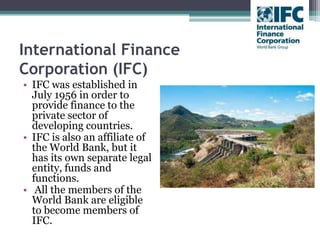
International Finance
Corporation (IFC)
• IFC was established in
  July 1956 in order to
  provide finance to the
  private sector of
  developing countries.
• IFC is also an affiliate of
  the World Bank, but it
  has its own separate legal
  entity, funds and
  functions.
• All the members of the
  World Bank are eligible
  to become members of
  IFC.
Objectives of MIGA
• To encourage flow of direct      • To insure new investments,
  foreign investment into the        expansion of existing
  less developed member              investments, privatisation
  countries                          and financial restructuring;
• To provide insurance cover       • To provide promotional and
  to investors against political      advisory services
  risks                            • To establish credibility
• To provide guarantee
  against on commercial risks
  (like dangers involved in
  currency transfer, war and
  civil disturbances and
  breach of contract)
.
International Monetary Fund (IMF)
                                • In 2005, it had 191
                                  countries as its
• International Monetary Fund
  (IMF) is the second             members.
  international organization
  next to the World Bank.
                                • The major idea
• IMF came into existence in      underlying the
  1945 has its headquarters       setting up of the
  located in Washington DC.
                                  IMF is to evolve an
                                  orderly
                                  international
                                  monetary system.
Major Objectives of IMF
• To promote international monetary cooperation through
  a permanent institution
• To promote exchange stability with a view to maintain
  orderly exchange arrangements among member
  countries.
• To assist in the establishment of a multilateral system of
  payments in respect of current transactions between
  members.
• To facilitate expansion of balanced growth of
  international trade and to contribute thereby to the
  promotion and maintenance of high levels of
  employment and real income.
Functions of IMF
• Acting as a short-term credit institution.
• Providing machinery for the orderly adjustment of
  exchange rates.
• Acting as a reservoir of the currencies of all the member
  countries, from which a borrower nation can borrow
  the currency of other nations.
• Acting as a lending institution of foreign currency and
  current transaction.
• Determining the value of a country’s currency and
  altering it if needed, so as to bring about an orderly
  adjustment of exchange rates of member countries.
• Providing machinery for international consultations.
World Trade Organization
(WTO)
• GATT was transformed     • WTO is a permanent
  into World Trade           organisation created by
  Organisation (WTO)         an international treaty
  with effect from 1st       ratified by the
  January 1995.              governments and
• The head quarters of       legislatures of member
  WTO are situated at        states.
  Geneva, Switzerland.     • As on 11th December
• It has a global status     2005, there were 149
  similar to that of the     members in WTO.
  IMF and the World
  Bank.
Major Objectives of WTO
• To ensure reduction of tariffs and other trade
  barriers imposed by different countries.
• To engage in such activities which improve the
  standards of living, create employment, increase
  income and effective demand and facilitate
  higher production and trade.
• To facilitate the optimal use of the world’s
  resources for sustainable development.
• To promote an integrated, more viable and
  durable trading system.
Functions of WTO
• Promoting an environment that is encouraging to its member
  countries to come forward to WTO in mitigating their
  grievances.
• Laying down a commonly accepted code of conduct with a
  view to reducing trade barriers including tariffs and
  eliminating discriminations in international trade relations
  acting as a dispute settlement body.
• Ensuring that all the rules regulations prescribed in the Act
  are duly followed by the member countries for the settlement
  of their disputes
• Holding consultations with IMF and IBRD and its affiliated
  agencies so as to bring better understanding and cooperation
  in global economic policy making.
• Supervising on a regular basis the operations of the revised
  Agreements and Ministerial declarations relating to goods,
  services and Trade Related intellectual Property Rights
  (TRIPS).
Functions of WTO
• Holding consultations with IMF and IBRD and
  its affiliated agencies so as to bring better
  understanding and cooperation in global
  economic policy making.
• Supervising on a regular basis the operations of
  the revised Agreements and Ministerial
  declarations relating to goods, services and
  Trade Related Intellectual Property Rights
  (TRIPS).
Benefits of WTO
• WTO helps promote international peace and
  facilitates international business.
• All disputes between member nations are
  settled with mutual consultations.
• Rules make international trade and relations
  very smooth and predictable.
• Free trade improves the living standard of
  the people by increasing the income level.
Benefits of WTO
• Free trade provides ample scope of getting
  varieties of qualitative products.
• Economic growth has been fastened because
  of free trade.
• The system encourages good government.
• WTO helps fostering growth of developing
  countries by providing them with special and
  preferential treatment in trade related
  matters.
Agreements of WTO
•   Agreements Forming Part of GATT
•   Agreement on Textile and Clothing (ATC)
•   Agreement on Agriculture (AoA)
•   General Agreement on Trade in Services (GATS)
•   Agreement on Trade Related Aspects of
    Intellectual Property Rights (TRIPS).
•The End

International business

  • 1.
  • 2.
    Contents 1. International Trade 2. World Bank • Functions 3. International Development Association • Objectives 4. International Finance Corporation 5. MIGA • Objectives 6. IMF • Objectives • Functions 7. WTO • Objectives • Functions • Benefits • Agreements
  • 3.
    International Trade • Theworld wars adversely affected the economies. • Meeting was held at Bretton Woods, New Hampshire. • JM Kynes lead 41 countries to restore peace and normalcy • The meeting was concluded with the setting up of three international institutions, namely the International Monetary Fund (IMF), International Bank for Reconstruction and Development (IBRD) and the International Trade Organisation (ITO).
  • 4.
    International Trade • WorldBank was assigned with the task of reconstructing war-torn economies. • IMF was entrusted with the responsibility of ensuring stabilisation of exchange rates to pave way for the expansion of world trade. • The idea of setting up of ITO, however, could not materialise due to stiff opposition from the United States.
  • 5.
    World Bank • TheInternational Bank for Reconstruction and Development (IBRD), was result of the Bretton Woods Conference. • The main objectives behind setting up this international organization were to aid the task of reconstruction of the war-affected economies of Europe and assist in the development of the underdeveloped nations of the world.
  • 6.
    Functions of WorldBank • During its initial years of inception, it placed more emphasis on developing infrastructure facilities like energy, transportation and others. • World Bank decided to divert resources to bring about industrial and agricultural development in under developed countries.
  • 7.
    Functions of WorldBank • The bank has also been providing resources for education, sanitation, health care and small scale enterprises. • It is rather significantly involved in areas like removal of rural poverty through raising productivity, increasing income of the rural poor, providing technical support, and initiating research and cooperative ventures.
  • 8.
    International Development Association • InternationalDevelopment Association (IDA) was set up in 1960 as an affiliate of the World Bank. • It is due to its objective of providing soft loans that it is called the Soft Loan Window of the IBRD.
  • 9.
    Objectives of IDA •To provide development finance on easy terms to the less developed member countries • To provide assistance for poverty alleviation in the poorest countries • To provide finance at concessional interest rates in order to promote economic development, raise productivity and living standards in less developed nations • To extend macro economic management services such as those relating to health, education, nutrition, human resource development and population control.
  • 10.
    International Finance Corporation (IFC) •IFC was established in July 1956 in order to provide finance to the private sector of developing countries. • IFC is also an affiliate of the World Bank, but it has its own separate legal entity, funds and functions. • All the members of the World Bank are eligible to become members of IFC.
  • 11.
    Objectives of MIGA •To encourage flow of direct • To insure new investments, foreign investment into the expansion of existing less developed member investments, privatisation countries and financial restructuring; • To provide insurance cover • To provide promotional and to investors against political advisory services risks • To establish credibility • To provide guarantee against on commercial risks (like dangers involved in currency transfer, war and civil disturbances and breach of contract) .
  • 12.
    International Monetary Fund(IMF) • In 2005, it had 191 countries as its • International Monetary Fund (IMF) is the second members. international organization next to the World Bank. • The major idea • IMF came into existence in underlying the 1945 has its headquarters setting up of the located in Washington DC. IMF is to evolve an orderly international monetary system.
  • 13.
    Major Objectives ofIMF • To promote international monetary cooperation through a permanent institution • To promote exchange stability with a view to maintain orderly exchange arrangements among member countries. • To assist in the establishment of a multilateral system of payments in respect of current transactions between members. • To facilitate expansion of balanced growth of international trade and to contribute thereby to the promotion and maintenance of high levels of employment and real income.
  • 14.
    Functions of IMF •Acting as a short-term credit institution. • Providing machinery for the orderly adjustment of exchange rates. • Acting as a reservoir of the currencies of all the member countries, from which a borrower nation can borrow the currency of other nations. • Acting as a lending institution of foreign currency and current transaction. • Determining the value of a country’s currency and altering it if needed, so as to bring about an orderly adjustment of exchange rates of member countries. • Providing machinery for international consultations.
  • 15.
    World Trade Organization (WTO) •GATT was transformed • WTO is a permanent into World Trade organisation created by Organisation (WTO) an international treaty with effect from 1st ratified by the January 1995. governments and • The head quarters of legislatures of member WTO are situated at states. Geneva, Switzerland. • As on 11th December • It has a global status 2005, there were 149 similar to that of the members in WTO. IMF and the World Bank.
  • 16.
    Major Objectives ofWTO • To ensure reduction of tariffs and other trade barriers imposed by different countries. • To engage in such activities which improve the standards of living, create employment, increase income and effective demand and facilitate higher production and trade. • To facilitate the optimal use of the world’s resources for sustainable development. • To promote an integrated, more viable and durable trading system.
  • 17.
    Functions of WTO •Promoting an environment that is encouraging to its member countries to come forward to WTO in mitigating their grievances. • Laying down a commonly accepted code of conduct with a view to reducing trade barriers including tariffs and eliminating discriminations in international trade relations acting as a dispute settlement body. • Ensuring that all the rules regulations prescribed in the Act are duly followed by the member countries for the settlement of their disputes • Holding consultations with IMF and IBRD and its affiliated agencies so as to bring better understanding and cooperation in global economic policy making. • Supervising on a regular basis the operations of the revised Agreements and Ministerial declarations relating to goods, services and Trade Related intellectual Property Rights (TRIPS).
  • 18.
    Functions of WTO •Holding consultations with IMF and IBRD and its affiliated agencies so as to bring better understanding and cooperation in global economic policy making. • Supervising on a regular basis the operations of the revised Agreements and Ministerial declarations relating to goods, services and Trade Related Intellectual Property Rights (TRIPS).
  • 19.
    Benefits of WTO •WTO helps promote international peace and facilitates international business. • All disputes between member nations are settled with mutual consultations. • Rules make international trade and relations very smooth and predictable. • Free trade improves the living standard of the people by increasing the income level.
  • 20.
    Benefits of WTO •Free trade provides ample scope of getting varieties of qualitative products. • Economic growth has been fastened because of free trade. • The system encourages good government. • WTO helps fostering growth of developing countries by providing them with special and preferential treatment in trade related matters.
  • 21.
    Agreements of WTO • Agreements Forming Part of GATT • Agreement on Textile and Clothing (ATC) • Agreement on Agriculture (AoA) • General Agreement on Trade in Services (GATS) • Agreement on Trade Related Aspects of Intellectual Property Rights (TRIPS).
  • 22.