INTERNATIONAL
HUMAN RESOURCE
MANAGEMENT
A.SRILAKSHMI DEVI
ASSISTANT PROFESSOR
CONCEPTS
► INTRODUCTION TO INTERNATIONAL HRM
► HRM AT INTERNATIONAL PERSPECTIVE
► DISTINCTION BETWEEN DOMESTIC AND INTERNATIONAL HRM
► HRM CHALLENGES AT INTERNATIONAL LEVEL
DEFINITION OF IHRM
INTRODUCTION:
International human resource management is the process of employing, training and developing
and compensating the employees in international and global organizations.
An international company is one which has subsidiaries outside the home-county which rely on
the business expertise or manufacturing capabilities of the parent company. Generally, an MNC
is considered to have a number of businesses in different countries but managed as a whole from
the headquarters, located in one country.
International Human Resource Management (IHRM) is “the process of procuring, allocating,
and effectively utilizing human resources in a multinational corporation”.
DEFINITION:
International Human Resource Management (IHRM) can be defined as a set of activities
targeting human resource management at the international level. It strives to meet organizational
objectives and achieve competitive advantage over competitors at national and international
level.
MODEL OF IHRM
Lorem ipsum dolor sit amet at
nec at adipiscing
03
● Donec risus dolor porta venenatis
● Pharetra luctus felis
● Proin in tellus felis volutpat
Lorem ipsum dolor sit amet at
nec at adipiscing
02
● Donec risus dolor porta venenatis
● Pharetra luctus felis
● Proin in tellus felis volutpat
Lorem ipsum dolor sit amet at
nec at adipiscing
01
● Donec risus dolor porta venenatis
● Pharetra luctus felis
● Proin in tellus felis volutpat
Lorem ipsum dolor sit amet at
nec at adipiscing
03
● Donec risus dolor porta venenatis
● Pharetra luctus felis
● Proin in tellus felis volutpat
Lorem ipsum dolor sit amet at
nec at adipiscing
02
● Donec risus dolor porta venenatis
● Pharetra luctus felis
● Proin in tellus felis volutpat
Lorem ipsum dolor sit amet at
nec at adipiscing
01
● Donec risus dolor porta venenatis
● Pharetra luctus felis
● Proin in tellus felis volutpat
Lorem ipsum dolor sit amet at
nec at adipiscing
03
● Donec risus dolor po
● Pharetra luctus felis
● Pro
Lorem ipsum dolor sit amet at
nec at adipiscing
02
● Donec risus dolor porta venenatis
● Pharetra luctus felis
● Proin in tellus felis volutpat
Lorem ipsum dolor sit amet at
nec at adipiscing
01 ● Donec risus dol
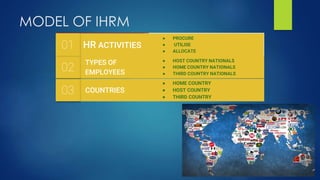
COUNTRIES
03
● HOME COUNTRY
● HOST COUNTRY
● THIRD COUNTRY
TYPES OF
EMPLOYEES
02
● HOST COUNTRY NATIONALS
● HOME COUNTRY NATIONALS
● THIRD COUNTRY NATIONALS
HR ACTIVITIES
01
● PROCURE
● UTILISE
● ALLOCATE
TYPES OF EMPLOYEES
► Home country employees − Employees residing in the home country of
the company where the corporate headquarter is situated, for example, an
Indian working in India for some company whose headquarters are in India
itself.
► Host country employees − Employees residing in the nation in which the
subsidiary is located, for example, an Indian working as an NRI in some
foreign country.
► Third country employees − These are the employees who are not from
home country or host country but are employed at the additional or
corporate headquarters.
► For example, an Indian MNC, which has its corporate office in America,
may employ a French person as the CEO to the subsidiary. The Frenchman
employed is a third country employee.
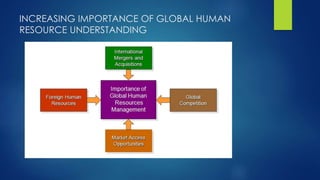
INCREASING IMPORTANCE OF GLOBAL HUMAN
RESOURCE UNDERSTANDING
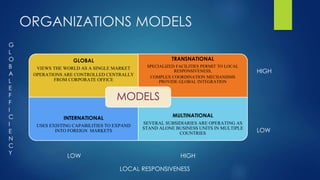
ORGANIZATIONS MODELS
GLOBAL
VIEWS THE WORLD AS A SINGLE MARKET
OPERATIONS ARE CONTROLLED CENTRALLY
FROM CORPORATE OFFICE
TRANSNATIONAL
SPECIALIZED FACILITIES PERMIT TO LOCAL
RESPONSIVENESS,
COMPLEX COORDINATION MECHANISMS
PROVIDE GLOBAL INTEGRATION
INTERNATIONAL
USES EXISTING CAPABILITIES TO EXPAND
INTO FOREIGN MARKETS
MULTINATIONAL
SEVERAL SUBSIDIARIES ARE OPERATING AS
STAND ALONE BUSINESS UNITS IN MULTIPLE
COUNTRIES
MODELS
LOCAL RESPONSIVENESS
LOW HIGH
G
L
O
B
A
L
E
F
F
I
C
I
E
N
C
Y
HIGH
LOW
MODELS OF INTERNATIONAL HUMAN
RESOURCE MANAGEMENT
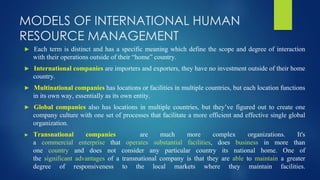
► Each term is distinct and has a specific meaning which define the scope and degree of interaction
with their operations outside of their “home” country.
► International companies are importers and exporters, they have no investment outside of their home
country.
► Multinational companies has locations or facilities in multiple countries, but each location functions
in its own way, essentially as its own entity.
► Global companies also has locations in multiple countries, but they’ve figured out to create one
company culture with one set of processes that facilitate a more efficient and effective single global
organization.
► Transnational companies are much more complex organizations. It's
a commercial enterprise that operates substantial facilities, does business in more than
one country and does not consider any particular country its national home. One of
the significant advantages of a transnational company is that they are able to maintain a greater
degree of responsiveness to the local markets where they maintain facilities.
HR CHALLENGES AT INTERNATIONAL
LEVEL
► ATTRACTING TOP TALENT
► EMBRACING CHANGE
► DEVELOPING LEADERS
► FOSTERING A CULTURE OF CONTINUOUS LEARNING
► MANAGING CULTURE AND DIVERSITY
► MONITOR HEALTH & SAFETY
► CREATING A QUALITY EMPLOYEE EXPERIENCE
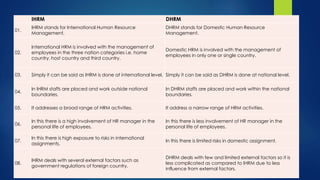
IHRM DHRM
01.
IHRM stands for International Human Resource
Management.
DHRM stands for Domestic Human Resource
Management.
02.
International HRM is involved with the management of
employees in the three nation categories i.e. home
country, host country and third country.
Domestic HRM is involved with the management of
employees in only one or single country.
03. Simply it can be said as IHRM is done at international level. Simply it can be said as DHRM is done at national level.
04.
In IHRM staffs are placed and work outside national
boundaries.
In DHRM staffs are placed and work within the national
boundaries.
05. It addresses a broad range of HRM activities. It address a narrow range of HRM activities.
06.
In this there is a high involvement of HR manager in the
personal life of employees.
In this there is less involvement of HR manager in the
personal life of employees.
07.
In this there is high exposure to risks in international
assignments.
In this there is limited risks in domestic assignment.
08.
IHRM deals with several external factors such as
government regulations of foreign country.
DHRM deals with few and limited external factors so it is
less complicated as compared to IHRM due to less
influence from external factors.
DIFFERENCES BETWEEN DOMESTIC AND INTERNATIONAL HRM
► 1. INTERNATIONAL HUMAN RESOURCE MANAGEMENT (IHRM) :
International Human Resource Management (IHRM) is involved with the management of employees in
the three nation categories i.e. parent/home country, host country and third country. Simply it can be said
as IHRM is done at international level. So, staffs are placed and work outside national boundaries. It
deals with several external factors such as government regulations of foreign country. There is greater
complexity involved in handling different people from different countries as they work outside the
national boundaries.
► 2. DOMESTIC HUMAN RESOURCE MANAGEMENT (DHRM) :
Domestic Human Resource Management (DHRM) is involved with the management of employees in
only one or single country. Simply it can be said as DHRM is done at national level. So, staffs are placed
and work within the national boundaries. It deals with few and limited external factors so it is less
complicated as compared to IHRM due to less influence from external factors. It is relatively easy to
handle the employees as they belong to same country and all employees works inside the national
boundary.
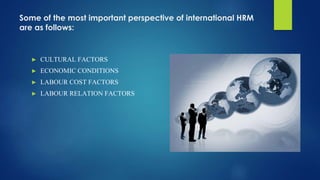
Some of the most important perspective of international HRM
are as follows:
► CULTURAL FACTORS
► ECONOMIC CONDITIONS
► LABOUR COST FACTORS
► LABOUR RELATION FACTORS
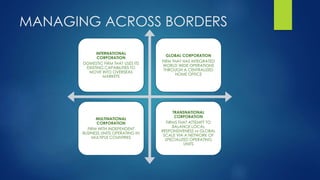
MANAGING ACROSS BORDERS
INTERNATIONAL
CORPORATION
DOMESTIC FIRM THAT USES ITS
EXISTING CAPABILITIES TO
MOVE INTO OVERSEAS
MARKETS
GLOBAL CORPORATION
FIRM THAT HAS INTEGRATED
WORLD WIDE OPERATIONS
THROUGH A CENTRALIZED
HOME OFFICE
MULTINATIONAL
CORPORATION
FIRM WITH INDEPENDENT
BUSINESS UNITS OPERATING IN
MULTIPLE COUNTRIES
TRANSNATIONAL
CORPORATION
FIRMS THAT ATTEMPT TO
BALANCE LOCAL
RESPONSIVENESS vs GLOBAL
SCALE VIA A NETWORK OF
SPECIALIZED OPERATING
UNITS
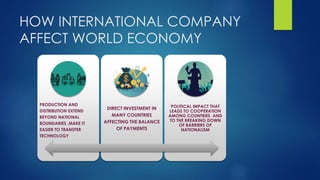
HOW INTERNATIONAL COMPANY
AFFECT WORLD ECONOMY
PRODUCTION AND
DISTRIBUTION EXTEND
BEYOND NATIONAL
BOUNDARIES ,MAKE IT
EASIER TO TRANSFER
TECHNOLOGY
DIRECT INVESTMENT IN
MANY COUNTRIES
AFFECTING THE BALANCE
OF PAYMENTS
POLITICAL IMPACT THAT
LEADS TO COOPERATION
AMONG COUNTRIES AND
TO THE BREAKING DOWN
OF BARRIERS OF
NATIONALISM
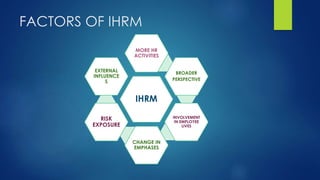
FACTORS OF IHRM
IHRM
MORE HR
ACTIVITIES
BROADER
PERSPECTIVE
INVOLVEMENT
IN EMPLOYEE
LIVES
CHANGE IN
EMPHASES
RISK
EXPOSURE
EXTERNAL
INFLUENCE
S
Thank You!

Ihrm Definition,Differences between domestic and international ,challenges.

  • 1.
  • 2.
    CONCEPTS ► INTRODUCTION TOINTERNATIONAL HRM ► HRM AT INTERNATIONAL PERSPECTIVE ► DISTINCTION BETWEEN DOMESTIC AND INTERNATIONAL HRM ► HRM CHALLENGES AT INTERNATIONAL LEVEL
  • 3.
    DEFINITION OF IHRM INTRODUCTION: Internationalhuman resource management is the process of employing, training and developing and compensating the employees in international and global organizations. An international company is one which has subsidiaries outside the home-county which rely on the business expertise or manufacturing capabilities of the parent company. Generally, an MNC is considered to have a number of businesses in different countries but managed as a whole from the headquarters, located in one country. International Human Resource Management (IHRM) is “the process of procuring, allocating, and effectively utilizing human resources in a multinational corporation”. DEFINITION: International Human Resource Management (IHRM) can be defined as a set of activities targeting human resource management at the international level. It strives to meet organizational objectives and achieve competitive advantage over competitors at national and international level.
  • 4.
    MODEL OF IHRM Loremipsum dolor sit amet at nec at adipiscing 03 ● Donec risus dolor porta venenatis ● Pharetra luctus felis ● Proin in tellus felis volutpat Lorem ipsum dolor sit amet at nec at adipiscing 02 ● Donec risus dolor porta venenatis ● Pharetra luctus felis ● Proin in tellus felis volutpat Lorem ipsum dolor sit amet at nec at adipiscing 01 ● Donec risus dolor porta venenatis ● Pharetra luctus felis ● Proin in tellus felis volutpat Lorem ipsum dolor sit amet at nec at adipiscing 03 ● Donec risus dolor porta venenatis ● Pharetra luctus felis ● Proin in tellus felis volutpat Lorem ipsum dolor sit amet at nec at adipiscing 02 ● Donec risus dolor porta venenatis ● Pharetra luctus felis ● Proin in tellus felis volutpat Lorem ipsum dolor sit amet at nec at adipiscing 01 ● Donec risus dolor porta venenatis ● Pharetra luctus felis ● Proin in tellus felis volutpat Lorem ipsum dolor sit amet at nec at adipiscing 03 ● Donec risus dolor po ● Pharetra luctus felis ● Pro Lorem ipsum dolor sit amet at nec at adipiscing 02 ● Donec risus dolor porta venenatis ● Pharetra luctus felis ● Proin in tellus felis volutpat Lorem ipsum dolor sit amet at nec at adipiscing 01 ● Donec risus dol COUNTRIES 03 ● HOME COUNTRY ● HOST COUNTRY ● THIRD COUNTRY TYPES OF EMPLOYEES 02 ● HOST COUNTRY NATIONALS ● HOME COUNTRY NATIONALS ● THIRD COUNTRY NATIONALS HR ACTIVITIES 01 ● PROCURE ● UTILISE ● ALLOCATE
  • 5.
    TYPES OF EMPLOYEES ►Home country employees − Employees residing in the home country of the company where the corporate headquarter is situated, for example, an Indian working in India for some company whose headquarters are in India itself. ► Host country employees − Employees residing in the nation in which the subsidiary is located, for example, an Indian working as an NRI in some foreign country. ► Third country employees − These are the employees who are not from home country or host country but are employed at the additional or corporate headquarters. ► For example, an Indian MNC, which has its corporate office in America, may employ a French person as the CEO to the subsidiary. The Frenchman employed is a third country employee.
  • 6.
    INCREASING IMPORTANCE OFGLOBAL HUMAN RESOURCE UNDERSTANDING
  • 7.
    ORGANIZATIONS MODELS GLOBAL VIEWS THEWORLD AS A SINGLE MARKET OPERATIONS ARE CONTROLLED CENTRALLY FROM CORPORATE OFFICE TRANSNATIONAL SPECIALIZED FACILITIES PERMIT TO LOCAL RESPONSIVENESS, COMPLEX COORDINATION MECHANISMS PROVIDE GLOBAL INTEGRATION INTERNATIONAL USES EXISTING CAPABILITIES TO EXPAND INTO FOREIGN MARKETS MULTINATIONAL SEVERAL SUBSIDIARIES ARE OPERATING AS STAND ALONE BUSINESS UNITS IN MULTIPLE COUNTRIES MODELS LOCAL RESPONSIVENESS LOW HIGH G L O B A L E F F I C I E N C Y HIGH LOW
  • 8.
    MODELS OF INTERNATIONALHUMAN RESOURCE MANAGEMENT ► Each term is distinct and has a specific meaning which define the scope and degree of interaction with their operations outside of their “home” country. ► International companies are importers and exporters, they have no investment outside of their home country. ► Multinational companies has locations or facilities in multiple countries, but each location functions in its own way, essentially as its own entity. ► Global companies also has locations in multiple countries, but they’ve figured out to create one company culture with one set of processes that facilitate a more efficient and effective single global organization. ► Transnational companies are much more complex organizations. It's a commercial enterprise that operates substantial facilities, does business in more than one country and does not consider any particular country its national home. One of the significant advantages of a transnational company is that they are able to maintain a greater degree of responsiveness to the local markets where they maintain facilities.
  • 9.
    HR CHALLENGES ATINTERNATIONAL LEVEL ► ATTRACTING TOP TALENT ► EMBRACING CHANGE ► DEVELOPING LEADERS ► FOSTERING A CULTURE OF CONTINUOUS LEARNING ► MANAGING CULTURE AND DIVERSITY ► MONITOR HEALTH & SAFETY ► CREATING A QUALITY EMPLOYEE EXPERIENCE
  • 10.
    IHRM DHRM 01. IHRM standsfor International Human Resource Management. DHRM stands for Domestic Human Resource Management. 02. International HRM is involved with the management of employees in the three nation categories i.e. home country, host country and third country. Domestic HRM is involved with the management of employees in only one or single country. 03. Simply it can be said as IHRM is done at international level. Simply it can be said as DHRM is done at national level. 04. In IHRM staffs are placed and work outside national boundaries. In DHRM staffs are placed and work within the national boundaries. 05. It addresses a broad range of HRM activities. It address a narrow range of HRM activities. 06. In this there is a high involvement of HR manager in the personal life of employees. In this there is less involvement of HR manager in the personal life of employees. 07. In this there is high exposure to risks in international assignments. In this there is limited risks in domestic assignment. 08. IHRM deals with several external factors such as government regulations of foreign country. DHRM deals with few and limited external factors so it is less complicated as compared to IHRM due to less influence from external factors.
  • 11.
    DIFFERENCES BETWEEN DOMESTICAND INTERNATIONAL HRM ► 1. INTERNATIONAL HUMAN RESOURCE MANAGEMENT (IHRM) : International Human Resource Management (IHRM) is involved with the management of employees in the three nation categories i.e. parent/home country, host country and third country. Simply it can be said as IHRM is done at international level. So, staffs are placed and work outside national boundaries. It deals with several external factors such as government regulations of foreign country. There is greater complexity involved in handling different people from different countries as they work outside the national boundaries. ► 2. DOMESTIC HUMAN RESOURCE MANAGEMENT (DHRM) : Domestic Human Resource Management (DHRM) is involved with the management of employees in only one or single country. Simply it can be said as DHRM is done at national level. So, staffs are placed and work within the national boundaries. It deals with few and limited external factors so it is less complicated as compared to IHRM due to less influence from external factors. It is relatively easy to handle the employees as they belong to same country and all employees works inside the national boundary.
  • 12.
    Some of themost important perspective of international HRM are as follows: ► CULTURAL FACTORS ► ECONOMIC CONDITIONS ► LABOUR COST FACTORS ► LABOUR RELATION FACTORS
  • 13.
    MANAGING ACROSS BORDERS INTERNATIONAL CORPORATION DOMESTICFIRM THAT USES ITS EXISTING CAPABILITIES TO MOVE INTO OVERSEAS MARKETS GLOBAL CORPORATION FIRM THAT HAS INTEGRATED WORLD WIDE OPERATIONS THROUGH A CENTRALIZED HOME OFFICE MULTINATIONAL CORPORATION FIRM WITH INDEPENDENT BUSINESS UNITS OPERATING IN MULTIPLE COUNTRIES TRANSNATIONAL CORPORATION FIRMS THAT ATTEMPT TO BALANCE LOCAL RESPONSIVENESS vs GLOBAL SCALE VIA A NETWORK OF SPECIALIZED OPERATING UNITS
  • 14.
    HOW INTERNATIONAL COMPANY AFFECTWORLD ECONOMY PRODUCTION AND DISTRIBUTION EXTEND BEYOND NATIONAL BOUNDARIES ,MAKE IT EASIER TO TRANSFER TECHNOLOGY DIRECT INVESTMENT IN MANY COUNTRIES AFFECTING THE BALANCE OF PAYMENTS POLITICAL IMPACT THAT LEADS TO COOPERATION AMONG COUNTRIES AND TO THE BREAKING DOWN OF BARRIERS OF NATIONALISM
  • 15.
    FACTORS OF IHRM IHRM MOREHR ACTIVITIES BROADER PERSPECTIVE INVOLVEMENT IN EMPLOYEE LIVES CHANGE IN EMPHASES RISK EXPOSURE EXTERNAL INFLUENCE S
  • 16.