International Human Resources Management
Fakultas Ekonomi dan Bisnis
Universitas Pasundan
Sadikun Citra Rusmana
Tujuan Pembelajaran
• Define key terms in international human resources
management (IHRM) and consider several definition of
IHRM;
• Introduce the historically significant issue of expatriate
assignment management and review the evolution of
these assignment to reflect the increasing diversity
work and the type of international assignment;
• Outline the difference between domestic and
international HRM;
• Present the complexity of HRM, the increasing
potential for challenges to exicting HRM practice and
current models.
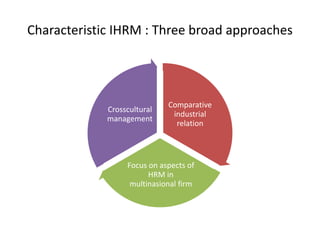
Characteristic IHRM : Three broad approaches
Comparative
industrial
relation
Focus on aspects of
HRM in
multinasional firm
Crosscultural
management
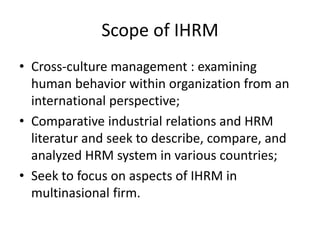
Scope of IHRM
• Cross-culture management : examining
human behavior within organization from an
international perspective;
• Comparative industrial relations and HRM
literatur and seek to describe, compare, and
analyzed HRM system in various countries;
• Seek to focus on aspects of IHRM in
multinasional firm.
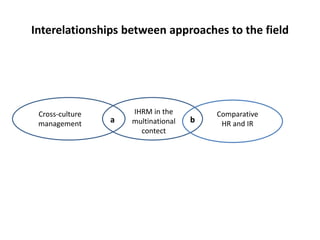
Interelationships between approaches to the field
Cross-culture
management
IHRM in the
multinational
contect
Comparative
HR and IRa b
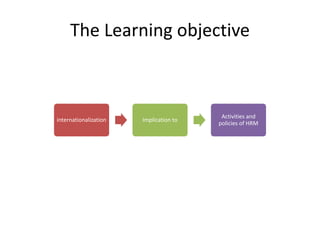
The Learning objective
internationalization Implication to
Activities and
policies of HRM
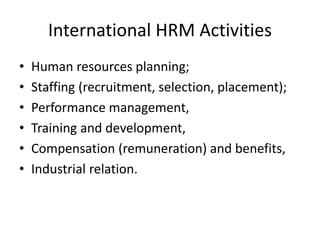
International HRM Activities
• Human resources planning;
• Staffing (recruitment, selection, placement);
• Performance management,
• Training and development,
• Compensation (remuneration) and benefits,
• Industrial relation.
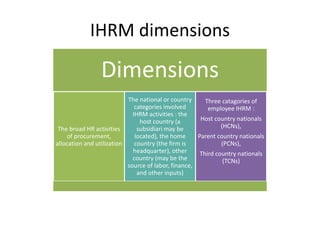
IHRM dimensions
Dimensions
The broad HR activities
of procurement,
allocation and utilization
The national or country
categories involved
IHRM activities : the
host country (a
subsidiari may be
located), the home
country (the firm is
headquarter), other
country (may be the
source of labor, finance,
and other inputs)
Three catagories of
employee IHRM :
Host country nationals
(HCNs),
Parent country nationals
(PCNs),
Third country nationals
(TCNs)
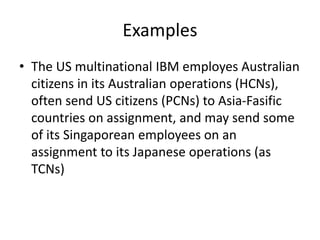
Examples
• The US multinational IBM employes Australian
citizens in its Australian operations (HCNs),
often send US citizens (PCNs) to Asia-Fasific
countries on assignment, and may send some
of its Singaporean employees on an
assignment to its Japanese operations (as
TCNs)
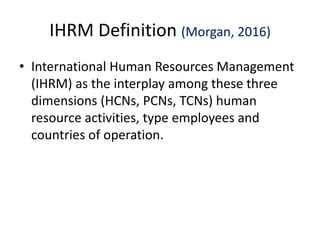
IHRM Definition (Morgan, 2016)
• International Human Resources Management
(IHRM) as the interplay among these three
dimensions (HCNs, PCNs, TCNs) human
resource activities, type employees and
countries of operation.
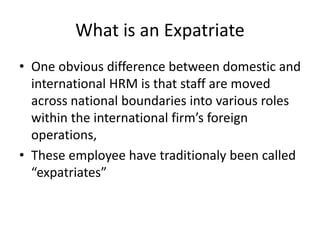
What is an Expatriate
• One obvious difference between domestic and
international HRM is that staff are moved
across national boundaries into various roles
within the international firm’s foreign
operations,
• These employee have traditionaly been called
“expatriates”
Who is expatriate
• An expatriate is an
employee who is working
and temporarily residing in
a foreign country .
• Some firms prefer to call
such “international
assignees”
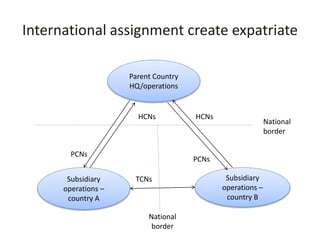
International assignment create expatriate
Subsidiary
operations –
country A
Subsidiary
operations –
country B
Parent Country
HQ/operations
National
border
National
border
HCNs HCNs
PCNs
PCNs
TCNs
Differences between domestic and IHRM
The complexity of operating
in different countries and
employing different
national catagories of
workers ia a key variabels
that differentiates
domestic and
international HRM
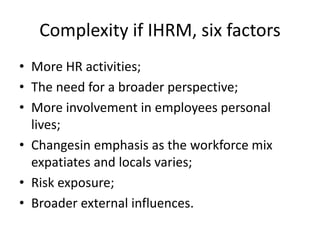
Complexity if IHRM, six factors
• More HR activities;
• The need for a broader perspective;
• More involvement in employees personal
lives;
• Changesin emphasis as the workforce mix
expatiates and locals varies;
• Risk exposure;
• Broader external influences.
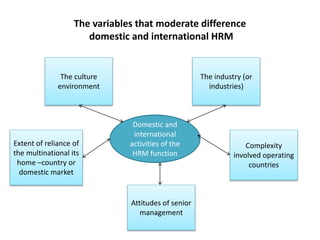
The variables that moderate difference
domestic and international HRM
The culture
environment
The industry (or
industries)
Complexity
involved operating
countries
Extent of reliance of
the multinational its
home –country or
domestic market
Attitudes of senior
management
Domestic and
international
activities of the
HRM function
Applying strategic view of IHRM
• Strategic view of IHRM is required to better
explainthe complexity and challenges of
managing IHRM issues.
• Theoritical framework that has been derived
from a strategic approach using multiple
methodological approach is that of De Cieri
and Dowling.
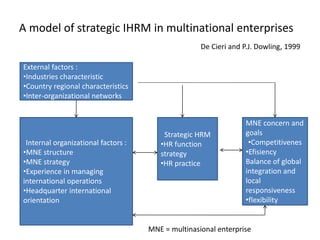
A model of strategic IHRM in multinational enterprises
External factors :
•Industries characteristic
•Country regional characteristics
•Inter-organizational networks
Strategic HRM
•HR function
strategy
•HR practice
Internal organizational factors :
•MNE structure
•MNE strategy
•Experience in managing
international operations
•Headquarter international
orientation
MNE concern and
goals
•Competitivenes
•Efisiency
Balance of global
integration and
local
responsiveness
•flexibility
De Cieri and P.J. Dowling, 1999
MNE = multinasional enterprise
Discussion questions
1. What are the main similarities and differences
between domestic and international HRM?
2. Define these terms : IHRM, PCN, HCN and TCN
3. Discuss two HR activities in which a multinational firm
must engage that would not be required in a domestic
environment.
4. Why is a greater degree of involvment in employees’
personal lives inevitable in many international HRM
activities?
5. Discuss at least two or the variables that moderate
differences between domestic and international HR
practices.

International human resources management

  • 1.
    International Human ResourcesManagement Fakultas Ekonomi dan Bisnis Universitas Pasundan Sadikun Citra Rusmana
  • 2.
    Tujuan Pembelajaran • Definekey terms in international human resources management (IHRM) and consider several definition of IHRM; • Introduce the historically significant issue of expatriate assignment management and review the evolution of these assignment to reflect the increasing diversity work and the type of international assignment; • Outline the difference between domestic and international HRM; • Present the complexity of HRM, the increasing potential for challenges to exicting HRM practice and current models.
  • 3.
    Characteristic IHRM :Three broad approaches Comparative industrial relation Focus on aspects of HRM in multinasional firm Crosscultural management
  • 4.
    Scope of IHRM •Cross-culture management : examining human behavior within organization from an international perspective; • Comparative industrial relations and HRM literatur and seek to describe, compare, and analyzed HRM system in various countries; • Seek to focus on aspects of IHRM in multinasional firm.
  • 5.
    Interelationships between approachesto the field Cross-culture management IHRM in the multinational contect Comparative HR and IRa b
  • 6.
    The Learning objective internationalizationImplication to Activities and policies of HRM
  • 7.
    International HRM Activities •Human resources planning; • Staffing (recruitment, selection, placement); • Performance management, • Training and development, • Compensation (remuneration) and benefits, • Industrial relation.
  • 8.
    IHRM dimensions Dimensions The broadHR activities of procurement, allocation and utilization The national or country categories involved IHRM activities : the host country (a subsidiari may be located), the home country (the firm is headquarter), other country (may be the source of labor, finance, and other inputs) Three catagories of employee IHRM : Host country nationals (HCNs), Parent country nationals (PCNs), Third country nationals (TCNs)
  • 9.
    Examples • The USmultinational IBM employes Australian citizens in its Australian operations (HCNs), often send US citizens (PCNs) to Asia-Fasific countries on assignment, and may send some of its Singaporean employees on an assignment to its Japanese operations (as TCNs)
  • 10.
    IHRM Definition (Morgan,2016) • International Human Resources Management (IHRM) as the interplay among these three dimensions (HCNs, PCNs, TCNs) human resource activities, type employees and countries of operation.
  • 11.
    What is anExpatriate • One obvious difference between domestic and international HRM is that staff are moved across national boundaries into various roles within the international firm’s foreign operations, • These employee have traditionaly been called “expatriates”
  • 12.
    Who is expatriate •An expatriate is an employee who is working and temporarily residing in a foreign country . • Some firms prefer to call such “international assignees”
  • 13.
    International assignment createexpatriate Subsidiary operations – country A Subsidiary operations – country B Parent Country HQ/operations National border National border HCNs HCNs PCNs PCNs TCNs
  • 14.
    Differences between domesticand IHRM The complexity of operating in different countries and employing different national catagories of workers ia a key variabels that differentiates domestic and international HRM
  • 15.
    Complexity if IHRM,six factors • More HR activities; • The need for a broader perspective; • More involvement in employees personal lives; • Changesin emphasis as the workforce mix expatiates and locals varies; • Risk exposure; • Broader external influences.
  • 16.
    The variables thatmoderate difference domestic and international HRM The culture environment The industry (or industries) Complexity involved operating countries Extent of reliance of the multinational its home –country or domestic market Attitudes of senior management Domestic and international activities of the HRM function
  • 17.
    Applying strategic viewof IHRM • Strategic view of IHRM is required to better explainthe complexity and challenges of managing IHRM issues. • Theoritical framework that has been derived from a strategic approach using multiple methodological approach is that of De Cieri and Dowling.
  • 18.
    A model ofstrategic IHRM in multinational enterprises External factors : •Industries characteristic •Country regional characteristics •Inter-organizational networks Strategic HRM •HR function strategy •HR practice Internal organizational factors : •MNE structure •MNE strategy •Experience in managing international operations •Headquarter international orientation MNE concern and goals •Competitivenes •Efisiency Balance of global integration and local responsiveness •flexibility De Cieri and P.J. Dowling, 1999 MNE = multinasional enterprise
  • 19.
    Discussion questions 1. Whatare the main similarities and differences between domestic and international HRM? 2. Define these terms : IHRM, PCN, HCN and TCN 3. Discuss two HR activities in which a multinational firm must engage that would not be required in a domestic environment. 4. Why is a greater degree of involvment in employees’ personal lives inevitable in many international HRM activities? 5. Discuss at least two or the variables that moderate differences between domestic and international HR practices.