WORLD  VIEW…
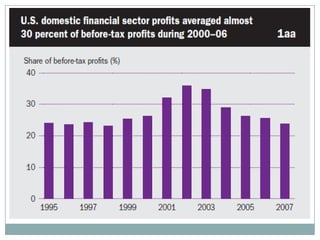
INTRODUCTIONAfter 2000-2007 of economic growth , world saw a severe crisis. There was a liquidity trap as businesses preferred holding cash to spending on consumption or investment.Unemployment rising to more than 11 million.Export led economic growth, shifted the balance of global economic power.Poorer economies were financing current account deficits of high income economies.Crisis had its origin in US , real estate bubble fed by boom in sub prime mortgage lending.
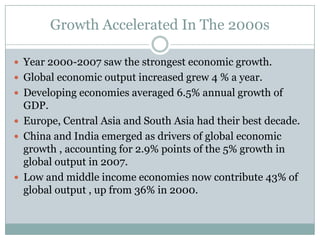
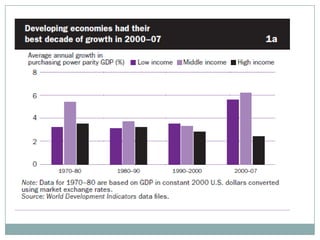
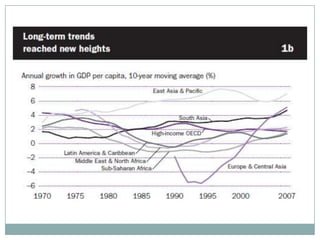
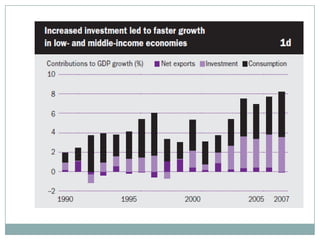
Growth Accelerated In The 2000sYear 2000-2007 saw the strongest economic growth.Global economic output increased grew 4 % a year.Developing economies averaged 6.5% annual growth of GDP.Europe, Central Asia and South Asia had their best decade.China and India emerged as drivers of global economic growth , accounting for 2.9% points of the 5% growth in global output in 2007.Low and middle income economies now contribute 43% of global output , up from 36% in 2000.
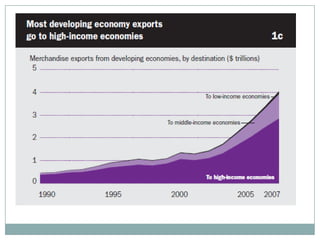
Exports Led GrowthExports played major role in growth in low and middle income economies.It grew at an average annual rate of 12 %.China and India emerged as fast growing exporters.China- Manufactured Products     India -Services.Exports by low and middle income economies accounted for 29 %(2007) as compared to 21% in 2000.70% was exported to high income economies.Savings increased which attracted for foreign investment.
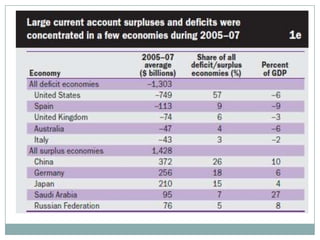
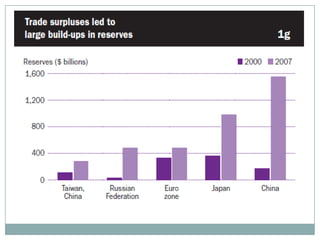
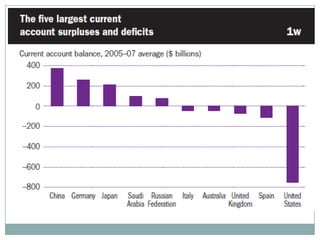
Structural Imbalance EmergedCountries with trade Surplus, had a surplus current account.Countries with trade deficit had to finance their current account by increasing borrowings.Saudi Arabia , China & Germany  saw a major surplus.Large Deficits were in high income economies, US accounted for more than half the worlds current account deficits.US current account deficit increased from 4.3 % to 6% in 2005 – 07.
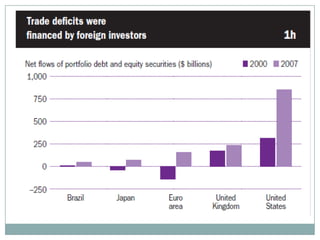
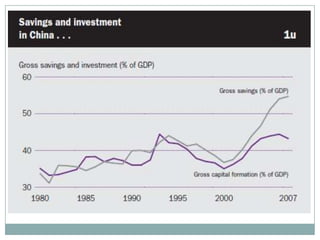
Countries Became more InterdependentCountries with large deficits borrowed from countries with surpluses.US and other deficit countries consumed more and financed their deficits by issuing mare debt and equity.China’s savings rate increased, exceeding investment by 11.5 % of GDP in 2007.US private savings almost disappeared, investment exceeded savings by 4.6 %.As a result , China was largest foreign holder of US treasury securities, followed by Japan.
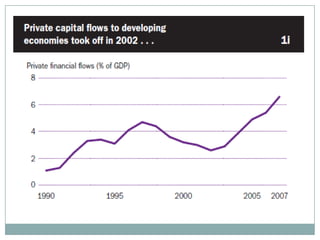
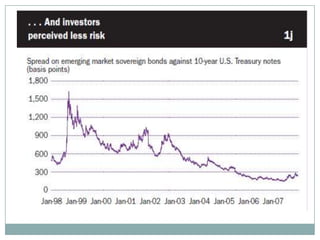
Foreign Investment GrewMultinationals started investing in developing economies , to get more profit.Capital inflow to developing economy quadrupled from 200 billion to 900 billion dollars.Portfolio investment in bonds and equities also increased as return prospects were more.Risk involved in investing in low & middle income economies dropped to all time low.Brazil , China, India & Russian Federation attracted large share of capital flows.
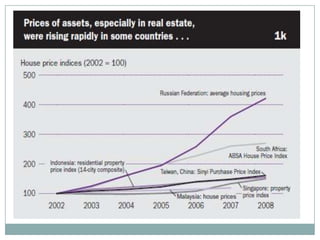
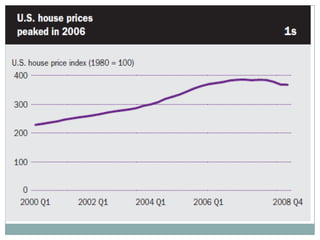
Asset Prices rose rapidly ….As investment  in low and middle income economies increased.There was more optimistic expectations for future earnings . This led to rise in asset price.Rising housing prices reflected expectations for continuing appreciation.
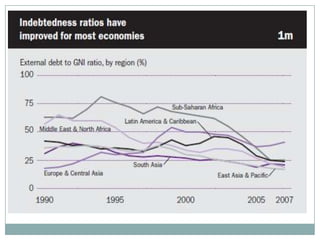
External debt declined and Changed CompositionDebt initiative & multilateral debt relief helped the poorest indebted countries.External debt to GNI ratio for Sub-Saharan African went from 80 % to 30 % from 1990s till date.Many countries gained access to private financing.Short term debt in low and middle income economies 24 % of total debt in 2000 to 37 % in 2007.Growing international reserve helped offset the risk of short term financing in foreign currencies.
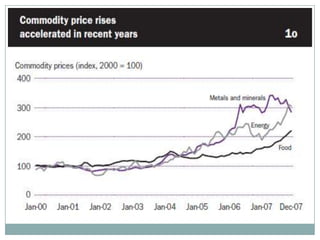
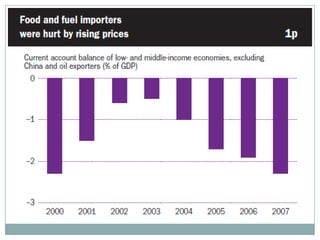
Demand For Primary Commodities IncreasedGlobal economic growth, increased the demand for commodities , boosting price.(oil, metals, and minerals)Prices rose more rapidly in 2007 – 2008.Food prices also rose.Rising prices benefited exporters , especially in Latin  America and Sub-Sahara Africa.Higher commodity price increased government revenue from taxes on commodity exports and attracted foreign direct investment and infrastructure projects.For food and fuel importers the spike in price has been costly.
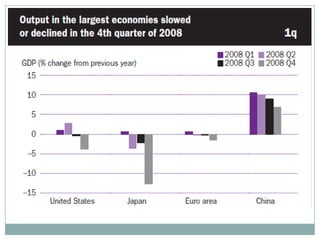
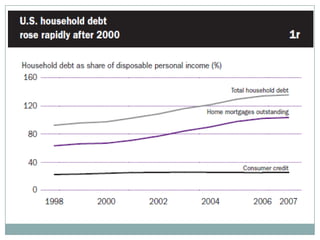
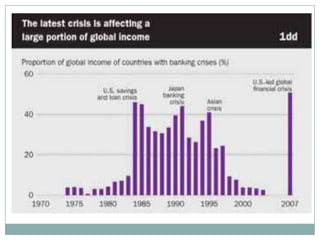
A PERFECT STORM?The current global financial and economic crisis is unlike anything the world has seen since the great depression .Crisis in housing, equity and financial markets leading to global recession.Decline in trade and output.In 2009 the global growth was reported 0% which lead to increase in unemployment.The crisis had its superficial roots in the rise in us household debt.
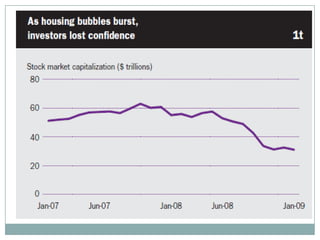
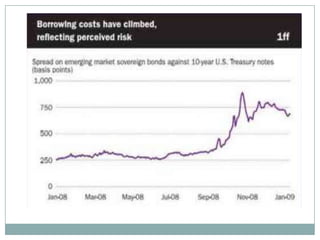
CONTINUED………Subprime mortgage crisis developed into a full fledged financial crisis.Global stock market s lost an estimated $30 trillion in market capitalization in 2008.Fall in asset prices and sharp decline in demand for exports in developing countries.3 major factors account for scale of crisis.Macroeconomic imbalances in global real estate and stock markets, lowering real interest rates and failure of financial regulators to effectively regulate global financial market.
Macroeconomic ImbalancesGlobal savings and investment rates have been fairly stable in recent years at 20-22% but this affected the source of savings. In developing economies, saving rates rose to 7% exceeding the investment rates while in high income, Organization for Economic Co-operation and Developed countries, savings rates fell by about 2% points of aggregate GDP.  US savings rates fell nearly 4% points between 2000-2007, producing a savings investment imbalance of close to 5% points of GDP.
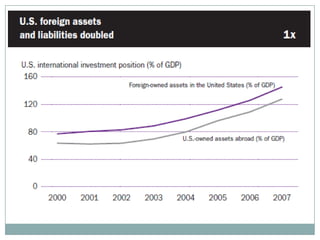
CONTINUED…. US owned assets abroad doubled between 2000-2007 to 128% of GDP, reflecting the importance of UNITED STATES as a source of both foreign direct investment and portfolio flows. US liabilities as from 77% of GDP to 145% over the same period, increasing the negative net liabilities to 17% of GDP in 2007. The personal savings in US falls to 0.4% of GDP reflecting the consumption growth in “substantial excess of income growth.” Both surplus and deficit countries benefited: the first from high export-led growth; the second from low interest rates and cheap consumer goods which led to inflation.
THE ROLE OF FINANCIAL INOVATIONMORTGAGE MARKET:    Mortgage loans, made  by originators, were resold to financial institutions, which sliced and diced pools of mortgages and aggregated them into collateralized debt obligations resold in turn to investors all over the world.
Continued….FINANCIAL INSTRUMENT:   Financial instrument whose values are derive is derived from the value of an underlying asset or an index, enable those who trade in them to mitigate risk through hedging or to speculate. Financial instruments can be bought and sold through over the counter trade of two parties or they can be exchange traded.
Reasons for Financial CrisisBanks borrow short and lend long. Banks mainly rely on depositors not to withdraw their deposits all at the same time.Banks often sell their assets resulting in decline of value of the assets leading to solvency crises.Higher risk involved in financial sector.Reduce in the workers remittance because of higher unemployment.Rise in the prices of commodity which usually makes some venture less appealing.Uncertain environment because of FDI.
Effect of CrisisEquity prices falls 55% over 3.5 years.Housing price falls 35% over 6 years.Unemployment rise 7% over 4 years.Output falls  by 9 % over 2 years.Real value of the govt. debt rise an avg of 86%.Effect of decline in demand of exports on middle and low income economies because of the high economies.Unemployment will also reduce workers remittance flows to low and middle income economies.
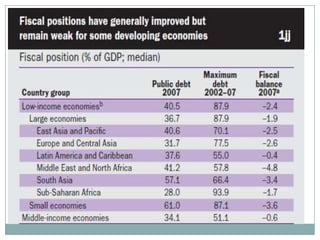
Effect of crisis upon the developing economiesLow income economies are the most vulnerable group.Slowdown of trade has also its impact upon the low income economies.Lower commodity prices will reduce both export revenues and fiscal revenues.
Coping with crisisChina introduced a $585 billion economic stimulus package to counter the global crisis.40% of low and middle income economies have good fiscal and current account positions . They also had Simulation plans. Packages often cannot be delivered quickly enough, and expenditures may go to wasteful projects.Boosting existing safety net programs , creating jobs through public works project , facilitating central bank support of trade financing.
Protecting the vulnerablePoor people in developing economies are highly exposed to the global crisis.Poor people are the first to be hurt by lower demand for labor and falling remittance.Households may have to sell productive assets, pull children out of school.Low and middle income economics are highly exposed to the poverty effects of crisis.
World  view

World view

  • 1.
  • 2.
    INTRODUCTIONAfter 2000-2007 ofeconomic growth , world saw a severe crisis. There was a liquidity trap as businesses preferred holding cash to spending on consumption or investment.Unemployment rising to more than 11 million.Export led economic growth, shifted the balance of global economic power.Poorer economies were financing current account deficits of high income economies.Crisis had its origin in US , real estate bubble fed by boom in sub prime mortgage lending.
  • 3.
    Growth Accelerated InThe 2000sYear 2000-2007 saw the strongest economic growth.Global economic output increased grew 4 % a year.Developing economies averaged 6.5% annual growth of GDP.Europe, Central Asia and South Asia had their best decade.China and India emerged as drivers of global economic growth , accounting for 2.9% points of the 5% growth in global output in 2007.Low and middle income economies now contribute 43% of global output , up from 36% in 2000.
  • 6.
    Exports Led GrowthExportsplayed major role in growth in low and middle income economies.It grew at an average annual rate of 12 %.China and India emerged as fast growing exporters.China- Manufactured Products India -Services.Exports by low and middle income economies accounted for 29 %(2007) as compared to 21% in 2000.70% was exported to high income economies.Savings increased which attracted for foreign investment.
  • 9.
    Structural Imbalance EmergedCountrieswith trade Surplus, had a surplus current account.Countries with trade deficit had to finance their current account by increasing borrowings.Saudi Arabia , China & Germany saw a major surplus.Large Deficits were in high income economies, US accounted for more than half the worlds current account deficits.US current account deficit increased from 4.3 % to 6% in 2005 – 07.
  • 11.
    Countries Became moreInterdependentCountries with large deficits borrowed from countries with surpluses.US and other deficit countries consumed more and financed their deficits by issuing mare debt and equity.China’s savings rate increased, exceeding investment by 11.5 % of GDP in 2007.US private savings almost disappeared, investment exceeded savings by 4.6 %.As a result , China was largest foreign holder of US treasury securities, followed by Japan.
  • 14.
    Foreign Investment GrewMultinationalsstarted investing in developing economies , to get more profit.Capital inflow to developing economy quadrupled from 200 billion to 900 billion dollars.Portfolio investment in bonds and equities also increased as return prospects were more.Risk involved in investing in low & middle income economies dropped to all time low.Brazil , China, India & Russian Federation attracted large share of capital flows.
  • 17.
    Asset Prices roserapidly ….As investment in low and middle income economies increased.There was more optimistic expectations for future earnings . This led to rise in asset price.Rising housing prices reflected expectations for continuing appreciation.
  • 19.
    External debt declinedand Changed CompositionDebt initiative & multilateral debt relief helped the poorest indebted countries.External debt to GNI ratio for Sub-Saharan African went from 80 % to 30 % from 1990s till date.Many countries gained access to private financing.Short term debt in low and middle income economies 24 % of total debt in 2000 to 37 % in 2007.Growing international reserve helped offset the risk of short term financing in foreign currencies.
  • 21.
    Demand For PrimaryCommodities IncreasedGlobal economic growth, increased the demand for commodities , boosting price.(oil, metals, and minerals)Prices rose more rapidly in 2007 – 2008.Food prices also rose.Rising prices benefited exporters , especially in Latin America and Sub-Sahara Africa.Higher commodity price increased government revenue from taxes on commodity exports and attracted foreign direct investment and infrastructure projects.For food and fuel importers the spike in price has been costly.
  • 24.
    A PERFECT STORM?Thecurrent global financial and economic crisis is unlike anything the world has seen since the great depression .Crisis in housing, equity and financial markets leading to global recession.Decline in trade and output.In 2009 the global growth was reported 0% which lead to increase in unemployment.The crisis had its superficial roots in the rise in us household debt.
  • 25.
    CONTINUED………Subprime mortgage crisisdeveloped into a full fledged financial crisis.Global stock market s lost an estimated $30 trillion in market capitalization in 2008.Fall in asset prices and sharp decline in demand for exports in developing countries.3 major factors account for scale of crisis.Macroeconomic imbalances in global real estate and stock markets, lowering real interest rates and failure of financial regulators to effectively regulate global financial market.
  • 30.
    Macroeconomic ImbalancesGlobal savingsand investment rates have been fairly stable in recent years at 20-22% but this affected the source of savings. In developing economies, saving rates rose to 7% exceeding the investment rates while in high income, Organization for Economic Co-operation and Developed countries, savings rates fell by about 2% points of aggregate GDP. US savings rates fell nearly 4% points between 2000-2007, producing a savings investment imbalance of close to 5% points of GDP.
  • 31.
    CONTINUED…. US ownedassets abroad doubled between 2000-2007 to 128% of GDP, reflecting the importance of UNITED STATES as a source of both foreign direct investment and portfolio flows. US liabilities as from 77% of GDP to 145% over the same period, increasing the negative net liabilities to 17% of GDP in 2007. The personal savings in US falls to 0.4% of GDP reflecting the consumption growth in “substantial excess of income growth.” Both surplus and deficit countries benefited: the first from high export-led growth; the second from low interest rates and cheap consumer goods which led to inflation.
  • 35.
    THE ROLE OFFINANCIAL INOVATIONMORTGAGE MARKET: Mortgage loans, made by originators, were resold to financial institutions, which sliced and diced pools of mortgages and aggregated them into collateralized debt obligations resold in turn to investors all over the world.
  • 36.
    Continued….FINANCIAL INSTRUMENT: Financial instrument whose values are derive is derived from the value of an underlying asset or an index, enable those who trade in them to mitigate risk through hedging or to speculate. Financial instruments can be bought and sold through over the counter trade of two parties or they can be exchange traded.
  • 38.
    Reasons for FinancialCrisisBanks borrow short and lend long. Banks mainly rely on depositors not to withdraw their deposits all at the same time.Banks often sell their assets resulting in decline of value of the assets leading to solvency crises.Higher risk involved in financial sector.Reduce in the workers remittance because of higher unemployment.Rise in the prices of commodity which usually makes some venture less appealing.Uncertain environment because of FDI.
  • 40.
    Effect of CrisisEquityprices falls 55% over 3.5 years.Housing price falls 35% over 6 years.Unemployment rise 7% over 4 years.Output falls by 9 % over 2 years.Real value of the govt. debt rise an avg of 86%.Effect of decline in demand of exports on middle and low income economies because of the high economies.Unemployment will also reduce workers remittance flows to low and middle income economies.
  • 42.
    Effect of crisisupon the developing economiesLow income economies are the most vulnerable group.Slowdown of trade has also its impact upon the low income economies.Lower commodity prices will reduce both export revenues and fiscal revenues.
  • 43.
    Coping with crisisChinaintroduced a $585 billion economic stimulus package to counter the global crisis.40% of low and middle income economies have good fiscal and current account positions . They also had Simulation plans. Packages often cannot be delivered quickly enough, and expenditures may go to wasteful projects.Boosting existing safety net programs , creating jobs through public works project , facilitating central bank support of trade financing.
  • 45.
    Protecting the vulnerablePoorpeople in developing economies are highly exposed to the global crisis.Poor people are the first to be hurt by lower demand for labor and falling remittance.Households may have to sell productive assets, pull children out of school.Low and middle income economics are highly exposed to the poverty effects of crisis.