Carl Todd
Da Vinci 1
Processors (CPU)
A CPU is like the brain of your computer, it controls
everything that goes on inside your computer from
the most basic tasks to the more complicated
aspects.
Memory
RAM (Random Access Memory):
This is the area of temporary storage for applications, the operating
system and other bits of data being used, this is for easier access.
Flash memory (Card):
A type of memory that can be deleted and reprogrammed, the units
for this memory is blocks.
ROM (Read Only Memory):
This is memory that once data has written onto the chip it cannot be
removed only read.
Memory
Adapter Cards
                Ex:
                A printer circuit card is
                needed to connect a printer.


                An adapter card is required
                to allow the computer to
                communicate with the
                peripheral device of your
                choice.
BUS Topology
The topology the network uses
controls what functions are
available. Also how the
network reacts to set backs.
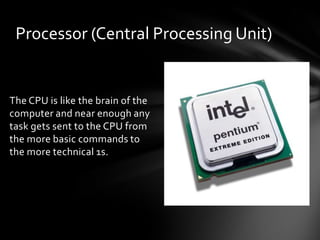
Processor (Central Processing Unit)


The CPU is like the brain of the
computer and near enough any
task gets sent to the CPU from
the more basic commands to
the more technical 1s.
Storage Devices
This is a piece of hardware that can store and read
information, 1 of the main types of storage devices is a
hard drive. The computers primary hard drives are the
operating system, application and folders and files for the
users of the computer. Can be used with nearly any
energy. Input and output devices are also very popular
storage devices.
Partitioning and Formatting
Partitioning is the dividing of a hard disk so you
can create a group of different operating systems.

Internal components (technical)

  • 1.
  • 2.
    Processors (CPU) A CPUis like the brain of your computer, it controls everything that goes on inside your computer from the most basic tasks to the more complicated aspects.
  • 3.
    Memory RAM (Random AccessMemory): This is the area of temporary storage for applications, the operating system and other bits of data being used, this is for easier access. Flash memory (Card): A type of memory that can be deleted and reprogrammed, the units for this memory is blocks. ROM (Read Only Memory): This is memory that once data has written onto the chip it cannot be removed only read.
  • 4.
  • 5.
    Adapter Cards Ex: A printer circuit card is needed to connect a printer. An adapter card is required to allow the computer to communicate with the peripheral device of your choice.
  • 6.
    BUS Topology The topologythe network uses controls what functions are available. Also how the network reacts to set backs.
  • 7.
    Processor (Central ProcessingUnit) The CPU is like the brain of the computer and near enough any task gets sent to the CPU from the more basic commands to the more technical 1s.
  • 8.
    Storage Devices This isa piece of hardware that can store and read information, 1 of the main types of storage devices is a hard drive. The computers primary hard drives are the operating system, application and folders and files for the users of the computer. Can be used with nearly any energy. Input and output devices are also very popular storage devices.
  • 9.
    Partitioning and Formatting Partitioningis the dividing of a hard disk so you can create a group of different operating systems.