
What is a computer?
 A computer is an electronic
 device that executes the
 instructions in a program.
Benefits of Computers

 The three main benefits of using computers are :
 Speed
 Accuracy
 Capacity to take large amount of work.
Applications
 Computers are used in various fields ranging from
 making cartoon films to
 space research.
 Some applications of computers are:
  Railway reservation
  Banking and Accounts
 Weather Forecast
  Space Research
 Weather Forecast
  Space Research
 Medical Diagnosis
  Chemical Analysis
Types of computers
 Computers are categorized on the basis of size, sot
 and performance.
 Generally, the larger the system, the greater is its
 processing speed, storage capacity, cost and ability to
 handle large number of devices. The various types of
 computers are:
  Microcomputer
  Personal computers/laptops
 Minicomputers
 Mainframes
 Super computers
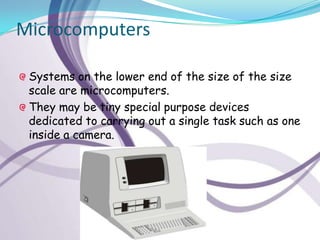
Microcomputers

 Systems on the lower end of the size of the size
 scale are microcomputers.
 They may be tiny special purpose devices
 dedicated to carrying out a single task such as one
 inside a camera.
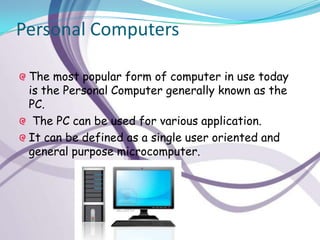
Personal Computers

 The most popular form of computer in use today
 is the Personal Computer generally known as the
 PC.
  The PC can be used for various application.
 It can be defined as a single user oriented and
 general purpose microcomputer.
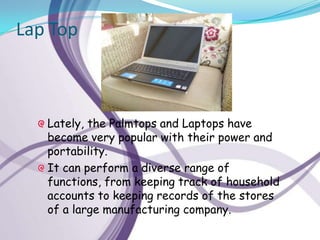
Lap Top


   Lately, the Palmtops and Laptops have
   become very popular with their power and
   portability.
   It can perform a diverse range of
   functions, from keeping track of household
   accounts to keeping records of the stores
   of a large manufacturing company.
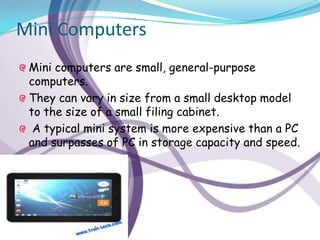
Mini Computers
 Mini computers are small, general-purpose
 computers.
 They can vary in size from a small desktop model
 to the size of a small filing cabinet.
  A typical mini system is more expensive than a PC
 and surpasses of PC in storage capacity and speed.
contd………
While most PCs are oriented towards single
users,minisystems are designed to handle the needs of
multiple users, i.e., more than one person can work on
a mini at the same time.
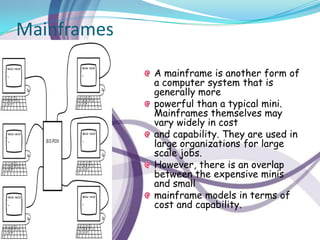
Mainframes

             A mainframe is another form of
             a computer system that is
             generally more
             powerful than a typical mini.
             Mainframes themselves may
             vary widely in cost
             and capability. They are used in
             large organizations for large
             scale jobs.
             However, there is an overlap
             between the expensive minis
             and small
             mainframe models in terms of
             cost and capability.
Super computers

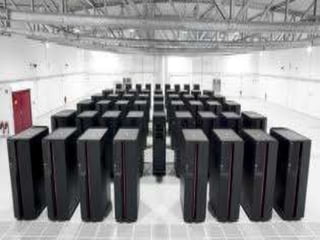
 At the end of the size and capability scale,
 are the super computers.
 These systems are the largest, fastest and
 most expensive computers in the world.
 These computers are owned by large
 organizations.
 They are used for complex scientific
 applications.
Software
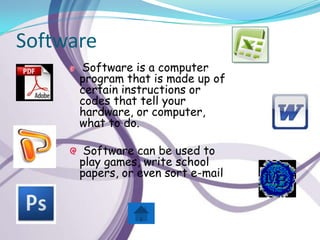
      Software is a computer
      program that is made up of
      certain instructions or
      codes that tell your
      hardware, or computer,
      what to do.

       Software can be used to
      play games, write school
      papers, or even sort e-mail
Hardware
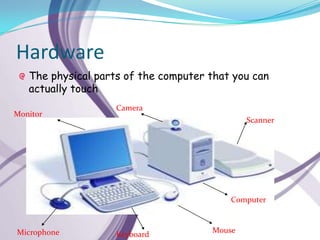
   The physical parts of the computer that you can
   actually touch
                    Camera
Monitor
                                              Scanner


                                          Computer


Microphone                            Mouse
                    Keyboard
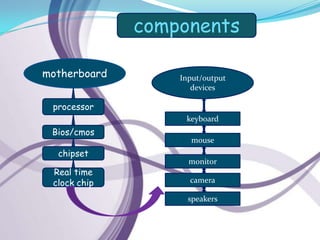
components

motherboard       Input/output
                     devices

 processor
                   keyboard
 Bios/cmos
                    mouse
  chipset
                    monitor
 Real time
 clock chip         camera

                    speakers
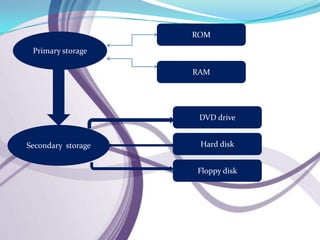
ROM

 Primary storage

                    RAM


                     DVD drive


Secondary storage    Hard disk


                    Floppy disk
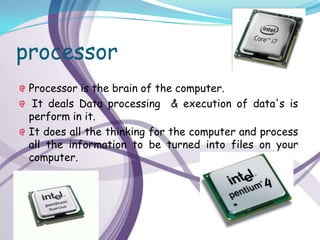
processor
 Processor is the brain of the computer.
  It deals Data processing & execution of data's is
 perform in it.
 It does all the thinking for the computer and process
 all the information to be turned into files on your
 computer.
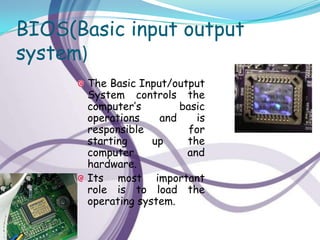
BIOS(Basic input output
system)
       The Basic Input/output
       System controls the
       computer’s        basic
       operations    and    is
       responsible         for
       starting     up    the
       computer           and
       hardware.
       Its most important
       role is to load the
       operating system.
Some of the other common tasks that the BIOS
performs include:
Check the CMOS Setup for custom settings
Load the interrupt handlers and device drivers
Initialize registers and power management
Perform the power-on self-test (POST)
Display system settings
Determine which devices are bootable
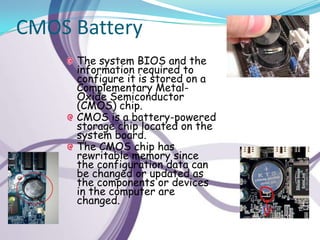
CMOS Battery
     The system BIOS and the
     information required to
     configure it is stored on a
     Complementary Metal-
     Oxide Semiconductor
     (CMOS) chip.
     CMOS is a battery-powered
     storage chip located on the
     system board.
     The CMOS chip has
     rewritable memory since
     the configuration data can
     be changed or updated as
     the components or devices
     in the computer are
     changed.
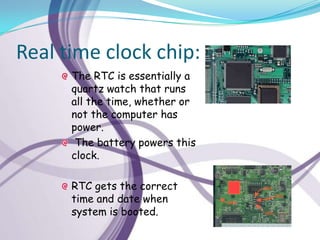
Real time clock chip:
      The RTC is essentially a
      quartz watch that runs
      all the time, whether or
      not the computer has
      power.
       The battery powers this
      clock.

      RTC gets the correct
      time and date when
      system is booted.
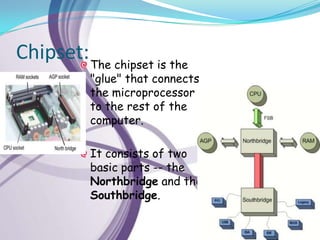
Chipset: The chipset is the
           "glue" that connects
           the microprocessor
           to the rest of the
           computer.

           It consists of two
           basic parts -- the
           Northbridge and the
           Southbridge.
Input/ output devices
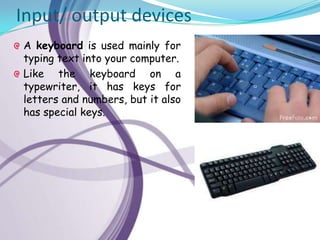
A keyboard is used mainly for
typing text into your computer.
Like the keyboard on a
typewriter, it has keys for
letters and numbers, but it also
has special keys.
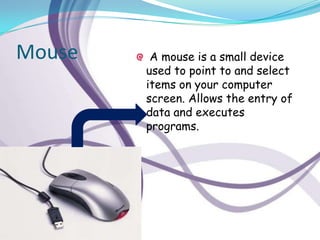
Mouse    A mouse is a small device
        used to point to and select
        items on your computer
        screen. Allows the entry of
        data and executes
        programs.
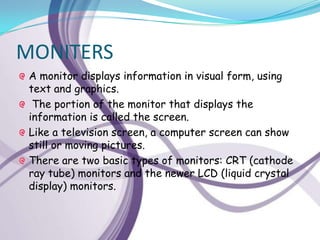
MONITERS
 A monitor displays information in visual form, using
 text and graphics.
  The portion of the monitor that displays the
 information is called the screen.
 Like a television screen, a computer screen can show
 still or moving pictures.
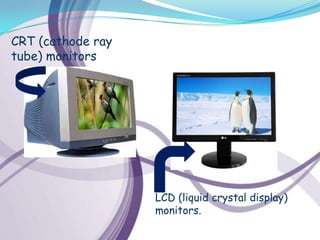
 There are two basic types of monitors: CRT (cathode
 ray tube) monitors and the newer LCD (liquid crystal
 display) monitors.
CRT (cathode ray
tube) monitors


                   LCD (liquid crystal display)
                   monitors.
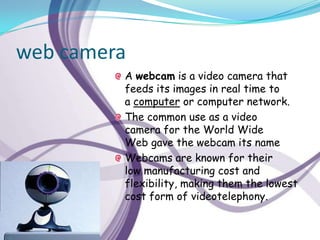
web camera
         A webcam is a video camera that
         feeds its images in real time to
         a computer or computer network.
         The common use as a video
         camera for the World Wide
         Web gave the webcam its name
         Webcams are known for their
         low manufacturing cost and
         flexibility, making them the lowest
         cost form of videotelephony.
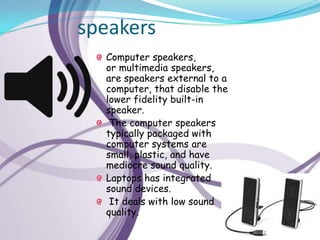
speakers
  Computer speakers,
  or multimedia speakers,
  are speakers external to a
  computer, that disable the
  lower fidelity built-in
  speaker.
   The computer speakers
  typically packaged with
  computer systems are
  small, plastic, and have
  mediocre sound quality.
  Laptops has integrated
  sound devices.
   It deals with low sound
  quality.
STORAGES
 Primary storages consists of two types.
 They are
 ROM(Read only memory)
 RAM(Random access memory)
ROM
Computers almost always contain a small amount of
read-only memory that holds instructions for starting
up the computer. Unlike RAM, ROM cannot be written
to.
Types of ROM
PROM(programmable read-only memory):
EPROM (erasable programmable read-only memory)
EEPROM (electrically erasable programmable read-
only memory):
RAM
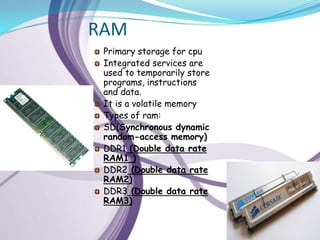
 Primary storage for cpu
 Integrated services are
 used to temporarily store
 programs, instructions
 and data.
 It is a volatile memory
 Types of ram:
 SD(Synchronous dynamic
 random-access memory)
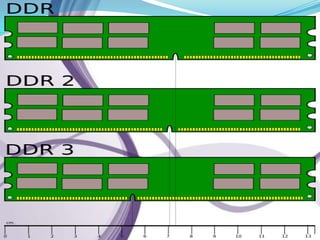
 DDR1 (Double data rate
 RAM1 )
 DDR2 (Double data rate
 RAM2)
 DDR3 (Double data rate
 RAM3)
Secondary storages
 There are three types of secondary devices
 They are
 Dvd drive
 Hard disk
 Floppy disk
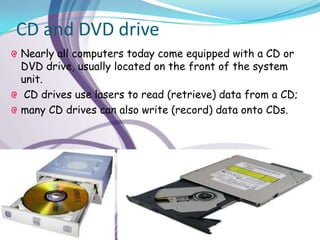
CD and DVD drive
Nearly all computers today come equipped with a CD or
DVD drive, usually located on the front of the system
unit.
 CD drives use lasers to read (retrieve) data from a CD;
many CD drives can also write (record) data onto CDs.
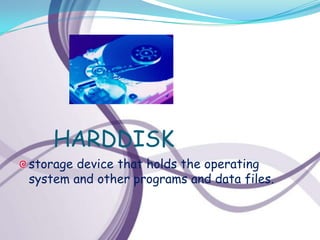
HARDDISK
storage device that holds the operating
system and other programs and data files.
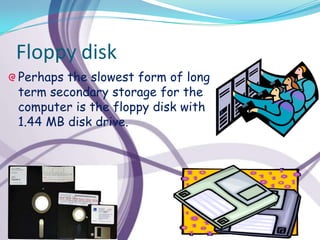
Floppy disk
Perhaps the slowest form of long
term secondary storage for the
computer is the floppy disk with
1.44 MB disk drive.
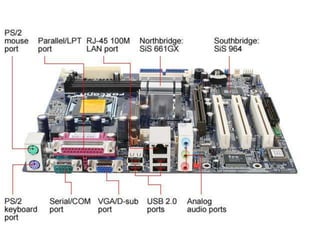
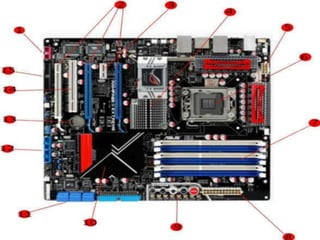
MOTHERBOARD
This transfers data between all of the computer’s
components: the human nervous system.
It is the main circuit board that incommoded
processor slot, RAM slot , Extension slot , PCI
slot, Serial port, parallel port, connectors for
keyboard & mouse etc.
Computer hardware3
Computer hardware3
Computer hardware3

Computer hardware3

  • 2.
    What is acomputer? A computer is an electronic device that executes the instructions in a program.
  • 3.
    Benefits of Computers The three main benefits of using computers are : Speed Accuracy Capacity to take large amount of work.
  • 4.
    Applications Computers areused in various fields ranging from making cartoon films to space research. Some applications of computers are: Railway reservation Banking and Accounts Weather Forecast Space Research Weather Forecast Space Research Medical Diagnosis Chemical Analysis
  • 5.
    Types of computers Computers are categorized on the basis of size, sot and performance. Generally, the larger the system, the greater is its processing speed, storage capacity, cost and ability to handle large number of devices. The various types of computers are: Microcomputer Personal computers/laptops Minicomputers Mainframes Super computers
  • 6.
    Microcomputers Systems onthe lower end of the size of the size scale are microcomputers. They may be tiny special purpose devices dedicated to carrying out a single task such as one inside a camera.
  • 7.
    Personal Computers Themost popular form of computer in use today is the Personal Computer generally known as the PC. The PC can be used for various application. It can be defined as a single user oriented and general purpose microcomputer.
  • 8.
    Lap Top Lately, the Palmtops and Laptops have become very popular with their power and portability. It can perform a diverse range of functions, from keeping track of household accounts to keeping records of the stores of a large manufacturing company.
  • 9.
    Mini Computers Minicomputers are small, general-purpose computers. They can vary in size from a small desktop model to the size of a small filing cabinet. A typical mini system is more expensive than a PC and surpasses of PC in storage capacity and speed.
  • 10.
    contd……… While most PCsare oriented towards single users,minisystems are designed to handle the needs of multiple users, i.e., more than one person can work on a mini at the same time.
  • 11.
    Mainframes A mainframe is another form of a computer system that is generally more powerful than a typical mini. Mainframes themselves may vary widely in cost and capability. They are used in large organizations for large scale jobs. However, there is an overlap between the expensive minis and small mainframe models in terms of cost and capability.
  • 12.
    Super computers Atthe end of the size and capability scale, are the super computers. These systems are the largest, fastest and most expensive computers in the world. These computers are owned by large organizations. They are used for complex scientific applications.
  • 14.
    Software Software is a computer program that is made up of certain instructions or codes that tell your hardware, or computer, what to do. Software can be used to play games, write school papers, or even sort e-mail
  • 15.
    Hardware The physical parts of the computer that you can actually touch Camera Monitor Scanner Computer Microphone Mouse Keyboard
  • 16.
    components motherboard Input/output devices processor keyboard Bios/cmos mouse chipset monitor Real time clock chip camera speakers
  • 17.
    ROM Primary storage RAM DVD drive Secondary storage Hard disk Floppy disk
  • 18.
    processor Processor isthe brain of the computer. It deals Data processing & execution of data's is perform in it. It does all the thinking for the computer and process all the information to be turned into files on your computer.
  • 19.
    BIOS(Basic input output system) The Basic Input/output System controls the computer’s basic operations and is responsible for starting up the computer and hardware. Its most important role is to load the operating system.
  • 20.
    Some of theother common tasks that the BIOS performs include: Check the CMOS Setup for custom settings Load the interrupt handlers and device drivers Initialize registers and power management Perform the power-on self-test (POST) Display system settings Determine which devices are bootable
  • 21.
    CMOS Battery The system BIOS and the information required to configure it is stored on a Complementary Metal- Oxide Semiconductor (CMOS) chip. CMOS is a battery-powered storage chip located on the system board. The CMOS chip has rewritable memory since the configuration data can be changed or updated as the components or devices in the computer are changed.
  • 22.
    Real time clockchip: The RTC is essentially a quartz watch that runs all the time, whether or not the computer has power. The battery powers this clock. RTC gets the correct time and date when system is booted.
  • 23.
    Chipset: The chipsetis the "glue" that connects the microprocessor to the rest of the computer. It consists of two basic parts -- the Northbridge and the Southbridge.
  • 24.
    Input/ output devices Akeyboard is used mainly for typing text into your computer. Like the keyboard on a typewriter, it has keys for letters and numbers, but it also has special keys.
  • 25.
    Mouse A mouse is a small device used to point to and select items on your computer screen. Allows the entry of data and executes programs.
  • 26.
    MONITERS A monitordisplays information in visual form, using text and graphics. The portion of the monitor that displays the information is called the screen. Like a television screen, a computer screen can show still or moving pictures. There are two basic types of monitors: CRT (cathode ray tube) monitors and the newer LCD (liquid crystal display) monitors.
  • 27.
    CRT (cathode ray tube)monitors LCD (liquid crystal display) monitors.
  • 28.
    web camera A webcam is a video camera that feeds its images in real time to a computer or computer network. The common use as a video camera for the World Wide Web gave the webcam its name Webcams are known for their low manufacturing cost and flexibility, making them the lowest cost form of videotelephony.
  • 29.
    speakers Computerspeakers, or multimedia speakers, are speakers external to a computer, that disable the lower fidelity built-in speaker. The computer speakers typically packaged with computer systems are small, plastic, and have mediocre sound quality. Laptops has integrated sound devices. It deals with low sound quality.
  • 30.
    STORAGES Primary storagesconsists of two types. They are ROM(Read only memory) RAM(Random access memory)
  • 31.
    ROM Computers almost alwayscontain a small amount of read-only memory that holds instructions for starting up the computer. Unlike RAM, ROM cannot be written to. Types of ROM PROM(programmable read-only memory): EPROM (erasable programmable read-only memory) EEPROM (electrically erasable programmable read- only memory):
  • 32.
    RAM Primary storagefor cpu Integrated services are used to temporarily store programs, instructions and data. It is a volatile memory Types of ram: SD(Synchronous dynamic random-access memory) DDR1 (Double data rate RAM1 ) DDR2 (Double data rate RAM2) DDR3 (Double data rate RAM3)
  • 34.
    Secondary storages Thereare three types of secondary devices They are Dvd drive Hard disk Floppy disk
  • 35.
    CD and DVDdrive Nearly all computers today come equipped with a CD or DVD drive, usually located on the front of the system unit. CD drives use lasers to read (retrieve) data from a CD; many CD drives can also write (record) data onto CDs.
  • 36.
    HARDDISK storage device thatholds the operating system and other programs and data files.
  • 37.
    Floppy disk Perhaps theslowest form of long term secondary storage for the computer is the floppy disk with 1.44 MB disk drive.
  • 38.
    MOTHERBOARD This transfers databetween all of the computer’s components: the human nervous system. It is the main circuit board that incommoded processor slot, RAM slot , Extension slot , PCI slot, Serial port, parallel port, connectors for keyboard & mouse etc.