More Related Content

PPT
Intrrnl env, resources competancies 
PDF
Chapter 3 the internal organization- resources capabilities core competencies... 
PPT

PPT
Assessing Strengths and Weaknesses 
PPT

PPTX

PPT
Internal Analysys Of Strategic Management 
PPTX
Chp 3_Examining Internal organisation.pptx Similar to Class4_444444444444444444444The Internal Organization.ppt

PPT

DOCX
BUS 499, Week 3 The Internal Organization Resources, Capabilitie 
PDF
Session 5 - Strategic Management.pptx.pdf 
PPT

DOCX
Pagedundee.ac.ukDr. Andrew G. RossLecture Internal.docx 
PPTX
L 9 value chain analysis, eva, mva etc 
PPTX
Hitt_ppt_12e_ch03_SM.pptx 
PPT
Analysing Strategic Capability Tools.ppt 
PPTX
Student Career Development Centre Plan 2018 E (1).pptx 
PPTX
MF strategic marketing slides competitive advantage MF 
PPTX
MODULE-3-THE-INTERNAL-ORGANIZATION.pptx 
PPTX
How to use Internal Analysis In Strategic Management.pptx 
PPTX

DOC
Strategic management chapter 5 and 6 note for bba vii 
PPTX

PPTX

PPTX
Competing for Advantage.pptx 
PPT

PPTX

PDF
Ch04_Roth3e_Enhanced_PPT.pdf Recently uploaded

PPTX
Advanced SEO: Ranking in a Competitive Digital World 
PPTX
What is a Source Context in semantic seo? 
PPTX
MANUFACTURING LOYALTY: AN EXPLORATION INTO DIGITAL FAN ENGAGEMENT AND COMPARA... 
PDF
2026 Digital Marketing Roadmap for Higher Education 
PDF
How Modern Brands Actually Scale in a Market Shaped by AI 
PDF
YouTube SEO Playbook: Ranking, Discovery, and Search Optimization 
PDF
The 2026 Sports Marketing Blueprint: Orchestrating Fan Engagement in India 
PDF
Why Voice of Customer Is the Missing Layer in Positioning and Competitive Str... 
PPTX
Google Business Video Verification in 2026: The 3-Minute Walkthrough That Get... 
PDF
Multicultural Strategy Playbook.pptx.pdf 
PDF
How Verified Alipay Accounts Boost Online Business and Credibility 
PDF
How DigiTechzo Is Redefining Sales-Focused Digital Marketing in India 
DOCX
12 Way to Buy Verified Cash App Accounts Smartly 
PDF
🥳 BUKTI KEMENANGAN HARI INI MINGGU 01 FEBRUARI 2026 🥰 
PDF
From stadiums to Screens Digital Marketing and the Future of Fan Engagement ... 
PDF
Ananya hi solutions digital marketing hy 
PPTX
Google Local Services Ads Not Showing? 5 Fixes for Zero Impressions (LSA) 
PDF
22 Ways to Increase Ecommerce Sales .... 
PDF
Google SERPs In 2026: Changes, Features & How To Boost Your Organic Traffic 
PDF
SEO Strategy in 2026_ Proven Methods to Boost Visibility, Traffic, and Conver... Class4_444444444444444444444The Internal Organization.ppt
- 1.
©2011 Cengage Learning.All Rights Reserved. May not be scanned,
copied or duplicated, or posted to a publicly accessible website, in
whole or in part.
1 | 1
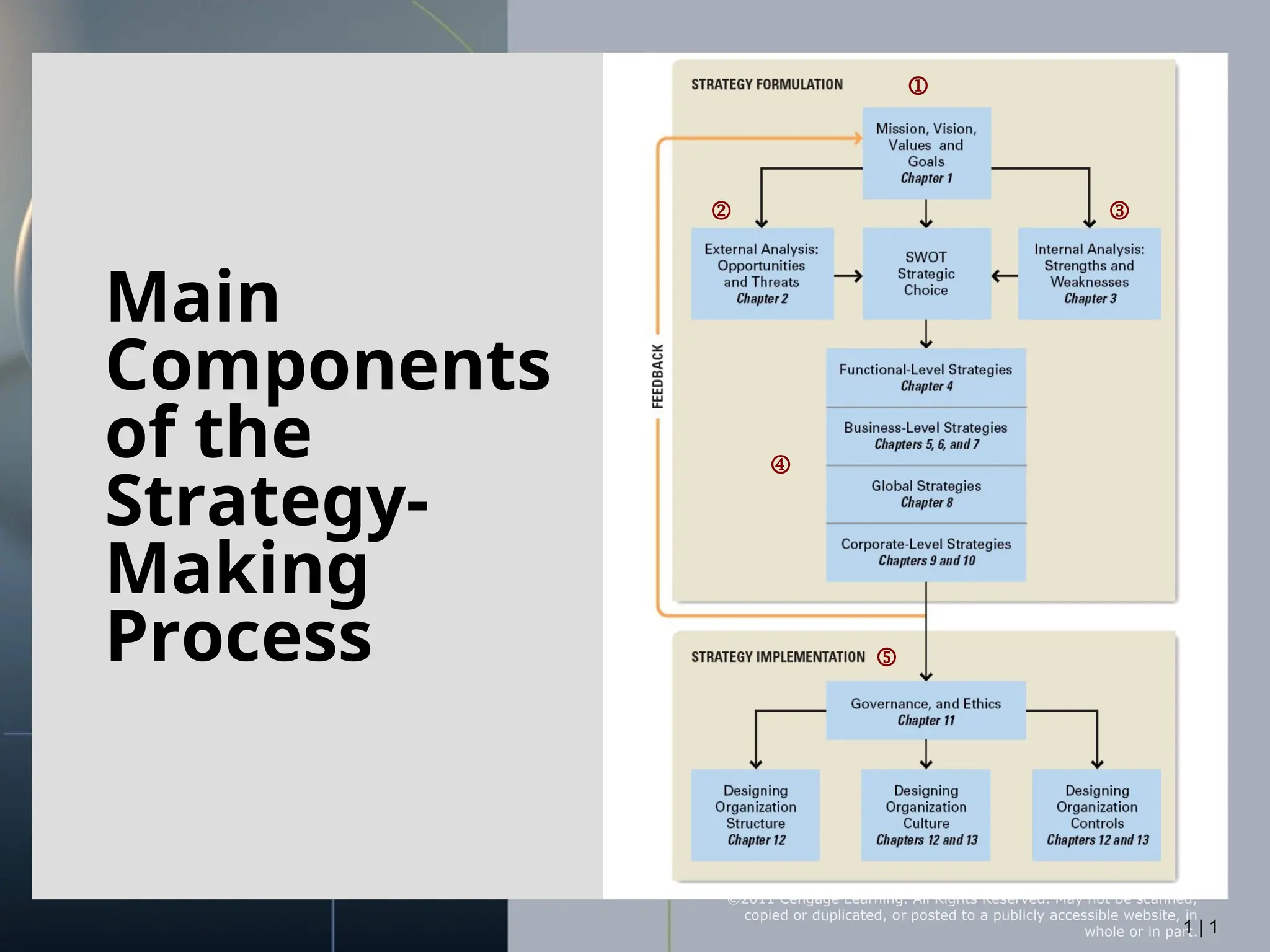
Main
Components
of the
Strategy-
Making
Process
- 2.
©2011 Cengage Learning.All Rights Reserved. May not be scanned,
copied or duplicated, or posted to a publicly accessible website, in
whole or in part.
Strategic Management Inputs
The Internal Organization:
Resources, Capabilities, Core
Competencies
and Competitive Advantages
- 3.
©2011 Cengage Learning.All Rights Reserved. May not be scanned, copied or duplicated, or posted to a publicly accessible website, in whole or in part.
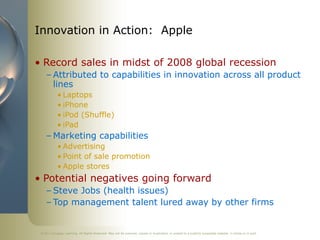
Innovation in Action: Apple
• Record sales in midst of 2008 global recession
– Attributed to capabilities in innovation across all product
lines
• Laptops
• iPhone
• iPod (Shuffle)
• iPad
– Marketing capabilities
• Advertising
• Point of sale promotion
• Apple stores
• Potential negatives going forward
– Steve Jobs (health issues)
– Top management talent lured away by other firms
- 4.
©2011 Cengage Learning.All Rights Reserved. May not be scanned, copied or duplicated, or posted to a publicly accessible website, in whole or in part.
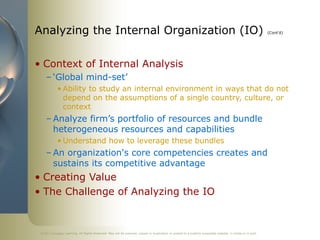
Analyzing the Internal Organization (IO) (Cont’d)
• Context of Internal Analysis
– ‘Global mind-set’
• Ability to study an internal environment in ways that do not
depend on the assumptions of a single country, culture, or
context
– Analyze firm’s portfolio of resources and bundle
heterogeneous resources and capabilities
• Understand how to leverage these bundles
– An organization's core competencies creates and
sustains its competitive advantage
• Creating Value
• The Challenge of Analyzing the IO
- 5.
©2011 Cengage Learning.All Rights Reserved. May not be scanned, copied or duplicated, or posted to a publicly accessible website, in whole or in part.
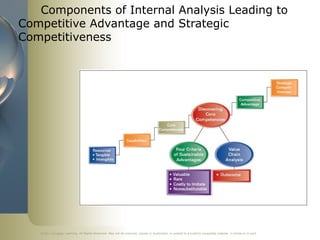
Components of Internal Analysis Leading to
Competitive Advantage and Strategic
Competitiveness
- 6.
©2011 Cengage Learning.All Rights Reserved. May not be scanned, copied or duplicated, or posted to a publicly accessible website, in whole or in part.
Analyzing the Internal Organization (IO) (Cont’d)
• Context of Internal Analysis
• Creating Value
–Develop core competencies that lead to
competitive advantage
–Value: measured by a product's
performance characteristics and by its
attributes for which customers are willing
to pay
- 7.
©2011 Cengage Learning.All Rights Reserved. May not be scanned, copied or duplicated, or posted to a publicly accessible website, in whole or in part.
Analyzing the Internal Organization (IO) (Cont’d)
• The Challenge of Analyzing the IO
–Strategic decisions are non-routine, have ethical
implications and influence the organization’s above-
average returns
•Involves identifying, developing, deploying and
protecting firms’ resources, capabilities and core
competencies
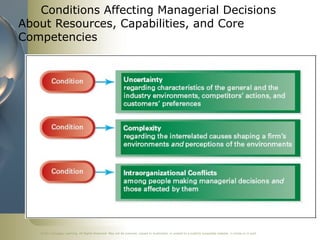
–Managers face uncertainty on many fronts --
•Proprietary technologies
•Changes in economic and political trends, societal values
and shifts in customer demands
•Environment – increases complexity
–Intraorganizational conflict
•Due to decisions about core competencies and how to
nurture them
- 8.
©2011 Cengage Learning.All Rights Reserved. May not be scanned, copied or duplicated, or posted to a publicly accessible website, in whole or in part.
Conditions Affecting Managerial Decisions
About Resources, Capabilities, and Core
Competencies
- 9.
©2011 Cengage Learning.All Rights Reserved. May not be scanned, copied or duplicated, or posted to a publicly accessible website, in whole or in part.
Resources, Capabilities and Core
Competencies
• Competitive Advantage (CA) foundation includes
– Resources
• Bundled to create organizational capabilities
• Tangible and intangible.
– Capabilities
• Source of a firm’s core competencies and basis for CA
• Purposely integrated to achieve a specific task/set of tasks
– Core Competencies
• Capabilities that serve as a source of CA for a firm over its
rivals
• Distinguish a company from its competitors – the personality
- 10.
©2011 Cengage Learning.All Rights Reserved. May not be scanned, copied or duplicated, or posted to a publicly accessible website, in whole or in part.
Resources, Capabilities and Core
Competencies
• Tangible Resources
– Assets that can be seen, touched and quantified
– Examples include equipment, facilities, distribution
centers, formal reporting structures
– Four specific types
• Intangible Resources
– Assets rooted deeply in the firm’s history, accumulated
over time
– In comparison to ‘tangible’ resources, usually can’t be
seen or touched
– Examples include knowledge, trusts, organizational
routines, capabilities, innovation, brand name, reputation
– Three specific types
- 11.
©2011 Cengage Learning.All Rights Reserved. May not be scanned, copied or duplicated, or posted to a publicly accessible website, in whole or in part.
Building Core Competencies:
Criteria and Value Chain Analysis
• Two tools firms use to identify and build on their
core competencies
– Four specific criteria of Sustainable CA
– Value Chain Analysis
- 12.
©2011 Cengage Learning.All Rights Reserved. May not be scanned, copied or duplicated, or posted to a publicly accessible website, in whole or in part.
Building Core Competencies:
Criteria and Value Chain Analysis
• Four specific criteria of sustainable competitive
advantage – capabilities that are:
– Valuable
– Rare
– Costly-to-imitate
– Nonsubstitutable capabilities
• Competitive consequences:
– Focus on capabilities that yield competitive parity and
either temporary or sustainable competitive advantage
• Performance implications include:
– Parity = average returns
– Temporary advantage = avg. to above avg. returns
– Sustainable advantage = above average returns
- 13.
©2011 Cengage Learning.All Rights Reserved. May not be scanned, copied or duplicated, or posted to a publicly accessible website, in whole or in part.
Building Core Competencies:
Criteria and Value Chain Analysis
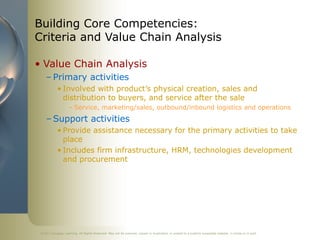
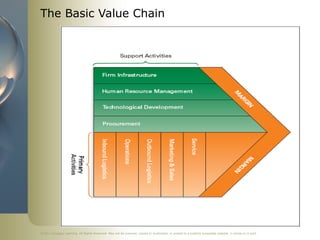
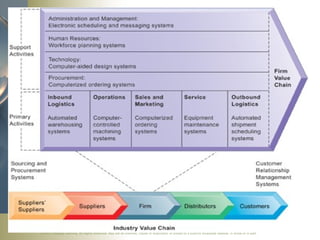
• Value Chain Analysis
– Primary activities
• Involved with product’s physical creation, sales and
distribution to buyers, and service after the sale
– Service, marketing/sales, outbound/inbound logistics and operations
– Support activities
• Provide assistance necessary for the primary activities to take
place
• Includes firm infrastructure, HRM, technologies development
and procurement
- 14.
©2011 Cengage Learning.All Rights Reserved. May not be scanned, copied or duplicated, or posted to a publicly accessible website, in whole or in part.
The Basic Value Chain
- 15.
©2011 Cengage Learning.All Rights Reserved. May not be scanned, copied or duplicated, or posted to a publicly accessible website, in whole or in part.
The Concept of a Company Value Chain
• The Value Chain
– Identifies the primary internal activities that
create customer value and the related
support activities.
– Permits a deep look at the firm’s cost
structure and ability to offer low prices.
– Reveals the emphasis that a firm places on
activities that enhance differentiation and
support higher prices.
- 16.
©2011 Cengage Learning.All Rights Reserved. May not be scanned, copied or duplicated, or posted to a publicly accessible website, in whole or in part.
Comparing the Value Chains of Rival Firms
• Value Chain Analysis
– Facilitates a comparison, activity-by-activity, of how
effectively and efficiently a company delivers value
to its customers, relative to its competitors.
• The Value Chain Analysis Process:
– Segregate the firm’s operations into different types
of primary and secondary activities to identify the
major components of its internal cost structure.
– Use activity-based costing to evaluate the activities.
– Do the same for significant competitors.
- 17.
©2011 Cengage Learning.All Rights Reserved. May not be scanned, copied or duplicated, or posted to a publicly accessible website, in whole or in part.
- 18.
©2011 Cengage Learning.All Rights Reserved. May not be scanned, copied or duplicated, or posted to a publicly accessible website, in whole or in part.
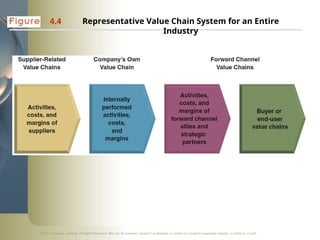
4.4 Representative Value Chain System for an Entire
Industry
- 19.
©2011 Cengage Learning.All Rights Reserved. May not be scanned, copied or duplicated, or posted to a publicly accessible website, in whole or in part.
Value Chain System for an Entire Industry
• Industry Value Chain:
– The firm’s internal value chain
– The value chains of industry suppliers
– The value chains of channel intermediaries
• Effects of the Industry Value Chain:
– Costs and margins of suppliers and channel
partners can affect prices to end consumers.
– Activities of channel partners can affect industry
sales volumes and customer satisfaction.
- 20.
©2011 Cengage Learning.All Rights Reserved. May not be scanned, copied or duplicated, or posted to a publicly accessible website, in whole or in part.
Benchmarking and Value Chain Activities
• Benchmarking:
– Benchmarking is a process of measuring the performance
of a company's products, services, or processes against
those of another business considered to be the best in the
industry, OR “best in class.”
– Involves improving a firm’s internal activities based on
learning other companies’ “best practices.”
– Assesses whether the cost competitiveness and
effectiveness of a firm’s value chain activities are in line
with its competitors’ activities.
• Sources of Benchmarking Information
– Reports, trade groups, analysts and customers
– Visits to benchmark companies
– Data from consulting firms
- 21.
©2011 Cengage Learning.All Rights Reserved. May not be scanned, copied or duplicated, or posted to a publicly accessible website, in whole or in part.
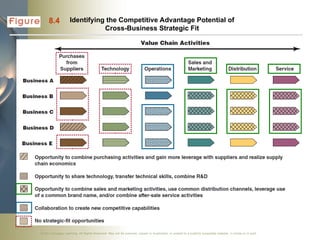
8.4 Identifying the Competitive Advantage Potential of
Cross-Business Strategic Fit
- 22.
©2011 Cengage Learning.All Rights Reserved. May not be scanned, copied or duplicated, or posted to a publicly accessible website, in whole or in part.
Outsourcing
• Definition: Purchase of a value-creating activity
from an external supplier
– Effective execution includes an increase in flexibility,
risk mitigation and capital investment reduction
– Trend continues at a rapid pace
– Firms must outsource activities where they cannot
create value or are at a substantial disadvantage
compared to competitors
• Can cause concerns
– Usually revolves around innovative ability and loss of
jobs
- 23.
©2011 Cengage Learning.All Rights Reserved. May not be scanned, copied or duplicated, or posted to a publicly accessible website, in whole or in part.
Internal Organization Assessment and
Strategic Decisions
• Firms must identify their strengths and weaknesses
• Appropriate resources and capabilities needed to
develop desired strategy and create value for
customers/other stakeholders
• Tools (i.e., outsourcing) can help a firm focus on
core competencies as the source for CA
• Core competencies have potential to become core
rigidities
– Competencies emphasized when no longer competitively
relevant can become a weakness
• External environmental conditions and events
impact a firm’s core competencies