Experience Curve
In the 1960's, management consultants at The Boston Consulting Group observed a consistent relationship between the cost of production and the cumulative production quantity (total quantity produced from the first unit to the last). Data revealed that the real value-added production cost declined by 20 to 30 percent for each doubling of cumulative production quantity:
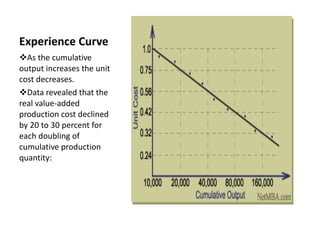
Experience Curve As the cumulative output increases the unit cost decreases. Data revealed that the real value-added production cost declined by 20 to 30 percent for each doubling of cumulative production quantity:
It is common for the terms  experience curve  and  learning curve  to be used interchangeably. They do, however, have different meanings .
Experience Curve Learning curve The term experience curve is more of a macro concept All cost and effects are reflected by experience curve The term learning curve is a micro concept. learning curve relates to labor hours and hence labor cost as consequence, reduction in cost due to learning curve is much lower
Uses of Experience curve  There are three general areas for the application and use of experience curves; strategic, internal, and external to the organization.  Strategic uses include determining volume-cost changes, estimating new product start-up costs, and pricing of new products.
Internal applications include developing labor standards, scheduling, budgeting, and make-or-buy decisions.  External uses are supplier scheduling, cash flow budgeting, and estimating purchase costs
Pricing based on the experience curve Loss of proprietary knowledge Technical innovation Globalization    

Experience curve

  • 1.
  • 2.
    In the 1960's,management consultants at The Boston Consulting Group observed a consistent relationship between the cost of production and the cumulative production quantity (total quantity produced from the first unit to the last). Data revealed that the real value-added production cost declined by 20 to 30 percent for each doubling of cumulative production quantity:
  • 3.
    Experience Curve Asthe cumulative output increases the unit cost decreases. Data revealed that the real value-added production cost declined by 20 to 30 percent for each doubling of cumulative production quantity:
  • 4.
    It is commonfor the terms experience curve and learning curve to be used interchangeably. They do, however, have different meanings .
  • 5.
    Experience Curve Learningcurve The term experience curve is more of a macro concept All cost and effects are reflected by experience curve The term learning curve is a micro concept. learning curve relates to labor hours and hence labor cost as consequence, reduction in cost due to learning curve is much lower
  • 6.
    Uses of Experiencecurve There are three general areas for the application and use of experience curves; strategic, internal, and external to the organization. Strategic uses include determining volume-cost changes, estimating new product start-up costs, and pricing of new products.
  • 7.
    Internal applications includedeveloping labor standards, scheduling, budgeting, and make-or-buy decisions. External uses are supplier scheduling, cash flow budgeting, and estimating purchase costs
  • 8.
    Pricing based onthe experience curve Loss of proprietary knowledge Technical innovation Globalization