Store and Warehouse
A warehouse is a commercial building for storage of goods. Warehouses are used by manufacturers,
importers, exporters, wholesalers, transport businesses, customs, etc. They are usually large plain buildings in
industrial areas of cities, towns and villages.
Store and Warehouse
Trim Card:
Trim cardis prepare according to PDM by attaching different types of accessories.
SOS board:
SOS board is used for the purpose of same style for different countries. As per country variation, the levels are
different
TEX 60=20/2 i.e 3000m/cone
TEX 27=40/2 i.e 4000m/cone
TEX 18=60/2 i.e 5000m/cone
Management Staff
 Monir Hosen(Executive)
 Store Room
 01755-587967
Total Manpower of Store Section:
 A-Team=19
 B-Team=18
 Management staff: 1
Types of store:
 Trims & accessories store
Types of goods (sewing & finishing items):
 1)Fabric 2)Thread
 3)Button 4)Interlining
 5)Level 6)Zipper
 7)Elastic 8)Sizer
 9)Hanger10)Poly
 11)Cartoon
 12)Price ticket
 13)Hangtag
 14)Tag pin
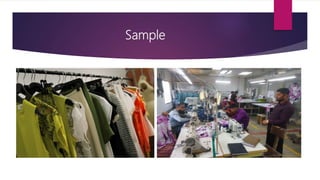
Sample
Management Staff:
 Shah Jamal,
 (Sample in charge)
 01715-686576
 Management Staff: 2
 Total Manpower of Sample Section: 12
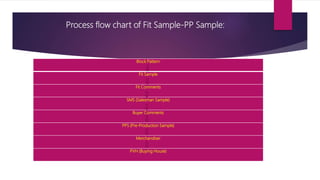
Process flow chart of Fit Sample-PP Sample:
Block Pattern
Fit Sample
Fit Comments
SMS (Salesman Sample)
Buyer Comments
PPS (Pre-Production Sample)
Merchandiser
PVH (Buying House)
Inspection
Inspection can be defined as the visual examination or review of raw materials (such as
fabric, buttons, zippers, sewing threads, trims etc
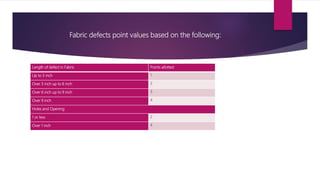
Fabric defects point values based on the following:
Length of defect in Fabric Points allotted
Up to 3 inch 1
Over 3 inch up to 6 inch 2
Over 6 inch up to 9 inch 3
Over 9 inch 4
Holes and Opening
1 or less 2
Over 1 inch 4
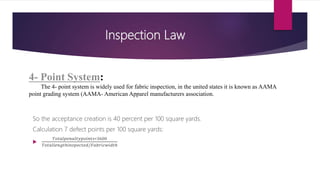
Inspection Law
So the acceptance creation is 40 percent per 100 square yards.
Calculation 7 defect points per 100 square yards:

𝑇𝑜𝑡𝑎𝑙𝑝𝑒𝑛𝑎𝑙𝑡𝑦𝑝𝑜𝑖𝑛𝑡𝑠∗3600
𝑇𝑜𝑡𝑎𝑙𝑙𝑒𝑛𝑔𝑡ℎ𝑖𝑛𝑠𝑝𝑒𝑐𝑡𝑒𝑑/𝐹𝑎𝑏𝑟𝑖𝑐𝑤𝑖𝑑𝑡ℎ
4- Point System:
The 4- point system is widely used for fabric inspection, in the united states it is known as AAMA
point grading system (AAMA- American Apparel manufacturers association.
Major Defects Found in Woven Fabric:
 Various types of faults found in woven fabric has mentioned in the below:
 Bad selvedge,
 Broken ends or warp,
 Broken picks or weft,
 Loose warp,
 Loose weft or snarl,
 Double end,
 Tight end,
 Float of warp,
 Wrong end color,
 Miss pick,
 Double pick,
 Weft bar,
 Ball,
 Hole,
Cutting
Fabric cutting is important in textile or garments industry. A garment will be ready to wear when
it will be completed by sewing many part of fabric which are cutter in a cutting table in the lay
or spread of fabric
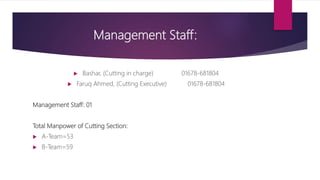
Management Staff:
 Bashar, (Cutting in charge) 01678-681804
 Faruq Ahmed, (Cutting Executive) 01678-681804
Management Staff: 01
Total Manpower of Cutting Section:
 A-Team=53
 B-Team=59
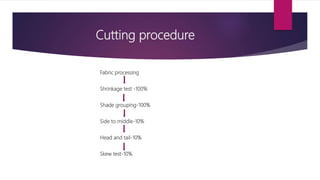
Cutting procedure
Fabric processing
Shrinkage test -100%
Shade grouping-100%
Side to middle-10%
Head and tail-10%
Skew test-10%
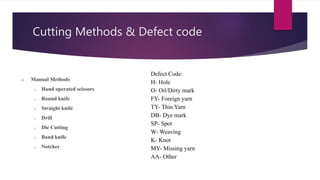
Cutting Methods & Defect code
 Manual Methods
o Hand operated scissors
o Round knife
o Straight knife
o Drill
o Die Cutting
o Band knife
o Notcher
Defect Code:
H- Hole
O- Oil/Dirty mark
FY- Foreign yarn
TY- Thin Yarn
DB- Dye mark
SP- Spot
W- Weaving
K- Knot
MY- Missing yarn
AA- Other
Sewing Section
Sewing is an important department in garments manufacturing industry. All the parts of a garment are
joined here by making stitch with the help of needle and thread.
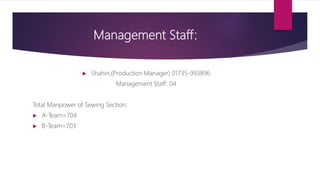
Management Staff:
 Shahin,(Production Manager) 01735-993896
Management Staff: 04
Total Manpower of Sewing Section:
 A-Team=704
 B-Team=703
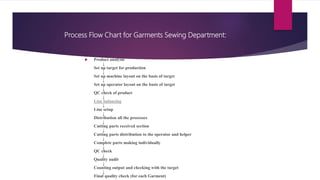
Process Flow Chart for Garments Sewing Department:
 Product analysis
↓
Set up target for production
↓
Set up machine layout on the basis of target
↓
Set up operator layout on the basis of target
↓
QC check of product
↓
Line balancing
↓
Line setup
↓
Distribution all the processes
↓
Cutting parts received section
↓
Cutting parts distribution to the operator and helper
↓
Complete parts making individually
↓
QC check
↓
Quality audit
↓
Counting output and checking with the target
↓
Final quality check (for each Garment)
I.E (Industrial Engineering)
Important formula for industrial Engineer
1. Standard Pitch Time (S.P.T) = Basic Pitch Time (B.P.T) + Allowances (%)
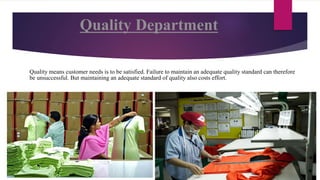
Quality Department
Quality means customer needs is to be satisfied. Failure to maintain an adequate quality standard can therefore
be unsuccessful. But maintaining an adequate standard of quality also costs effort.
Management Staff:
 Kamal Hosen, (Quality in charge)
 01920-114295
 Rafiqul Islam, (Quality Manager)
 01678-681804
Management Staff:
 Quality: 2
 Quality Assurance: 8
Total Manpower of Quality Section:
 A-Team=101
 B-Team=111
Various Steps of Inspection & Quality
Control:
Before or Pre-production Inspection
 The following parameters & defects are checked prior to cutting.
 Shade Matching
 Fabric Construction
 GSM (grams per square metrer
 Whales & courses if required)
 Diameter
 Dyeing Levelness
 Ecological parameters if required
 Softness
 Shrinkage etc.
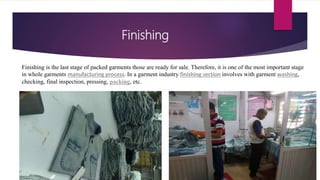
Finishing
Finishing is the last stage of packed garments those are ready for sale. Therefore, it is one of the most important stage
in whole garments manufacturing process. In a garment industry finishing section involves with garment washing,
checking, final inspection, pressing, packing, etc.
Management Staff:
 Arif, (Finishing Manager)
 01678-681804
Management Staff: 01
 Total Manpower of Finishing Section:
 A-Team=132
 B-Team=125
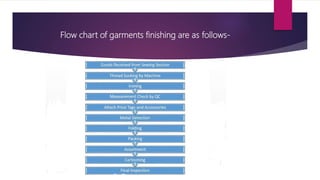
Flow chart of garments finishing are as follows-
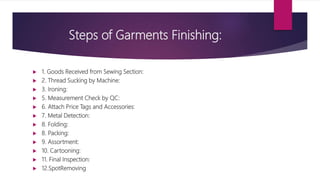
Steps of Garments Finishing:
 1. Goods Received from Sewing Section:
 2. Thread Sucking by Machine:
 3. Ironing:
 5. Measurement Check by QC:
 6. Attach Price Tags and Accessories:
 7. Metal Detection:
 8. Folding:
 8. Packing:
 9. Assortment:
 10. Cartooning:
 11. Final Inspection:
 12.SpotRemoving
Thank you !

Intern ppt

  • 2.
    Store and Warehouse Awarehouse is a commercial building for storage of goods. Warehouses are used by manufacturers, importers, exporters, wholesalers, transport businesses, customs, etc. They are usually large plain buildings in industrial areas of cities, towns and villages.
  • 3.
    Store and Warehouse TrimCard: Trim cardis prepare according to PDM by attaching different types of accessories. SOS board: SOS board is used for the purpose of same style for different countries. As per country variation, the levels are different TEX 60=20/2 i.e 3000m/cone TEX 27=40/2 i.e 4000m/cone TEX 18=60/2 i.e 5000m/cone
  • 4.
    Management Staff  MonirHosen(Executive)  Store Room  01755-587967 Total Manpower of Store Section:  A-Team=19  B-Team=18  Management staff: 1
  • 5.
    Types of store: Trims & accessories store Types of goods (sewing & finishing items):  1)Fabric 2)Thread  3)Button 4)Interlining  5)Level 6)Zipper  7)Elastic 8)Sizer  9)Hanger10)Poly  11)Cartoon  12)Price ticket  13)Hangtag  14)Tag pin
  • 6.
  • 7.
    Management Staff:  ShahJamal,  (Sample in charge)  01715-686576  Management Staff: 2  Total Manpower of Sample Section: 12
  • 8.
    Process flow chartof Fit Sample-PP Sample: Block Pattern Fit Sample Fit Comments SMS (Salesman Sample) Buyer Comments PPS (Pre-Production Sample) Merchandiser PVH (Buying House)
  • 9.
    Inspection Inspection can bedefined as the visual examination or review of raw materials (such as fabric, buttons, zippers, sewing threads, trims etc
  • 10.
    Fabric defects pointvalues based on the following: Length of defect in Fabric Points allotted Up to 3 inch 1 Over 3 inch up to 6 inch 2 Over 6 inch up to 9 inch 3 Over 9 inch 4 Holes and Opening 1 or less 2 Over 1 inch 4
  • 11.
    Inspection Law So theacceptance creation is 40 percent per 100 square yards. Calculation 7 defect points per 100 square yards:  𝑇𝑜𝑡𝑎𝑙𝑝𝑒𝑛𝑎𝑙𝑡𝑦𝑝𝑜𝑖𝑛𝑡𝑠∗3600 𝑇𝑜𝑡𝑎𝑙𝑙𝑒𝑛𝑔𝑡ℎ𝑖𝑛𝑠𝑝𝑒𝑐𝑡𝑒𝑑/𝐹𝑎𝑏𝑟𝑖𝑐𝑤𝑖𝑑𝑡ℎ 4- Point System: The 4- point system is widely used for fabric inspection, in the united states it is known as AAMA point grading system (AAMA- American Apparel manufacturers association.
  • 12.
    Major Defects Foundin Woven Fabric:  Various types of faults found in woven fabric has mentioned in the below:  Bad selvedge,  Broken ends or warp,  Broken picks or weft,  Loose warp,  Loose weft or snarl,  Double end,  Tight end,  Float of warp,  Wrong end color,  Miss pick,  Double pick,  Weft bar,  Ball,  Hole,
  • 13.
    Cutting Fabric cutting isimportant in textile or garments industry. A garment will be ready to wear when it will be completed by sewing many part of fabric which are cutter in a cutting table in the lay or spread of fabric
  • 14.
    Management Staff:  Bashar,(Cutting in charge) 01678-681804  Faruq Ahmed, (Cutting Executive) 01678-681804 Management Staff: 01 Total Manpower of Cutting Section:  A-Team=53  B-Team=59
  • 15.
    Cutting procedure Fabric processing Shrinkagetest -100% Shade grouping-100% Side to middle-10% Head and tail-10% Skew test-10%
  • 16.
    Cutting Methods &Defect code  Manual Methods o Hand operated scissors o Round knife o Straight knife o Drill o Die Cutting o Band knife o Notcher Defect Code: H- Hole O- Oil/Dirty mark FY- Foreign yarn TY- Thin Yarn DB- Dye mark SP- Spot W- Weaving K- Knot MY- Missing yarn AA- Other
  • 17.
    Sewing Section Sewing isan important department in garments manufacturing industry. All the parts of a garment are joined here by making stitch with the help of needle and thread.
  • 18.
    Management Staff:  Shahin,(ProductionManager) 01735-993896 Management Staff: 04 Total Manpower of Sewing Section:  A-Team=704  B-Team=703
  • 19.
    Process Flow Chartfor Garments Sewing Department:  Product analysis ↓ Set up target for production ↓ Set up machine layout on the basis of target ↓ Set up operator layout on the basis of target ↓ QC check of product ↓ Line balancing ↓ Line setup ↓ Distribution all the processes ↓ Cutting parts received section ↓ Cutting parts distribution to the operator and helper ↓ Complete parts making individually ↓ QC check ↓ Quality audit ↓ Counting output and checking with the target ↓ Final quality check (for each Garment)
  • 20.
  • 21.
    Important formula forindustrial Engineer 1. Standard Pitch Time (S.P.T) = Basic Pitch Time (B.P.T) + Allowances (%)
  • 22.
    Quality Department Quality meanscustomer needs is to be satisfied. Failure to maintain an adequate quality standard can therefore be unsuccessful. But maintaining an adequate standard of quality also costs effort.
  • 23.
    Management Staff:  KamalHosen, (Quality in charge)  01920-114295  Rafiqul Islam, (Quality Manager)  01678-681804 Management Staff:  Quality: 2  Quality Assurance: 8 Total Manpower of Quality Section:  A-Team=101  B-Team=111
  • 24.
    Various Steps ofInspection & Quality Control: Before or Pre-production Inspection  The following parameters & defects are checked prior to cutting.  Shade Matching  Fabric Construction  GSM (grams per square metrer  Whales & courses if required)  Diameter  Dyeing Levelness  Ecological parameters if required  Softness  Shrinkage etc.
  • 25.
    Finishing Finishing is thelast stage of packed garments those are ready for sale. Therefore, it is one of the most important stage in whole garments manufacturing process. In a garment industry finishing section involves with garment washing, checking, final inspection, pressing, packing, etc.
  • 26.
    Management Staff:  Arif,(Finishing Manager)  01678-681804 Management Staff: 01  Total Manpower of Finishing Section:  A-Team=132  B-Team=125
  • 27.
    Flow chart ofgarments finishing are as follows-
  • 28.
    Steps of GarmentsFinishing:  1. Goods Received from Sewing Section:  2. Thread Sucking by Machine:  3. Ironing:  5. Measurement Check by QC:  6. Attach Price Tags and Accessories:  7. Metal Detection:  8. Folding:  8. Packing:  9. Assortment:  10. Cartooning:  11. Final Inspection:  12.SpotRemoving
  • 29.