MICROPROCESSOR
INTERFACING
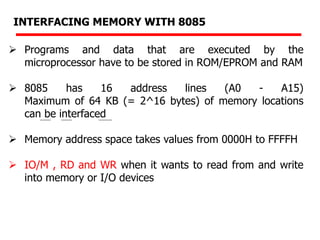
 Programs and data that are executed by the
microprocessor have to be stored in ROM/EPROM and RAM
 8085 has 16 address lines (A0 - A15)
Maximum of 64 KB (= 2^16 bytes) of memory locations
can be interfaced
 Memory address space takes values from 0000H to FFFFH
 IO/M , RD and WR when it wants to read from and write
into memory or I/O devices
INTERFACING MEMORY WITH 8085
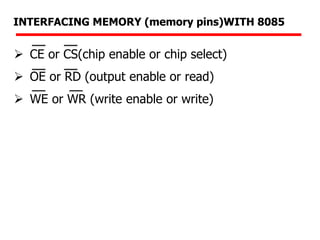
 CE or CS(chip enable or chip select)
 OE or RD (output enable or read)
 WE or WR (write enable or write)
INTERFACING MEMORY (memory pins)WITH 8085
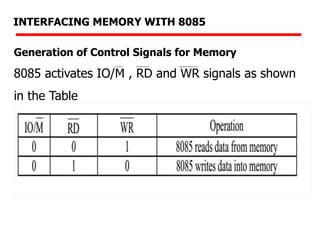
Generation of Control Signals for Memory
8085 activates IO/M , RD and WR signals as shown
in the Table
INTERFACING MEMORY WITH 8085
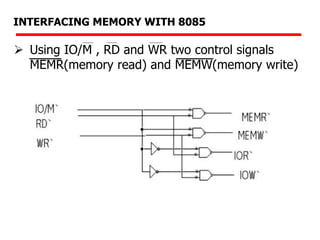
 Using IO/M , RD and WR two control signals
MEMR(memory read) and MEMW(memory write)
INTERFACING MEMORY WITH 8085
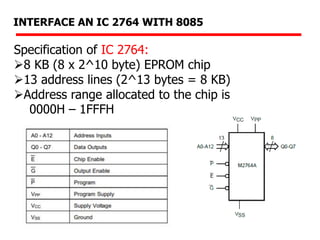
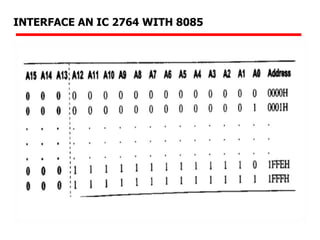
Specification of IC 2764:
8 KB (8 x 2^10 byte) EPROM chip
13 address lines (2^13 bytes = 8 KB)
Address range allocated to the chip is
0000H – 1FFFH
INTERFACE AN IC 2764 WITH 8085
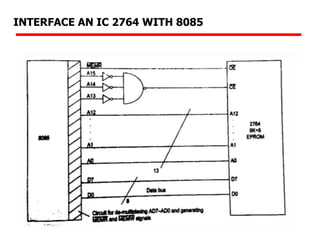
 13 address lines of IC are connected to A0-A12
 Remaining (A13, A14, A15) are connected to
address decoder formed using logic gates
 Output of decoder is connected to the CE pin of IC
 Chip is enabled whenever the 8085 places an
address allocated to EPROM chip in the address
bus
INTERFACE AN IC 2764 WITH 8085
EXAMPLES OF MEMORY INTERFACING
EXAMPLE-2
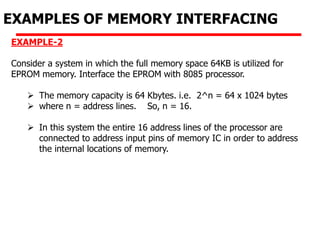
Consider a system in which the full memory space 64KB is utilized for
EPROM memory. Interface the EPROM with 8085 processor.
 The memory capacity is 64 Kbytes. i.e. 2^n = 64 x 1024 bytes
 where n = address lines. So, n = 16.
 In this system the entire 16 address lines of the processor are
connected to address input pins of memory IC in order to address
the internal locations of memory.
EXAMPLES OF MEMORY INTERFACING
EXAMPLE-2
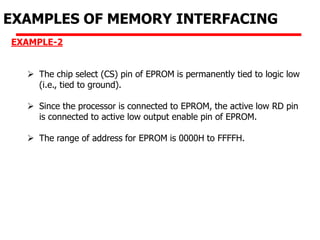
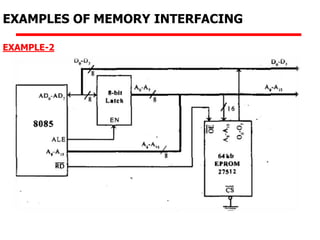
 The chip select (CS) pin of EPROM is permanently tied to logic low
(i.e., tied to ground).
 Since the processor is connected to EPROM, the active low RD pin
is connected to active low output enable pin of EPROM.
 The range of address for EPROM is 0000H to FFFFH.
EXAMPLE-2
EXAMPLES OF MEMORY INTERFACING
EXAMPLE-3
Consider a system in which the available 64KB memory space is equally
divided between EPROM and RAM. Interface the EPROM and RAM with
8085 processor.
Implement 32KB memory capacity of EPROM using single IC 27256.
32KB RAM capacity is implemented using single IC 62256.
The 32KB memory requires 15 address lines and so the address lines
A0 - A14 of the processor are connected to 15 address pins of both
EPROM and RAM.
EXAMPLES OF MEMORY INTERFACING
EXAMPLE-3
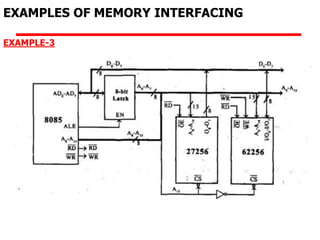
The unused address line A15 is used as to chip select. If A15 is 1, it select
RAM and If A15 is 0, it select EPROM.
Inverter is used for selecting the memory.
The memory used is both Ram and EPROM, so the low RD and WR pins of
processor are connected to low WE and OE pins of memory respectively.
The address range of EPROM will be 0000H to 7FFFH and that of RAM will
be 8000H to FFFFH.
EXAMPLE-3
EXAMPLES OF MEMORY INTERFACING
EXAMPLE-4
Consider a system in which 32KB memory space is implemented using
four numbers of 8KB memory. Interface the EPROM and RAM with 8085
processor.
The total memory capacity is 32KB. So, let two number of 8KB
memory be EPROM and the remaining two numbers be RAM.
Each 8KB memory requires 13 address lines and so the address lines
A0- A12 of the processor are connected to 13 address pins of all the
memory.
EXAMPLES OF MEMORY INTERFACING
EXAMPLE-4
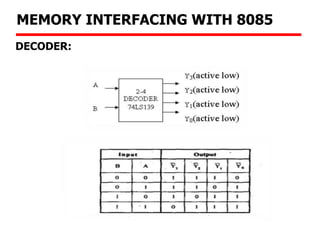
The address lines and A13 - A14 can be decoded using a 2-to-4
decoder to generate four chip select signals.
These four chip select signals can be used to select one of the four
memory IC at any one time.
The address line A15 is used as enable for decoder.
The simplified schematic memory organization is shown.
MEMORY INTERFACING WITH 8085
DECODER:
REVIEW

interfacing1 lecture notes for eng 5.ppt

  • 1.
  • 2.
     Programs anddata that are executed by the microprocessor have to be stored in ROM/EPROM and RAM  8085 has 16 address lines (A0 - A15) Maximum of 64 KB (= 2^16 bytes) of memory locations can be interfaced  Memory address space takes values from 0000H to FFFFH  IO/M , RD and WR when it wants to read from and write into memory or I/O devices INTERFACING MEMORY WITH 8085
  • 3.
     CE orCS(chip enable or chip select)  OE or RD (output enable or read)  WE or WR (write enable or write) INTERFACING MEMORY (memory pins)WITH 8085
  • 4.
    Generation of ControlSignals for Memory 8085 activates IO/M , RD and WR signals as shown in the Table INTERFACING MEMORY WITH 8085
  • 5.
     Using IO/M, RD and WR two control signals MEMR(memory read) and MEMW(memory write) INTERFACING MEMORY WITH 8085
  • 6.
    Specification of IC2764: 8 KB (8 x 2^10 byte) EPROM chip 13 address lines (2^13 bytes = 8 KB) Address range allocated to the chip is 0000H – 1FFFH INTERFACE AN IC 2764 WITH 8085
  • 7.
     13 addresslines of IC are connected to A0-A12  Remaining (A13, A14, A15) are connected to address decoder formed using logic gates  Output of decoder is connected to the CE pin of IC  Chip is enabled whenever the 8085 places an address allocated to EPROM chip in the address bus INTERFACE AN IC 2764 WITH 8085
  • 8.
    INTERFACE AN IC2764 WITH 8085
  • 9.
    INTERFACE AN IC2764 WITH 8085
  • 10.
    EXAMPLES OF MEMORYINTERFACING EXAMPLE-2 Consider a system in which the full memory space 64KB is utilized for EPROM memory. Interface the EPROM with 8085 processor.  The memory capacity is 64 Kbytes. i.e. 2^n = 64 x 1024 bytes  where n = address lines. So, n = 16.  In this system the entire 16 address lines of the processor are connected to address input pins of memory IC in order to address the internal locations of memory.
  • 11.
    EXAMPLES OF MEMORYINTERFACING EXAMPLE-2  The chip select (CS) pin of EPROM is permanently tied to logic low (i.e., tied to ground).  Since the processor is connected to EPROM, the active low RD pin is connected to active low output enable pin of EPROM.  The range of address for EPROM is 0000H to FFFFH.
  • 12.
  • 13.
    EXAMPLES OF MEMORYINTERFACING EXAMPLE-3 Consider a system in which the available 64KB memory space is equally divided between EPROM and RAM. Interface the EPROM and RAM with 8085 processor. Implement 32KB memory capacity of EPROM using single IC 27256. 32KB RAM capacity is implemented using single IC 62256. The 32KB memory requires 15 address lines and so the address lines A0 - A14 of the processor are connected to 15 address pins of both EPROM and RAM.
  • 14.
    EXAMPLES OF MEMORYINTERFACING EXAMPLE-3 The unused address line A15 is used as to chip select. If A15 is 1, it select RAM and If A15 is 0, it select EPROM. Inverter is used for selecting the memory. The memory used is both Ram and EPROM, so the low RD and WR pins of processor are connected to low WE and OE pins of memory respectively. The address range of EPROM will be 0000H to 7FFFH and that of RAM will be 8000H to FFFFH.
  • 15.
  • 16.
    EXAMPLES OF MEMORYINTERFACING EXAMPLE-4 Consider a system in which 32KB memory space is implemented using four numbers of 8KB memory. Interface the EPROM and RAM with 8085 processor. The total memory capacity is 32KB. So, let two number of 8KB memory be EPROM and the remaining two numbers be RAM. Each 8KB memory requires 13 address lines and so the address lines A0- A12 of the processor are connected to 13 address pins of all the memory.
  • 17.
    EXAMPLES OF MEMORYINTERFACING EXAMPLE-4 The address lines and A13 - A14 can be decoded using a 2-to-4 decoder to generate four chip select signals. These four chip select signals can be used to select one of the four memory IC at any one time. The address line A15 is used as enable for decoder. The simplified schematic memory organization is shown.
  • 18.
  • 19.