MICROPROCESSOR- Q. Bank 
1. What is microprocessor. Give the power supply & clock frequency of 8085 
A microprocessor is a multipurpose, programmable logic device that reads binary 
instructions from a storage device called memory, accepts binary data as input and processes 
data according to those instructions and provide result as output. The power supply of 8085 is 
+5V and clock frequency in 3MHz. 
2. What is the signal classification of 8085 
All the signals of 8085 can be classified into 6 groups 
· Address bus 
· Data bus 
· Control and status signals 
· Power supply and frequency signals 
· Externally initiated signals 
· Serial I/O ports 
3. What are operations performed on data in 8085 
The various operations performed are 
· Store 8-bit data 
· Perform arithmetic and logical operations 
· Test for conditions 
· Sequence the execution of instructions 
· Store data temporarily during execution in the defined R/W memory 
locations called the stack 
4. Steps involved to fetch a byte in 8085 
The PC places the 16-bit memory address on the address bus 
The control unit sends the control signal RD to enable the memory chip 
The byte from the memory location is placed on the data bus 
The byte is placed in the instruction decoder of the microprocessor and the task is 
carried out according to the instruction 
5. How many interrupts does 8085 have, mention them 
The 8085 has 5 interrupt signals, they are INTR, RST7.5, RST6.5, RST5.5 and TRAP 
6. Basic concepts in memory interfacing 
The primary function of memory interfacing is that the microprocessor should be able to 
read from and write into a given register of a memory chip. To perform these operations the 
microprocessor should 
· Be able to select the chip 
· Identify the register 
· Enable the appropriate buffer 
7. Define instruction cycle, machine cycle and T-state 
Instruction cycle is defined as the time required to complete the execution of an 
instruction. Machine cycle is defined as the time required to complete one operation of 
accessing memory, I/O or acknowledging an external request. T-cycle is defined as one 
subdivision of the operation performed in one clock period 
8. What is an instruction 
An instruction is a binary pattern entered through an input device to command the 
microprocessor to perform that specific function 
9. What is the use of ALE 
The ALE is used to latch the lower order address so that it can be available in T2 and 
T3 and used for identifying the memory address. During T1 the ALE goes high, the latch is 
transparent ie, the output changes according to the input data, so the output of the latch is the 
lower order address. When ALE goes low the lower order address is latched until the next ALE. 
10. How many machine cycles does 8085 have, mention them 
The 8085 has seven machine cycles. They are 
· Opcode fetch
· Memory read 
· Memory write 
· I/O read 
· I/O write 
· Interrupt acknowledge 
· Bus idle 
11. Explain the signals HOLD, READY and SID 
HOLD indicates that a peripheral such as DMA controller is requesting the use of 
address bus, data bus and control bus. READY is used to delay the microprocessor read or 
write cycles until a slow responding peripheral is ready to send or accept data. SID is used to 
accept serial data bit by bit 
12. Mention the categories of instruction and give two examples for each category 
The instructions of 8085 can be categorized into the following five 
· Data transfer MOV Rd,Rs STA 16-bit 
· Arithmetic ADD R DCR M 
· Logical XRI 8-bit RAR 
· Branching JNZ CALL 16-bit 
· Machine control HLT NOP 
13. Explain LDA, STA and DAA instructions 
LDA copies the data byte into accumulator from the memory location specified by the 
16-bit address. STA copies the data byte from the accumulator in the memory location specified 
by 16-bit address. DAA changes the contents of the accumulator from binary to 4-bit BCD 
digits. 
14. Explain the different instruction formats with examples 
The instruction set is grouped into the following formats 
· One byte instruction MOV C,A 
· Two byte instruction MVI A,39H 
· Three byte instruction JMP 2345H 
15. What is the use of addressing modes , mention the different types 
The various formats of specifying the operands are called addressing modes, it is used 
to access the operands or data. The different types are as follows 
· Immediate addressing 
· Register addressing 
· Direct addressing 
· Indirect addressing 
· Implicit addressing 
16. Differentiate between absolute and linear select decoding? 
Absolute decoding Linear decoding 
All higher address lines are defined to 
select the memory or I/O device 
Few higher address lines are decoded to 
select the memory or I/O device 
More h/w is required to design decoding 
logic 
Hardware required to design decoding 
logic is less 
Higher cost for decoding circuit Less cost for decoding circuit 
No multiple address Has a disadvantage of multiple addressing 
Used in large systems Used in small systems 
17. What is the use of bi-directional buffers 
It is used to increase the driving capacity of the data bus. The data bus of a 
microcomputer system is bi-directional, so it requires a buffer that allows the data to flow in both 
directions. 
18. Give the resister organization of 8085
W(8) 
Temp. Reg 
Z(8) 
Temp. Reg 
B(8) 
Register 
C(8) 
Register 
D(8) 
Register 
E(8) 
Register 
H(8) 
Register 
L(8) 
Register 
Stack Pointer(16) 
Program Counter(16) 
19. Define stack and explain stack related instructions 
The stack is a group of memory locations in the R/W memory that is used for the 
temporary storage of binary information during the execution of the program. The stack related 
instructions are PUSH & POP 
20. Why do we use XRA A instruction 
The XRA A instruction is used to clear the contents of the Accumulator and store the 
value 00H. 
21. Compare CALL and PUSH instructions 
CALL PUSH 
When CALL is executed the 
microprocessor automatically stores the 
16-bit address of the instruction next to 
CALL on the stack 
The programmer uses the instruction 
PUSH to save the contents of the register 
pair on the stack 
When CALL is executed the stack pointer 
is decremented by two 
When PUSH is executed the stack pointer 
register is decremented by two 
22. What is Microcontroller and Microcomputer 
Microcontroller is a device that includes microprocessor, memory and I/O signal lines on 
a single chip, fabricated using VLSI technology. Microcomputer is a computer that is designed 
using microprocessor as its CPU. It includes microprocessor, memory and I/O. 
23. Define PSW 
The PSW or flags are used to reflect the data conditions in the accumulator. The 8085 
flags are S-Sign flag, Z-Zero flag, AC-Auxillary carry flag, P-Parity flag, CY-Carry flag 
D7 D6 D5 D4 D3 D2 D1 D0 
S Z AC P CY 
24. How does the microprocessor differentiate between data and instruction 
When the first m/c code of an instruction is fetched and decoded in the instruction 
register , the microprocessor recognizes the number of bytes required to fetch the entire 
instruction. For example MVI A, Data, the second byte is always considered as data. If the data 
byte is omitted by mistake whatever is in that memory location will be considered as data & the 
byte after the “data” will be treated as the next instruction. 
25. Compare RET and POP 
RET POP 
RET transfers the contents of the top two 
locations of the stack to the PC 
POP transfers the contents of the top two 
locations of the stack to the specified 
register pair 
When RET is executed the SP is 
incremented by two 
When POP is executed the SP is 
incremented by two 
Has 8 conditional RETURN instructions No conditional POP instructions

Qb microprocessors

  • 1.
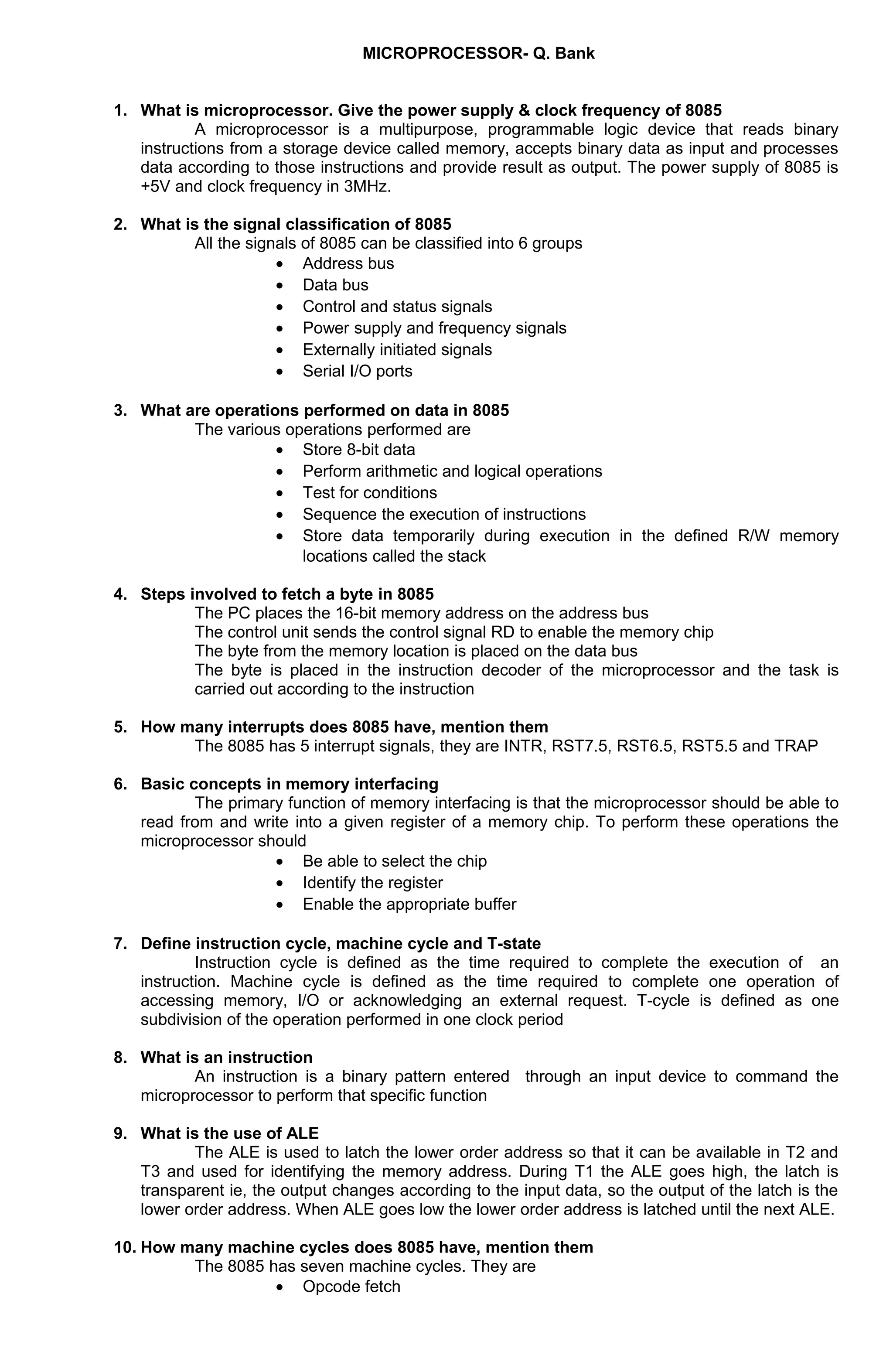
    MICROPROCESSOR- Q. Bank 1. What is microprocessor. Give the power supply & clock frequency of 8085 A microprocessor is a multipurpose, programmable logic device that reads binary instructions from a storage device called memory, accepts binary data as input and processes data according to those instructions and provide result as output. The power supply of 8085 is +5V and clock frequency in 3MHz. 2. What is the signal classification of 8085 All the signals of 8085 can be classified into 6 groups · Address bus · Data bus · Control and status signals · Power supply and frequency signals · Externally initiated signals · Serial I/O ports 3. What are operations performed on data in 8085 The various operations performed are · Store 8-bit data · Perform arithmetic and logical operations · Test for conditions · Sequence the execution of instructions · Store data temporarily during execution in the defined R/W memory locations called the stack 4. Steps involved to fetch a byte in 8085 The PC places the 16-bit memory address on the address bus The control unit sends the control signal RD to enable the memory chip The byte from the memory location is placed on the data bus The byte is placed in the instruction decoder of the microprocessor and the task is carried out according to the instruction 5. How many interrupts does 8085 have, mention them The 8085 has 5 interrupt signals, they are INTR, RST7.5, RST6.5, RST5.5 and TRAP 6. Basic concepts in memory interfacing The primary function of memory interfacing is that the microprocessor should be able to read from and write into a given register of a memory chip. To perform these operations the microprocessor should · Be able to select the chip · Identify the register · Enable the appropriate buffer 7. Define instruction cycle, machine cycle and T-state Instruction cycle is defined as the time required to complete the execution of an instruction. Machine cycle is defined as the time required to complete one operation of accessing memory, I/O or acknowledging an external request. T-cycle is defined as one subdivision of the operation performed in one clock period 8. What is an instruction An instruction is a binary pattern entered through an input device to command the microprocessor to perform that specific function 9. What is the use of ALE The ALE is used to latch the lower order address so that it can be available in T2 and T3 and used for identifying the memory address. During T1 the ALE goes high, the latch is transparent ie, the output changes according to the input data, so the output of the latch is the lower order address. When ALE goes low the lower order address is latched until the next ALE. 10. How many machine cycles does 8085 have, mention them The 8085 has seven machine cycles. They are · Opcode fetch
  • 2.
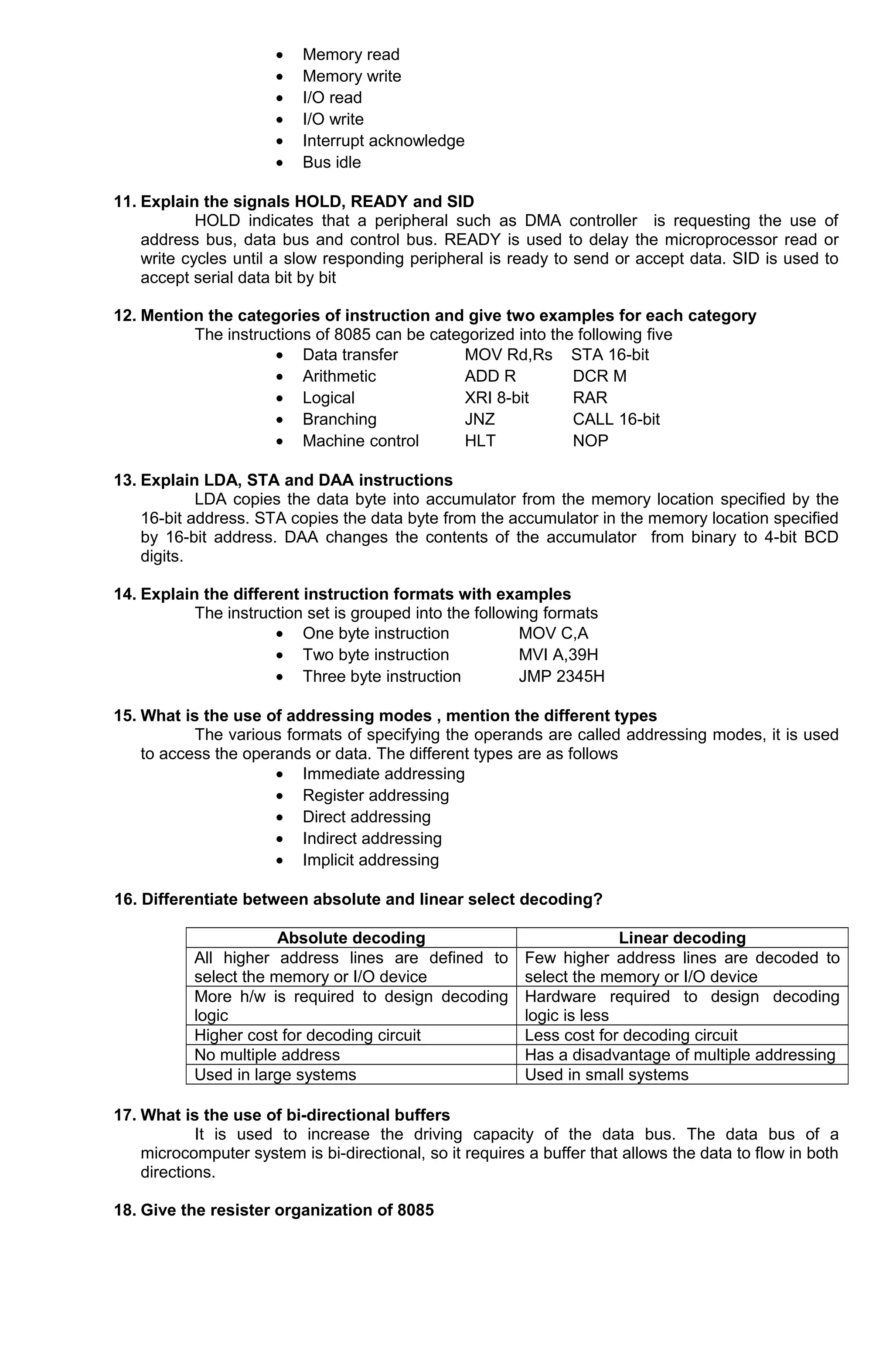
    · Memory read · Memory write · I/O read · I/O write · Interrupt acknowledge · Bus idle 11. Explain the signals HOLD, READY and SID HOLD indicates that a peripheral such as DMA controller is requesting the use of address bus, data bus and control bus. READY is used to delay the microprocessor read or write cycles until a slow responding peripheral is ready to send or accept data. SID is used to accept serial data bit by bit 12. Mention the categories of instruction and give two examples for each category The instructions of 8085 can be categorized into the following five · Data transfer MOV Rd,Rs STA 16-bit · Arithmetic ADD R DCR M · Logical XRI 8-bit RAR · Branching JNZ CALL 16-bit · Machine control HLT NOP 13. Explain LDA, STA and DAA instructions LDA copies the data byte into accumulator from the memory location specified by the 16-bit address. STA copies the data byte from the accumulator in the memory location specified by 16-bit address. DAA changes the contents of the accumulator from binary to 4-bit BCD digits. 14. Explain the different instruction formats with examples The instruction set is grouped into the following formats · One byte instruction MOV C,A · Two byte instruction MVI A,39H · Three byte instruction JMP 2345H 15. What is the use of addressing modes , mention the different types The various formats of specifying the operands are called addressing modes, it is used to access the operands or data. The different types are as follows · Immediate addressing · Register addressing · Direct addressing · Indirect addressing · Implicit addressing 16. Differentiate between absolute and linear select decoding? Absolute decoding Linear decoding All higher address lines are defined to select the memory or I/O device Few higher address lines are decoded to select the memory or I/O device More h/w is required to design decoding logic Hardware required to design decoding logic is less Higher cost for decoding circuit Less cost for decoding circuit No multiple address Has a disadvantage of multiple addressing Used in large systems Used in small systems 17. What is the use of bi-directional buffers It is used to increase the driving capacity of the data bus. The data bus of a microcomputer system is bi-directional, so it requires a buffer that allows the data to flow in both directions. 18. Give the resister organization of 8085
  • 3.
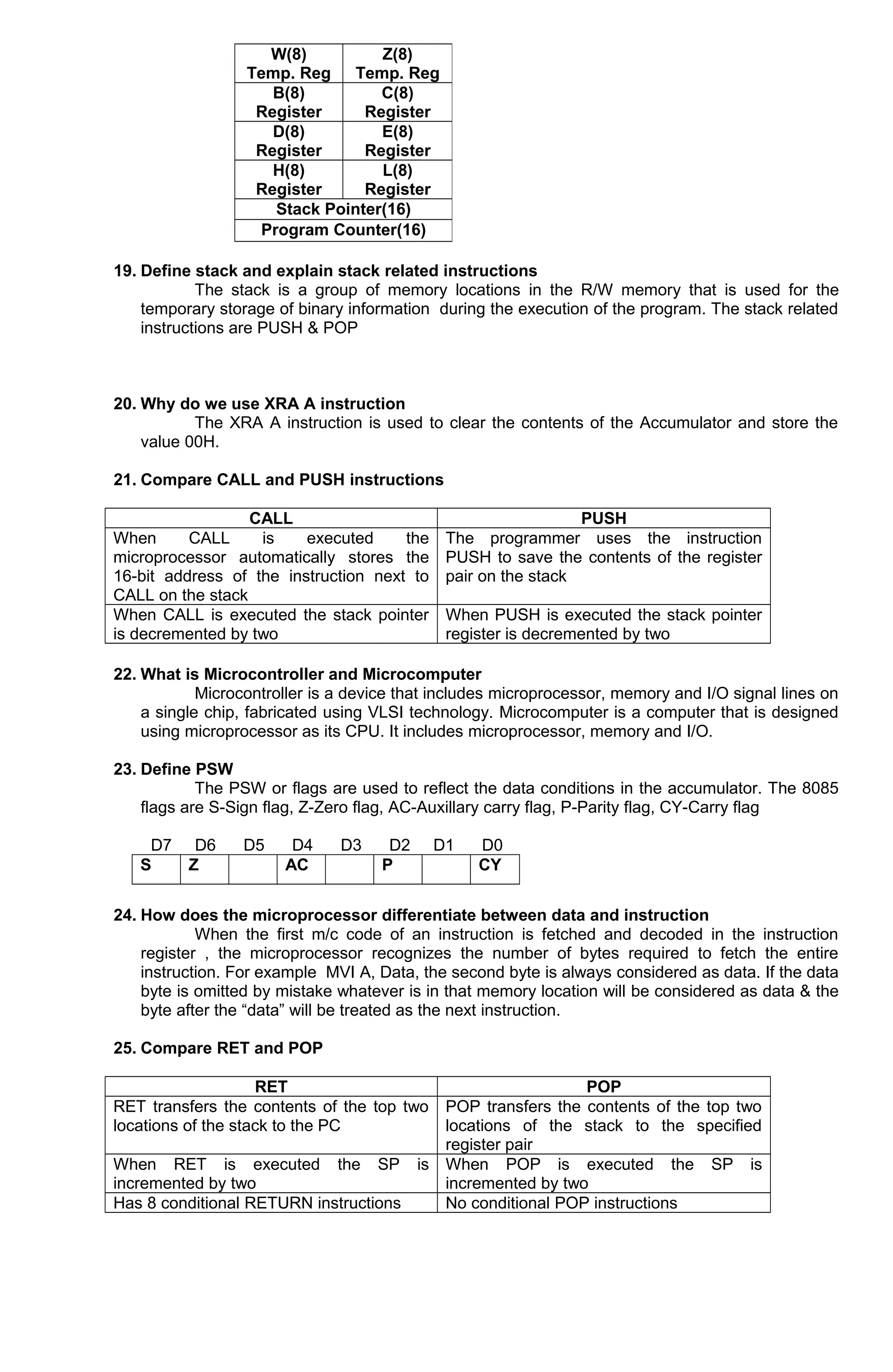
    W(8) Temp. Reg Z(8) Temp. Reg B(8) Register C(8) Register D(8) Register E(8) Register H(8) Register L(8) Register Stack Pointer(16) Program Counter(16) 19. Define stack and explain stack related instructions The stack is a group of memory locations in the R/W memory that is used for the temporary storage of binary information during the execution of the program. The stack related instructions are PUSH & POP 20. Why do we use XRA A instruction The XRA A instruction is used to clear the contents of the Accumulator and store the value 00H. 21. Compare CALL and PUSH instructions CALL PUSH When CALL is executed the microprocessor automatically stores the 16-bit address of the instruction next to CALL on the stack The programmer uses the instruction PUSH to save the contents of the register pair on the stack When CALL is executed the stack pointer is decremented by two When PUSH is executed the stack pointer register is decremented by two 22. What is Microcontroller and Microcomputer Microcontroller is a device that includes microprocessor, memory and I/O signal lines on a single chip, fabricated using VLSI technology. Microcomputer is a computer that is designed using microprocessor as its CPU. It includes microprocessor, memory and I/O. 23. Define PSW The PSW or flags are used to reflect the data conditions in the accumulator. The 8085 flags are S-Sign flag, Z-Zero flag, AC-Auxillary carry flag, P-Parity flag, CY-Carry flag D7 D6 D5 D4 D3 D2 D1 D0 S Z AC P CY 24. How does the microprocessor differentiate between data and instruction When the first m/c code of an instruction is fetched and decoded in the instruction register , the microprocessor recognizes the number of bytes required to fetch the entire instruction. For example MVI A, Data, the second byte is always considered as data. If the data byte is omitted by mistake whatever is in that memory location will be considered as data & the byte after the “data” will be treated as the next instruction. 25. Compare RET and POP RET POP RET transfers the contents of the top two locations of the stack to the PC POP transfers the contents of the top two locations of the stack to the specified register pair When RET is executed the SP is incremented by two When POP is executed the SP is incremented by two Has 8 conditional RETURN instructions No conditional POP instructions