
International Parity
    Conditions
  By : Madam Zakiah Hassan
        9 February 2010
Introduction

Exchange rates are influenced by interest rates and inflation
    rates and together, they influence markets for
    exchange rates in the future, known as forward rates.

Means that, the main determinants of exchange rates are
   relative inflation rate, interest rates, national income
   and political stability.

The linkages among these variables are called ‘parity
    conditions’

Parity conditions are key relationship used to predict
     movements in exchange rates.

Since arbitrage plays a critical role in this discussion, we
    should define it upfront.
Objective


Learn how to predict foreign exchange
   rates using arbitrage arguments.
What is arbitrage

Business operation involving the purchase of foreign exchange
 gold, financial securities or commodities in one market and their
  almost simultaneous sale in another market, in order to profit
      from price differentials existing between the markets.

Arbitrage generally tends to eliminate price differentials between
                              markets.

                              So,
   the act of simultaneously buying and selling the same or
   equivalent assets or commodities for the purpose of making
                          certain profit.
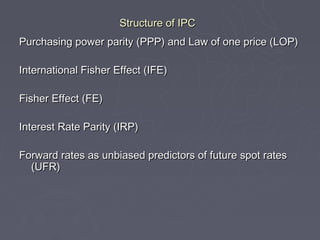
Structure of IPC
Purchasing power parity (PPP) and Law of one price (LOP)

International Fisher Effect (IFE)

Fisher Effect (FE)

Interest Rate Parity (IRP)

Forward rates as unbiased predictors of future spot rates
  (UFR)
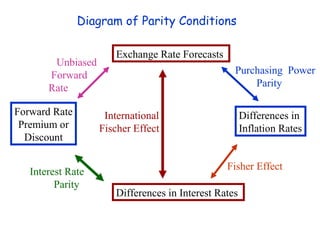
Diagram of Parity Conditions

                      Exchange Rate Forecasts
        Unbiased
       Forward                                    Purchasing Power
       Rate                                           Parity

Forward Rate        International                     Differences in
 Premium or        Fischer Effect                     Inflation Rates
  Discount

                                                Fisher Effect
   Interest Rate
         Parity
                      Differences in Interest Rates
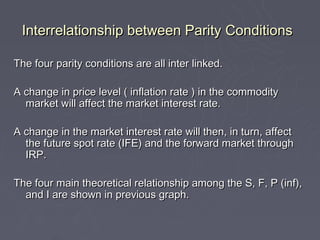
Interrelationship between Parity Conditions

The four parity conditions are all inter linked.

A change in price level ( inflation rate ) in the commodity
  market will affect the market interest rate.

A change in the market interest rate will then, in turn, affect
  the future spot rate (IFE) and the forward market through
  IRP.

The four main theoretical relationship among the S, F, P (inf),
  and I are shown in previous graph.
Purchasing power parity (PPP) and Law of one price
PPP is based on law of one price (LOP) and the no arbitrage condition.

LOP states : identical goods sell for the same price worldwide

Stated that in the absence of transportation cost, taxes and other
   restrictions, meanwhile the price of a product stated in a common
   currency such as USD should be the same in every country.

This means ‘ same product, same price’’ in one common currency.

Since the product is sold in different countries, the product’s price
   must be stated in different currency terms, but the price of the
   product should still be the same when expressed in one common
   currency.
So, PPP states : the exchange rate between
 two countries’ currencies should be equal to
 the ratio of their price levels.

PPP is a manifestation of the LOP applied
 internationally to a standard commodity
 basket.
Purchasing power parity (PPP)

(1) Absolute PPP
Goods and services should cost the same regardless of the
   country

This simply requires replacing a single product with a price index.

Example : if the price index in USD is the price of basket of goods
  in the US and a price index in AUD is the price of a similar
  basket of goods in Australia, then :

Price index USD = Price index AUD ( spot USD/AUD)

Problem : difficult of getting similar basket goods for both
  countries, because due to each country’s different consumption
  patterns.
Purchasing power parity (PPP)

(2) Relative PPP
The exchange rate is expected to adjust in order to reflect
   expected relative differences in purchasing power.

-----the exchange between HC and any FC will adjust of reflect
   changes in the price levels ( inflation) of two countries.
PURCHASING POWER
          PARITY
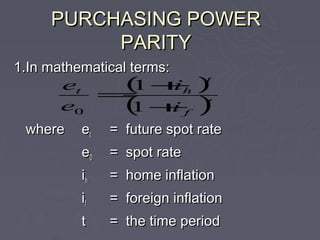
1.In mathematical terms:
       et
            =
                 ( +
                  1      ih   )t


       e0        (1+     if   )t


 where    et   = future spot rate
          e0   = spot rate
          ih   = home inflation
          if   = foreign inflation
          t    = the time period
PURCHASING POWER
          PARITY
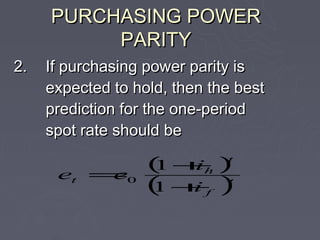
2.   If purchasing power parity is
     expected to hold, then the best
     prediction for the one-period
     spot rate should be

      et =0
          e
                   ( +)
                   1 ih
                               t


                   ( + )
                   1  i    f
                               t
Example PPP
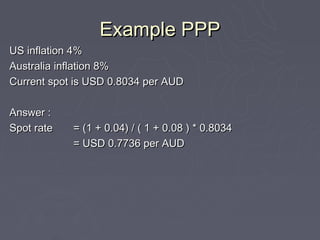
US inflation 4%
Australia inflation 8%
Current spot is USD 0.8034 per AUD

Answer :
Spot rate   = (1 + 0.04) / ( 1 + 0.08 ) * 0.8034
            = USD 0.7736 per AUD
THE INTERNATIONAL FISHER EFFECT (IFE)


IFE STATES:
 the spot rate adjusts to the interest rate differential
                between two countries.
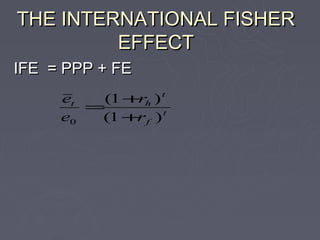
THE INTERNATIONAL FISHER
         EFFECT
IFE = PPP + FE
     et  (1 + h ) t
             r
        =
     e0  (1 + f )
             r    t
EXAMPLE IFE
►   Malaysia interest rate for 6-month       4%
►   Australia interest rate for 6 month      8%
►   Current spot rate is MYR2.8735/AUD
►   What is forecast future spot rate of the MYR/AUD if the
    interest rate in Australia were rise to 10% p.a?

►   Future spot rate = 2.8735 [ 1 + 0.04/20] / [1 + (0.1/2)] =
    2.7914
Interest Rate Parity (IRP)
              Theory
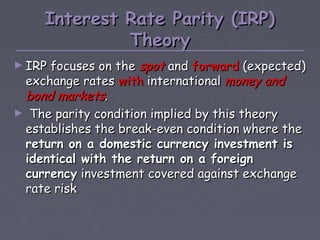
► IRP focuses on the spot and forward (expected)
 exchange rates with international money and
 bond markets.
► The parity condition implied by this theory
 establishes the break-even condition where the
 return on a domestic currency investment is
 identical with the return on a foreign
 currency investment covered against exchange
 rate risk
EXAMPLE OF IRP
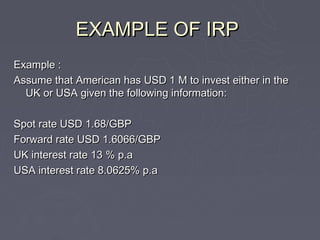
Example :
Assume that American has USD 1 M to invest either in the
  UK or USA given the following information:

Spot rate USD 1.68/GBP
Forward rate USD 1.6066/GBP
UK interest rate 13 % p.a
USA interest rate 8.0625% p.a
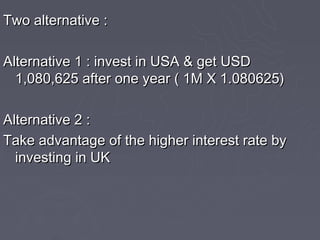
Two alternative :

Alternative 1 : invest in USA & get USD
  1,080,625 after one year ( 1M X 1.080625)

Alternative 2 :
Take advantage of the higher interest rate by
  investing in UK
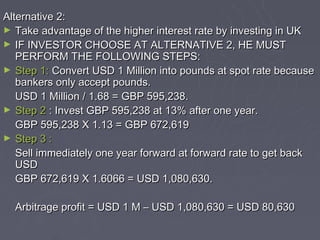
Alternative 2:
► Take advantage of the higher interest rate by investing in UK
► IF INVESTOR CHOOSE AT ALTERNATIVE 2, HE MUST
   PERFORM THE FOLLOWING STEPS:
► Step 1: Convert USD 1 Million into pounds at spot rate because
   bankers only accept pounds.
   USD 1 Million / 1.68 = GBP 595,238.
► Step 2 : Invest GBP 595,238 at 13% after one year.
   GBP 595,238 X 1.13 = GBP 672,619
► Step 3 :
   Sell immediately one year forward at forward rate to get back
   USD
   GBP 672,619 X 1.6066 = USD 1,080,630.

  Arbitrage profit = USD 1 M – USD 1,080,630 = USD 80,630
Why doing covered interest rate because to
   protect against risk that pound will
         depreciate in one year.
UNCOVERED INTEREST RATE PARITY

Example :
  Suppose that the current one year interest
  rate in the US is 9.4% and the UK interest
  rate is 11%. The spot rate is USD1.5 per
  GBP.
► What is expected one year forward rate for
  USD/GBP?
► [ 1 + 0.094] / [1 + 0.11] = f / s
► [ 1 + 0.094] / [1 + 0.11] = f / 1.5
► So one year USD/GBP = 1.478
EXPECTATION THEORY OF THE EXCHANGE
                   RATE.

► Theory seeks to answer the question: is the forward
  rate an accurate forecast of future spot rate?
► Actually investor want to know whether the forward
  rate is an unbiased predictor of the future spot rate.
► The expectation theory state that forward rate
  approximately = the expected future spot but
  does not means they same, because forward rate
  will, on average, over estimate and under estimate
  the actual future spot rate.
► The rationale behind that is the foreign exchange is
  reasonable efficient.
Conclusion

In this chapter, we learned about five parity conditions or
  relationship apply to spot rates, inflation rates and interest
  rates in different currencies: PPP, FE, IFE,IRP and forward
  rates as an unbiased forecast of the future spot rate or
  UFR.

International trade or exchange of goods and services across
  borders gives rise to international settlement with
  payments being made in different currencies.

Discrepancies may arise as a consequences when the
  settlement is executed in one currency as against the other
  currency. Moreover, economic conditions and changes in
  economic conditions in different countries may take effect
  on the value of goods measured in different currencies and
  the relative values and opportunity costs of these
  currencies.
International parities are important since they establish relative
   currency values and their evolution in terms of economic
   circumstances and cross broader arbitrage may be possible
   when they are violated.

International parity-conditions-9-feb-2010

  • 1.
    International Parity Conditions By : Madam Zakiah Hassan 9 February 2010
  • 2.
    Introduction Exchange rates areinfluenced by interest rates and inflation rates and together, they influence markets for exchange rates in the future, known as forward rates. Means that, the main determinants of exchange rates are relative inflation rate, interest rates, national income and political stability. The linkages among these variables are called ‘parity conditions’ Parity conditions are key relationship used to predict movements in exchange rates. Since arbitrage plays a critical role in this discussion, we should define it upfront.
  • 3.
    Objective Learn how topredict foreign exchange rates using arbitrage arguments.
  • 4.
    What is arbitrage Businessoperation involving the purchase of foreign exchange gold, financial securities or commodities in one market and their almost simultaneous sale in another market, in order to profit from price differentials existing between the markets. Arbitrage generally tends to eliminate price differentials between markets. So, the act of simultaneously buying and selling the same or equivalent assets or commodities for the purpose of making certain profit.
  • 5.
    Structure of IPC Purchasingpower parity (PPP) and Law of one price (LOP) International Fisher Effect (IFE) Fisher Effect (FE) Interest Rate Parity (IRP) Forward rates as unbiased predictors of future spot rates (UFR)
  • 6.
    Diagram of ParityConditions Exchange Rate Forecasts Unbiased Forward Purchasing Power Rate Parity Forward Rate International Differences in Premium or Fischer Effect Inflation Rates Discount Fisher Effect Interest Rate Parity Differences in Interest Rates
  • 7.
    Interrelationship between ParityConditions The four parity conditions are all inter linked. A change in price level ( inflation rate ) in the commodity market will affect the market interest rate. A change in the market interest rate will then, in turn, affect the future spot rate (IFE) and the forward market through IRP. The four main theoretical relationship among the S, F, P (inf), and I are shown in previous graph.
  • 8.
    Purchasing power parity(PPP) and Law of one price PPP is based on law of one price (LOP) and the no arbitrage condition. LOP states : identical goods sell for the same price worldwide Stated that in the absence of transportation cost, taxes and other restrictions, meanwhile the price of a product stated in a common currency such as USD should be the same in every country. This means ‘ same product, same price’’ in one common currency. Since the product is sold in different countries, the product’s price must be stated in different currency terms, but the price of the product should still be the same when expressed in one common currency.
  • 9.
    So, PPP states: the exchange rate between two countries’ currencies should be equal to the ratio of their price levels. PPP is a manifestation of the LOP applied internationally to a standard commodity basket.
  • 10.
    Purchasing power parity(PPP) (1) Absolute PPP Goods and services should cost the same regardless of the country This simply requires replacing a single product with a price index. Example : if the price index in USD is the price of basket of goods in the US and a price index in AUD is the price of a similar basket of goods in Australia, then : Price index USD = Price index AUD ( spot USD/AUD) Problem : difficult of getting similar basket goods for both countries, because due to each country’s different consumption patterns.
  • 11.
    Purchasing power parity(PPP) (2) Relative PPP The exchange rate is expected to adjust in order to reflect expected relative differences in purchasing power. -----the exchange between HC and any FC will adjust of reflect changes in the price levels ( inflation) of two countries.
  • 12.
    PURCHASING POWER PARITY 1.In mathematical terms: et = ( + 1 ih )t e0 (1+ if )t where et = future spot rate e0 = spot rate ih = home inflation if = foreign inflation t = the time period
  • 13.
    PURCHASING POWER PARITY 2. If purchasing power parity is expected to hold, then the best prediction for the one-period spot rate should be et =0 e ( +) 1 ih t ( + ) 1 i f t
  • 14.
    Example PPP US inflation4% Australia inflation 8% Current spot is USD 0.8034 per AUD Answer : Spot rate = (1 + 0.04) / ( 1 + 0.08 ) * 0.8034 = USD 0.7736 per AUD
  • 15.
    THE INTERNATIONAL FISHEREFFECT (IFE) IFE STATES: the spot rate adjusts to the interest rate differential between two countries.
  • 16.
    THE INTERNATIONAL FISHER EFFECT IFE = PPP + FE et (1 + h ) t r = e0 (1 + f ) r t
  • 17.
    EXAMPLE IFE ► Malaysia interest rate for 6-month 4% ► Australia interest rate for 6 month 8% ► Current spot rate is MYR2.8735/AUD ► What is forecast future spot rate of the MYR/AUD if the interest rate in Australia were rise to 10% p.a? ► Future spot rate = 2.8735 [ 1 + 0.04/20] / [1 + (0.1/2)] = 2.7914
  • 18.
    Interest Rate Parity(IRP) Theory ► IRP focuses on the spot and forward (expected) exchange rates with international money and bond markets. ► The parity condition implied by this theory establishes the break-even condition where the return on a domestic currency investment is identical with the return on a foreign currency investment covered against exchange rate risk
  • 19.
    EXAMPLE OF IRP Example: Assume that American has USD 1 M to invest either in the UK or USA given the following information: Spot rate USD 1.68/GBP Forward rate USD 1.6066/GBP UK interest rate 13 % p.a USA interest rate 8.0625% p.a
  • 20.
    Two alternative : Alternative1 : invest in USA & get USD 1,080,625 after one year ( 1M X 1.080625) Alternative 2 : Take advantage of the higher interest rate by investing in UK
  • 21.
    Alternative 2: ► Takeadvantage of the higher interest rate by investing in UK ► IF INVESTOR CHOOSE AT ALTERNATIVE 2, HE MUST PERFORM THE FOLLOWING STEPS: ► Step 1: Convert USD 1 Million into pounds at spot rate because bankers only accept pounds. USD 1 Million / 1.68 = GBP 595,238. ► Step 2 : Invest GBP 595,238 at 13% after one year. GBP 595,238 X 1.13 = GBP 672,619 ► Step 3 : Sell immediately one year forward at forward rate to get back USD GBP 672,619 X 1.6066 = USD 1,080,630. Arbitrage profit = USD 1 M – USD 1,080,630 = USD 80,630
  • 22.
    Why doing coveredinterest rate because to protect against risk that pound will depreciate in one year.
  • 23.
    UNCOVERED INTEREST RATEPARITY Example : Suppose that the current one year interest rate in the US is 9.4% and the UK interest rate is 11%. The spot rate is USD1.5 per GBP. ► What is expected one year forward rate for USD/GBP? ► [ 1 + 0.094] / [1 + 0.11] = f / s ► [ 1 + 0.094] / [1 + 0.11] = f / 1.5 ► So one year USD/GBP = 1.478
  • 24.
    EXPECTATION THEORY OFTHE EXCHANGE RATE. ► Theory seeks to answer the question: is the forward rate an accurate forecast of future spot rate? ► Actually investor want to know whether the forward rate is an unbiased predictor of the future spot rate. ► The expectation theory state that forward rate approximately = the expected future spot but does not means they same, because forward rate will, on average, over estimate and under estimate the actual future spot rate. ► The rationale behind that is the foreign exchange is reasonable efficient.
  • 25.
    Conclusion In this chapter,we learned about five parity conditions or relationship apply to spot rates, inflation rates and interest rates in different currencies: PPP, FE, IFE,IRP and forward rates as an unbiased forecast of the future spot rate or UFR. International trade or exchange of goods and services across borders gives rise to international settlement with payments being made in different currencies. Discrepancies may arise as a consequences when the settlement is executed in one currency as against the other currency. Moreover, economic conditions and changes in economic conditions in different countries may take effect on the value of goods measured in different currencies and the relative values and opportunity costs of these currencies.
  • 26.
    International parities areimportant since they establish relative currency values and their evolution in terms of economic circumstances and cross broader arbitrage may be possible when they are violated.