Introduction
 The pleura: thin membrane cover each lung, has two parts:
 A parietal layer: which lines the thoracic wall, covers the diaphragm,
the lateral aspect of the mediastinum
 A visceral layer: which covers the outer surfaces of the lungs
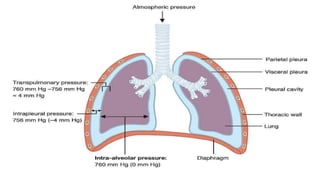
 intrapleural space : a small space that surrounds the lungs that contains
approximately 7 to 20 mL of pleural fluid, which lubricates the
visceral pleura and parietal pleura to reduce friction during respiration.
 Intrapleural pressure is normally negative (less than atmospheric
pressure) because of inward lung and outward chest wall recoil.
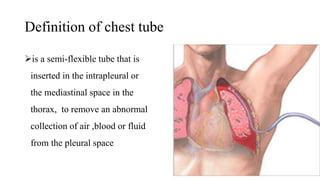
Definition of chest tube
is a semi-flexible tube that is
inserted in the intrapleural or
the mediastinal space in the
thorax, to remove an abnormal
collection of air ,blood or fluid
from the pleural space
Purpose of Chest Tubes
 To re-expand the lungs after a pneumothorax.
 After surgery for lung cancer to drain fluids that accumulate in the
space that's created after a portion of a lung is removed
 For pleural effusions, both benign and malignant
 After heart surgery, to remove fluids that accumulate in the chest.
 If there is a hemothorax (bleeding into the chest), for example from
trauma.
 To drain pus from an empyema (infection or abscess)
indication for a chest tube:
 Cardiovascular surgery
 Pneumothorax
 Pleural Effusion
 Types of Pleural Effusions:
 Hemothorax
 Empyema
 Chylothorax
CONTRAINDICATION
 There are no absolute contraindications for drainage by means of a
chest tube except when a lung is completely adherent to the chest wall
throughout the hemithorax.
 Relative contraindications include the following:
Coagulopathy
Pulmonary, pleural, or thoracic adhesions
Loculated pleural effusion or empyema
Skin infection over the chest tube insertion site.
Cont.…
 Blind insertion of a chest tube is dangerous in a patient with pleural
adhesions from
infection,
previous pleurodesis, or
prior pulmonary surgery;
so guidance by ultrasound or CT scan without contrast is preferred.
Performance chest tube procedure
• Wash hands.
• Prepare the equipment:
• lidocaine

• An antiseptic
• Sterile gloves
• Sutures
• Sterile water
• Suction control chambers
• Suture scissors
• 4*4 inch sterile gauze
• Petroleum gauze • Two clamps • Knife handle • Knife blade • 3.0 silk suture
• Needle holder
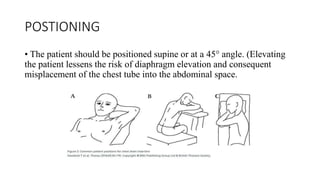
POSTIONING
• The patient should be positioned supine or at a 45° angle. (Elevating
the patient lessens the risk of diaphragm elevation and consequent
misplacement of the chest tube into the abdominal space.
Cont..
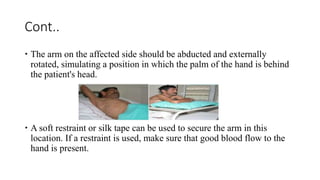
 The arm on the affected side should be abducted and externally
rotated, simulating a position in which the palm of the hand is behind
the patient's head.
 A soft restraint or silk tape can be used to secure the arm in this
location. If a restraint is used, make sure that good blood flow to the
hand is present.
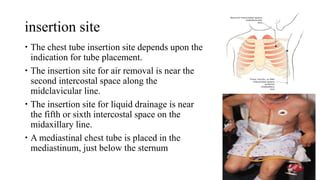
insertion site
 The chest tube insertion site depends upon the
indication for tube placement.
 The insertion site for air removal is near the
second intercostal space along the
midclavicular line.
 The insertion site for liquid drainage is near
the fifth or sixth intercostal space on the
midaxillary line.
 A mediastinal chest tube is placed in the
mediastinum, just below the sternum
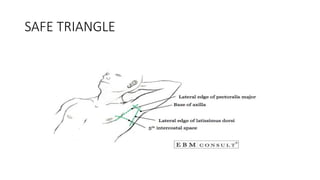
SAFE TRIANGLE
Technique
1. Obtain informed consent from the patient or patient’s representative.
2. Assemble the drainage system and connect it to the suction source.
The appearance of bubbles in the water chamber is a sign that the
chest tube drainage device is functioning properly.
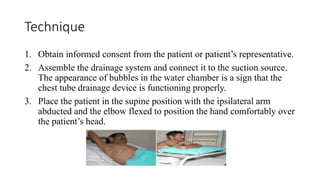
3. Place the patient in the supine position with the ipsilateral arm
abducted and the elbow flexed to position the hand comfortably over
the patient’s head.
Cont.
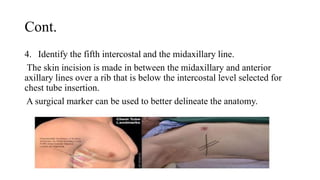
4. Identify the fifth intercostal and the midaxillary line.
The skin incision is made in between the midaxillary and anterior
axillary lines over a rib that is below the intercostal level selected for
chest tube insertion.
A surgical marker can be used to better delineate the anatomy.
Cont..
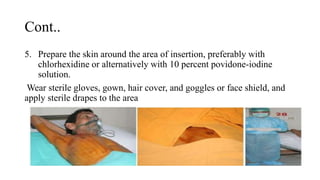
5. Prepare the skin around the area of insertion, preferably with
chlorhexidine or alternatively with 10 percent povidone-iodine
solution.
Wear sterile gloves, gown, hair cover, and goggles or face shield, and
apply sterile drapes to the area
Cont..
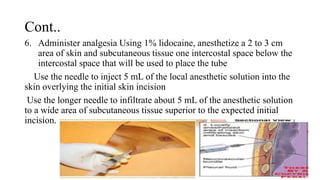
6. Administer analgesia Using 1% lidocaine, anesthetize a 2 to 3 cm
area of skin and subcutaneous tissue one intercostal space below the
intercostal space that will be used to place the tube
Use the needle to inject 5 mL of the local anesthetic solution into the
skin overlying the initial skin incision
Use the longer needle to infiltrate about 5 mL of the anesthetic solution
to a wide area of subcutaneous tissue superior to the expected initial
incision.
Cont..
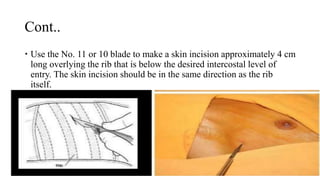
 Use the No. 11 or 10 blade to make a skin incision approximately 4 cm
long overlying the rib that is below the desired intercostal level of
entry. The skin incision should be in the same direction as the rib
itself.
Cont..
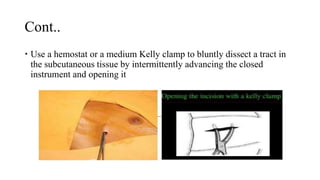
 Use a hemostat or a medium Kelly clamp to bluntly dissect a tract in
the subcutaneous tissue by intermittently advancing the closed
instrument and opening it
Cont..
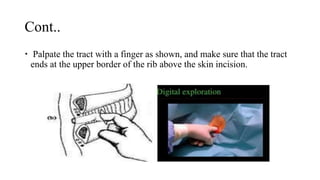
 Palpate the tract with a finger as shown, and make sure that the tract
ends at the upper border of the rib above the skin incision.
Cont..
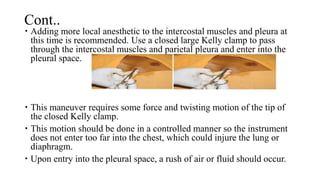
 Adding more local anesthetic to the intercostal muscles and pleura at
this time is recommended. Use a closed large Kelly clamp to pass
through the intercostal muscles and parietal pleura and enter into the
pleural space.
 This maneuver requires some force and twisting motion of the tip of
the closed Kelly clamp.
 This motion should be done in a controlled manner so the instrument
does not enter too far into the chest, which could injure the lung or
diaphragm.
 Upon entry into the pleural space, a rush of air or fluid should occur.
Cont..
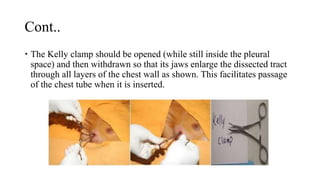
 The Kelly clamp should be opened (while still inside the pleural
space) and then withdrawn so that its jaws enlarge the dissected tract
through all layers of the chest wall as shown. This facilitates passage
of the chest tube when it is inserted.
Cont..
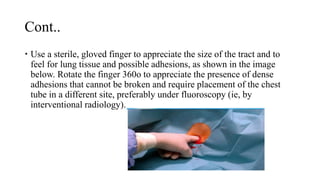
 Use a sterile, gloved finger to appreciate the size of the tract and to
feel for lung tissue and possible adhesions, as shown in the image
below. Rotate the finger 360o to appreciate the presence of dense
adhesions that cannot be broken and require placement of the chest
tube in a different site, preferably under fluoroscopy (ie, by
interventional radiology).
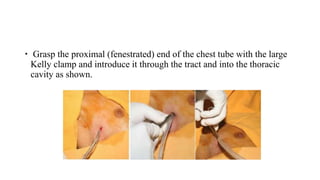
 Grasp the proximal (fenestrated) end of the chest tube with the large
Kelly clamp and introduce it through the tract and into the thoracic
cavity as shown.
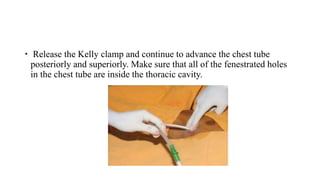
 Release the Kelly clamp and continue to advance the chest tube
posteriorly and superiorly. Make sure that all of the fenestrated holes
in the chest tube are inside the thoracic cavity.
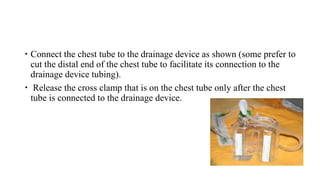
 Connect the chest tube to the drainage device as shown (some prefer to
cut the distal end of the chest tube to facilitate its connection to the
drainage device tubing).
 Release the cross clamp that is on the chest tube only after the chest
tube is connected to the drainage device.
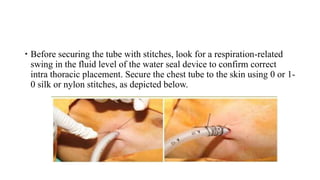
 Before securing the tube with stitches, look for a respiration-related
swing in the fluid level of the water seal device to confirm correct
intra thoracic placement. Secure the chest tube to the skin using 0 or 1-
0 silk or nylon stitches, as depicted below.
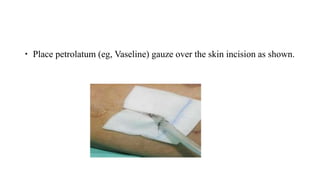
 Place petrolatum (eg, Vaseline) gauze over the skin incision as shown.
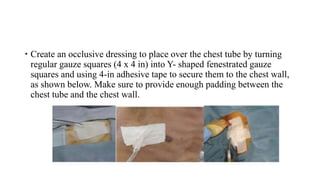
 Create an occlusive dressing to place over the chest tube by turning
regular gauze squares (4 x 4 in) into Y- shaped fenestrated gauze
squares and using 4-in adhesive tape to secure them to the chest wall,
as shown below. Make sure to provide enough padding between the
chest tube and the chest wall.
Drainage Systems
1. One bottle / single bottle system:
The simplest drainage system is the single chamber unit.
The chamber serve as a fluid collector and a water seal.
During normal respiration the fluid in the chamber ascends with inspiration and descends
with expiration.
This is used for smaller amounts of drainage such as an empyema.
2. The two-chamber system has a water seal and a collection chamber
3. Three-chamber system adds a suction control chamber.
Drainage Systems
2. The two-chamber system has a water seal and a collection chamber:
 The use of two chambers permits any fluid to flow into the collection
chamber as air flows into the water seal chamber.
 Fluctuations in the water-seal tube are anticipated.
 Two chambers allow for more accurate measurement of chest drainage and
are used when larger amount of drainage are expected.
 the second chamber to the 2-cm level to achieve the seal.
Drainage Systems
3. Three-Chamber System : a suction control chamber is added to the
two-chamber system.
 This is the safest way to regulate the amount of suction.
Indications for Chest Tube Removal
• One day after cessation of air leak
• Drainage of less than 50 to 100 mL of fluid/d
• One to three days after cardiac surgery
• Two to six days after thoracic surgery
• Obliteration of empyema cavity
• Serosanguineous drainage from around the chest tube insertion site
• Chest tube partially migrated out with holes visible (may require a new
chest tube insertion)
Chest Tube Removal
 Before the chest tube is removed, the patient is placed in Fowler or
semi-Fowler position (head of bed elevated 45 to 90 degrees).
Premedication is recommended to alleviate pain and discomfort.
 The dressing over the insertion site is removed, and the area is
cleaned.
 The suture is clipped.
 The tube is removed in one quick movement at end expiration with
valsalva maneuver to prevent entraining air back into the pleural
cavity through the chest tube eyelets.
Chest Tube Removal
 Immediately after tube removal, the lung fields are auscultated for any
change in breath sounds, and an occlusive sterile dressing is applied
over the site.
 A chest radiograph is usually obtained several hours later to look for
the presence of residual air or fluid.
Positioning
 The ideal position for a patient with a chest tube is the semi-Fowler
position.
 Turning the patient every 2 hours enhances air and fluid evacuation.
 The nurse teaches the patient how to support or “splint” the chest wall
near the tube insertion site using a pillow, bath blanket, or arms placed
firmly against the chest.
 The nurse also encourages coughing, deep breathing, and ambulation.
 Administration of pain medication before these exercises decreases
pain and enhances lung expansion.
Complications
 The most serious complication resulting from chest tube placement is
tension pneumothorax, which can develop if there is any obstruction in
the chest tube drainage system.
 Clamping chest tubes as a routine practice predisposes patients to this
complication.
 Clamping of chest tubes is recommended in only two situations:
• To locate the source of an air leak if bubbling occurs in the water seal
chamber (clamping is only momentary)
• To replace the chest tube drainage unit (clamping is only momentary)
Transporting the Patient With a Chest Tube
 Chest drainage system integrity is maintained by positioning the
drainage system below the level of the chest.
 The nurse secures the system to the foot of the bed, and ensures that
the tubing does not become crushed or kinked.
 If the system requires suction to evacuate the pleural space, portable
suction must be implemented.

chest tube.pptx

  • 1.
    Introduction  The pleura:thin membrane cover each lung, has two parts:  A parietal layer: which lines the thoracic wall, covers the diaphragm, the lateral aspect of the mediastinum  A visceral layer: which covers the outer surfaces of the lungs  intrapleural space : a small space that surrounds the lungs that contains approximately 7 to 20 mL of pleural fluid, which lubricates the visceral pleura and parietal pleura to reduce friction during respiration.  Intrapleural pressure is normally negative (less than atmospheric pressure) because of inward lung and outward chest wall recoil.
  • 3.
    Definition of chesttube is a semi-flexible tube that is inserted in the intrapleural or the mediastinal space in the thorax, to remove an abnormal collection of air ,blood or fluid from the pleural space
  • 5.
    Purpose of ChestTubes  To re-expand the lungs after a pneumothorax.  After surgery for lung cancer to drain fluids that accumulate in the space that's created after a portion of a lung is removed  For pleural effusions, both benign and malignant  After heart surgery, to remove fluids that accumulate in the chest.  If there is a hemothorax (bleeding into the chest), for example from trauma.  To drain pus from an empyema (infection or abscess)
  • 6.
    indication for achest tube:  Cardiovascular surgery  Pneumothorax  Pleural Effusion  Types of Pleural Effusions:  Hemothorax  Empyema  Chylothorax
  • 7.
    CONTRAINDICATION  There areno absolute contraindications for drainage by means of a chest tube except when a lung is completely adherent to the chest wall throughout the hemithorax.  Relative contraindications include the following: Coagulopathy Pulmonary, pleural, or thoracic adhesions Loculated pleural effusion or empyema Skin infection over the chest tube insertion site.
  • 8.
    Cont.…  Blind insertionof a chest tube is dangerous in a patient with pleural adhesions from infection, previous pleurodesis, or prior pulmonary surgery; so guidance by ultrasound or CT scan without contrast is preferred.
  • 9.
    Performance chest tubeprocedure • Wash hands. • Prepare the equipment: • lidocaine • An antiseptic • Sterile gloves • Sutures • Sterile water • Suction control chambers • Suture scissors • 4*4 inch sterile gauze • Petroleum gauze • Two clamps • Knife handle • Knife blade • 3.0 silk suture • Needle holder
  • 10.
    POSTIONING • The patientshould be positioned supine or at a 45° angle. (Elevating the patient lessens the risk of diaphragm elevation and consequent misplacement of the chest tube into the abdominal space.
  • 11.
    Cont..  The armon the affected side should be abducted and externally rotated, simulating a position in which the palm of the hand is behind the patient's head.  A soft restraint or silk tape can be used to secure the arm in this location. If a restraint is used, make sure that good blood flow to the hand is present.
  • 12.
    insertion site  Thechest tube insertion site depends upon the indication for tube placement.  The insertion site for air removal is near the second intercostal space along the midclavicular line.  The insertion site for liquid drainage is near the fifth or sixth intercostal space on the midaxillary line.  A mediastinal chest tube is placed in the mediastinum, just below the sternum
  • 13.
  • 14.
    Technique 1. Obtain informedconsent from the patient or patient’s representative. 2. Assemble the drainage system and connect it to the suction source. The appearance of bubbles in the water chamber is a sign that the chest tube drainage device is functioning properly. 3. Place the patient in the supine position with the ipsilateral arm abducted and the elbow flexed to position the hand comfortably over the patient’s head.
  • 15.
    Cont. 4. Identify thefifth intercostal and the midaxillary line. The skin incision is made in between the midaxillary and anterior axillary lines over a rib that is below the intercostal level selected for chest tube insertion. A surgical marker can be used to better delineate the anatomy.
  • 16.
    Cont.. 5. Prepare theskin around the area of insertion, preferably with chlorhexidine or alternatively with 10 percent povidone-iodine solution. Wear sterile gloves, gown, hair cover, and goggles or face shield, and apply sterile drapes to the area
  • 17.
    Cont.. 6. Administer analgesiaUsing 1% lidocaine, anesthetize a 2 to 3 cm area of skin and subcutaneous tissue one intercostal space below the intercostal space that will be used to place the tube Use the needle to inject 5 mL of the local anesthetic solution into the skin overlying the initial skin incision Use the longer needle to infiltrate about 5 mL of the anesthetic solution to a wide area of subcutaneous tissue superior to the expected initial incision.
  • 18.
    Cont..  Use theNo. 11 or 10 blade to make a skin incision approximately 4 cm long overlying the rib that is below the desired intercostal level of entry. The skin incision should be in the same direction as the rib itself.
  • 19.
    Cont..  Use ahemostat or a medium Kelly clamp to bluntly dissect a tract in the subcutaneous tissue by intermittently advancing the closed instrument and opening it
  • 20.
    Cont..  Palpate thetract with a finger as shown, and make sure that the tract ends at the upper border of the rib above the skin incision.
  • 21.
    Cont..  Adding morelocal anesthetic to the intercostal muscles and pleura at this time is recommended. Use a closed large Kelly clamp to pass through the intercostal muscles and parietal pleura and enter into the pleural space.  This maneuver requires some force and twisting motion of the tip of the closed Kelly clamp.  This motion should be done in a controlled manner so the instrument does not enter too far into the chest, which could injure the lung or diaphragm.  Upon entry into the pleural space, a rush of air or fluid should occur.
  • 22.
    Cont..  The Kellyclamp should be opened (while still inside the pleural space) and then withdrawn so that its jaws enlarge the dissected tract through all layers of the chest wall as shown. This facilitates passage of the chest tube when it is inserted.
  • 23.
    Cont..  Use asterile, gloved finger to appreciate the size of the tract and to feel for lung tissue and possible adhesions, as shown in the image below. Rotate the finger 360o to appreciate the presence of dense adhesions that cannot be broken and require placement of the chest tube in a different site, preferably under fluoroscopy (ie, by interventional radiology).
  • 24.
     Grasp theproximal (fenestrated) end of the chest tube with the large Kelly clamp and introduce it through the tract and into the thoracic cavity as shown.
  • 25.
     Release theKelly clamp and continue to advance the chest tube posteriorly and superiorly. Make sure that all of the fenestrated holes in the chest tube are inside the thoracic cavity.
  • 26.
     Connect thechest tube to the drainage device as shown (some prefer to cut the distal end of the chest tube to facilitate its connection to the drainage device tubing).  Release the cross clamp that is on the chest tube only after the chest tube is connected to the drainage device.
  • 27.
     Before securingthe tube with stitches, look for a respiration-related swing in the fluid level of the water seal device to confirm correct intra thoracic placement. Secure the chest tube to the skin using 0 or 1- 0 silk or nylon stitches, as depicted below.
  • 28.
     Place petrolatum(eg, Vaseline) gauze over the skin incision as shown.
  • 29.
     Create anocclusive dressing to place over the chest tube by turning regular gauze squares (4 x 4 in) into Y- shaped fenestrated gauze squares and using 4-in adhesive tape to secure them to the chest wall, as shown below. Make sure to provide enough padding between the chest tube and the chest wall.
  • 30.
    Drainage Systems 1. Onebottle / single bottle system: The simplest drainage system is the single chamber unit. The chamber serve as a fluid collector and a water seal. During normal respiration the fluid in the chamber ascends with inspiration and descends with expiration. This is used for smaller amounts of drainage such as an empyema. 2. The two-chamber system has a water seal and a collection chamber 3. Three-chamber system adds a suction control chamber.
  • 31.
    Drainage Systems 2. Thetwo-chamber system has a water seal and a collection chamber:  The use of two chambers permits any fluid to flow into the collection chamber as air flows into the water seal chamber.  Fluctuations in the water-seal tube are anticipated.  Two chambers allow for more accurate measurement of chest drainage and are used when larger amount of drainage are expected.  the second chamber to the 2-cm level to achieve the seal.
  • 32.
    Drainage Systems 3. Three-ChamberSystem : a suction control chamber is added to the two-chamber system.  This is the safest way to regulate the amount of suction.
  • 33.
    Indications for ChestTube Removal • One day after cessation of air leak • Drainage of less than 50 to 100 mL of fluid/d • One to three days after cardiac surgery • Two to six days after thoracic surgery • Obliteration of empyema cavity • Serosanguineous drainage from around the chest tube insertion site • Chest tube partially migrated out with holes visible (may require a new chest tube insertion)
  • 34.
    Chest Tube Removal Before the chest tube is removed, the patient is placed in Fowler or semi-Fowler position (head of bed elevated 45 to 90 degrees). Premedication is recommended to alleviate pain and discomfort.  The dressing over the insertion site is removed, and the area is cleaned.  The suture is clipped.  The tube is removed in one quick movement at end expiration with valsalva maneuver to prevent entraining air back into the pleural cavity through the chest tube eyelets.
  • 35.
    Chest Tube Removal Immediately after tube removal, the lung fields are auscultated for any change in breath sounds, and an occlusive sterile dressing is applied over the site.  A chest radiograph is usually obtained several hours later to look for the presence of residual air or fluid.
  • 37.
    Positioning  The idealposition for a patient with a chest tube is the semi-Fowler position.  Turning the patient every 2 hours enhances air and fluid evacuation.  The nurse teaches the patient how to support or “splint” the chest wall near the tube insertion site using a pillow, bath blanket, or arms placed firmly against the chest.  The nurse also encourages coughing, deep breathing, and ambulation.  Administration of pain medication before these exercises decreases pain and enhances lung expansion.
  • 38.
    Complications  The mostserious complication resulting from chest tube placement is tension pneumothorax, which can develop if there is any obstruction in the chest tube drainage system.  Clamping chest tubes as a routine practice predisposes patients to this complication.  Clamping of chest tubes is recommended in only two situations: • To locate the source of an air leak if bubbling occurs in the water seal chamber (clamping is only momentary) • To replace the chest tube drainage unit (clamping is only momentary)
  • 39.
    Transporting the PatientWith a Chest Tube  Chest drainage system integrity is maintained by positioning the drainage system below the level of the chest.  The nurse secures the system to the foot of the bed, and ensures that the tubing does not become crushed or kinked.  If the system requires suction to evacuate the pleural space, portable suction must be implemented.