Interconnections of hybrid systems
Michael Kosmykov
3. February 2012, Fachhochschule Erfurt
Centre for
Industrial Mathematics
Outline
1 Motivation
2 Hybrid system
3 Extension of hybrid time domain
4 Conclusion and outlook
2 / 40Motivation Hybrid system Hybrid domain Summary
Centre for
Industrial Mathematics
Logistics network as hybrid system from PhD thesis:
3 production sites (D, F, E) for
Liquidring-Vaccum (LRVP), Industrial (IND)
and Side-channel (SC) pumps
5 distribution centers (D, NL, B, F, E)
33 first and second-tier suppliers for the
production of pumps
90 suppliers for components that are needed
for the assembly of pump sets
More than 1000 customers
3 / 40Motivation Hybrid system Hybrid domain Summary
Centre for
Industrial Mathematics
Logistics network as hybrid system from PhD thesis:
Instability leads to:
High inventory costs
Large number of unsatisfied orders
Loss of customers
3 / 40Motivation Hybrid system Hybrid domain Summary
Centre for
Industrial Mathematics
Analysis steps:
1 Mathematical modelling
2 Model reduction, if the model size is large
3 Stability analysis
4 / 40Motivation Hybrid system Hybrid domain Summary
Centre for
Industrial Mathematics
Modelling approaches
Discrete system:
Decentralized supply chain
Re-entrant/queueing
system
”Bucket brigade”
Continuous system:
Ordinary differential equations
- Damped oscillator model
Multilevel network
Partial differential equations
Hybrid model:
Hybrid system
Switched system
Stochastic system:
Stochastic system
Queueing/fluid network
5 / 40Motivation Hybrid system Hybrid domain Summary
Centre for
Industrial Mathematics
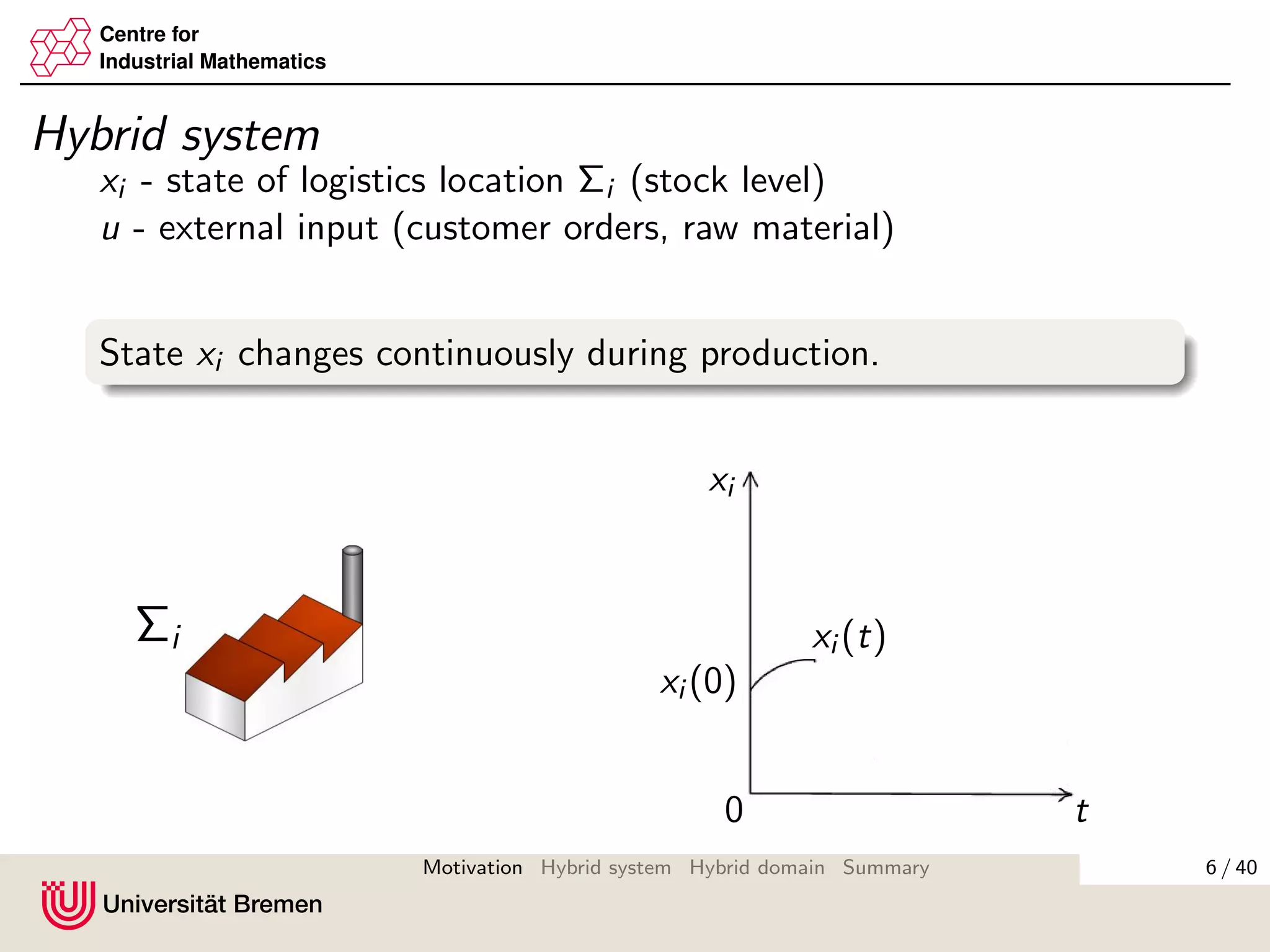
Hybrid system
xi - state of logistics location Σi (stock level)
u - external input (customer orders, raw material)
State xi changes continuously during production.
Σi
t0
xi (0)
xi (t)
xi
6 / 40Motivation Hybrid system Hybrid domain Summary
Centre for
Industrial Mathematics
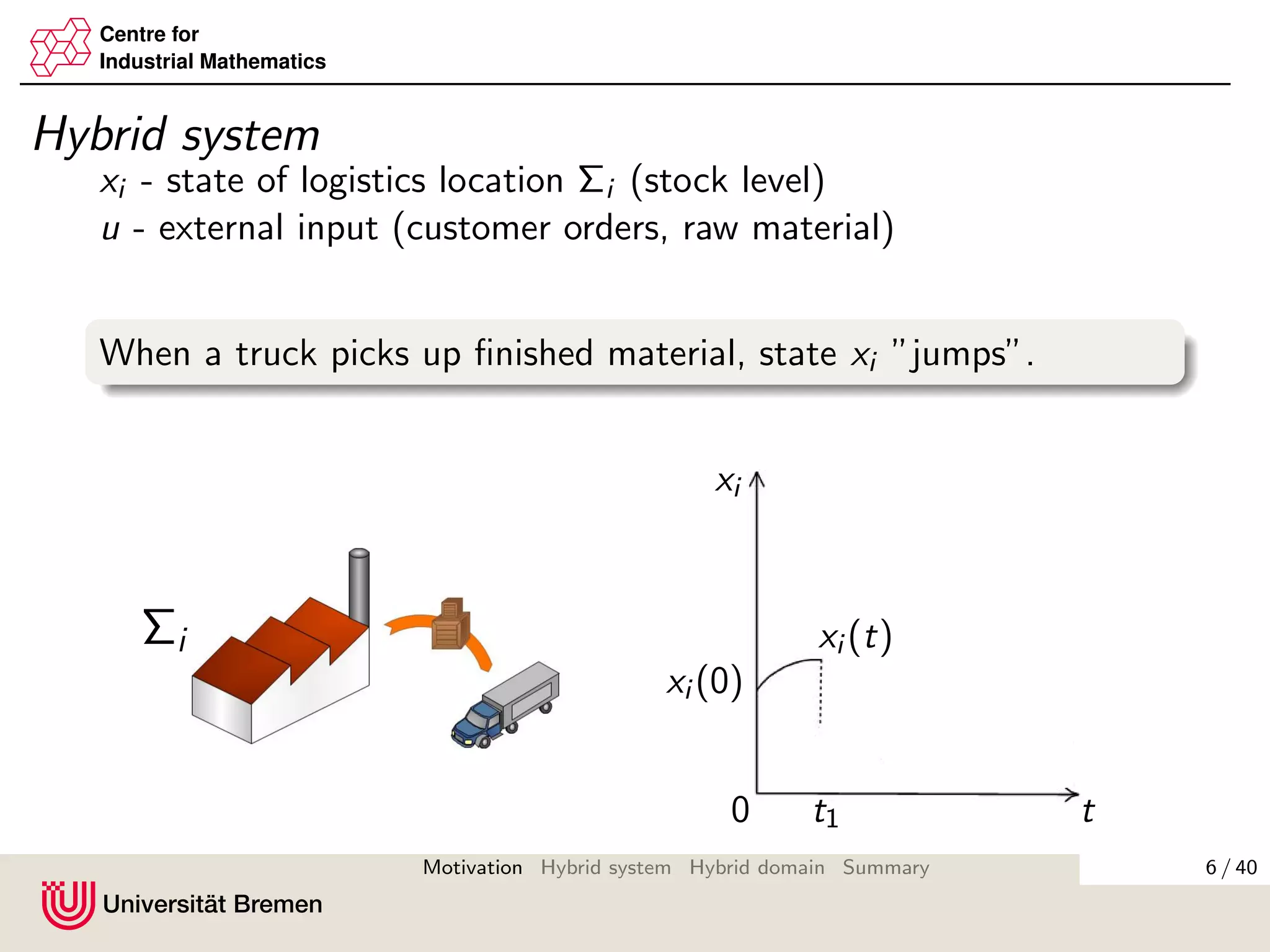
Hybrid system
xi - state of logistics location Σi (stock level)
u - external input (customer orders, raw material)
When a truck picks up finished material, state xi ”jumps”.
Σi
t0
xi (0)
xi (t)
t1
xi
6 / 40Motivation Hybrid system Hybrid domain Summary
Centre for
Industrial Mathematics
Hybrid system
xi - state of logistics location Σi (stock level)
u - external input (customer orders, raw material)
After the jump state xi changes again continuously.
Σi
t0
xi (0)
xi (t)
t1
xi
6 / 40Motivation Hybrid system Hybrid domain Summary
Centre for
Industrial Mathematics
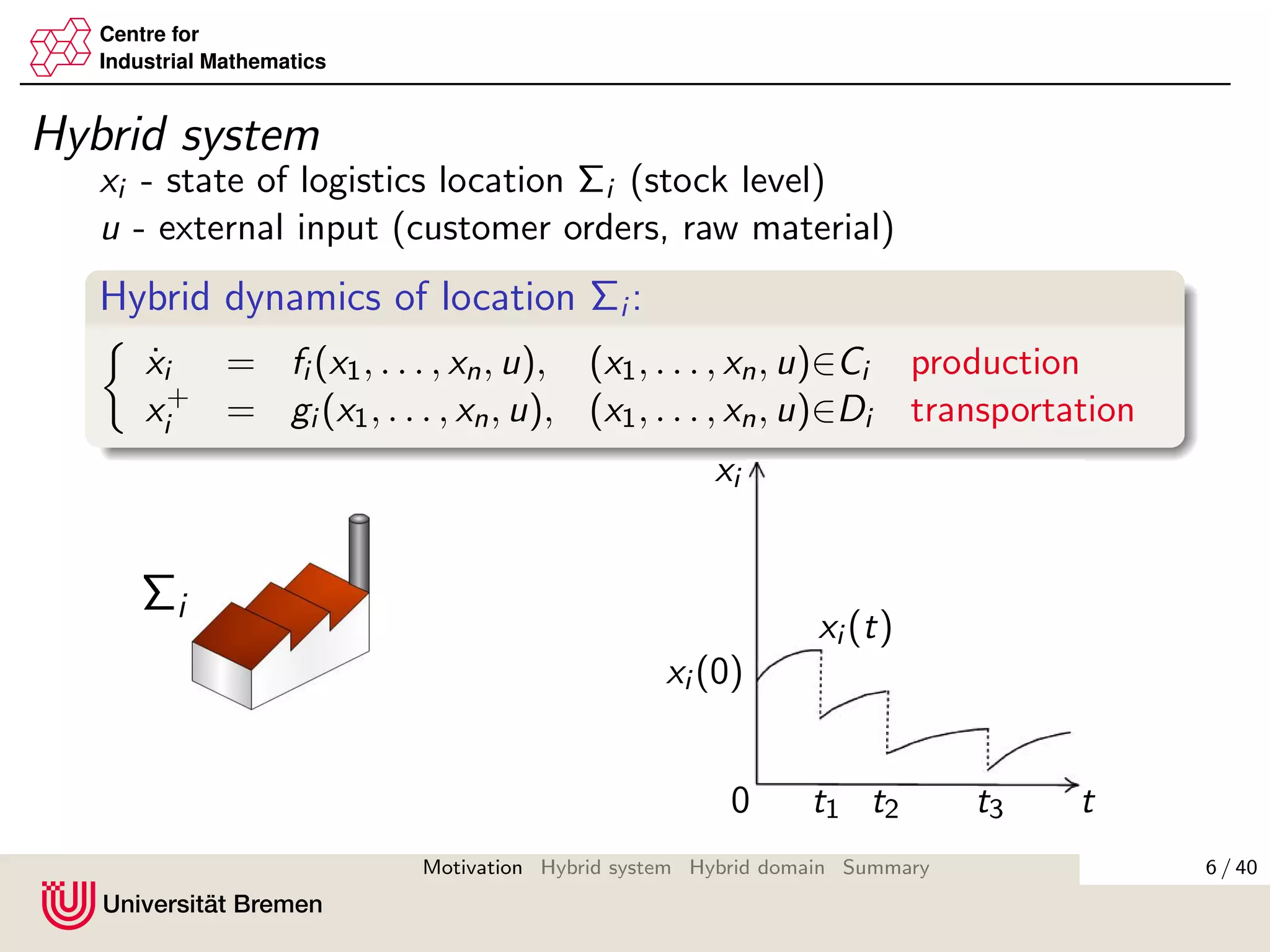
Hybrid system
xi - state of logistics location Σi (stock level)
u - external input (customer orders, raw material)
Hybrid dynamics of location Σi :
˙xi = fi (x1, . . . , xn, u), (x1, . . . , xn, u)∈Ci production
x+
i = gi (x1, . . . , xn, u), (x1, . . . , xn, u)∈Di transportation
Σi
t0
xi (0)
xi (t)
t1 t2 t3
xi
6 / 40Motivation Hybrid system Hybrid domain Summary
Centre for
Industrial Mathematics
Hybrid system
The whole network Σ is given by interconnection of individual
locations:
Hybrid dynamics of the whole logistics network Σ:
˙x = ?, (x1, . . . , xn, u) ∈ C =? overall production
x+ = ?, (x1, . . . , xn, u) ∈ D =? overall transportation
7 / 40Motivation Hybrid system Hybrid domain Summary
Centre for
Industrial Mathematics
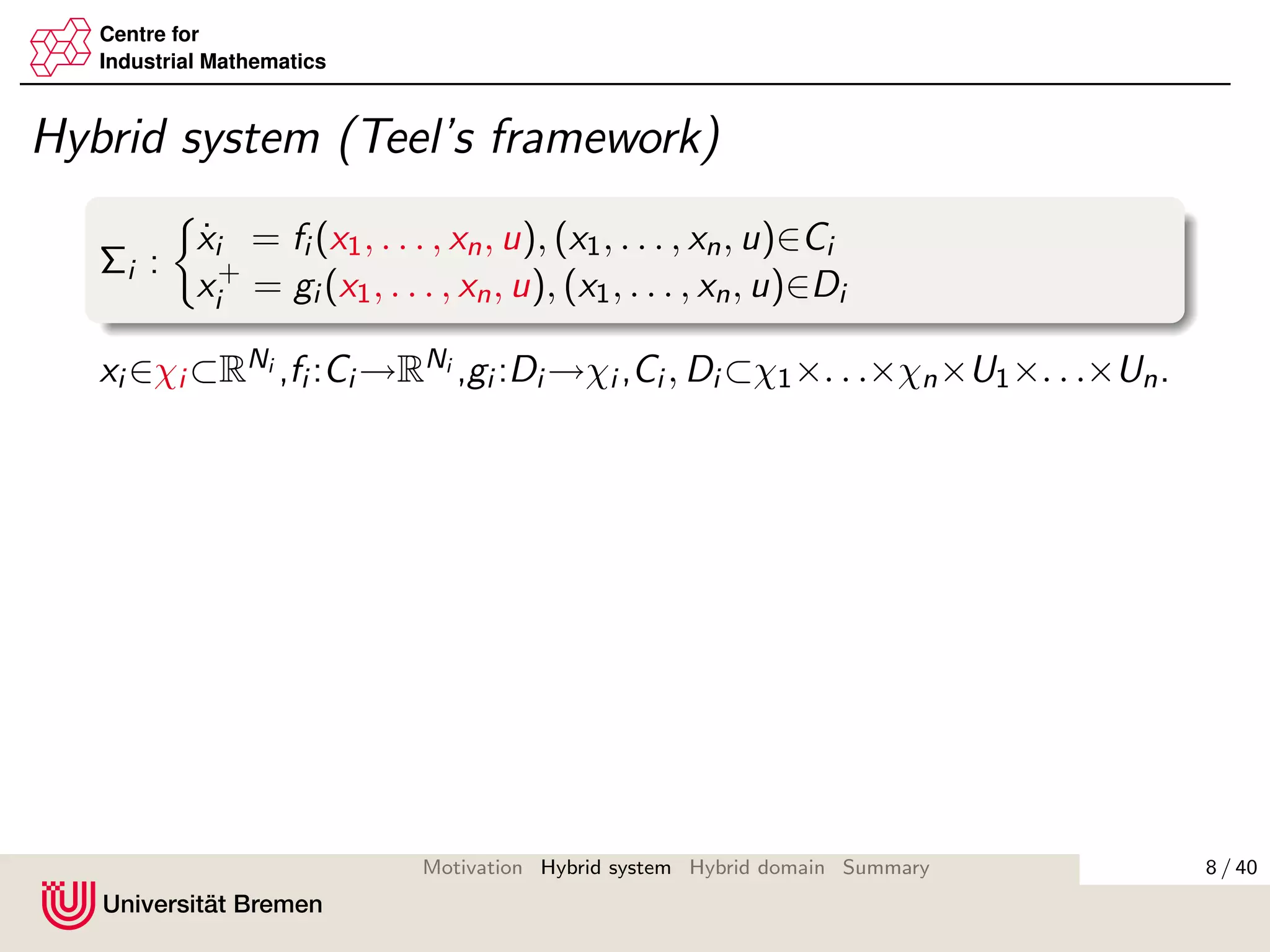
Hybrid system (Teel’s framework)
Σi :
˙xi = fi (x1, . . . , xn, u), (x1, . . . , xn, u)∈Ci
x+
i = gi (x1, . . . , xn, u), (x1, . . . , xn, u)∈Di
xi ∈χi ⊂RNi ,fi :Ci →RNi ,gi :Di →χi ,Ci , Di ⊂χ1×. . .×χn×U1×. . .×Un.
8 / 40Motivation Hybrid system Hybrid domain Summary
Centre for
Industrial Mathematics
Hybrid system (Teel’s framework)
Σi :
˙xi = fi (x1, . . . , xn, u), (x1, . . . , xn, u)∈Ci
x+
i = gi (x1, . . . , xn, u), (x1, . . . , xn, u)∈Di
xi ∈χi ⊂RNi ,fi :Ci →RNi ,gi :Di →χi ,Ci , Di ⊂χ1×. . .×χn×U1×. . .×Un.
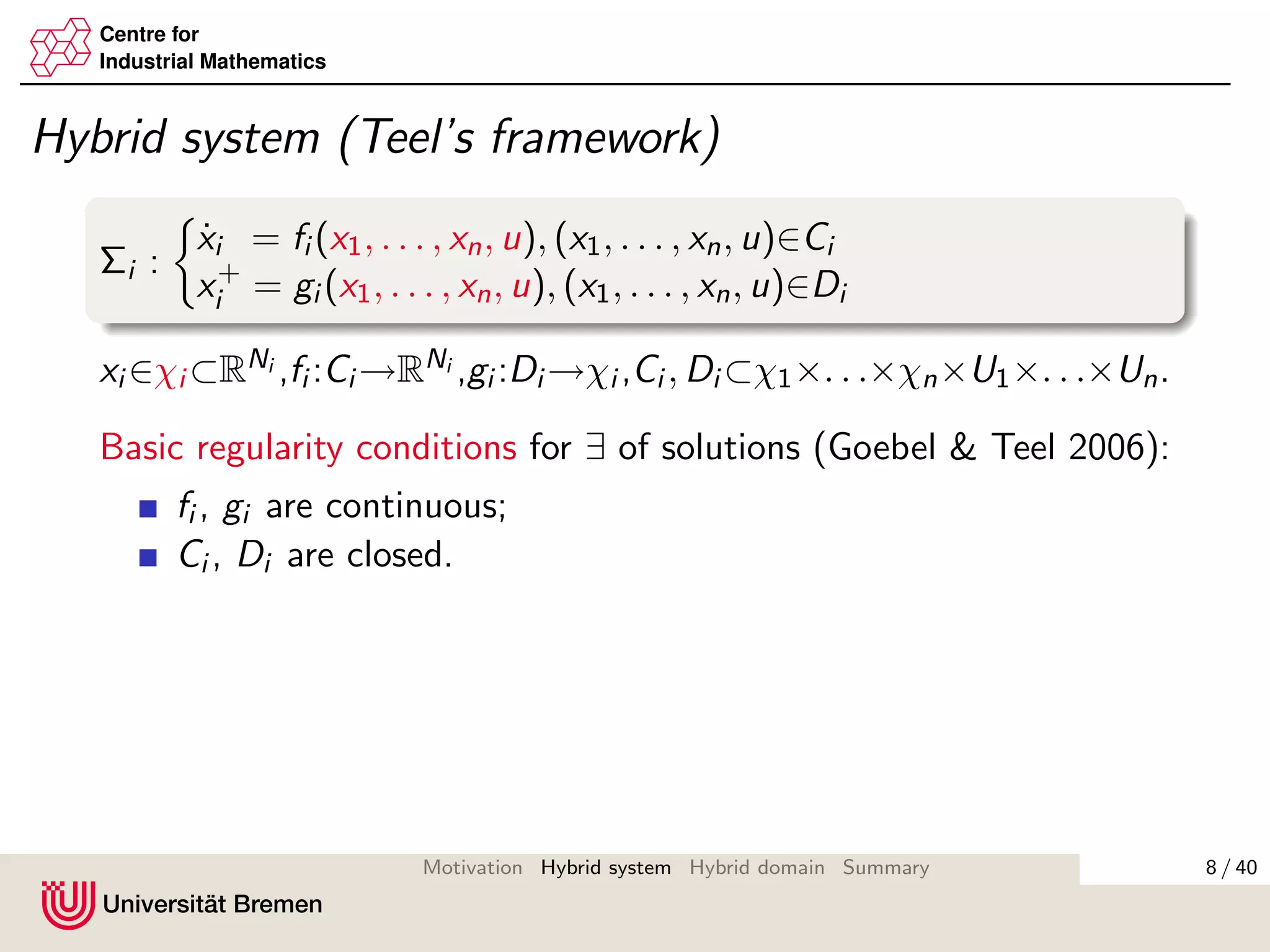
Basic regularity conditions for ∃ of solutions (Goebel & Teel 2006):
fi , gi are continuous;
Ci , Di are closed.
8 / 40Motivation Hybrid system Hybrid domain Summary
Centre for
Industrial Mathematics
Hybrid system (Teel’s framework)
Σi :
˙xi = fi (x1, . . . , xn, u), (x1, . . . , xn, u)∈Ci
x+
i = gi (x1, . . . , xn, u), (x1, . . . , xn, u)∈Di
xi ∈χi ⊂RNi ,fi :Ci →RNi ,gi :Di →χi ,Ci , Di ⊂χ1×. . .×χn×U1×. . .×Un.
Basic regularity conditions for ∃ of solutions (Goebel & Teel 2006):
fi , gi are continuous;
Ci , Di are closed.
Solution xi (t, k) is defined on hybrid time domain:
dom xi := ∪[tk, tk+1]×{k}
t is time and k is number of the last jump.
8 / 40Motivation Hybrid system Hybrid domain Summary
Centre for
Industrial Mathematics
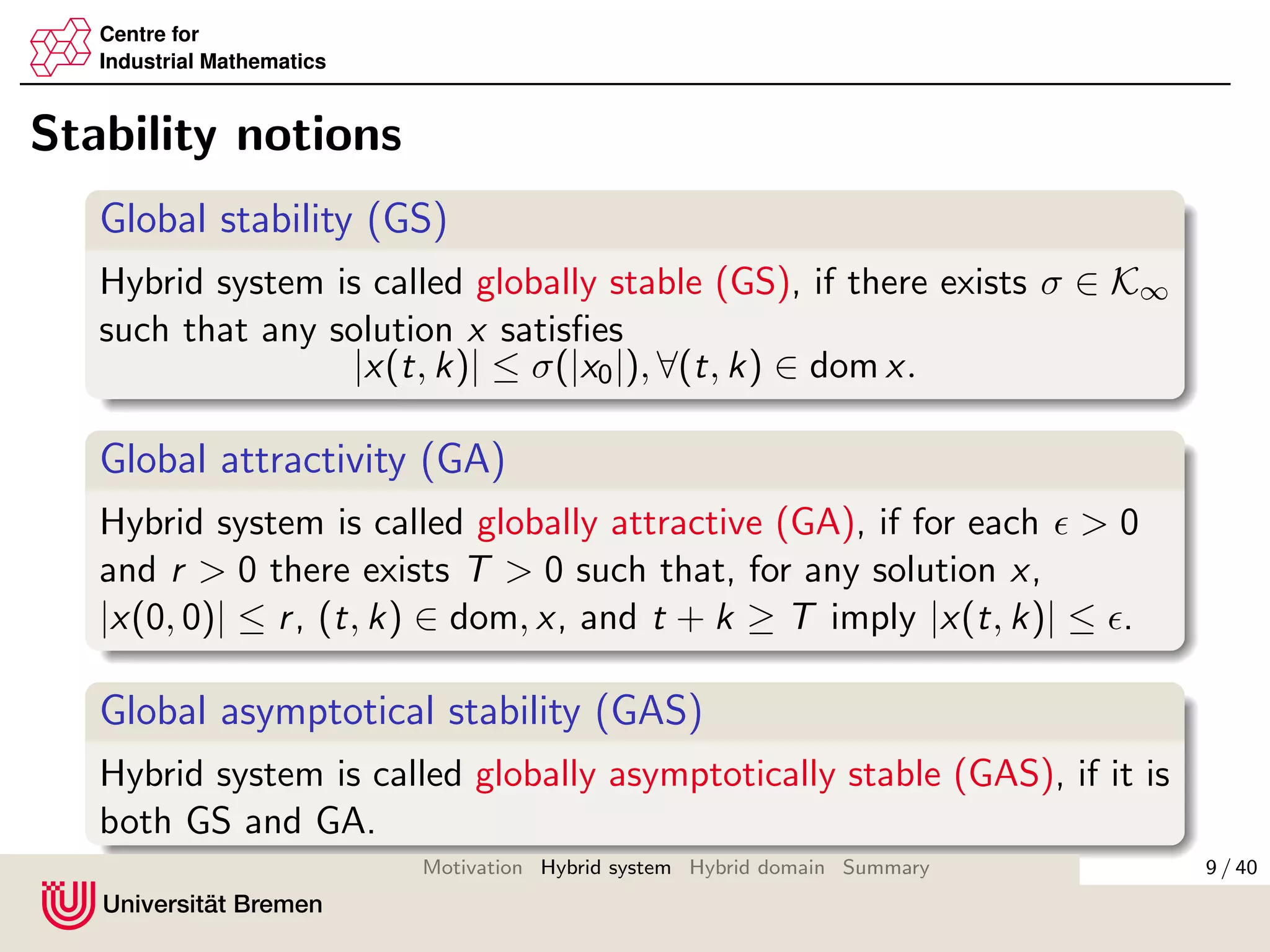
Stability notions
Global stability (GS)
Hybrid system is called globally stable (GS), if there exists σ ∈ K∞
such that any solution x satisfies
|x(t, k)| ≤ σ(|x0|), ∀(t, k) ∈ dom x.
Global attractivity (GA)
Hybrid system is called globally attractive (GA), if for each > 0
and r > 0 there exists T > 0 such that, for any solution x,
|x(0, 0)| ≤ r, (t, k) ∈ dom, x, and t + k ≥ T imply |x(t, k)| ≤ .
Global asymptotical stability (GAS)
Hybrid system is called globally asymptotically stable (GAS), if it is
both GS and GA.
9 / 40Motivation Hybrid system Hybrid domain Summary
Centre for
Industrial Mathematics
Example: Bouncing ball
˙x=
x2
−γ
=:f (x), x∈C,
x+=
x1
−λx2
=:g(x), x∈D.
x1 - height
x2 - velocity
C := {(x, u) ∈ R2 × U : x1 ≥ 0},
D := {(x, u) ∈ R2 × U : x1 =
0, x2 ≤ 0},
γ - gravitation force,
λ ∈ (0, 1) - restitution coefficient
10 / 40Motivation Hybrid system Hybrid domain Summary
Centre for
Industrial Mathematics
Example: Bouncing ball
Figure: Trajectory of the
bouncing ball.
Figure: Time domain of the
bouncing ball.
11 / 40Motivation Hybrid system Hybrid domain Summary
Centre for
Industrial Mathematics
Zeno solutions
Definition (Ames et. al. 2006)
The solution (x, u) possesses:
chattering Zeno behaviour, if there exists a finite K ≥ 0 such
that (t, k), (t, k + 1) ∈ dom x for all k ≥ K;
genuinely Zeno behaviour, if there exists a finite T ≥ 0 such
that for all (s, k), (t, k + 1) ∈ dom x, s < t < T.
Bouncing ball possesses the genuinely Zeno behaviour with
T = tmax = 2h
γ + 2λ
1−λ
2h
γ .
Furthermore, it is GAS (Sanfelice and Teel 2008).
12 / 40Motivation Hybrid system Hybrid domain Summary
Centre for
Industrial Mathematics
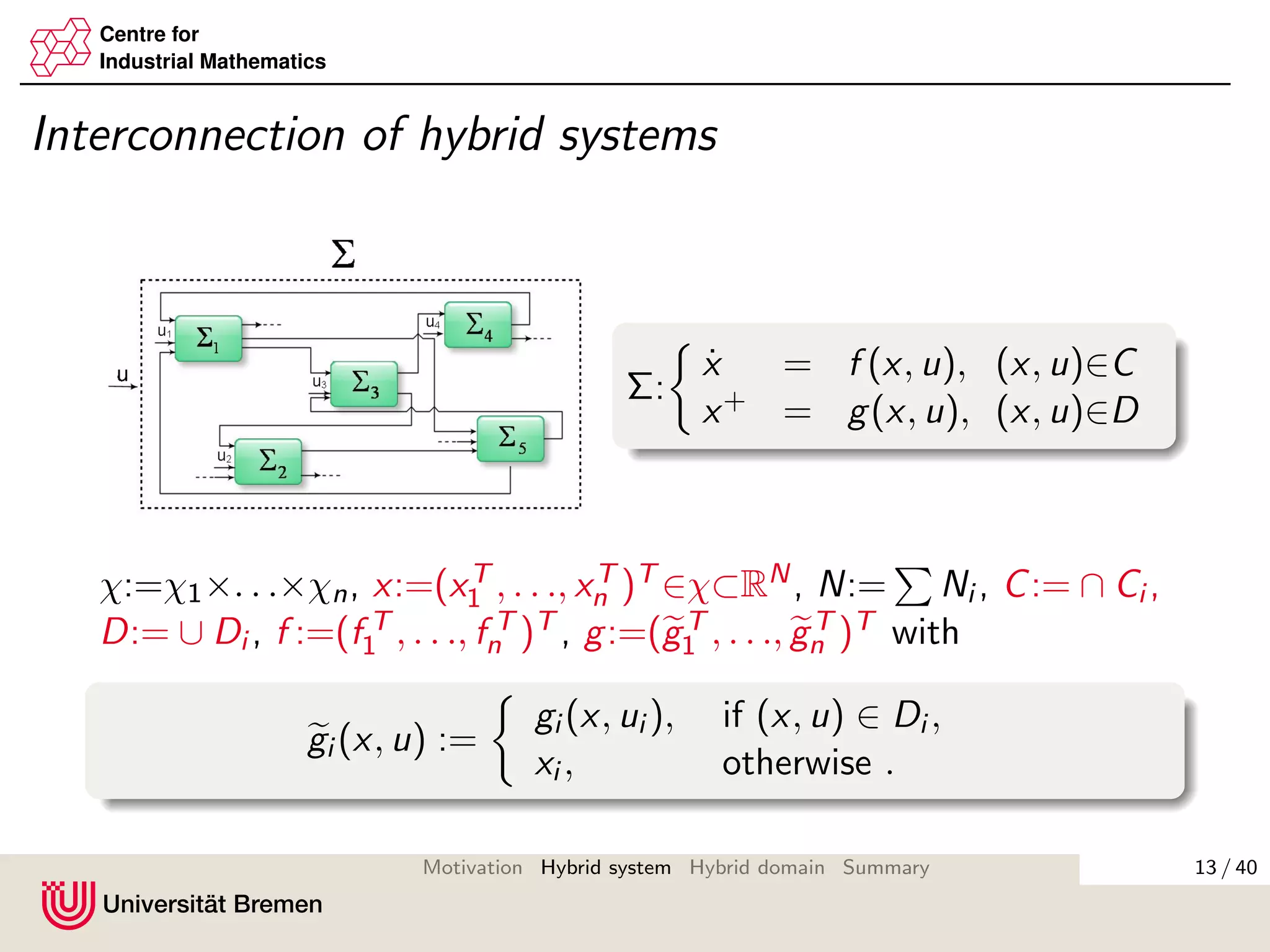
Interconnection of hybrid systems
Σ:
˙x = f (x, u), (x, u)∈C
x+ = g(x, u), (x, u)∈D
χ:=χ1×. . .×χn, x:=(xT
1 , . . ., xT
n )T ∈χ⊂RN, N:= Ni , C:= ∩ Ci ,
D:= ∪ Di , f :=(f T
1 , . . ., f T
n )T , g:=(gT
1 , . . ., gT
n )T with
gi (x, u) :=
gi (x, ui ), if (x, u) ∈ Di ,
xi , otherwise .
13 / 40Motivation Hybrid system Hybrid domain Summary
Centre for
Industrial Mathematics
Example of interconnection of hybrid systems
two bouncing balls with states x1 ∈ R2 and x2 ∈ R2
respectively.
they are interconnected by an elastic elastic coefficient k ≥ 0
horizontal distance between the balls is neglected
the balls do not hit each other.
The interaction force due to the elastic spring is given by
±k(x1
1 − x2
1 ).
14 / 40Motivation Hybrid system Hybrid domain Summary
Centre for
Industrial Mathematics
Example of interconnection of hybrid systems
Their dynamics is given by:
First ball
˙x1
=
x1
2
−γ − k(x1
1 − x2
1 )
, (x1
, x2
) ∈ C1
={(x1
, x2
) ∈ R4
: x1
1 ≥ 0},
x1+
=
x1
1
−λx1
2
, (x1
, x2
) ∈ D1
={(x1
, x2
) ∈ R4
: x1
1 = 0, x1
2 ≤ 0},
Second ball
˙x2
=
x2
2
−γ + k(x1
1 − x2
1 )
, (x1
, x2
) ∈ C2
={(x1
, x2
) ∈ R4
: x2
1 ≥ 0},
x2+
=
x2
1
−λx2
2
, (x1
, x2
) ∈ D2
={(x1
, x2
) ∈ R4
: x2
1 = 0, x2
2 ≤ 0},
15 / 40Motivation Hybrid system Hybrid domain Summary
Centre for
Industrial Mathematics
Example of interconnection of hybrid systems
Dynamics of interconnection
˙z = f (z), z ∈ C := C1 ∩ C2,
z+ = g(z), z ∈ D := D1 ∪ D2 ∈ R4,
where z := (x1T
, x2T
)T , f (z) := (f 1T , f 2T )T ,
g(z) := (g1T , g2T )T ,
gi
(z) = gi
(x1
, x2
) :=
gi (x1, x2), if (x1, x2) ∈ Di ,
xi , otherwise .
16 / 40Motivation Hybrid system Hybrid domain Summary
Centre for
Industrial Mathematics
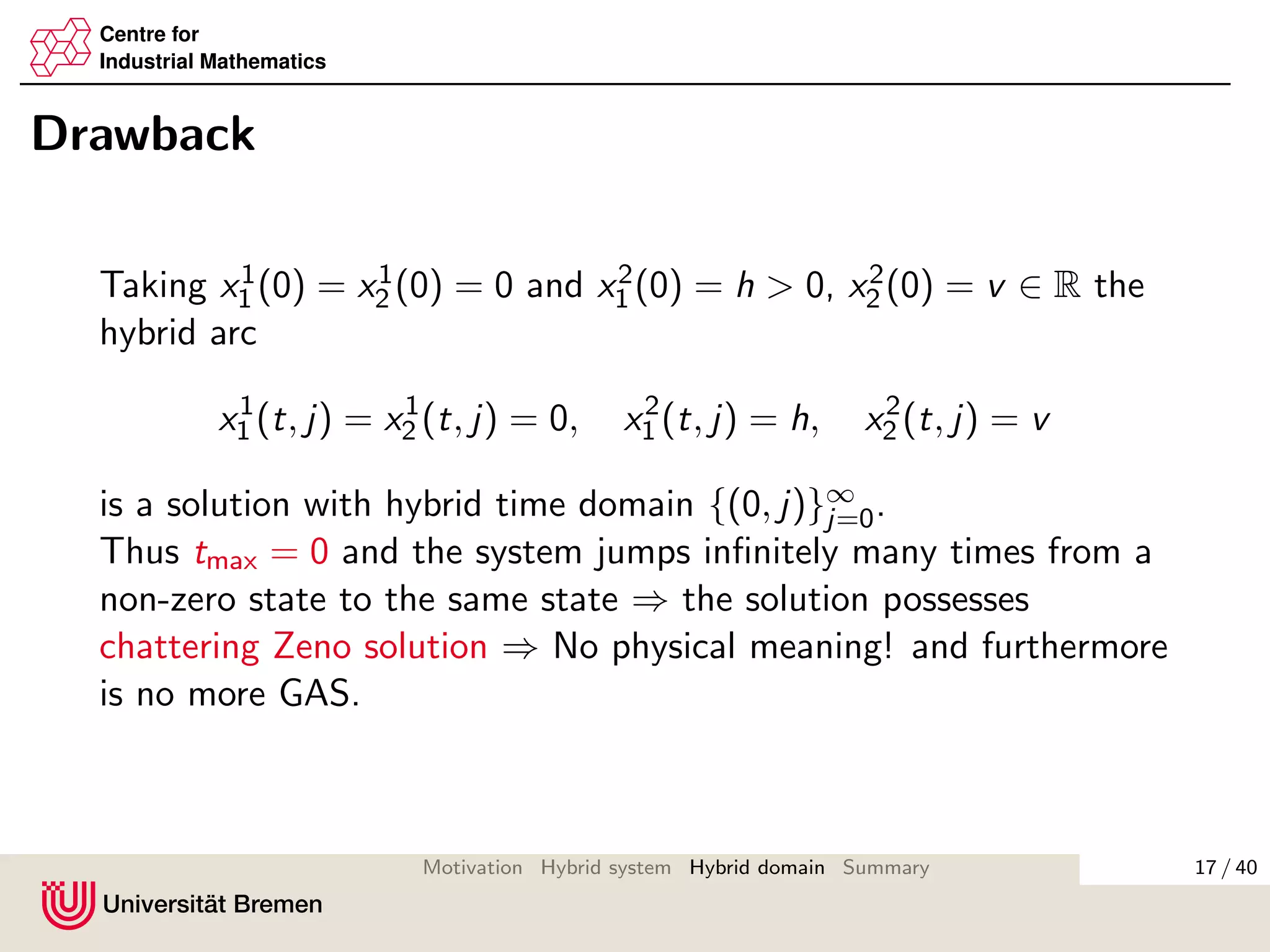
Drawback
Taking x1
1 (0) = x1
2 (0) = 0 and x2
1 (0) = h > 0, x2
2 (0) = v ∈ R the
hybrid arc
x1
1 (t, j) = x1
2 (t, j) = 0, x2
1 (t, j) = h, x2
2 (t, j) = v
is a solution with hybrid time domain {(0, j)}∞
j=0.
Thus tmax = 0 and the system jumps infinitely many times from a
non-zero state to the same state ⇒ the solution possesses
chattering Zeno solution ⇒ No physical meaning! and furthermore
is no more GAS.
17 / 40Motivation Hybrid system Hybrid domain Summary
Centre for
Industrial Mathematics
Our approach
We take into account which of the system can jump by:
IC (x, u):={i : (x, u) ∈ Ci }, ID(x, u):={i : (x, u) ∈ Di }.
Then dynamics is given by
˙xi = fi (x, u), i ∈ IC (x, u),
x+
i = gi (x, u), i ∈ ID(x, u).
Hybrid time domain considers the jumps of the subsystems
separately:
domk1,...,kn := ∪[tk, tk+1] × {k1, . . . , kn} ⊂ R+ × Nn
+,
where k = k1 + · · · + kn and ki ∈ N+ calculates the jumps of
the ith subsystem.
ti
max
18 / 40Motivation Hybrid system Hybrid domain Summary
Centre for
Industrial Mathematics
Solution
(i) (x(0, 0), u(0, 0)) ∈ Ci ∪ Di , ∀i
(ii) for i ∈ IC (x1
1 (t, k), . . . , xn(t, k), u(t, k)),
˙xi (t, k)=fi (x1
1 (min{t, t1
max}, k), . . ., xn(min{t, tn
max}, k), u(t, k))
(iii) for all (t, k) ∈ domk x with (t, k + p) ∈ domk x p ≥ 1
for i ∈ ID(x1
1 (t, k), . . . , xn(t, k), u(t, k),
x+
i (min{t, tk
max}, k+p) =
gi (x1
1 (min{t, t1
max}, k), . . . , xn(min{t, tn
max}, k), u(t, k))
k = (k1, . . . , kn) ∈ Nn
+
19 / 40Motivation Hybrid system Hybrid domain Summary
Centre for
Industrial Mathematics
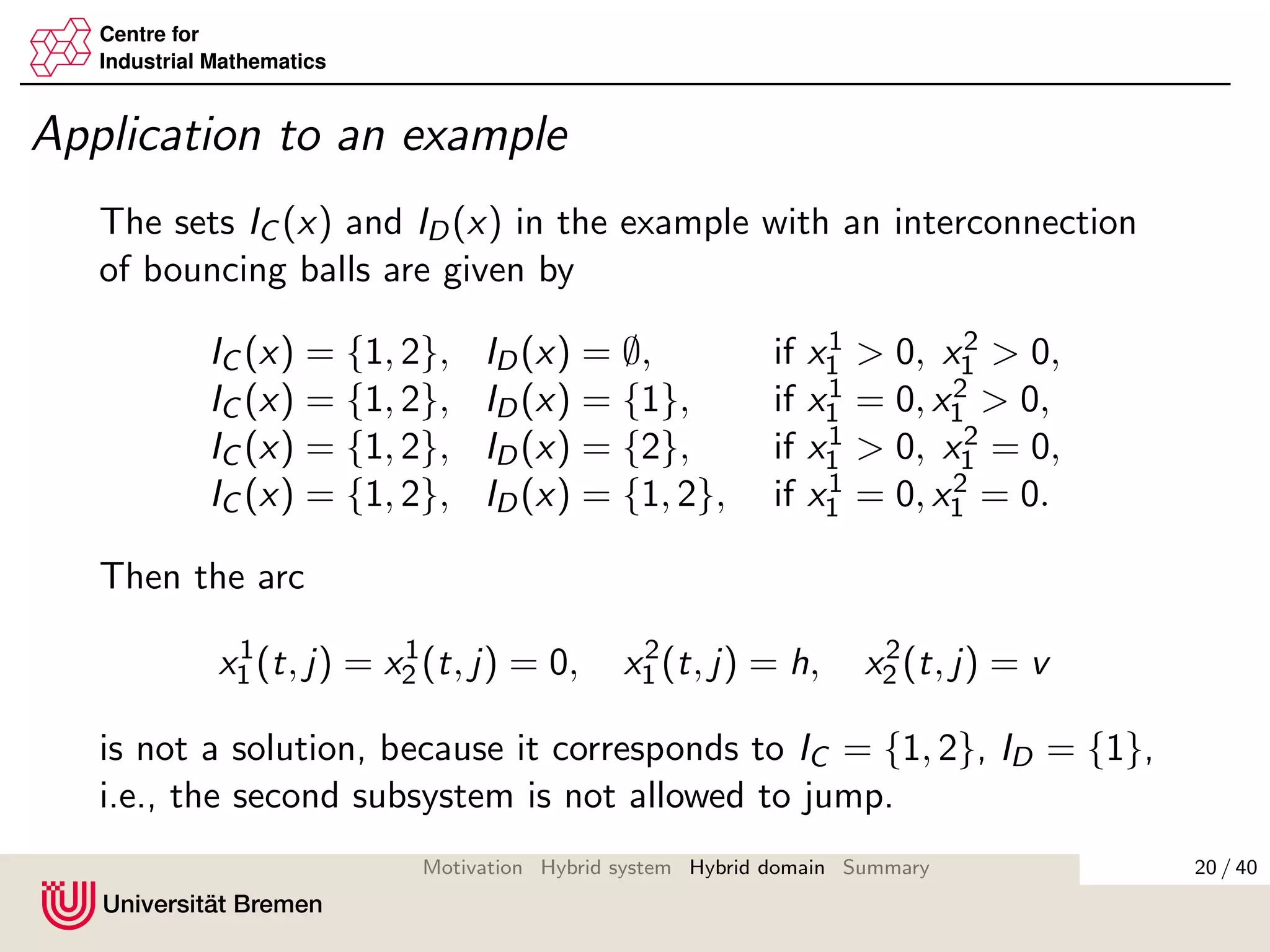
Application to an example
The sets IC (x) and ID(x) in the example with an interconnection
of bouncing balls are given by
IC (x) = {1, 2}, ID(x) = ∅, if x1
1 > 0, x2
1 > 0,
IC (x) = {1, 2}, ID(x) = {1}, if x1
1 = 0, x2
1 > 0,
IC (x) = {1, 2}, ID(x) = {2}, if x1
1 > 0, x2
1 = 0,
IC (x) = {1, 2}, ID(x) = {1, 2}, if x1
1 = 0, x2
1 = 0.
Then the arc
x1
1 (t, j) = x1
2 (t, j) = 0, x2
1 (t, j) = h, x2
2 (t, j) = v
is not a solution, because it corresponds to IC = {1, 2}, ID = {1},
i.e., the second subsystem is not allowed to jump.
20 / 40Motivation Hybrid system Hybrid domain Summary
Centre for
Industrial Mathematics
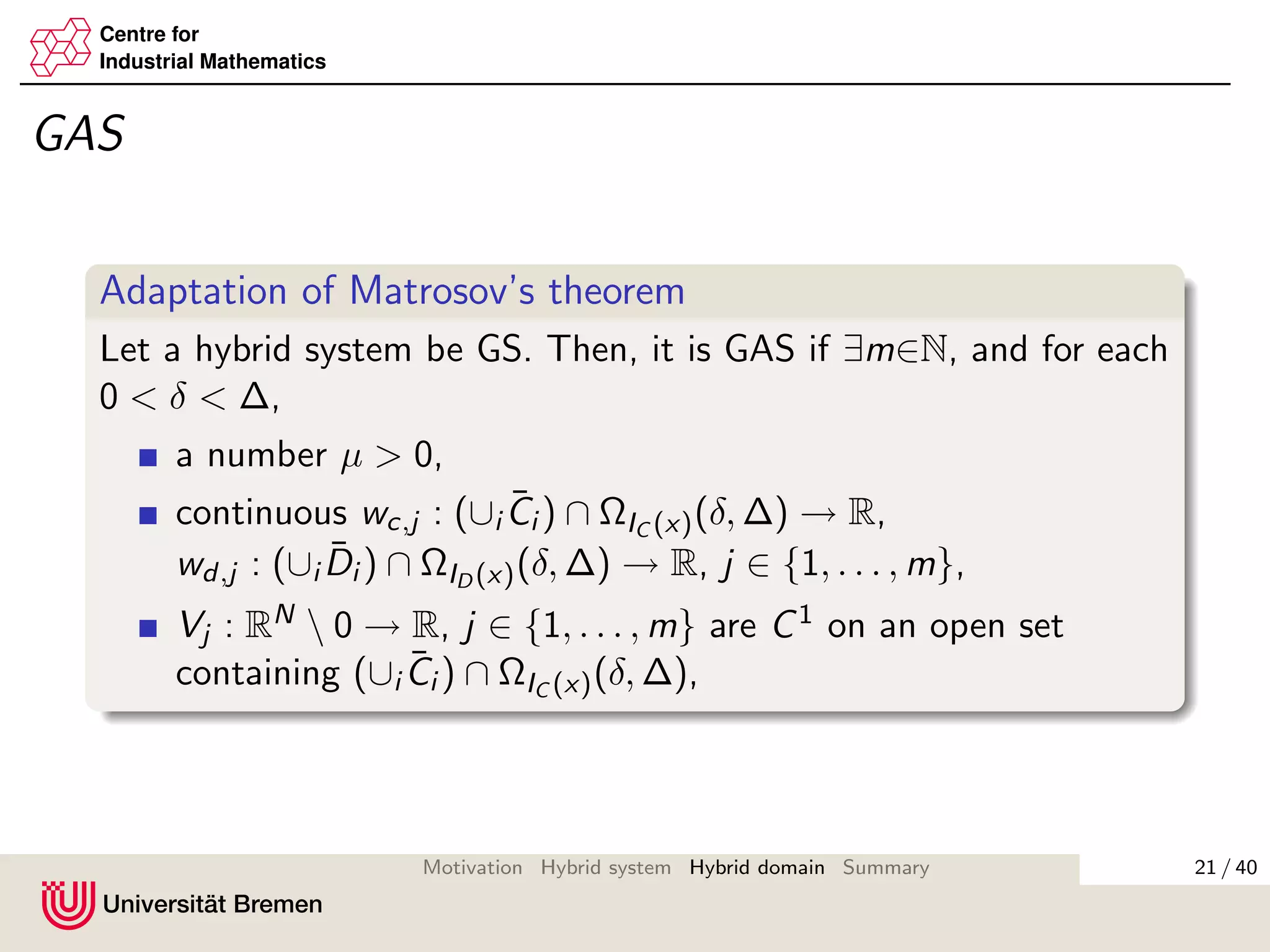
GAS
Adaptation of Matrosov’s theorem
Let a hybrid system be GS. Then, it is GAS if ∃m∈N, and for each
0 < δ < ∆,
a number µ > 0,
continuous wc,j : (∪i
¯Ci ) ∩ ΩIC (x)(δ, ∆) → R,
wd,j : (∪i
¯Di ) ∩ ΩID (x)(δ, ∆) → R, j ∈ {1, . . . , m},
Vj : RN  0 → R, j ∈ {1, . . . , m} are C1 on an open set
containing (∪i
¯Ci ) ∩ ΩIC (x)(δ, ∆),
21 / 40Motivation Hybrid system Hybrid domain Summary
Centre for
Industrial Mathematics
GAS
Adaptation of Matrosov’s theorem (continued)
such that, for each j ∈ {1, . . . , m}
i) |Vj (x)| ≤ µ ∀x ∈ (∪i
¯Ci )∪(∪i Di ) ∪ (∪i gi (Di ))∩Ω(δ, ∆)
ii) Vj (x)IC
, (f T
1 , . . ., f T
n )T
IC
≤wc,j (x), ∀x∈(∪i Ci )∩ΩIC (x)(δ, ∆)
iii)Vj ((gT
1 , . . . , gT
n )T
(˜x))−Vj (˜x)≤wd,j (x), ∀x∈(∪i Di )∩ΩID (x)(δ, ∆)
and with wc,0, wd,0 : RN → {0} and wc,m+1, wd,m+1 : RN → {1}
such that for each l ∈ {0, . . . , m},
1) if x ∈ (∪i
¯Ci ) ∩ Ω(δ, ∆) and wc,j (x) = 0 for all j ∈ {0, . . . , l}
then wc,l+1(x) ≤ 0,
2) if x ∈ (∪i
¯Di ) ∩ Ω(δ, ∆)ID (x) and wd,j (x) = 0 for all
j ∈ {0, . . . , l} then wd,l+1(x) ≤ 0.
22 / 40Motivation Hybrid system Hybrid domain Summary
Centre for
Industrial Mathematics
Application of Matrosov’s theorem to an interconnection
of bouncing balls
System is GS (Sanfelice and Teel 2008).
Define z := (x1, x2)T and
V1(z) := V1(x1, x2) := 1
2(x1
2
2
+ x2
2
2
) + γx1
1 + γx2
1 + k
2 (x2
1 − x1
1 )2
V2(z) := V2(x1, x2) = γx1
2 + γx2
2 .
Consider the following four cases:
both components of the state flow continuously:
˙V1(z) = x1
2 (−kx1
1 + kx2
1 − γ) + x2
2 (kx1
1 − kx2
1 − γ) + γx1
2 +
γx2
2 + k(x2
1 − x1
1 )(x2
2 − x1
2 ) = 0,
˙V2(z) = −2γ2
23 / 40Motivation Hybrid system Hybrid domain Summary
Centre for
Industrial Mathematics
Application of Matrosov’s theorem to an interconnection
of bouncing balls
both components of the state jump:
V1(z+) − V1(z) = −1
2(1 − λ2)x1
2
2
− 1
2(1 − λ2)x2
2
2
,
V2(z+) − V2(z) = −(1 + λ)γ(x1
2 + x2
2 )
the first component of the state jumps and the second flows
continuously:
V1(z+) − V1(z) = −1
2(1 − λ2)x1
2
2
,
V2(z+) − V2(z) = −(1 + λ)γx1
2
the first component of the state flows continuously and the
second jumps:
V1(z+) − V1(z) = −1
2(1 − λ2)x2
2
2
,
V2(z+) − V2(z) = −(1 + λ)γx2
2
Then the interconnected system is GAS.
24 / 40Motivation Hybrid system Hybrid domain Summary
Centre for
Industrial Mathematics
Trajectories
Figure: Trajectories two bouncing
balls connected by a spring.
Figure: Time domain of two
interconnected balls.
25 / 40Motivation Hybrid system Hybrid domain Summary
Centre for
Industrial Mathematics
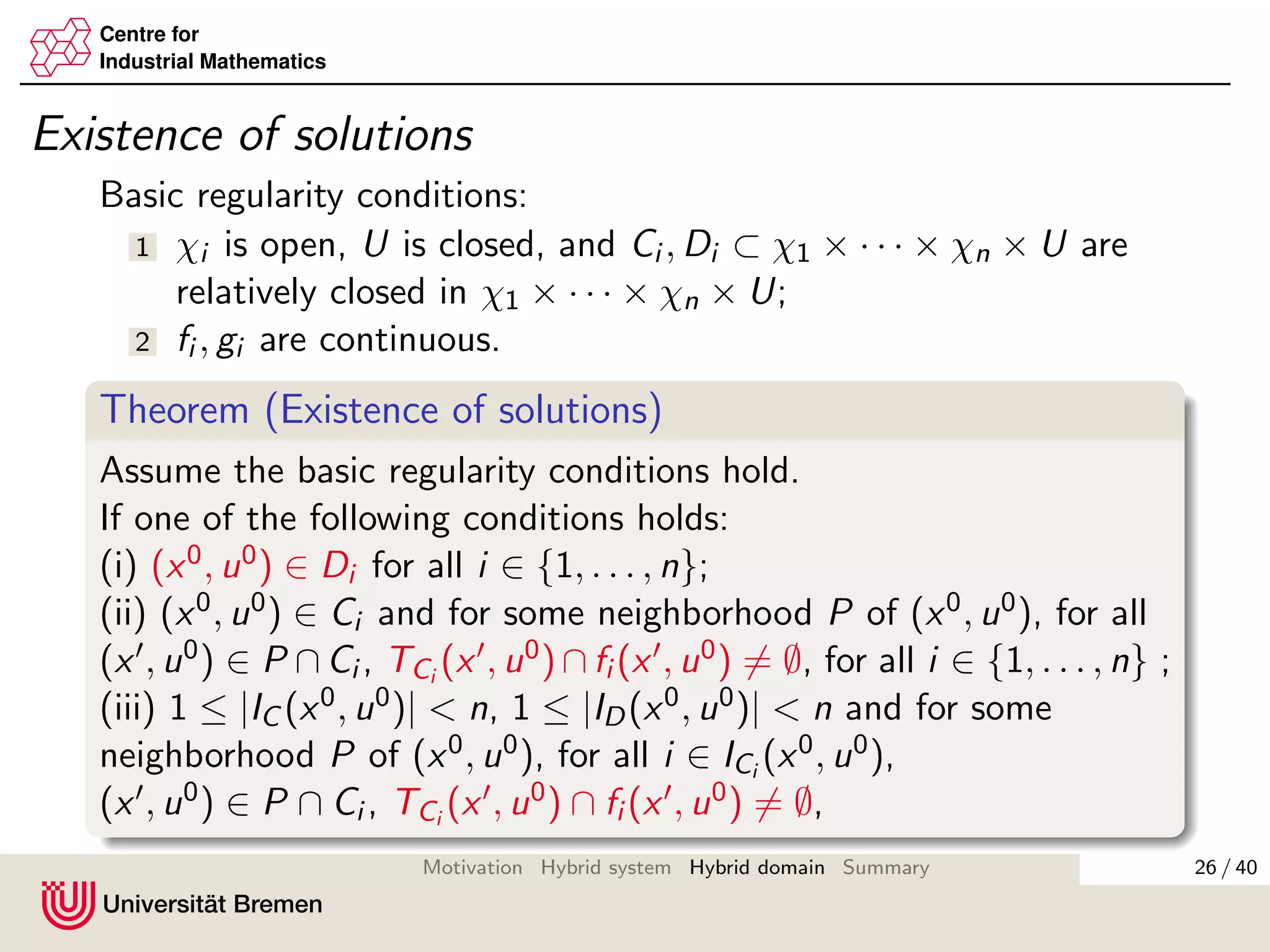
Existence of solutions
Basic regularity conditions:
1 χi is open, U is closed, and Ci , Di ⊂ χ1 × · · · × χn × U are
relatively closed in χ1 × · · · × χn × U;
2 fi , gi are continuous.
Theorem (Existence of solutions)
Assume the basic regularity conditions hold.
If one of the following conditions holds:
(i) (x0, u0) ∈ Di for all i ∈ {1, . . . , n};
(ii) (x0, u0) ∈ Ci and for some neighborhood P of (x0, u0), for all
(x , u0) ∈ P ∩ Ci , TCi
(x , u0) ∩ fi (x , u0) = ∅, for all i ∈ {1, . . . , n} ;
(iii) 1 ≤ |IC (x0, u0)| < n, 1 ≤ |ID(x0, u0)| < n and for some
neighborhood P of (x0, u0), for all i ∈ ICi
(x0, u0),
(x , u0) ∈ P ∩ Ci , TCi
(x , u0) ∩ fi (x , u0) = ∅,
26 / 40Motivation Hybrid system Hybrid domain Summary
Centre for
Industrial Mathematics
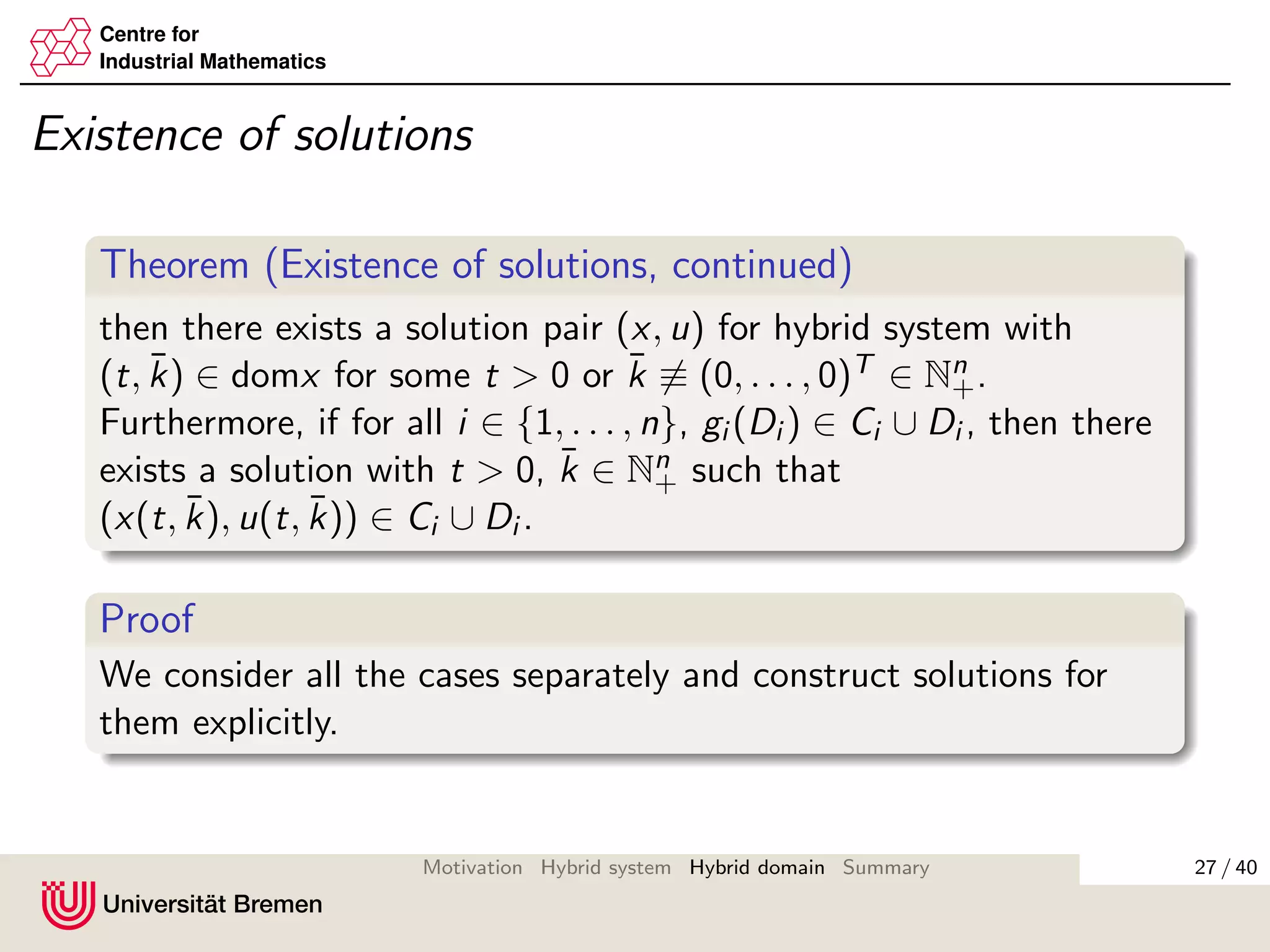
Existence of solutions
Theorem (Existence of solutions, continued)
then there exists a solution pair (x, u) for hybrid system with
(t, ¯k) ∈ domx for some t > 0 or ¯k ≡ (0, . . . , 0)T ∈ Nn
+.
Furthermore, if for all i ∈ {1, . . . , n}, gi (Di ) ∈ Ci ∪ Di , then there
exists a solution with t > 0, ¯k ∈ Nn
+ such that
(x(t, ¯k), u(t, ¯k)) ∈ Ci ∪ Di .
Proof
We consider all the cases separately and construct solutions for
them explicitly.
27 / 40Motivation Hybrid system Hybrid domain Summary
Centre for
Industrial Mathematics
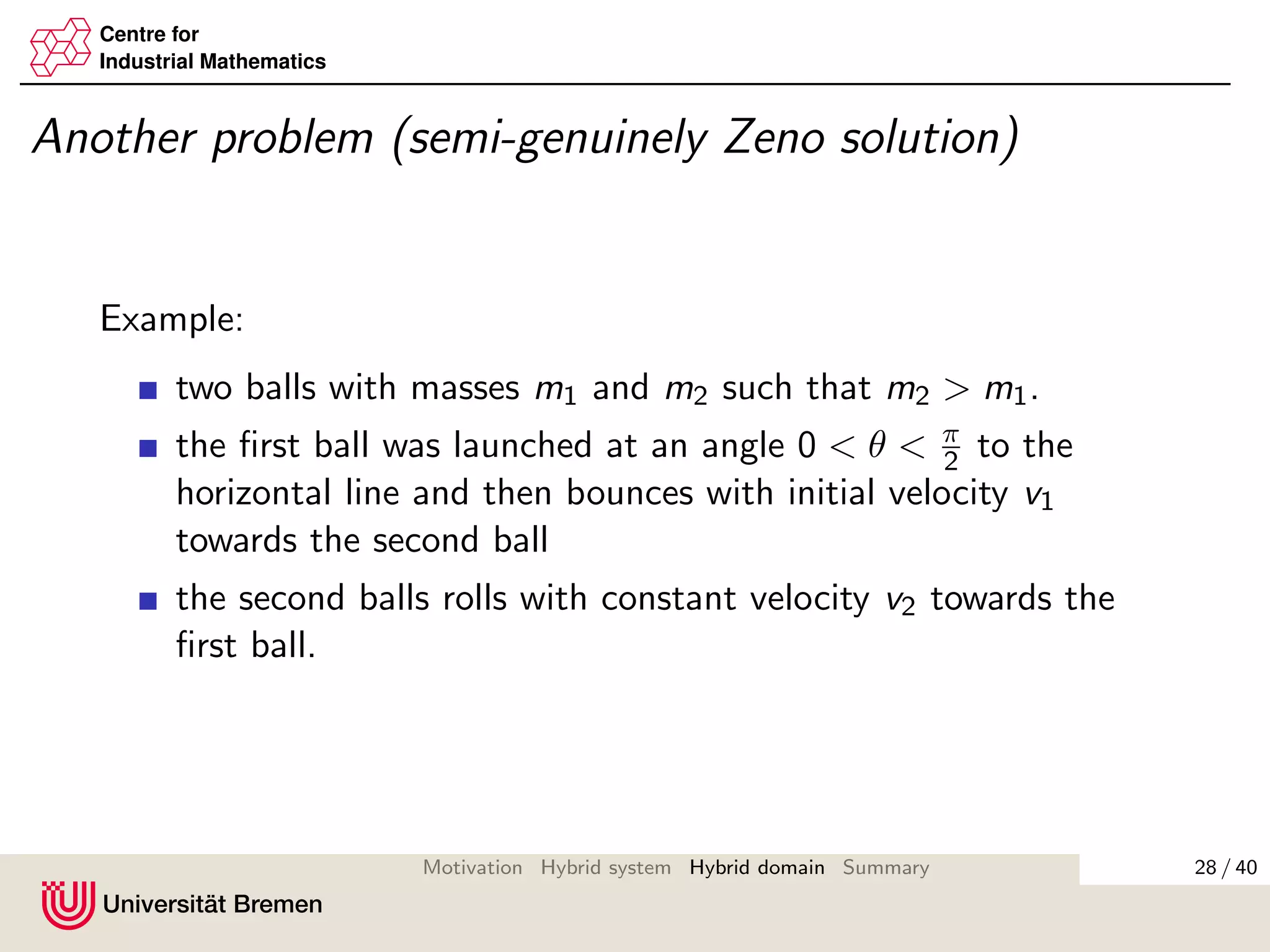
Another problem (semi-genuinely Zeno solution)
Example:
two balls with masses m1 and m2 such that m2 > m1.
the first ball was launched at an angle 0 < θ < π
2 to the
horizontal line and then bounces with initial velocity v1
towards the second ball
the second balls rolls with constant velocity v2 towards the
first ball.
28 / 40Motivation Hybrid system Hybrid domain Summary
Centre for
Industrial Mathematics
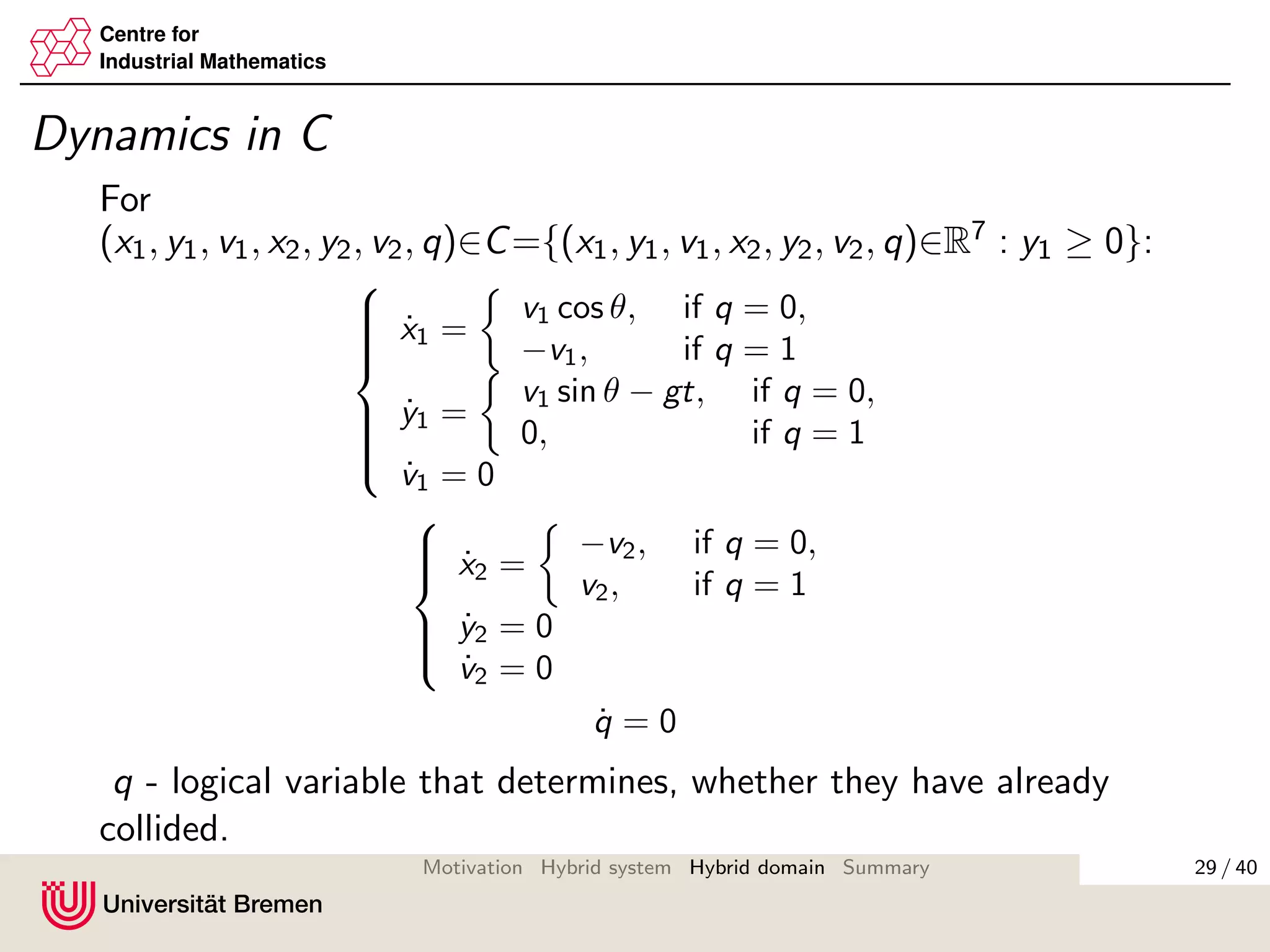
Dynamics in C
For
(x1, y1, v1, x2, y2, v2, q)∈C={(x1, y1, v1, x2, y2, v2, q)∈R7 : y1 ≥ 0}:



˙x1 =
v1 cos θ, if q = 0,
−v1, if q = 1
˙y1 =
v1 sin θ − gt, if q = 0,
0, if q = 1
˙v1 = 0



˙x2 =
−v2, if q = 0,
v2, if q = 1
˙y2 = 0
˙v2 = 0
˙q = 0
q - logical variable that determines, whether they have already
collided.
29 / 40Motivation Hybrid system Hybrid domain Summary
Centre for
Industrial Mathematics
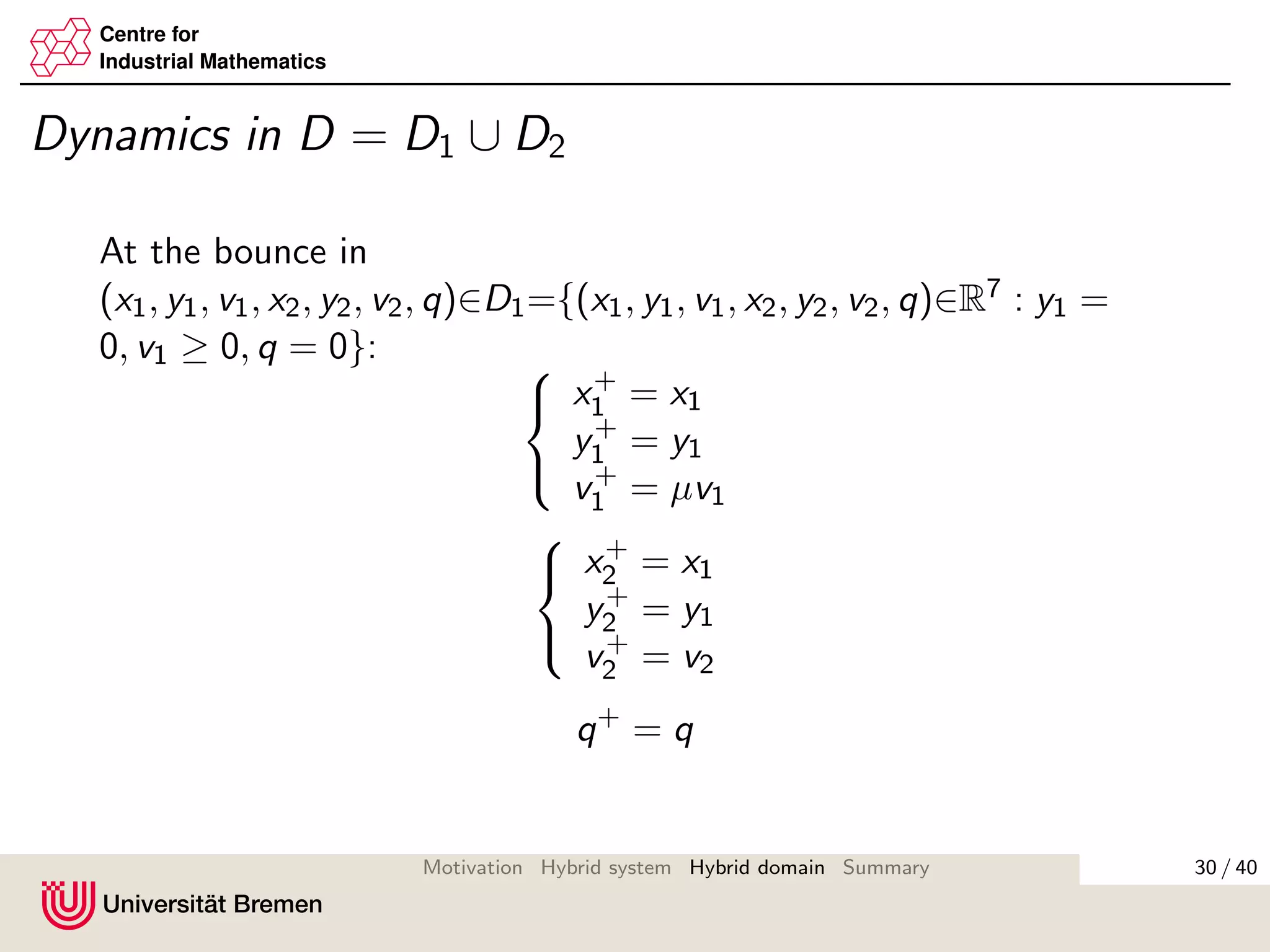
Dynamics in D = D1 ∪ D2
At the bounce in
(x1, y1, v1, x2, y2, v2, q)∈D1={(x1, y1, v1, x2, y2, v2, q)∈R7 : y1 =
0, v1 ≥ 0, q = 0}: 


x+
1 = x1
y+
1 = y1
v+
1 = µv1



x+
2 = x1
y+
2 = y1
v+
2 = v2
q+
= q
30 / 40Motivation Hybrid system Hybrid domain Summary
Centre for
Industrial Mathematics
Dynamics in D = D1 ∪ D2
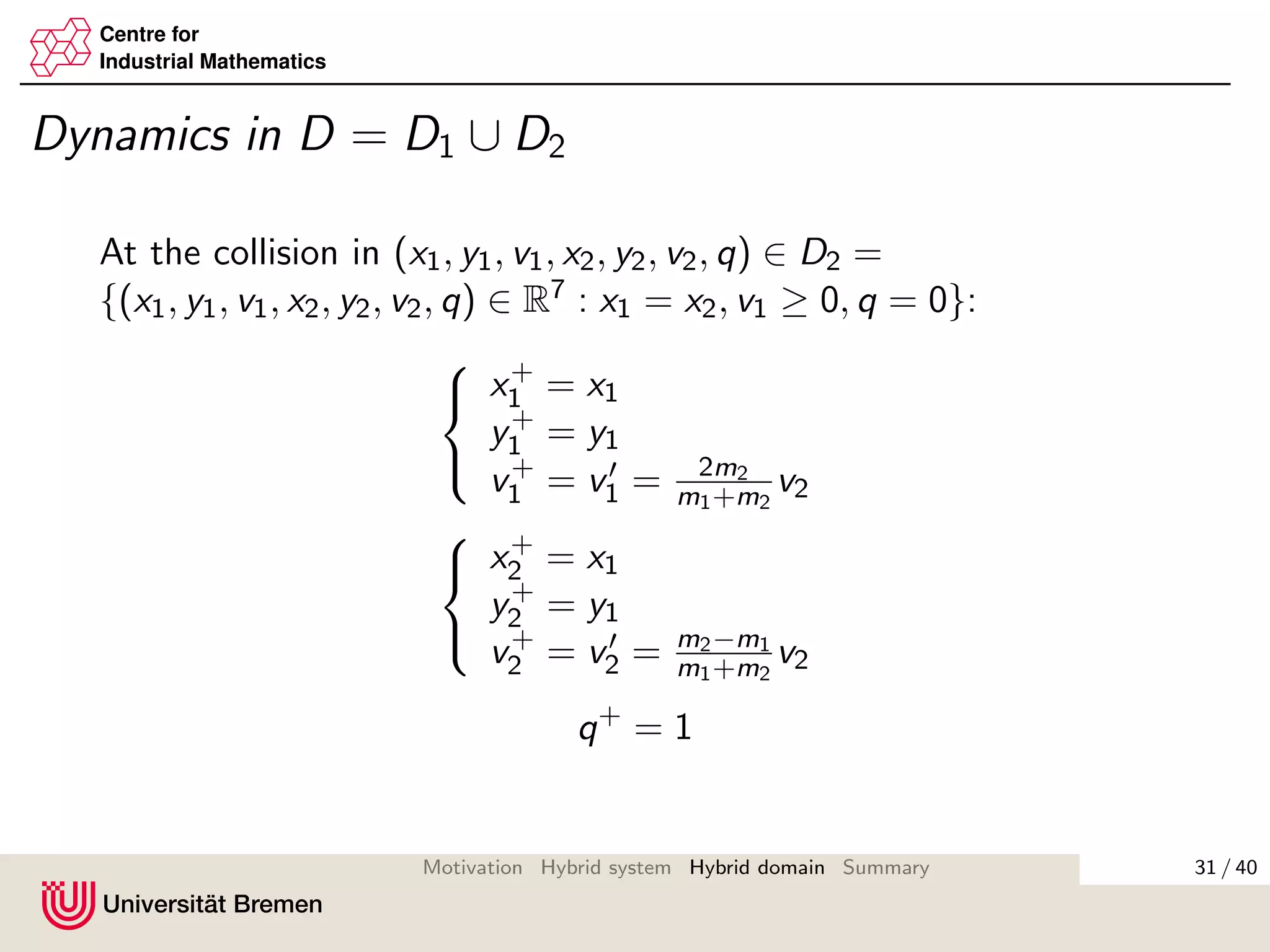
At the collision in (x1, y1, v1, x2, y2, v2, q) ∈ D2 =
{(x1, y1, v1, x2, y2, v2, q) ∈ R7 : x1 = x2, v1 ≥ 0, q = 0}:



x+
1 = x1
y+
1 = y1
v+
1 = v1 = 2m2
m1+m2
v2



x+
2 = x1
y+
2 = y1
v+
2 = v2 = m2−m1
m1+m2
v2
q+
= 1
31 / 40Motivation Hybrid system Hybrid domain Summary
Centre for
Industrial Mathematics
Trajectories
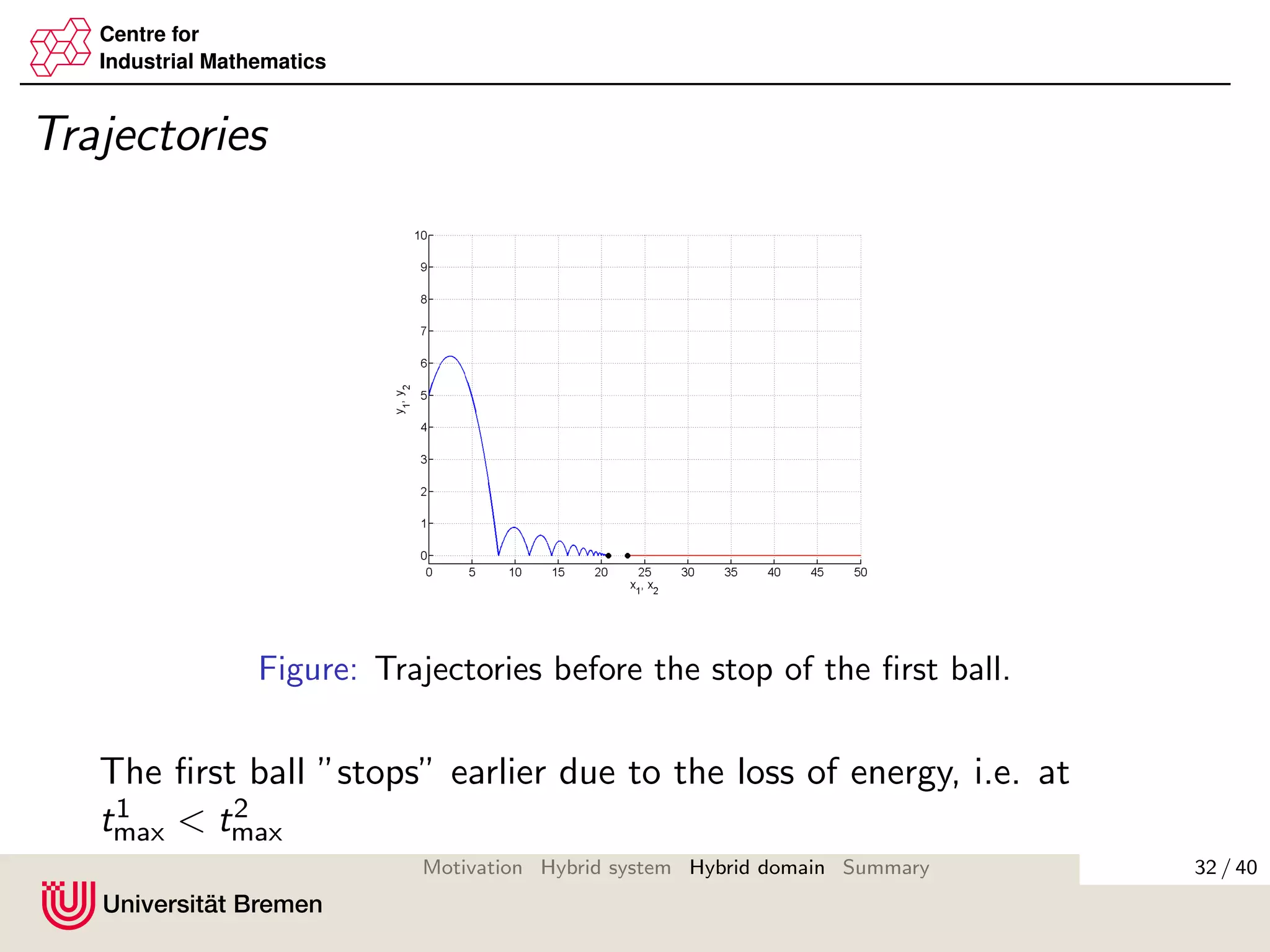
Figure: Trajectories before the stop of the first ball.
The first ball ”stops” earlier due to the loss of energy, i.e. at
t1
max < t2
max
32 / 40Motivation Hybrid system Hybrid domain Summary
Centre for
Industrial Mathematics
Trajectories
Figure: Trajectories before the collision.
After some time the second ball reaches the first, i.e. at
(x1, y1, v1, x2, y2, v2, q) ∈ D2 and they collide.
33 / 40Motivation Hybrid system Hybrid domain Summary
Centre for
Industrial Mathematics
Trajectories
Figure: Trajectories after the collision.
As m2 > m1, the first ball begins to move again in opposite
direction to the second ball.
Thus hybrid time domain of the first ball is extended beyond t1
max!
34 / 40Motivation Hybrid system Hybrid domain Summary
Centre for
Industrial Mathematics
Possible solution
Instead of considering min{t, ti
max}, we consider intervals
[ti,ki
min, ti,ki
max], ki = 0, 1, 2, . . .
where system i is ”active”, and intervals
[ti,ki
max, ti,ki +1
min ],
where system i is ”passive” (in physical sense).
θi (t) :=
t, ti,ki
min < t < ti,ki
max
ti,ki
max, ti,ki
max < t < ti,ki +1
min
identifies, whether at time t the system i is ”active” or ”passive”.
35 / 40Motivation Hybrid system Hybrid domain Summary
Centre for
Industrial Mathematics
Definition of solution
Hybrid arc x and hybrid input u are a solution pair, if
(i) (x(0, 0), u(0, 0)) ∈ Ci ∪ Di , ∀i
(ii) for i ∈ IC (x1
1 (t, k), . . . , xn(t, k), u(t, k)),
˙xi (t, k) = fi (x1
1 (θ1(t), k), . . . , xn(θn(t), k), u(t, k));
(iii) for all (t, k) ∈ domk x with (t, k + p) ∈ domk x where p ≥ 1
for i ∈ ID(x1
1 (t, k), . . . , xn(t, k), u(t, k),
x+
i (θi (t), k + p) = gi (x1
1 (θ1(t), k), . . . , xn(θn(t), k), u(t, k)).
k := (k1, . . . , kn) ∈ Nn
+
36 / 40Motivation Hybrid system Hybrid domain Summary
Centre for
Industrial Mathematics
Application to an example
1 The second ball is always ”active” ⇒ k2 = 0, t2,k2
min = 0,
t2,k2
max = ∞.
2 The first ball first bounces from t1,0
min = 0 till t1,0
max.
3 Then it lies on the floor.
4 At t1,1
min the two balls collide
5 And the first ball flows till t1,1
max = ∞ ⇒ Thus k1 = 1.
37 / 40Motivation Hybrid system Hybrid domain Summary
Centre for
Industrial Mathematics
Existence of solutions
Theorem (Existence of solutions, continued)
then there exists a solution pair (x, u) for hybrid system with
(t, ¯k) ∈ domx for some t > 0 or ¯k ≡ (0, . . . , 0)T ∈ Nn
+.
Furthermore, if for all i ∈ {1, . . . , n}, gi (Di ) ∈ Ci ∪ Di , then there
exists a solution with t > 0, ¯k ∈ Nn
+ such that
(x(t, ¯k), u(t, ¯k)) ∈ Ci ∪ Di .
Proof
For each interval [ti,ki
min, ti,ki +1
min ] we consider all the cases separately
and construct solutions for them explicitly. Then we concatenate
the solutions on the intervals.
38 / 40Motivation Hybrid system Hybrid domain Summary
Centre for
Industrial Mathematics
Conclusion
Hybrid systems allow to describe complex dynamics like
behaviour of logistics networks
Hybrid systems may possess solutions with no physical
meaning (Zeno behaviour) ⇒ hybrid systems have to be used
very carefully
If subsystems in interconnections of hybrid systems possess
Zeno behaviour, one can extend the notion of time domain to
exclude such solutions
39 / 40Motivation Hybrid system Hybrid domain Summary
Centre for
Industrial Mathematics
Thank you for your attention!
40 / 40Motivation Hybrid system Hybrid domain Summary

Interconnections of hybrid systems

  • 1.
    Interconnections of hybridsystems Michael Kosmykov 3. February 2012, Fachhochschule Erfurt
  • 2.
    Centre for Industrial Mathematics Outline 1Motivation 2 Hybrid system 3 Extension of hybrid time domain 4 Conclusion and outlook 2 / 40Motivation Hybrid system Hybrid domain Summary
  • 3.
    Centre for Industrial Mathematics Logisticsnetwork as hybrid system from PhD thesis: 3 production sites (D, F, E) for Liquidring-Vaccum (LRVP), Industrial (IND) and Side-channel (SC) pumps 5 distribution centers (D, NL, B, F, E) 33 first and second-tier suppliers for the production of pumps 90 suppliers for components that are needed for the assembly of pump sets More than 1000 customers 3 / 40Motivation Hybrid system Hybrid domain Summary
  • 4.
    Centre for Industrial Mathematics Logisticsnetwork as hybrid system from PhD thesis: Instability leads to: High inventory costs Large number of unsatisfied orders Loss of customers 3 / 40Motivation Hybrid system Hybrid domain Summary
  • 5.
    Centre for Industrial Mathematics Analysissteps: 1 Mathematical modelling 2 Model reduction, if the model size is large 3 Stability analysis 4 / 40Motivation Hybrid system Hybrid domain Summary
  • 6.
    Centre for Industrial Mathematics Modellingapproaches Discrete system: Decentralized supply chain Re-entrant/queueing system ”Bucket brigade” Continuous system: Ordinary differential equations - Damped oscillator model Multilevel network Partial differential equations Hybrid model: Hybrid system Switched system Stochastic system: Stochastic system Queueing/fluid network 5 / 40Motivation Hybrid system Hybrid domain Summary
  • 7.
    Centre for Industrial Mathematics Hybridsystem xi - state of logistics location Σi (stock level) u - external input (customer orders, raw material) State xi changes continuously during production. Σi t0 xi (0) xi (t) xi 6 / 40Motivation Hybrid system Hybrid domain Summary
  • 8.
    Centre for Industrial Mathematics Hybridsystem xi - state of logistics location Σi (stock level) u - external input (customer orders, raw material) When a truck picks up finished material, state xi ”jumps”. Σi t0 xi (0) xi (t) t1 xi 6 / 40Motivation Hybrid system Hybrid domain Summary
  • 9.
    Centre for Industrial Mathematics Hybridsystem xi - state of logistics location Σi (stock level) u - external input (customer orders, raw material) After the jump state xi changes again continuously. Σi t0 xi (0) xi (t) t1 xi 6 / 40Motivation Hybrid system Hybrid domain Summary
  • 10.
    Centre for Industrial Mathematics Hybridsystem xi - state of logistics location Σi (stock level) u - external input (customer orders, raw material) Hybrid dynamics of location Σi : ˙xi = fi (x1, . . . , xn, u), (x1, . . . , xn, u)∈Ci production x+ i = gi (x1, . . . , xn, u), (x1, . . . , xn, u)∈Di transportation Σi t0 xi (0) xi (t) t1 t2 t3 xi 6 / 40Motivation Hybrid system Hybrid domain Summary
  • 11.
    Centre for Industrial Mathematics Hybridsystem The whole network Σ is given by interconnection of individual locations: Hybrid dynamics of the whole logistics network Σ: ˙x = ?, (x1, . . . , xn, u) ∈ C =? overall production x+ = ?, (x1, . . . , xn, u) ∈ D =? overall transportation 7 / 40Motivation Hybrid system Hybrid domain Summary
  • 12.
    Centre for Industrial Mathematics Hybridsystem (Teel’s framework) Σi : ˙xi = fi (x1, . . . , xn, u), (x1, . . . , xn, u)∈Ci x+ i = gi (x1, . . . , xn, u), (x1, . . . , xn, u)∈Di xi ∈χi ⊂RNi ,fi :Ci →RNi ,gi :Di →χi ,Ci , Di ⊂χ1×. . .×χn×U1×. . .×Un. 8 / 40Motivation Hybrid system Hybrid domain Summary
  • 13.
    Centre for Industrial Mathematics Hybridsystem (Teel’s framework) Σi : ˙xi = fi (x1, . . . , xn, u), (x1, . . . , xn, u)∈Ci x+ i = gi (x1, . . . , xn, u), (x1, . . . , xn, u)∈Di xi ∈χi ⊂RNi ,fi :Ci →RNi ,gi :Di →χi ,Ci , Di ⊂χ1×. . .×χn×U1×. . .×Un. Basic regularity conditions for ∃ of solutions (Goebel & Teel 2006): fi , gi are continuous; Ci , Di are closed. 8 / 40Motivation Hybrid system Hybrid domain Summary
  • 14.
    Centre for Industrial Mathematics Hybridsystem (Teel’s framework) Σi : ˙xi = fi (x1, . . . , xn, u), (x1, . . . , xn, u)∈Ci x+ i = gi (x1, . . . , xn, u), (x1, . . . , xn, u)∈Di xi ∈χi ⊂RNi ,fi :Ci →RNi ,gi :Di →χi ,Ci , Di ⊂χ1×. . .×χn×U1×. . .×Un. Basic regularity conditions for ∃ of solutions (Goebel & Teel 2006): fi , gi are continuous; Ci , Di are closed. Solution xi (t, k) is defined on hybrid time domain: dom xi := ∪[tk, tk+1]×{k} t is time and k is number of the last jump. 8 / 40Motivation Hybrid system Hybrid domain Summary
  • 15.
    Centre for Industrial Mathematics Stabilitynotions Global stability (GS) Hybrid system is called globally stable (GS), if there exists σ ∈ K∞ such that any solution x satisfies |x(t, k)| ≤ σ(|x0|), ∀(t, k) ∈ dom x. Global attractivity (GA) Hybrid system is called globally attractive (GA), if for each > 0 and r > 0 there exists T > 0 such that, for any solution x, |x(0, 0)| ≤ r, (t, k) ∈ dom, x, and t + k ≥ T imply |x(t, k)| ≤ . Global asymptotical stability (GAS) Hybrid system is called globally asymptotically stable (GAS), if it is both GS and GA. 9 / 40Motivation Hybrid system Hybrid domain Summary
  • 16.
    Centre for Industrial Mathematics Example:Bouncing ball ˙x= x2 −γ =:f (x), x∈C, x+= x1 −λx2 =:g(x), x∈D. x1 - height x2 - velocity C := {(x, u) ∈ R2 × U : x1 ≥ 0}, D := {(x, u) ∈ R2 × U : x1 = 0, x2 ≤ 0}, γ - gravitation force, λ ∈ (0, 1) - restitution coefficient 10 / 40Motivation Hybrid system Hybrid domain Summary
  • 17.
    Centre for Industrial Mathematics Example:Bouncing ball Figure: Trajectory of the bouncing ball. Figure: Time domain of the bouncing ball. 11 / 40Motivation Hybrid system Hybrid domain Summary
  • 18.
    Centre for Industrial Mathematics Zenosolutions Definition (Ames et. al. 2006) The solution (x, u) possesses: chattering Zeno behaviour, if there exists a finite K ≥ 0 such that (t, k), (t, k + 1) ∈ dom x for all k ≥ K; genuinely Zeno behaviour, if there exists a finite T ≥ 0 such that for all (s, k), (t, k + 1) ∈ dom x, s < t < T. Bouncing ball possesses the genuinely Zeno behaviour with T = tmax = 2h γ + 2λ 1−λ 2h γ . Furthermore, it is GAS (Sanfelice and Teel 2008). 12 / 40Motivation Hybrid system Hybrid domain Summary
  • 19.
    Centre for Industrial Mathematics Interconnectionof hybrid systems Σ: ˙x = f (x, u), (x, u)∈C x+ = g(x, u), (x, u)∈D χ:=χ1×. . .×χn, x:=(xT 1 , . . ., xT n )T ∈χ⊂RN, N:= Ni , C:= ∩ Ci , D:= ∪ Di , f :=(f T 1 , . . ., f T n )T , g:=(gT 1 , . . ., gT n )T with gi (x, u) := gi (x, ui ), if (x, u) ∈ Di , xi , otherwise . 13 / 40Motivation Hybrid system Hybrid domain Summary
  • 20.
    Centre for Industrial Mathematics Exampleof interconnection of hybrid systems two bouncing balls with states x1 ∈ R2 and x2 ∈ R2 respectively. they are interconnected by an elastic elastic coefficient k ≥ 0 horizontal distance between the balls is neglected the balls do not hit each other. The interaction force due to the elastic spring is given by ±k(x1 1 − x2 1 ). 14 / 40Motivation Hybrid system Hybrid domain Summary
  • 21.
    Centre for Industrial Mathematics Exampleof interconnection of hybrid systems Their dynamics is given by: First ball ˙x1 = x1 2 −γ − k(x1 1 − x2 1 ) , (x1 , x2 ) ∈ C1 ={(x1 , x2 ) ∈ R4 : x1 1 ≥ 0}, x1+ = x1 1 −λx1 2 , (x1 , x2 ) ∈ D1 ={(x1 , x2 ) ∈ R4 : x1 1 = 0, x1 2 ≤ 0}, Second ball ˙x2 = x2 2 −γ + k(x1 1 − x2 1 ) , (x1 , x2 ) ∈ C2 ={(x1 , x2 ) ∈ R4 : x2 1 ≥ 0}, x2+ = x2 1 −λx2 2 , (x1 , x2 ) ∈ D2 ={(x1 , x2 ) ∈ R4 : x2 1 = 0, x2 2 ≤ 0}, 15 / 40Motivation Hybrid system Hybrid domain Summary
  • 22.
    Centre for Industrial Mathematics Exampleof interconnection of hybrid systems Dynamics of interconnection ˙z = f (z), z ∈ C := C1 ∩ C2, z+ = g(z), z ∈ D := D1 ∪ D2 ∈ R4, where z := (x1T , x2T )T , f (z) := (f 1T , f 2T )T , g(z) := (g1T , g2T )T , gi (z) = gi (x1 , x2 ) := gi (x1, x2), if (x1, x2) ∈ Di , xi , otherwise . 16 / 40Motivation Hybrid system Hybrid domain Summary
  • 23.
    Centre for Industrial Mathematics Drawback Takingx1 1 (0) = x1 2 (0) = 0 and x2 1 (0) = h > 0, x2 2 (0) = v ∈ R the hybrid arc x1 1 (t, j) = x1 2 (t, j) = 0, x2 1 (t, j) = h, x2 2 (t, j) = v is a solution with hybrid time domain {(0, j)}∞ j=0. Thus tmax = 0 and the system jumps infinitely many times from a non-zero state to the same state ⇒ the solution possesses chattering Zeno solution ⇒ No physical meaning! and furthermore is no more GAS. 17 / 40Motivation Hybrid system Hybrid domain Summary
  • 24.
    Centre for Industrial Mathematics Ourapproach We take into account which of the system can jump by: IC (x, u):={i : (x, u) ∈ Ci }, ID(x, u):={i : (x, u) ∈ Di }. Then dynamics is given by ˙xi = fi (x, u), i ∈ IC (x, u), x+ i = gi (x, u), i ∈ ID(x, u). Hybrid time domain considers the jumps of the subsystems separately: domk1,...,kn := ∪[tk, tk+1] × {k1, . . . , kn} ⊂ R+ × Nn +, where k = k1 + · · · + kn and ki ∈ N+ calculates the jumps of the ith subsystem. ti max 18 / 40Motivation Hybrid system Hybrid domain Summary
  • 25.
    Centre for Industrial Mathematics Solution (i)(x(0, 0), u(0, 0)) ∈ Ci ∪ Di , ∀i (ii) for i ∈ IC (x1 1 (t, k), . . . , xn(t, k), u(t, k)), ˙xi (t, k)=fi (x1 1 (min{t, t1 max}, k), . . ., xn(min{t, tn max}, k), u(t, k)) (iii) for all (t, k) ∈ domk x with (t, k + p) ∈ domk x p ≥ 1 for i ∈ ID(x1 1 (t, k), . . . , xn(t, k), u(t, k), x+ i (min{t, tk max}, k+p) = gi (x1 1 (min{t, t1 max}, k), . . . , xn(min{t, tn max}, k), u(t, k)) k = (k1, . . . , kn) ∈ Nn + 19 / 40Motivation Hybrid system Hybrid domain Summary
  • 26.
    Centre for Industrial Mathematics Applicationto an example The sets IC (x) and ID(x) in the example with an interconnection of bouncing balls are given by IC (x) = {1, 2}, ID(x) = ∅, if x1 1 > 0, x2 1 > 0, IC (x) = {1, 2}, ID(x) = {1}, if x1 1 = 0, x2 1 > 0, IC (x) = {1, 2}, ID(x) = {2}, if x1 1 > 0, x2 1 = 0, IC (x) = {1, 2}, ID(x) = {1, 2}, if x1 1 = 0, x2 1 = 0. Then the arc x1 1 (t, j) = x1 2 (t, j) = 0, x2 1 (t, j) = h, x2 2 (t, j) = v is not a solution, because it corresponds to IC = {1, 2}, ID = {1}, i.e., the second subsystem is not allowed to jump. 20 / 40Motivation Hybrid system Hybrid domain Summary
  • 27.
    Centre for Industrial Mathematics GAS Adaptationof Matrosov’s theorem Let a hybrid system be GS. Then, it is GAS if ∃m∈N, and for each 0 < δ < ∆, a number µ > 0, continuous wc,j : (∪i ¯Ci ) ∩ ΩIC (x)(δ, ∆) → R, wd,j : (∪i ¯Di ) ∩ ΩID (x)(δ, ∆) → R, j ∈ {1, . . . , m}, Vj : RN 0 → R, j ∈ {1, . . . , m} are C1 on an open set containing (∪i ¯Ci ) ∩ ΩIC (x)(δ, ∆), 21 / 40Motivation Hybrid system Hybrid domain Summary
  • 28.
    Centre for Industrial Mathematics GAS Adaptationof Matrosov’s theorem (continued) such that, for each j ∈ {1, . . . , m} i) |Vj (x)| ≤ µ ∀x ∈ (∪i ¯Ci )∪(∪i Di ) ∪ (∪i gi (Di ))∩Ω(δ, ∆) ii) Vj (x)IC , (f T 1 , . . ., f T n )T IC ≤wc,j (x), ∀x∈(∪i Ci )∩ΩIC (x)(δ, ∆) iii)Vj ((gT 1 , . . . , gT n )T (˜x))−Vj (˜x)≤wd,j (x), ∀x∈(∪i Di )∩ΩID (x)(δ, ∆) and with wc,0, wd,0 : RN → {0} and wc,m+1, wd,m+1 : RN → {1} such that for each l ∈ {0, . . . , m}, 1) if x ∈ (∪i ¯Ci ) ∩ Ω(δ, ∆) and wc,j (x) = 0 for all j ∈ {0, . . . , l} then wc,l+1(x) ≤ 0, 2) if x ∈ (∪i ¯Di ) ∩ Ω(δ, ∆)ID (x) and wd,j (x) = 0 for all j ∈ {0, . . . , l} then wd,l+1(x) ≤ 0. 22 / 40Motivation Hybrid system Hybrid domain Summary
  • 29.
    Centre for Industrial Mathematics Applicationof Matrosov’s theorem to an interconnection of bouncing balls System is GS (Sanfelice and Teel 2008). Define z := (x1, x2)T and V1(z) := V1(x1, x2) := 1 2(x1 2 2 + x2 2 2 ) + γx1 1 + γx2 1 + k 2 (x2 1 − x1 1 )2 V2(z) := V2(x1, x2) = γx1 2 + γx2 2 . Consider the following four cases: both components of the state flow continuously: ˙V1(z) = x1 2 (−kx1 1 + kx2 1 − γ) + x2 2 (kx1 1 − kx2 1 − γ) + γx1 2 + γx2 2 + k(x2 1 − x1 1 )(x2 2 − x1 2 ) = 0, ˙V2(z) = −2γ2 23 / 40Motivation Hybrid system Hybrid domain Summary
  • 30.
    Centre for Industrial Mathematics Applicationof Matrosov’s theorem to an interconnection of bouncing balls both components of the state jump: V1(z+) − V1(z) = −1 2(1 − λ2)x1 2 2 − 1 2(1 − λ2)x2 2 2 , V2(z+) − V2(z) = −(1 + λ)γ(x1 2 + x2 2 ) the first component of the state jumps and the second flows continuously: V1(z+) − V1(z) = −1 2(1 − λ2)x1 2 2 , V2(z+) − V2(z) = −(1 + λ)γx1 2 the first component of the state flows continuously and the second jumps: V1(z+) − V1(z) = −1 2(1 − λ2)x2 2 2 , V2(z+) − V2(z) = −(1 + λ)γx2 2 Then the interconnected system is GAS. 24 / 40Motivation Hybrid system Hybrid domain Summary
  • 31.
    Centre for Industrial Mathematics Trajectories Figure:Trajectories two bouncing balls connected by a spring. Figure: Time domain of two interconnected balls. 25 / 40Motivation Hybrid system Hybrid domain Summary
  • 32.
    Centre for Industrial Mathematics Existenceof solutions Basic regularity conditions: 1 χi is open, U is closed, and Ci , Di ⊂ χ1 × · · · × χn × U are relatively closed in χ1 × · · · × χn × U; 2 fi , gi are continuous. Theorem (Existence of solutions) Assume the basic regularity conditions hold. If one of the following conditions holds: (i) (x0, u0) ∈ Di for all i ∈ {1, . . . , n}; (ii) (x0, u0) ∈ Ci and for some neighborhood P of (x0, u0), for all (x , u0) ∈ P ∩ Ci , TCi (x , u0) ∩ fi (x , u0) = ∅, for all i ∈ {1, . . . , n} ; (iii) 1 ≤ |IC (x0, u0)| < n, 1 ≤ |ID(x0, u0)| < n and for some neighborhood P of (x0, u0), for all i ∈ ICi (x0, u0), (x , u0) ∈ P ∩ Ci , TCi (x , u0) ∩ fi (x , u0) = ∅, 26 / 40Motivation Hybrid system Hybrid domain Summary
  • 33.
    Centre for Industrial Mathematics Existenceof solutions Theorem (Existence of solutions, continued) then there exists a solution pair (x, u) for hybrid system with (t, ¯k) ∈ domx for some t > 0 or ¯k ≡ (0, . . . , 0)T ∈ Nn +. Furthermore, if for all i ∈ {1, . . . , n}, gi (Di ) ∈ Ci ∪ Di , then there exists a solution with t > 0, ¯k ∈ Nn + such that (x(t, ¯k), u(t, ¯k)) ∈ Ci ∪ Di . Proof We consider all the cases separately and construct solutions for them explicitly. 27 / 40Motivation Hybrid system Hybrid domain Summary
  • 34.
    Centre for Industrial Mathematics Anotherproblem (semi-genuinely Zeno solution) Example: two balls with masses m1 and m2 such that m2 > m1. the first ball was launched at an angle 0 < θ < π 2 to the horizontal line and then bounces with initial velocity v1 towards the second ball the second balls rolls with constant velocity v2 towards the first ball. 28 / 40Motivation Hybrid system Hybrid domain Summary
  • 35.
    Centre for Industrial Mathematics Dynamicsin C For (x1, y1, v1, x2, y2, v2, q)∈C={(x1, y1, v1, x2, y2, v2, q)∈R7 : y1 ≥ 0}:    ˙x1 = v1 cos θ, if q = 0, −v1, if q = 1 ˙y1 = v1 sin θ − gt, if q = 0, 0, if q = 1 ˙v1 = 0    ˙x2 = −v2, if q = 0, v2, if q = 1 ˙y2 = 0 ˙v2 = 0 ˙q = 0 q - logical variable that determines, whether they have already collided. 29 / 40Motivation Hybrid system Hybrid domain Summary
  • 36.
    Centre for Industrial Mathematics Dynamicsin D = D1 ∪ D2 At the bounce in (x1, y1, v1, x2, y2, v2, q)∈D1={(x1, y1, v1, x2, y2, v2, q)∈R7 : y1 = 0, v1 ≥ 0, q = 0}:    x+ 1 = x1 y+ 1 = y1 v+ 1 = µv1    x+ 2 = x1 y+ 2 = y1 v+ 2 = v2 q+ = q 30 / 40Motivation Hybrid system Hybrid domain Summary
  • 37.
    Centre for Industrial Mathematics Dynamicsin D = D1 ∪ D2 At the collision in (x1, y1, v1, x2, y2, v2, q) ∈ D2 = {(x1, y1, v1, x2, y2, v2, q) ∈ R7 : x1 = x2, v1 ≥ 0, q = 0}:    x+ 1 = x1 y+ 1 = y1 v+ 1 = v1 = 2m2 m1+m2 v2    x+ 2 = x1 y+ 2 = y1 v+ 2 = v2 = m2−m1 m1+m2 v2 q+ = 1 31 / 40Motivation Hybrid system Hybrid domain Summary
  • 38.
    Centre for Industrial Mathematics Trajectories Figure:Trajectories before the stop of the first ball. The first ball ”stops” earlier due to the loss of energy, i.e. at t1 max < t2 max 32 / 40Motivation Hybrid system Hybrid domain Summary
  • 39.
    Centre for Industrial Mathematics Trajectories Figure:Trajectories before the collision. After some time the second ball reaches the first, i.e. at (x1, y1, v1, x2, y2, v2, q) ∈ D2 and they collide. 33 / 40Motivation Hybrid system Hybrid domain Summary
  • 40.
    Centre for Industrial Mathematics Trajectories Figure:Trajectories after the collision. As m2 > m1, the first ball begins to move again in opposite direction to the second ball. Thus hybrid time domain of the first ball is extended beyond t1 max! 34 / 40Motivation Hybrid system Hybrid domain Summary
  • 41.
    Centre for Industrial Mathematics Possiblesolution Instead of considering min{t, ti max}, we consider intervals [ti,ki min, ti,ki max], ki = 0, 1, 2, . . . where system i is ”active”, and intervals [ti,ki max, ti,ki +1 min ], where system i is ”passive” (in physical sense). θi (t) := t, ti,ki min < t < ti,ki max ti,ki max, ti,ki max < t < ti,ki +1 min identifies, whether at time t the system i is ”active” or ”passive”. 35 / 40Motivation Hybrid system Hybrid domain Summary
  • 42.
    Centre for Industrial Mathematics Definitionof solution Hybrid arc x and hybrid input u are a solution pair, if (i) (x(0, 0), u(0, 0)) ∈ Ci ∪ Di , ∀i (ii) for i ∈ IC (x1 1 (t, k), . . . , xn(t, k), u(t, k)), ˙xi (t, k) = fi (x1 1 (θ1(t), k), . . . , xn(θn(t), k), u(t, k)); (iii) for all (t, k) ∈ domk x with (t, k + p) ∈ domk x where p ≥ 1 for i ∈ ID(x1 1 (t, k), . . . , xn(t, k), u(t, k), x+ i (θi (t), k + p) = gi (x1 1 (θ1(t), k), . . . , xn(θn(t), k), u(t, k)). k := (k1, . . . , kn) ∈ Nn + 36 / 40Motivation Hybrid system Hybrid domain Summary
  • 43.
    Centre for Industrial Mathematics Applicationto an example 1 The second ball is always ”active” ⇒ k2 = 0, t2,k2 min = 0, t2,k2 max = ∞. 2 The first ball first bounces from t1,0 min = 0 till t1,0 max. 3 Then it lies on the floor. 4 At t1,1 min the two balls collide 5 And the first ball flows till t1,1 max = ∞ ⇒ Thus k1 = 1. 37 / 40Motivation Hybrid system Hybrid domain Summary
  • 44.
    Centre for Industrial Mathematics Existenceof solutions Theorem (Existence of solutions, continued) then there exists a solution pair (x, u) for hybrid system with (t, ¯k) ∈ domx for some t > 0 or ¯k ≡ (0, . . . , 0)T ∈ Nn +. Furthermore, if for all i ∈ {1, . . . , n}, gi (Di ) ∈ Ci ∪ Di , then there exists a solution with t > 0, ¯k ∈ Nn + such that (x(t, ¯k), u(t, ¯k)) ∈ Ci ∪ Di . Proof For each interval [ti,ki min, ti,ki +1 min ] we consider all the cases separately and construct solutions for them explicitly. Then we concatenate the solutions on the intervals. 38 / 40Motivation Hybrid system Hybrid domain Summary
  • 45.
    Centre for Industrial Mathematics Conclusion Hybridsystems allow to describe complex dynamics like behaviour of logistics networks Hybrid systems may possess solutions with no physical meaning (Zeno behaviour) ⇒ hybrid systems have to be used very carefully If subsystems in interconnections of hybrid systems possess Zeno behaviour, one can extend the notion of time domain to exclude such solutions 39 / 40Motivation Hybrid system Hybrid domain Summary
  • 46.
    Centre for Industrial Mathematics Thankyou for your attention! 40 / 40Motivation Hybrid system Hybrid domain Summary