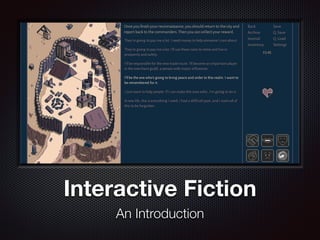
Interactive Fiction
An Introduction
What is interactive fiction?
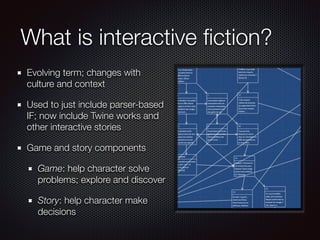
Evolving term; changes with
culture and context
Used to just include parser-based
IF; now include Twine works and
other interactive stories
Game and story components
Game: help character solve
problems; explore and discover
Story: help character make
decisions
Some definitions of IF
Broad definition: “any story that allows reader
participation to alter the presentation or outcome of the
narrative” (Emily Short)
Historical & formal definition (since mid-1980s): works
that share the formal characteristics of the text adventure,
a genre that focused heavily on puzzles and exploration
Technical definition: piece of software that makes
use of both parsed input and a model world
General Characteristics of IF
Player interactions center on text (text output, text input)
Written in the second-person perspective (“You”)
You play as the main character of a story
Playable character, rooms (setting), objects (props), and actions
Comes in variety of types and genres
You type commands which determine actions of character/plot
Often involve exploration and puzzles
Often written by single authors; expresses a focused authorial vision
Three varieties of IF
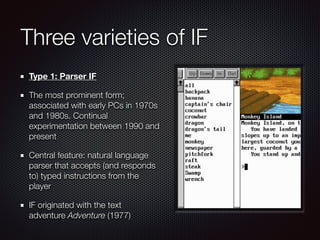
Type 1: Parser IF
The most prominent form;
associated with early PCs in 1970s
and 1980s. Continual
experimentation between 1990 and
present
Central feature: natural language
parser that accepts (and responds
to) typed instructions from the
player
IF originated with the text
adventure Adventure (1977)
Three varieties of IF
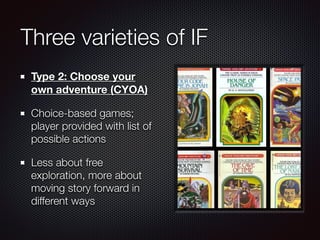
Type 2: Choose your
own adventure (CYOA)
Choice-based games;
player provided with list of
possible actions
Less about free
exploration, more about
moving story forward in
different ways
Three varieties of IF
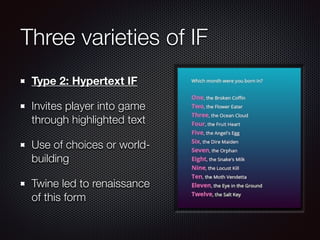
Type 2: Hypertext IF
Invites player into game
through highlighted text
Use of choices or world-
building
Twine led to renaissance
of this form
Parser-based IF
parsed input (text parser analyzes typed input)
a text parser takes typed input (a command) from the
player and simplifies it to something the game can
understand.
every text input consults a world model
world model (represented in code)
Tracks player location, objects in rooms, qualities or
states of objects
How is the world of IF assembled?
Space - most IF games consist of rooms; movement between
room is possible. Rooms are setting.
Objects - objects are generally conceived as single, intact
units. Objects are props.
Containment - IF good at modeling containment (object
placement, position, through prepositions).
Look at, look inside, look under, etc.
Types of action - general, abstract behavior broken down into
discrete actions
Player Immersion & Interpretation
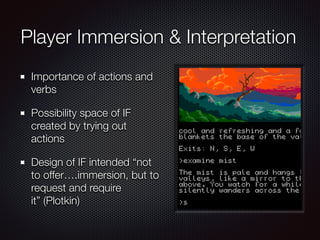
Importance of actions and
verbs
Possibility space of IF
created by trying out
actions
Design of IF intended “not
to offer….immersion, but to
request and require
it” (Plotkin)
Narrative, formal, thematic
approaches to IF
Deep exploration - of a setting
or narrative possibility space
Constrained agency -
constrain player agency as part
of story
Complicity - involve player in
ethical dilemmas
Wordplay - focus on player’s
response to qualities of the text
as prose object
Communicating with the story
Basic formula: “Action object” (go north, take sword, open door)
action does something; object the action is applied to)
Look or Examine (x)
Movement (directions): n, s, w, e, nw, ne, sw, se
Inventory (i): take objects; take inventory
People or characters:
ask about ___, talk to ___, tell a person about ___
Save, Restore, Quit, Transcript, Undo
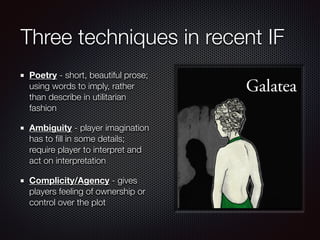
Three techniques in recent IF
Poetry - short, beautiful prose;
using words to imply, rather
than describe in utilitarian
fashion
Ambiguity - player imagination
has to fill in some details;
require player to interpret and
act on interpretation
Complicity/Agency - gives
players feeling of ownership or
control over the plot

Interactive Fiction

  • 1.
  • 2.
    What is interactivefiction? Evolving term; changes with culture and context Used to just include parser-based IF; now include Twine works and other interactive stories Game and story components Game: help character solve problems; explore and discover Story: help character make decisions
  • 3.
    Some definitions ofIF Broad definition: “any story that allows reader participation to alter the presentation or outcome of the narrative” (Emily Short) Historical & formal definition (since mid-1980s): works that share the formal characteristics of the text adventure, a genre that focused heavily on puzzles and exploration Technical definition: piece of software that makes use of both parsed input and a model world
  • 4.
    General Characteristics ofIF Player interactions center on text (text output, text input) Written in the second-person perspective (“You”) You play as the main character of a story Playable character, rooms (setting), objects (props), and actions Comes in variety of types and genres You type commands which determine actions of character/plot Often involve exploration and puzzles Often written by single authors; expresses a focused authorial vision
  • 5.
    Three varieties ofIF Type 1: Parser IF The most prominent form; associated with early PCs in 1970s and 1980s. Continual experimentation between 1990 and present Central feature: natural language parser that accepts (and responds to) typed instructions from the player IF originated with the text adventure Adventure (1977)
  • 6.
    Three varieties ofIF Type 2: Choose your own adventure (CYOA) Choice-based games; player provided with list of possible actions Less about free exploration, more about moving story forward in different ways
  • 7.
    Three varieties ofIF Type 2: Hypertext IF Invites player into game through highlighted text Use of choices or world- building Twine led to renaissance of this form
  • 8.
    Parser-based IF parsed input(text parser analyzes typed input) a text parser takes typed input (a command) from the player and simplifies it to something the game can understand. every text input consults a world model world model (represented in code) Tracks player location, objects in rooms, qualities or states of objects
  • 9.
    How is theworld of IF assembled? Space - most IF games consist of rooms; movement between room is possible. Rooms are setting. Objects - objects are generally conceived as single, intact units. Objects are props. Containment - IF good at modeling containment (object placement, position, through prepositions). Look at, look inside, look under, etc. Types of action - general, abstract behavior broken down into discrete actions
  • 10.
    Player Immersion &Interpretation Importance of actions and verbs Possibility space of IF created by trying out actions Design of IF intended “not to offer….immersion, but to request and require it” (Plotkin)
  • 11.
    Narrative, formal, thematic approachesto IF Deep exploration - of a setting or narrative possibility space Constrained agency - constrain player agency as part of story Complicity - involve player in ethical dilemmas Wordplay - focus on player’s response to qualities of the text as prose object
  • 12.
    Communicating with thestory Basic formula: “Action object” (go north, take sword, open door) action does something; object the action is applied to) Look or Examine (x) Movement (directions): n, s, w, e, nw, ne, sw, se Inventory (i): take objects; take inventory People or characters: ask about ___, talk to ___, tell a person about ___ Save, Restore, Quit, Transcript, Undo
  • 13.
    Three techniques inrecent IF Poetry - short, beautiful prose; using words to imply, rather than describe in utilitarian fashion Ambiguity - player imagination has to fill in some details; require player to interpret and act on interpretation Complicity/Agency - gives players feeling of ownership or control over the plot