Gaming Literacy
• What are her problems
with videogames?
• What are most
videogames about?
• What does she want
from games?
• Is the chapter outdated
or still relevant? Explain.
Anna Anthropy
“The Problem with
Videogames”
(2012)
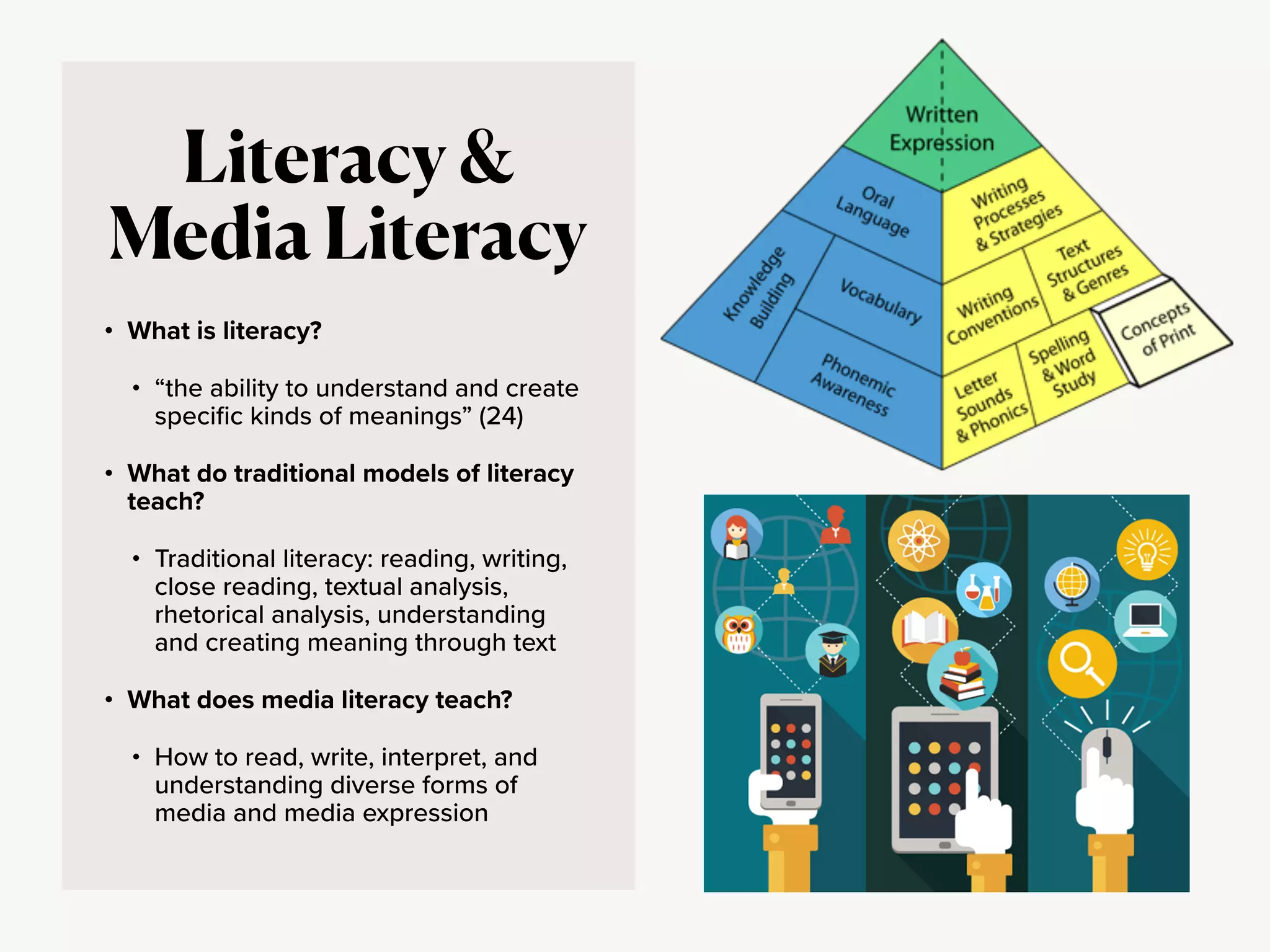
• What is literacy?
• “the ability to understand and create
specific kinds of meanings” (24)
• What do traditional models of literacy
teach?
• Traditional literacy: reading, writing,
close reading, textual analysis,
rhetorical analysis, understanding
and creating meaning through text
• What does media literacy teach?
• How to read, write, interpret, and
understanding diverse forms of
media and media expression
Literacy &
Media Literacy
“When information is put at play, game-like
experiences replace linear media. Media and
culture in the Ludic Century is increasingly
systemic, modular, customizable, and
participatory. Games embody all of these
characteristics in a very direct sense.”
Eric Zimmerman
• What is it?
• “An approach to literacy based on
game design” (23)
• “new set of cognitive, creative, and
social skills” (25)
• Why is it needed?
• Emerging set of skills and
competencies needed to address
changes in world
• How does it reverse traditional
understanding of games?
• Reverses the magic circle, turning it
inside out into the real world
Eric Zimmerman
Gaming
Literacy
• Gaming literacy addresses new sorts off
literacies that are crucial in 21st century
• Gaming literacy reverses the magic
circle. It asks how games relate to
outside world.
• What can we learn from game design?
How can games and game design
help us solve problems and think in
new ways?
• Gaming literacy based on three
concepts: systems, play, and design
• Double meaning of “gaming” - gaming a
system (hacking, bending, breaking
rules)
Eric Zimmerman
Gaming
Literacy
• Systems
• Systems-based thinking is about
process, not answers
• Play
• Why does play matter? Play is
the “human effect of rules set
into motion”
• Design
• Process by which designer
creates context
• Reading/Writing
• Cultural practices that give
meaning to gaming practices.
Four Concepts
Systems Literacy
• What are systems? Systems are groups of interrelated
elements that work together to form a complex whole.
• Systems literacy means having a systems point of view.
Seeing things as systems: understanding the world as a
dynamic set of parts with complex, interchangeable
relationships
• What are the elements of systems?
• data, databases, units, modules, information, interfaces,
relationships, patterns, etc.
• How are games essentially systems?
• With games, there is a clarity of formal system (i.e., the
rules of the game)
“Having a systems point of view (being
systems literate) means understanding the
world as dynamic sets of parts with complex,
constantly changing interrelationships—
seeing the structures that underlie out
world, and comprehending how these
structures function.”
Eric Zimmerman
Why play?
Pieter Bruegel the Elder, Children’s Games (1560)
“Systems are important, but if we limit literacy
to structural, systemic literacy, then we are
missing part of the equation. When we move
from systems to play, we shift focus from the
game to the players, from structures of rules
to structures of human interaction.”
Eric Zimmerman
“Play is the human effect of rules set into
motion, in its many forms transcending
the systems from which it emerges.”
“Play in many ways is the opposite of rules:
as much as rules are closed and fixed, play
is improvisational and uncertain.”
Why is play necessary for gaming
literacy? What does it add to systems
literacy?
Common definition: play is “free movement
within a more rigid structure.”
Play “within a structure,” but “play can play
with structures.
Players do not just play games; they mod them,
engage in meta play between games, and
develop cultures around games.”
Eric Zimmerman on Play
“Although play exists outside of games, games do
provide one of the very best platforms for
understanding play—from free play within a
structure to the transformative play that
reconfigures that structure. Any instance of a game
is an engine designed to produce play, a miniature
laboratory for studying play quaplay” (27)
Games and Play
Design “the process by which a designer creates a
context, to be encountered by a participant,
from which meaning emerges”
“In a game, design mediates between
structure and play; a game system is
designed just so that play will occur” (28)
Design isn’t about a fixed object; “it is
about creating a set of possibilities” (29)
Design
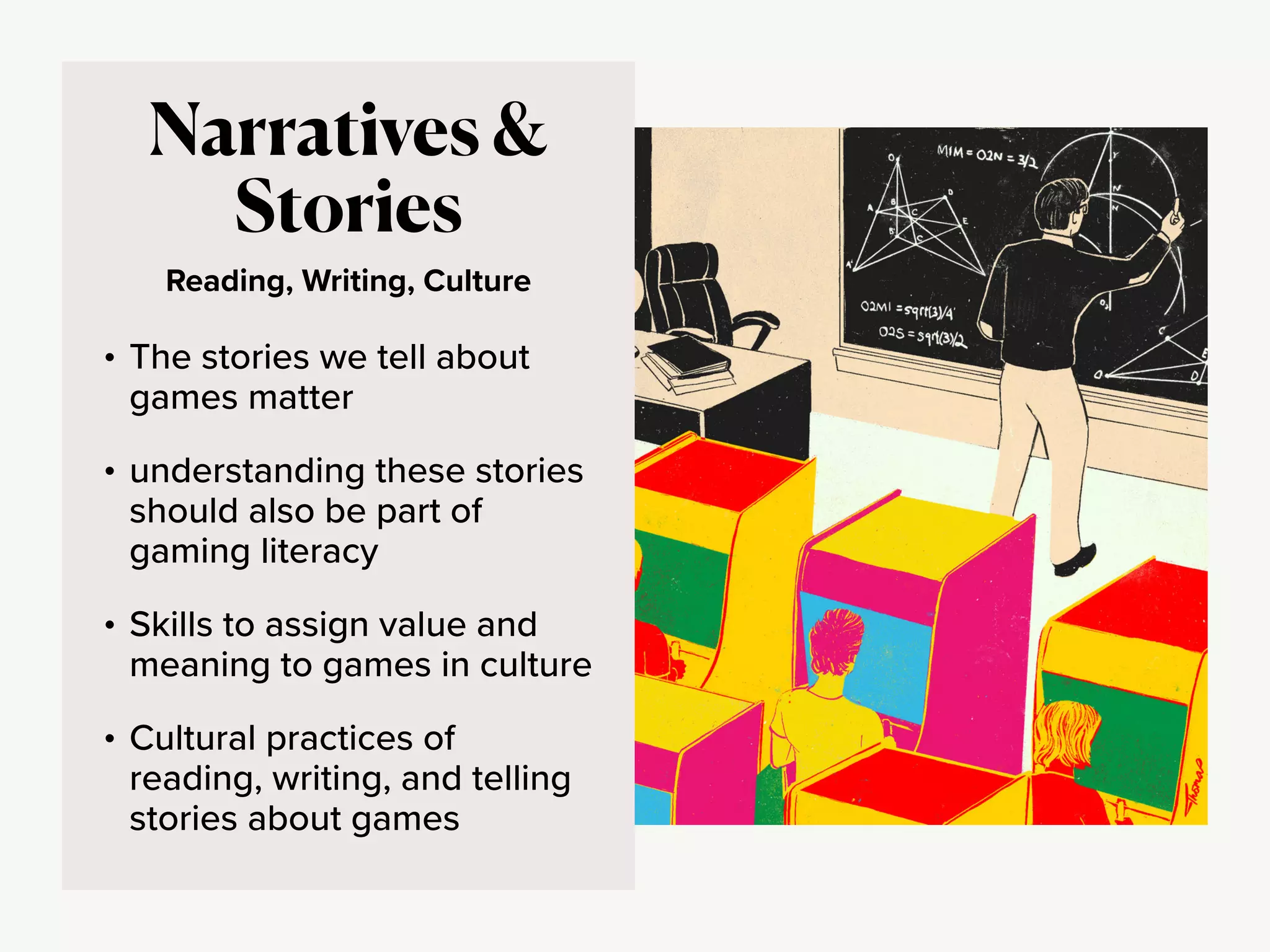
• The stories we tell about
games matter
• understanding these stories
should also be part of
gaming literacy
• Skills to assign value and
meaning to games in culture
• Cultural practices of
reading, writing, and telling
stories about games
Reading, Writing, Culture
Narratives &
Stories
• Player-centric approach to game
design
• “Instead of focusing on the
actions the player can perform, it
focuses on the situations the
player can encounter.”
• More than interaction. Focus on
anticipation, interpretation, and
introspection.
• Designing and writing situations.
Using constraints to create
situations for players.
Brian Upton
Situational
Game Design
“a game can be structured around situations where the ‘best
move’ is not necessarily one that advances the player toward an
arbitrary win state, but rather one that shifts the player’s
attitudes or feelings in satisfying ways”
The core concept of situational game design is (unsurprisingly)
the situation. A situation is an interval of play that contains a
choice.
The notion of the situation gives us a way to break down the
experience of playing a game into small, manageable chunks.
Situations are structured by constraints. When we’re within a
situation we’re offered a range of moves to choose from.
Brian Upton, Situational Game Design
Situations instead of Stories

Gaming Literacy

  • 1.
  • 2.
    • What areher problems with videogames? • What are most videogames about? • What does she want from games? • Is the chapter outdated or still relevant? Explain. Anna Anthropy “The Problem with Videogames” (2012)
  • 3.
    • What isliteracy? • “the ability to understand and create specific kinds of meanings” (24) • What do traditional models of literacy teach? • Traditional literacy: reading, writing, close reading, textual analysis, rhetorical analysis, understanding and creating meaning through text • What does media literacy teach? • How to read, write, interpret, and understanding diverse forms of media and media expression Literacy & Media Literacy
  • 4.
    “When information isput at play, game-like experiences replace linear media. Media and culture in the Ludic Century is increasingly systemic, modular, customizable, and participatory. Games embody all of these characteristics in a very direct sense.” Eric Zimmerman
  • 5.
    • What isit? • “An approach to literacy based on game design” (23) • “new set of cognitive, creative, and social skills” (25) • Why is it needed? • Emerging set of skills and competencies needed to address changes in world • How does it reverse traditional understanding of games? • Reverses the magic circle, turning it inside out into the real world Eric Zimmerman Gaming Literacy
  • 6.
    • Gaming literacyaddresses new sorts off literacies that are crucial in 21st century • Gaming literacy reverses the magic circle. It asks how games relate to outside world. • What can we learn from game design? How can games and game design help us solve problems and think in new ways? • Gaming literacy based on three concepts: systems, play, and design • Double meaning of “gaming” - gaming a system (hacking, bending, breaking rules) Eric Zimmerman Gaming Literacy
  • 7.
    • Systems • Systems-basedthinking is about process, not answers • Play • Why does play matter? Play is the “human effect of rules set into motion” • Design • Process by which designer creates context • Reading/Writing • Cultural practices that give meaning to gaming practices. Four Concepts
  • 8.
    Systems Literacy • Whatare systems? Systems are groups of interrelated elements that work together to form a complex whole. • Systems literacy means having a systems point of view. Seeing things as systems: understanding the world as a dynamic set of parts with complex, interchangeable relationships • What are the elements of systems? • data, databases, units, modules, information, interfaces, relationships, patterns, etc. • How are games essentially systems? • With games, there is a clarity of formal system (i.e., the rules of the game)
  • 9.
    “Having a systemspoint of view (being systems literate) means understanding the world as dynamic sets of parts with complex, constantly changing interrelationships— seeing the structures that underlie out world, and comprehending how these structures function.” Eric Zimmerman
  • 11.
  • 12.
    Pieter Bruegel theElder, Children’s Games (1560)
  • 13.
    “Systems are important,but if we limit literacy to structural, systemic literacy, then we are missing part of the equation. When we move from systems to play, we shift focus from the game to the players, from structures of rules to structures of human interaction.” Eric Zimmerman
  • 14.
    “Play is thehuman effect of rules set into motion, in its many forms transcending the systems from which it emerges.” “Play in many ways is the opposite of rules: as much as rules are closed and fixed, play is improvisational and uncertain.” Why is play necessary for gaming literacy? What does it add to systems literacy?
  • 15.
    Common definition: playis “free movement within a more rigid structure.” Play “within a structure,” but “play can play with structures. Players do not just play games; they mod them, engage in meta play between games, and develop cultures around games.” Eric Zimmerman on Play
  • 16.
    “Although play existsoutside of games, games do provide one of the very best platforms for understanding play—from free play within a structure to the transformative play that reconfigures that structure. Any instance of a game is an engine designed to produce play, a miniature laboratory for studying play quaplay” (27) Games and Play
  • 17.
    Design “the processby which a designer creates a context, to be encountered by a participant, from which meaning emerges”
  • 18.
    “In a game,design mediates between structure and play; a game system is designed just so that play will occur” (28) Design isn’t about a fixed object; “it is about creating a set of possibilities” (29) Design
  • 19.
    • The storieswe tell about games matter • understanding these stories should also be part of gaming literacy • Skills to assign value and meaning to games in culture • Cultural practices of reading, writing, and telling stories about games Reading, Writing, Culture Narratives & Stories
  • 21.
    • Player-centric approachto game design • “Instead of focusing on the actions the player can perform, it focuses on the situations the player can encounter.” • More than interaction. Focus on anticipation, interpretation, and introspection. • Designing and writing situations. Using constraints to create situations for players. Brian Upton Situational Game Design
  • 22.
    “a game canbe structured around situations where the ‘best move’ is not necessarily one that advances the player toward an arbitrary win state, but rather one that shifts the player’s attitudes or feelings in satisfying ways” The core concept of situational game design is (unsurprisingly) the situation. A situation is an interval of play that contains a choice. The notion of the situation gives us a way to break down the experience of playing a game into small, manageable chunks. Situations are structured by constraints. When we’re within a situation we’re offered a range of moves to choose from. Brian Upton, Situational Game Design Situations instead of Stories