By
S.A.S.VINEELAREDDY
(11149B025)
AN INTELLIGENTLOAD MANAGEMENTSYSTEMWITH
RENEWABLE ENERGY INTEGRATIONFOR SMARTHOMES
 Demand side management (DSM) will play a significant role in
the future smart grid by managing loads in a smart way.
 In this project, evolutionary algorithms-based(binary particle
swarm optimization, genetic algorithm and cuckoo search) DSM
model for scheduling the appliances of residential users is
presented.
 Integration of renewable energy into residential units provides
reliable, efficient and most attractive solution now a days.
It can curtail electricity cost at residential premises and flatten the
peaks at utility premises.
In this project, we present a cost efficient appliance scheduling
model for residential users.
 Our appliance scheduling model aims at optimizing the operation
time of electrical appliances.
The model also takes into account the RES generated energy
jointly with grid generated energy.
introduction
• Global energy demand is increasing rapidly in comparison to the
steady growth of energy generation and transmission setups.
• Consequently, widening the demand and supply gap. In
traditional grids, utilities cater this situation by increasing the
total generation capacity as a function of peak demand.
• Recently, two parallel approaches are developed to handle such
situations: (i) using and promoting energy efficient technologies
to reduce the aggregated power consumption, and (ii) developing
strategies to control the aggregated power demand.
• The model also takes into account the Renewable Energy
Sources generated energy jointly with grid generated energy.
• The model uses algorithms based on BPSO for generating the
optimized schedules and it is simulated in ToU pricing
environment.
1. P. P. Varaiya, F. F. Wu, and J. W. Bialek, “Smart
operation of smart grid: Risk-limiting dispatch,” Proc.
IEEE, vol. 99, no. 1, pp. 40_57, Jan. 2011.
In this paper, Smart distribution grids should efficiently integrate
stochastic renewable resources while effecting voltage regulation.
2.T. F. Garrity, ``Getting smart,'' IEEE Power Energy Mag.,
vol. 6, no. 2, pp. 38_45, Mar./Apr. 2008.
In this magazine, they have said about getting smart with electricity.
In this the load side management and use of renewable energy has
been explained in brief.
They have discussed about smart homes with smart meters, smart
schedulers etc.
BLOCK DIAGRAM
 A new approach is proposed that autonomously generates energy
consumption pattern for each appliance based on the electricity
price tariff.
 First, we categorized the energy consumers into three categories;
traditional users, smart users and smart prosumers.
 Traditional users - this class of users is non - price sensitive, thus
have no HEM architecture in their homes.
 Smart users- this class of users has HEM architecture but have
no on-site energy generation system.
 Smart Prosumers – this type of users not only consume the grid
energy but also produce some energy from the RES system and
have HEM architecture and RES generation along with storage
system in their homes.
CONCEPTUAL MODEL
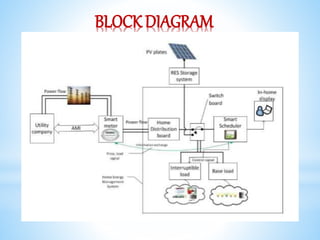
* The block diagram representation of the proposed model
serves as the basis for the development of optimization
algorithm.
* It consists of integrated power & renewable energy utility that
is interested in serving all types of residential or commercial
loads.
* The optimization program dispatches power to residential
loads and storage system that could be utilized during high
demanding hours.
* The energy demand of residential load is directly fulfilled by
using grid energy, direct renewable energy or storage systems
depending on the electricity price in particular hours.
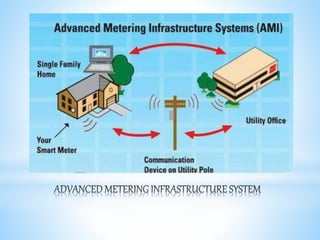
ADVANCED METERING INFRASTRUCTURE
* Advance metering infrastructure is an integration of multiple
technologies such as smart metering, home area network,
software interfaces, and data management applications.
* The system composed of these technologies leads to make
intelligent decision making, reliability, safety and ease of use.
* Smart meter is located between home area network and utility
which forwards aggregated load demand to utility via smart
meter.
* Then based on load data, utility calculates and provides pricing
signal (i.e., ToU, RTP) which later on is used for load
scheduling.
*Due to recent energy crises and environmental concerns,
much attention is given to the integration of renewable
energy resources.
*Among all renewable energy sources, solar energy is most
abundant and easily accessible. However, its unpredictable
nature poses many questions (i.e., availability, capacity,
usage) to energy retailers and consumers.
* Keeping the trade offs in mind, this work utilises battery
storage system to save extra energy during under load
conditions.
* This, however, significantly reduces end user cost and
flattens the peaks on grid side.
ENERGY MANAGEMENT MODEL
A demand side HEM model based on ToU pricing scheme for a
household that is connected to the utility grid and an onsite RES is
presented.
The Smart Scheduler (SS) receives the differential price signal
from the smart grid via smart meter and adjusts the hourly load
level of the user accordingly.
When Smart Scheduler is not included in Household Energy
Management system then power (energy) is allocated to the
appliances following first come first serve policy.
When the SS is available, an optimal power pattern is allocated to
a set of appliances that minimizes the total cost by solving the
objective function.
The objective of the proposed model is to maximize the economic
benefit, minimize high power imported from the grid during high
peak hours and high peak demand, reduce the peak cost and
exploit the use of Renewable Energy Sources.
HOUSEHOLD ORIENTED HEMS
EMS is deployed in a home to schedule the electrical
appliances in order to consume the grid and RES stored energy
optimally.
 The HEM system is comprised of different devices; Home
Grid (HG), electrical appliances and an in home display device.
 The home has an intelligent appliance scheduling and decision
making device, i.e., SS which is embedded in HEM architecture
and coordinate with the appliances.
 The home is equipped with an on-site RES system for local
energy generation.
 A smart meter which provides energy price signals and a set of
electrical appliances that consume energy.
1. We propose a model for different types of users and loads
and a simple way to model user preferences with the aim at
cost and peak reductions. Then cost reduction objective
function is formulated, mathematically.
2. Binary Particle Swarm Optimization, Genetic Algorithm
and Cuckoo search algorithms are used to solve centralized
optimization problem. Control parameters of these algorithms
are selected in such a way that an optimal solution is found
within acceptable processing time.
3. To avoid the usage of peaking power plants during high
demanding hours, on-site renewable energy and backup
storage systems are used which further reduce electricity
cost.
BINARY PARTICLE SWARMOPTIMISATION
*PSO is a robust stochastic optimization technique based
on the movement and intelligence of swarms. PSO
applies the concept of social interaction to problem
solving. It uses a number of agents (particles) that
constitute a swarm moving around in the search space
looking for the best solution.
*Each particle keeps track of its coordinates in the
solution space which are associated with the best
solution (fitness) that has achieved so far by that
particle. This value is called personal best, pbest.
*Another best value that is tracked by the PSO is the best
value obtained so far by any particle in the
neighbourhood of that particle. This value is
called gbest.
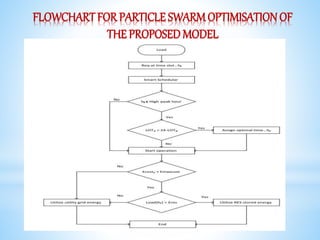
FLOWCHARTFOR PARTICLE SWARMOPTIMISATIONOF
THE PROPOSED MODEL
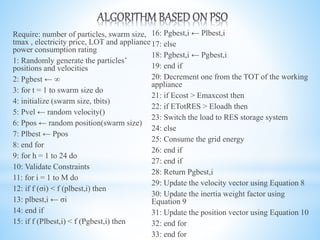
Require: number of particles, swarm size,
tmax , electricity price, LOT and appliance
power consumption rating
1: Randomly generate the particles’
positions and velocities
2: Pgbest ← ∞
3: for t = 1 to swarm size do
4: initialize (swarm size, tbits)
5: Pvel ← random velocity()
6: Ppos ← random position(swarm size)
7: Plbest ← Ppos
8: end for
9: for h = 1 to 24 do
10: Validate Constraints
11: for i = 1 to M do
12: if f (σi) < f (plbest,i) then
13: plbest,i ← σi
14: end if
15: if f (Plbest,i) < f (Pgbest,i) then
16: Pgbest,i ← Plbest,i
17: else
18: Pgbest,i ← Pgbest,i
19: end if
20: Decrement one from the TOT of the working
appliance
21: if Ecost > Emaxcost then
22: if ETotRES > Eloadh then
23: Switch the load to RES storage system
24: else
25: Consume the grid energy
26: end if
27: end if
28: Return Pgbest,i
29: Update the velocity vector using Equation 8
30: Update the inertia weight factor using
Equation 9
31: Update the position vector using Equation 10
32: end for
33: end for
• Peak load demand can be
reduced.
• Customers enjoy electricity price
saving.
Traditional Homes
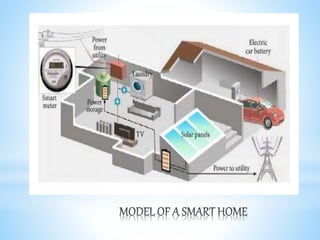
Smart Homes
Smart Homes with renewable
energy sources.
Simulation of the mentioned
algorithms using MATLAB.
Output graph for Energy cost
profile and Pricing scheme.
PHASE 2 - PLANNING
[1] J. Gao, Y. Xiao, J. Liu, W. Liang, and C. L. P. Chen, ‘‘A survey of
communication/networking in smart grids,’’ Future Generat. Comput. Syst., vol. 28, no. 2,
pp. 391–404, Feb. 2012.
[2] C. Alcaraz and J. Lopez, ‘‘WASAM: A dynamic wide-area situational awareness model
for critical domains in smart grids,’’ Future Generat. Comput. Syst., vol. 30, pp. 146–154,
Jan. 2014.
[3] P. Yi, X. Dong, A. Iwayemi, C. Zhou, and S. Li, ‘‘Real-time opportunistic scheduling for
residential demand response,’’ IEEE Trans. Smart Grid, vol. 4, no. 1, pp. 227–234, Mar.
2013.
[4] M. B. Rasheed, N. Javaid, A. Ahmad, Z. A. Khan, U. Qasim, and N. Alrajeh, “An
efficient power scheduling scheme for residential load management in smart homes,'' Appl.
Sci., vol. 5, no. 4, pp. 1134_1163, Nov. 2015.
[5] Q. Qdr, ``Benefits of demand response in electricity markets and recommendations for
achieving them,'' United States Dept. Energy, Washington, DC, USA, Tech. Rep., Feb. 2006.
[6] P. Cappers, J. MacDonald, J. Page, J. Potter, and E. Stewart, “Future opportunities and
challenges with using demand response as a resource in distribution system operation and
planning activities,'' Lawrence Berkeley Nat. Lab., Berkeley, CA, USA, Tech. Rep. LBNL-
1003951, Jan. 2016.
[7] G. Ferruzzi, G. Cervone, L. D. Monache, G. Graditi, and F. Jacobone, “Optimal
bidding in a Day-Ahead energy market for micro grid under uncertainty in renewable
energy production”, Energy, vol. 106, pp. 194_202, Jul. 2016.
Any Queries????

Intelligent load management system

  • 1.
  • 2.
     Demand sidemanagement (DSM) will play a significant role in the future smart grid by managing loads in a smart way.  In this project, evolutionary algorithms-based(binary particle swarm optimization, genetic algorithm and cuckoo search) DSM model for scheduling the appliances of residential users is presented.  Integration of renewable energy into residential units provides reliable, efficient and most attractive solution now a days. It can curtail electricity cost at residential premises and flatten the peaks at utility premises. In this project, we present a cost efficient appliance scheduling model for residential users.  Our appliance scheduling model aims at optimizing the operation time of electrical appliances. The model also takes into account the RES generated energy jointly with grid generated energy.
  • 3.
    introduction • Global energydemand is increasing rapidly in comparison to the steady growth of energy generation and transmission setups. • Consequently, widening the demand and supply gap. In traditional grids, utilities cater this situation by increasing the total generation capacity as a function of peak demand. • Recently, two parallel approaches are developed to handle such situations: (i) using and promoting energy efficient technologies to reduce the aggregated power consumption, and (ii) developing strategies to control the aggregated power demand. • The model also takes into account the Renewable Energy Sources generated energy jointly with grid generated energy. • The model uses algorithms based on BPSO for generating the optimized schedules and it is simulated in ToU pricing environment.
  • 4.
    1. P. P.Varaiya, F. F. Wu, and J. W. Bialek, “Smart operation of smart grid: Risk-limiting dispatch,” Proc. IEEE, vol. 99, no. 1, pp. 40_57, Jan. 2011. In this paper, Smart distribution grids should efficiently integrate stochastic renewable resources while effecting voltage regulation. 2.T. F. Garrity, ``Getting smart,'' IEEE Power Energy Mag., vol. 6, no. 2, pp. 38_45, Mar./Apr. 2008. In this magazine, they have said about getting smart with electricity. In this the load side management and use of renewable energy has been explained in brief. They have discussed about smart homes with smart meters, smart schedulers etc.
  • 5.
  • 6.
     A newapproach is proposed that autonomously generates energy consumption pattern for each appliance based on the electricity price tariff.  First, we categorized the energy consumers into three categories; traditional users, smart users and smart prosumers.  Traditional users - this class of users is non - price sensitive, thus have no HEM architecture in their homes.  Smart users- this class of users has HEM architecture but have no on-site energy generation system.  Smart Prosumers – this type of users not only consume the grid energy but also produce some energy from the RES system and have HEM architecture and RES generation along with storage system in their homes.
  • 7.
    CONCEPTUAL MODEL * Theblock diagram representation of the proposed model serves as the basis for the development of optimization algorithm. * It consists of integrated power & renewable energy utility that is interested in serving all types of residential or commercial loads. * The optimization program dispatches power to residential loads and storage system that could be utilized during high demanding hours. * The energy demand of residential load is directly fulfilled by using grid energy, direct renewable energy or storage systems depending on the electricity price in particular hours.
  • 8.
    ADVANCED METERING INFRASTRUCTURE *Advance metering infrastructure is an integration of multiple technologies such as smart metering, home area network, software interfaces, and data management applications. * The system composed of these technologies leads to make intelligent decision making, reliability, safety and ease of use. * Smart meter is located between home area network and utility which forwards aggregated load demand to utility via smart meter. * Then based on load data, utility calculates and provides pricing signal (i.e., ToU, RTP) which later on is used for load scheduling.
  • 10.
    *Due to recentenergy crises and environmental concerns, much attention is given to the integration of renewable energy resources. *Among all renewable energy sources, solar energy is most abundant and easily accessible. However, its unpredictable nature poses many questions (i.e., availability, capacity, usage) to energy retailers and consumers. * Keeping the trade offs in mind, this work utilises battery storage system to save extra energy during under load conditions. * This, however, significantly reduces end user cost and flattens the peaks on grid side.
  • 11.
    ENERGY MANAGEMENT MODEL Ademand side HEM model based on ToU pricing scheme for a household that is connected to the utility grid and an onsite RES is presented. The Smart Scheduler (SS) receives the differential price signal from the smart grid via smart meter and adjusts the hourly load level of the user accordingly. When Smart Scheduler is not included in Household Energy Management system then power (energy) is allocated to the appliances following first come first serve policy. When the SS is available, an optimal power pattern is allocated to a set of appliances that minimizes the total cost by solving the objective function. The objective of the proposed model is to maximize the economic benefit, minimize high power imported from the grid during high peak hours and high peak demand, reduce the peak cost and exploit the use of Renewable Energy Sources.
  • 12.
    HOUSEHOLD ORIENTED HEMS EMSis deployed in a home to schedule the electrical appliances in order to consume the grid and RES stored energy optimally.  The HEM system is comprised of different devices; Home Grid (HG), electrical appliances and an in home display device.  The home has an intelligent appliance scheduling and decision making device, i.e., SS which is embedded in HEM architecture and coordinate with the appliances.  The home is equipped with an on-site RES system for local energy generation.  A smart meter which provides energy price signals and a set of electrical appliances that consume energy.
  • 13.
    1. We proposea model for different types of users and loads and a simple way to model user preferences with the aim at cost and peak reductions. Then cost reduction objective function is formulated, mathematically. 2. Binary Particle Swarm Optimization, Genetic Algorithm and Cuckoo search algorithms are used to solve centralized optimization problem. Control parameters of these algorithms are selected in such a way that an optimal solution is found within acceptable processing time. 3. To avoid the usage of peaking power plants during high demanding hours, on-site renewable energy and backup storage systems are used which further reduce electricity cost.
  • 14.
    BINARY PARTICLE SWARMOPTIMISATION *PSOis a robust stochastic optimization technique based on the movement and intelligence of swarms. PSO applies the concept of social interaction to problem solving. It uses a number of agents (particles) that constitute a swarm moving around in the search space looking for the best solution. *Each particle keeps track of its coordinates in the solution space which are associated with the best solution (fitness) that has achieved so far by that particle. This value is called personal best, pbest. *Another best value that is tracked by the PSO is the best value obtained so far by any particle in the neighbourhood of that particle. This value is called gbest.
  • 15.
  • 16.
    Require: number ofparticles, swarm size, tmax , electricity price, LOT and appliance power consumption rating 1: Randomly generate the particles’ positions and velocities 2: Pgbest ← ∞ 3: for t = 1 to swarm size do 4: initialize (swarm size, tbits) 5: Pvel ← random velocity() 6: Ppos ← random position(swarm size) 7: Plbest ← Ppos 8: end for 9: for h = 1 to 24 do 10: Validate Constraints 11: for i = 1 to M do 12: if f (σi) < f (plbest,i) then 13: plbest,i ← σi 14: end if 15: if f (Plbest,i) < f (Pgbest,i) then 16: Pgbest,i ← Plbest,i 17: else 18: Pgbest,i ← Pgbest,i 19: end if 20: Decrement one from the TOT of the working appliance 21: if Ecost > Emaxcost then 22: if ETotRES > Eloadh then 23: Switch the load to RES storage system 24: else 25: Consume the grid energy 26: end if 27: end if 28: Return Pgbest,i 29: Update the velocity vector using Equation 8 30: Update the inertia weight factor using Equation 9 31: Update the position vector using Equation 10 32: end for 33: end for
  • 17.
    • Peak loaddemand can be reduced. • Customers enjoy electricity price saving.
  • 18.
    Traditional Homes Smart Homes SmartHomes with renewable energy sources.
  • 20.
    Simulation of thementioned algorithms using MATLAB. Output graph for Energy cost profile and Pricing scheme. PHASE 2 - PLANNING
  • 21.
    [1] J. Gao,Y. Xiao, J. Liu, W. Liang, and C. L. P. Chen, ‘‘A survey of communication/networking in smart grids,’’ Future Generat. Comput. Syst., vol. 28, no. 2, pp. 391–404, Feb. 2012. [2] C. Alcaraz and J. Lopez, ‘‘WASAM: A dynamic wide-area situational awareness model for critical domains in smart grids,’’ Future Generat. Comput. Syst., vol. 30, pp. 146–154, Jan. 2014. [3] P. Yi, X. Dong, A. Iwayemi, C. Zhou, and S. Li, ‘‘Real-time opportunistic scheduling for residential demand response,’’ IEEE Trans. Smart Grid, vol. 4, no. 1, pp. 227–234, Mar. 2013. [4] M. B. Rasheed, N. Javaid, A. Ahmad, Z. A. Khan, U. Qasim, and N. Alrajeh, “An efficient power scheduling scheme for residential load management in smart homes,'' Appl. Sci., vol. 5, no. 4, pp. 1134_1163, Nov. 2015. [5] Q. Qdr, ``Benefits of demand response in electricity markets and recommendations for achieving them,'' United States Dept. Energy, Washington, DC, USA, Tech. Rep., Feb. 2006. [6] P. Cappers, J. MacDonald, J. Page, J. Potter, and E. Stewart, “Future opportunities and challenges with using demand response as a resource in distribution system operation and planning activities,'' Lawrence Berkeley Nat. Lab., Berkeley, CA, USA, Tech. Rep. LBNL- 1003951, Jan. 2016. [7] G. Ferruzzi, G. Cervone, L. D. Monache, G. Graditi, and F. Jacobone, “Optimal bidding in a Day-Ahead energy market for micro grid under uncertainty in renewable energy production”, Energy, vol. 106, pp. 194_202, Jul. 2016.
  • 23.