International Research Journal of Engineering and Technology (IRJET) e-ISSN: 2395-0056
Volume: 06 Issue: 08 | Aug 2019 www.irjet.net p-ISSN: 2395-0072
© 2019, IRJET | Impact Factor value: 7.34 | ISO 9001:2008 Certified Journal | Page 422
“IOT based Energy Management System Including Renewable Energy
using Arduino and Zig-Bee”
Sneha1, Smt A. V. Malini2
1Sneha: Student Dept of EEE M.Tech PSE, UBDT College of Engineering Davanagere, Karnataka, India
2Smt A. V. Malini: Associate Professor, Dept of EEE, UBDT College of Engineering Davanagere, Karnataka, India
----------------------------------------------------------------------***---------------------------------------------------------------------
Abstract - Energy is one of the most crucial aspects of
country’s technological progress. With the assessment of
modern technology, the usage of energy escalating gently.
Almost amount of electrical energy demand are met by
conventional sources like coal, oil, gas etc. which are going to
deplete in future, which lead to sever energydemandinfuture.
Increasing cost and demand of energy has lead many
organizations to find smart ways for monitoring, controlling
and saving energy. A energy management system (EMS) can
contribute towards cutting the costs while still meeting the
energy demand. Energy saving is one of the main challenge in
our day to day life. Energy saving is done only whentheenergy
consumed by the load is monitored. Once the load is
monitored, suitable control methods can be adopted to
operate the load in a optimized way to save the energy. There
are different technology are developed to overcome this
problem. IOT (internet of things) technology is one of them.
Home energy management system considers both energy
consumption and generation simultaneously to minimize the
cost. This paper offers a smart HEMS which consider both
energy consumption and generation using Zig-Bee based
energy monitoring module technology. It takes energy data
from numerous home serves, and compares them, and create
useful information. Considering both energyconsumptionand
generation the proposed HEMS predicted to optimize home
energy use and home energy cost saving.
KEY WORD: (Energy management, IOT, Renewable energy)
1. INTRODUCTION:
Electrical energy forms an vital constituent when it
comes to human ease. Diverse activities wouldn’t be
possible without the aid of the electrical energy. The
production and consumption of the electrical power
influence on the human budget as well as the environment.
To reduce the cost of the fossil fuel power, and to reduce the
impact on the environment, the installation of renewable
energy sources increased dramatically in the past two
decades. There has been present and quite much publicity
about “Internet of Things”.
1.1NEED OF ENERGY MANAGEMENT:
Energy is one of the most imperative aspects of
countries technological progress. Efficient use ofenergyand
its saving is essential for sustainable development. The
process of energy saving is referred to as energy
management. Thus the process of planning energy saving
measures, monitoring energy utilization, controlling, and
conserving energy in a building is termed as energy
Management.
2. PROPOSED SYSTEM:
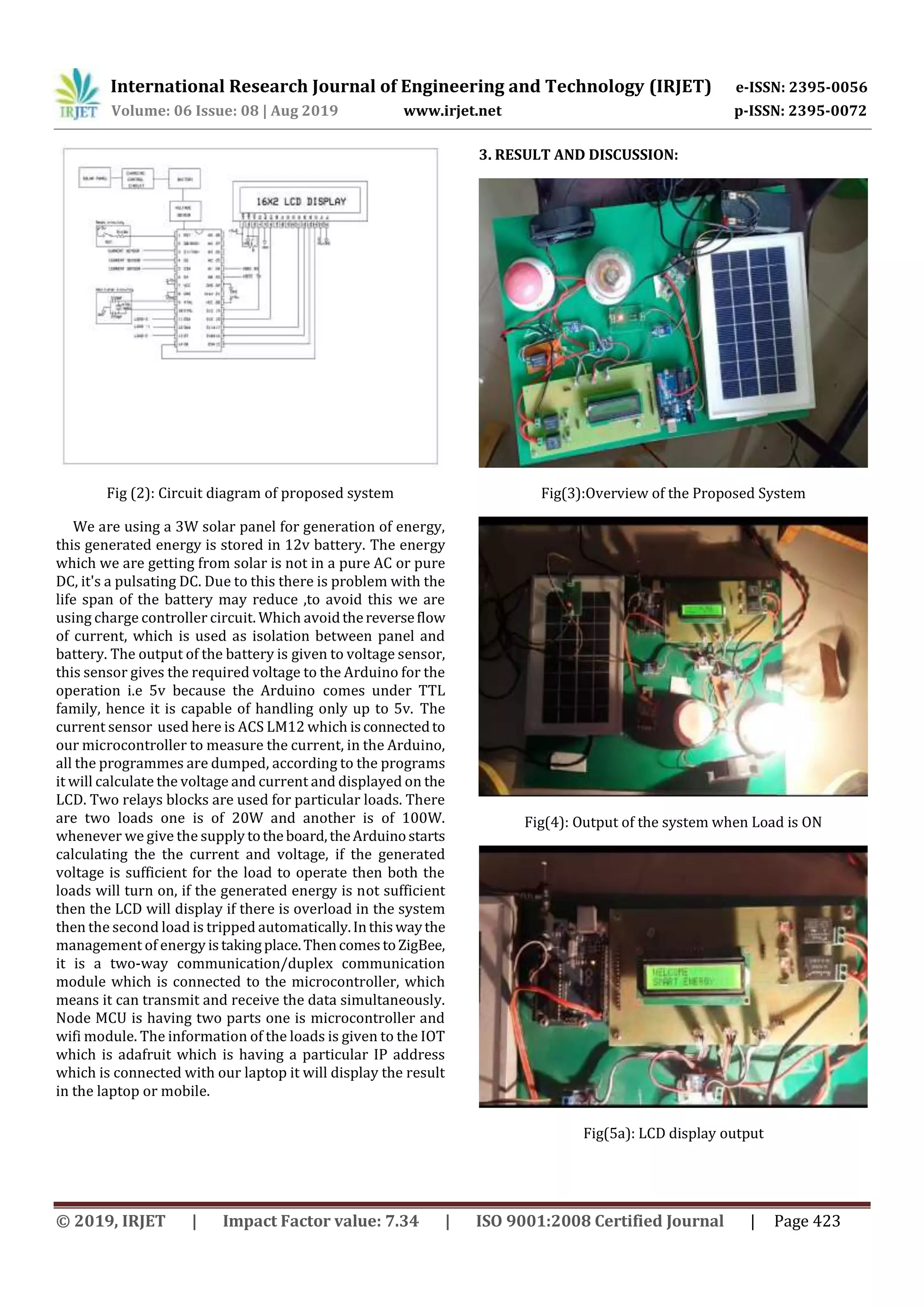
Fig (1): Block diagram of proposed system
International Research Journal of Engineering and Technology (IRJET) e-ISSN: 2395-0056
Volume: 06 Issue: 08 | Aug 2019 www.irjet.net p-ISSN: 2395-0072
© 2019, IRJET | Impact Factor value: 7.34 | ISO 9001:2008 Certified Journal | Page 423
Fig (2): Circuit diagram of proposed system
We are using a 3W solar panel for generation of energy,
this generated energy is stored in 12v battery. The energy
which we are getting from solar is not in a pure AC or pure
DC, it's a pulsating DC. Due to this there is problem with the
life span of the battery may reduce ,to avoid this we are
using charge controller circuit. Which avoidthereverseflow
of current, which is used as isolation between panel and
battery. The output of the battery is given to voltage sensor,
this sensor gives the required voltage to the Arduino for the
operation i.e 5v because the Arduino comes under TTL
family, hence it is capable of handling only up to 5v. The
current sensor used here is ACS LM12 which isconnectedto
our microcontroller to measure the current, in the Arduino,
all the programmes are dumped, according to the programs
it will calculate the voltage and current and displayed on the
LCD. Two relays blocks are used for particular loads. There
are two loads one is of 20W and another is of 100W.
whenever we give the supply totheboard,theArduinostarts
calculating the the current and voltage, if the generated
voltage is sufficient for the load to operate then both the
loads will turn on, if the generated energy is not sufficient
then the LCD will display if there is overload in the system
then the second load is tripped automatically.Inthiswaythe
management of energy istakingplace.ThencomestoZigBee,
it is a two-way communication/duplex communication
module which is connected to the microcontroller, which
means it can transmit and receive the data simultaneously.
Node MCU is having two parts one is microcontroller and
wifi module. The information of the loads is given to the IOT
which is adafruit which is having a particular IP address
which is connected with our laptop it will display the result
in the laptop or mobile.
3. RESULT AND DISCUSSION:
Fig(3):Overview of the Proposed System
Fig(4): Output of the system when Load is ON
Fig(5a): LCD display output
International Research Journal of Engineering and Technology (IRJET) e-ISSN: 2395-0056
Volume: 06 Issue: 08 | Aug 2019 www.irjet.net p-ISSN: 2395-0072
© 2019, IRJET | Impact Factor value: 7.34 | ISO 9001:2008 Certified Journal | Page 424
Fig(5b):LCD display
4. CONCLUSION:
As residential homes have installed renewable energy
sources to save the energy cost, it is important that both
energy consumption and generation are simultaneously
considered in HEMS. This paper proposes the smart HEMS
architecture that considers both consumption and
generation. In the energy consumption, the EMCUs are
installed in outlets and lights to measure the energy usages
of home appliances and lights based on ZigBee;theytransfer
the gathered data to the home sever. With this scheme, the
home server figures out the home energy usage pattern. In
the energy generation, ardunio controller modems are
installed in each solar panel to monitor its status. The REG
gathers the status data of the solar panels based on ardunio
controller and the generation data from inverters based on
RS -485; it transfers the gathered data to the home server.
This ardunio controller monitoring technology can monitor
each solar panel for maintenance. The home server can
estimate the energy generation based on a weatherforecast.
Using the obtained energy information, the home servercan
control the home energy use schedule to minimize the
energy cost. Users can access the home energy information
through smart devices. The HEMS provides the comparison
and analysis of each home energyusage.Byconsideringboth
consumption and generation, the proposed architecture is
expected to enhance home energy management and to save
the energy cost.
REFERENCES:
[1] A.R. Al-Ali, Imran A. Zukerman, Mohammed Rashid,
Ragini Gupta, Mazin AliKarar-“A Smart Home Energy
Management System Using Iot And Big Data Analytics
Approach”.
[2] Manoj, S.Sri Ram Ganesh, Asst. Prof, M.Janarthanan,
Asst.Prof chania-“IOTBased EnergyManagementSystem By
Using Raspberry Pi ARM Cortex”.
[3] Yatharth Gupta, Shiv Prakash Bajoria, Rahul Kumar
Singh, Dr. O.V. Gnana Swathika*VIT University Chennai.-“
IOT Based Energy Management System With Load Sharing
And Source Management Features”.
[4] Jinsung Byun, Insung Hong, and Sehyun Park, Member,
IEEE-“Intelligent Cloud Home Energy Management System
Using Household Appliance Priority BasedSchedulingBased
On Prediction Of Renewable Energy Capability”.
[5] Erdal Irmak, Ali Kose, Gokhan Gocmen-“Simulation And
Zigbee Based Wireless Monitoring Of The Amount Of
Consumed Energy At Smart Homes”.
[6]. Nichoas Liew Long Guang, Thillainathan Logenthiran,
Khalid Abidi-“Application of Internet of Things for home
Energy management”.
[7]. Naddem Javid, IshanUllah,MariamAkbar-“AnIntelligent
load Management System with Renewable Energy
Integration for Smart Homes.”
[8]. M. Nassereddine, J. Rizk, A. Hellany, M. Nagrial, A Elrafhi,
Z. Obeid, K. Hajar -“Electrical Energy Management for
Advance Smart Home systems”.

IRJET- IoT based Energy Management System Including Renewable Energy using Arduino and Zig-Bee

  • 1.
    International Research Journalof Engineering and Technology (IRJET) e-ISSN: 2395-0056 Volume: 06 Issue: 08 | Aug 2019 www.irjet.net p-ISSN: 2395-0072 © 2019, IRJET | Impact Factor value: 7.34 | ISO 9001:2008 Certified Journal | Page 422 “IOT based Energy Management System Including Renewable Energy using Arduino and Zig-Bee” Sneha1, Smt A. V. Malini2 1Sneha: Student Dept of EEE M.Tech PSE, UBDT College of Engineering Davanagere, Karnataka, India 2Smt A. V. Malini: Associate Professor, Dept of EEE, UBDT College of Engineering Davanagere, Karnataka, India ----------------------------------------------------------------------***--------------------------------------------------------------------- Abstract - Energy is one of the most crucial aspects of country’s technological progress. With the assessment of modern technology, the usage of energy escalating gently. Almost amount of electrical energy demand are met by conventional sources like coal, oil, gas etc. which are going to deplete in future, which lead to sever energydemandinfuture. Increasing cost and demand of energy has lead many organizations to find smart ways for monitoring, controlling and saving energy. A energy management system (EMS) can contribute towards cutting the costs while still meeting the energy demand. Energy saving is one of the main challenge in our day to day life. Energy saving is done only whentheenergy consumed by the load is monitored. Once the load is monitored, suitable control methods can be adopted to operate the load in a optimized way to save the energy. There are different technology are developed to overcome this problem. IOT (internet of things) technology is one of them. Home energy management system considers both energy consumption and generation simultaneously to minimize the cost. This paper offers a smart HEMS which consider both energy consumption and generation using Zig-Bee based energy monitoring module technology. It takes energy data from numerous home serves, and compares them, and create useful information. Considering both energyconsumptionand generation the proposed HEMS predicted to optimize home energy use and home energy cost saving. KEY WORD: (Energy management, IOT, Renewable energy) 1. INTRODUCTION: Electrical energy forms an vital constituent when it comes to human ease. Diverse activities wouldn’t be possible without the aid of the electrical energy. The production and consumption of the electrical power influence on the human budget as well as the environment. To reduce the cost of the fossil fuel power, and to reduce the impact on the environment, the installation of renewable energy sources increased dramatically in the past two decades. There has been present and quite much publicity about “Internet of Things”. 1.1NEED OF ENERGY MANAGEMENT: Energy is one of the most imperative aspects of countries technological progress. Efficient use ofenergyand its saving is essential for sustainable development. The process of energy saving is referred to as energy management. Thus the process of planning energy saving measures, monitoring energy utilization, controlling, and conserving energy in a building is termed as energy Management. 2. PROPOSED SYSTEM: Fig (1): Block diagram of proposed system
  • 2.
    International Research Journalof Engineering and Technology (IRJET) e-ISSN: 2395-0056 Volume: 06 Issue: 08 | Aug 2019 www.irjet.net p-ISSN: 2395-0072 © 2019, IRJET | Impact Factor value: 7.34 | ISO 9001:2008 Certified Journal | Page 423 Fig (2): Circuit diagram of proposed system We are using a 3W solar panel for generation of energy, this generated energy is stored in 12v battery. The energy which we are getting from solar is not in a pure AC or pure DC, it's a pulsating DC. Due to this there is problem with the life span of the battery may reduce ,to avoid this we are using charge controller circuit. Which avoidthereverseflow of current, which is used as isolation between panel and battery. The output of the battery is given to voltage sensor, this sensor gives the required voltage to the Arduino for the operation i.e 5v because the Arduino comes under TTL family, hence it is capable of handling only up to 5v. The current sensor used here is ACS LM12 which isconnectedto our microcontroller to measure the current, in the Arduino, all the programmes are dumped, according to the programs it will calculate the voltage and current and displayed on the LCD. Two relays blocks are used for particular loads. There are two loads one is of 20W and another is of 100W. whenever we give the supply totheboard,theArduinostarts calculating the the current and voltage, if the generated voltage is sufficient for the load to operate then both the loads will turn on, if the generated energy is not sufficient then the LCD will display if there is overload in the system then the second load is tripped automatically.Inthiswaythe management of energy istakingplace.ThencomestoZigBee, it is a two-way communication/duplex communication module which is connected to the microcontroller, which means it can transmit and receive the data simultaneously. Node MCU is having two parts one is microcontroller and wifi module. The information of the loads is given to the IOT which is adafruit which is having a particular IP address which is connected with our laptop it will display the result in the laptop or mobile. 3. RESULT AND DISCUSSION: Fig(3):Overview of the Proposed System Fig(4): Output of the system when Load is ON Fig(5a): LCD display output
  • 3.
    International Research Journalof Engineering and Technology (IRJET) e-ISSN: 2395-0056 Volume: 06 Issue: 08 | Aug 2019 www.irjet.net p-ISSN: 2395-0072 © 2019, IRJET | Impact Factor value: 7.34 | ISO 9001:2008 Certified Journal | Page 424 Fig(5b):LCD display 4. CONCLUSION: As residential homes have installed renewable energy sources to save the energy cost, it is important that both energy consumption and generation are simultaneously considered in HEMS. This paper proposes the smart HEMS architecture that considers both consumption and generation. In the energy consumption, the EMCUs are installed in outlets and lights to measure the energy usages of home appliances and lights based on ZigBee;theytransfer the gathered data to the home sever. With this scheme, the home server figures out the home energy usage pattern. In the energy generation, ardunio controller modems are installed in each solar panel to monitor its status. The REG gathers the status data of the solar panels based on ardunio controller and the generation data from inverters based on RS -485; it transfers the gathered data to the home server. This ardunio controller monitoring technology can monitor each solar panel for maintenance. The home server can estimate the energy generation based on a weatherforecast. Using the obtained energy information, the home servercan control the home energy use schedule to minimize the energy cost. Users can access the home energy information through smart devices. The HEMS provides the comparison and analysis of each home energyusage.Byconsideringboth consumption and generation, the proposed architecture is expected to enhance home energy management and to save the energy cost. REFERENCES: [1] A.R. Al-Ali, Imran A. Zukerman, Mohammed Rashid, Ragini Gupta, Mazin AliKarar-“A Smart Home Energy Management System Using Iot And Big Data Analytics Approach”. [2] Manoj, S.Sri Ram Ganesh, Asst. Prof, M.Janarthanan, Asst.Prof chania-“IOTBased EnergyManagementSystem By Using Raspberry Pi ARM Cortex”. [3] Yatharth Gupta, Shiv Prakash Bajoria, Rahul Kumar Singh, Dr. O.V. Gnana Swathika*VIT University Chennai.-“ IOT Based Energy Management System With Load Sharing And Source Management Features”. [4] Jinsung Byun, Insung Hong, and Sehyun Park, Member, IEEE-“Intelligent Cloud Home Energy Management System Using Household Appliance Priority BasedSchedulingBased On Prediction Of Renewable Energy Capability”. [5] Erdal Irmak, Ali Kose, Gokhan Gocmen-“Simulation And Zigbee Based Wireless Monitoring Of The Amount Of Consumed Energy At Smart Homes”. [6]. Nichoas Liew Long Guang, Thillainathan Logenthiran, Khalid Abidi-“Application of Internet of Things for home Energy management”. [7]. Naddem Javid, IshanUllah,MariamAkbar-“AnIntelligent load Management System with Renewable Energy Integration for Smart Homes.” [8]. M. Nassereddine, J. Rizk, A. Hellany, M. Nagrial, A Elrafhi, Z. Obeid, K. Hajar -“Electrical Energy Management for Advance Smart Home systems”.