
Plant Quarantine
prabha.reddy95@gmail.com
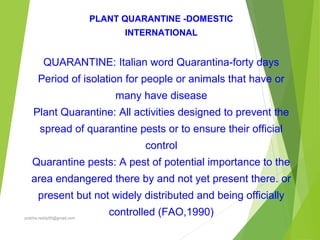
PLANT QUARANTINE -DOMESTIC
INTERNATIONAL
QUARANTINE: Italian word Quarantina-forty days
Period of isolation for people or animals that have or
many have disease
Plant Quarantine: All activities designed to prevent the
spread of quarantine pests or to ensure their official
control
Quarantine pests: A pest of potential importance to the
area endangered there by and not yet present there. or
present but not widely distributed and being officially
controlled (FAO,1990)prabha.reddy95@gmail.com
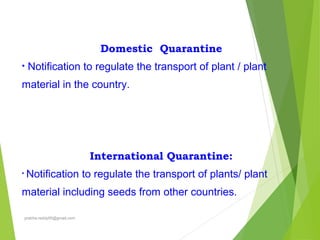
Domestic Quarantine
• Notification to regulate the transport of plant / plant
material in the country.
International Quarantine:
• Notification to regulate the transport of plants/ plant
material including seeds from other countries.
prabha.reddy95@gmail.com
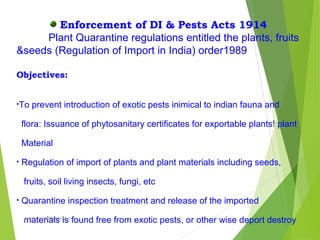
Enforcement of DI & Pests Acts 1914
Plant Quarantine regulations entitled the plants, fruits
&seeds (Regulation of Import in India) order1989
Objectives:
•To prevent introduction of exotic pests inimical to indian fauna and
flora: Issuance of phytosanitary certificates for exportable plants! plant
Material
• Regulation of import of plants and plant materials including seeds,
fruits, soil living insects, fungi, etc
• Quarantine inspection treatment and release of the imported
materials is found free from exotic pests, or other wise deport destroyprabha.reddy95@gmail.com
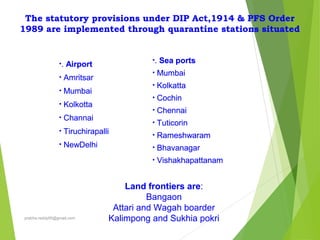
The statutory provisions under DIP Act,1914 & PFS Order
1989 are implemented through quarantine stations situated
•. Airport
• Amritsar
• Mumbai
• Kolkotta
• Channai
• Tiruchirapalli
• NewDelhi
•. Sea ports
• Mumbai
• Kolkatta
• Cochin
• Chennai
• Tuticorin
• Rameshwaram
• Bhavanagar
• Vishakhapattanam
Land frontiers are:
Bangaon
Attari and Wagah boarder
Kalimpong and Sukhia pokri
The statutory provisions under DIP Act,1914 & PFS Order
1989 are implemented through quarantine stations situated
•. Sea ports
• Mumbai
• Kolkatta
• Cochin
• Chennai
• Tuticorin
• Rameshwaram
• Bhavanagar
• Vishakhapattanam
•. Airport
• Amritsar
• Mumbai
• Kolkotta
• Channai
• Tiruchirapalli
• NewDelhi
The statutory provisions under DIP Act,1914 & PFS Order
1989 are implemented through quarantine stations situated
•. Sea ports
• Mumbai
• Kolkatta
• Cochin
• Chennai
• Tuticorin
• Rameshwaram
• Bhavanagar
• Vishakhapattanam
Land frontiers are:
Bangaon
Attari and Wagah boarder
Kalimpong and Sukhia pokri
•. Airport
• Amritsar
• Mumbai
• Kolkotta
• Channai
• Tiruchirapalli
• NewDelhi
The statutory provisions under DIP Act,1914 & PFS Order
1989 are implemented through quarantine stations situated
•. Sea ports
• Mumbai
• Kolkatta
• Cochin
• Chennai
• Tuticorin
• Rameshwaram
• Bhavanagar
• Vishakhapattanam
prabha.reddy95@gmail.com
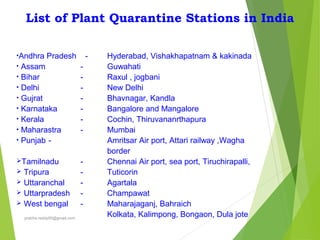
List of Plant Quarantine Stations in India
•Andhra Pradesh -
• Assam -
• Bihar -
• Delhi -
• Gujrat -
• Karnataka -
• Kerala -
• Maharastra -
• Punjab -
Tamilnadu -
 Tripura -
 Uttaranchal -
 Uttarpradesh -
 West bengal -
Hyderabad, Vishakhapatnam & kakinada
Guwahati
Raxul , jogbani
New Delhi
Bhavnagar, Kandla
Bangalore and Mangalore
Cochin, Thiruvananrthapura
Mumbai
Amritsar Air port, Attari railway ,Wagha
border
Chennai Air port, sea port, Tiruchirapalli,
Tuticorin
Agartala
Champawat
Maharajaganj, Bahraich
Kolkata, Kalimpong, Bongaon, Dula joteprabha.reddy95@gmail.com
Research material is examined by 3 agencies.
• National Bureau of Plant Genetic Resources New Delhi
• Forest Research institute, Deharadun
• Botanical Survey of India, Kolkotta
prabha.reddy95@gmail.com
Phytosanitory Certificates
•. The Dept. of Agriculture , Ministry of industry and primary resources
• Fumigation
• X-ray Radiography
• Seed washing
• Hot water treatment
• Spray/ dip etc.
• Valid for 14 days
prabha.reddy95@gmail.com
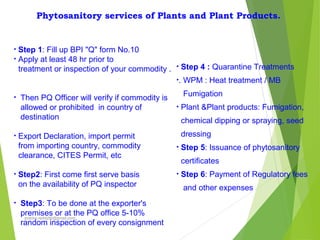
Phytosanitory services of Plants and Plant Products.
• Step 1: Fill up BPI "Q" form No.10
• Apply at least 48 hr prior to
treatment or inspection of your commodity .
• Then PQ Officer will verify if commodity is
allowed or prohibited in country of
destination
• Export Declaration, import permit
from importing country, commodity
clearance, CITES Permit, etc
• Step2: First come first serve basis
on the availability of PQ inspector
• Step3: To be done at the exporter's
premises or at the PQ office 5-10%
random inspection of every consignment
• Step 4 : Quarantine Treatments
•. WPM : Heat treatment / MB
Fumigation
• Plant &Plant products: Fumigation,
chemical dipping or spraying, seed
dressing
• Step 5: Issuance of phytosanitory
certificates
• Step 6: Payment of Regulatory fees
and other expenses
prabha.reddy95@gmail.com
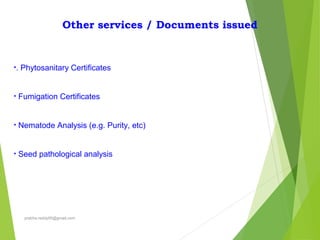
Other services / Documents issued
•. Phytosanitary Certificates
• Fumigation Certificates
• Nematode Analysis (e.g. Purity, etc)
• Seed pathological analysis
prabha.reddy95@gmail.com
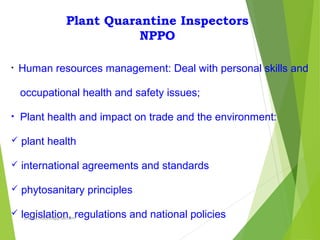
Plant Quarantine Inspectors
NPPO
• Human resources management: Deal with personal skills and
occupational health and safety issues;
• Plant health and impact on trade and the environment:
 plant health
 international agreements and standards
 phytosanitary principles
 legislation, regulations and national policiesprabha.reddy95@gmail.com
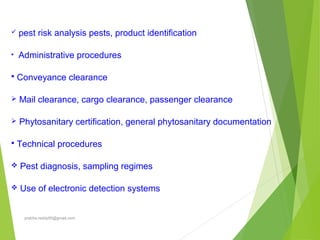
 pest risk analysis pests, product identification
• Administrative procedures
 Conveyance clearance
 Mail clearance, cargo clearance, passenger clearance
 Phytosanitary certification, general phytosanitary documentation
 Technical procedures
 Pest diagnosis, sampling regimes
 Use of electronic detection systems
prabha.reddy95@gmail.com
Contd. .
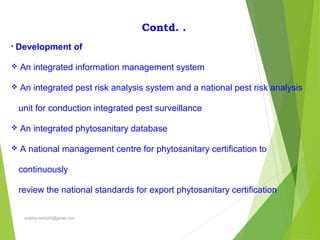
• Development of
 An integrated information management system
 An integrated pest risk analysis system and a national pest risk analysis
unit for conduction integrated pest surveillance
 An integrated phytosanitary database
 A national management centre for phytosanitary certification to
continuously
review the national standards for export phytosanitary certification
prabha.reddy95@gmail.com
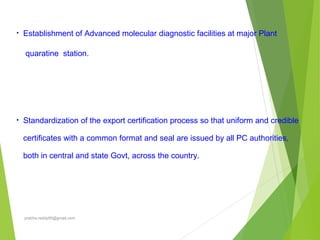
• Establishment of Advanced molecular diagnostic facilities at major Plant
quaratine station.
• Standardization of the export certification process so that uniform and credible
certificates with a common format and seal are issued by all PC authorities,
both in central and state Govt, across the country.
prabha.reddy95@gmail.com
The Plant Quarantine Order
2003
prabha.reddy95@gmail.com
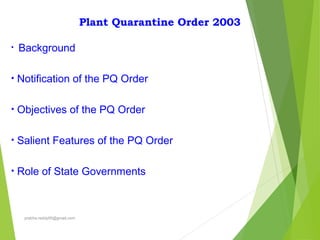
Plant Quarantine Order 2003
• Background
• Notification of the PQ Order
• Objectives of the PQ Order
• Salient Features of the PQ Order
• Role of State Governments
prabha.reddy95@gmail.com
Background – 1
• The Destructive Insects & Pest Act, 1914' enacted to prevent the introduction and
spread of destructive pests affecting crops (amended 9 times)
• Notifications: 'Rules for regulating import of live insects, 1941/1951; 'Rules for
regulating import of fungi, 1943/47/52'; and 'Rules for Regulating the import of
cotton into India, 1972//75/76/78' were issued under the said Act..
•‘ The Plants, Fruits & Seeds (Regulation of Import into India Order, 1989', notified
for prohibiting and regulating the import into India of agricultural articles mentioned
therin (amended 24 times).
prabha.reddy95@gmail.com
Background - 2
• Liberalised trade in agriculture consequent to WTO Agreement in 1995 offered wide
opportunities and innumerable challenges.
• Removal of quantitive restrictions by Ministry of Commerce in April 2001 and
regulating
the import of primary agricultural produce by a permit issued by the PPA.
• India with diversified agro-climatic zones is in an advantageous position to expand
agriculture trade.
• Compliance with stringent phytosanitary regulations to gain market access to
developed countries.
• With increase in volume of trade the associated pest risks got amplified.
prabha.reddy95@gmail.com
Background - 3
• Additional declarations for pests and special conditions in respect of various
seed/planting material covered under the New Seed policy as per
recommendations of ICAR Committee were to be incorporated.
• Need to review the Import phytosanitary requirements for
several agricultural commodities based on Pest Risk Analysis as per the
international standards of IPPC/WTOSPS Agreement
• Need for a comprehensive notification for regulating import of germplasm/ GMOs/
transgenic plant material; live insects & microbial cultures including bio-control
agents; bulk import of food grains; timber; cotton etc;
prabha.reddy95@gmail.com
Notification of PQ Order
• Ministry of Agriculture (Department of Agriculture & Cooperation) of Government of
India issued a Gazette Notification No: 8.0. 1322(E) dated 18thNovember 2003
titled 'The Plant Quarantine (Regulation of Import into India) Order, 2003'
under Sub-section (I Section 3 of 'The Destructive Insects & Pests Act, 1914‘
• This Order has come into force on the 1st day of January 2004 except the sub-
clause (22) of clause 3 shall come into force on the 1stday of April 2004.
• The said order was amended by PQ (Amendment) Order, 2004 (8.0. 167 (E)
dated 6thFebruary 2004
prabha.reddy95@gmail.com
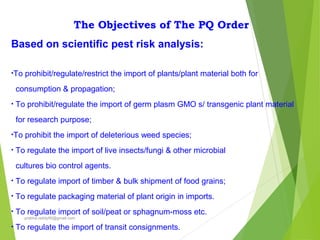
The Objectives of The PQ Order
Based on scientific pest risk analysis:
•To prohibit/regulate/restrict the import of plants/plant material both for
consumption & propagation;
• To prohibit/regulate the import of germ plasm GMO s/ transgenic plant material
for research purpose;
•To prohibit the import of deleterious weed species;
• To regulate the import of live insects/fungi & other microbial
cultures bio control agents.
• To regulate import of timber & bulk shipment of food grains;
• To regulate packaging material of plant origin in imports.
• To regulate import of soil/peat or sphagnum-moss etc.
• To regulate the import of transit consignments.
prabha.reddy95@gmail.com
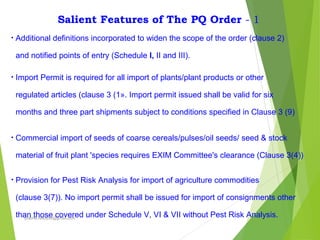
Salient Features of The PQ Order - 1
• Additional definitions incorporated to widen the scope of the order (clause 2)
and notified points of entry (Schedule I, II and III).
• Import Permit is required for all import of plants/plant products or other
regulated articles (clause 3 (1». Import permit issued shall be valid for six
months and three part shipments subject to conditions specified in Clause 3 (9)
• Commercial import of seeds of coarse cereals/pulses/oil seeds/ seed & stock
material of fruit plant 'species requires EXIM Committee's clearance (Clause 3(4))
• Provision for Pest Risk Analysis for import of agriculture commodities
(clause 3(7)). No import permit shall be issued for import of consignments other
than those covered under Schedule V, VI & VII without Pest Risk Analysis.prabha.reddy95@gmail.com
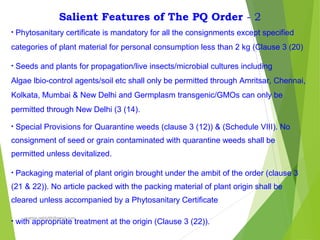
Salient Features of The PQ Order - 2
• Phytosanitary certificate is mandatory for all the consignments except specified
categories of plant material for personal consumption less than 2 kg (Clause 3 (20)
• Seeds and plants for propagation/live insects/microbial cultures including
Algae lbio-control agents/soil etc shall only be permitted through Amritsar, Chennai,
Kolkata, Mumbai & New Delhi and Germplasm transgenic/GMOs can only be
permitted through New Delhi (3 (14).
• Special Provisions for Quarantine weeds (clause 3 (12)) & (Schedule VIII). No
consignment of seed or grain contaminated with quarantine weeds shall be
permitted unless devitalized.
• Packaging material of plant origin brought under the ambit of the order (clause 3
(21 & 22)). No article packed with the packing material of plant origin shall be
cleared unless accompanied by a Phytosanitary Certificate
• with appropriate treatment at the origin (Clause 3 (22)).
prabha.reddy95@gmail.com
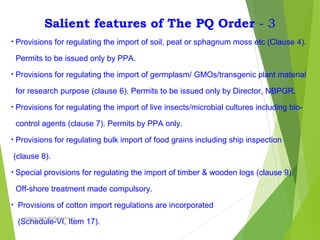
Salient features of The PQ Order - 3
• Provisions for regulating the import of soil, peat or sphagnum moss etc (Clause 4).
Permits to be issued only by PPA.
• Provisions for regulating the import of germplasm/ GMOs/transgenic plant material
for research purpose (clause 6). Permits to be issued only by Director, NBPGR.
• Provisions for regulating the import of live insects/microbial cultures including bio-
control agents (clause 7). Permits by PPA only.
• Provisions for regulating bulk import of food grains including ship inspection
(clause 8).
• Special provisions for regulating the import of timber & wooden logs (clause 9).
Off-shore treatment made compulsory.
• Provisions of cotton import regulations are incorporated
(Schedule-VI, Item 17).
prabha.reddy95@gmail.com
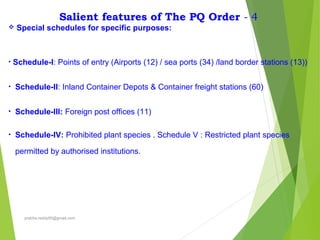
Salient features of The PQ Order - 4
 Special schedules for specific purposes:
• Schedule-I: Points of entry (Airports (12) / sea ports (34) /land border stations (13))
• Schedule-II: Inland Container Depots & Container freight stations (60)
• Schedule-III: Foreign post offices (11)
• Schedule-IV: Prohibited plant species . Schedule V : Restricted plant species
permitted by authorised institutions.
prabha.reddy95@gmail.com
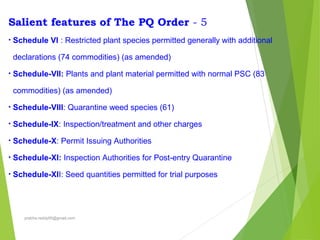
Salient features of The PQ Order - 5
• Schedule VI : Restricted plant species permitted generally with additional
declarations (74 commodities) (as amended)
• Schedule-VII: Plants and plant material permitted with normal PSC (83
commodities) (as amended)
• Schedule-VIII: Quarantine weed species (61)
• Schedule-IX: Inspection/treatment and other charges
• Schedule-X: Permit Issuing Authorities
• Schedule-XI: Inspection Authorities for Post-entry Quarantine
• Schedule-XII: Seed quantities permitted for trial purposes
prabha.reddy95@gmail.com
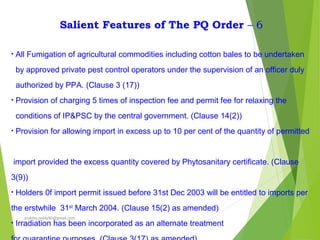
Salient Features of The PQ Order – 6
• All Fumigation of agricultural commodities including cotton bales to be undertaken
by approved private pest control operators under the supervision of an officer duly
authorized by PPA. (Clause 3 (17))
• Provision of charging 5 times of inspection fee and permit fee for relaxing the
conditions of IP&PSC by the central government. (Clause 14(2))
• Provision for allowing import in excess up to 10 per cent of the quantity of permitted
import provided the excess quantity covered by Phytosanitary certificate. (Clause
3(9))
• Holders 0f import permit issued before 31st Dec 2003 will be entitled to imports per
the erstwhile 31st
March 2004. (Clause 15(2) as amended)
• Irradiation has been incorporated as an alternate treatment
prabha.reddy95@gmail.com
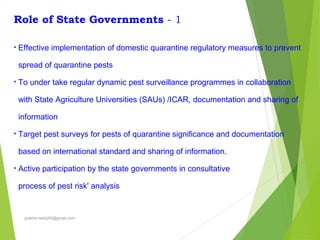
Role of State Governments - 1
• Effective implementation of domestic quarantine regulatory measures to prevent
spread of quarantine pests
• To under take regular dynamic pest surveillance programmes in collaboration
with State Agriculture Universities (SAUs) /ICAR, documentation and sharing of
information
• Target pest surveys for pests of quarantine significance and documentation
based on international standard and sharing of information.
• Active participation by the state governments in consultative
process of pest risk' analysis
prabha.reddy95@gmail.com
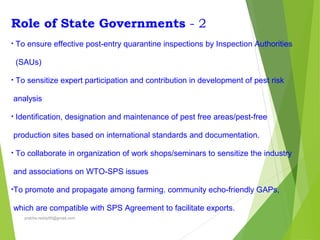
Role of State Governments - 2
• To ensure effective post-entry quarantine inspections by Inspection Authorities
(SAUs)
• To sensitize expert participation and contribution in development of pest risk
analysis
• Identification, designation and maintenance of pest free areas/pest-free
production sites based on international standards and documentation.
• To collaborate in organization of work shops/seminars to sensitize the industry
and associations on WTO-SPS issues
•To promote and propagate among farming. community echo-friendly GAPs,
which are compatible with SPS Agreement to facilitate exports.
prabha.reddy95@gmail.com
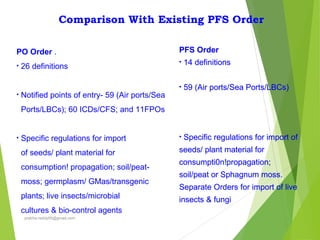
Comparison With Existing PFS Order
PO Order .
• 26 definitions
• Notified points of entry- 59 (Air ports/Sea
Ports/LBCs); 60 ICDs/CFS; and 11FPOs
• Specific regulations for import
of seeds/ plant material for
consumption! propagation; soil/peat-
moss; germplasm/ GMas/transgenic
plants; live insects/microbial
cultures & bio-control agents
PFS Order
• 14 definitions
• 59 (Air ports/Sea Ports/LBCs)
• Specific regulations for import of
seeds/ plant material for
consumpti0n!propagation;
soil/peat or Sphagnum moss.
Separate Orders for import of live
insects & fungi
PFS Order
• 14 definitions
• 59 (Air ports/Sea Ports/LBCs)
• Specific regulations for import of
seeds/ plant material for
consumpti0n!propagation;
soil/peat or Sphagnum moss.
Separate Orders for import of live
insects & fungi
prabha.reddy95@gmail.com
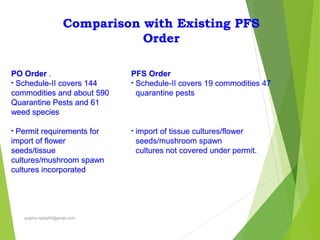
Comparison with Existing PFS
Order
PO Order .
• Schedule-II covers 144
commodities and about 590
Quarantine Pests and 61
weed species
• Permit requirements for
import of flower
seeds/tissue
cultures/mushroom spawn
cultures incorporated
PFS Order
• Schedule-II covers 19 commodities 47
quarantine pests
• import of tissue cultures/flower
seeds/mushroom spawn
cultures not covered under permit.
Comparison with Existing PFS
Order
Comparison with Existing PFS
Order
PO Order .
• Schedule-II covers 144
commodities and about 590
Quarantine Pests and 61
weed species
• Permit requirements for
import of flower
seeds/tissue
cultures/mushroom spawn
cultures incorporated
PO Order .
• Schedule-II covers 144
commodities and about 590
Quarantine Pests and 61
weed species
• Permit requirements for
import of flower
seeds/tissue
cultures/mushroom spawn
cultures incorporated
PFS Order
• Schedule-II covers 19 commodities 47
quarantine pests
• import of tissue cultures/flower
seeds/mushroom spawn
cultures not covered under permit.
PO Order .
• Schedule-II covers 144
commodities and about 590
Quarantine Pests and 61
weed species
• Permit requirements for
import of flower
seeds/tissue
cultures/mushroom spawn
cultures incorporated
prabha.reddy95@gmail.com
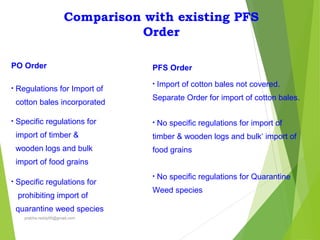
Comparison with existing PFS
Order
PO Order
• Regulations for Import of
cotton bales incorporated
• Specific regulations for
import of timber &
wooden logs and bulk
import of food grains
• Specific regulations for
prohibiting import of
quarantine weed species
PFS Order
• Import of cotton bales not covered.
Separate Order for import of cotton bales.
• No specific regulations for import of
timber & wooden logs and bulk‘ import of
food grains
• No specific regulations for Quarantine
Weed species
prabha.reddy95@gmail.com
Procedures for issue of Permit
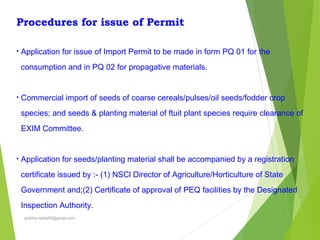
• Application for issue of Import Permit to be made in form PQ 01 for the
consumption and in PQ 02 for propagative materials.
• Commercial import of seeds of coarse cereals/pulses/oil seeds/fodder crop
species; and seeds & planting material of ftuit plant species require clearance of
EXIM Committee.
• Application for seeds/planting material shall be accompanied by a registration
certificate issued by :- (1) NSCl Director of Agriculture/Horticulture of State
Government and;(2) Certificate of approval of PEQ facilities by the Designated
Inspection Authority.
prabha.reddy95@gmail.com
Procedures for issue of Permit
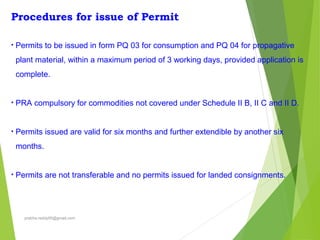
• Permits to be issued in form PQ 03 for consumption and PQ 04 for propagative
plant material, within a maximum period of 3 working days, provided application is
complete.
• PRA compulsory for commodities not covered under Schedule II B, II C and II D.
• Permits issued are valid for six months and further extendible by another six
months.
• Permits are not transferable and no permits issued for landed consignments.
prabha.reddy95@gmail.com
Procedures for issue of permit
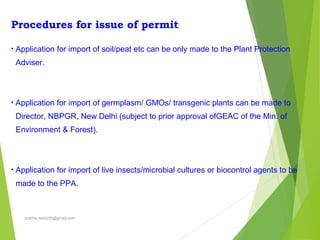
• Application for import of soil/peat etc can be only made to the Plant Protection
Adviser.
• Application for import of germplasm/ GMOs/ transgenic plants can be made to
Director, NBPGR, New Delhi (subject to prior approval ofGEAC of the Min. of
Environment & Forest).
• Application for import of live insects/microbial cultures or biocontrol agents to be
made to the PPA.
prabha.reddy95@gmail.com
Urgency of Notification of PQ order
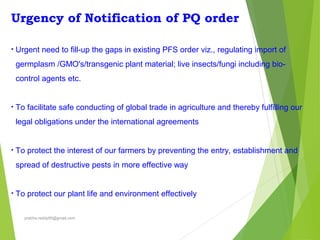
• Urgent need to fill-up the gaps in existing PFS order viz., regulating import of
germplasm /GMO's/transgenic plant material; live insects/fungi including bio-
control agents etc.
• To facilitate safe conducting of global trade in agriculture and thereby fulfilling our
legal obligations under the international agreements
• To protect the interest of our farmers by preventing the entry, establishment and
spread of destructive pests in more effective way
• To protect our plant life and environment effectively
prabha.reddy95@gmail.com
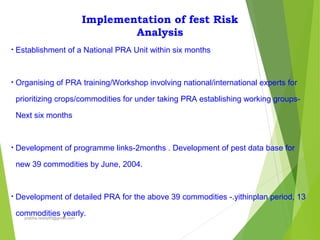
Implementation of fest Risk
Analysis
• Establishment of a National PRA Unit within six months
• Organising of PRA training/Workshop involving national/international experts for
prioritizing crops/commodities for under taking PRA establishing working groups-
Next six months
• Development of programme links-2months . Development of pest data base for
new 39 commodities by June, 2004.
• Development of detailed PRA for the above 39 commodities -.yithinplan period, 13
commodities yearly.prabha.reddy95@gmail.com
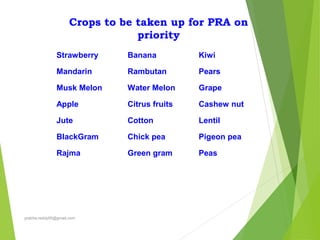
Crops to be taken up for PRA on
priority
Strawberry
Mandarin
Musk Melon
Apple
Jute
BlackGram
Rajma
Banana
Rambutan
Water Melon
Citrus fruits
Cotton
Chick pea
Green gram
Kiwi
Pears
Grape
Cashew nut
Lentil
Pigeon pea
Peas
prabha.reddy95@gmail.com
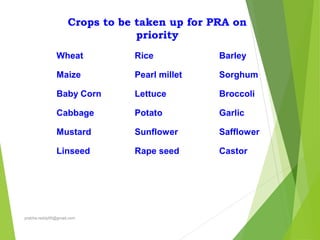
Crops to be taken up for PRA on
priority
Wheat
Maize
Baby Corn
Cabbage
Mustard
Linseed
Rice
Pearl millet
Lettuce
Potato
Sunflower
Rape seed
Barley
Sorghum
Broccoli
Garlic
Safflower
Castor
prabha.reddy95@gmail.com
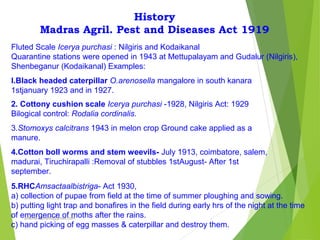
History
Madras Agril. Pest and Diseases Act 1919
Fluted Scale Icerya purchasi : Nilgiris and Kodaikanal
Quarantine stations were opened in 1943 at Mettupalayam and Gudalur (Nilgiris),
Shenbeganur (Kodaikanal) Examples:
l.Black headed caterpillar O.arenosella mangalore in south kanara
1stjanuary 1923 and in 1927.
2. Cottony cushion scale Icerya purchasi -1928, Nilgiris Act: 1929
Bilogical control: Rodalia cordinalis.
3.Stomoxys calcitrans 1943 in melon crop Ground cake applied as a
manure.
4.Cotton boll worms and stem weevils- July 1913, coimbatore, salem,
madurai, Tiruchirapalli :Removal of stubbles 1stAugust- After 1st
september.
5.RHCAmsactaalbistriga- Act 1930,
a) collection of pupae from field at the time of summer ploughing and sowing.
b) putting light trap and bonafires in the field during early hrs of the night at the time
of emergence of moths after the rains.
c) hand picking of egg masses & caterpillar and destroy them.
prabha.reddy95@gmail.com
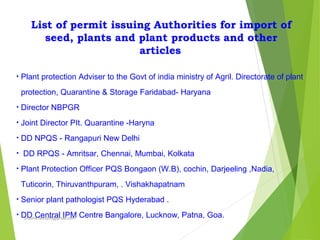
List of permit issuing Authorities for import of
seed, plants and plant products and other
articles
• Plant protection Adviser to the Govt of india ministry of Agril. Directorate of plant
protection, Quarantine & Storage Faridabad- Haryana
• Director NBPGR
• Joint Director PIt. Quarantine -Haryna
• DD NPQS - Rangapuri New Delhi
• DD RPQS - Amritsar, Chennai, Mumbai, Kolkata
• Plant Protection Officer PQS Bongaon (W.B), cochin, Darjeeling ,Nadia,
Tuticorin, Thiruvanthpuram, . Vishakhapatnam
• Senior plant pathologist PQS Hyderabad .
• DD Central IPM Centre Bangalore, Lucknow, Patna, Goa.prabha.reddy95@gmail.com
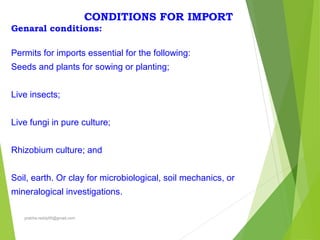
CONDITIONS FOR IMPORT
Genaral conditions:
Permits for imports essential for the following:
Seeds and plants for sowing or planting;
Live insects;
Live fungi in pure culture;
Rhizobium culture; and
Soil, earth. Or clay for microbiological, soil mechanics, or
mineralogical investigations.
prabha.reddy95@gmail.com
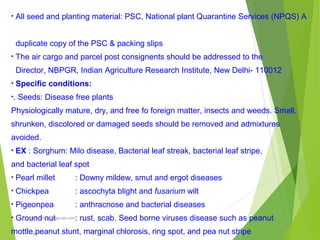
• All seed and planting material: PSC, National plant Quarantine Services (NPQS) A
duplicate copy of the PSC & packing slips
• The air cargo and parcel post consignents should be addressed to the
Director, NBPGR, Indian Agriculture Research Institute, New Delhi- 110012
• Specific conditions:
•. Seeds: Disease free plants
Physiologically mature, dry, and free fo foreign matter, insects and weeds. Small,
shrunken, discolored or damaged seeds should be removed and admixtures
avoided.
• EX : Sorghum: Milo disease, Bacterial leaf streak, bacterial leaf stripe,
and bacterial leaf spot
• Pearl millet : Downy mildew, smut and ergot diseases
• Chickpea : ascochyta blight and fusarium wilt
• Pigeonpea : anthracnose and bacterial diseases
• Ground nut : rust, scab. Seed borne viruses disease such as peanut
mottle,peanut stunt, marginal chlorosis, ring spot, and pea nut stripe
prabha.reddy95@gmail.com
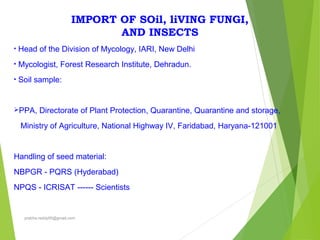
IMPORT OF SOil, liVING FUNGI,
AND INSECTS
• Head of the Division of Mycology, IARI, New Delhi
• Mycologist, Forest Research Institute, Dehradun.
• Soil sample:
PPA, Directorate of Plant Protection, Quarantine, Quarantine and storage,
Ministry of Agriculture, National Highway IV, Faridabad, Haryana-121001
Handling of seed material:
NBPGR - PQRS (Hyderabad)
NPQS - ICRISAT ------ Scientists
prabha.reddy95@gmail.com
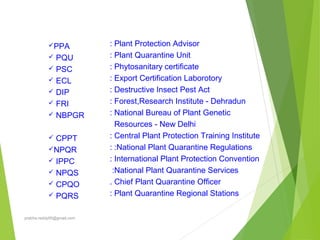
PPA
 PQU
 PSC
 ECL
 DIP
 FRI
 NBPGR
 CPPT
NPQR
 IPPC
 NPQS
 CPQO
 PQRS
: Plant Protection Advisor
: Plant Quarantine Unit
: Phytosanitary certificate
: Export Certification Laborotory
: Destructive Insect Pest Act
: Forest,Research Institute - Dehradun
: National Bureau of Plant Genetic
Resources - New Delhi
: Central Plant Protection Training Institute
: :National Plant Quarantine Regulations
: International Plant Protection Convention
:National Plant Quarantine Services
. Chief Plant Quarantine Officer
: Plant Quarantine Regional Stations
prabha.reddy95@gmail.com
Thank you
prabha.reddy95@gmail.com

Plant quarantine

  • 1.
  • 2.
    PLANT QUARANTINE -DOMESTIC INTERNATIONAL QUARANTINE:Italian word Quarantina-forty days Period of isolation for people or animals that have or many have disease Plant Quarantine: All activities designed to prevent the spread of quarantine pests or to ensure their official control Quarantine pests: A pest of potential importance to the area endangered there by and not yet present there. or present but not widely distributed and being officially controlled (FAO,1990)prabha.reddy95@gmail.com
  • 3.
    Domestic Quarantine • Notificationto regulate the transport of plant / plant material in the country. International Quarantine: • Notification to regulate the transport of plants/ plant material including seeds from other countries. prabha.reddy95@gmail.com
  • 4.
    Enforcement of DI& Pests Acts 1914 Plant Quarantine regulations entitled the plants, fruits &seeds (Regulation of Import in India) order1989 Objectives: •To prevent introduction of exotic pests inimical to indian fauna and flora: Issuance of phytosanitary certificates for exportable plants! plant Material • Regulation of import of plants and plant materials including seeds, fruits, soil living insects, fungi, etc • Quarantine inspection treatment and release of the imported materials is found free from exotic pests, or other wise deport destroyprabha.reddy95@gmail.com
  • 5.
    The statutory provisionsunder DIP Act,1914 & PFS Order 1989 are implemented through quarantine stations situated •. Airport • Amritsar • Mumbai • Kolkotta • Channai • Tiruchirapalli • NewDelhi •. Sea ports • Mumbai • Kolkatta • Cochin • Chennai • Tuticorin • Rameshwaram • Bhavanagar • Vishakhapattanam Land frontiers are: Bangaon Attari and Wagah boarder Kalimpong and Sukhia pokri The statutory provisions under DIP Act,1914 & PFS Order 1989 are implemented through quarantine stations situated •. Sea ports • Mumbai • Kolkatta • Cochin • Chennai • Tuticorin • Rameshwaram • Bhavanagar • Vishakhapattanam •. Airport • Amritsar • Mumbai • Kolkotta • Channai • Tiruchirapalli • NewDelhi The statutory provisions under DIP Act,1914 & PFS Order 1989 are implemented through quarantine stations situated •. Sea ports • Mumbai • Kolkatta • Cochin • Chennai • Tuticorin • Rameshwaram • Bhavanagar • Vishakhapattanam Land frontiers are: Bangaon Attari and Wagah boarder Kalimpong and Sukhia pokri •. Airport • Amritsar • Mumbai • Kolkotta • Channai • Tiruchirapalli • NewDelhi The statutory provisions under DIP Act,1914 & PFS Order 1989 are implemented through quarantine stations situated •. Sea ports • Mumbai • Kolkatta • Cochin • Chennai • Tuticorin • Rameshwaram • Bhavanagar • Vishakhapattanam prabha.reddy95@gmail.com
  • 6.
    List of PlantQuarantine Stations in India •Andhra Pradesh - • Assam - • Bihar - • Delhi - • Gujrat - • Karnataka - • Kerala - • Maharastra - • Punjab - Tamilnadu -  Tripura -  Uttaranchal -  Uttarpradesh -  West bengal - Hyderabad, Vishakhapatnam & kakinada Guwahati Raxul , jogbani New Delhi Bhavnagar, Kandla Bangalore and Mangalore Cochin, Thiruvananrthapura Mumbai Amritsar Air port, Attari railway ,Wagha border Chennai Air port, sea port, Tiruchirapalli, Tuticorin Agartala Champawat Maharajaganj, Bahraich Kolkata, Kalimpong, Bongaon, Dula joteprabha.reddy95@gmail.com
  • 7.
    Research material isexamined by 3 agencies. • National Bureau of Plant Genetic Resources New Delhi • Forest Research institute, Deharadun • Botanical Survey of India, Kolkotta prabha.reddy95@gmail.com
  • 8.
    Phytosanitory Certificates •. TheDept. of Agriculture , Ministry of industry and primary resources • Fumigation • X-ray Radiography • Seed washing • Hot water treatment • Spray/ dip etc. • Valid for 14 days prabha.reddy95@gmail.com
  • 9.
    Phytosanitory services ofPlants and Plant Products. • Step 1: Fill up BPI "Q" form No.10 • Apply at least 48 hr prior to treatment or inspection of your commodity . • Then PQ Officer will verify if commodity is allowed or prohibited in country of destination • Export Declaration, import permit from importing country, commodity clearance, CITES Permit, etc • Step2: First come first serve basis on the availability of PQ inspector • Step3: To be done at the exporter's premises or at the PQ office 5-10% random inspection of every consignment • Step 4 : Quarantine Treatments •. WPM : Heat treatment / MB Fumigation • Plant &Plant products: Fumigation, chemical dipping or spraying, seed dressing • Step 5: Issuance of phytosanitory certificates • Step 6: Payment of Regulatory fees and other expenses prabha.reddy95@gmail.com
  • 10.
    Other services /Documents issued •. Phytosanitary Certificates • Fumigation Certificates • Nematode Analysis (e.g. Purity, etc) • Seed pathological analysis prabha.reddy95@gmail.com
  • 11.
    Plant Quarantine Inspectors NPPO •Human resources management: Deal with personal skills and occupational health and safety issues; • Plant health and impact on trade and the environment:  plant health  international agreements and standards  phytosanitary principles  legislation, regulations and national policiesprabha.reddy95@gmail.com
  • 12.
     pest riskanalysis pests, product identification • Administrative procedures  Conveyance clearance  Mail clearance, cargo clearance, passenger clearance  Phytosanitary certification, general phytosanitary documentation  Technical procedures  Pest diagnosis, sampling regimes  Use of electronic detection systems prabha.reddy95@gmail.com
  • 13.
    Contd. . • Developmentof  An integrated information management system  An integrated pest risk analysis system and a national pest risk analysis unit for conduction integrated pest surveillance  An integrated phytosanitary database  A national management centre for phytosanitary certification to continuously review the national standards for export phytosanitary certification prabha.reddy95@gmail.com
  • 14.
    • Establishment ofAdvanced molecular diagnostic facilities at major Plant quaratine station. • Standardization of the export certification process so that uniform and credible certificates with a common format and seal are issued by all PC authorities, both in central and state Govt, across the country. prabha.reddy95@gmail.com
  • 15.
    The Plant QuarantineOrder 2003 prabha.reddy95@gmail.com
  • 16.
    Plant Quarantine Order2003 • Background • Notification of the PQ Order • Objectives of the PQ Order • Salient Features of the PQ Order • Role of State Governments prabha.reddy95@gmail.com
  • 17.
    Background – 1 •The Destructive Insects & Pest Act, 1914' enacted to prevent the introduction and spread of destructive pests affecting crops (amended 9 times) • Notifications: 'Rules for regulating import of live insects, 1941/1951; 'Rules for regulating import of fungi, 1943/47/52'; and 'Rules for Regulating the import of cotton into India, 1972//75/76/78' were issued under the said Act.. •‘ The Plants, Fruits & Seeds (Regulation of Import into India Order, 1989', notified for prohibiting and regulating the import into India of agricultural articles mentioned therin (amended 24 times). prabha.reddy95@gmail.com
  • 18.
    Background - 2 •Liberalised trade in agriculture consequent to WTO Agreement in 1995 offered wide opportunities and innumerable challenges. • Removal of quantitive restrictions by Ministry of Commerce in April 2001 and regulating the import of primary agricultural produce by a permit issued by the PPA. • India with diversified agro-climatic zones is in an advantageous position to expand agriculture trade. • Compliance with stringent phytosanitary regulations to gain market access to developed countries. • With increase in volume of trade the associated pest risks got amplified. prabha.reddy95@gmail.com
  • 19.
    Background - 3 •Additional declarations for pests and special conditions in respect of various seed/planting material covered under the New Seed policy as per recommendations of ICAR Committee were to be incorporated. • Need to review the Import phytosanitary requirements for several agricultural commodities based on Pest Risk Analysis as per the international standards of IPPC/WTOSPS Agreement • Need for a comprehensive notification for regulating import of germplasm/ GMOs/ transgenic plant material; live insects & microbial cultures including bio-control agents; bulk import of food grains; timber; cotton etc; prabha.reddy95@gmail.com
  • 20.
    Notification of PQOrder • Ministry of Agriculture (Department of Agriculture & Cooperation) of Government of India issued a Gazette Notification No: 8.0. 1322(E) dated 18thNovember 2003 titled 'The Plant Quarantine (Regulation of Import into India) Order, 2003' under Sub-section (I Section 3 of 'The Destructive Insects & Pests Act, 1914‘ • This Order has come into force on the 1st day of January 2004 except the sub- clause (22) of clause 3 shall come into force on the 1stday of April 2004. • The said order was amended by PQ (Amendment) Order, 2004 (8.0. 167 (E) dated 6thFebruary 2004 prabha.reddy95@gmail.com
  • 21.
    The Objectives ofThe PQ Order Based on scientific pest risk analysis: •To prohibit/regulate/restrict the import of plants/plant material both for consumption & propagation; • To prohibit/regulate the import of germ plasm GMO s/ transgenic plant material for research purpose; •To prohibit the import of deleterious weed species; • To regulate the import of live insects/fungi & other microbial cultures bio control agents. • To regulate import of timber & bulk shipment of food grains; • To regulate packaging material of plant origin in imports. • To regulate import of soil/peat or sphagnum-moss etc. • To regulate the import of transit consignments. prabha.reddy95@gmail.com
  • 22.
    Salient Features ofThe PQ Order - 1 • Additional definitions incorporated to widen the scope of the order (clause 2) and notified points of entry (Schedule I, II and III). • Import Permit is required for all import of plants/plant products or other regulated articles (clause 3 (1». Import permit issued shall be valid for six months and three part shipments subject to conditions specified in Clause 3 (9) • Commercial import of seeds of coarse cereals/pulses/oil seeds/ seed & stock material of fruit plant 'species requires EXIM Committee's clearance (Clause 3(4)) • Provision for Pest Risk Analysis for import of agriculture commodities (clause 3(7)). No import permit shall be issued for import of consignments other than those covered under Schedule V, VI & VII without Pest Risk Analysis.prabha.reddy95@gmail.com
  • 23.
    Salient Features ofThe PQ Order - 2 • Phytosanitary certificate is mandatory for all the consignments except specified categories of plant material for personal consumption less than 2 kg (Clause 3 (20) • Seeds and plants for propagation/live insects/microbial cultures including Algae lbio-control agents/soil etc shall only be permitted through Amritsar, Chennai, Kolkata, Mumbai & New Delhi and Germplasm transgenic/GMOs can only be permitted through New Delhi (3 (14). • Special Provisions for Quarantine weeds (clause 3 (12)) & (Schedule VIII). No consignment of seed or grain contaminated with quarantine weeds shall be permitted unless devitalized. • Packaging material of plant origin brought under the ambit of the order (clause 3 (21 & 22)). No article packed with the packing material of plant origin shall be cleared unless accompanied by a Phytosanitary Certificate • with appropriate treatment at the origin (Clause 3 (22)). prabha.reddy95@gmail.com
  • 24.
    Salient features ofThe PQ Order - 3 • Provisions for regulating the import of soil, peat or sphagnum moss etc (Clause 4). Permits to be issued only by PPA. • Provisions for regulating the import of germplasm/ GMOs/transgenic plant material for research purpose (clause 6). Permits to be issued only by Director, NBPGR. • Provisions for regulating the import of live insects/microbial cultures including bio- control agents (clause 7). Permits by PPA only. • Provisions for regulating bulk import of food grains including ship inspection (clause 8). • Special provisions for regulating the import of timber & wooden logs (clause 9). Off-shore treatment made compulsory. • Provisions of cotton import regulations are incorporated (Schedule-VI, Item 17). prabha.reddy95@gmail.com
  • 25.
    Salient features ofThe PQ Order - 4  Special schedules for specific purposes: • Schedule-I: Points of entry (Airports (12) / sea ports (34) /land border stations (13)) • Schedule-II: Inland Container Depots & Container freight stations (60) • Schedule-III: Foreign post offices (11) • Schedule-IV: Prohibited plant species . Schedule V : Restricted plant species permitted by authorised institutions. prabha.reddy95@gmail.com
  • 26.
    Salient features ofThe PQ Order - 5 • Schedule VI : Restricted plant species permitted generally with additional declarations (74 commodities) (as amended) • Schedule-VII: Plants and plant material permitted with normal PSC (83 commodities) (as amended) • Schedule-VIII: Quarantine weed species (61) • Schedule-IX: Inspection/treatment and other charges • Schedule-X: Permit Issuing Authorities • Schedule-XI: Inspection Authorities for Post-entry Quarantine • Schedule-XII: Seed quantities permitted for trial purposes prabha.reddy95@gmail.com
  • 27.
    Salient Features ofThe PQ Order – 6 • All Fumigation of agricultural commodities including cotton bales to be undertaken by approved private pest control operators under the supervision of an officer duly authorized by PPA. (Clause 3 (17)) • Provision of charging 5 times of inspection fee and permit fee for relaxing the conditions of IP&PSC by the central government. (Clause 14(2)) • Provision for allowing import in excess up to 10 per cent of the quantity of permitted import provided the excess quantity covered by Phytosanitary certificate. (Clause 3(9)) • Holders 0f import permit issued before 31st Dec 2003 will be entitled to imports per the erstwhile 31st March 2004. (Clause 15(2) as amended) • Irradiation has been incorporated as an alternate treatment prabha.reddy95@gmail.com
  • 28.
    Role of StateGovernments - 1 • Effective implementation of domestic quarantine regulatory measures to prevent spread of quarantine pests • To under take regular dynamic pest surveillance programmes in collaboration with State Agriculture Universities (SAUs) /ICAR, documentation and sharing of information • Target pest surveys for pests of quarantine significance and documentation based on international standard and sharing of information. • Active participation by the state governments in consultative process of pest risk' analysis prabha.reddy95@gmail.com
  • 29.
    Role of StateGovernments - 2 • To ensure effective post-entry quarantine inspections by Inspection Authorities (SAUs) • To sensitize expert participation and contribution in development of pest risk analysis • Identification, designation and maintenance of pest free areas/pest-free production sites based on international standards and documentation. • To collaborate in organization of work shops/seminars to sensitize the industry and associations on WTO-SPS issues •To promote and propagate among farming. community echo-friendly GAPs, which are compatible with SPS Agreement to facilitate exports. prabha.reddy95@gmail.com
  • 30.
    Comparison With ExistingPFS Order PO Order . • 26 definitions • Notified points of entry- 59 (Air ports/Sea Ports/LBCs); 60 ICDs/CFS; and 11FPOs • Specific regulations for import of seeds/ plant material for consumption! propagation; soil/peat- moss; germplasm/ GMas/transgenic plants; live insects/microbial cultures & bio-control agents PFS Order • 14 definitions • 59 (Air ports/Sea Ports/LBCs) • Specific regulations for import of seeds/ plant material for consumpti0n!propagation; soil/peat or Sphagnum moss. Separate Orders for import of live insects & fungi PFS Order • 14 definitions • 59 (Air ports/Sea Ports/LBCs) • Specific regulations for import of seeds/ plant material for consumpti0n!propagation; soil/peat or Sphagnum moss. Separate Orders for import of live insects & fungi prabha.reddy95@gmail.com
  • 31.
    Comparison with ExistingPFS Order PO Order . • Schedule-II covers 144 commodities and about 590 Quarantine Pests and 61 weed species • Permit requirements for import of flower seeds/tissue cultures/mushroom spawn cultures incorporated PFS Order • Schedule-II covers 19 commodities 47 quarantine pests • import of tissue cultures/flower seeds/mushroom spawn cultures not covered under permit. Comparison with Existing PFS Order Comparison with Existing PFS Order PO Order . • Schedule-II covers 144 commodities and about 590 Quarantine Pests and 61 weed species • Permit requirements for import of flower seeds/tissue cultures/mushroom spawn cultures incorporated PO Order . • Schedule-II covers 144 commodities and about 590 Quarantine Pests and 61 weed species • Permit requirements for import of flower seeds/tissue cultures/mushroom spawn cultures incorporated PFS Order • Schedule-II covers 19 commodities 47 quarantine pests • import of tissue cultures/flower seeds/mushroom spawn cultures not covered under permit. PO Order . • Schedule-II covers 144 commodities and about 590 Quarantine Pests and 61 weed species • Permit requirements for import of flower seeds/tissue cultures/mushroom spawn cultures incorporated prabha.reddy95@gmail.com
  • 32.
    Comparison with existingPFS Order PO Order • Regulations for Import of cotton bales incorporated • Specific regulations for import of timber & wooden logs and bulk import of food grains • Specific regulations for prohibiting import of quarantine weed species PFS Order • Import of cotton bales not covered. Separate Order for import of cotton bales. • No specific regulations for import of timber & wooden logs and bulk‘ import of food grains • No specific regulations for Quarantine Weed species prabha.reddy95@gmail.com
  • 33.
    Procedures for issueof Permit • Application for issue of Import Permit to be made in form PQ 01 for the consumption and in PQ 02 for propagative materials. • Commercial import of seeds of coarse cereals/pulses/oil seeds/fodder crop species; and seeds & planting material of ftuit plant species require clearance of EXIM Committee. • Application for seeds/planting material shall be accompanied by a registration certificate issued by :- (1) NSCl Director of Agriculture/Horticulture of State Government and;(2) Certificate of approval of PEQ facilities by the Designated Inspection Authority. prabha.reddy95@gmail.com
  • 34.
    Procedures for issueof Permit • Permits to be issued in form PQ 03 for consumption and PQ 04 for propagative plant material, within a maximum period of 3 working days, provided application is complete. • PRA compulsory for commodities not covered under Schedule II B, II C and II D. • Permits issued are valid for six months and further extendible by another six months. • Permits are not transferable and no permits issued for landed consignments. prabha.reddy95@gmail.com
  • 35.
    Procedures for issueof permit • Application for import of soil/peat etc can be only made to the Plant Protection Adviser. • Application for import of germplasm/ GMOs/ transgenic plants can be made to Director, NBPGR, New Delhi (subject to prior approval ofGEAC of the Min. of Environment & Forest). • Application for import of live insects/microbial cultures or biocontrol agents to be made to the PPA. prabha.reddy95@gmail.com
  • 36.
    Urgency of Notificationof PQ order • Urgent need to fill-up the gaps in existing PFS order viz., regulating import of germplasm /GMO's/transgenic plant material; live insects/fungi including bio- control agents etc. • To facilitate safe conducting of global trade in agriculture and thereby fulfilling our legal obligations under the international agreements • To protect the interest of our farmers by preventing the entry, establishment and spread of destructive pests in more effective way • To protect our plant life and environment effectively prabha.reddy95@gmail.com
  • 37.
    Implementation of festRisk Analysis • Establishment of a National PRA Unit within six months • Organising of PRA training/Workshop involving national/international experts for prioritizing crops/commodities for under taking PRA establishing working groups- Next six months • Development of programme links-2months . Development of pest data base for new 39 commodities by June, 2004. • Development of detailed PRA for the above 39 commodities -.yithinplan period, 13 commodities yearly.prabha.reddy95@gmail.com
  • 38.
    Crops to betaken up for PRA on priority Strawberry Mandarin Musk Melon Apple Jute BlackGram Rajma Banana Rambutan Water Melon Citrus fruits Cotton Chick pea Green gram Kiwi Pears Grape Cashew nut Lentil Pigeon pea Peas prabha.reddy95@gmail.com
  • 39.
    Crops to betaken up for PRA on priority Wheat Maize Baby Corn Cabbage Mustard Linseed Rice Pearl millet Lettuce Potato Sunflower Rape seed Barley Sorghum Broccoli Garlic Safflower Castor prabha.reddy95@gmail.com
  • 40.
    History Madras Agril. Pestand Diseases Act 1919 Fluted Scale Icerya purchasi : Nilgiris and Kodaikanal Quarantine stations were opened in 1943 at Mettupalayam and Gudalur (Nilgiris), Shenbeganur (Kodaikanal) Examples: l.Black headed caterpillar O.arenosella mangalore in south kanara 1stjanuary 1923 and in 1927. 2. Cottony cushion scale Icerya purchasi -1928, Nilgiris Act: 1929 Bilogical control: Rodalia cordinalis. 3.Stomoxys calcitrans 1943 in melon crop Ground cake applied as a manure. 4.Cotton boll worms and stem weevils- July 1913, coimbatore, salem, madurai, Tiruchirapalli :Removal of stubbles 1stAugust- After 1st september. 5.RHCAmsactaalbistriga- Act 1930, a) collection of pupae from field at the time of summer ploughing and sowing. b) putting light trap and bonafires in the field during early hrs of the night at the time of emergence of moths after the rains. c) hand picking of egg masses & caterpillar and destroy them. prabha.reddy95@gmail.com
  • 41.
    List of permitissuing Authorities for import of seed, plants and plant products and other articles • Plant protection Adviser to the Govt of india ministry of Agril. Directorate of plant protection, Quarantine & Storage Faridabad- Haryana • Director NBPGR • Joint Director PIt. Quarantine -Haryna • DD NPQS - Rangapuri New Delhi • DD RPQS - Amritsar, Chennai, Mumbai, Kolkata • Plant Protection Officer PQS Bongaon (W.B), cochin, Darjeeling ,Nadia, Tuticorin, Thiruvanthpuram, . Vishakhapatnam • Senior plant pathologist PQS Hyderabad . • DD Central IPM Centre Bangalore, Lucknow, Patna, Goa.prabha.reddy95@gmail.com
  • 42.
    CONDITIONS FOR IMPORT Genaralconditions: Permits for imports essential for the following: Seeds and plants for sowing or planting; Live insects; Live fungi in pure culture; Rhizobium culture; and Soil, earth. Or clay for microbiological, soil mechanics, or mineralogical investigations. prabha.reddy95@gmail.com
  • 43.
    • All seedand planting material: PSC, National plant Quarantine Services (NPQS) A duplicate copy of the PSC & packing slips • The air cargo and parcel post consignents should be addressed to the Director, NBPGR, Indian Agriculture Research Institute, New Delhi- 110012 • Specific conditions: •. Seeds: Disease free plants Physiologically mature, dry, and free fo foreign matter, insects and weeds. Small, shrunken, discolored or damaged seeds should be removed and admixtures avoided. • EX : Sorghum: Milo disease, Bacterial leaf streak, bacterial leaf stripe, and bacterial leaf spot • Pearl millet : Downy mildew, smut and ergot diseases • Chickpea : ascochyta blight and fusarium wilt • Pigeonpea : anthracnose and bacterial diseases • Ground nut : rust, scab. Seed borne viruses disease such as peanut mottle,peanut stunt, marginal chlorosis, ring spot, and pea nut stripe prabha.reddy95@gmail.com
  • 44.
    IMPORT OF SOil,liVING FUNGI, AND INSECTS • Head of the Division of Mycology, IARI, New Delhi • Mycologist, Forest Research Institute, Dehradun. • Soil sample: PPA, Directorate of Plant Protection, Quarantine, Quarantine and storage, Ministry of Agriculture, National Highway IV, Faridabad, Haryana-121001 Handling of seed material: NBPGR - PQRS (Hyderabad) NPQS - ICRISAT ------ Scientists prabha.reddy95@gmail.com
  • 45.
    PPA  PQU  PSC ECL  DIP  FRI  NBPGR  CPPT NPQR  IPPC  NPQS  CPQO  PQRS : Plant Protection Advisor : Plant Quarantine Unit : Phytosanitary certificate : Export Certification Laborotory : Destructive Insect Pest Act : Forest,Research Institute - Dehradun : National Bureau of Plant Genetic Resources - New Delhi : Central Plant Protection Training Institute : :National Plant Quarantine Regulations : International Plant Protection Convention :National Plant Quarantine Services . Chief Plant Quarantine Officer : Plant Quarantine Regional Stations prabha.reddy95@gmail.com
  • 46.