MISSION RAKSHA GYAN SHAKTI
PRESENTATION
ON
1
INTELLECTUAL PROPERTY RIGHTS (IPR)
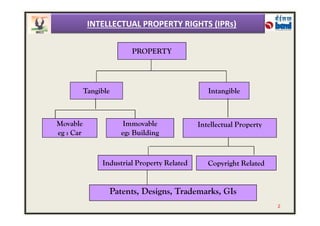
PROPERTY
Tangible Intangible
INTELLECTUAL PROPERTY RIGHTS (IPRs)
Movable
eg : Car
Immovable
eg: Building
Intellectual Property
Patents, Designs, Trademarks, GIs
Industrial Property Related Copyright Related
2
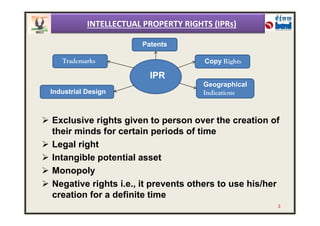
IPR
Patents
Copy Rights
Geographical
Indications
Industrial Design
Trademarks
INTELLECTUAL PROPERTY RIGHTS (IPRs)
 Exclusive rights given to person over the creation of
their minds for certain periods of time
 Legal right
 Intangible potential asset
 Monopoly
 Negative rights i.e., it prevents others to use his/her
creation for a definite time
3
The intellectual property rights were essentially recognized
and accepted all over the world due to some very important
reasons.
To provide an incentive to individuals for new creations
INTELLECTUAL PROPERTY RIGHTS (IPRs)
To accord due recognition to the creators and inventors
To ensure material reward for intellectual property
To make available genuine and original products.
4
Patents:
 Inventions (Products, Processes, Materials, Compositions)
 Technical Solution to a Technical problem
Industrial Designs:
 External features appealing to the eye
 New Shape, Pattern or Configuration
VARIOUS KINDS OF IPRS
 New Shape, Pattern or Configuration
Trade Marks:
 A visual symbol such as a Word, Name, Logo, Label,
Monogram, Slogan etc.
 Applied on Article of Manufacture or Service
 Indicates the origin of goods and services
5
Copyrights:
 Artistic, literary, musical and dramatic creations
 Proprietary right
 Comes into existence as soon as the work is created
Geographical Indications (GIs):
VARIOUS KINDS OF IPRS
Geographical Indications (GIs):
 Identifies agricultural, natural or manufactured goods
originating from a definite territory in India
 Possessing special quality or reputation based upon unique
characteristics of the geographical location
6
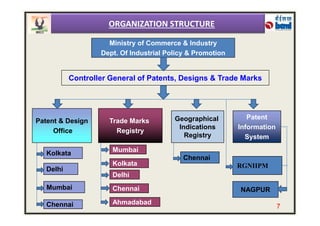
Ministry of Commerce & Industry
Dept. Of Industrial Policy & Promotion
Controller General of Patents, Designs & Trade Marks
ORGANIZATION STRUCTURE
Patent & Design
Office
Trade Marks
Registry
Geographical
Indications
Registry
Patent
Information
System
Kolkata
Delhi
Mumbai
Chennai
Delhi
Mumbai
Chennai
Kolkata
Ahmadabad
Chennai
RGNIIPM
NAGPUR
7
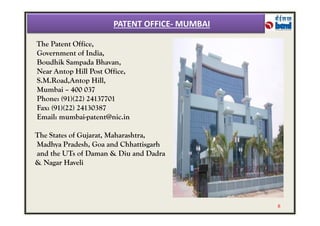
The Patent Office,
Government of India,
Boudhik Sampada Bhavan,
Near Antop Hill Post Office,
S.M.Road,Antop Hill,
Mumbai – 400 037
Phone: (91)(22) 24137701
Fax: (91)(22) 24130387
Email: mumbai-patent@nic.in
PATENT OFFICE- MUMBAI
Email: mumbai-patent@nic.in
The States of Gujarat, Maharashtra,
Madhya Pradesh, Goa and Chhattisgarh
and the UTs of Daman & Diu and Dadra
& Nagar Haveli
8
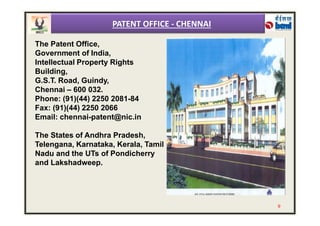
The Patent Office,
Government of India,
Intellectual Property Rights
Building,
G.S.T. Road, Guindy,
Chennai – 600 032.
Phone: (91)(44) 2250 2081-84
Fax: (91)(44) 2250 2066
Email: chennai-patent@nic.in
PATENT OFFICE - CHENNAI
Email: chennai-patent@nic.in
The States of Andhra Pradesh,
Telengana, Karnataka, Kerala, Tamil
Nadu and the UTs of Pondicherry
and Lakshadweep.
9
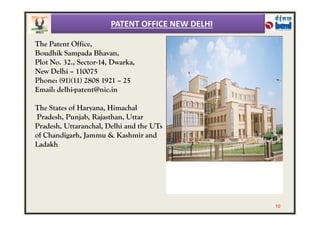
The Patent Office,
Boudhik Sampada Bhavan,
Plot No. 32., Sector-14, Dwarka,
New Delhi – 110075
Phone: (91)(11) 2808 1921 – 25
Email: delhi-patent@nic.in
The States of Haryana, Himachal
Pradesh, Punjab, Rajasthan, Uttar
PATENT OFFICE NEW DELHI
Pradesh, Punjab, Rajasthan, Uttar
Pradesh, Uttaranchal, Delhi and the UTs
of Chandigarh, Jammu & Kashmir and
Ladakh
10
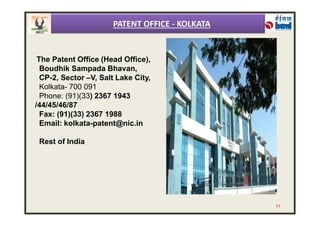
The Patent Office (Head Office),
Boudhik Sampada Bhavan,
CP-2, Sector –V, Salt Lake City,
Kolkata- 700 091
Phone: (91)(33) 2367 1943
/44/45/46/87
Fax: (91)(33) 2367 1988
PATENT OFFICE - KOLKATA
Fax: (91)(33) 2367 1988
Email: kolkata-patent@nic.in
Rest of India
11
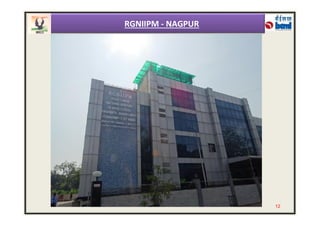
RGNIIPM - NAGPUR
12
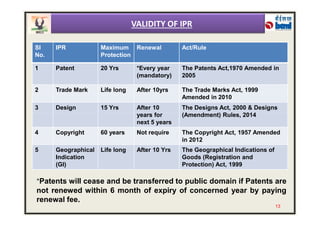
SI
No.
IPR Maximum
Protection
Renewal Act/Rule
1 Patent 20 Yrs *Every year
(mandatory)
The Patents Act,1970 Amended in
2005
2 Trade Mark Life long After 10yrs The Trade Marks Act, 1999
Amended in 2010
3 Design 15 Yrs After 10
years for
The Designs Act, 2000 & Designs
(Amendment) Rules, 2014
VALIDITY OF IPR
years for
next 5 years
(Amendment) Rules, 2014
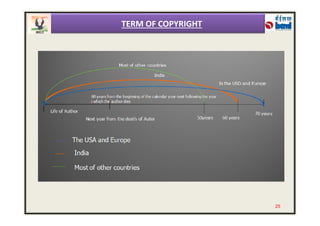
4 Copyright 60 years Not require The Copyright Act, 1957 Amended
in 2012
5 Geographical
Indication
(GI)
Life long After 10 Yrs The Geographical Indications of
Goods (Registration and
Protection) Act, 1999
*Patents will cease and be transferred to public domain if Patents are
not renewed within 6 month of expiry of concerned year by paying
renewal fee.
13
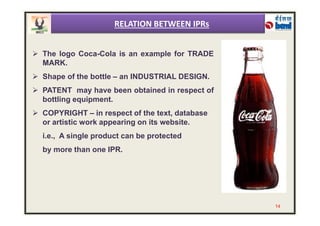
 The logo Coca-Cola is an example for TRADE
MARK.
 Shape of the bottle – an INDUSTRIAL DESIGN.
 PATENT may have been obtained in respect of
bottling equipment.
 COPYRIGHT – in respect of the text, database
RELATION BETWEEN IPRs
 COPYRIGHT – in respect of the text, database
or artistic work appearing on its website.
i.e., A single product can be protected
by more than one IPR.
14
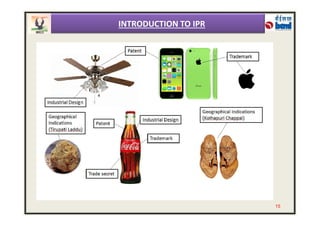
INTRODUCTION TO IPR
15
 It is the exclusive right of inventor to prevent others from
possessing, using, selling, manufacturing and importing
the patented invention or offering to do any of these with
in a definite geographical area.
 Patents have territorial jurisdiction i.e., we have to
register the patents in all countries where we have our
interests.
PATENTS
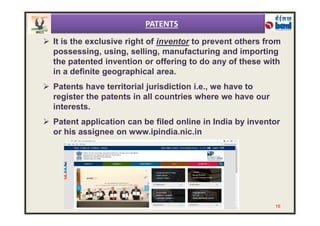
 Patent application can be filed online in India by inventor
or his assignee on www.ipindia.nic.in
16
Patent is an exclusive monopoly right:
Granted by Government of India
For an Invention
To the Inventor or his Assignee
As a Territorial Right
PATENTS
As a Territorial Right
In lieu of Disclosure of invention to the Government
Term of Patent: 20 years from date of filing
17
 In India, Patent rights are governed by the Patents Act,
1970. At present 3rd amendment of Act known as the
Patent (Amendment) Act, 2005 is in force.
 For application of Patents Act, rules are made by the
Government, which are known as “Patent Rules, 2003”,
as of now Patent (Amendment) Rule, 2006 and further
updated in Sept’2015 are in force.
PATENT ACT & RULES
updated in Sept’2015 are in force.
 For better understanding of Act & Rules, “Draft Manual
of Patent Practice & Procedure (MPPP), 2008” is made
by the patent office.
 There are 4 patent offices in India having work
distribution according to their geographical location
viz. Kolkata, Delhi, Mumbai & Chennai
18
Criteria of Patentability:
 Novelty
 Inventive step or it must be non-obvious
 Capable of industrial application
 Not fall within the provision of section 3 & 4 of the Patents Act
1970
Patents Act 1970:
 Section3: List which are not inventions
PATENT ACT & RULES
 Section3: List which are not inventions
 Frivolous or obvious
 Contrary to well established natural laws
 Injurious to Public Health
 Mere arrangement or re-arrangement,
 Discovery of Scientific principle
 Discovery of living thing or non-living substances in nature
 Method of agriculture or horticulture
 A mathematical or business method or a computer program
 Section4: Not-patentable: Atomic Energy related
19
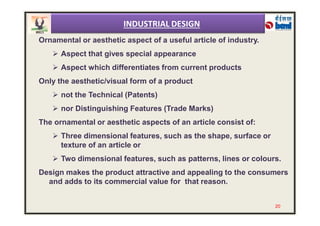
Ornamental or aesthetic aspect of a useful article of industry.
 Aspect that gives special appearance
 Aspect which differentiates from current products
Only the aesthetic/visual form of a product
 not the Technical (Patents)
 nor Distinguishing Features (Trade Marks)
INDUSTRIAL DESIGN
The ornamental or aesthetic aspects of an article consist of:
 Three dimensional features, such as the shape, surface or
texture of an article or
 Two dimensional features, such as patterns, lines or colours.
Design makes the product attractive and appealing to the consumers
and adds to its commercial value for that reason.
20
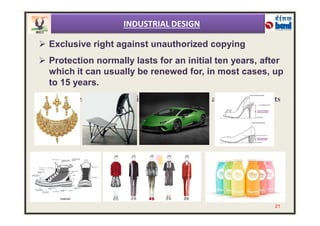
 Exclusive right against unauthorized copying
 Protection normally lasts for an initial ten years, after
which it can usually be renewed for, in most cases, up
to 15 years.
 Promotes more innovative and aesthetically attractive products
INDUSTRIAL DESIGN
21
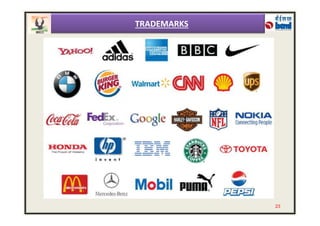
 Generally “Brand” or “Logo”
 A visual symbol which may be word signature, name, device,
label, numerals or combination of colors used by one undertaking
on goods or services or other articles of commerce to distinguish
it from other similar goods or services originating from a different
undertaking
 Any Name which is not unusual for trade to adopt as mark
TRADEMARKS
 Device or Symbol or Monogram
 Shape of goods or their packing
 Combination of colors or even a single color in combination with
word or device
22
TRADEMARKS
23
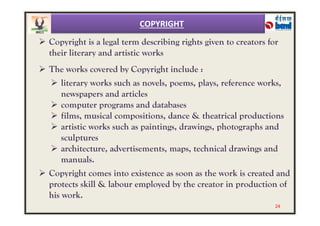
 Copyright is a legal term describing rights given to creators for
their literary and artistic works
 The works covered by Copyright include :
 literary works such as novels, poems, plays, reference works,
newspapers and articles
 computer programs and databases
 films, musical compositions, dance & theatrical productions
COPYRIGHT
 films, musical compositions, dance & theatrical productions
 artistic works such as paintings, drawings, photographs and
sculptures
 architecture, advertisements, maps, technical drawings and
manuals.
 Copyright comes into existence as soon as the work is created and
protects skill & labour employed by the creator in production of
his work.
24
TERM OF COPYRIGHT
25
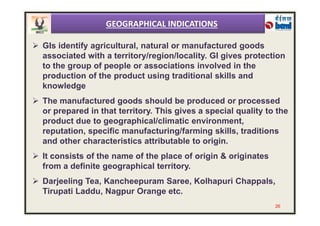
 GIs identify agricultural, natural or manufactured goods
associated with a territory/region/locality. GI gives protection
to the group of people or associations involved in the
production of the product using traditional skills and
knowledge
 The manufactured goods should be produced or processed
or prepared in that territory. This gives a special quality to the
GEOGRAPHICAL INDICATIONS
or prepared in that territory. This gives a special quality to the
product due to geographical/climatic environment,
reputation, specific manufacturing/farming skills, traditions
and other characteristics attributable to origin.
 It consists of the name of the place of origin & originates
from a definite geographical territory.
 Darjeeling Tea, Kancheepuram Saree, Kolhapuri Chappals,
Tirupati Laddu, Nagpur Orange etc.
26
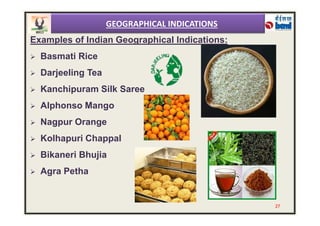
Examples of Indian Geographical Indications:
 Basmati Rice
 Darjeeling Tea
 Kanchipuram Silk Saree
 Alphonso Mango
GEOGRAPHICAL INDICATIONS
 Nagpur Orange
 Kolhapuri Chappal
 Bikaneri Bhujia
 Agra Petha
27
ध यवाद
THANK YOU
VARIOUS KINDS OF IPRS
28
ध यवाद

IPR_Training.pdf

  • 1.
    MISSION RAKSHA GYANSHAKTI PRESENTATION ON 1 INTELLECTUAL PROPERTY RIGHTS (IPR)
  • 2.
    PROPERTY Tangible Intangible INTELLECTUAL PROPERTYRIGHTS (IPRs) Movable eg : Car Immovable eg: Building Intellectual Property Patents, Designs, Trademarks, GIs Industrial Property Related Copyright Related 2
  • 3.
    IPR Patents Copy Rights Geographical Indications Industrial Design Trademarks INTELLECTUALPROPERTY RIGHTS (IPRs)  Exclusive rights given to person over the creation of their minds for certain periods of time  Legal right  Intangible potential asset  Monopoly  Negative rights i.e., it prevents others to use his/her creation for a definite time 3
  • 4.
    The intellectual propertyrights were essentially recognized and accepted all over the world due to some very important reasons. To provide an incentive to individuals for new creations INTELLECTUAL PROPERTY RIGHTS (IPRs) To accord due recognition to the creators and inventors To ensure material reward for intellectual property To make available genuine and original products. 4
  • 5.
    Patents:  Inventions (Products,Processes, Materials, Compositions)  Technical Solution to a Technical problem Industrial Designs:  External features appealing to the eye  New Shape, Pattern or Configuration VARIOUS KINDS OF IPRS  New Shape, Pattern or Configuration Trade Marks:  A visual symbol such as a Word, Name, Logo, Label, Monogram, Slogan etc.  Applied on Article of Manufacture or Service  Indicates the origin of goods and services 5
  • 6.
    Copyrights:  Artistic, literary,musical and dramatic creations  Proprietary right  Comes into existence as soon as the work is created Geographical Indications (GIs): VARIOUS KINDS OF IPRS Geographical Indications (GIs):  Identifies agricultural, natural or manufactured goods originating from a definite territory in India  Possessing special quality or reputation based upon unique characteristics of the geographical location 6
  • 7.
    Ministry of Commerce& Industry Dept. Of Industrial Policy & Promotion Controller General of Patents, Designs & Trade Marks ORGANIZATION STRUCTURE Patent & Design Office Trade Marks Registry Geographical Indications Registry Patent Information System Kolkata Delhi Mumbai Chennai Delhi Mumbai Chennai Kolkata Ahmadabad Chennai RGNIIPM NAGPUR 7
  • 8.
    The Patent Office, Governmentof India, Boudhik Sampada Bhavan, Near Antop Hill Post Office, S.M.Road,Antop Hill, Mumbai – 400 037 Phone: (91)(22) 24137701 Fax: (91)(22) 24130387 Email: mumbai-patent@nic.in PATENT OFFICE- MUMBAI Email: mumbai-patent@nic.in The States of Gujarat, Maharashtra, Madhya Pradesh, Goa and Chhattisgarh and the UTs of Daman & Diu and Dadra & Nagar Haveli 8
  • 9.
    The Patent Office, Governmentof India, Intellectual Property Rights Building, G.S.T. Road, Guindy, Chennai – 600 032. Phone: (91)(44) 2250 2081-84 Fax: (91)(44) 2250 2066 Email: chennai-patent@nic.in PATENT OFFICE - CHENNAI Email: chennai-patent@nic.in The States of Andhra Pradesh, Telengana, Karnataka, Kerala, Tamil Nadu and the UTs of Pondicherry and Lakshadweep. 9
  • 10.
    The Patent Office, BoudhikSampada Bhavan, Plot No. 32., Sector-14, Dwarka, New Delhi – 110075 Phone: (91)(11) 2808 1921 – 25 Email: delhi-patent@nic.in The States of Haryana, Himachal Pradesh, Punjab, Rajasthan, Uttar PATENT OFFICE NEW DELHI Pradesh, Punjab, Rajasthan, Uttar Pradesh, Uttaranchal, Delhi and the UTs of Chandigarh, Jammu & Kashmir and Ladakh 10
  • 11.
    The Patent Office(Head Office), Boudhik Sampada Bhavan, CP-2, Sector –V, Salt Lake City, Kolkata- 700 091 Phone: (91)(33) 2367 1943 /44/45/46/87 Fax: (91)(33) 2367 1988 PATENT OFFICE - KOLKATA Fax: (91)(33) 2367 1988 Email: kolkata-patent@nic.in Rest of India 11
  • 12.
  • 13.
    SI No. IPR Maximum Protection Renewal Act/Rule 1Patent 20 Yrs *Every year (mandatory) The Patents Act,1970 Amended in 2005 2 Trade Mark Life long After 10yrs The Trade Marks Act, 1999 Amended in 2010 3 Design 15 Yrs After 10 years for The Designs Act, 2000 & Designs (Amendment) Rules, 2014 VALIDITY OF IPR years for next 5 years (Amendment) Rules, 2014 4 Copyright 60 years Not require The Copyright Act, 1957 Amended in 2012 5 Geographical Indication (GI) Life long After 10 Yrs The Geographical Indications of Goods (Registration and Protection) Act, 1999 *Patents will cease and be transferred to public domain if Patents are not renewed within 6 month of expiry of concerned year by paying renewal fee. 13
  • 14.
     The logoCoca-Cola is an example for TRADE MARK.  Shape of the bottle – an INDUSTRIAL DESIGN.  PATENT may have been obtained in respect of bottling equipment.  COPYRIGHT – in respect of the text, database RELATION BETWEEN IPRs  COPYRIGHT – in respect of the text, database or artistic work appearing on its website. i.e., A single product can be protected by more than one IPR. 14
  • 15.
  • 16.
     It isthe exclusive right of inventor to prevent others from possessing, using, selling, manufacturing and importing the patented invention or offering to do any of these with in a definite geographical area.  Patents have territorial jurisdiction i.e., we have to register the patents in all countries where we have our interests. PATENTS  Patent application can be filed online in India by inventor or his assignee on www.ipindia.nic.in 16
  • 17.
    Patent is anexclusive monopoly right: Granted by Government of India For an Invention To the Inventor or his Assignee As a Territorial Right PATENTS As a Territorial Right In lieu of Disclosure of invention to the Government Term of Patent: 20 years from date of filing 17
  • 18.
     In India,Patent rights are governed by the Patents Act, 1970. At present 3rd amendment of Act known as the Patent (Amendment) Act, 2005 is in force.  For application of Patents Act, rules are made by the Government, which are known as “Patent Rules, 2003”, as of now Patent (Amendment) Rule, 2006 and further updated in Sept’2015 are in force. PATENT ACT & RULES updated in Sept’2015 are in force.  For better understanding of Act & Rules, “Draft Manual of Patent Practice & Procedure (MPPP), 2008” is made by the patent office.  There are 4 patent offices in India having work distribution according to their geographical location viz. Kolkata, Delhi, Mumbai & Chennai 18
  • 19.
    Criteria of Patentability: Novelty  Inventive step or it must be non-obvious  Capable of industrial application  Not fall within the provision of section 3 & 4 of the Patents Act 1970 Patents Act 1970:  Section3: List which are not inventions PATENT ACT & RULES  Section3: List which are not inventions  Frivolous or obvious  Contrary to well established natural laws  Injurious to Public Health  Mere arrangement or re-arrangement,  Discovery of Scientific principle  Discovery of living thing or non-living substances in nature  Method of agriculture or horticulture  A mathematical or business method or a computer program  Section4: Not-patentable: Atomic Energy related 19
  • 20.
    Ornamental or aestheticaspect of a useful article of industry.  Aspect that gives special appearance  Aspect which differentiates from current products Only the aesthetic/visual form of a product  not the Technical (Patents)  nor Distinguishing Features (Trade Marks) INDUSTRIAL DESIGN The ornamental or aesthetic aspects of an article consist of:  Three dimensional features, such as the shape, surface or texture of an article or  Two dimensional features, such as patterns, lines or colours. Design makes the product attractive and appealing to the consumers and adds to its commercial value for that reason. 20
  • 21.
     Exclusive rightagainst unauthorized copying  Protection normally lasts for an initial ten years, after which it can usually be renewed for, in most cases, up to 15 years.  Promotes more innovative and aesthetically attractive products INDUSTRIAL DESIGN 21
  • 22.
     Generally “Brand”or “Logo”  A visual symbol which may be word signature, name, device, label, numerals or combination of colors used by one undertaking on goods or services or other articles of commerce to distinguish it from other similar goods or services originating from a different undertaking  Any Name which is not unusual for trade to adopt as mark TRADEMARKS  Device or Symbol or Monogram  Shape of goods or their packing  Combination of colors or even a single color in combination with word or device 22
  • 23.
  • 24.
     Copyright isa legal term describing rights given to creators for their literary and artistic works  The works covered by Copyright include :  literary works such as novels, poems, plays, reference works, newspapers and articles  computer programs and databases  films, musical compositions, dance & theatrical productions COPYRIGHT  films, musical compositions, dance & theatrical productions  artistic works such as paintings, drawings, photographs and sculptures  architecture, advertisements, maps, technical drawings and manuals.  Copyright comes into existence as soon as the work is created and protects skill & labour employed by the creator in production of his work. 24
  • 25.
  • 26.
     GIs identifyagricultural, natural or manufactured goods associated with a territory/region/locality. GI gives protection to the group of people or associations involved in the production of the product using traditional skills and knowledge  The manufactured goods should be produced or processed or prepared in that territory. This gives a special quality to the GEOGRAPHICAL INDICATIONS or prepared in that territory. This gives a special quality to the product due to geographical/climatic environment, reputation, specific manufacturing/farming skills, traditions and other characteristics attributable to origin.  It consists of the name of the place of origin & originates from a definite geographical territory.  Darjeeling Tea, Kancheepuram Saree, Kolhapuri Chappals, Tirupati Laddu, Nagpur Orange etc. 26
  • 27.
    Examples of IndianGeographical Indications:  Basmati Rice  Darjeeling Tea  Kanchipuram Silk Saree  Alphonso Mango GEOGRAPHICAL INDICATIONS  Nagpur Orange  Kolhapuri Chappal  Bikaneri Bhujia  Agra Petha 27
  • 28.
    ध यवाद THANK YOU VARIOUSKINDS OF IPRS 28 ध यवाद