Science: Its
Structure and
Nature
ANABELLE A. ARENA
PROFESSOR
What is science?
 Science is
commonly
associated
with an
accumulation
of facts,
concepts and
theories. It is
even confused
with
technology .
Science as:
Process
a dynamic way of
acquiring, using and
refining that body of
knowledge
Product
an organized and
rapidly changing
body of
knowledge
Science as a Product
 Facts which are truths and therefore can not be
questioned or doubted
 Generalizations and theories which are subject
to error and likely to change
Science as a Process
 A way of investigating which involves questions,
observations, experimentations and predictions.
 A way of thinking which involves inductive and
deductive reasoning
Science as product
5. models
4. theories
3. hypotheses
1. facts
2.
generalization
FACT
 is a recognition and
observation of a single
event. It is the
foundation of scientific
knowledge
GENERALIZATION
 Is a statement of one of the
patterns of relationships among
facts. Many generalizations are
based upon so many
observations (facts) which are all
consistent with observational
error. Such generalizations, with
their empirical basis are given the
dignified name of “laws” and
“principles”
HYPOTHESIS
 Is an untested
speculation.
 It is a tentative idea
about certain
relationships which
connect observable
events as these occur
THEORY
 Is a speculation that has
been extensively tested,
fits all known facts, and
has no reasonable rival.
It is arrived at in an
inductive way from a set
of facts.
MODEL
 Is a device for testing
ideas and predicting
from hypotheses. It is
often abstract and even
purely imaginary. It is
arrived at in deductive
way from a theory.
Science as Process
It is both a way of investigating and a way of thinking.
Why?
How come?
How?
What?
What for ?
Science as Process
 It is a way of investigating. This involves questions, observations,
experimentations and predictions
 Why?
 Where?
 What for?
 When?
 How?
 It is a way of thinking which involves inductive and deductive
reasoning
 As a process, science is: “Learning how to learn”.
Inductive reasoning starts from the
specific to general
.
Inductive
Reasoning
Generalization
Abstraction and
organization of data
Comparison and
differentiation
Presentation of
raw data
from
specific
to
general
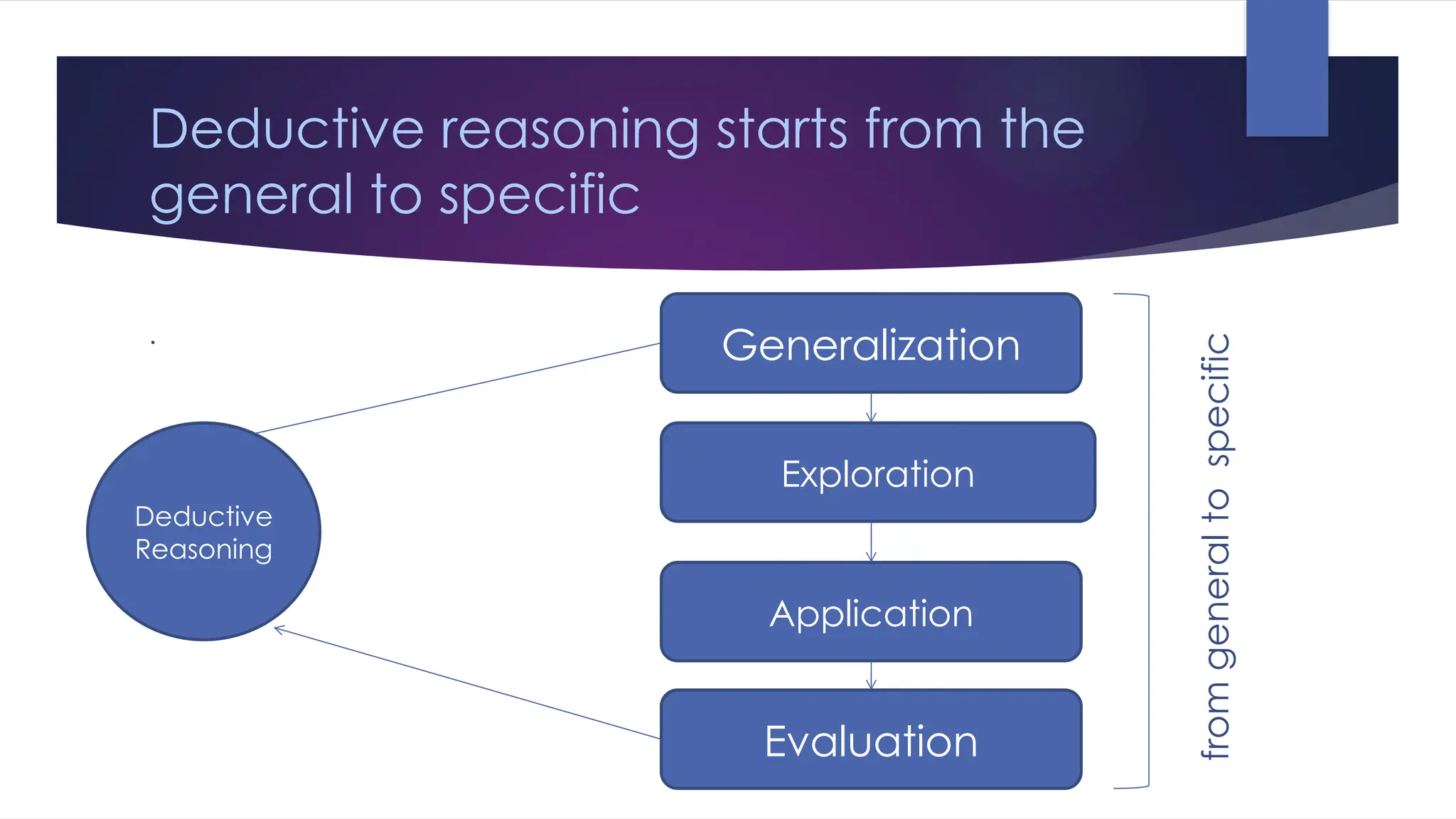
Deductive reasoning starts from the
general to specific
.
Deductive
Reasoning
Generalization
Exploration
Application
Evaluation
from
general
to
specific
Science
Product
is an organized and
rapid changing body of
knowledge
Process
is a dynamic way of
acquiring, using and refining
the body of knowledge
Implications of Science as Product
and Process
 Science as a product is an ever- changing body of knowledge.
Science as a process is an on going process of investigation and
thinking. As such, it should help our young learners to expect
change and to have a positive attitude for each change.
 Science as both product and process should be reflected in our
teaching- learning activities. It should be emphasized that there is
no single and best method of teaching science. Different science
topics call for different methods of teaching. Regardless of the
method used, the processes of science should be emphasized.
Science Process Skills
What is sps?
 How a scientist works, thinks and studies problem.
 A way of investigation that involves specific skills which
require the following steps:
~ planning course of actions.
~ carrying out activities.
~ collecting data.
~ organizing & interpreting data.
~ reaching a conclusion.
The Process Skills
Communicating
 Giving or exchanging information verbally,
orally and/ or in writing
 Observing
 Using one or more of the five senses to gather
information. May include the use of equipment
The Process Skills
 Measuring
 Comparing objects to arbitrary units that may
not be standardized
 Estimating
 Approximately calculating a quantity or value
based on judgment.
The Process Skills
 Classifying
 Grouping or ordering objects or events according
to an established scheme. Based on observations.
 Collecting Data
 Gathering information about observations and
measurements in systematic way.
The Process Skills
 Predicting
 Forming an idea of an expected result. Based
on inferences.
 Inferring
 Developing ideas based on observation. Requires
evaluation and judgment based on past experiences
The Process Skills
 Predicting
 Forming an idea of an expected result. Based
on inferences.
 Inferring
 Developing ideas based on observation. Requires
evaluation and judgment based on past experiences
The Process Skills
 Hypothesizing
 Stating a problem to be solved as a question
that can be tested by an experiment
 Making Graphs
 Converting numerical quantities into a diagram
that shows the relationships among the quantities.
The Process Skills
 Defining Operationally
 Stating specific information about an object or
phenomena based on experiences with it.
 Controlling Variables
 Manipulating one factor that may affect the outcome
of an event while other factors are held constant.
The Process Skills
 Investigating
 Using observations to collect and analyze data
to draw conclusions in order to solve a problem
THE RELATIONSHIP BETWEEN SCIENCE
PROCESS SKILLS AND THINKING SKILLS.
 SCIENCE PROCESS
SKILLS
 THINKING SKILLS
OBSERVING
-CHARACTERIZE
-TO COMPARE
-TO RELATE
THE RELATIONSHIP BETWEEN SCIENCE
PROCESS SKILLS AND THINKING SKILLS.
CLASSIFY
-CHARACTERIZE
- TO COMPARE AND
TO CONTRAST
- TO COLLECT AND
CLASSIFY
THE RELATIONSHIP BETWEEN SCIENCE
PROCESS SKILLS AND THINKING SKILLS.
 MEASURING
AND
USING
NUMBERS
- TO RELATE
-TO COMPARE AND
TO CONTRAST
THE RELATIONSHIP BETWEEN SCIENCE
PROCESS SKILLS AND THINKING SKILLS.
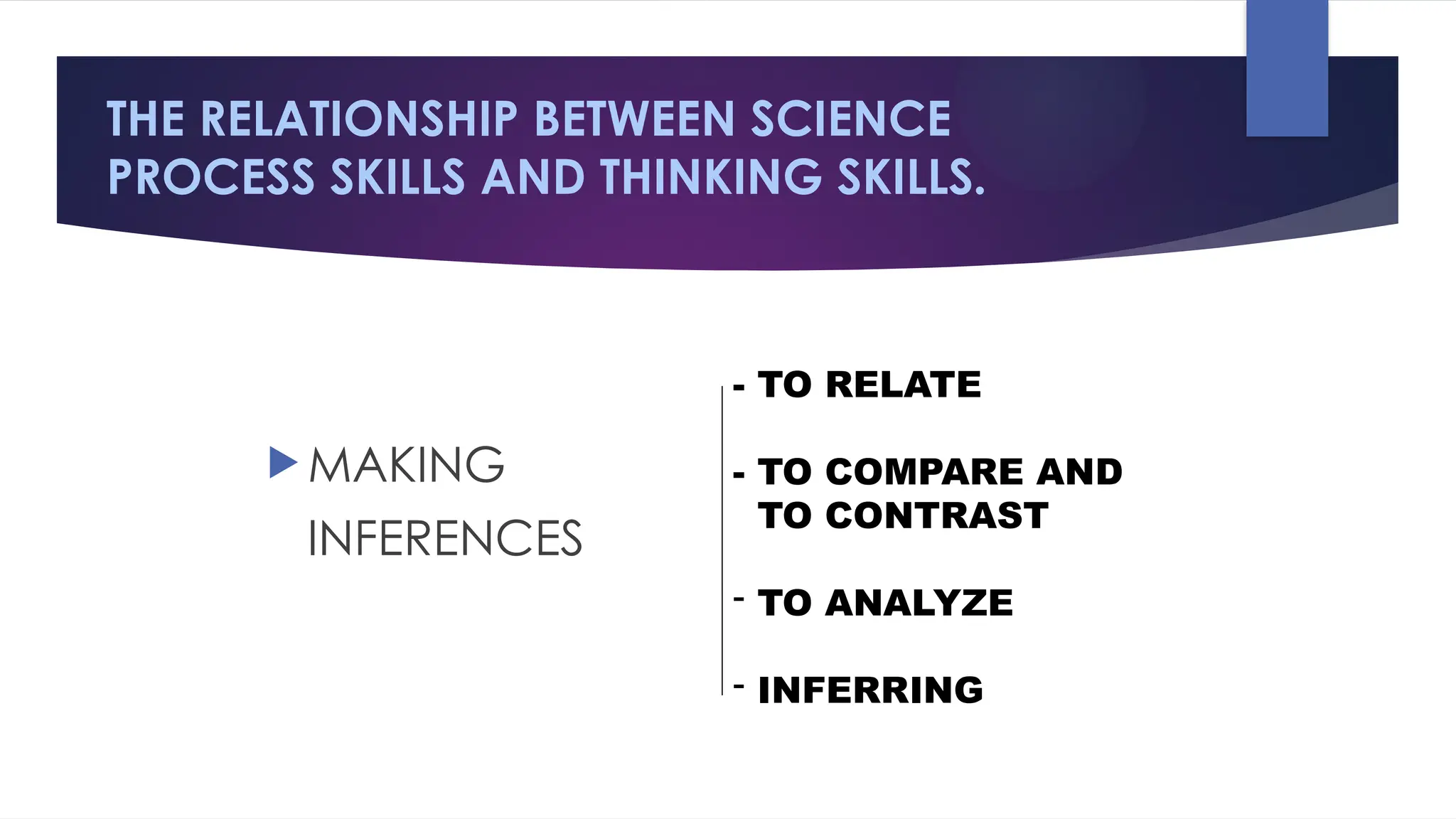
 MAKING
INFERENCES
- TO RELATE
- TO COMPARE AND
TO CONTRAST
- TO ANALYZE
- INFERRING
THE RELATIONSHIP BETWEEN SCIENCE
PROCESS SKILLS AND THINKING SKILLS.
- TO RELATE
- MENTAL IMAGE
PREDICTING
References:
 Modernizing Science Instruction in Elementary
School. “Science : Its Structure and Nature”
pp.21-29

Lesson-3-Science-as-a-Product-and-Process.pptx

  • 1.
  • 2.
    What is science? Science is commonly associated with an accumulation of facts, concepts and theories. It is even confused with technology . Science as: Process a dynamic way of acquiring, using and refining that body of knowledge Product an organized and rapidly changing body of knowledge
  • 3.
    Science as aProduct  Facts which are truths and therefore can not be questioned or doubted  Generalizations and theories which are subject to error and likely to change
  • 4.
    Science as aProcess  A way of investigating which involves questions, observations, experimentations and predictions.  A way of thinking which involves inductive and deductive reasoning
  • 5.
    Science as product 5.models 4. theories 3. hypotheses 1. facts 2. generalization
  • 6.
    FACT  is arecognition and observation of a single event. It is the foundation of scientific knowledge GENERALIZATION  Is a statement of one of the patterns of relationships among facts. Many generalizations are based upon so many observations (facts) which are all consistent with observational error. Such generalizations, with their empirical basis are given the dignified name of “laws” and “principles”
  • 7.
    HYPOTHESIS  Is anuntested speculation.  It is a tentative idea about certain relationships which connect observable events as these occur THEORY  Is a speculation that has been extensively tested, fits all known facts, and has no reasonable rival. It is arrived at in an inductive way from a set of facts.
  • 8.
    MODEL  Is adevice for testing ideas and predicting from hypotheses. It is often abstract and even purely imaginary. It is arrived at in deductive way from a theory.
  • 9.
    Science as Process Itis both a way of investigating and a way of thinking. Why? How come? How? What? What for ?
  • 10.
    Science as Process It is a way of investigating. This involves questions, observations, experimentations and predictions  Why?  Where?  What for?  When?  How?  It is a way of thinking which involves inductive and deductive reasoning  As a process, science is: “Learning how to learn”.
  • 11.
    Inductive reasoning startsfrom the specific to general . Inductive Reasoning Generalization Abstraction and organization of data Comparison and differentiation Presentation of raw data from specific to general
  • 12.
    Deductive reasoning startsfrom the general to specific . Deductive Reasoning Generalization Exploration Application Evaluation from general to specific
  • 13.
    Science Product is an organizedand rapid changing body of knowledge Process is a dynamic way of acquiring, using and refining the body of knowledge
  • 14.
    Implications of Scienceas Product and Process  Science as a product is an ever- changing body of knowledge. Science as a process is an on going process of investigation and thinking. As such, it should help our young learners to expect change and to have a positive attitude for each change.  Science as both product and process should be reflected in our teaching- learning activities. It should be emphasized that there is no single and best method of teaching science. Different science topics call for different methods of teaching. Regardless of the method used, the processes of science should be emphasized.
  • 15.
  • 16.
    What is sps? How a scientist works, thinks and studies problem.  A way of investigation that involves specific skills which require the following steps: ~ planning course of actions. ~ carrying out activities. ~ collecting data. ~ organizing & interpreting data. ~ reaching a conclusion.
  • 17.
    The Process Skills Communicating Giving or exchanging information verbally, orally and/ or in writing  Observing  Using one or more of the five senses to gather information. May include the use of equipment
  • 18.
    The Process Skills Measuring  Comparing objects to arbitrary units that may not be standardized  Estimating  Approximately calculating a quantity or value based on judgment.
  • 19.
    The Process Skills Classifying  Grouping or ordering objects or events according to an established scheme. Based on observations.  Collecting Data  Gathering information about observations and measurements in systematic way.
  • 20.
    The Process Skills Predicting  Forming an idea of an expected result. Based on inferences.  Inferring  Developing ideas based on observation. Requires evaluation and judgment based on past experiences
  • 21.
    The Process Skills Predicting  Forming an idea of an expected result. Based on inferences.  Inferring  Developing ideas based on observation. Requires evaluation and judgment based on past experiences
  • 22.
    The Process Skills Hypothesizing  Stating a problem to be solved as a question that can be tested by an experiment  Making Graphs  Converting numerical quantities into a diagram that shows the relationships among the quantities.
  • 23.
    The Process Skills Defining Operationally  Stating specific information about an object or phenomena based on experiences with it.  Controlling Variables  Manipulating one factor that may affect the outcome of an event while other factors are held constant.
  • 24.
    The Process Skills Investigating  Using observations to collect and analyze data to draw conclusions in order to solve a problem
  • 25.
    THE RELATIONSHIP BETWEENSCIENCE PROCESS SKILLS AND THINKING SKILLS.  SCIENCE PROCESS SKILLS  THINKING SKILLS OBSERVING -CHARACTERIZE -TO COMPARE -TO RELATE
  • 26.
    THE RELATIONSHIP BETWEENSCIENCE PROCESS SKILLS AND THINKING SKILLS. CLASSIFY -CHARACTERIZE - TO COMPARE AND TO CONTRAST - TO COLLECT AND CLASSIFY
  • 27.
    THE RELATIONSHIP BETWEENSCIENCE PROCESS SKILLS AND THINKING SKILLS.  MEASURING AND USING NUMBERS - TO RELATE -TO COMPARE AND TO CONTRAST
  • 28.
    THE RELATIONSHIP BETWEENSCIENCE PROCESS SKILLS AND THINKING SKILLS.  MAKING INFERENCES - TO RELATE - TO COMPARE AND TO CONTRAST - TO ANALYZE - INFERRING
  • 29.
    THE RELATIONSHIP BETWEENSCIENCE PROCESS SKILLS AND THINKING SKILLS. - TO RELATE - MENTAL IMAGE PREDICTING
  • 30.
    References:  Modernizing ScienceInstruction in Elementary School. “Science : Its Structure and Nature” pp.21-29