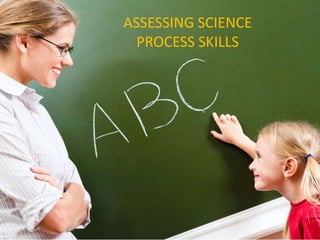
ASSESSING SCIENCE
PROCESS SKILLS
Classroom Assessment in
Science
Planning
Strategies
Challenges
Pitfalls
Planning
Planning involves (1) what to assess (2) why
assess (3) how to use the assessment
information (4)who will use the assessment
information (5) the assessment task or
activities that give students opportunities to
show what they learned in an authentic way.
Strategies
Assessment strategies in Science include
observation, self-assessment, group or peer
assessment, interviews, performance
assessment, student demonstration, entries
in science journals, the use of rubrics or
checklists, paper-and-pencil tasks or tests,
visual displays, laboratory reports, poster
presentation, research report and authentic
assessment.
Challenges
Some forms of assessment are not feasible
due to limited resources and time.
Pitfalls
Pitfalls in authentic assessment include:
• Failing to differentiate why you are
assessing
• Failing to use assessment to inform your
instruction
• Using assessments that only emphasize
lower order thinking skills
Challenges
Some forms of assessment are not feasible
due to limited resources and time.
Effective characteristics of assessment are as
follows:
1. Congruent and integrated with instruction
2. Based on authentic tasks and meaningful
real-life contexts and science learning
processes
3. Multidimensional, using many tools and
methods
4. Based on what the students know,
understand, and are interested in
5. Involves collaboration of students
6. Focuses on what students learned and can
do
7. Is continually going on (formative)
HOW YOU WILL ASSESS WILL
DEPEND ON WHAT YOU WILL
ASSESS
Assessing the Science process
skills
There are 12 science process skills namely:
*Observing *Formulating hypothesis
*Classifying *Defining Operationally
*Communicating *Interpreting Data
*Measuring *Experimenting
*Predicting *Constructing Models
*Inferring
*Identifying and Controlling Variable
Observing
• How do we know how well a student can
observe?
• Be able to identify objects using more
than just one sense anduse the
appropriate senses
• Describe the properties of the object
accurately, provide both qualitative and
quantitative observations and describe
differences among objects that are similar
Classifying
• Figure out what are the major properties
that can be used to sort objects
• Identify properties that are common to all
the objects
Communicating
• How well can a student communicate
• Be able to describe an object accurately
• Be able to provide a very clear
descriptions so that others can identify
unknown objects or events
• Convey information both in verbal and
written forms
Measuring
• A student can measure well if they can
select an appropriate type of
measurement needed (how to measure a
door, road, book)
• Does not forget to indicate the
appropriate unit of measurements
• Is able to use measuring instruments and
units appropriately
Predicting
• How well does a student predict?
• Be able to form and extend patterns of
similar events
• Make simple but rational predictions
Inferring
• How well does a student infer?
• Be able to use all information making
their inferences
• Avoid inventing information
• Give sound reasoning in appropriate
situations
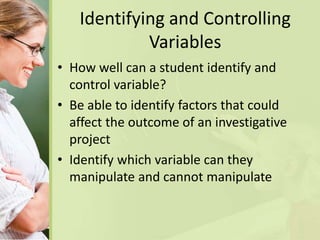
Identifying and Controlling
Variables
• How well can a student identify and
control variable?
• Be able to identify factors that could
affect the outcome of an investigative
project
• Identify which variable can they
manipulate and cannot manipulate
Formulating Hypothesis
• Be able to formulate a hypothesis from a
given question or problem, create a
hypothesis from a given question or
problem
• Create a hypothesis from his/her own
question or problem
• Explain the reason behind the creation of
such hypothesis
Defining Operationally
• How do you know a student can define
operationally?
• Be able to recognize the need to make an
operational definition
• Show the logical connection between the
variable to be measured and its
operational definition
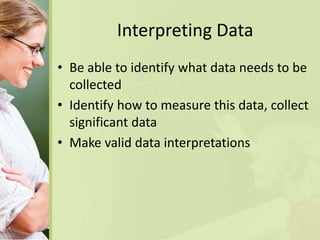
Interpreting Data
• Be able to identify what data needs to be
collected
• Identify how to measure this data, collect
significant data
• Make valid data interpretations
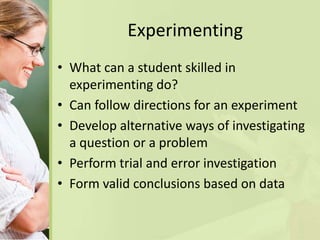
Experimenting
• What can a student skilled in
experimenting do?
• Can follow directions for an experiment
• Develop alternative ways of investigating
a question or a problem
• Perform trial and error investigation
• Form valid conclusions based on data
Constructing Models
• Can differentiate between a mode and
the real thing
• Develop an appropriate model with
correct labels and interpretations

ASSESSING SCIENCE PROCESS SKILLS.pptx

  • 1.
  • 2.
  • 3.
    Planning Planning involves (1)what to assess (2) why assess (3) how to use the assessment information (4)who will use the assessment information (5) the assessment task or activities that give students opportunities to show what they learned in an authentic way.
  • 4.
    Strategies Assessment strategies inScience include observation, self-assessment, group or peer assessment, interviews, performance assessment, student demonstration, entries in science journals, the use of rubrics or checklists, paper-and-pencil tasks or tests, visual displays, laboratory reports, poster presentation, research report and authentic assessment.
  • 5.
    Challenges Some forms ofassessment are not feasible due to limited resources and time.
  • 6.
    Pitfalls Pitfalls in authenticassessment include: • Failing to differentiate why you are assessing • Failing to use assessment to inform your instruction • Using assessments that only emphasize lower order thinking skills
  • 7.
    Challenges Some forms ofassessment are not feasible due to limited resources and time.
  • 8.
    Effective characteristics ofassessment are as follows: 1. Congruent and integrated with instruction 2. Based on authentic tasks and meaningful real-life contexts and science learning processes 3. Multidimensional, using many tools and methods 4. Based on what the students know, understand, and are interested in 5. Involves collaboration of students 6. Focuses on what students learned and can do 7. Is continually going on (formative)
  • 9.
    HOW YOU WILLASSESS WILL DEPEND ON WHAT YOU WILL ASSESS
  • 10.
    Assessing the Scienceprocess skills There are 12 science process skills namely: *Observing *Formulating hypothesis *Classifying *Defining Operationally *Communicating *Interpreting Data *Measuring *Experimenting *Predicting *Constructing Models *Inferring *Identifying and Controlling Variable
  • 11.
    Observing • How dowe know how well a student can observe? • Be able to identify objects using more than just one sense anduse the appropriate senses • Describe the properties of the object accurately, provide both qualitative and quantitative observations and describe differences among objects that are similar
  • 12.
    Classifying • Figure outwhat are the major properties that can be used to sort objects • Identify properties that are common to all the objects
  • 13.
    Communicating • How wellcan a student communicate • Be able to describe an object accurately • Be able to provide a very clear descriptions so that others can identify unknown objects or events • Convey information both in verbal and written forms
  • 14.
    Measuring • A studentcan measure well if they can select an appropriate type of measurement needed (how to measure a door, road, book) • Does not forget to indicate the appropriate unit of measurements • Is able to use measuring instruments and units appropriately
  • 15.
    Predicting • How welldoes a student predict? • Be able to form and extend patterns of similar events • Make simple but rational predictions
  • 16.
    Inferring • How welldoes a student infer? • Be able to use all information making their inferences • Avoid inventing information • Give sound reasoning in appropriate situations
  • 17.
    Identifying and Controlling Variables •How well can a student identify and control variable? • Be able to identify factors that could affect the outcome of an investigative project • Identify which variable can they manipulate and cannot manipulate
  • 18.
    Formulating Hypothesis • Beable to formulate a hypothesis from a given question or problem, create a hypothesis from a given question or problem • Create a hypothesis from his/her own question or problem • Explain the reason behind the creation of such hypothesis
  • 19.
    Defining Operationally • Howdo you know a student can define operationally? • Be able to recognize the need to make an operational definition • Show the logical connection between the variable to be measured and its operational definition
  • 20.
    Interpreting Data • Beable to identify what data needs to be collected • Identify how to measure this data, collect significant data • Make valid data interpretations
  • 21.
    Experimenting • What cana student skilled in experimenting do? • Can follow directions for an experiment • Develop alternative ways of investigating a question or a problem • Perform trial and error investigation • Form valid conclusions based on data
  • 22.
    Constructing Models • Candifferentiate between a mode and the real thing • Develop an appropriate model with correct labels and interpretations