SCIENCE PROCESS
SKILLS
INTRODUCTION
One of the most important and pervasive goals of schooling is to teach students
to think. All school subjects should share in accomplishing this overall goal. Science
contributes its unique skills, with its emphasis on hypothesizing, manipulating the physical
world and reasoning from data.
The scientific method, scientif i c thinking and critical thinking have been terms
used at various times to describe these science skills. Today the term "science process skills"
is commonly used. Popularized by the curriculum project, Science - A Process Approach
(SAPA), these skills are de ned as a set of broadly transferable abilities, appropriate to many
science disciplines and re ective of the behavior of scientists. SAPA grouped process skills
into two types-basic and integrated. The basic (simpler) process skills provide a foundation
for learning the integrated (more complex) skills. These skills are listed and described below.
BASIC SCIENCE PROCESS SKILLS
1.Observing - using the senses to gather
information about an object or event. Example:
Describing a pencil as yellow.
2.Inferring - making an "educated guess" about
an object or event based on previously gathered
data or information. Example: Saying that the
person who used a pencil made a lot of
mistakes because the eraser was well worn.
3.Measuring - using both standard and
nonstandard measures or estimates to describe
the dimensions of an object or event. Example:
Using a meter stick to measure the length of a
BASIC SCIENCE PROCESS SKILLS
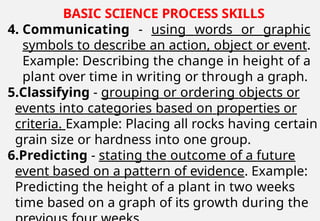
4. Communicating - using words or graphic
symbols to describe an action, object or event.
Example: Describing the change in height of a
plant over time in writing or through a graph.
5.Classifying - grouping or ordering objects or
events into categories based on properties or
criteria. Example: Placing all rocks having certain
grain size or hardness into one group.
6.Predicting - stating the outcome of a future
event based on a pattern of evidence. Example:
Predicting the height of a plant in two weeks
time based on a graph of its growth during the
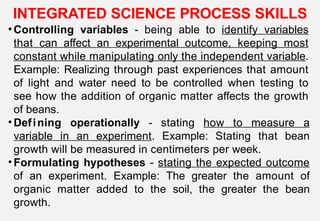
INTEGRATED SCIENCE PROCESS SKILLS
•Controlling variables - being able to identify variables
that can affect an experimental outcome, keeping most
constant while manipulating only the independent variable.
Example: Realizing through past experiences that amount
of light and water need to be controlled when testing to
see how the addition of organic matter affects the growth
of beans.
•Defining operationally - stating how to measure a
variable in an experiment. Example: Stating that bean
growth will be measured in centimeters per week.
•Formulating hypotheses - stating the expected outcome
of an experiment. Example: The greater the amount of
organic matter added to the soil, the greater the bean
growth.
INTEGRATED SCIENCE PROCESS SKILLS
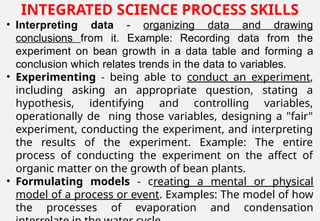
• Interpreting data - organizing data and drawing
conclusions from it. Example: Recording data from the
experiment on bean growth in a data table and forming a
conclusion which relates trends in the data to variables.
• Experimenting - being able to conduct an experiment,
including asking an appropriate question, stating a
hypothesis, identifying and controlling variables,
operationally de ning those variables, designing a "fair"
experiment, conducting the experiment, and interpreting
the results of the experiment. Example: The entire
process of conducting the experiment on the affect of
organic matter on the growth of bean plants.
• Formulating models - creating a mental or physical
model of a process or event. Examples: The model of how
the processes of evaporation and condensation
SUMMARY AND CONCLUSIONS
• A reasonable portion of the science curriculum
should emphasize science process skills
according to the National Science Teachers
Association.
• In general, the research literature indicates that
when science process skills are a specific
planned outcome of a science program, those
skills can be learned by students.

The Science Process Skills by NARST.pptx

  • 1.
  • 2.
    INTRODUCTION One of themost important and pervasive goals of schooling is to teach students to think. All school subjects should share in accomplishing this overall goal. Science contributes its unique skills, with its emphasis on hypothesizing, manipulating the physical world and reasoning from data. The scientific method, scientif i c thinking and critical thinking have been terms used at various times to describe these science skills. Today the term "science process skills" is commonly used. Popularized by the curriculum project, Science - A Process Approach (SAPA), these skills are de ned as a set of broadly transferable abilities, appropriate to many science disciplines and re ective of the behavior of scientists. SAPA grouped process skills into two types-basic and integrated. The basic (simpler) process skills provide a foundation for learning the integrated (more complex) skills. These skills are listed and described below.
  • 3.
    BASIC SCIENCE PROCESSSKILLS 1.Observing - using the senses to gather information about an object or event. Example: Describing a pencil as yellow. 2.Inferring - making an "educated guess" about an object or event based on previously gathered data or information. Example: Saying that the person who used a pencil made a lot of mistakes because the eraser was well worn. 3.Measuring - using both standard and nonstandard measures or estimates to describe the dimensions of an object or event. Example: Using a meter stick to measure the length of a
  • 4.
    BASIC SCIENCE PROCESSSKILLS 4. Communicating - using words or graphic symbols to describe an action, object or event. Example: Describing the change in height of a plant over time in writing or through a graph. 5.Classifying - grouping or ordering objects or events into categories based on properties or criteria. Example: Placing all rocks having certain grain size or hardness into one group. 6.Predicting - stating the outcome of a future event based on a pattern of evidence. Example: Predicting the height of a plant in two weeks time based on a graph of its growth during the
  • 5.
    INTEGRATED SCIENCE PROCESSSKILLS •Controlling variables - being able to identify variables that can affect an experimental outcome, keeping most constant while manipulating only the independent variable. Example: Realizing through past experiences that amount of light and water need to be controlled when testing to see how the addition of organic matter affects the growth of beans. •Defining operationally - stating how to measure a variable in an experiment. Example: Stating that bean growth will be measured in centimeters per week. •Formulating hypotheses - stating the expected outcome of an experiment. Example: The greater the amount of organic matter added to the soil, the greater the bean growth.
  • 6.
    INTEGRATED SCIENCE PROCESSSKILLS • Interpreting data - organizing data and drawing conclusions from it. Example: Recording data from the experiment on bean growth in a data table and forming a conclusion which relates trends in the data to variables. • Experimenting - being able to conduct an experiment, including asking an appropriate question, stating a hypothesis, identifying and controlling variables, operationally de ning those variables, designing a "fair" experiment, conducting the experiment, and interpreting the results of the experiment. Example: The entire process of conducting the experiment on the affect of organic matter on the growth of bean plants. • Formulating models - creating a mental or physical model of a process or event. Examples: The model of how the processes of evaporation and condensation
  • 7.
    SUMMARY AND CONCLUSIONS •A reasonable portion of the science curriculum should emphasize science process skills according to the National Science Teachers Association. • In general, the research literature indicates that when science process skills are a specific planned outcome of a science program, those skills can be learned by students.