Workshop Interdisciplinary Units
CIEDI - 23 October and 5 November 2014
Elena Jurado, Ángel Girano
!
Goal: To develop rich, effective and authentic
interdisciplinary units in MYP CIEDI
‣ What is interdisciplinarity and why it is important in teaching and
learning?
‣ To interiorise what the IB says about Interdisciplinary Units.
‣ To develop a methodology to make interdisciplinarity real in
MYP at CIEDI
‣ To join the Interdisciplinary Units group in Managebac
‣ To create a core research group of interdisciplinarity (innovative
practices? assessment? markers to measure the impact at
CIEDI? foster collaboration and entrepeneurship?)
Subgoals:
Goal Agenda Interdisciplinarity MYP practices Teaching framework Bibliograpfy
23#October,#5#November:
• Importance of
interdisciplinary
teaching and
learning
• Interdisciplinary
Units (IU) in
MYP
• Plan of action in
CIEDI
23 October 5 November
Goal Agenda Interdisciplinarity MYP practices Teaching framework Bibliograpfy
- Milestones:
- 23 October and 5 November 2014 “Induction Workshop” of
Interdisciplinary Units, lead by Elena Jurado and Angel Girano.
- 6 and 7 February 2015 “Deepening Workshop” of Interdisciplinary
Units, lead by Gabriela Gonzalez.
- The 31 January 2014 we aim to have 4 Interdisciplinary Units well
defined and partially designed, one for each level of MYP, and
each unit involving 2 or 3 disciplines. Those Interdisciplinary Units
will be taught during march-may 2015.
Milestones
Goal Agenda Interdisciplinarity MYP practices Teaching framework Bibliograpfy
- Regular check-ins on thursdays (3:30 - 4:30 pm) and/or fridays (7 - 8
am) and/or mondays (7-8 am)
IB Americas Chicago 26-27 July
Publication: Jeff Thompson Research Award??
What#is#the#difference#between#
interdisciplinary,#trandisciplinary#and#
multidisciplinary?
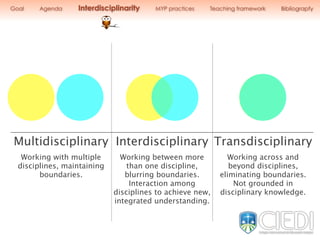
Multidisciplinary
Working with multiple
disciplines, maintaining
boundaries.
Interdisciplinary
Working between more
than one discipline,
blurring boundaries.
Interaction among
disciplines to achieve new,
integrated understanding.
Transdisciplinary
Working across and
beyond disciplines,
eliminating boundaries.
Not grounded in
disciplinary knowledge.
Goal Agenda Interdisciplinarity MYP practices Teaching framework Bibliograpfy
Frijoles en bolitas de algodón www.carolinamillas.com
“Interdisciplinary understanding refers to the ability to integrate
knowledge and modes of thinking from two or more disciplines to
generate a new insight’... new understanding’ … ‘it does not replace
disciplinary teaching, rather it builds on it..”
Veronica Boix Mansilla, Harvard Project Zero
“Interdisciplinarity is excellent if it is firmly rooted in disciplinarity.
Each subject is not an end in itself but it must be an efficient tool.
We must keep its identity and especially its own methodology.
Only on that basis will we be able to construct a serious
interdisciplinarity. Other wise we will lead our students to mental
confusion and superficial surveys.”
Gérard Renaud, 1989 (IB General Director 1977-1983)
Goal Agenda Interdisciplinarity MYP practices Teaching framework Bibliograpfy
Interdisciplinary understanding is:
‣ Purposeful
‣ Grounded in disciplines
‣ Integrative
Goal Agenda Interdisciplinarity MYP practices Teaching framework Bibliograpfy
Why#is#interdisciplinarity#important#in#
education?
Why is interdisciplinarity important in education?
Because it helps students to:
• Develop a holistic view of concepts and issues.
• Become life-long learners and problem solvers.
• Gain an intellectually rigorous view of knowledge.
• Understand the importance of collaboration and teamwork across
disciplines.
• Understand and address complex global issues.
Because it helps teachers to:
• Develop holistic understanding of disciplinary concepts and
contexts.
• Increase collaboration across subject groups.
• Allow subject groups to share responsibility for developing content
and skills.
Goal Agenda Interdisciplinarity MYP practices Teaching framework Bibliograpfy
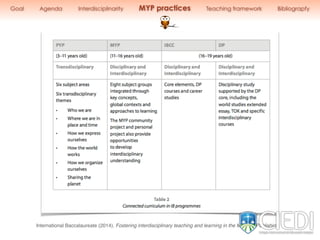
International Baccalaureate (2014). Fostering interdisciplinary teaching and learning in the MYP. IB Publishing
Goal Agenda Interdisciplinarity MYP practices Teaching framework Bibliograpfy
“In each year of the programme, MYP schools are
responsible of engaging students in at least one
collaboratively planned interdisciplinary unit that
involves at least two subject groups.”
Goal Agenda Interdisciplinarity MYP practices Teaching framework Bibliograpfy
International Baccalaureate (2014). Fostering interdisciplinary teaching and learning in the MYP. IB Publishing
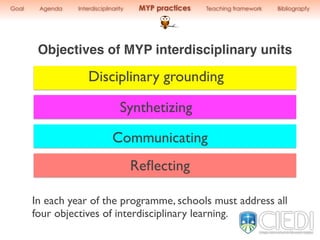
Disciplinary grounding
Synthetizing
Communicating
Reflecting
Objectives of MYP interdisciplinary units
In each year of the programme, schools must address all
four objectives of interdisciplinary learning.
Goal Agenda Interdisciplinarity MYP practices Teaching framework Bibliograpfy
Example: “The sound of music”
The International School of Uganda
‣MYP 2
‣Physics and music
‣ What will students do to learn?
‣ Create an orchestra of traditional instruments and compose and
perform a rhythmic piece for their school.
‣ What disciplinary tools will students need?
• Study the physics of sound waves.
• Understand how instruments work to make sound and music.
• Create a compelling musical experience for their audience.
Goal Agenda Interdisciplinarity MYP practices Teaching framework Bibliograpfy
Millorar amb les transparencias de Interdisciplinariedad en el PAI pptx!!!!
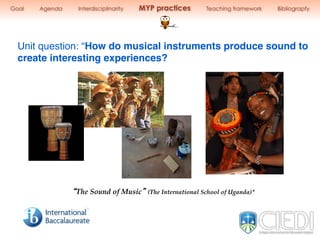
Unit question: “How do musical instruments produce sound to
create interesting experiences?
The$Sound$of$Music (The$International$School$of$Uganda)*9
Goal Agenda Interdisciplinarity MYP practices Teaching framework Bibliograpfy
Purposeful: clear aim, compelling topic, enriched
student understanding of local culture
Grounded in disciplines: Physics & Music
Integrative: students understood the science of
sound to explain how instruments make music,
students understood new musical possibilities
enabled by novel sounds.
Three qualities of interdisciplinary understanding
in the context of this example
Goal Agenda Interdisciplinarity MYP practices Teaching framework Bibliograpfy
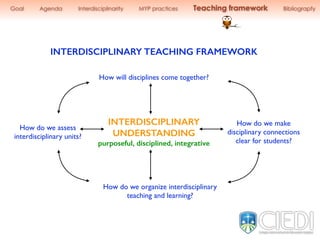
How will disciplines come together?
How do we make
disciplinary connections
clear for students?
How do we organize interdisciplinary
teaching and learning?
Goal Agenda Interdisciplinarity MYP practices Teaching framework Bibliograpfy
How do we assess
interdisciplinary units?
INTERDISCIPLINARY TEACHING FRAMEWORK
INTERDISCIPLINARY
UNDERSTANDING
purposeful, disciplined, integrative
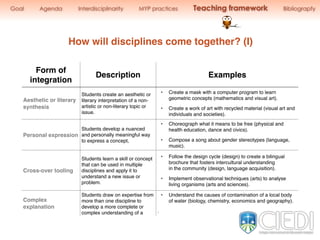
How will disciplines come together? (I)
Form of
integration
Description Examples
Aesthetic or literary
synthesis
Students create an aesthetic or
literary interpretation of a non-
artistic or non-literary topic or
issue.
• Create a mask with a computer program to learn
geometric concepts (mathematics and visual art).
• Create a work of art with recycled material (visual art and
individuals and societies).
Personal expression
Students develop a nuanced
and personally meaningful way
to express a concept,
• Choreograph what it means to be free (physical and
health education, dance and civics).
• Compose a song about gender stereotypes (language,
music).
Cross-over tooling
Students learn a skill or concept
that can be used in multiple
disciplines and apply it to
understand a new issue or
problem.
• Follow the design cycle (design) to create a bilingual
brochure that fosters intercultural understanding

in the community (design, language acquisition).
• Implement observational techniques (arts) to analyse
living organisms (arts and sciences).
Complex
explanation
Students draw on expertise from
more than one discipline to
develop a more complete or
complex understanding of a
phenomenon.
• Understand the causes of contamination of a local body
of water (biology, chemistry, economics and geography).
.
Goal Agenda Interdisciplinarity MYP practices Teaching framework Bibliograpfy
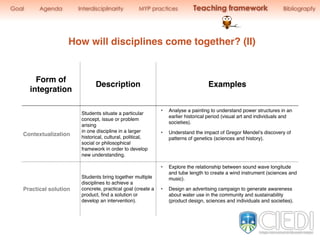
Form of
integration
Description Examples
Contextualization
Students situate a particular
concept, issue or problem
arising

in one discipline in a larger
historical, cultural, political,
social or philosophical
framework in order to develop
new understanding.
• Analyse a painting to understand power structures in an
earlier historical period (visual art and individuals and
societies).
• Understand the impact of Gregor Mendel’s discovery of
patterns of genetics (sciences and history).
Practical solution
Students bring together multiple
disciplines to achieve a
concrete, practical goal (create a
product, find a solution or
develop an intervention).
• Explore the relationship between sound wave longitude
and tube length to create a wind instrument (sciences and
music).
• Design an advertising campaign to generate awareness
about water use in the community and sustainability
(product design, sciences and individuals and societies).
Goal Agenda Interdisciplinarity MYP practices Teaching framework Bibliograpfy
How will disciplines come together? (II)
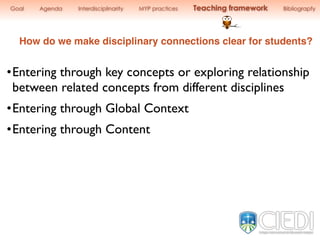
How do we make disciplinary connections clear for students?
Goal Agenda Interdisciplinarity MYP practices Teaching framework Bibliograpfy
•Entering through key concepts or exploring relationship
between related concepts from different disciplines
•Entering through Global Context
•Entering through Content
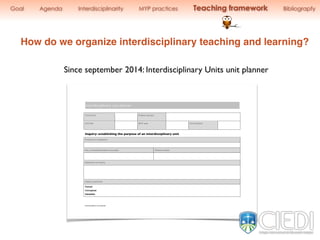
Since september 2014: Interdisciplinary Units unit planner
Interdisciplinary.unit.planner.
Interdisciplinary unit planner
Teacher(s) Subject groups
Unit title MYP year Unit duration
Inquiry: establishing the purpose of an interdisciplinary unit
Purpose of integration
Key concept(s)/(related concepts) Global context
Statement of inquiry
Inquiry questions
Factual
Conceptual
Debatable
How do we organize interdisciplinary teaching and learning?
Goal Agenda Interdisciplinarity MYP practices Teaching framework Bibliograpfy
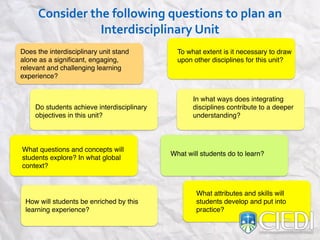
Consider#the#following#questions#to#plan#an#
Interdisciplinary#Unit
Does the interdisciplinary unit stand
alone as a significant, engaging,
relevant and challenging learning
experience?
What attributes and skills will
students develop and put into
practice?
To what extent is it necessary to draw
upon other disciplines for this unit?
In what ways does integrating
disciplines contribute to a deeper
understanding?
Do students achieve interdisciplinary
objectives in this unit?
What questions and concepts will
students explore? In what global
context?
How will students be enriched by this
learning experience?
What will students do to learn?
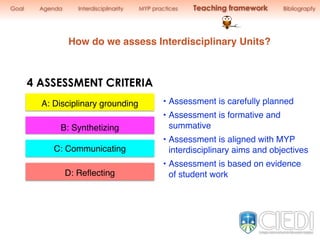
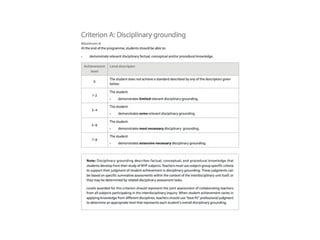
A: Disciplinary grounding
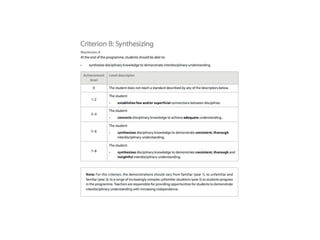
B: Synthetizing
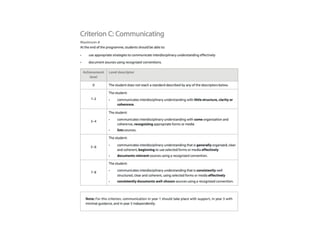
C: Communicating
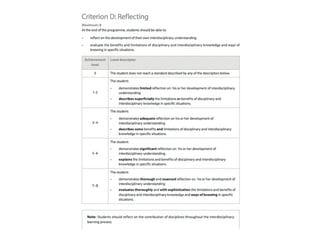
D: Reflecting
4 ASSESSMENT CRITERIA
• Assessment is carefully planned
• Assessment is formative and
summative
• Assessment is aligned with MYP
interdisciplinary aims and objectives
• Assessment is based on evidence
of student work
Goal Agenda Interdisciplinarity MYP practices Teaching framework Bibliograpfy
How do we assess Interdisciplinary Units?
Importance to create regular opportunities for
reflection on the unit, including important milestones
in its teaching!
Importance of work collaboratively to evaluate
student achievement!
Goal Agenda Interdisciplinarity MYP practices Teaching framework Bibliograpfy
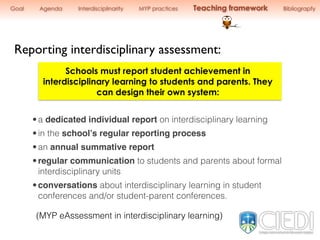
Schools must report student achievement in
interdisciplinary learning to students and parents. They
can design their own system:
Reporting interdisciplinary assessment:
•a dedicated individual report on interdisciplinary learning
•in the school’s regular reporting process
•an annual summative report
•regular communication to students and parents about formal
interdisciplinary units
•conversations about interdisciplinary learning in student
conferences and/or student-parent conferences.
(MYP eAssessment in interdisciplinary learning)
Goal Agenda Interdisciplinarity MYP practices Teaching framework Bibliograpfy
Quiz!!!!!!
http://goo.gl/zKuGH7
Goal Agenda Interdisciplinarity MYP practices Teaching framework Bibliograpfy
Bibliography
Boix-Mansilla, V. (2010). MYP guide to interdisciplinary
teaching and learning. IB Publishing.
International Baccalaureate (2014). Fostering interdisciplinary
teaching and learning in the MYP. IB Publishing.
International Baccalaureate (2014). Interdisciplinary Unit
Planner. IB Publishing.
Interdisciplinary Projects forum in MYP coordinators, forum,
keyword “interdisciplinary” http://occ.ibo.org/ibis/occ/fusetalk2/
forum/searchresults.cfm
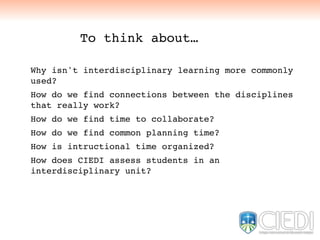
Why isn't interdisciplinary learning more commonly
used?
How do we find connections between the disciplines
that really work?
How do we find time to collaborate?
How do we find common planning time?
How is intructional time organized?
How does CIEDI assess students in an
interdisciplinary unit?
To think about…
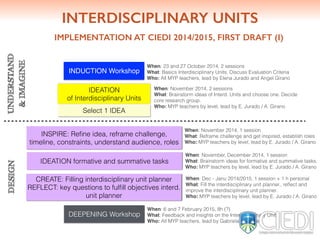
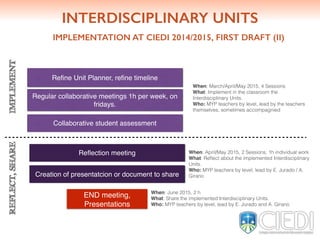
INTERDISCIPLINARY UNITS
IMPLEMENTATION AT CIEDI 2014/2015, FIRST DRAFT (I)
INDUCTION Workshop
IDEATION
of Interdisciplinary Units
When: 23 and 27 October 2014, 2 sessions
What: Basics Interdisciplinary Units, Discuss Evaluation Criteria
Who: All MYP teachers, lead by Elena Jurado and Angel Girano
Select 1 IDEA
INSPIRE: Refine idea, reframe challenge,
timeline, constraints, understand audience, roles
IDEATION formative and summative tasks
CREATE: Filling interdisciplinary unit planner
REFLECT: key questions to fulfill objectives interd.
unit planner
DEEPENING Workshop
DESIGN
When: 6 and 7 February 2015, 8h (?)
What: Feedback and insights on the Interdisciplinary Units
Who: All MYP teachers, lead by Gabriela Gonzalez
When: November 2014, 2 sessions
What: Brainstorm ideas of Interd. Units and choose one. Decide
core research group.
Who: MYP teachers by level, lead by E. Jurado / A. Girano
When: November 2014, 1 session
What: Reframe challenge and get inspired, establish roles
Who: MYP teachers by level, lead by E. Jurado / A. Girano
When: November, December 2014, 1 session
What: Brainstorm ideas for formative and summative tasks.
Who: MYP teachers by level, lead by E. Jurado / A. Girano
When: Dec - Janu 2014/2015, 1 session + 1 h personal
What: Fill the interdisciplinary unit planner., reflect and
improve the interdisciplinary unit planner.
Who: MYP teachers by level, lead by E. Jurado / A. Girano
UNDERSTAND
&IMAGINE
Regular collaborative meetings 1h per week, on
fridays.
Collaborative student assessment
Refine Unit Planner, refine timeline
END meeting,
Presentations
IMPLEMENTREFLECT,SHARE
Reflection meeting
Creation of presentatcion or document to share
When: March/April/May 2015, 4 Sessions
What: Implement in the classroom the
Interdisciplinary Units.
Who: MYP teachers by level, lead by the teachers
themselves, sometimes accompagnied
When: April/May 2015, 2 Sessions, 1h individual work
What: Reflect about the implemented Interdisciplinary
Units.
Who: MYP teachers by level, lead by E. Jurado / A.
Girano
When: June 2015, 2 h
What: Share the implemented Interdisciplinary Units.
Who: MYP teachers by level, lead by E. Jurado and A. Girano
INTERDISCIPLINARY UNITS
IMPLEMENTATION AT CIEDI 2014/2015, FIRST DRAFT (II)
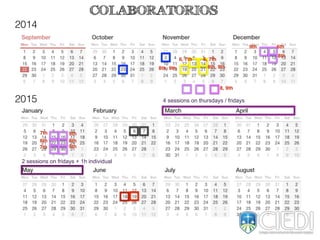
2014
2015
6, 7th
8th, 9th 8th, 9th
9th 6th
8th
8th
9th
6th
7th
7th 9th
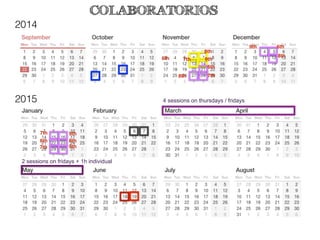
4 sessions on thursdays / fridays
2 sessions on fridays + 1h individual
8, 9th
COLABORATORIOS
6, 7th
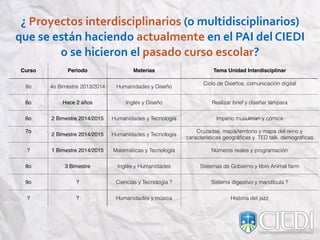
¿#Proyectos#interdisciplinarios#(o#multidisciplinarios)#
que#se#están#haciendo#actualmente#en#el#PAI#del#CIEDI#
o#se#hicieron#el#pasado#curso#escolar?
Curso Periodo Materias Tema Unidad Interdisciplinar
8o 4o Bimestre 2013/2014 Humanidades y Diseño
Ciclo de Diseños, comunicación digital
6o Hace 2 años Inglés y Diseño Realizar brief y diseñar lámpara
6o 2 Bimestre 2014/2015 Humanidades y Tecnología Imperio musulman y cómics
7o
2 Bimestre 2014/2015 Humanidades y Tecnología
Cruzadas, mapa/territorio y mapa del reino y
características geográficas y TED talk. demográficas
? 1 Bimestre 2014/2015 Matemáticas y Tecnología Números reales y programación
8o 3 Bimestre Inglés y Humanidades Sistemas de Gobierno y libro Animal farm
9o ? Ciencias y Tecnología ? Sistema digestivo y mandíbula ?
? ? Humanidades y música Historia del jazz
Preguntas, preguntas, preguntas…
OtrosEvaluaciónEnseñanzaPlaneación
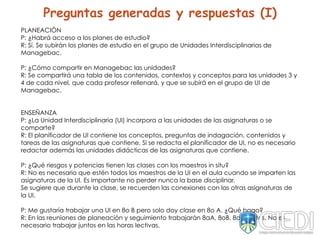
PLANEACIÓN
P: ¿Habrá acceso a los planes de estudio?
R: Sí. Se subirán los planes de estudio en el grupo de Unidades Interdisciplinarias de
Managebac.
P: ¿Cómo compartir en Managebac las unidades?
R: Se compartirá una tabla de los contenidos, contextos y conceptos para las unidades 3 y
4 de cada nivel, que cada profesor rellenará, y que se subirá en el grupo de UI de
Managebac.
ENSEÑANZA
P: ¿La Unidad Interdisciplinaria (UI) incorpora a las unidades de las asignaturas o se
comparte?
R: El planificador de UI contiene los conceptos, preguntas de indagación, contenidos y
tareas de las asignaturas que contiene, Si se redacta el planificador de UI, no es necesario
redactar además las unidades didácticas de las asignaturas que contiene.
P: ¿Qué riesgos y potencias tienen las clases con los maestros in situ?
R: No es necesario que estén todos los maestros de la UI en el aula cuando se imparten las
asignaturas de la UI. Es importante no perder nunca la base disciplinar.
Se sugiere que durante la clase, se recuerden las conexiones con las otras asignaturas de
la UI.
P: Me gustaría trabajar una UI en 8o B pero solo doy clase en 8o A. ¿Qué hago?
R: En las reuniones de planeación y seguimiento trabajarán 8aA, 8oB, 8oC juntos. No es
necesario trabajar juntos en las horas lectivas.
Preguntas generadas y respuestas (I)
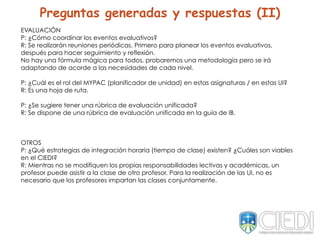
EVALUACIÓN
P: ¿Cómo coordinar los eventos evaluativos?
R: Se realizarán reuniones periódicas. Primero para planear los eventos evaluativos,
después para hacer seguimiento y reflexión.
No hay una fórmula mágica para todos, probaremos una metodología pero se irá
adaptando de acorde a las necesidades de cada nivel.
P: ¿Cuál es el rol del MYPAC (planificador de unidad) en estas asignaturas / en estas UI?
R: Es una hoja de ruta.
P: ¿Se sugiere tener una rúbrica de evaluación unificada?
R: Se dispone de una rúbrica de evaluación unificada en la guía de IB.
OTROS
P: ¿Qué estrategias de integración horaria (tiempo de clase) existen? ¿Cuáles son viables
en el CIEDI?
R: Mientras no se modifiquen los propias responsabilidades lectivas y académicas, un
profesor puede asistir a la clase de otro profesor. Para la realización de las UI, no es
necesario que los profesores impartan las clases conjuntamente.
Preguntas generadas y respuestas (II)
Video 6 blind man http://www.youtube.com/watch?
v=iBqgr5xZLz0
TED talk Jean Baptiste Michel http://www.ted.com/talks/
jean_baptiste_michel_the_mathematics_of_history#
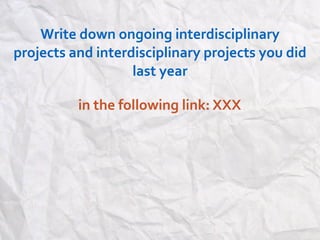
Write#down#ongoing#interdisciplinary#
projects#and#interdisciplinary#projects#you#did#
last#year
in#the#following#link:#XXX
Colaboratorio
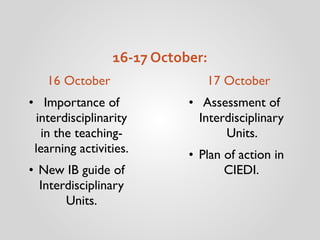
16S17#October:
• Importance of
interdisciplinarity
in the teaching-
learning activities.
• New IB guide of
Interdisciplinary
Units.
• Assessment of
Interdisciplinary
Units.
• Plan of action in
CIEDI.
16 October 17 October
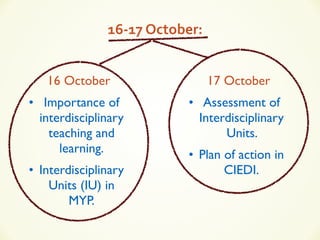
16S17#October:
• Importance of
interdisciplinary
teaching and
learning.
• Interdisciplinary
Units (IU) in
MYP.
• Assessment of
Interdisciplinary
Units.
• Plan of action in
CIEDI.
16 October 17 October
2014
2015
8th
6th 7th
8th
6th
7th
9th 6th
8th
8th
9th
6th
7th
7th 9th
4 sessions on thursdays / fridays
2 sessions on fridays + 1h individual
9th
COLABORATORIOS

Workshop Interdisciplinar 23oct4nov 2014 CIEDI

  • 1.
    Workshop Interdisciplinary Units CIEDI- 23 October and 5 November 2014 Elena Jurado, Ángel Girano !
  • 2.
    Goal: To developrich, effective and authentic interdisciplinary units in MYP CIEDI ‣ What is interdisciplinarity and why it is important in teaching and learning? ‣ To interiorise what the IB says about Interdisciplinary Units. ‣ To develop a methodology to make interdisciplinarity real in MYP at CIEDI ‣ To join the Interdisciplinary Units group in Managebac ‣ To create a core research group of interdisciplinarity (innovative practices? assessment? markers to measure the impact at CIEDI? foster collaboration and entrepeneurship?) Subgoals: Goal Agenda Interdisciplinarity MYP practices Teaching framework Bibliograpfy
  • 3.
    23#October,#5#November: • Importance of interdisciplinary teachingand learning • Interdisciplinary Units (IU) in MYP • Plan of action in CIEDI 23 October 5 November Goal Agenda Interdisciplinarity MYP practices Teaching framework Bibliograpfy
  • 4.
    - Milestones: - 23October and 5 November 2014 “Induction Workshop” of Interdisciplinary Units, lead by Elena Jurado and Angel Girano. - 6 and 7 February 2015 “Deepening Workshop” of Interdisciplinary Units, lead by Gabriela Gonzalez. - The 31 January 2014 we aim to have 4 Interdisciplinary Units well defined and partially designed, one for each level of MYP, and each unit involving 2 or 3 disciplines. Those Interdisciplinary Units will be taught during march-may 2015. Milestones Goal Agenda Interdisciplinarity MYP practices Teaching framework Bibliograpfy - Regular check-ins on thursdays (3:30 - 4:30 pm) and/or fridays (7 - 8 am) and/or mondays (7-8 am) IB Americas Chicago 26-27 July Publication: Jeff Thompson Research Award??
  • 5.
  • 6.
    Multidisciplinary Working with multiple disciplines,maintaining boundaries. Interdisciplinary Working between more than one discipline, blurring boundaries. Interaction among disciplines to achieve new, integrated understanding. Transdisciplinary Working across and beyond disciplines, eliminating boundaries. Not grounded in disciplinary knowledge. Goal Agenda Interdisciplinarity MYP practices Teaching framework Bibliograpfy
  • 7.
    Frijoles en bolitasde algodón www.carolinamillas.com
  • 8.
    “Interdisciplinary understanding refersto the ability to integrate knowledge and modes of thinking from two or more disciplines to generate a new insight’... new understanding’ … ‘it does not replace disciplinary teaching, rather it builds on it..” Veronica Boix Mansilla, Harvard Project Zero “Interdisciplinarity is excellent if it is firmly rooted in disciplinarity. Each subject is not an end in itself but it must be an efficient tool. We must keep its identity and especially its own methodology. Only on that basis will we be able to construct a serious interdisciplinarity. Other wise we will lead our students to mental confusion and superficial surveys.” Gérard Renaud, 1989 (IB General Director 1977-1983) Goal Agenda Interdisciplinarity MYP practices Teaching framework Bibliograpfy
  • 9.
    Interdisciplinary understanding is: ‣Purposeful ‣ Grounded in disciplines ‣ Integrative Goal Agenda Interdisciplinarity MYP practices Teaching framework Bibliograpfy
  • 10.
  • 11.
    Why is interdisciplinarityimportant in education? Because it helps students to: • Develop a holistic view of concepts and issues. • Become life-long learners and problem solvers. • Gain an intellectually rigorous view of knowledge. • Understand the importance of collaboration and teamwork across disciplines. • Understand and address complex global issues. Because it helps teachers to: • Develop holistic understanding of disciplinary concepts and contexts. • Increase collaboration across subject groups. • Allow subject groups to share responsibility for developing content and skills. Goal Agenda Interdisciplinarity MYP practices Teaching framework Bibliograpfy
  • 12.
    International Baccalaureate (2014).Fostering interdisciplinary teaching and learning in the MYP. IB Publishing Goal Agenda Interdisciplinarity MYP practices Teaching framework Bibliograpfy
  • 13.
    “In each yearof the programme, MYP schools are responsible of engaging students in at least one collaboratively planned interdisciplinary unit that involves at least two subject groups.” Goal Agenda Interdisciplinarity MYP practices Teaching framework Bibliograpfy International Baccalaureate (2014). Fostering interdisciplinary teaching and learning in the MYP. IB Publishing
  • 14.
    Disciplinary grounding Synthetizing Communicating Reflecting Objectives ofMYP interdisciplinary units In each year of the programme, schools must address all four objectives of interdisciplinary learning. Goal Agenda Interdisciplinarity MYP practices Teaching framework Bibliograpfy
  • 15.
    Example: “The soundof music” The International School of Uganda ‣MYP 2 ‣Physics and music ‣ What will students do to learn? ‣ Create an orchestra of traditional instruments and compose and perform a rhythmic piece for their school. ‣ What disciplinary tools will students need? • Study the physics of sound waves. • Understand how instruments work to make sound and music. • Create a compelling musical experience for their audience. Goal Agenda Interdisciplinarity MYP practices Teaching framework Bibliograpfy Millorar amb les transparencias de Interdisciplinariedad en el PAI pptx!!!!
  • 16.
    Unit question: “Howdo musical instruments produce sound to create interesting experiences? The$Sound$of$Music (The$International$School$of$Uganda)*9 Goal Agenda Interdisciplinarity MYP practices Teaching framework Bibliograpfy
  • 17.
    Purposeful: clear aim,compelling topic, enriched student understanding of local culture Grounded in disciplines: Physics & Music Integrative: students understood the science of sound to explain how instruments make music, students understood new musical possibilities enabled by novel sounds. Three qualities of interdisciplinary understanding in the context of this example Goal Agenda Interdisciplinarity MYP practices Teaching framework Bibliograpfy
  • 18.
    How will disciplinescome together? How do we make disciplinary connections clear for students? How do we organize interdisciplinary teaching and learning? Goal Agenda Interdisciplinarity MYP practices Teaching framework Bibliograpfy How do we assess interdisciplinary units? INTERDISCIPLINARY TEACHING FRAMEWORK INTERDISCIPLINARY UNDERSTANDING purposeful, disciplined, integrative
  • 19.
    How will disciplinescome together? (I) Form of integration Description Examples Aesthetic or literary synthesis Students create an aesthetic or literary interpretation of a non- artistic or non-literary topic or issue. • Create a mask with a computer program to learn geometric concepts (mathematics and visual art). • Create a work of art with recycled material (visual art and individuals and societies). Personal expression Students develop a nuanced and personally meaningful way to express a concept, • Choreograph what it means to be free (physical and health education, dance and civics). • Compose a song about gender stereotypes (language, music). Cross-over tooling Students learn a skill or concept that can be used in multiple disciplines and apply it to understand a new issue or problem. • Follow the design cycle (design) to create a bilingual brochure that fosters intercultural understanding
 in the community (design, language acquisition). • Implement observational techniques (arts) to analyse living organisms (arts and sciences). Complex explanation Students draw on expertise from more than one discipline to develop a more complete or complex understanding of a phenomenon. • Understand the causes of contamination of a local body of water (biology, chemistry, economics and geography). . Goal Agenda Interdisciplinarity MYP practices Teaching framework Bibliograpfy
  • 20.
    Form of integration Description Examples Contextualization Studentssituate a particular concept, issue or problem arising
 in one discipline in a larger historical, cultural, political, social or philosophical framework in order to develop new understanding. • Analyse a painting to understand power structures in an earlier historical period (visual art and individuals and societies). • Understand the impact of Gregor Mendel’s discovery of patterns of genetics (sciences and history). Practical solution Students bring together multiple disciplines to achieve a concrete, practical goal (create a product, find a solution or develop an intervention). • Explore the relationship between sound wave longitude and tube length to create a wind instrument (sciences and music). • Design an advertising campaign to generate awareness about water use in the community and sustainability (product design, sciences and individuals and societies). Goal Agenda Interdisciplinarity MYP practices Teaching framework Bibliograpfy How will disciplines come together? (II)
  • 21.
    How do wemake disciplinary connections clear for students? Goal Agenda Interdisciplinarity MYP practices Teaching framework Bibliograpfy •Entering through key concepts or exploring relationship between related concepts from different disciplines •Entering through Global Context •Entering through Content
  • 22.
    Since september 2014:Interdisciplinary Units unit planner Interdisciplinary.unit.planner. Interdisciplinary unit planner Teacher(s) Subject groups Unit title MYP year Unit duration Inquiry: establishing the purpose of an interdisciplinary unit Purpose of integration Key concept(s)/(related concepts) Global context Statement of inquiry Inquiry questions Factual Conceptual Debatable How do we organize interdisciplinary teaching and learning? Goal Agenda Interdisciplinarity MYP practices Teaching framework Bibliograpfy
  • 23.
    Consider#the#following#questions#to#plan#an# Interdisciplinary#Unit Does the interdisciplinaryunit stand alone as a significant, engaging, relevant and challenging learning experience? What attributes and skills will students develop and put into practice? To what extent is it necessary to draw upon other disciplines for this unit? In what ways does integrating disciplines contribute to a deeper understanding? Do students achieve interdisciplinary objectives in this unit? What questions and concepts will students explore? In what global context? How will students be enriched by this learning experience? What will students do to learn?
  • 24.
    A: Disciplinary grounding B:Synthetizing C: Communicating D: Reflecting 4 ASSESSMENT CRITERIA • Assessment is carefully planned • Assessment is formative and summative • Assessment is aligned with MYP interdisciplinary aims and objectives • Assessment is based on evidence of student work Goal Agenda Interdisciplinarity MYP practices Teaching framework Bibliograpfy How do we assess Interdisciplinary Units?
  • 25.
    Importance to createregular opportunities for reflection on the unit, including important milestones in its teaching! Importance of work collaboratively to evaluate student achievement! Goal Agenda Interdisciplinarity MYP practices Teaching framework Bibliograpfy
  • 26.
    Schools must reportstudent achievement in interdisciplinary learning to students and parents. They can design their own system: Reporting interdisciplinary assessment: •a dedicated individual report on interdisciplinary learning •in the school’s regular reporting process •an annual summative report •regular communication to students and parents about formal interdisciplinary units •conversations about interdisciplinary learning in student conferences and/or student-parent conferences. (MYP eAssessment in interdisciplinary learning) Goal Agenda Interdisciplinarity MYP practices Teaching framework Bibliograpfy
  • 27.
  • 28.
    Goal Agenda InterdisciplinarityMYP practices Teaching framework Bibliograpfy Bibliography Boix-Mansilla, V. (2010). MYP guide to interdisciplinary teaching and learning. IB Publishing. International Baccalaureate (2014). Fostering interdisciplinary teaching and learning in the MYP. IB Publishing. International Baccalaureate (2014). Interdisciplinary Unit Planner. IB Publishing. Interdisciplinary Projects forum in MYP coordinators, forum, keyword “interdisciplinary” http://occ.ibo.org/ibis/occ/fusetalk2/ forum/searchresults.cfm
  • 29.
    Why isn't interdisciplinarylearning more commonly used? How do we find connections between the disciplines that really work? How do we find time to collaborate? How do we find common planning time? How is intructional time organized? How does CIEDI assess students in an interdisciplinary unit? To think about…
  • 30.
    INTERDISCIPLINARY UNITS IMPLEMENTATION ATCIEDI 2014/2015, FIRST DRAFT (I) INDUCTION Workshop IDEATION of Interdisciplinary Units When: 23 and 27 October 2014, 2 sessions What: Basics Interdisciplinary Units, Discuss Evaluation Criteria Who: All MYP teachers, lead by Elena Jurado and Angel Girano Select 1 IDEA INSPIRE: Refine idea, reframe challenge, timeline, constraints, understand audience, roles IDEATION formative and summative tasks CREATE: Filling interdisciplinary unit planner REFLECT: key questions to fulfill objectives interd. unit planner DEEPENING Workshop DESIGN When: 6 and 7 February 2015, 8h (?) What: Feedback and insights on the Interdisciplinary Units Who: All MYP teachers, lead by Gabriela Gonzalez When: November 2014, 2 sessions What: Brainstorm ideas of Interd. Units and choose one. Decide core research group. Who: MYP teachers by level, lead by E. Jurado / A. Girano When: November 2014, 1 session What: Reframe challenge and get inspired, establish roles Who: MYP teachers by level, lead by E. Jurado / A. Girano When: November, December 2014, 1 session What: Brainstorm ideas for formative and summative tasks. Who: MYP teachers by level, lead by E. Jurado / A. Girano When: Dec - Janu 2014/2015, 1 session + 1 h personal What: Fill the interdisciplinary unit planner., reflect and improve the interdisciplinary unit planner. Who: MYP teachers by level, lead by E. Jurado / A. Girano UNDERSTAND &IMAGINE
  • 31.
    Regular collaborative meetings1h per week, on fridays. Collaborative student assessment Refine Unit Planner, refine timeline END meeting, Presentations IMPLEMENTREFLECT,SHARE Reflection meeting Creation of presentatcion or document to share When: March/April/May 2015, 4 Sessions What: Implement in the classroom the Interdisciplinary Units. Who: MYP teachers by level, lead by the teachers themselves, sometimes accompagnied When: April/May 2015, 2 Sessions, 1h individual work What: Reflect about the implemented Interdisciplinary Units. Who: MYP teachers by level, lead by E. Jurado / A. Girano When: June 2015, 2 h What: Share the implemented Interdisciplinary Units. Who: MYP teachers by level, lead by E. Jurado and A. Girano INTERDISCIPLINARY UNITS IMPLEMENTATION AT CIEDI 2014/2015, FIRST DRAFT (II)
  • 32.
    2014 2015 6, 7th 8th, 9th8th, 9th 9th 6th 8th 8th 9th 6th 7th 7th 9th 4 sessions on thursdays / fridays 2 sessions on fridays + 1h individual 8, 9th COLABORATORIOS 6, 7th
  • 33.
    ¿#Proyectos#interdisciplinarios#(o#multidisciplinarios)# que#se#están#haciendo#actualmente#en#el#PAI#del#CIEDI# o#se#hicieron#el#pasado#curso#escolar? Curso Periodo MateriasTema Unidad Interdisciplinar 8o 4o Bimestre 2013/2014 Humanidades y Diseño Ciclo de Diseños, comunicación digital 6o Hace 2 años Inglés y Diseño Realizar brief y diseñar lámpara 6o 2 Bimestre 2014/2015 Humanidades y Tecnología Imperio musulman y cómics 7o 2 Bimestre 2014/2015 Humanidades y Tecnología Cruzadas, mapa/territorio y mapa del reino y características geográficas y TED talk. demográficas ? 1 Bimestre 2014/2015 Matemáticas y Tecnología Números reales y programación 8o 3 Bimestre Inglés y Humanidades Sistemas de Gobierno y libro Animal farm 9o ? Ciencias y Tecnología ? Sistema digestivo y mandíbula ? ? ? Humanidades y música Historia del jazz
  • 34.
  • 35.
    PLANEACIÓN P: ¿Habrá accesoa los planes de estudio? R: Sí. Se subirán los planes de estudio en el grupo de Unidades Interdisciplinarias de Managebac. P: ¿Cómo compartir en Managebac las unidades? R: Se compartirá una tabla de los contenidos, contextos y conceptos para las unidades 3 y 4 de cada nivel, que cada profesor rellenará, y que se subirá en el grupo de UI de Managebac. ENSEÑANZA P: ¿La Unidad Interdisciplinaria (UI) incorpora a las unidades de las asignaturas o se comparte? R: El planificador de UI contiene los conceptos, preguntas de indagación, contenidos y tareas de las asignaturas que contiene, Si se redacta el planificador de UI, no es necesario redactar además las unidades didácticas de las asignaturas que contiene. P: ¿Qué riesgos y potencias tienen las clases con los maestros in situ? R: No es necesario que estén todos los maestros de la UI en el aula cuando se imparten las asignaturas de la UI. Es importante no perder nunca la base disciplinar. Se sugiere que durante la clase, se recuerden las conexiones con las otras asignaturas de la UI. P: Me gustaría trabajar una UI en 8o B pero solo doy clase en 8o A. ¿Qué hago? R: En las reuniones de planeación y seguimiento trabajarán 8aA, 8oB, 8oC juntos. No es necesario trabajar juntos en las horas lectivas. Preguntas generadas y respuestas (I)
  • 36.
    EVALUACIÓN P: ¿Cómo coordinarlos eventos evaluativos? R: Se realizarán reuniones periódicas. Primero para planear los eventos evaluativos, después para hacer seguimiento y reflexión. No hay una fórmula mágica para todos, probaremos una metodología pero se irá adaptando de acorde a las necesidades de cada nivel. P: ¿Cuál es el rol del MYPAC (planificador de unidad) en estas asignaturas / en estas UI? R: Es una hoja de ruta. P: ¿Se sugiere tener una rúbrica de evaluación unificada? R: Se dispone de una rúbrica de evaluación unificada en la guía de IB. OTROS P: ¿Qué estrategias de integración horaria (tiempo de clase) existen? ¿Cuáles son viables en el CIEDI? R: Mientras no se modifiquen los propias responsabilidades lectivas y académicas, un profesor puede asistir a la clase de otro profesor. Para la realización de las UI, no es necesario que los profesores impartan las clases conjuntamente. Preguntas generadas y respuestas (II)
  • 38.
    Video 6 blindman http://www.youtube.com/watch? v=iBqgr5xZLz0 TED talk Jean Baptiste Michel http://www.ted.com/talks/ jean_baptiste_michel_the_mathematics_of_history#
  • 43.
  • 44.
  • 45.
    16S17#October: • Importance of interdisciplinarity inthe teaching- learning activities. • New IB guide of Interdisciplinary Units. • Assessment of Interdisciplinary Units. • Plan of action in CIEDI. 16 October 17 October
  • 46.
    16S17#October: • Importance of interdisciplinary teachingand learning. • Interdisciplinary Units (IU) in MYP. • Assessment of Interdisciplinary Units. • Plan of action in CIEDI. 16 October 17 October
  • 47.
    2014 2015 8th 6th 7th 8th 6th 7th 9th 6th 8th 8th 9th 6th 7th 7th9th 4 sessions on thursdays / fridays 2 sessions on fridays + 1h individual 9th COLABORATORIOS